The Hole
East Village, New York, NY
312 Bowery
The Hole is a contemporary art gallery run by Kathy Grayson. Opened in July of 2010, The Hole presents monthly solo and group exhibitions with a focus on emerging art and thematic group shows. The gallery represents 25 artists and has shown hundreds more across three locations: Bowery and Tribeca in New York, and Los Angeles. The space hosts performances, events, and special projects that support artistic collaboration and the downtown art community.
Sign in to save this gallery, log a visit, or add a show to a shared list.
Exhibitions
- On viewGlass Class
May 9 – Jun 15
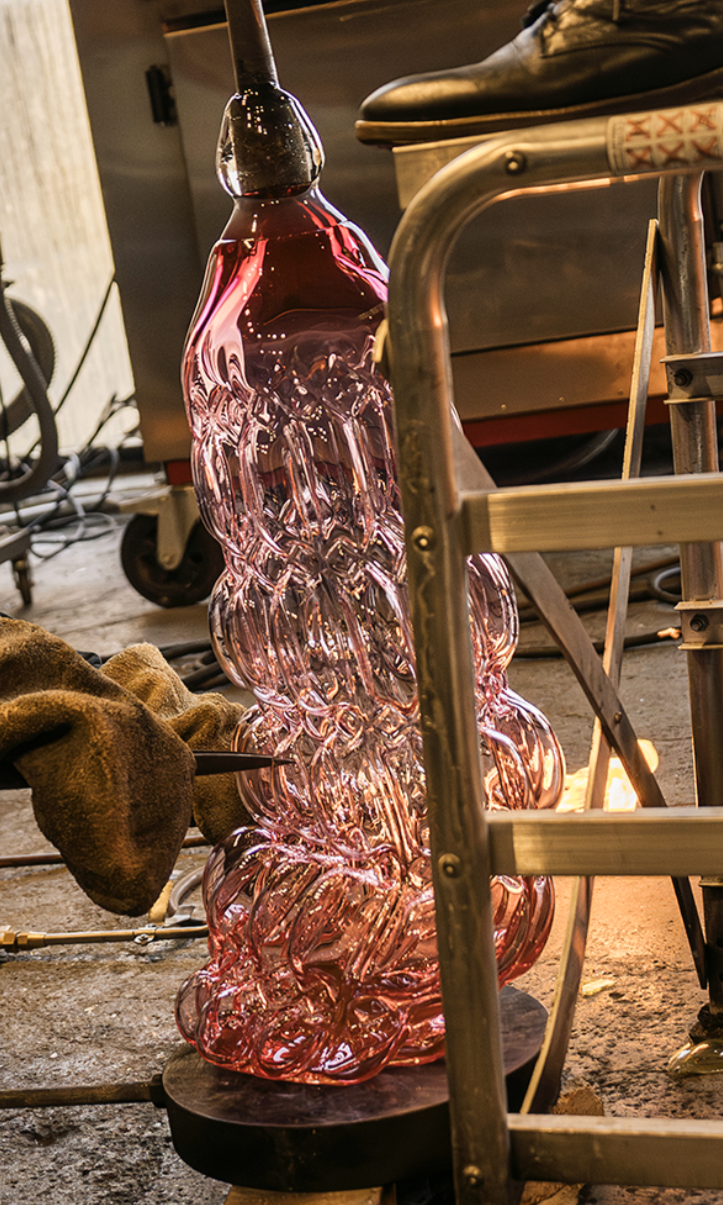
Akeylah Washington, Anthony Coleman, Barry McGee, Cody Hoyt, Deborah Czeresko, Elliott Todd, Eric Sullivan, Grace Horan, Hanna Hansdotter, Henry Baumann, Henry Richardson, Jessica Tsai, Jillian Mayer, James Bouché, Jonny Campolo, Kelly Witmer, Klaus Moje, Matt Eskuche, Matthew Palladino, Maxwell Jacobs (Kinda), Mike Raman, Ryan Jenkins, Shingo Yamazaki, Thaddeus Wolfe, Tom Fruin The Hole is pleased to present Glass Class, a group show focusing on the medium of glass curated by glass artist and collector, Eric Sullivan. From flameworked glass to kiln forming, casting to microwaved borosilicate, paintings and paraphernalia, Glass Class showcases glass in all its endless potential. Incorporating plexiglass, fiberglass, resin and paint, there are works depicting glass and works exploring the various properties of glass in other media. This exhibition continues our tradition of medium-specific survey shows from Clay Today (2018) to Not a Photo (2015) to Thread Count (2025). Including works by both established and emerging artists from the late Klaus Moje (1936-2016), one of the most significant innovators in the medium to Hannah Hansdotter (above) whose rebellious vessels remain defiantly craft-oriented in their techniques, our most fragile group show to date gives you the best of glass today and a crash course on the medium. During the run of the show we will host a variety of workshops and events to include the public in learning about and experimenting with glass—stay tuned!
 On viewMicrowave Memories
Eric Sullivan
May 9 – Jun 15
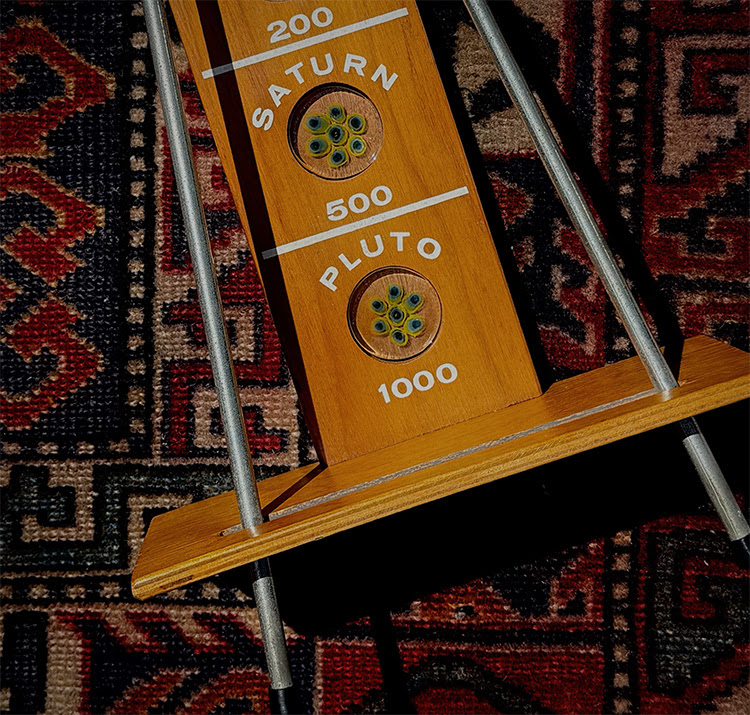
In this special show in our rear gallery, Eric Sullivan explores the quiet pull of nostalgia—how moments, places, and emotions linger not as fixed images, but as shifting impressions shaped by time. Through an interplay of glass, wood, and found objects, Sullivan aims to conjure these memories. Central to Sullivan’s practice is the juxtaposition of texture and color. Glass, polished to pristine, sits in dialogue with the weathered grain of wood and the irregular surfaces of reclaimed materials. His use of microwave fused glass, both carefully crafted and deliberately imperfect, reflects a desire to balance control with spontaneity, echoing the way memory itself is both constructed and distorted. A key material in this body of work, microwave-fused borosilicate glass, is made through a process that allows Sullivan to manipulate durability and fragility simultaneously. The resulting forms carry a distinctive, imperfect distortion, evidence of the unique transformation shaped by uncontrollable microwave radiation. Found objects play a crucial role in Sullivan’s process. He seeks out materials that bear traces of previous lives—fragments that suggest use, history, and human presence. By integrating these elements with glass forms made with intention, he bridges the gap between the past and the present, allowing each piece to function as a vessel. The artworks in this show use repetition as a means of accessing memory—a conceptual thread informed by the work of artist Elaine Sturtevant. Sturtevant’s exploration of memory was central to her process; she became known for recreating works by other artists from memory, working “in the style of another artist” while subtly altering their material and presence. Her repetitions were never exact copies, but acts of recall—filtered and imperfect, transformed through perception and time. In his newest works, Sturtevant herself becomes the subject, as Sullivan reinterprets her legacy through his own material language. By translating her ideas into compositions of glass, paint, and wood, he both honors and disrupts her process, redirecting the act of repetition back onto its source. In doing so, Sullivan creates a layered dialogue about authorship, memory, and transformation—one that underscores how even the act of remembering another artist’s work becomes an original gesture in itself. The works invite a kind of quiet reflection, encouraging an awareness of how personal histories attach themselves to the physical world. Through this fusion of material exploration and emotional resonance, Eric Sullivan offers a body of work that is both tactile and introspective—an invitation to consider how memory is held, altered, and preserved with the objects we encounter and keep.
 PastBirdbath
Julian MacMillan
Apr 2 – May 4
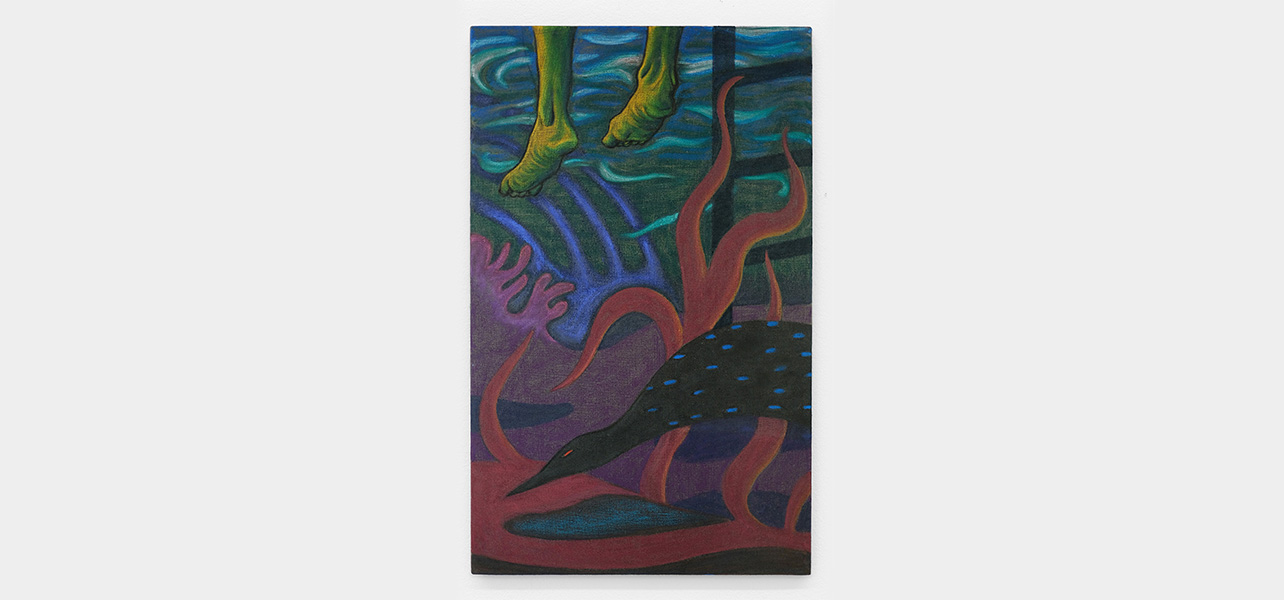
The Hole & Tombolo are pleased to present Birdbath, a solo exhibition by Julian MacMillan, the 2025-2026 Tombolo artist in residence. Across sixteen new paintings and sculptures, we see loons, swans, swirling eddies and dangling feet, rendered in the artist's signature graphic language. Above and below the water line, the works draw on the tradition of the landscape as idyll, played against a darker vision of the water’s surface as a boundary with the afterlife. While the artist has always held art-making to be fundamentally funerary, this body of work in particular looks to a tomb painting from antiquity, “The Tomb of The Diver” (circa 470 B.C.E.) a rare, intact example of Greek funerary fresco depicting a youth flinging himself off a rock into the water below. He is poised between two worlds; the earthly terrain of the above ground and the water rushing up to meet him, symbolizing the passage from life to death. Tomb Painting (Diver) depicts this reference most literally, with the diver's feet caught mid-air. Across all the paintings, we see this through-line expanded and remixed with striking narrative clarity—from steps in Supportive Smoker to a loon in a hellish-red underworld in Self-Discovery / Self-Improvement. The loon, which slips darkly and silently between these realms, enacts the vision of the psychopomp, a guide for the dead across the threshold from life to the afterlife, from the Greek for "soul conductor”. The loon motif is also a personal one for the artist, drawing on the mystery and mournfulness of the bird in the wild, where it’s known to disappear underwater for long periods. MacMillan spent months on a lake in Vermont during the pandemic where the first decoy was carved and birds began to migrate onto the canvas. There is a lightness of touch to the way the artist uses charcoal and oilstick which is in tension with the density of color and the darkness of the work’s themes. Painted on burlap and rough canvas, the darkly saturated grain of the fabric itself is gorgeously on view. Throughout the paintings MacMillan attends to the surface of the water, imagined as a permeable barrier between the known world and murkier, unknown realms. That fluid skin is perceived as both reflection and lens, a magnifying glass for our fears and desires. Surface Tension, swirls these boundaries, the diving loon displacing water, pouring pastel skies into underwater indigo. In Emerging Loon both diver and Loon come up for air, water rippling concentrically away from each. In the fully submerged Visitation, lightness and ladder elude to the world above but the direction of travel is unclear. In Tomb Painting (Bathtub), underground trees and caverns make reference to the regional and historical practice of dowsing—or water-witching—a means of divining the location of underground bodies of water through possibly magical means. In the center of the gallery, decoys flock around an eight-foot stainless steel birdbath. The decoy sculptures map the artist’s interest in design onto three dimensions, creating avatars whose hallucinatory plumage hints at the supernatural. (The avatar, from the Sanskrit avatāra ‘descent’, is defined as “a manifestation of a deity or released soul in bodily form on earth; an incarnate divine teacher.”) The hand-carved sculptures and metalwork highlight MacMillan’s sculptural prowess in a predominantly painting show. The decoys, their bases and the larger-than-life birdbath are all fabricated in Red Hook, Brooklyn at the artist’s studio and at Friendly Metals, the artist-run metal studio where he works. Julian MacMillan (b. 1992) lives and works in New York. Working across painting, printmaking and sculpture he creates work that resembles abstract portraits, anthropomorphic landscapes, and geometric studies. Through his multidisciplinary practice, which also spans carpentry and metalworking, MacMillan is able to combine and compress these genres, and make images that are both sensitive and other-worldly. Born and raised in Washington, D.C., MacMillan studied art at Dartmouth College prior to receiving his MFA in painting at Boston University. Recent exhibitions include Left Tower at Atlantic Mills (Providence, RI), Do It Again at East Manning Projects (Providence, RI), The View From Mars at Gallery 263 (Cambridge, MA) and Tell The Devil I'm Coming As Fast As I Can at Outlet Manhattan, New York, NY.
 PastNeon Moon
Apr 2 – May 4
Dan Attoe, Alison Blickle, Caitlin Cherry, Zbiok Czajkowski, Ben Godward, Alexis Mata, Nathan Ritterpusch, Michael Staniak, Eric Yahnker, Jon Young The Hole presents Neon Moon, a group exhibition staged as a nocturnal environment of charged color, artificial light and heightened atmosphere. We wanted to give Bowery a taste of key works from our Los Angeles program as that location fades into memory. Bringing together painting, neon, and sculpture, the show explores how images behave after dark when things take a turn towards the cinematic and melancholy. The exhibition takes its title from the 1992 Brooks & Dunn song “Neon Moon,” a meditation on loneliness and dive bar broken dreams under a neon sign. That tonal register carries through the works on view, where light is something felt, absorbed and held onto. Our goal is a distilled mood: night scenes, neon color, and a persistent tension between spectacle and solitude as we reflect on our time out West and the road ahead. Caitlin Cherry’s massive installation anchors the exhibition. Four canvases, stretched into a circular metal frame and mounted above eye level, form a continuous loop of Black pop cultural figures—femme entertainers and muses rendered in saturated color. The structure recalls a zoetrope, creating a sense of motion and surround. Eric Yahnker exhibits two panoramic drawings from his Lost Angeles suite of works that show a gorgeous L.A. skyline at night with a cowboy astride a Jeff Koons Balloon Dog. Dan Attoe’s two neons from his LA show light up our darkened galleries and draw you to their humming glow. They’ve attracted a Nathan Ritterspusch vintage cinematic cowboy and a “maenad of the Hollywood Hills” looking at her phone from Alison Blickle. They make the metal sheets of Caitlin shimmer and activate the upholstered iridescence of the Jon Young piece. A line of tiny club kid monsters by Zbiok Czajkowski lurk across the room. Michael Staniak exhibits painted bronzes that look like literal moon rocks, sprayed and dusty with neon, fragments from a different reality. A black resin flower by Ben Godward and two oil paintings of psychedelic cactus landscapes by Alexis Mata round out the group and if you’re picking up Western vibes, dark neon and lunar surfaces, that is indeed what we are putting down. Seeing these works here in New York in a new setting for a new and larger audience just might be buoyant enough to lift our melancholy mood.
 PastPrometheus and Pietà
Lee Gihun
Jan 24 – Mar 2
The Hole is pleased to present the New York debut of Korean artist Lee Gihun. The exhibition includes thirty-two new paintings and a live painting performance by the artist over opening weekend. Lee creates dark post-industrial landscapes populated by animals and hybrid beings, merging painting and drawing with acrylic and oil pastel on canvases (like the above) that reach up to ten feet in scale. The new paintings in this exhibition fall into two ongoing bodies of work. In the “Prometheus” series, figures carry fire through damaged landscapes. In the “Pietà” works, one figure cradles another in a pose borrowed from Christian iconography. Across both series, Lee balances melancholy with hope: his worlds are marked by power lines, factories, barbed wire and ruined architecture, yet the figures within them are active and cooperative, carrying and building together. Visually, the paintings recall the dark surrealism of Max Ernst and Yves Tanguy, but Lee consistently introduces light into these spaces. Sometimes this appears literally with flaming torches but just as often it comes through a playful or tender sensibility that he brings to his characters. Lee grew up in a rural village where two national parks coexisted with the country’s largest cement factory. Surrounded simultaneously by the grandeur of nature and the monumental machinery of industry, we see the paradoxical environment marked by abundance, wounds, rapid growth and inherent contradictions in the paintings. Lee’s technique is virtuosic but also displays a light touch: ocean spray, drifting smoke, or distant haze are rendered beautifully with remarkably few marks. The surfaces are not overworked: just enough is described to allow the world of each painting to cohere and breathe. Often presenting a live painting performance with his exhibitions, Lee considers them an essential element in his work: "When I do live painting, I usually work with music inspired by traditional Korean Pungmulnori, which is primarily percussion-based. Pungmulnori has traditionally been performed at festivals, ceremonial rituals, and communal gatherings—often as a way to celebrate, offer prayers, or dispel negative energy while wishing for peace and well-being. During live painting, the resonance created by the music connects closely with my performance, forming another layer of shared energy. At times it feels like a ritual, and at other times like a joyful celebration, where the rhythm gradually builds and the painting naturally comes into being. The energy of the music, the presence of the audience, and my act of painting come together as one unified work." It was the live painting performances that first caught my eye, and that point of connection is very contemporary. As visual culture shifts further from still images toward video—and as art circulates increasingly through screens, filtered by algorithms that also privilege video—it may no longer feel sufficient to produce a compelling static image. Attention now demands “activation”. While the problems with this shift are obvious, it is also worth considering what it can enable: painting does not have to remain a solitary, antisocial act. Painting in public, in real time, and in connection with others offers a different model. It pushes back against isolation and invites participation. At a moment when creativity is increasingly artificial and automated, watching something handmade unfold in front of you feels both human and necessary. Lee is technically skilled enough to open his process to viewers without diminishing the artwork, providing not just a point of entry for his work but into the world of creativity itself. Lee Gihun (b. 1980, South Korea) lives and works in his hometown in Korea. His work has been exhibited internationally with recent solo exhibitions in London, Rome, Miami and Copenhagen and live painting performances at the Paris Olympics (Korea House) and in Berlin with Mercedes-Benz. Alongside his painting practice Lee is an international award-winning illustrator.
Past
Staggered PaintingsMatthew Stone
Nov 20 – Jan 19
The Hole is pleased to present Staggered Paintings, our seventh solo exhibition with British artist Matthew Stone. After debuting a single painting in 2023 show produced by a custom machine capable of depositing oil-based pigment into textured, impasto surfaces, Stone returns with a full show that expands this approach. In our dark and candlelit back room, nine new "staggered paintings" entice and perplex. Understanding painting as a technology in its own right and one that is inextricably linked with contemporary digital imaging tools, the artist travelled to New York to create this new body of work at Matr Labs in Red Hook, where MIT artists and engineers have come together to build innovative tools and tech. By leveraging computer simulation and advanced printing systems, this new process results in traditional oil paintings with the artist’s hand at every stage of the process. These new paintings depicting whirling, dancing figures are built through countless overlapping stages, where each layer reuses and subjectively transforms the last. These steps of mediation (brushstrokes painted and then simulated over and over) blur traditionally discrete methodologies while depicting somatically engaged bodies in shared flow. Painted brushstrokes are photographed, cut out and mapped onto digital figures, reworked in simulation, printed into a hand-rendered oil ground with custom machinery, and then painted into by hand again: then repeat, repeat, repeat. Each stage folds into the next, so that traces of every previous image merge and remain encoded within the surface of the oil. Stone's looping technique constitutes a self-generating system of image-making: each layer reproduces the conditions of its own emergence by embedding one mode of image production within another. According to the artist, the representational apparatus turns back on itself, so that the method of depiction is depicted again, creating a feedback loop between the act of representing and what is represented. What results is not a skeuomorphic image of “painting” or just a painting of an image, but painting as an iterative mediation, a relational matrix of index and simulation, made up of gestural residue and computational projection. Stone asks us to “consider these paintings as proposals for visual literacy under present conditions”. They stage how simulation and material co-author perception in digital image culture. He asks that we slow the scroll into a gaze that can register both the mark and the system that carries it. Suggesting that painting can acknowledge its own inevitable digital mediation and maintain a precise, intentional use of it, the artist proposes an "ethics of attention" through which we can become more conscious of how powerfully images still move us, think with and for us, and remake how we see. “I wanted to communicate that these are paintings that are self aware of the time in which they have come into existence.” Always exploring and poking at the forefront of new technology, Stone tries to move beyond technology-as-spectacle. When he first debuted his scanned brush stroke figures in 2016, the “how’d he do that” dominated their reception and indeed they were technically dazzling. But a decade on, even amidst innovating further with the tools of design and production, Stone focuses on the emotive potential and the mysterious new aesthetic harmonies that emerge, as opposed to the sharp new edges of the tech. Matthew emphasizes a desire to recreate the feeling of confusion as to the nature of the contemporary image but with an orientation towards the light. This impulse connects back to his first solo exhibition at the gallery, Optimism as Cultural Rebellion (2011), where Ken Johnson of The New York Times observed that Stone’s work proposed “a new mystically inspired choreography of how to be human” a sentiment that now finds renewed form in the dancing, interlaced bodies of these paintings. Matthew Stone (b. 1982, London, England) is a multimedia artist whose work combines the particularities of the artist’s hand with the possibilities of digital construction. His paintings have been exhibited extensively both in the United States and abroad, both in galleries and at institutions, including Fiorucci Foundation (Stromboli, Italy), The National Museum of Photography, The Royal Library (Copenhagen, Denmark), Fotografiemuseum (Amsterdam, Netherlands), Institute of Contemporary Arts (London, UK), Tate Britain (London, UK), Centre for Contemporary Art (Glasgow, Scotland) and Jeju Museum of Art (Jeju City, South Korea). He has exhibited with The Hole since 2011. Solo shows with the gallery include AI Paintings (2023) Optimism as Cultural Rebellion (2011), Love Focused Like a Laser (2012), Unconditional Love (2012), Neophyte (2018), Together (2020) and A Portrait of the Artist in the Metaverse (2021). He holds a BA in Painting from Camberwell College of Arts, University of the Arts of London.
Past
Thread CountNov 20 – Jan 19
Anne Samat, Antonio Santín, Brent Wadden, Christina Forrer, Desire Moheb-Zandi, Forcefield, Hope Wang, Jacqueline Surdell, Jim Drain, Kenny Nguyen, LMRM x Abraham Cone, Malaika Temba, Meg Lipke, Mia Weiner, Molly Haynes, Matthew Logsdon, Natasha Das, Noel W Anderson, Rachel Mica Weiss, Rebecca Ward, Samantha Bittman, Sarah Zapata, Shinique Smith, Victoria Manganiello, Qualeasha Wood The Hole is pleased to present Thread Count, a fiber-focused group exhibition curated by Charlotte Grüssing. Bringing together emerging and established artists working with textile today, the show foregrounds form, process, and tactile sensibility through the lasting influence of Anni Albers—her Bauhaus foundations, her writing, and her insistence that material and construction are the true engines of invention. Fiber practices may be having a cultural moment, yet they remain widely misunderstood. Thread Count invites a slower kind of looking: attention to surface, texture, knots, dyes and the physical logic of how things are built. Unlike painting, the “value” of the artwork sits far from the pictorial. The title plays on the familiar metric of bed-sheet “thread count”—a reminder of how inadequate such quality measurements are for describing the complexity of textile work. Anni Albers (1899–1994) was the 20th century’s most influential textile artist. Trained at the Bauhaus and later teaching at Black Mountain College, Albers fused weaving with modernist abstraction and produced a body of writing, especially her 1965 book On Weaving, that remains the primary manifesto of the field. Her retrospective now on view at Zentrum Paul Klee affirms how deeply her ideas continue to shape contemporary practice. Albers warned that construction was becoming less inventive even as technology expanded. At its simplest, every fabric is defined by two elements: material and structure. Thread Count highlights how artists push those fundamentals today. Kenny Nguyen tears silk into hundreds of strips, dips them in acrylic and adheres them to canvas. Meg Lipke cuts, sews, paints and stuffs canvas forms into towering sculptural paintings. Jacqueline Surdell and Matthew Logsdon work with rope and utility cord, emphasizing knots—one of humanity’s oldest technologies. Anne Samat merges Southeast Asian Pua Kumbu weaving with dollar-store plastics and denim, while Malaika Temba constructs a cowrie-patterned Lady in Red inspired by Tanzania’s vibrant, ornamented trucks and buses. Several artists engage the clear grid of warp and weft. Brent Wadden embraces repetition and Bauhaus geometry; Victoria Manganiello uses dyed threads to investigate the grid with scientific precision; Christina Forrer inflects the Bauhaus legacy through fantastical figuration; and Samantha Bittman fuses painting with hand-woven structure, emphasizing the mathematics of pattern. Collaborative works such as LMRM x Abraham Cone and the Forcefield “Shroud” underscore the often communal labor inherent to weaving and the wearable activation through performance. To limit the loom as “domestic,” as Jerry Saltz recently observed, ignores its historical and technological force—one of the earliest machines capable of complex computation, and a precursor to digital logic. While Albers’s own entry into weaving was shaped by gender restrictions at the Bauhaus, fiber art extends far beyond domesticity or craft debates. Technology and identity surface in Qualeasha Wood’s pixel-rendered tapestries, which merge screenshots, craft and the Black femme body. Hope Wang’s buttered tongue chokes the sky rewards close inspection of the woven substrate. Rebecca Ward deconstructs canvas to reveal its skeleton, literally pulling threads, while Jim Drain’s Big Boy invites a 360° geodesic reading of color and construction. Albers wrote of “the event of a thread” as a structure without beginning or end. That sense of open possibility animates Rachel Mica Weiss’s woven screens, rendered in subtle color-field gradients, and Shinique Smith’s Gathering Stars, which binds indigo cloth, clothing, and performance remnants into a constellation held together by thread. “Much of the potency of textile art has been lost in centuries of efforts to produce woven versions of paintings,” Albers wrote. Instead, weavers think structurally, more like architects than image-makers. Works by Molly Haynes, Noel W. Anderson, Mia Weiner, Sarah Zapata, Natasha Das, and Antonio Santín reassert textile’s physicality, daring viewers to feel its depths with their eyes. Thread Count offers not a single thesis but a linguistic field of approaches—a celebration of process, structure, and the ingenuity that emerges when form and material meet their limits. Charlotte Grüssing is a curator and gallerist by day and soft sculptress by night. She is currently Administrative Director at The Hole, where she has curated shows including Title IX and Thinks, Twunks, Hunks and Dad Bods at The Hole and The Politics of Pink at The Hood Museum of Art. Dedicated to championing emerging artists she is the founder and curator of Tombolo’s artist residency program and previously ran The Other Art Fair in Brooklyn and Chicago. Her own fiber forward practice is heavily informed by the work of Anni Albers. Originally from London, she holds a degree in Art and Asian and Middle Eastern Studies from Dartmouth College.w
Past
Mutant LabYounguk Yi
Oct 17 – Nov 17
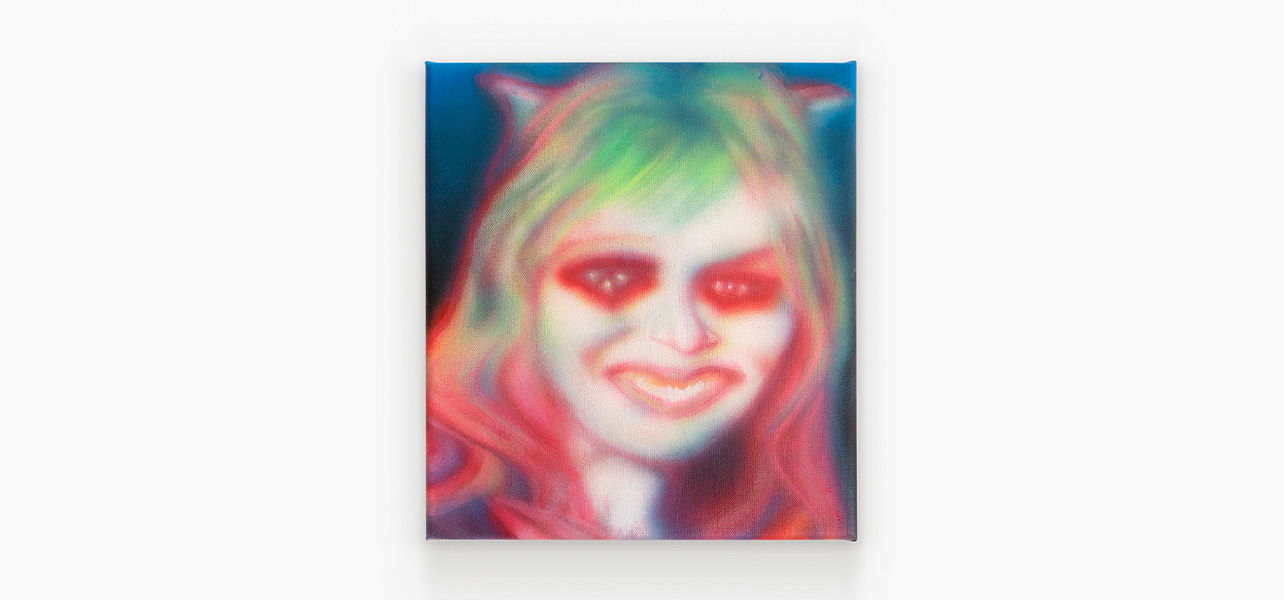
The Hole is proud to present Mutant Lab, the first New York solo exhibition by Korean artist Younguk Yi, whose unsettling repetitions and smooth verisimilitude have made him one of the most distinctive emerging painters. Yi’s canvases look like portraits from a hallucination—or a lab report. Figures proliferate, double and splice together, their limbs and faces recombining into new anatomies. In place of a stable body we find humans and animals mid-mutation: eyes stack like windows, torsos scaffold upward as flesh becomes architecture. The white backgrounds, raw and unpainted, provide "containment" like the fluorescent void of an exam room where the body is subjected to inspection, a space of regulation and surveillance disguised as neutrality. Trained in Seoul, Yi approaches painting through reiteration and distortion to test what painting can reveal once the image begins to break down. His airbrush provides pigment suspended in air, dispersed by pressure, forming shapes that hover between solidity and vapor. It trades in calibration, chance and breath and is, to the artist, "a philosophical choice." These whisper-thin gradients are then edged by hand in oil with ghostly precision, making the paintings at first appear digital. If I hadn’t seen his geometrically-precise drawings and extensive anatomical sketching, I wouldn’t know how he was able to create works like this. Yi builds compositions from collapsing scaffolds and fragile grids—visual echoes of Korea’s accelerated modernization and the instability it leaves behind. The body becomes a building in a system of strain and support. These painted architectures recall both the optimism and the failures of modern progress: the scaffolding of ambition, the memory of disaster, and the quiet fear of things needing maintenance and repair. Themes in this show unfold across thirty paintings in four zones: the front gallery filled with yawning figures, the rear with wrestlers and referees locked in struggle, a small side room devoted entirely to dogs, and the large green “lab” where new experiments take shape. A dark humor haunts these scenes: the painting titles circle ideas of obedience and training, choreography and competition, power and artifice. They puncture solemnity—Portrait of one who pretends to listen while secretly worrying when the conversation will end or Portrait of someone forcing a faint smile while hiding the envy at a friend’s success—turning existential unease into wry self-awareness. Taken together in this Mutant Lab, these rooms form a kind of behavioral study: a world in which every gesture, impulse and repetition becomes data. If these works carry a hint of science fiction, it’s not because they depict another world, but because they expose how mysterious our own is. They suggest parallel realities or biotech mutations, yet their real subject is human nature—the tangle of emotion, imitation, and desire that shapes our behavior. As the titles imply, Yi’s repetitions probe the “unknowability of the other.” His figures multiply like frames in a time-lapse, a kind of psychological Cubism where dilation replaces motion and emotion finds form. The proliferation of bodies provides a surplus of “body language,” yet even with this abundance of gesture, the inner world remains hidden. Behind the many “windows” of the eyes, each of our "buildings" is sealed off; surrounded by others, we remain unknowable to one another. Younguk Yi (b. 1991) lives and works in Seoul, Korea. He graduated from Dankook University, Department of Western Studies, and completed his MFA and PhD programs at Hongik University, Department of Painting. Recent solo exhibitions include Deformation of the Frame, OCI Museum of Art, Seoul (2024); When the remote control did not work, the drone crashed to the floor, Art Centre Art Moment, Seoul (2023); and A Fragment Thrown Up by a Dumped Image, Rund Gallery, Seoul (2022). Following Yi’s inclusion in a group show with us this spring, we are delighted to present the artist’s stateside solo debut. Special thanks to Yi’s Korean gallery WWNN for their thoughtful collaboration and assistance with this exhibition. We would also like to thank Kim Min-kyung and the artist himself for their thoughtful texts about this body of work, which will be available at the exhibition.
Past
ClownetteCharline Tyberghein
Sep 4 – Oct 13
The Hole is pleased to present Clownette a solo exhibition by Charline Tyberghein. Continuing Belgium's lineage of Surrealist greats, Tyberghein—a master of trompe l’oeil—takes us on a trip to the circus for her stateside solo debut. Seventeen new oil paintings (and some suggestively elephantine gallery benches) fill up our big Bowery tent this September. There have been salutes to the circus in Charline’s work since the beginning, a theme brewing but yet to be fully recognized by their creator. Signature stripes, checkers and harlequin patterns grab your gaze, but the details and delights revealing themselves only upon closer looking; she makes us work for it. The paintings begin with the patterning: the artist does not use tape and instead her technical execution is possible only with layering and precise planning, deconstructing images in her head and figuring out exactly how it will work before puzzle-piecing it back together. In this new body of work Charline brings in more human components into the painting. “Painting quotidian objects had begun to feel distant,” noted the artist. “Anthropomorphizing the work with gloves and ruffs instead softens the works to feels less sterile.” In Lost AND Found?!?! we see elegant evening gloves rendered as marble hands, impractically holding scissors. In Sloppy Sad Sleepy ruffled knickers await discovery under the yellow and black stripe pattern and in Sighlence we find heeled boots made of rope. In about half the paintings, actually, a jesterly ruff at the top of the composition alludes to a figure, presumably Clownette’s head, just cropped out of view. Traditionally there is no female or male clown, there is just "clown"; with this show title Charline explicitly declines this gender neutrality with the feminine diminutive form: Clownette. “It’s funny at first, then kind of sad how feminization and smaller-ization go hand in hand,” remarks Charline. “As I get older I’m finding myself leaning more into gender in my work.” The style of clowning depicted in this exhibition comes from the Pierrot school of sad clown, pining for his lady love. Charline works from an archive of imagery compiled over many years (as an analog person she has folders of printed pictures and references), then carefully composes a balance between the sweet and girly and something to "enhance the depth of emotion with a little sting to it.” While in the studio, Charline takes on up to ten paintings at once in a dizzying pattern-fest to allow for oil paint drying times. Her titles come last, pulled from a notebook with years of scribbled words, saving the titles for the perfect work. “Titling artworks shows how seriously you take it, so it’s important there is an element of humor to counterbalance the sadness and melancholy.” What A Great Feeling To Be The Horse You Bet On is a title that sat for five years waiting for the perfect painting. Charline’s circus isn’t nostalgic for a vintage Big Top tent; she is seeing today, in the world around us, a kind of a circus with heads of states around the world acting like clowns. While offering us the joy and play our eyeballs crave, her paintings contain a polite reminder that the joke's on us, the general public. Clowns and jesters are capable of highlighting the ridiculousness of situations, often tasked with speaking truth to power, or at least having a free pass to mock it. Charline asks in this show whether the role of the artist is similar. Charline Tyberghein (b. 1993, Antwerp, BE) lives and works in Antwerp. She has exhibited in numerous group shows at The Hole in New York and Los Angeles over the last 5 years (Second Smile, Nature Morte, Horripilation, Tone Poem) and we couldn't be more excited to host her stateside solo debut. She graduated from the Royal Academy of Fine Arts Antwerp in 2018 and has exhibited extensively internationally since. Recent solo exhibitions include Unapologetically Sorry and Worrier Princess, Gallery Sofie Van de Velde, Antwerp, BE, Domestic Blitz, Gallery Vacancy, Shanghai, CN and Sugar and Spite, L21 Gallery, Palma de Mallorca, ES. Her works have been presented in institutions such as the Kunsthalle Bielefeld in Germany, M HKA Antwerp and Beursschouwburg in Brussels. Her work is in the collections of the M HKA Antwerp, Vlaamse Gemeenschap and the Belfius collection. She is currently working on a second collaboration with Hermes along with and a 2026 exhibition with Gallery Sofie Van de Velde, her Belgian gallery, who we are grateful for their thoughtful collaboration for this exhibition.
Past
HerbivoreJul 17 – Sep 1
Andy Dixon, Ant Hamlyn, Ariane Heloise Hughes, Barry McGee, Ben Godward, Carly Owen Weiss, Caroline Larsen, Chelsea Seltzer, E.V Day, Francesco Igory Deiana, Graphic Rewilding, Hanna Hansdotter, Hein Koh, Kembra Pfahler, Kevin Christy, Laurens Legier, Michael Assiff, Mona Broschar, Nathan Ritterpusch, Paul Wackers, Pedro Pedro, Sophie Parker, Theo Rosenblum, Vanessa Prager The Hole is pleased to present Herbivore, our summer group exhibition. This plant-forward show gathers artists whose works feature flora in all its forms: flowering, fruiting, sprouting and climbing. From succulents to spores, Herbivore considers why artists so often turn to the botanical world—what it represents, what it absorbs, and what possibilities it holds when figuration falters. Across media, the show is lush and abundant. British duo Graphic Rewilding grow an eruption of irises in our front windows, welcoming visitors into a space where living and representational plants intertwine. Refracting light across our garden in the entry gallery are a giant resin flower by Ben Godward and bulbous glass vases blown by Hanna Hansdotter. Barry McGee’s animatronic tree sculpture tags the gallery wall like a domesticated plant going rogue. Sophie Parker weaves live plants into her sculptural installation, while Hein Koh’s ceramic sculpture sprouts a giant cactus out of a smoking broccoli pot. Later this month a performance piece by Kembra Pfahler features flowers from an even more surprising location. Some works in Herbivore revel in abundance: Ant Hamlyn’s Sporegasm, a cluster of soft mushrooms, teems with plush fecundity while Theo Rosenblum’s absurdly hung chair sculpture of a giant weed leaf asks us to take plant sex (and furniture) less seriously. Kevin Christy, Ariana Hughes, and Carly Owen Weiss bear fruits, while Caroline Larsen, Nathan Ritterspusch, Pedro Pedro and Vanessa Prager overflow with florals in dense, painterly detail. The botanical genre you could call it, though it hovers somewhere in the overlap of still life and landscape: Andy Dixon Red Composition with Pomegranite provides a real homage to the masters of still life in a hot pastel pastiche. Laurens Legiers (above) offers small, perplexing paintings where geometric thickets of stippled foliage obscure a traditional old master-style landscape. Is he showing how surface and design have overtaken history and genre—or simply letting his uniquely beautiful paint application method steal focus? In our past thematic exhibitions like Nature Morte (2021), which revisited the still life, and Manscaping (2022), focused on landscape tropes, we saw how artists return to traditional genres not to repeat them, but to subvert and reanimate. A plant is a subject that carries symbolic weight but allows for formal play—a stand-in for the human figure when a human might say too much—a structure of beauty or a vessel for drama. Plant life is the substrate of our living world—xylem and phloem or gigantic underground mycelium moving unseen beneath the surface— its cycles mirroring our own. It’s why our sick cultural moment demands we “touch grass.” In Herbivore, the artists lean into that fact not as naturalists, but as stylists and symbolists, inviting us to look closely and bathe our retinas in healing green. We didn’t get as many vegetable paintings and sculptures as anticipated so join us this Thursday at the opening for a gigantic edible vegetable arrangement to round out our garden.
Past
ReflectionsMathew Zefeldt
Jul 17 – Sep 1
The Hole is proud to present Reflections, our third solo exhibition by Minneapolis-based artist Mathew Zefeldt. Zefeldt creates paintings of simulated worlds and describes himself as "a contemporary plein-air painter who sets up my easel at the edge of a screen." His work explores the intersection between the real and the virtual, offering reflections that are both uncanny and familiar. Following the traditions of landscape painters, Zefeldt approaches digital spaces as they might have approached natural vistas: where Turner captured ephemeral clouds or Church depicted sweeping natural landscapes, Zefeldt engages with a simulated world—a space already translated onto a screen with 3D imaging programs, analyzing what that translation might mean visually and conceptually. Zefeldt's paintings spring from the world of the 2013 video game Grand Theft Auto V, seeking out moments of chaos and calm. Past series have focused more on the action (think exploding police cruisers and vehicles flying off cliffs) and the range of rich city-scapes within the game, while in Reflections, Zefeldt really looks down and zooms in on the “natural” world. Though only made of code these virtual landscapes are hyper-real and exaggerated for dramatic effect, frame after frame, repeating textures into gorgeous scrolling fields of information. Reflecting the fragmented nature of digital reality, Zefeldt draws from Andy Warhol’s grid compositions, where repetition underscores artificiality. This compositional tool contributes to the screen-like flatness of the paintings and also suggests the possibility that we occupy multiple parallel realities. In Leaf Logic we see the exact same cluster of leaves nine times, painstakingly painted in perfect pixelation. Two new freestanding paintings bring these unnatural textures into the gallery with more physicality and confrontation. The viewer almost becoming the player within the game, confronted by Ivy or a Stone Facade to navigate. Zefeldt’s undeniable technique and mastery of paint allows him to have one foot in the machine world: such repetition is not natural to analog life, rather it is the realm of cut-and-pasteable, endlessly iterable images in the digital realm. Stare too long and the pixelated rocks start to move; encountering the exact same flower over and over lends a whiff of the uncanny. If we are fascinated with painting the world around us and we now spend the majority of our lives in constructed virtual worlds, this show finds Zefeldt holding the mirror back to us and ultimately suggesting, perhaps, that we go touch grass. Mathew Zefeldt (b. 1987, California) is Associate Professor of Painting and Drawing at the University of Minnesota. He received his MFA in studio art from UC Davis in 2011 and received his BA in Art at UC Santa Cruz in 2009. He has had solo exhibitions at The Hole, NY; Celaya Brothers, Mexico City; Hair + Nails, Minneapolis; Big Pictures, Los Angeles; 5-50 Gallery, Long Island City; The Soap Factory, Minneapolis; Circuit 12, Dallas; Verge Center for the Arts, Sacramento; Minneapolis Institute of Art, Minneapolis; Hap Gallery, Portland; and Santa Monica Museum of Art, Santa Monica. He has exhibited in numerous group exhibitions internationally including at The Minnesota Museum of American Art, Saint Paul; Akron Art Museum, Ohio; Currier Art Museum, New Hampshire, and The Oklahoma Contemporary, Oklahoma City. Lisa Cooley, NY; The Hole, Los Angeles; Better Go South, Berlin; Night Club, Minneapolis; MOHS Exhibit, Copenhagen; Galerie Fran Reus, Palma de Mallorca; In 2022, Zefeldt was an international resident at the Cob x Plop Residency in London, UK, and in 2023 was an artists in residence at the Moosey Residency in Norwich, UK. Mathew has a new book out titled Mathew Zefeldt: Painting Constructed Virtual Worlds.
Past
Art MysteryPhilip Gerald
May 29 – Jul 14
The Hole is pleased to present Art Mystery, Philip Gerald’s New York solo debut. The title nods to his approach of spoofing canonical art history, but also gestures more simply toward art as a mystery. “That’s how I think art works best—especially humor in art,” says Gerald. “If you have to explain the joke, it’s probably not funny.” Fortunately, Gerald is funny. His compositions are irreverent, farcical, and satirical—painted in a fluorescent palette that bursts with both joy and absurdity, to be taken seriously and not seriously. With titles like Boner Shack, The Piss, and Painting Cronus with my Ass, the Dublin-based painter channels a distinctly Irish wit, relishing vulgarity and faux pas. “From reading Joyce, Beckett, and Flann O’Brien, there’s a thread of irreverence that runs through Irish society. I’m sure there’s post-colonial psychology in there, but that’s another thing altogether.” “Bootleg” paintings form the backbone of the show, originating from Gerald’s response to Douglas Gordon’s Bootleg Empire. These have since become a signature: mischievous riffs on hits from museum trips—Picasso Bootlegs, Matisse Bootlegs, Goya Bootlegs. In Art Mystery, mythological references appear more prominently, with Gerald diving into Homer, Sophocles, Aeschylus, Hesiod—“all the lads”—as well as Irish mythology. These highbrow touchstones are filtered through comic irreverence: in Laocoön and His Sons, the figures are rendered in graphite with wobbly emoji faces; in Birth of Aphrodite, the goddess wears sports socks. The images begin as quick iPad sketches, but turning them into paintings—while preserving that digital immediacy—is painstaking. “There’s something funny about these disposable digital drawings taking so long to make as paintings. It started as a joke; I’ve kept going for years.” In person, the artist’s hand comes through: precise tape lines, delicate texture shifts, and matte neon colors capture a kind of screen-like glow. In the rear gallery, an installation of works on paper accompanies a new video that provides fictional but “informative” context. Narrated by Gerald’s alter ego, it covers topics including pee (as stream of consciousness or bodily trap), memory’s role in making better art, and the supposed relocation of galleries from cities to caves—citing rising overhead and a cooling market. “It’s bloated and heavy-handed,” Gerald says. “It’s satirical, but also a bit of a mirror.” We could flaunt our art history degrees here—name the references, chart the juxtapositions, underline the digital-age resonance—but that might ruin the joke. Best to leave the Art Mystery for you to solve. Philip Gerald (b. 1992, Dublin, Ireland) lives and works in Dublin. He studied Fine Art Sculpture and Visual Culture at the National College of Art and Design. Gerald has exhibited internationally, with solo shows at Mindy Solomon Gallery (Miami), Over the Influence (Hong Kong), and Tuesday to Friday (Valencia).
Past
CarnageXavier Baxter
Apr 12 – May 25
The Hole is proud to presentour second solo exhibition with British-born, Brooklyn-based artist Xavier Baxter. Following his 2024 Los Angeles debut, Titans, this new body of work, Carnage, presents a more raw, more personal chapter for the artist. Fourteen new large-scale oil paintings fill our Bowery gallery with slashing gestures, smeared limbs, and painterly violence. In the back gallery, a site-specific installation transforms the space into a refrigerator box from Baxter’s childhood. Baxter’s paintings are unrelenting. He attacks the canvas with brushes, trowels, scrapers—building dense fields of oil paint that churn with energy and threat. Figures stagger through the wreckage, across surfaces are layered, torn open and rebuilt. Carnage piles up the parts with loads of limbs, a clattering of bone and pounds of flesh. Walking a line between control and release, trained technique and raw instinct, Baxter leans into disorder—letting each canvas hold the trace of a battle, a purge, a burst of something urgent and unfiltered. The installation in the back gallery is a full-scale recreation of a refrigerator box that Baxter once lived in as a child. In a photograph from the time, he’s beaming in bed with a boom box and a Snoopy plush, surrounded by chaotic cardboard walls covered in enthusiastic scribbles. In the studio today, Baxter generates a ton of cardboard in his process—laying it on the floor to catch strays, clear brushes, or smear scrapings. These discarded surfaces accumulate paint like a diary of accidents, which he now brings into the installation, covering the walls and floor of the space with the textures of both past and present. This piece evokes a time when creativity was private, fearless, and free: it's less about nostalgia than staying connected to that first, feral version of making: before anyone told you how art should look, or what it should mean. Xavier Baxter (b. 1991, London) studied sculpture at City & Guilds of London Art School before relocating to Brooklyn, where he now lives and works. He has exhibited internationally, with solo shows at Vigo Gallery and Union Gallery in London, Jack Hanley Gallery in New York, and PIERMARQ* in Sydney. His work is held in numerous private collections across the U.S., U.K., and Europe.
Past
Echo ChamberFeb 27 – Mar 31
Adam Parker Smith, Alejandra Moros, Alexandra Rubinstein, Andrew Sendor, Andy Dixon, Angela Fraleigh, Charlotte Hailstone, Danielle Roberts, Gina Beavers, Jared Friedman, Kamoy Smalling, Katelyn Ledford, Lauren Cohen, Lizzy Lunday, Matt Phillips, Maya Mason, Melanie Delach, Mia Dunn, Michella Roman, Nicole James, Summer Wheat, Tara Lewis and Takura Suzuki The Hole is pleased to present Echo Chamber, a group show curated by Leslie Weissman and Charlotte Hailstone. The exhibition explores the cyclical nature of influence, blurring lines between homage, appropriation, and reinvention while questioning originality and celebrating the power of interpretation. Accompanying the show are audio recordings from each artist about their sources of inspiration. Across thirty-one paintings and sculptures we see artists pulling from film, music, art history and performance filtered through the artist's personal lenses. In Adam Parker Smith 'The Abduction of Proserpina' Bernini's iconic Carrara marble sculpture is seemingly squashed down into a bronze cube. The ankle-height dogs in the original now are cheek-to-cheek with Pluto and Proserpina in an almost comedic crumpling of the iconic original. The take-down of Art History continues in Alexandra Rubenstein's 'Bad Blood' painted in pig's blood, compositionally inspired by Pablo Picasso's 'Les Demoiselles d'Avignon'. Here instead of depicting five female prostitutes she paints male artists in the buff—Picasso bottom right, Gauguin in a Russian fur hat, Dalí and Freud right behind—her accompanying audio clip exposing the problematic backgrounds of the male 'masters' of art history. To quote the problematic Picasso: 'Good artists copy, great artists steal'; in Echo Chamber we see the impact of art history as a treasure trove of ideas for artists to pillage. In Andy Dixon's 'Getty Villa' sculptures from the Getty Museum's collection are sampled and styled into a rich Bacchanalian still life in acrylic and pastel. Matt Phillip's gives us the largest work in the show 'Hold Tight Horizon Eyes' inspired by the impact and scale of the Garden Frescoes at the Palazzo Massimo in Rome, while Kamoy Smalling's, 'Portrait of a Man (Triptych)' was painted after seeing a Frans Hals exhibition at the British Museum. Many contributions nod to art history but seek a more active inquiry into the pop cultural world we live in. Gina Beaver's 'Delft Al Nails' remixes Delft pottery with one of Beaver's core influences: TikTok makeup tutorials. In 'It's My Party And I'll Cry If I Want To,' Nicole James references the cheerful tune from the 60s articulated in confetti, mascara-marked tears and fake eyelashes. Melodramatic like the song, the painting deals with the clash of external expectations and internal emotions. In Maya Mason's 'North By Northwest' we see a still of the film's stars embracing with a self portrait of the artist staring wistfully from the bottom of the canvas. And in Tara Lewis's 'Batwoman' and 'Marge' the artist depicts all-grown-up reinterpretation of childhood cartoon memories. Flirting with nostalgia, Echo Chamber presents work that feels as much about the artist's identity as it does about the legacy they engage with, examining the difference between derivative work and meaningful dialogue with the past. In Maya Dunn's 'Heirlooms' we see the artist's Kamon (Japanese family crest) depicted in acrylic and tufted components, the work exploring how traditions and heritage fade, her work not just inspired by history but preserving it with a contemporary reimagining. To free us from our own art echo chambers, the curators present an interactive element on the plexiglass front wall of the show: viewers are encouraged to fill in the blanks on the stickers provided and post them up, continuing the dialogue about the artworks and the role of influence with visitors to the show.
Past
Tinyvices Archive: 20th Anniversary ExhibitionFeb 8 – Feb 24
Mustafah Abdulaziz, Gilda Aloisi Louise, Aurélien Arbet, Corey Arnold, Casper Balslev, Tim Barber, Gideon Barnett, Alexander Binder, Anthony Blasko, Adam Bordow, Ali Bosworth, Julia Burlingham, Camila Butcher, Asger Carlsen, Alana Celii, Philip Cheung, ElíSabet DavíDsdóTtir, Alexandra Demenkova, Chris Dorland, Jessica Eaton, Jeremie Egry, Shayne Ehman, Thobias Faldt, Leo Fitzpatrick, Andrew Fladeboe, Jimi Franklin, Peter Funch, Philippe Gerlach, Andres Gonzalez, Kathy Grayson, Jeffro Halladay, Greg Halpern, Jeanette Hayes, Balarama Heller, Victoria Hely-Hutchinson, Andrew Hines, Alexi Hobbs, Jerry Hsu, Marty Hyers, Maciek Jasik, Klara Kallstrom, Thatcher Keats, Simon Keoug, Richard Kern, Sandy Kim, Michael M. Koehler, Jeff Ladouceur, Adam Lampton, Marten Lange, Alain Levitt, Allan Macintyre, Craig Mammano, Peter McCollough, Ryan McGinley, Will Mebane, David Meskhi, Santiago Mostyn, Reza Nader, Nguan, Jason Nocito, Patrick O'Dell, Christine Osinski, Boru O’Connell O’Brien, Ed Panar, Skye Parrott, Christian Patterson, Asher Penn, Brad Phillips, Ben Pier, Matthew Porter, Gus Powell, Caitlin Teal Price, Nuria Rius, Lina Scheynius, Michael Schmelling, Aurel Schmidt, Stephen Schuster, Robin Schwartz, Darnell Scott, Dan Siney, Lenard Smith, Brooke Smith, Dash Snow, Brea Souders, Barry Stone, Peter Sutherland, Ed Templeton, Agnes Thor, Nathanael Turner, Brian Ulrich, Alexis Vasilikos, Peter Voelker, Hannah Whitaker, Logan White, Aaron Wynia, Daisuke Yokota, Nick Zinner The Hole is pleased to present Tinyvices Archive: 20th Anniversary Exhibition curated by Tim Barber. Tinyvices.com, the influential emerging artist platform founded and curated by Tim Barber, ran from 2005 - 2011 and showcased an eclectic, international roster of over 600 photographers and artists. The site was a unique, pre-social-media hub, where thousands of daily visitors came to discover new and exciting work. For the site's 20th anniversary, Barber brings together over 100 artists for a show at the gallery, and launches the newly designed website tinyvicesarchive.com.
Past
Paper View IIDec 19 – Jan 27
Julian Adon Alexander, Adèle Aproh, Ayé Aton, Dan Attoe, Alpha Channeling, Ginny Casey, Canyon Castator, Ryan Travis Christian, József Csato, Nick Dahlen, Lee Dawson, Gabi Dunayski, Austin English, Cory Feder, Bianca Fields, Matt Furie, Tim Gardner, Monica Kim Garza, Steven Gavenas, Philip Gerald, Namio Harukawa, Rowley Haynes, Ania Hobson, Nigel Howlet, Anthony Iacono, Maddy Inez, Todd James, Chris Johanson, Aaron Elvis Jupin, Jordan Kasey, Sally Kindberg, Emma Kohlmann, Carl Krull, Matt Leines, Tida Whitney Lek, Michael Gac Levin, Amy Lincoln, Tyler Loftis, JJ Manford, Eddie Martinez, Barry McGee, Taylor McKimens, Kevin McNamee-Tweed, Nat Meade, Gabriela Silva Myers-Lipton, Barbara Nessim, Prinston Nnanna, Luke O'Halloran, Joakim Ojanen, Peter Opheim, Leo Park, Sofia Pashaei, Pedro Pedro, Kembra Pfahler, Robert Pokorny, Paul Riedmüller, Theo Rosenblum and Chelsea Seltzer Conrad Ruiz, Anja Salonen, Katsu Sawada, Aurel Schmidt, Alfred Steiner, Stickymonger, Marika Thunder, Richard Tinkler, Thomas Trum, Dani Tull, James Ulmer, Paul Wackers, Augustina Wang, Samual Weinberg, Taylor White, Karl Wirsum, Shingo Yamazaki, Allison Zuckerman The Hole is proud to present Paper View II, a second installment of our 2019 works on paper-fest on Bowery. With over eighty artists and a hundred included pieces, our fest has grown this year: the show is a true celebration of the medium with a broad assortment of techniques and styles. From colorful and detailed oil pastels to sparse swipes of charcoal or graphite, artists use works on paper for a variety of reasons: preparatory sketching for painting and sculpture is just the beginning and many artists included in this show choose paper as their sole medium. Paper can be quick, portable, accessible: to emphasize this we cover the gallery walls with cork board and pin everything up unframed like a giant bulletin board. Our love of paper began with Panic Room curated by Kathy Grayson and Jeffrey Deitch at the Deste Foundation in Athens in 2006, where underground artists from Providence, RI and San Francisco met blue chip artists and was the debut of many now-major names. David Shrigley and Paper Rad, Tauba Auerbach and Mat Brinkman, Margaret Kilgallen and Elliott Hundley; we tried to capture that depth and structure with Paper View thirteen years later, and had many repeat offenders (Xylor Jane, Chris Johanson) as well as debuting that year’s top new talent like Anna Park, Grace Weaver, and Cristina BanBan, as well as new regions of excitement like Japan with Susumu Kamijo and Koichi Sato. For our final show of 2024 we give you the best of what is happening on tree pulp today. In Allison Zuckerman’s Day of Rest Study #1 and Day of Rest Study #2, we see the artists mind a-whirrin’, annotations plotting out the references and details for what appears to be plans for a painting. In Dan Attoe's Accretion Drawing LXXIX (79), we get an inside peek at this practice which included daily drawings with racy little texts. Meanwhile in the detailed painted collages of Anthony Iacono and the monochromatic framing of Jordan Kasey we see works clear and confident that paper is their final form. And in honor of the show’s name bestowed on us by Brian Chippendale, we try to turn up the seedy sizzle: in Philip Gerald’s Sexy Tree we get a flash by pre-paper with a hint of “pay per view”, Alpha Channeling returns with some erotic drawings that had Jerry Saltz all riled up, Alfred Steiner's Cream is too-hot for network TV and Namio Harukawa’s BDSM pencil protagonists dominate. Swedes Sally Kindberg and Leo Park are a bit more demure, mindful, while Aurel Schmidt of course remains full-frontal. This show is jam-packed so please grab a guide at the front; we are delighted to include so many familiar faces from the first Paper View like Barry McGee, Anthony Iacono, Taylor McKimens, Prinston Nnanna, Ryan Travis Christian, Samual Weinberg, and many more! If we wrote even just one sentence about each artist this email would be endless; we’re grateful to all the artists, consignors and Hole staff that added their paper pals to the fest. Breaking down the classical hierarchy of media takes a village!
Past
Apple of My EyeDaniel Um
Oct 24 – Dec 16
The Hole is pleased to present Apple of My Eye a solo exhibition by Daniel Um, the artist’s first with the gallery. Working in oil and oil pastel, Um creates dream-like landscapes painting solitary protagonists with notes of melancholy and sweet nostalgia. In an assortment of sizes including very petite painting studies, the artist explores the liminal space between dark shades of twilight and the subtle light of dawn. Based on memories of childhood camping trips to Yosemite and Sequoia National Park, the works capture the safety and comfort Um felt in the great outdoors. Escaping Los Angeles, he describes finding a home as an outsider in a new country by feeling small but secure surrounded by the largest trees in the world. Creating these works high above the city in his World Trade Center studio at Silver Arts Project, Um paints shelter for his protagonists, giving them privacy and sanctuary, while he works amongst the towering skyscrapers of downtown. Detailed yet anonymous, the figures act as an anchor for the viewer to enter the world of the painting. The titles provide just a sprinkle of insight to provoke the imagination, as in Edgar whose fire-red hair protrudes in pigtails with a baggy sweater that nearly drags on the murky campsite floor. Outside, a star-studded night sky envelopes the left third of the canvas, as if the story unfolds while floating through space. With plush toys, disheveled hair or Sunday’s best, Um’s tiny protagonists wander in wonder, evoking nostalgia for the bygone imagination of childhood and the thrill of a page-turning storybook. To really understand Um's work one must not overlook the subtlety and power of color as in works like the all-blue "No Waves In This Still Pond" and proliferating ochres of "Triplets by the Orchard". Tactile layers of oil paint and pastels render dusk in vivid colors, applied intuitively with all the plot taking place on the palette. Color dictates all, working slowly and building layers, the figures only enter the frame once the scene and mood are set. Um's considered and sensitive use of color emerges from a convergence of influences and long looking: from the layering of Impressionists and Post-Impressionists to the atmospheric achievements of the German Romantic period; from the sensory color of Korean ceramics to the power of minimalism in Sean Scully's dark, immersive abstraction. Daniel Um (b. 2001, Seoul, South Korea) lives and works in New York City. Recent solo exhibitions include Trails Left by the Moonlight at Linseed, Shanghai and Lullaby at, Turn Gallery, New York plus a two-person exhibition at Scroll NYC. His work has been exhibited in numerous group shows internationally including Make Room (LA), Galerie Hussenot (Paris), and The Room (London). Artist Residencies include Silver Art Projects, New York (Current) and PPP/ Oostmeijer, Amsterdam.
Past
Cryptofire DegenChristine Tien Wang
Sep 5 – Oct 21
The Hole is pleased to present Cryptofire Degen, a solo exhibition by Christine Tien Wang, the San Francisco-based artist's first in New York. Working in acrylic and oil on canvas, Wang's practice looks closely at the most era-defining output of the creative public: memes. In Cryptofire Degen Wang focuses on Bitcoin and cryptocurrency, her paintings toying with both the bizarre culture that has formed around the volatile cryptocurrency market and the unique and fascinating medium of memes that helps us both understand and ridicule it. Degen as in short for ‘degenerate’: engaging in speculative trading or investment strategies; even the exhibition title is cryptic and part of an insider world with its own nomenclature. While the memes we consume are often fed to us by unseen algorithms, across thirteen new paintings Wang curates our IRL FYP (in real life, for you page). Her selection of scalding-hot takes utilizes imagery from pop culture and politics, from Janet Yellen to Lord of the Rings. Many of them are well-worn meme structures the crypto world has put their twist on; whether you are a doom scroller or accidentally opened Twitter in the past decade, you’ve seen this Drake format before, seen the Mean Girls whispering and a monkey puppet looking askance. Making paintings about Bitcoin is not new for Wang with a 2018 show titled Crypto Rich and in 2019 #cryptomemes, women and Leo DiCaprio. When starting the body of work for this show, Bitcoin was valued at $54,000 for the first time since December 2021 after its not-insignificant plummet: the value today as you read this $59,125 but that information could be very different when the show opens week. In Angelina Jolie Crying screen grabs from the movie Original Sin (2001) are overlayed with all-caps “Bought Bitcoin for $50k and sold for $17k”. This painting updates the 2018 meme, made when Bitcoin fell from $19k in December of 2017 to $8k less than two months later: the speed of crypto and the speed of memes, the speed of digital culture leaves painting in the dust. In this latest installment Wang explores the embarrassment and humor of being in too deep, down the rabbit hole not just with crypto but technology addiction or even the avaricious nature of the art world. The duration is off: memes are fast and disposable, her paintings are arduous and months-long; crypto changes value dramatically in a single day, the art world raises up talent and drops it within the same year. Our brains have been rewired to have short attention spans and an insatiable appetite for new content: we are supposed to spend hours gazing at an artwork in a museum to slowly chewing through the layers of history and meaning but instead we scroll fast through an auction catalogue and click to bid. Looking at Wang’s paintings of memes is like getting off a treadmill or hitting a sudden speed bump; we have to slow down but it is uncomfortable. "Another gallery once wrote about my work that I'm making memes high art like painting, but that's wrong: I'm bringing paintings down to memes." Translating this online shared imagery into paint could be considered a pop gesture, where the artist is simply showing us our existing cultural artifacts in paint in a gallery so we can consider them closely. But I think the artist feels more about the content of these memes than she lets on, and feels more about painting itself. Both internet trolls and her mom frequently ask her “why are you doing this” and I think the process of making these paintings is how she is figuring that out. Christine Tien Wang (b. 1985, Washington, D.C.) lives and works in San Francisco. Using meme paintings as an accessible format, Wang creates thought-provoking and hyper-contemporary work that comments on everything from identity to the consequences of capitalist ideology. She received her BFA from the Cooper Union and her MFA from UCLA. Recent solo exhibitions include Screen Time at Night Gallery in Los Angeles Banana Philosophy at PTT Space in Taipei and Fake Stupid, queen of cringe at Galerie Nagel Draxler in Cologne as well as group shows at the Museum of Contemporary Art Los Angeles and the Museum of Contemporary Art Busan. Wang is currently Associate Professor of Painting and Drawing at the California College of Art.
Past
Twinks, Twunks, Hunks & Dad BodsAug 8 – Sep 2
Amalia Angulo, Fernando Botero, Drake Carr, Mattia Guarnera MaCcarthy, Anthony Iacono, Morteza Khahkshoor, Todd Lim, Joseph Parra, Ricardo Partida, Carlos Rodríguez, Alexandra Rubinstein, William Schaeuble, Xavier Schipani, Michael Stamm, Matthew Stone, Justin Yoon The Hole is pleased to present Twinks, Twunks, Hunks & Dad Bods, a group show curated by Charlotte Grüssing looking at the male form in semi to total stages of undress. Prudes beware: from budgie smugglers to full frontal nudity, this show shows flesh. Using contemporary terminology and stereotypes as the starting point and title, the exhibition undresses the blurrier boundaries of masculinity via the male physique. Men are absolutely everywhere: the “his" in history, they dominate the canon of art as well, and have for centuries. So while men overall do not need more attention, perhaps their bodies do and how they feel about their bodies does? The male gaze and female form have been explored exhaustively in art, but the objectification of the male body and the nuances of its form have forgone as much scrutiny. “Ladies” and “gentlemen" come in all shapes and sizes yet we assume the gentleman is blasé about his form, which leads me to my first question: muscles; health or narcissism? In Morteza Khakshoor’s My Fictional Trip To The Gym our human desire to be admired is laid bare, abs and ass tight for the pic. We see the increased self-awareness of form in our aesthetically-focused social media-driven age again in Michael Stamm’s closely-cropped portrait of the infamous Barragan swimsuit (that all the gays in Fire Island were wearing last year with an optical illusion on the front and back that enhanced your anatomy, to put it politely). Flexing their manliness for your vote, the contestants in William Schaeuble’s Annual Warren County Flex-Off have a wholesome hint of Americana pre-Schwarzenegger, the paintings timelessness predating American Gladiators or the first official bodybuilding contest around 1900. We see the behind-the-scenes of the hunkier muscular physique in Justin Yoon’s blue Calculating Bimbo and the outcome in A Good Pump dripping beads of glittery sweat. Another poseur for our viewing pleasure, the sinister smile and pearly whites of Amalia Angulo feels as forced and tense as the figure's rippling abs. The largest work in the exhibition, Xavier Schipani’s grayscale mural undresses all our highly-performative muscle-tensing masquerade of masculinity. Simultaneously fluid and grand, the palette pays homage to the original "art hunks", the chiseled marble of Greek and Roman sculpture also referenced in Matthew Stone’s Gaddi Torso (Stone). Creating tension between machismo, bravado and quiet moments of tenderness, the work is inspired by Xavier’s own journey as a transmasculine man, searching for his own identity to find visibility in a fully realized body. In Ricardo Partida’s Emergency Contact we see further vulnerability where even tough guys bleed, as blood streams from a gash on the figure’s forehead while a mysterious set of hands comfort the diver, referencing “Third man syndrome” or to some, a guardian angel. Not just in the compositions but also the subject matter do we see the more nuanced and beautiful side of man in the exquisite and detailed mark making of Drake Carr’s Torch and abundant details of Anthony Iacono’s painted collages. Our need to standardize and quickly categorize forms into subgroups comes hand-in-hand with plenty of specific stereotypes. From the hairy chest of Todd Lim’s Untitled (Life Preserver) (made with the artist’s own chest hair) to Mattia Guarnera MaCcarthy typically female promiscuous lower back tattoo, the artists here are taking gendered stereotypes with a grain of salt. After all, the definition of “dad bod” being "a physique regarded as typical of an average father" does not mean anything given such broad body diversity. Is the term then a scapegoat for big beer bellies and body complacency, suggesting once a man has found a mate and fathered a child, he no longer needs to maintain his physique? The majority of the artist's muscular response to the theme (like the heavenly idealized torso in Joseph Parra’s topographical painting) and the deficit of girthier guts in this show suggests a "dad bod" could be any bod, just as a "beach bod" is any body at the beach. Twinks, Twunks, Hunks and Dad Bods was all that could fit in the title but bears and otters deserve an honorable mention. The Twink is a young attractive gay man normally with a slim or boyish appearance; the Twunk has the boyish-face of a twink but the muscular or “jockier” body of a hunk (or in some cases is a sort of veteran twink.) I am certainly not saying it’s time for us all to overtly ogle or start wolfing dudes on the street; however, I once did catcall a male friend to a look of shock and pure delight for his first time being publicly objectified, but instead we should consider both the catcaller and the catcalled. Our body type and how we look apparently does not matter so much in Alexandra Rubinstein's Just A Hole, as you can play cornhole in the gallery using two very attractive men as just a fun game, degrading the subjects bodies to sexual objects. When scrutinizing masculinity, the conversation can easily escalate to serious issues with global political impact, especially now with the idea of "manhood" and "manliness" looming over the election, gender on the ballot alongside anti-LGBTQIA+ legislation. The show is a response to both the current polemical issues of gender and the incredible work happening in male figuration now. Not to say this is new—we have the great beefy Botero in the room here after all—but male attractiveness is being questioned in very vulnerable and honest ways and the bodies we are seeing in art feel more and more liberated from the straitjacket of masculinity than ever before—or at least unbuttoned.
Past
Wild RosesNastaran Shahbazi
May 30 – Jul 21
The Hole is pleased to present Wild Roses, a solo exhibition by Nastaran Shahbazi, the artist's first with the gallery. Across sixteen new paintings Nastaran Shahbazi provides gatherings, joy and poetry. The human figures are alive: dancing, peeling fruits, kissing. From Goya’s picnic to a memory of the mountains in her mother’s hometown in Iran, the references carry the nostalgic sweetness of painting from memory, enchanting us with optimism and conjuring conviviality. The Paris-based painter captures the poetic nuances of revelry and from optimism comes freedom: Shahbazi’s figures populate vivid fields of color, inviting viewers to project their own joy and memories onto each interaction. With notes of Manet, Degas, Renoir, Matisse or Toulouse-Lautrec, Shahbazi conjures a half-remembered tune of 19th century styles with modern and personal motives. Food and drinks will be served: many paintings have people déjeune-ing in herbe or stacking up the empty wine glasses in a dark cafe. In Nowhere Land (above) a woman dances with a fish while two embrace; musicians play accordions and violins while a figure sculpts. In The Red Room a bevy of Degas ballerinas twirl in what looks like a karaoke bar. A blurred scene of chandeliers and dancing couples in Blue Lobster is perhaps a window or giant mirror, a composition that shares the Parisian richness and perspectival ambiguity of Manet's “A Bar at the Folies-Bergère”. The title of the exhibition refers to Van Gogh’s “Wild Roses” painting, while the words of Iranian poet Forugh Farrokhzad seep into the subject matter of the paintings and their mood. The figures are charming yet anonymous, the unseen strangers of the quotidian. They are not protagonists but the extras in the film, the dinner date at the table next to you. Her subjects come from her travels: living in Hong Kong and Paris, she depicts both personal and shared memories, holding an accessible intimacy that reflects the ways loved-ones disperse. With the Iranian diaspora spread so globally, the people she knows are everywhere. Van Gogh’s "Wild Roses” paintings were created in the gardens of the psychiatric clinic in Saint-Rémy-de-Provence, while Van Gogh was suffering a severe mental crisis. The pain of the painter is hidden in plain sight, sorrow and melancholy grown over by flowers, while the artist shows the viewer serenity and beauty. In Nastaran’s work, sorrow stays similarly silent, pouring optimism into each painting and reworking compositions that start to show too much of life’s sadness. She has painted away the sadness for us, the lucky viewer, inviting us to soak in a wistful beauty of being alive. Nastaran Shahbazi (b. 1982, Iran) lives and works in Paris. Memory and motion are important characteristics in her painting, drawing on her experience moving between Tehran, Paris, and Hong Kong before finally setting back in Paris. The characters featured in her work are often anonymous—born from sketches of physical locations and experiences—her final compositions reside in these personal places and cinematic scenes. Shahbazi's compositions offer the viewer several paths, leaving one free to create a personal and intimate relationship with the canvas and characters within. Recent exhibitions include her solo show To The Butterflies with Scroll (New York) and group show Rose Tinted Glasses curated by Saša Bogojev at Ojiri Gallery (London).
Past
CocoonPeter Opheim
Apr 18 – May 27
The Hole is pleased to present Cocoon, Peter Opheim’s solo debut with the gallery. With over twenty new oil paintings and an installation of tiny clay sculptures and knit wall hangings, he elaborates his invented world as well as his art-making process. After a 25-year career as an abstract painter, Opheim started anew; “since everything we see in the world around us has already been painted”, a family of imaginary creatures and Opheim’s career-defining style was born. His works are an intuitive manifestation of emergence: sculpting the figures first in clay, Opheim removes roadblocks to his imagination. Working intuitively with his hands, the creatures reveal themselves to him and he then paints “from life”. Not focused on conveying a snapshot of our contemporary world or visual markers of the present day, the sculptural approach to making the subjects of the paintings results in works that exist out of time—the characters are transient yet grounded in subdued color fields, their bodies and borders ambiguous and hazy. In Meadow of My Heart, Holding You and others, multiple figures fill the canvas, an assortment of semi-recognizable parts from a few fuzzy friends fill the canvas, cat-like ears, skinny arms or blobby bodies, with many large eyeballs blinking. In paintings such as Thinking of You a lone figure presents themselves, staring right back at you. Rather than conveying grandiosity, Opheim instead is in the pursuit of emotional impact. The exhibition includes smaller paintings than ever before, making viewers look closely and the textural brush strokes more prominent. In the large rear gallery, small sculptures are positioned on the floor, barely visible from the other side of the room and dwarfed by 17-foot ceilings. Above the paintings, large woven flowers climb the length of the wall, further figures revealing themselves at the base of the stems: a sense of coziness and protection settles in with clay figures nestled in a small wooden home carved by a fallen tree on his property in Taos, New Mexico. For this recent body of work there is a shift to a different type of subtlety based on concepts of emergence, interconnectedness, and growth. The title Cocoon is a multifaceted metaphor for these themes, as when a caterpillar spins its body transforming into a chrysalis and cocoon, it is surrendering to transform. This emergence can’t be expedited; patience and independence are crucial, a butterfly must emerge on its own. In the work we see an emergence of form, skillful blurred brush marks of creatures in a softer, hazier palette than when we first showed Opheim in 2018 and an emergence of emotions, a warm joy, the sensation of standing in the sun. These new paintings were difficult to make, notes Opheim, with the figures only starting to reveal themself once the painting was close to completion. Opheim notes the importance of an intuitive organic emergence: “we can have preconceptions on how something is supposed to be, but that’s not how they are made” Standing In The Sun, I Feel Your Arms Around Me the title of one of the larger paintings in the show and one of the potential titles for the exhibition, evokes the physical warmth that you feel in these paintings. The hues and figures are inviting yet the asymmetric, spherical bodies have just enough wonkiness to not be classified as overly “cute”. Opheim has shown extensively in Asia where Kawaii culture is widely pervasive and appreciated: New York is known for many things, but cuteness would not be one of them. While foreign, Opheim’s visual language feels refreshing and necessary, inviting curiosity and play through imagery we don’t often see in Western art. Here, Opheim is deliberately moving on from a lot of what we see in galleries at the moment and instead gives us enough room to think on our own, leaving space for our own joy and pleasure. Peter Opheim (b. 1961 Landstuhl, Germany) is known for his paintings of fantastical imaginary creatures. Based between New York and Taos, New Mexico, his work has been exhibited in solo and group shows across North America, Europe, and Asia. Opheim first showed with The Hole in 2021 in Nature Morte and has been included in numerous group shows and fairs with us since. Recent solo exhibitions include Friends at PAHO Gallery, Hiroshima; The Sublime and Elusive Flower, Powen Gallery, Taipei and Summer Adventures, Sens Gallery, Hong Kong. Opheim’s work is included in public and private collections internationally, including the Harwood Museum of Art in Taos, New Mexico, and has received grants and awards from The New York Foundation for the Arts, The Pollock-Krasner Foundation, and The Museum of Fine Arts in Santa Fe, New Mexico. He has been featured in a variety of publications, including New American Paintings, Juxtapoz, The New York Times, The Boston Globe, The Huffington Post, and New York Magazine.
Past
I’m Doing it Again BabyGirl in Red
Apr 12 – Apr 14
The Hole is pleased to host a two-day pop up exhibition by Girl in Red ahead of her new album, I’m Doing it Again Baby.
Past
Adrift on the Lonely Etheric OceanMar 9 – Apr 8
Thomas Barger, TM Davy, Andie Dinkin, Lizzy Gabay, Aisling Hamrogue, Sam Lipp, Kate Meissner, Catherine Mulligan, Brittany Shepherd, Neal Vandenbergh, Gray Wielebinski The Hole is proud to present Adrift on the Lonely Etheric Ocean, curated by Brooke Wise. This group exhibition delves into the enigmatic realms of the uncanny, the provocative and fantasy. Inspired by Jeffrey Sconce’s exploration in “Haunted Media”, viewers are invited to navigate the familiar turned unfamiliar- a chilling breeze on a dark night, stirring primal fears and unsettling perceptions of reality. Through a diverse selection of works, the exhibition invites viewers to confront the murky waters of the uncanny in all its eerie glory. Adrift on the Lonely Etheric Ocean transcends mere discomfort, venturing into the realms of the provocative and the fantastical. From works that boldly challenge societal norms and expectations to those that transport us to whimsical and wondrous realms, each artwork offers a unique exploration of the human experience. Andie Dinkin’s dream-like tablescape traverses the blissful blur between the real and imagined while in TM Davy’s pink Tiny Monster pulls us further from the confines of reality and towards the paranormal. Navigating through the exhibition, viewers encounter works that evoke spine-tingling seduction, provocative contemplation on societal taboos, and fantastical journeys into the unknown- a captivating exploration of the darker recesses of the human psyche as famously explored by Freud. In Aisling Hamrogue’s Blue Bond and Sub Drop we see leather harnesses and masks, hints of BDSM while in Brittany Shepherd’s Satin (Rose) and Sam Lipp’s Fog, seduction is softer in hazy brush marks and rosy pink. A tease of internet imagery in Catherine Mulligan’s Influencer paired with Gray Wielebinski’s exploration of gender roles, masculinity and consumer culture, contextualizes the exhibition’s otherwise ambiguous era. Transcending time and the necessity of logic we float towards the dream-like space of Lizzy Gabay’s “Big Sister”. Brooke Wise is an independent curator based in New York, NY and Los Angeles, CA. Originally from Montreal, Canada, Wise curates for galleries, spaces, and foundations internationally. Recognized for her charitable art ventures and unconventional curatorial projects, she has collaborated with esteemed institutions such as the Tom of Finland Foundation, Ali Forney Center, and the New York MTA system. Noteworthy among her ventures is her annual comedy film festival Aloha From Hell, benefiting Planned Parenthood, and her donation-based downloadable Fine Art Quarantine Coloring Book, showcasing her commitment to utilizing art as a catalyst for social engagement and activism.
Past
Signs From AboveGosha Levochkin
Mar 9 – Apr 8
The Hole is proud to present Signs From Above, a solo show by Gosha Levochkin, the artist's second with the gallery. These eight new paintings were inspired by looking around, walking around, taking in all the different centuries of style the streets of New York have to offer. While perusing the gallery exhibition there are some interesting surprises if you look up as well. Absorbing both Art Deco buildings and their new neighbors on his daily commute to his Navy Yard studio, Levochkin also depicts daily rituals like the pour-over coffees, subway rides or piles of jeans. In this new body of work Gosha gives us a vintage vision of the future, a branch in the timeline not taken. With his recognizable electric linework, where the brush vibrates and shading is stippled, he limns guitars, squirrels and ambiguous machines. In liver-red, olive, orange and pink, Gosha forges ahead with a digitally-influenced expressionist technique. Instead of hard-edge screen-like painting we see the liberated pre-computing language of Chicago Imagists, references to Roger Brown and Karl Wirsum, or one of his favorite elder states-people, Peter Saul. This timeline gives us fluidity in form and imagery from Russian constructivist characters more than Photoshop, especially hidden in One Of Many and Constantly Growing. Trains traverse Tokyo to New York: in approaching these paintings, we see freedom, movement, revolution and sound, stars with a guitar handle in Finding Fault, trains and cars forging forward, adrenaline in color. “When approaching this new body of work, I’m always telling myself 'what is freedom in your painting, each painting should have a moment of freedom.'” Gosha Levochkin (b. 1986 Moscow) grew up during the fall of the Soviet Union. Moving from Moscow to Hollywood, Gosha spent a decade-plus in Los Angeles prior to moving to New York City where he now lives and teaches. Over the years, jobs at an animation studio, an art supply store and as an assistant to artist Ben Jones have all shaped his practice. Levochkin’s recent solo exhibitions include Opera Portal at Allouche Benias in Athens, Greece 2023; Last Element at The Hole, New York 2022; Secret Button at OTI, Los Angeles, 2021 and (synthetic reality) at OTI, Hong Kong in 2020. His work has been shown at art fairs internationally including The Armory show in New York, Kiaf in Seoul, Zona Maco in Mexico City, Art SG in Singapore and Enter Art Fair in Copenhagen.
Past
HorripilationJan 13 – Mar 4
Aks Misyuta, Alic Brock, Ariane Heloise Hughes, Charline Tyberghein, Hunter Amos, Jackson Shaner, Joseph Parra, Kelly Shami, Ken Nurenberg, Rita Maikova, Tim Brawner, Vilte Fuller, Will Thornton The Hole is proud to present a hair-raising group show Horripilation on the Bowery for the winter. During these darkest months we highlight the sinister edge of surrealist impulses in emerging art of the moment. The chill down your spine or the raised hairs on your arm or back of the neck provide the title of the show, and this animalistic physical response to fear unites the works. A spatter of blood, the look in someone’s eye, a muffled scream: the works in the show go darker. Greeting you at the entrance is the above painting by Tim Brawner whose terrible grinning red visage is lit from below just as all good horror story raconteurs should be. Going deeper we encounter Vilte Fuller’s fragmenting reality where the atmosphere is thick with suspense hung near Hunter Amos’ fragmented figure unraveling before us. Ariane Heloise Hughes’ piercing gaze is hard to hold, and her use of swan imagery ups the psychological intensity. Aks Misyuta and Charline Tyberghein play with shadows from Aks’ black-eyed shadow figures lit like a Legier to hammers, boots, rope and other not quite innocuous items at low relief from Tyberghein. Ukrainian artist Rita Maikova has a more traditionally surrealist approach with an assortment of inscrutable shapes laid out in a plain expanse. They are alternately sharp or fuzzy but all creepy crawling, skittering around the canvas. Meanwhile Will Thornton offers us three suggestive little perverts that seem poised for sucking and squeezing and the Copper Escape Jar by Jackson Shaner with howling, trapped figures inside is the stuff of nightmares. Also in body horror we have Alic Brock's take on Maurizio and Pierpaolo’s Toilet Paper which was itself a take on perhaps Buñuel’s Chien Andalou and gives new ick to the ick phrase “eye teeth”. We have Kelly Shami pierced bouquet, puncturing the delicate, and Ken Nurenberg’s painting—somehow both meaty and necrotic—a Greek torso erupting with rococo decorative flourishes. Joseph Parra’s pointillistic topography of the human torso is straight from the tube and already electrically on-end. If this show is creepily familiar it has strong overlap with Second Smile (2020), our pandemic show that we installed but nobody got to see. Looking at surrealism and feminism from classical artists to emerging, the show’s wall colors were borrowed from international museum shows of female surrealists and we preserve those colors here.
Past
Winter FlowersCaroline Larsen & Vanessa Prager
Jan 13 – Mar 4
The Hole is proud to present Winter Flowers a special two-person exhibition by Caroline Larsen and Vanessa Prager. Featuring new oil paintings by both artists of harmonious and bountiful bouquets with plenty of thick paint, in this show more is more. Winter flowers are needed, why wait for spring? The gallery’s glowing drop ceiling nods to the greenhouse, warming the space for their blooms to open in these colder months—or perhaps bringing the heat needed for these uber-thick paintings to dry! Using bags of oil pigment with icing nibs, Caroline Larsen squirts and squeezes the paint into confectionary piles, frosting the panel with tubular and Spiro-form extrusions. In these works Larsen goes mad for plaid adding psychedelic patterns to the background. Vanessa Prager, too, is known for working with a preponderance of paint, her elaborate impasto technique builds up layers of oil on canvas to create sculptural surfaces. These bouquets are an extension of her portraits series suggested by hints of shoulders. While both artists fill their canvases with life, flowers at their zenith in full bloom and glory, in reality these flowers are doomed, shares Larsen, lives cut short and arranged in water for our joy. “I feel that painting still life flowers and cut flowers in general are very vain - as you kill something with beauty to slowly watch it die for your own pleasure. The painting of the cut flowers is like you're trying to capture the essence of one nature's more magical creations, before it wilts away and becomes decrepit.” Both Larsen and Prager address life—human and floral—in their works, capturing the living at its best and brightest. Prager provides a powerful ambiguity in obscuring her vessels. In Masquerade there is an almost human-like silhouette to the arrangement, is this a body or bouquet? Prager’s work often shifts between still life and classicism with prior series dedicated to ambiguously stunning half-floral beings, faceless subjects replaced with bouquets. In Larsen’s new series we also see figures for the first time in her floral scenarios, in Plaid with Lady with Fan Vase a 1920’s style figure rendered in blue peers coyly over her shoulder and I Rather Drown Than Ask for Help the vase is comprised of a drowning woman in the style of Roy Lichtenstein. A painting of a flower is susceptible to a quick take yet both artists provide us with the need to linger and really look. Since a floral arrangement in a vase was allowed to be the sole protagonist of a painting at the turn of the 17th century in the Dutch Golden Age, this genre has endured in many iterations across the movements and centuries. Here in 2023 Larsen uses Longwy Art Deco vases, pop culture references and reinterpreted Rococo Revival-era vases to present impossibly bright and thick flower arrangements against optically scintillating backgrounds. As if Larsen’s Clueless painting was inspired by Iggy Azalea’s music video for "Fancy", where Azalea is dressed as Cher from Clueless. Meanwhile, in texture and depth Prager offers us veiled dynamic interpretations, invoking motifs of Cezanne’s post-impressionist flower paintings with a new swirling opulence and renewal. Caroline Larsen (b. 1980, Toronto) is a Canadian painter and sculptor who has been living and working in Brooklyn since her graduation from the Pratt MFA program in 2015. This is her fourth exhibition at The Hole after Kabloom! (2016), Kaleidoscopic (2019) and Double Vision (2021) with Roxanne Jackson. She has also presented solo exhibitions with Mindy Solomon in Miami, Andrew Rafacz in Chicago, Dio Horia in Greece and Craig Krull in LA. Notable group exhibitions include the Crystal Bridges Museum in Arkansas, the Spring Break Art Fair, Hollis Taggart Gallery, curatorial projects by Jill Gerstenblatt, Maria Brito, Emily Burns and Swizz Beats. Her her work has been reviewed in The Brooklyn Rail, Office Magazine, TimeOut Israel, Artnews, Artinfo, Vice Magazine, Juxtapoz Magazine and Hyperallergic. Vanessa Prager (USA, b. 1984 Los Angeles) is a self-taught artist based in Los Angeles. She has had two prior solo shows at The Hole, New York, In The Pink (2018) and Voyeur (2016). She has also presented solo exhibitions with Diane Rosenstein, Los Angeles (2023 & 2021), at Kristin Hjellegjerde, Berlin (2019) and London (2018); plus Richard Heller, Los Angeles (2017). Recent group shows include, The Flower Show L.A Louver, Venice, CA (2023), Storage Wars The Hole, Los Angeles, CA (2023), The Street and The Shop, Curated by Michael Slenske, Venice, CA (2022) and Go Figure!, Curated by Beth Rudin DeWoody, Eric Firestone Gallery, East Hampton, NY (2019). Recent reviews and press include Forbes, Flaunt and Artillery Magazine.
Past
JoyAndy Dixon
Oct 28 – Dec 31
Andy Dixon's New York debut, Joy, is an invitation to frolic through art history and the gallery with softly-hued acrylic and pastel. Serving fruit, flowers and wine, Dixon continues his exploration of decadent imagery and tropes from art history, working here in a baroque state of mind. Sampling bits of famous paintings and sculpture in each of his works, he composes a new tune imbued with the sense that you must have heard it before. Is that a Rubens? Perhaps a bit of Bernini…. “The world could use a bit of happiness and celebration right now,” says Dixon. Up until now he says he saw himself as a kind of art world observer, like a neighbor watching a wild party in all its weirdness, shaking his fist from across the street. “Now I have entered the party.” One work “Yolo :)” shows a ring of cherubs each plucked from a different painting, while “Yolo :(“ does the same with memento mori skulls. You only live once, and after that it is pastiche. Dixon has often used the analogy of music sampling to describe his work, a connection to his past life in experimental music production. While his prior works were paintings-of-paintings, where he gave an old masterwork the sort of “Andy Dixon treatment”—pastelizing the palette, simplifying the forms, drawing in pastel lines for a final pass—those were like cover songs, whereas in this show he is creating a new and more personal song entirely. In these new works Dixon paints a frame, indicating that yes, this is a painting. His works are not about art history but rather about our relationship to art history, walking around museums, looking at the old masters in 2023. Playing with perception and concept, the color of the painted edges of the canvas disappears into the wall color, hovering in a surreal way to call extra attention to the act of looking. In the rear gallery hang four of Dixon’s signature painted shirts: Hermes, Moschino and Versace looming over the viewer. Painted on canvas and then sewn into a garment, this series explores the taboo relationship between fine art and luxury, teasing the artworld’s uneasy relationship to retail and highlighting the absurd truth that art is beauty and also, pragmatically, the manufacturing of luxury goods. Andy Dixon (b. 1979, British Columbia) began creating visual art after pivoting from his career as a musician in Vancouver's punk music scene. He has had solo exhibitions at Over The Influence, Los Angeles, Bangkok and Hong Kong; Beers London; and Joshua Liner, New York. Dixon's work is in collections including the Crystal Bridges Museum, LAM Museum, West Collection, and X Museum.
Past
FembotSep 6 – Oct 23
Aiste Stancikaite, Amy Brener, Andrea Nakhla, ANTN, Auriea Harvey, Bryant Girsch, Caitlin Cherry, Céline Ducrot, Eleni Christodolou, Emma Stern, Erika Jean Lincoln, Faith Holland, Jesper Just, Ji Zou, Jordan Homstad, Katie Hector, Kristen Sanders, Larissa De Jesus Negron, Malwine Stauss, Matthew Stone, Maya Fuji, Nicole Ruggiero, Nicolette Mishkan, Nyasha Madamombe, Olive Allen, Sally Kindberg, Salomé Chatriot, Samantha Rosenwald, Serwah Attafuah, SiiGii, ThreeAsFour The Hole is proud to present Fembot, our "house blend" yearly thematic group show. Fembot explores the intersection of technology and the female form, surveying the conceptual and aesthetic renderings of gender in the digital realm. With screens, sculpture, new media, mixed media and everything in between the representations of the female body are almost as vast as the internet, from futuristic robots to porous, sweaty flesh. Perhaps every show I curate is about technology and women? Since my thesis 20-some years ago Cyberfeminism and the Techno-sublime which included Mariko Mori, which is how I first heard about Deitch Projects and Jeffrey's visionary show Post Human (1992!) and of course after reading How We Became Posthuman (1999) by N. Katherine Hayles and A Cyborg Manifesto (1985) by Donna Haraway, I was hooked on the idea that technology would transform contemporary art practice and feminism and society and lo, how it has (kinda) happened! Ever since Roberta Smith (in her 2012 review of Wade Guyton at The Whitney Museum) said it was OK to print out your paintings, new media artmaking has expanded to include all manner of hybridization. I curated a lot of Post Analog Painting shows (2015, 2017, 2019) around that idea that new media was the new language for messaging. And even recent shows like Second Smile (2020) about feminism and Surrealism, Nature Morte (2021) about still life and climate catastrophe, Manscaping (2022) about landscape and gender, if you distill them down and swirl 'em around you pretty much get Fembot. Legacy Russell's Glitch Feminism (2020) a crucial addition to the canon came out around the time we presented the first solo show here by Caitlin Cherry. Cherry's freestanding metal framed paintings, paintings on machine arms and giant gaming server/ museum racks installation in the back was deeply satisfying and the imagery within the paintings, Black femininity refracted through structures of digital commodification and her own digital manipulations, expanded my understanding of "cyberfeminism" and the potential it promised. Caitlin's work here "Owen Grey" is a gyroscopic metal frame supporting a supple wave-distorted painting of Black female performers. Russell's idea of an online audience being ubiquitous in our performance of ourselves, performing our gender or sexuality or race; and the mandate to embrace the slippages and errors of the digital medium (the glitch) to subvert existing structures of power is central to young artists making work today. Fembot begins with a piece depicting just that ubiquity and obligation of performance by Jesper Just. Dancers from the Royal Danish Ballet are choreographed via MIDI file and electrodes into beautiful and somehow tragic poses. These unseen forces that control and manipulate our existence in the digital age run throughout the exhibition, and many works in the show address these invisible strings and try to cut free of them. If you spend most of your life online and are trying to figure out who you are and your place in the world, this show is for you. Gender expression appears in Bryant Girsch's 3-D mapped "space elf" skin, and SiiGii's wonderfully simple sculpture "I Am Aware I Am Wearing Myself". Pleasure and porn present in the sensual painting above by Nicolette Mishkan or Faith Holland's "Fetishes", not to mention the sexy abomination of Emma Stern's 3D printed and pearlescent "Brooke". Aiste Stancikaite's finish-fetish figure, waiting patiently in the nude with only opera gloves, as well as Ji Zou's orgasmic "Possession by Metal Demon" show pleasure in the anticipation and consummation of digital obliteration. Contrary to Donna Haraway's closing line, this exhibition contains many cyborg goddesses. Nicole Ruggiero, Serwah Attafuah and Olive Allen put forward virtual heroines in NFT form, while Nyasha Madamombe, Eleni Christodoulou and Malwine Stauss make sculptural figures of worship. Amy Brener's "Flexi Shield Empress" armor hanging from the ceiling pairs perfectly with the warrior women in Salome Chatriot's or Samatha Rosenwald's work. The meeting of flesh and machine is depicted in Jordan Homstad's "Construction", ANTN's painting and video as well as Kristen Sanders's barnacle-crusted littoral cyborg-on-the-beach, while the walls of the exhibition do the same with sheet metal and nude latex. Realizing that I had this unseen thread to my decade of art exhibitions allowed me to paradoxically be more free and less controlling of this project, not only including the artist suggestions of my staff Charlotte Grussing, Jessica Gallucci, Laura O'Reilly and May Andersen, but also activating artists that I had no idea what they might make, opening the door to old and new works that were self-selected. So the "curation" is hopefully a much lighter touch, as I no longer feel the compulsion to illustrate an agenda with other people's output; embracing the noded network and decentralization, I feel closer to understanding what art curation is about. —Kathy Grayson
Past
Title IXJun 21 – Aug 28
Alvin Armstrong, Andrea Bergart, Celia Croft, Didi Rojas, Elena Redmond, Ellen Hanson, Eric Yahnker, Evgen Čopi Gorišek, Fay Sanders, Felandus Thames, Gao Hang, Hamish Chapman, Jake Troyli, Jeremy John Kaplan, Julius Hofmann, Kristine Moran, Laura Nova, Mattia Guarnera-MacCarthy, Max Heiges, Misaki Kawai, Monica Kim Garza, Nikko Washington, Noel W Anderson, Olivier Souffrant, Rachael Bos, Ricardo Partida, Sheena Rose, Quinci Baker, Wendy White The Hole is proud to present Title IX a sports-themed group show across our two New York galleries, Bowery and Tribeca, curated by Charlotte Grüssing. The exhibition’s title references the policy that requires educational institutions to treat all sexes and gender identities equally, widely known for its impact on expanding opportunities for women and girls in sports. While celebrating women and historically excluded groups in sports, the exhibit highlights both Title IX’s impacts and shortcomings while more broadly exploring the politics, pleasure and power of sports. June 23rd, 2023 marks the 51st anniversary of Title IX. When signed into law in 1972 less than 300,000 girls nationwide played high school sports; that number is now more than three million. Despite the monumental impact on participation for women, white women have been the overwhelming beneficiaries while Black female athletes are still underrepresented in most programs. Addressing only one category of bias, and lacking language on the intersectionality of race, sexuality and income, Title IX is just the starting line for a more critical and inclusive look at sports. From elite gymnastics to tennis and swimming, certain sports are still not commonly associated with Black participation and excellence. In Simone Waits (above) and The Hindrance we see two of the USA’s most decorated female athletes, Simone Biles and Venus Williams who have broken records in predominantly white spaces. In Quinci Baker’s video work The Hindrance we see Williams penalized for beads falling out of her hair during a serve at the Australian Open, a call made by the white male umpire. It is the bodies not the voices of athletes that most fans care about, yet the voices of athletes are more powerful than ever: when QB Colin Kaepernick knelt during the national anthem as a protest against social injustice, especially the death of African-Americans at the hands of police brutality, his silent protest made global noise and sparked strong reactions from supporters and critics alike. Many believe politics should be kept out of sport ("shut up and dribble”), craving pure entertainment, awe inspiring athleticism, sublime skill and the spectacle of what the human body can achieve. But sport, even during the most nail-biting matches and penalty shoot outs does not exist in a vacuum. “You want my politics out of sports? Take your politics out of sports." —Colin Kaepernick The fascination and objectification of athletes' bodies have long been a major player in sports culture. Across the two galleries we see athletes in all shapes and forms, from Celia Croft's strong female bodybuilder flexing her guns, to Misaki Kawai’s playful tennis-playing teddy. In Die Tennisspierlen Julius Hofmann points to the sexualisation of the female body in both art history and sports. Hoffman’s title references German Artist Anton Räderscheidt’s 1926 painting, featuring a clothed man watching a nude, female tennis player from behind a fence. Hofmann’s take removes the male voyeur while adding a Nike logo shaved into her pubic hair, transforming her nudity into a branded uniform. In considering apparel worn in competition, female athletes have historically worn much skimpier uniforms than men, enforced both by regulations set by men and intended to inspire viewership by men. In Real Girls Playing Real Golf, Elena Redmond depicts the very real, very practical attire of two female golfers, topless and shoeless. Title IX is currently in the news with respect to gender identity. In the last two years, at least eighteen states have introduced or passed laws to ban transgender and nonbinary students from competing in sports. The Biden administration has proposed amendments which have divided the athletic community. Wendy White paints the debate depicting Billie Jean King who proudly supports the inclusion of trans athletes as well as Martina (c. 1981; Retitled), Martina Navratilova who has championed women's sport yet opposes the inclusion of Trans Athletes. The struggles and stereotypes, trends and triumphs we see play out in sports reflect what we see at scale in the arena of the everyday. Like in sports there are opposing sides, unfair advantages and obstacles to participation. There is also much to celebrate; victory laps to be had and pride to be taken.
Past
Re_SpawnMathew Zefeldt
Jun 21 – Aug 28
The Hole is proud to present Re_Spawn by Mathew Zefeldt. Zefeldt's paintings are informed by the 2013 video game Grand Theft Auto V, which Zefeldt augments with a personalized avatar, wardrobe and cars. Scenes include exploding police cruisers, vehicles flying off cliffs and interactions with other players’ avatars, along with in-game interfaces like navigational insets and notifications about the health status of adversaries. Zefeldt's canvases can be nice landscapes and cityscapes made sexy by the inclusion of fast cars, fighter jets and the impression that we could be at the controls. Taken as cultural commentary, they can be reflections on our obsession with the spectacle of violence and the vicarious experience of defying death. The title of the show—Re_Spawn—is a gaming term referring to the automatic cycle of death and rebirth which allows players freedom from legal consequence and digital immortality. Importantly though, there are scant depictions of gore in this series; in Re_Spawn 12 (Fire) one dead character lies supine and unbloodied halfway out of frame. More often we see Zefeldt's avatar stopping to admire a view. Over his shoulder, in Foreground Middleground Background, we see four beautiful frames of the GTA universe's version of Hollywood Hills. Many of Zefeldt's recent paintings use a Warholian grid composition to capture multiple scenes from the game, a technique that contributes to the screen-like flatness of the paintings and suggests the possibility that we occupy multiple parallel realities. With this body of work, the artist pokes not just at the scrim between the virtual and physical, but also between ourselves and our cultural realities: Who are we and how do we express ourselves? What worlds do we create, and which do we destroy? Mathew Zefeldt (b. 1987, California) is Associate Professor of Painting and Drawing at the University of Minnesota. He received his MFA in studio art from UC Davis in 2011 and received his BA in Art at UC Santa Cruz in 2009. He has had solo exhibitions at The Hole, NY; Celaya Brothers, Mexico City; Hair + Nails, Minneapolis; Big Pictures, Los Angeles; 5-50 Gallery, Long Island City; The Soap Factory, Minneapolis; Circuit 12, Dallas; Verge Center for the Arts, Sacramento; Minneapolis Institute of Art, Minneapolis; Hap Gallery, Portland; and Santa Monica Museum of Art, Santa Monica.
Past
Delicate SunFelix Treadwell
May 3 – Jun 19
The Hole is pleased to present Delicate Sun, the first solo exhibition in New York of new paintings by British artist Felix Treadwell (b. 1992, Maidstone, United Kingdom). The idiom “looking for a place in the sun” generally suggests a search for a desirable location. In a more poetic way, it indicates a pursuit of mental balance and existential well-being. And in Felix Treadwell’s case, the sun itself proved to be the force that kept his sanity in check when it was most needed. So while contemplating his New York solo debut at The Hole, the London-based artist looked back at his old, reliable, warm friend: the sun. Taking place in early summer, when the city’s pavement and concrete start adding to the sweeping heat, Delicate Sun celebrates the life force radiating from the nearly perfect ball of hot plasma at the center of the Solar System. Thinking about the vital energy we’re sourcing from it and its pivotal effect on our psyche, the sun’s existentially paramount role is captured through its eternal presence. Spellbound by the profound effect it has on his own psyche, a star often considered as the god itself is personified as a gentle, sensitive, and tender character: a companion that’s interacting, playing, and dancing with the figures, often mimicking their moves and postures while providing them vital energy. Such an approach shifts the protagonist to the inferior position from which they worship this principal, powerful but friendly healing force. Their connection is presented through repetitive dance-like interaction, intensifying the perspective and proportions play that this body of work introduces. On a technical level, the canvases are painted in a way that catches and sustains the briskness and the innocence of the intuitive drawing method; a method through which a hotchpotch of strokes, gestures, and “errors” forms a figure and its surroundings. Trying to replicate a specific moment captured in a rough sketch or line drawing, they hold onto the immediacy, spontaneity and joy of making them. This results in the cleanness and sharpness existing together with rough edges that define forms and elements in the image. The tension between essentially graphic-like language and the expressive, intuitive paint application helps mirror the spectrum of the protagonists’ personalities while nodding at Henri Matisse’s draughtsmanship. At the same time, it conveys the hectic dynamics of Treadwell’s reasoning mechanism that distills a range of intense and weighty thoughts into seemingly frivolous visuals. Such a back-and-forth creative method reveals the work as being simple in its formal aspect but precarious to make or finalize; just as the question of identity might seem as straightforward and elementary but is infinitely perplexing and deceptive. Placed on a curved instead of a flat horizon, the scenes are swathed with a more jovial ambiance, making the views appear more icon-like and monumental. The fish-eye lens hints at fresh, contemporary aesthetics, suggesting a sense of urgency and dynamics by evoking skateboarding videos, Beastie Boys clips, or DIY culture. It also puts the viewer in a subdued position from which they’re looking up to the scene, transforming them into stylized visual metaphors akin to primitive ico- nographies such as the Bayeux Tapestry or hieroglyphics. Where Treadwell’s previous exhibition had the subdued tone of soothing quietness, the new imagery is underlined with enthusiasm and rejoicing, radiating with affirmative energy and positivity. Still holding onto the melancholic undertone, the bubbly presence of the figures conveys a hopeful, uplifting, sometimes loud atmosphere. Zooming out of his most recognized body of work through a prism of an adolescent with more profound life experiences and expectations, the much more accessible visuals are painted using slightly restricted yet bold language. The smartening-up is backed by love and trust in this particular body of work and a new way of looking at and considering them both emotionally and technically. The intensity of new thoughts, sentiments, and concerns is prompted using a Milton Avery-like palette that energizes the scenes and underlines the recharging, revitalizing capacity of the sun. Invested in creating cogent, spirited metaphors for identity search and empowerment, the main characters represent the same person (the artist), who takes different shapes throughout the presentation. From several versions of the recognizable, slightly aged, androgynous Feelo character, over the insecure and armored medieval knight, to their incarnation as dinosaurs millions of years ago. Due to their shapeshifting nature, their emotion, mental state, and relationship with the environment become the main protagonist, while the figures get reduced to vessels that convey timelessness and ubiquity. Through such widened perspective, the work continues developing and growing while dealing with certain concerns at the same pace as the artist himself. The fluid feminine and masculine adolescent protagonists reveal the interest in how a person identifies themselves internally or presents themselves to the world. Somewhat naive and curious, they are on a never-ending quest to find a balance between adventurously experiencing the world and their own vulnerability and fragility. —Saša Bogojev Felix Treadwell lives and works in London, England. Combining acrylic and spray, Treadwell creates deceptively simple paintings that are simultaneously wistful, nostalgic and awkward. Treadwell holds a BFA from the Camberwell College of Art and an MFA from the Royal College of Art. Recent solo exhibitions include Kindred Lands, (Stockholm, 2022) and Taipei Dangdai (Taipei, 2022) with Carl Kostyál.
Past
AI PaintingsMatthew Stone
Mar 16 – May 1
The Hole is thrilled to present AI Paintings, our sixth solo exhibition with British artist Matthew Stone. In his latest body of work, Stone engages with AI to pioneer the possibilities where the artist’s hand engages with new digital tools. Two LED screens form the center of this show, displaying an unedited stream of novel AI outputs; a new painting every ten seconds. Corresponding in scale to the surrounding works on linen and functioning like smart canvases, these AI paintings transform endlessly and if you’re alone in the gallery, you will be the only person to ever see that version of the artwork. Stone’s AI paintings—both the tangible on linen and the fleeting screenic pieces—are created through his training of a custom AI model on top of Stable Diffusion’s open source, deep learning, text-to-image model. By feeding it only his past artworks, Stone has created a self-reflexive new series of AI works that disintegrates the hegemony of the singular static masterpiece and problematizes the idea of ownership, or even what “the artwork” itself entails. AI has become part of contemporary culture, used to solve real world problems and also create TikTok filters. It’s a tool and like a paintbrush it can be used skillfully or not. At the moment AI is throwing the art world into upheaval as artists explore its potential, galleries contend with its disruption of technique and presentation and collectors and museums feel the dissolution of authorship and ownership. A second type of work makes its debut here, Radiating Kindness (Oil), a 3D printed, machine-assisted oil painting made in collaboration with Artmatr Labs in Red Hook, where MIT artists and engineers have come together to make innovative tools and tech. By leveraging AI, robotics, computer vision and painting scripts, their robot has created a traditional oil painting in three dimensions. You can see on the surface how the interplay between analog and digital mark making is eye-boggling. The show also includes examples of Stone’s “traditional” technique, which is anything but: on the 13-foot wide linen painting, Irradiance, four nude figures dance over piles of strewn AI paintings. The figures in the foreground, reminiscent in choreography of Henri Matisse’s Dance (La Dance), 1910, are bodacious, athletic women, heavy and sexy like a Michelangelo marble while at the same time futuristic, weightless and splendid in impossible glass and metallic brush marks. Here Stone’s circular and sensitive approach is laid bare for the viewer, the references to art history, technology, culture, access and the pursuit for the intangible is almost ovewhelming to grasp. Stone’s approach points to the deeply interwoven nature of our offline and online lives today. He sees artists’ use of new technologies as necessary, with creatives deploying these tools in a manner that’s not motivated by big tech or financial gains, disrupting the algorithm by creating their own and exploring this new frontier without data-driven deliverables. Creating new context and room for human subjectivities and emotion in the shift from analog to digital that arguably has already occurred. Matthew Stone (b. 1982, London, England) is a multimedia artist whose work combines the particularities of the artist’s hand with the possibilities of digital construction. His work has been exhibited extensively both in the United States and abroad, both in galleries and at institutions, including Fiorucci Foundation (Stromboli, Italy), The National Museum of Photography, The Royal Library (Copenhagen, Denmark), Fotografiemuseum (Amsterdam, Netherlands), Institute of Contemporary Arts (London, UK), Tate Britain (London, UK), Centre for Contemporary Art (Glasgow, Scotland) and Jeju Museum of Art (Jeju City, South Korea). He has exhibited with The Hole since 2011. Solo shows with the gallery include Optimism as Cultural Rebellion (2011), Love Focused Like a Laser (2012), Unconditional Love (2012), Neophyte (2018), Together (2020) and A Portrait of the Artist in the Metaverse (2021). He holds a BA in Painting from Camberwell College of Arts, University of the Arts of London.
Past
Must Love DogsVassilis H.
Jan 12 – Mar 7
The Hole is delighted to present the first New York show of paintings by Greek artist Vassilis H. (b. 1977, Athens), entitled Must Love Dogs. Drawing inspiration from magazines, fanzines, films and photographs from the seventies and eighties, Vassilis paints men and women in configurations suggesting themes of lust and aggression, often isolating them against plain backgrounds with chromatic auras. Vassilis’s subjects, from a very popular vaquero to a quartet of slow-dancers, all seem aware of an external gaze, bracing for it. Off-kilter like a thrift store discovery, gnarly like a found photo in a stranger’s family album, these fifteen paintings depict women, couples, dogs, dancing—and lots of ice cream. Scoundrel men, unattractive ladies or the actual puppy dogs offered might be referenced by the title, which here feels like a mandate: "Must Love Dogs." The inherent symbolism of his selections speaks to Vassilis’s broader project: uncovering all the pathos and nuance in human relationships. Part of that mystery is how we imagine ourselves in relation to others, and who we become when we pose. We drape a proprietary arm over a friend or lover, square off for the viewer, let our dog give us doggie kisses. Vassilis captures the way we are when we are consumed by our subject-hood. Stylistically, the paintings rethink the formal language of contemporary realism, referencing the sure-handed style of social realists like Thomas Hart Benton and the genre-bending irreverence of George Condo. There is deliberate brutality in the way subjects’ faces are rendered, their lazy red eyes and smushed-putty features seem to confront us with our voyeurism as if it is a joke we share: if you’ve ever accidentally opened the front camera on your phone, you already get it. Vassilis H. is an artist who lives and works in Athens, Greece. He is represented by Allouche Benias Gallery and recently exhibited in their gorgeous historic building in Athens near Syntagma Square. He has shown at Dio Horia's Mykonos location as well as group shows at The Breeder. He studied in the UK at Sheffield College of Art and Design and then the Athens School of Fine Art.
Past
Novacene: Portraits Of A MachineRy David Bradley
Nov 12 – Jan 1
The Hole is delighted to present Novacene: Portraits Of A Machine, our third solo exhibition at the gallery by Australian-born new media artist Ry David Bradley. Known for his exploration of the impact of digital tools on painting and culture, Bradley’s new body of work makes portrait paintings of bots, a precious object of the 21st century. What is intelligence without a body; what does it mean to make a portrait of something that has no identity? Influenced by the rise of AI tools like Dall-E and the algorithmic reality we now inhabit, Bradley began to think about how to paint the bots themselves with their all seeing eyes through triple lenses on phones, immense amounts of data and perhaps inner life. Bradley paints the bots as bodiless objects, the face of the faceless machines with which we interact everyday, hidden agents of our experience of reality. Each one is a character and perhaps an abstraction, each with its own unique name generated in ASCII code. 由¯\_﴾ꔸ⍊ꔸ﴿_/¯由 he gives machine names for machine paintings. Bradleys’ title Novacene references a new geological age, characterized by the emergence of a new form of life produced by innovation in artificial intelligence technology. The Anthropocene – the geological age of humanity – represents the last few hundred years of human history, an infinitesimally tiny period. After a few centuries, the Anthropocene is already nearing the finish line catalyzed by the mass burning of fossil fuels and human destruction of earth’s environmental systems. With the end in sight and the Novacene just around the corner Bradley’s bot paintings could just be our new neighbors. Ry David Bradley (b. 1979 Melbourne, Australia) received his MFA, Victorian College of the Arts, University of Melbourne. Since then, he has exhibited widely both at galleries and museums in his native Australia, as well as in exhibitions and fairs in New York, London, Milan, Los Angeles, Berlin, Paris, and Palm Beach. Bradley is represented by Sullivan & Strumpf in Sydney & The Hole in New York. Bradley’s work is collected by the National Gallery of Victoria, Herning Museum of Contemporary Art, Lyon Housemusem, Museum of Contemporary Art Krakow, and numerous private collections around the world.
Past
Nature is a Whore: A Comedy & A TragedyRoxanne Jackson
Sep 7 – Oct 24
The Hole is pleased to present the first solo exhibition of Roxanne Jackson, Nature is a Whore: A Comedy & A Tragedy. Roxanne Jackson’s ceramic sculptures are a world of animal personification and creature teachers, a weird cast of characters putting on a wild psychedelic play. Seductive, monstrous, humorous, punk, these works bat around dizzying ideas of what is beautiful and what is beastly, what is real and what is imagined, what is serious and what is simply, a joke. This tragicomedy of an exhibition is a visual myth. And one aspect of mythology itself, employed in Jackson’s show, is its ability to amplify reality. Jackson leaves it up to the audience to determine if this is a tragic play which contains enough comic elements to lighten the overall mood? Or, is this a serious play with a happy ending? And what, in either of those scenarios, does this say about the nature of humanity and our relationship with nature right now, within the context of our times? The title prepares us for entry; a pop cultural nod to a lyric from Nirvana’s “In Bloom,” followed by a polite description indicating, in this case, that we will both laugh and weep. Jackson uses the classical form of the stoic amphora vase and applies her contemporary riotous spin, adorning and therefore animating the sculptures with surprises such as ceramic sea shells, chicken feet, and shelf fungus. Her provocative decapitated head sculptures include a medusa, a unicorn and a severed tiger head morphing into a cornucopia. Stand alone characters include a snake lady, a zebra centaur, and new iterations of her signature beastly paws offering tempting, albeit possibly dangerous, treats such as strawberries freshly dipped in chocolate. All of the work brings to mind the powerful words of poet Carmen Giménez Smith in her poem Fragments From the Confessions, “Decoupage the jar with mouths, cut from Cosmo, mister death, fill it with our minstrel blood, or the placenta from our collective lacunae, grow lascivious magnolias in it, heavy lipped and lush with pollen, the jar houses my illusions, of eating men like hairballs.” Ceramics is one of the most ancient industries going back thousands of years just as the objects themselves last for thousands of years. Jackson’s command of the medium and the conversation her work has with its long lineage, techniques and uses, parallels the concepts she is highlighting in the exhibition with the ceramic process itself. Transformation and alchemy are inherent in her process, as she starts with malleable material that then hardens and finally becomes impervious with the firing process and the powerful change agent of heat. The way Jackson uses glaze is also unique as she fires each piece between four and nine times, at varying temperatures, to build up the surface. Last, Jackson incorporates ceramics’ long history with storytelling, making the exhibition layered and powerful. Each character or object tells a monstrous tale infused with a sacred narrative. This play is set within the divine side of life, igniting the power of imagination and vision, and commenting on a society hijacked by the abstracting, rationalizing, and controlling ego. Jackson’s work reminds us of the observation of visual artist, author, art critic Suzi Gablick “…without the magical sense of perception, we do not live in a magical world.” These varied mythological creatures of sorcery, destruction and resurrection seem slightly terrifying but commandingly necessary, and ask the audience to hold space with them between worlds, a luscious and complex topography of the spirit. —Sarah Walko
Past
ManscapingSep 7 – Oct 24
Adam de Boer, Amelia Briggs, Amy Lincoln, Andrea Galvani, Ant Hamlyn, Anthony Miler, Audrey Large, Botond Keresztesi, Brandon Lipchik, Brittney Leeanne Williams, Bryant Girsch, Cara Nahaul, Caroline Larsen, Cecilia Fiona Strandbygaard, Dan Attoe, Daniel Andres Alcazar, Darryl Westly, Ena Swansea, Gabrielle Garland, Gao Hang, Grant Stoops, Henry Hudson, Hiroya Kurata, Ivan Seal, James Ulmer, Jean Nagai, JJ Manford, Jochen Mühlenbrink, Jon Young, Karl Maughan, Kate Klingbeil, Kim Dorland, Krzysztof Grzybacz, Leo Park, Lisa Vlaemminck, Magda Kirk, Martina Grlick, Mathew Tom, Mathew Zefeldt, Matt Belk, Matthew F. Fisher, Matthew Hansel, Micah Ofstedahl, Natalie Birinyi, Natalie Westbrook, Nevena Parijic, Paul Corio, Philip Hinge, Rosson Crow, Shara Hughes, Sholto Blissett, Taylor McKimens, Tim Gardner, Tim Irani The Hole is proud to present Manscaping, our yearly thematic group extravaganza now across two galleries, Bowery and Los Angeles. With over sixty artists on both coasts and a forthcoming catalogue, Manscaping looks at depictions of landscape today with a whiff of gender nonsense. As a genre, landscape has been central to art since pre-history as humankind intrinsically seeks to record the world around it. Whether accurate or idealized, landscape reveals as much about the recorder as the recorded; just as in past centuries cartography showed how past peoples viewed the world as they tried to make sense of it, today the new frontiers to chart are intangible: video mapping instead of cartography, deep space instead of deep oceans, but the drive to give image to the world around us persists. Landscape today may not be the most snazzy genre; right now all the fireworks are still in figuration—and, as with our thematic group exhibition last year, Nature Morte, even still life is popping off. Landscape is the slow burn, where our contemporary world is reflected but with less flash. I have to be in the right headspace myself, and it is nice that these two exhibitions provide a figuration-free environment in which we can adjust our eyes to the solitude. Manscaping we interpret as nature impacted by mankind, not male grooming habits of course; how the idea of raw and rugged untouched nature is an anachronism. Instead of nature “red in tooth and claw” we have symmetrical and still nature, smoothed out and shaved; fantastical or virtual, but not the sloppy Romantic style traced from Turner though Plein Air. What I have been seeing in emerging landscape is a magical realism, a topiary-like control, and a digital framework. Magical realism has landscapes coming alive with activity and spirit, as in the detailed swirling works of Cecilia Fiona Strandbygaard or Kate Klingbeil. The tight control of the natural world comes across in the discrete and symmetrical shapings of Matthew Fisher or Tim Irani. And the digital tools impacting our way of giving image to nature range from literal with Mathew Zefeldt and Gao Hang to more subtle with Lisa Vlaemminck and Ena Swansea. Manscaping I liked because when studying landscape, gender trouble always made me wanna barf; anything earth mother, any rolling boob and butt hills, any enviro-gendering of our “assaulted” female earth. In this show we include female body as landscape but also male body as landscape and also no-body as landscape, as well as some humorous gender chiché-upending and some actual hairy man-scapes from Magda Kirk or Bryant Girsch. It's like figuration can't quite be kept at bay; even the landscape has to be somebody! I thought the plastic "live walls" were very poignant as I picture the consumers of these products to be well-intentioned interior designers of sad offices with no natural light. And seeing some green on your retina is undeniably uplifting—in fact scientifically! Having a profound transcendental experience with the natural world may not be as much of a thing today as it was in the Romantic era. Instead of "Monk By the Sea" we have Zefeldt's character in Grand Theft Auto looking out onto the beautiful programmed hills of the video game. As the wild, natural world is destroyed perhaps the future of landscape as a genre is the digital sublime. Our entire staff here contributed to the curation of this project, which makes it extra gratifying: Julien Pomerleau, Elena Plantanova, May Andersen, Jessica Gallucci and Raymond Bulman.
Past
FrequenciesJackie Head
Jul 21 – Aug 21
The Hole is excited to present Jackie Head’s debut solo show, Frequencies. Crafted from slip-cast porcelain components that are designed using a myriad of pattern-making methods, Jackie Head (b. 1991, Indianapolis, IN) creates large-scale wall works with eye-catching colors and intricate compositions. Made up of hundreds of small units, these ceramic panorama envelop the viewer in an other-worldly geography. With an eye on minimalism and geometric abstraction, Head creates these works through personal systems: beginning with simple grids, patterns and shapes, she whips things up to a high degree of complexity, describing herself as “the creator of her own organized chaos.” The close consideration of the viewer is rewarded by the surprises and patterns that lie within the work; using forms that draw from our pasts, our imagination can drift into a reverie. The ceramic medium is both highlighted and hidden; from afar the medium is confounding and foreign, but up close subtle glaze drips squeeze between crevices, delicious and naughty. Jackie Head grew up in Indianapolis, IN where her interest in ceramics began in high school. She received a Bachelor of Fine Arts, with an emphasis in Ceramics, and a Bachelor of Science in Arts Management from Indiana University Bloomington in 2014. Her exploration in creating slip-cast wall tiles and working with tessellations began during her study abroad in China in the Summer of 2014, where she worked at the Pottery Workshop in Jingdezhen. Prior to attending graduate school, Jackie pursued art residencies at The Archie Bray Foundation in Helena, MT, and the Morean Center for Clay in St. Petersburg, FL. She completed her MFA in Ceramic Art in 2022 at the New York State College of Ceramics at Alfred University.
Past
LoopsThomas Trum
May 27 – Jul 4
The Hole is proud to present the first solo exhibition in America by Dutch artist Thomas Trum. Having debuted his mesmerizing mechanized paintings in group shows before, we get to bring the artist here to New York at long last so he can present a mural installation as well. Captivated by a video of the artist at work, using a custom-crafted tool to spray a giant arch of color gradient on the wall, I was determined to expose audiences here to the unique work of Trum. Updating the formulaic wall paintings of Sol Lewitt, bumping up against orphic cubism and design, while also bringing his background in street culture into play, Trum is innovating in abstraction. Researching the material qualities of paint, and engineering new ways to deploy them, he appropriates street painting devices, super-sized felt pens from graffiti and graphic design, often rigged with drills or bike chains in his experiments with how to make a line. The wall murals feature a swinging arm of spray that he rotates as he pushes the machine across the gallery. Drippy and fast, they are meant to be expressive and inflected with serendipitous imperfections. The paintings on canvas are done with a giant squeegee and special ink controlled very precisely by the artist's hand. Here imperfections are not as welcome and the geometry must be precise. Thomas Trum (NL, 1989) lives and works in Den Bosch, The Netherlands. He studied at the Design Academy in Eindhoven. His work is represented in public and private collections including the Het Noordbrabants Museum, AkzoNobel Art Foundation and Erasmus Universiteit Rotterdam. Using the studio as a place for experiment, he looks into unconventional ways to paint on paper, canvas or walls. Paint is his muse, whether it is in small-scale research or expanding public spaces with his colorful large-scale work.
Past
Free StyleKristine Moran & Russell Tyler
May 5 – May 22
The Hole is proud to present a special two-person project combining Kristine Moran and Russell Tyler. For this exhibition we juxtapose eight new paintings by Canadian artist Kristine Moran with six new acrylic paintings by Brooklyn-based artist Russell Tyler. The repeated geometric shapes across these fourteen paintings resonate in surprising ways, as Moran's abstracted swimmers splash into the black-edged rectangles of Tyler's proliferating polygons. Hung in a gallery painted three feet up each wall with aqua blue, the show wades into the territory between figuration and abstraction with interesting results. Russel Tyler (b. 1981, Summertown, TN) received his MFA from Pratt Institute in Brooklyn and his BFA from Concordia University in Montreal. He has had solo exhibitions at Richard Heller Gallery in Los Angeles, Denny Gallery in New York City, Galerie Bernard Ceysson in France, Ribordy Contemporary in Switzerland, DCKT Contemporary in New York City, Freight + Volume in New York City, Alon Segev Gallery in Tel Aviv, Gordon Gallery 2 in Tel Aviv, and EbersMoore Gallery in Chicago. He has been included in group exhibitions at the Savannah College of Art and Design, the Torrance Art Museum, New Britain Museum of American Art, Anonymous Gallery, Retrospective Gallery, The Fireplace Project, Ana Cristea Gallery, Thierry Goldberg Gallery, Acme (Los Angeles), among others. His work has been reviewed or featured in Artforum, Hyperallergic, Modern Painters, T The New York Times Style Magazine, NY Arts Magazine, The Brooklyn Rail and Le Monde. Kristine Moran (b. 1974, Montreal, Canada) earned a BFA from the Ontario College of Art and Design in 2004 and went on to earn an MFA from Hunter College, NY in 2008. She has exhibited at Monica DeCardenas Gallery, Milan; Western Exhibitions, Chicago; Nicelle Beauchene Gallery in New York City; the Daniel Faria Gallery in Toronto and the Glenbow Museum in Calgary. Her work has been reviewed in Artforum, FlashArt, Momus and Artslant, as well as in NYArts Magazine, Canadian Art Magazine, Bordercrossings, Art Papers, Elle Magazine and Harper’s. Moran’s work is featured in Phaidon’s painting anthology, Vitamin P2: New Perspectives in Painting. Her work is included in the collection of the Albright-Knox Art Gallery, the Glenbow Museum and the University of Toronto.
Past
The Opium Smoker’s DreamBotond Keresztesi
Mar 5 – May 2
The Hole is proud to present a solo show by Budapest-based artist Botond Keresztesi, The Opium Smoker’s Dream. Taking its title from a well-known painting by Hungarian artist Lajos Gulácsy, this exhibition leads the viewer on a green fairy trip through the artist’s unconscious. Referencing European Avant-Garde movements and hanging on walls decorated with early 20th century flourishes, these paintings conjure a vibrant and unruly techno-surrealism. A swirl of internet imagery, coming together in mechanized and hybrid ways, populates Keresztesi’s bleak landscapes. In this "image cache" we see Japanese Noh masks, Barcelona chairs, Bernini, Brancusi, Thomas the Tank Engine, bicycle parts, piercings, lava lamps, vape pens and selfie sticks. Using both masking and airbrush alongside traditional brushwork, these oil and acrylic paintings succeed as great science fiction: imagining and giving image to the future while criticizing and framing the present. Botond Keresztesi (b. 1987, Romania) is a Budapest-based artist working in painting, drawing and installation. Remixing references from art history, popular culture, and both digital and everyday life, his paintings crystallize into the fragmented realities of dreamscapes. Recent solo and group exhibitions have included: Galerie Deroullion, Paris; Carl Kostyal, Malmo; Future Gallery, Berlin; Hungarian National Gallery, Budapest; and Schloss, Oslo.
Past
Last ElementGosha Levochkin
Jan 15 – Feb 28
The Hole is proud to present our first show of 2022, an immersive debut solo exhibition by Gosha Levochkin, Last Element. Russian constructivist shapes, zips of electric current, swirls from his mother's pastries and computer game characters unite, clash and reverberate in Gosha's explosive compositions. For his first New York solo show this Moscow-born, Brooklyn-based artist has elaborated his signature repertoire of human comedy, infusing it with allusions to fire, water and mystical digital symbols in his acrylic on canvas paintings. An elaborate multi-screen, site-specific audio visual installation further immerses the viewer in Gosha's parallel reality. With each new body of work, Levochkin seeks to "turn up the volume by 10%" and here, the sound and electricity are scintillating. His jagged line work looks like his colors have been plugged in, and hot red orange and yellow can look like flames licking or neurons firing. There are mine carts that roll, nails, thorns and studs that fly, pipes and drains, levers and pulleys. Somewhere in each one are indeed some figures! Pared down to basic circles and shapes, these figures are linked as in a Rube Goldberg machine where each moving part triggers the next trap in a circuit of causality. Of course they are paintings and are not in any way moving, however, for the first time in this exhibition Gosha creates an audio visual animation to bring his imagery to life. Since his first job at an animation studio, Levochkin thinks fondly of early video-gaming and sees animation as the ultimate machine, a painting "coming together like a clock." Levochkin creates a work about water and interconnectivity buried in our gallery wall with Jonny Lee, a motion graphic artist from South Korea now based in NYC, and Jay Rothman, who had a background in early video game music to do the score. Gosha Levochkin (b. 1986 Moscow) grew up during the fall of the Soviet Union, then lived in LA and now New York City. Influential jobs at an animation studio, an art supply store and assisting artist Ben Jones, have all shaped his development and he began exhibiting work only a few years ago. With shows at KP Projects, Ojiri Gallery, The Garage Amsterdam and Over The Influence in Los Angeles, this emerging artist is starting to be more widely known.
Past
The Part You Throw AwayJoakim Ojanen
Nov 18 – Jan 1
The Hole is pleased to present The Part You Throw Away, a solo exhibition of recent sculpture, paintings, and drawings by Joakim Ojanen. This exhibition is traveling to us from the beautiful Västerås Konstmuseum in Sweden—situated in Joakim’s hometown just outside of Stockholm—and was organized by Västerås Konstmuseum’s Head Curator of Exhibitions, Katrin Ingelstedt. Västerås Konstmuseum also created a catalogue for the exhibition which will be available at The Hole. This is Ojanen’s second solo show at The Hole and comprises some of the artist’s most emotionally considerate, technically masterful and graphically outlandish works to date. Recognized by Västerås Konstmuseum as one of Sweden’s most successful living artists, Ojanen’s mature work is the natural evolution of his love for childhood drawing, combined with adult forays into graffiti and illustration and an unflagging obsession with the ceramic form. Though he also sculpts frequently in wax followed by a casting in bronze, Ojanen favors the expressive opportunities of clay to shape his characters’ idiosyncratic eyes, noses and ears. Working without preconceptions when beginning a new form, the artist shapes with his hands the minute features and details of his cartoonish coterie, until a sense of each figure’s organic identity declares them finished. This sense of internal life is endemic in Ojanen’s sculptural works, which, for all their many imaginative variations, are each referred to by the artist as a type of self-portrait. Ojanen’s career-defining style includes a multitude of uncanny adolescents, often boys, octopuses and dogs reading or at play, with surreal combinations of gangly limbs, duckbills, and dog ears that can seemingly allude to the awkwardness of bodies going through change. The artist’s playful imagination retains a childlike quality, which has been singularly effective at mourning, in turn, the loss of youth itself. With this aptly titled show, The Part You Throw Away, Ojanen’s work seems to turn more deeply inward, toward characters that are neither obviously human nor clearly gendered, and retain through their imaginative indeterminacy a direct connection to childlike wonder, which must often be discarded as one enters adult life. While these new sculptural figures often appear alone—or even lonely, with eyes turned to the sky as if waiting for something—Ojanen’s paintings and drawings are teeming with friends, masterfully intertwined in a Boschian array. His two-dimensional works excellently translate the artist’s figurative style, and seem to almost overflow, brimming, alongside his sculpture, with the joys of freewheeling youth.
Past
Bio TechOct 14 – Nov 15
Anne Vieux Audrey Large Vickie Vainionpää The Hole is proud to present a three-person show of painting, sculpture and video that are both futuristic and organic, about the dematerialization of the digital and the embodiment of a gorgeous and seductive virtual world. Anne Vieux exhibits three new paintings where she has left hybrid printing techniques behind to embrace the unknown. Using the refracted light patterns of an optical scanner as a jumping off point, Anne mines the depths of digital imagery to look at the patterns and flows behind an image. Appearing at times both metallic and aqueous, her abstract paintings capture something not possible in an analog world, but give warmth and even soul to the randomized data. Vickie Vainionpää paints seductive computer-assisted abstraction as well, also in full oil on canvas using traditional techniques. Totally tubular, her intestinal tangles include sensuous reflectivity and opacity, from areas of blushing pink powder to a clear colorful gel resplendent with reflected light. Audrey Large makes iridescent 3D printed sculpture that look like fragments from a different reality, recovered and brought here for study. There is no logic or precedent for the formal decisions they contain, nor can they be seen as truly random. Her sculpture has a biological type of arrangement, with hieroglyphic-like doodles covering the surface. They could be vessels, or tables; function is implied but not fulfilled. We finally get to see these great works in person—come marvel at them alongside us.
Past
Painting PicturesJames Ulmer
Oct 14 – Nov 15
The Hole is proud to present our first solo exhibition by Brooklyn-based artist James Ulmer. Color block paintings of his unique world have been featured in many of our group exhibitions in past. For the first time now we devote our full attention to this intriguing artist. With a concurrent solo show at Marvin Gardens in Brooklyn and a newly released book, this is a chance for us to get to know James Ulmer’s work in depth. With notes of pop and improvisational energy, Ulmer's paintings of people, animals, fruit bowls and landscapes are sure to please. They have a rudimentary vocabulary that is simple and universal, and an economy of form that cuts away the excess and exposes the root. They have the detachment of Donald Baechler or Baldessari, the "wrongness" of Japanese punk styles, and a hint of inspiration from John Wesley in the repeated forms and comic orientation. Certainly the boxy figures, like the above, evoke both children's toys and high fashion. Blending childlike elements and sophisticated, minimalist restraint, the paintings have an interesting resonance and style not easy to place. With fourteen paintings and twenty works on paper, we can see Ulmer's ideas take shape through the interaction between line and shape, outline and fill. Ulmer has shown with Carl Kostyal and V1 Gallery, Jeffrey Deitch and The Pit, and recently completed a residency in London with PM/AM. His next solo show will be with V1 gallery in January 2022.
Past
A Portrait of the Artist in the MetaverseMatthew Stone
Sep 7 – Oct 11
The Hole is proud to present our fifth? solo exhibition with British artist Matthew Stone. He was the first artist we represented when we founded the gallery and it is such a pleasure to have grown and explored so much together. His pioneering work with digital technology has recently expanded into NFTs and the metaverse, so of course we will follow him there! For this exhibition Stone presents works on linen and video in the gallery as well as related NFTs in the Metaverse. The centerpiece of the show is a large diptych where one panel is a heroic composition of figures on linen and the other panel is a giant LED screen "playing" the same figures and draped fabrics in fluid motion. Having long used 3D software to compose and combine his scanned brushstrokes, it was only natural to draw on his experience making lens-based works and expand his use of these programs to include movement and shifting camera angles. The artist was inspired to use a time-stretched version of the famous “Hitchcock Zoom” camera technique, where he zooms in and pulls away at the same time, often used to communicate a life-altering shift in perception, that "things will never be the same." Add the moving, blinking figures and the paintings seems to be "awakening" and edging deeper and deeper into a parallel and limitless world. The artist suggests that we might think of painting as an early form of VR, which is an intentionally provocative statement pointing to how all image making is rendering subjective visions of reality. The image above features Stone's avatar from Cryptovoxels where he has been exhibiting art and hanging out with new online friends. The head is a unique wearable item, as is the magic wand standing in for a paint brush. This exhibition will be paralleled with a virtual exhibition and event in his Cryptovoxels gallery “Magic Energy”; more info on that forthcoming. The sense of floating and antigravity in the avatar gives expression to the experiences the artist has while working in 3D software, inhabiting these virtual spaces and also in meditation. One wall of the show features thirty portraits, available as linens paired with free NFTs, or NFTs paired with free linens, depending on your entry-point and orientation. They pay homage to the seminal 2017 “Cryptopunks” NFT project and explore the phenomenon of ownable jpgs as avatar, digital portraiture and of shifting creative identities in the metaverse. A suggested use for these works is that their collectors use them as profile pictures on social media. They are also a love letter to all he has been learning about and experiencing the past year. The biggest visual innovation in this part of the show is a new digital painting technique that utilizes glass textured brush strokes, to blend and distort his established gestural brushwork. These works open a space where Stone is really letting loose, getting past his own “restrictive rules”, having fun and sharing quite transparently (no pun intended) the variety of ideas and options and expressions he is able to share in this unique context. Matthew Stone’s work combines the particularities of the artist’s hand with the possibilities of digital construction. Born in London, 1982 and graduating from Camberwell College of Art, Stone has exhibited widely with solo exhibitions in New York, London, Copenhagen and Seoul. Including a recent solo exhibition at Somerset House, Stone has participated in projects and exhibitions at the Serpentine, the Baltic, the Royal Academy, ICA and Tate Britain.
Past
The Body Knows Its DoorBrittney Leeanne Williams
Sep 7 – Oct 11
The Hole is pleased to present The Body Knows Its Door, a solo exhibition of new works by Brittney Leeanne Williams. Her latest presentation of oil paintings centers around nine canvases the size of standard-size doors. They function as vessels for the flesh, memories, and psychological experiences of Black women. The work expands on Williams’ interest in the symbolic relevance of the bent back, which manifests the hidden burdens, strength, and malleability of women’s bodies and experiences. In The Body Knows Its Door, Williams employs a new method of framing using the standard measurements of a door (approx. 80x32-36 inches) to create nine surreal depictions of human experiences. The series depicts the bent or stooped body as both an anchor and passageway, supporting the dual forces of internal reality and the physical world. Rendered in her signature red palette with waves of temperate cool tones, Williams develops expansive emotional landscapes, evoking ambulance sirens, pools of water, dried foliage, and smoky terrain. Her colors signify psychological states of wonderment, anxiety, woundedness and beyond. “I often present space in my work to underline the tension between the psychological or spiritual and the external, physical world,” says Williams. “By bringing the arch of the doorway to scale with the women’s persistent bent back, the paintings reveal the interior world that each figure embodies, carries, and becomes.” Using the doorway as both a framing device and metaphor, the artist locates the body's intimate connection to architecture. For Williams, the back is the keystone of an archway—essential in collecting its weight. It stabilizes emotional and physical tension. It completes itself as it comes full circle. It’s the harbor from which everything springs and the repository for all memory. In times of distress, the back offers stability and centeredness within one’s psyche. In her careful depiction of these naked, curved bodies, Williams evokes their strength, shared humanity, and struggles that lie beyond the frame. Brittney Leeanne Williams is a Chicago-based artist, originally from Los Angeles. Her work has been exhibited in New York, Los Angeles, San Francisco, Miami (Untitled Art Fair), London, Venice, Italy (Venice Biennale), Antwerp, Copenhagen, and Hong Kong, as well as in Chicago and throughout the Midwest. Williams attended Skowhegan School of Painting and Sculpture and The School of the Art Institute of Chicago (2008-09). She is a Joan Mitchell Foundation grant recipient and a Luminarts Fellow. Williams’ artist residencies include Arts + Public Life (University of Chicago) and McColl Center for Art + Innovation, among others. Her work is in the collections of Museum X and the Domus Collection, among others.
Past
Standing on the MoonAdam Parker Smith
Jun 24 – Aug 9
The Hole is pleased to present Standing on the Moon, a solo exhibition of new sculpture by Adam Parker Smith. The show represents the full debut of Smith’s iconoclastic Sarcophagi series, which add a new existentialism to the artist’s longstanding practice of recasting classic sculptural forms with “faux” materials. Standing upright on marble plinths, Smith’s Sarcophagi are pointedly recognizable in their resemblance to sub-zero sleeping bags. In resin, steel, and urethane, Smith fashions familiar objects, made to appear both inflated and dispensable. His sculptures, in the manner of Readymades, are instantly accessible and quietly satiric, at first glance even seeming to celebrate modern mass production as its own monolithic, deracinated culture. As with Duchamp, the deception of Smith’s unruly objects becomes more apparent the longer one contemplates them. Crafted over the past year in response to tremendous global loss, Smith’s Sarcophagi are symbolic gestures of lamentation at a time when public commemorations of death are conspicuously absent. In name, shape, and tonality, they harken back to a time of elaborate burial rites, where embalming and entombing a body in stone could preserve it for millennia. As a pointed contrast, Adam considers the synthetic materials of today’s objects—such as mylar balloons, pool floats, and the polyester down of sleeping bags—which will inevitably outlast any individual experience, and even societal lifetimes, as these objects scatter indiscriminately through landfills across the globe. Freighted with temporal dimensions, the shapes and tones of Smith’s sculptures also evoke an otherworldly sense of being, appearing as if they might contain alien life-forms or function as gestation pods. Resonating with historic burial rites as well as sci-fi aesthetics, the works ruminate upon the timescales and global pathways along which these synthetic materials move. Bedecked with “chameleon” automotive paint jobs reminiscent of sunsets, and crafted, like much of his sculptural work, with an eye for replication and the false pretense of flimsiness and ephemerality, Smith’s Sarcophagi stand as liminal, withholding monuments to mourning. By anonymizing the human form, unseen yet implicit within the contours of the work, the artist obfuscates and intimates a crisis of loss, and the loss of our means of honoring the dead.
Past
The Concept of CalmRobert Moreland
Jun 24 – Aug 9
The Hole is pleased to present The Concept of Calm, the gallery’s second solo exhibition of sculptural wall works by Robert Moreland. Subtly inhabiting the space in restrained three-dimensional hangings, Moreland’s objects offer an emotional tenor often absent from the formal severity of other minimalist work. In his wall works, maquettes, and freestanding objects, Robert Moreland’s constructions represent an arresting intersection between painting and sculpture. With hand-stretched canvases along angled wooden beams, held together cleanly by hinges and brass tacks, Moreland’s works are as much an investigation of material as they are a declaration of objective unity on a minimalist pictureplane. Jutting into the gallery space, and often warped or creased along parallel lines like folding partitions or the pages of a book, Moreland’s works minutely alter the space they are in, provoking a relationship of direct proximity with their viewers. “A work needs only to be interesting,” Donald Judd declared in his 1965 essay, Specific Objects. “The thing as a whole, its quality as a whole, is what is interesting.” In his unified formalism and masterful craftwork, Moreland shows himself here as a successor to Judd—albeit, by hand-making his objects rather than formulating their industrial fabrication. While the latter’s near-scientific focus on purely formal qualities now reads as aggressively masculine, Moreland is willing to acknowledge that minimalism carries its own specific affects and responses. The works which compose The Concept of Calm, crafted in isolation over this past year, and the outcome of the artist’s intensive twelve-hour daily studio practice, involve and project this emotion from within, contemplating its qualities through their crystalline imposition on the surrounding gallery space.
Past
Total VibrationJonny Niesche & Michael Staniak
May 20 – Jun 21
The Hole is proud to present a two-person exhibition with wall pieces by Jonny Niesche and sculpture by Michael Staniak, both artists native to Australia. Niesche's trompe l'oeil "void" paintings suck you into their black center while Staniak's painted bronze sculpture look like holographic fragments from a different universe. Works in Total Vibration chart a dual reality where the physical and virtual worlds intermingle, poking artistic transformations introduced in the post-analog age. Pulsing, psychedelic colors and reverberating surfaces abound: Niesche and Staniak interrogate their chosen materials and limn the digital circulation of culture and history, gesturing toward a new frontier both obsessed with the omnipresent Internet. Kinesthesia and the optical effects factor largely in the exhibition and provide its throughline. Drawing on ideas introduced by ZERO group artists Otto Piene and Heinz Mack, the exhibition radiates the “dialectics of static and dynamic elements” and sheds light on the parasocial relationship between audience and art. Generating a rhythmic feedback loop between observer and observed, constructed through light and its visual currents, the works achieve what Piene termed “total vibration,” a quality only present when there is an uninterrupted physical exchange between art and viewer. Inspired by Ziggy Stardust and other collectible items from David Bowie’s indelible glam rock era, Niesche’s paintings function something like a concept album caked with cultural samples. His paintings disinter pigments central to Bowie’s iconic glam rock persona, blowing them up to disorienting proportions. Pulling color quotations from various sources—including Stardust’s iconic Schwartzkopf red hair inspired by Kansai Yamamoto’s first London show, and a rare, electric blue vinyl of the Ziggy Stardust album—Niesche exhibits a deep reverence for camp, glitz, and performance. "Astral Sphere for Pierre La Roche", which takes its name from both Stardust’s recurrent forehead make-up and its designer, boils down the pigment to its very essence, while also signaling the heat and intensity of a stage light. Staniak’s work looks to the origin of painting in the cave, where artistic instinct found its first expression, by replicating the textured surfaces of cave walls from scans available on open-source CAD software. Uneven, rough, and heavily saturated with color, the sculptures generate what the artist has termed as a “hypersurface,” meaning that the object produces a feeling of disorientation where areas of shadow and light are unclear and an objective viewing experience is inhibited. Staniak’s work explores the transfiguration from two-dimensional to three-dimensional, and from digital screen to reality, to expose the seams undergirding digital tools. Offering an ocular experience somewhere between orgasm and aneurysm, Total Vibration lays bare developments in post-analog art and how the human sensory experience is deeply impacted by digital technology, online culture, and their associated intrusions into reality.
Past
Heavy LemonsEric Yahnker
May 20 – Jun 21
The Hole is proud to present our fourth solo exhibition by Eric Yahnker. I almost called him "master draftsman" after thirteen years of his unbelievably skilled drawings and works on paper; however, this show will be his first solo show of oil paintings. Using dry wit, humor and political and pop culture references, Eric Yahnker produces satirical commentary on American life. With a background in journalism, television and animation, Yahnker is no stranger to the American experience and can’t help but poke some serious fun. Whether his work depicts a cultural icon, world leader, or Jacques Louis Davide's Patroclus draped across an awesome green motorbike, Yahnker highlights the dark realities of our contemporary moment, but does so with a self-described hopeful optimism. For this show Yahnker meditates on the "lost" pandemic year: Kind of inevitable that one of the main motivating factors of my upcoming show is thinking about this past year of necessitated global inertia—a B.C. to A.D. moment where everything we used to know suddenly froze or was trapped in amber, a parabolic melted clock permanently stopped at the precise moment of a bomb's detonation. Almost overnight, a huge number of us became ’non-essential' unwitting houseplants, instructed to be as inanimate as we could afford to be for the greater good of humanity, while the ‘essential' were instantly drafted to trench-less front lines with only a cotton mask and Purell in their holsters. It’s certainly no secret that most of the excruciating brunt avalanched on those who have unfortunately always borne our worst avalanches, but it is also inescapable that all our lives were in their own unique ways upended and forever altered. Setting aside the obvious massive bungling failures at the highest levels of government and a mind-numbing loss of life, I wanted to make a show that made allusions to the abrupt halt of individual human elastic potential energy—the smaller, less definable paper cuts not necessarily as headline-grabbing as death, shuttered businesses and canceled events. I’m thinking more about unrequited love and missed connections, sage affirmations of mentors and teachers, gentle torch passing from grandparent to grandchild, rehabilitative interactions for the socially awkward, or even the casual joke that no longer makes sense, all left mid-swing or potentially forever torpedoed. Like a tennis player lobbing a ball high in the air preparing to serve, muscles coiled, flexed, locked and loaded to swing, only to find the ball remains perpetually suspended above her. Where does all this tension go while awaiting the ball to drop? Do our gears, springs and cogs wear down and rust in place, or when gravity finally unlocks again will we simply swing through and crush our serve like normal? The truth is that none of us actually know.
Past
Nature MorteApr 8 – May 17
Aaron Elvis Jupin, Adam de Boer, Adam Parker Smith, Aleksandra Waliszewska, Allison Schulnik, Amanda C. Baldwin, Aurel Schmidt, Austin Lee, Barry McGee, Botond Keresztesi, Bryant Girsch, Charline Tyberghein, Chason Matthams, Chris Johanson, Christian Rex Van Minnen, Dan Attoe, Daniel Gordon, David Benjamin Sherry, Donald Baechler, Emily Mae Smith, Eric Yahnker, Fernando Botero, Gao Hang, Ginny Casey, Guy Yanai, Henry Gunderson, Henry Hudson, Holly Coulis, Ivan Seal, James Ulmer, Jon Young, Jonathan Chapline, Josh Smith, Laurens Legiers, Lucia Love, Lydia Blakeley, Mark Posey, Matthew F. Fisher, Matthew Hansel, Molly Greene, Nick Dahlen, Nicolas Party, Oliver Clegg, Paul Wackers, Pedro Pedro, Robert Lazzarini, Rosson Crow, Roxanne Jackson with Jefferson Nelson, Royal Jarmon, Ryan Travis Christian, Samantha Rosenwald, Sean Landers, Stephanie H. Shih, Stevie Dix, Taylor McKimens, Theo A. Rosenblum and Chelsea Seltzer, Thomas Lerooy, Tomokazu Matsuyama, Ulala Imai, Valerie Hegarty For our yearly thematic group exhibition we present Nature Morte, a 60-artist still life show with an environmental edge. Using the entire exhibition space and both showroom and office, this mega-show includes a total transformation of the gallery space into a dark concrete and forest environment. Mainly comprising still life works, the exhibition chooses the French appellation for the pictorial genre to foreground literal "dead nature", tracing themes of the global environmental crisis with subject matter ranging from turgid bouquets (Ivan Seal) and Holbein-inspired skulls (Robert Lazzarini) to a roasted duck on a hook (Stephanie H. Shih) and a melting garbage snowman (Theo A. Rosenblum and Chelsea Seltzer). Including painting, sculpture, works on paper and photography, Nature Morte features 60 artists from renowned to unknown whose works challenge the traditional elements of still life, leading viewers into the uncharted territory of our dark concrete forest. In 2021 the still life genre is impacted by not just the transience of life but by the impending global catastrophe that promises the end of all life. Responding to the climate crisis in disparate ways, the artists in Nature Morte depict disease, death and dark nature—the animals are taxidermied and the fruits inedible. From a delicate dead sparrow by Allison Schulnik to a gigantic bronze CGI lion by Austin Lee; a forest fire by Aaron Elvis Jupin to a highway overpass by Adam de Boer; even the lively-looking works have a whiff of death to them, like Rosson Crow’s vibrant jungle laced with tar pits. When pondering death in the 17th century, audiences looked at skulls, blown out candles, dead animals, flowers and fruits—and bubbles for some reason. Today we gaze upon much of the same, plus melting mini-fridges, sliced up butterflies, flooding, cigarette butts and mylar balloons. Collectively, the works in Nature Morte contemplate death at a time when humanity’s doom is realistically into view; life is fleeting as you see a blown out candle or life is fleeting as you see melting ice sheet chunks the size of Manhattan. All these artists have one eye on the death of the natural world—the extinction of the human race, even—whether painting a shoe or a skull. The exhibition is accompanied by a catalogue.
Past
Once TwiceRy David Bradley & Hanna Hansdotter
Feb 18 – Mar 29
The Hole is pleased to present Once Twice, the first collaborative exhibition by Ry David Bradley and Hanna Hansdotter. Featuring Hansdotter’s blown glass sculptures and Bradley’s digital-born tapestries, Once Twice melds disparate media by the two artists, united by a shared investment in process and craft. Shattering art market norms, Bradley’s tapestries in Once Twice will be for sale both as physical objects and simultaneously as unique files via SuperRare. Editioned as non-fungible tokens (NFTs), their ownership will be recorded through a blockchain ledger to provide proof of purchase and provenance. Bradley’s work will also be exhibited virtually in Decentraland, and both artists’ works will be available for purchase through the gallery in both USD and Ethereum. The biomorphic figures in Bradley’s tapestries aren’t what they appear. Digitally conceived as grayscale works, they are physically woven with RGB colored thread, their vibrancy only visible in close-up. They bear the faces of real people, digitally distorted—registering the seamless, platform-bound fluctuation and masking of identity native to a world of FaceTune and biometric surveillance. Challenging the contemporary visibility fetish, Bradley’s tapestries withhold as much as they disclose, the relative qualities of their physical and digital existences rejecting the question of an “original” work altogether. Based in the Kingdom of Crystal in Sweden, a region renowned for its hand-blown glass since 1742, Hansdotter forges fleshy, baroque sculptures, frozen in alien morphologies. Drawing on traditional processes she learned in formal training as a glassblower, Hansdotter’s work foregrounds craft and luxurious attention to detail—all in service of bombastic results, culminating in her strange and sensual objects. Five of her sculptures complement Bradley’s tapestries in Once Twice, opening a space for unexpected interplay between newfound collaborators. Ry David Bradley (b. 1979 Melbourne, Australia) received his MFA, Victorian College of the Arts, University of Melbourne. Since then, he has exhibited widely both at galleries and museums in his native Australia, as well as in exhibitions and fairs in New York, London, Milan, Los Angeles, Berlin, Paris, and Palm Beach. Bradley is represented by Sullivan & Strumpf in Sydney & The Hole in New York. Bradley’s work is collected by the National Gallery of Victoria, Herning Museum of Contemporary Art, Lyon Housemusem, Museum of Contemporary Art Krakow, and numerous private collections around the world. Hanna Hansdotter (b. 1984) is based in Kosta and Boda, in Sweden’s “Kingdom of Crystal.” Drawing on the region’s traditional techniques, her blown glass objects are made to swell between individually shaped iron mills, classical craft processes leading to unexpected results. Her work has been exhibited at Richard Heller Gallery in Los Angeles, CFHILL and Steinsland Berliner Gallery in Stockholm, and is represented in the National Museum Collection in Stockholm. She was also the recipient of the prestigious Åke Andrén grant in Sweden in 2020. This is her first New York exhibition.
Past
Memories are WeaponsKevin Christy
Feb 18 – Mar 29
The Hole is pleased to present Memories are Weapons, a captivating solo exhibition of 18 new oil paintings by artist Kevin Christy. Memories are Weapons is a culmination of the artist’s musings on the dependability of memory. In advance of the exhibition opening, Christy is launching a participatory experience for viewers by showcasing his forthcoming works on Instagram. Much like Christy’s multifaceted curriculum vitae, his artistic practice is complex, melding representation and surrealism to probe the human condition. In Memories are Weapons, Christy continues his exploration of surreal, comical and haunting imagery most recently embedded in his work for The Hole’s exhibition in 2020, Second Smile. By manifesting a sense of ambiguity with little crossover between frames, Christy transfers agency to the viewer, creating a space where individual memory can intersect with collective perception. The exhibition’s title originated from the artist’s own introspection on episodic memory and our ability as humans to manipulate, whether consciously or unconsciously, our perception of past experience. The show divulges the dark side of memory – as Christy calls it, “an apparatus to attack other people or yourself.” Conversely, Memories are Weapons as a body of work also conjures up seemingly innocent qualities of memory, such as our diminishing ability to recall detail as time passes. Memories are Weapons was born from Christy’s own selective ability to recount past events as time and narrative eroded during the pandemic. Where his earlier works featured scenes of interaction, this show emphasizes the independent echo of human experience, comprising a series of intimate paintings created during a time of social isolation. Kevin Christy is a Los Angeles-based fine artist whose work has been exhibited at galleries in New York City, San Francisco, Los Angeles as well as Europe. Captivated by drawing from a young age, Christy refined his art practice at Pasadena Art Center College of Design. Christy is most well-known for his professional roles as an actor and stand-up comedian, two endeavors interwoven with his career as a young artist. Christy’s work has been featured in publications such as The Atlantic, McSweeney’s, The New York Times, The New York Times Magazine, Nylon, and Stop Smiling Magazine. In addition to his media features, Christy has published an artist book under Cederteg Publishing titled, “Who’s Laughing Now.” Most recently, the artist’s works have been exhibited at New Image Art Gallery in Los Angeles, CA, and at The Hole in New York, NY.
Past
Double HappinessCaroline Larsen & Roxanne Jackson
Jan 7 – Feb 15
The Hole is proud to present a special two-person exhibition by Caroline Larsen and Roxanne Jackson. Featuring new oil paintings by Larsen and new ceramic sculpture by Jackson, "Double Happiness" features not just the harmonious integration of two artists but also artworks that look at doubling as a motif. Caroline Larsen expands upon her Longwy Art Deco vase series debuted here two years ago in "Kaleidoscopic" (2019) with proliferating vases and flowers. Most works feature not-quite-mirror images of two vases of flowers, like the above, where a psychedelic op background further warps your perception of near-symmetry. In other works the vases start repeating even further; four, five, six vases proliferate across the panel making your eyes spin out. Roxanne Jackson exhibits vases as well but these are traditional glazed ceramic vases in porcelain and cobalt. Like Larsen she seeks to reinvent craft and disrupt historical ideas of pattern and design. In the addition of puckering mouths to the traditional vase, some with gold grills, tongue piercings, black lipstick or draped in gold jewelry, she eroticizes and contemporizes the safe and staid motifs. Like Ruby Neri she uses a feminist punk approach to disrupt and occupy realms of design and craft in the ceramic arts. Caroline Larsen is a painter and sculptor from Canada who has been living and working in Brooklyn since her graduation from the Pratt MFA program in 2015. This is her third exhibition at The Hole after "Kabloom!" (2016) and "Kaleidoscopic" (2019). She has also presented solo exhibitions with Andrew Rafacz in Chicago, Dio Horia in Greece, Craig Krull in LA and has a forthcoming solo show at Mindy Solomon in Miami. Notable group exhibitions include the Crystal Bridges Museum in Arkansas, the Spring Break Art Fair, Hollis Taggart Gallery, curatorial projects by Jill Gerstenblatt, Maria Brito, Emily Burns and Swizz Beats, and her work has been reviewed in The Brooklyn Rail, Office Magazine, TimeOut Israel, Artnews, Artinfo, Vice Magazine, Juxtapoz Magazine and Hyperallergic. Roxanne Jackson is a ceramic artist and mixed-media sculptor living in Brooklyn, NY. Her macabre works are black-humored investigations of the links between transformation, myth and pop-culture. Jackson has exhibited widely with recent exhibitions at Duve Gallery, Berlin; Cob Gallery, London; Anonymous Gallery in Mexico City; Kunstraum Niederösterreich, Vienna; Mathilde Hatzenberger Gallery, Brussels; and Untitled Art Fair with Richard Heller Gallery. She has recently shown her work in New York City at venues including The Hole, Catinca Tabacaru Gallery, Ortega y Gasset Projects, Underdonk Gallery, Honey Ramka, Regina Rex, Sardine Gallery and Spring/Break Art Fair. She currently has works in the exhibition “Friends and Friends of Friends” curated by Oli Epp at the Schlossmuseum in Linz, Austria.
Past
Moko Moko Doki DokiMisaki Kawai
Jan 7 – Feb 15
The Hole is proud to present our fourth solo exhibition by Misaki Kawai at the gallery. Following up "Hair Show" (2013) "Cave Life" (2016) and "Pine Cone Times" (2018) we are very psyched to learn what "Moko Moko Doki Doki" will be! As in the painting above Misaki will be exhibiting her first text paintings, and while we are sure there will be Doki Doki (excited, heartbeat), Misaki also exhibits giant fluffy sculpture providing the Moko Moko or "fluffy". Building on her work from the Honolulu Biennial and the current National Gallery of Victoria Triennial in Australia, Misaki shares open and inviting works with the public to build connection through art. Her giant pettable, combable sculptures have rudimentary faces like emojis and are rated G, all ages. The paintings circulate faces and text to show the rudimentary building blocks of the world, "chu" (kiss), "suki" (like), "peko peko" (hungry), "pero pero" (licking), "kuru kuru" (spinning). Using mimetic word pairings Kawai creates a zone of creative play; bold, colorful and immersive. Kawai has held exhibitions around the world, including the Institute of Contemporary Art in Boston; Malmö Konsthall in Sweden; Children’s Museum of Arts in New York; and the Watari Museum of Contemporary Art in Tokyo. Her works have been featured in group exhibitions at MoMA PS1 and Deitch Projects in New York. Kawai has had recent solo exhibitions in Tokyo with Take Ninagawa and V1 in Copenhagen, as well as a traveling exhibition in South Korea.
Past
BluesAlex Gardner
Nov 19 – Dec 28
The Hole is pleased to present Blues, an exhibition of 10 new paintings by Alex Gardner. The etheric pastel paintings on view in Blues extend familiar tropes from the Long Beach-based artist’s practice, refracted through the minor-key spirit that 2020’s harsh realities have wrought. With nine of the works completed since the onset of COVID-19—and one, distinctly, before the dawn of that now ever-present doom—Blues telegraphs a shift in the artist’s psychology, a turn registering the discomfort of being bound to his studio as he watched the world change. These paintings, which are looser and more visibly worked-over than Gardner’s earlier output, metabolize the intensity of the times into something light and full of heart. While the show’s title hints at dejection, it also calls to mind a meditative state: the process of developing these new works was, in some ways, an attempt to self-soothe, conjuring a sense of calmness through their soft-hued scenes. The paintings presented in Blues are acrylic, a departure from the conventional use of oil painting for figurative works. Gardner applied layers and layers of paint onto sanded gesso, saturating the surface of the canvas to produce a fresco-like texture. The paintings’ near-ceramic quality is especially apparent in the satiny blue of their figures’ smooth forms—a tactile effect that comes from mixing a myriad of shades with calculating precision. Equally, certain fields of the paintings are left shambolic: the paint is applied in thin washes, dripping visibly, the record of their technique left out on view. While sometimes transparent in their technique, these paintings are oblique in their politics, as opaque as their subjects’ midnight-blue bodies. Gardner paints faceless figures, their dark skin less a reference to identity than an attempt to evade it. Their Blackness is a kind of blankness, encouraging the viewer to identify and project, drawing conclusions filtered through their own experiential lens. In their subtlety, the paintings also act as a kind of armor: Gardner’s private emotions coalesce behind the works’ bold facades, informing their affective auras without divulging the details of their underlying dramas. Lighting, body language, and spatial arrangement all connote a climate of feeling, a diffuse sensibility that flirts with disclosure while staying cool and constrained. The paintings on view in Blues are utterly personal yet thoroughly depersonalized. In this way, they are also generous: the avatars’ emptiness becomes an opening for hope, encouraging us to see what we share instead of dwelling on the ways that we differ. Even for all the apparent hopelessness and combativeness of the cultural moment from which they were produced, these works are evidence of cause to be hopeful: they animate empathy, patience, and affinity—encouraging self-awareness and enlivening the shared humanity. Alex Gardner (b. 1987, Long Beach, CA), is a figurative painter working in acrylic to make colorful canvases that smooth over cultural signifiers, featuring anonymized avatars that anyone can see themselves reflected in. He holds a BFA from California State University in Long Beach, which he completed in 2011. Since then, he has shown in Copenhagen, Mexico City, Miami, Chicago, Los Angeles, and New York, with solo shows in Hong Kong and London in 2019 and a show at the Long Beach Museum of Art forthcoming in March 2021. This is his second solo show at The Hole, following RomCom in 2017.
Past
Crichoues IndignationCaitlin Cherry
Oct 15 – Nov 16
The Hole is pleased to present Crichoues Indignation, an exhibition of new works by Caitlin Cherry. Crichoues Indignation will feature a slate of new creations—working between painting, sculpture and installation—that expand on the themes and imagery laid out in Cherry’s online show Corps Sonore at Luis De Jesus Gallery in Los Angeles. The exhibition’s title is drawn from a misspelled Kanye tweet, deriving from an online rant involving his wife, Kim Kardashian. The rapper’s misspelling of “righteous” melts into nonsense when abstracted from its original context, playing at the question of codes, text and syntax—but the discomfiting issues of gendered power and respectability politics remain palpably near to the surface, explored in more depth across Cherry’s new compositions. Cherry’s paintings feature larger-than-life subjects in striking color: Black femme figures, familiar composites drawn from an image culture that thrives on appropriating these women’s likeness while rarely crediting their creativity. Sustaining her engagement with the subjects of the previous show, which depicted the women employed at a Brooklyn cabaret, Cherry now paints dancers, bartenders and Instagram models working at cabarets and as online influencers. Across her recent work, these women’s bodies are overlaid with cryptic alphanumeric symbols—kaleidoscopic incursions that refer back to the codes and algorithms that power our media landscape, fueling the algorithmic tools of Black culture’s dissemination and extraction. They also play at themes of authenticity and authentication, gesturing towards the PIN numbers and digital locks that facilitate the online sale of artificially-editioned art. While the women on view would seem to bare it all, the invocation of cryptography suggests a layer of nuance and agency—a reproach to the traditional female nude figure who passively abides her own sexualization. While researching these paintings, Cherry was led down Instagram wormholes and meandering paths of internet-fuelled interest, combing through feeds to source and digitally-alter subjects that she eventually assembles into her psychedelic compositions. Cherry’s colorful canvases are engaged in a kind of archival work: they highlight the dimensions of Black women’s representation that would otherwise be lost within the unthinkably vast expanse of dead data. Resisting easy placement in the cultural marketplace of hot-takes—a reductive discourse native to the same online channels that Cherry’s subjects are drawn from—these paintings decline respectability politics in favor of a nuanced and unabashedly sexy assessment of online drama, distortion and desire. These paintings are set apart from their predecessors by the subtle inclusion of a male presence: “Let’s Play”-style YouTube gaming personalities occupy the corner of the works, riffing on the picture-in-picture—or critic-in-painting—features of digital streaming. The gamers’ position in the frame also refers to the teleconferencing platforms where everyday life and labor are increasingly centered. Poised within the same “desktop” as the women, the gamers’ gaze is triangulated with the viewer’s, igniting the painting to animate itself. Caitlin Cherry (b. 1987) draws on painting, sculpture and installation in her multifaceted practice, coalescing into articulate and alluring representations of Black femininity. Filtering these media through layers of digital manipulation, her work draws parallels between Black femme bodies, frequently commodified and positioned as sexual assets, and the seductiveness of art objects in the commercial gallery circuit. Cherry is currently Assistant Professor of Painting and Printmaking at Virginia Commonwealth University and the founder of the new online program Dark Study, a contra-institutional space for radical learning about art and theory. Her paintings have been exhibited at the Brooklyn Museum, Performance Space and The Studio Museum in Harlem, among other institutions of note. She is a recipient of a Robert Rauschenberg Foundation Fellowship Residency and Leonore Annenberg Fellowship.
Past
DaysAnders Oinonen
Oct 15 – Nov 16
The Hole is proud to present our second solo exhibition by Canadian artist Anders Oinonen. This exhibition will feature twelve new oil paintings and a color separation installation. This exhibition includes works in his signature style of abstracted faces, sometimes reclining into a landscape, sometimes curling up like a cat or rippling away like water. Shadows and shapes, linework and paint washes are selectively deployed to pull the familiar out of the colorful ether. New for the exhibition are a series of works where paint is more removed than applied: like Francis Bacon is famous for, Anders is toweling off puddles of paint to show where colors have been subtracted as opposed to added. These smoky, misty paintings have a darker palette of greens, reds and purples, as in the work above. With two mainly-white works in the show, the artist also includes color separation paintings where the white is split into the spectrum. Like these paintings, the exhibition design highlights subtractive color mixing, where a floating shadow of pink and one of green hover on the wall behind some of the works. The screenic overlays of the mesh curtain colors further overlay your sight lines as you walk around the exhibition. Anders Oinonen (b. 1977, Kenora, Ontario, Canada) makes paintings that resemble abstract portraits, anthropomorphic landscapes, and geometric studies. Through sophisticated brushwork he is able to combine and compress these genres, and make images that fluctuate between familiar and other worldly. Oinonen received his MFA from the University of Waterloo, and studied for his bachelor’s degree at the Ontario College of Art and Design, Toronto, Canada. He was a semi-finalist for the 2007 RBC Canadian Painting Competition. He has exhibited internationally at museums and galleries including The Hole, New York (2019); Cooper Cole, Toronto (2019); Greenpoint Terminal Gallery, New York (2018); CTRL Gallery, Houston (2010); DePaul Art Museum, Chicago (2012); Museum of Contemporary Canadian Art, Toronto (2011); LES Gallery, Vancouver (2011); and Musée d’art Contemporain de Montréal, Montréal (2009). Oinonen currently lives and works in Toronto, Ontario, Canada.
Past
CubedSep 10 – Oct 12
Andreas Angelidakis, Ara Peterson, Clinton King, Irina Ojovan, Jean Nagai, Jonny Niesche, Kristine Moran, Lilah Rose, Luke Diiorio, Luke Murphy, Palma Blank, Rebecca Ward, Robert Moreland, Thomas Trum The Hole is proud to present a group show of idiosyncratic geometric abstraction entitled Cubed. Building on our 2016 show Two on Two with Johnny Abrahams, Matt Mignanelli, Palma Blank and Russell Tyler, this exhibition was meant to be two on two on two, or 2 x 2 x 2, two cubed and eight artists. Unfortunately it has been so long since we have gotten to do a group show of this nature that there were 14 artists crucial to the exhibition. I suppose we should have added two more and changed the name to Tesseract. Regardless of the enforced continuity in our thematic group exhibitions, Cubed sprang into 3D from our encounters around the art world in 2019 before it all went on pause. Andreas had an amazing installation at Art Basel’s Art Unlimited (and at The Breeder in Athens), Rebecca Ward had beautiful works with Ronchini Gallery at Art Brussels, Luke Murphy had a fantastic solo exhibition at Shane Cambell in Chicago, Jonny Niesche we saw at ALAC in LA and also Art Athina in Athens. Our gallery director Ray engaged with Kristine Moran after her solo booth at Armory with Daniel Faria along with artists Luke Diiorio, Irina Ojovan and Clinton King. I seized a week of pandemic clouds parting to visit LA and see Lilah Rose, Jean Nagai and Robert Moreland in person—a luxury! But travel restrictions prevented Thomas Trum from coming to do a beautiful wall mural with this custom-built painting machine. We are super grateful that we will be able to welcome you to a socially-distanced opening for Cubed and be open with limited occupancy; unlike our last thematic group show Second Smile in April that not a single person got to come see. The works in this exhibition will fill the entire gallery, one office and also our new expanded entrance gallery. Having demolished our little shop zone (which over the past nine years was bookstore, pajama shop, eyeglass store, Matcha cafe, and most recently heritage perfumery) we now have a big front zone and two front doors to welcome you. A special project for this area, Andreas Angelidakis created a tipped-over column to go with our newly exposed little corinthian guy. And festooning our new walls, works by Irina Ojovan shift hue and albedo across their small and subtle compositions. The main long wall of the gallery features the single-line machine drawings of Dutch artist Thomas Trum, whose experimentation with drawing and painting machines leads to giant geometries. 3D wall works by Lilah Rose and Robert Moreland fill out this room with their undulating and folding protrusions from the picture plane. In the rear gallery the strands of light in Luke Murphy’s video cube mimic the bright electric lines of Clinton King, Palma Blank and Jean Nagai paintings. Australian artist Jonny Niesche creates two infinite void paintings with layers of dyed and painted fabrics, while Luke Diiorio’s shaped canvas-over-panel painting goes in the other direction with its insistent objecthood. In the big back gallery, Rebecca Ward’s skeins of painted silks and de-threaded weaving works pair with Canadian Kristine Moran’s quasi-abstract compositions. The beautiful arcs of black across her line of canvasses starts to resolve into swim caps with the peek of round pink goggles, just as the hint of personal idiosyncrasy pervades this show to keep the preponderance of geometric abstraction light on its feet.
Past
DotKatsu
Jul 9 – Aug 24
The Hole is proud to announce our third solo exhibition by new media artist Katsu, a one-name moniker that comes from graffiti practices describing this Japanese-American artist. Since his first show in 2015 where he debuted paintings made by flying a prototyped drone, the artist has researched and developed more sophisticated ways of painting in this manner: two years ago he debuted programs that allowed the drone to write text, last year in collaboration with Tsuru robotics in Moscow developed fully autonomous painting drone systems. In this series the artist seeks a machine-based abstract painting whose composition and style is dictated by his drone process. This exhibition is a total installation, hanging seven blank white canvasses and then destroying the room with drone spray. Using new tech he developed in Russia with programmers and engineers, Katsu can fly the drone to spray a programmedly random pattern of dots. The installation was completely laid out by drone including the composition of each painting. Extracted from their enameled environment, as is the work on the rear wall, the paintings can be considered like a traditional work of abstraction, perhaps part of the lineage of Warhol's mediated and mechanized practice. But even when literally removed from their process-driven context, there are visual clues in the finished painting that suggest the works were not made by hand—or human. Katsu (b. 1982) developed his art and technology practice as a research fellow with Free Art and Technology Lab, a collective of creative technologists and hacker artists (2007-2015). He has exhibited work at Fondation Cartier, Eyebeam, Diane Rosenstein Gallery, Coney Art Walls, "Beyond the Streets" curated by Roger Gastman, and numerous other exhibitions. His work has been written about in publications from Wired to the New York Times.
Past
Still LifePedro Pedro
Jul 9 – Aug 24
The Hole is proud to present the debut solo show by LA-based artist Pedro Pedro. This show, Still Life, includes a variety of the artist’s signature imagery from bowls of lumpy lemons to a disheveled chest of drawers. No humans are present in the exhibition as each work is a new take on the still life genre, but also perhaps because these works were all made during COVID quarantine where the artist was alone. We are all starting to emerge from our isolation: is this still life? These paintings have an overall muted tonality and soft texture that comes from the technique of painting textile paint onto unprimed linen. Instead of the paint sitting on top of the fabric these works have the pigment soak into the fibers, dyeing them. This however does not prevent the artist from using a palette of bright, beautiful colors and expressive juxtapositions. Puckering navel oranges are convincingly juicy, the American cheese on half-eaten sandwiches evocatively toxic; we have panties, keys and cigarettes, sloppy sneakers and sodden tea bags, fecund melons and sour little pickles; in one giant painting we have almost all those things spread out on a giant studio table. One grouping in this show includes palette tables and painting studio debris; another domestic grouping has couches, dressers and dirty clothes; while a third series renders fruit and veg with more traditional, edible still lifes. Giovanna Garzoni (Italian, 17th Century) is one inspiration in this show, especially the final work completed, “Melons, Peaches, Lemon, Pickle and Fly”; while many viewers tell me they feel Peter Saul vibes from the funky shapes and colors, I personally see some Eddie Martinez in the flipped up tables covered with crap; certainly these works are vibrant and exciting and simultaneously humble and human, bringing inventiveness to the quotidian still life. Pedro Pedro (b. 1986) lives in Los Angeles, CA and has exhibited at Richard Heller Gallery with solo shows at New Image Art in 2018 and Zero Zero Gallery in 2017.
Past
Hope Eight Days a WeekKoichi Sato
May 28 – Jun 28
The Hole is proud to present our first solo show by Koichi Sato. The exhibition features eight new paintings and three silkscreen works. Sato's paintings are instantly recognizable by their joyful imagery and scintillating patterns. Born in Tokyo, Sato moved to New York City in the late 90s and works out of a studio down on Canal Street. Fascinated by old American magazines while growing up, Sato makes paintings that have a vintage feel to them, and not just from the huge mustache choices of the sports players he depicts. The subjects of his paintings are always group portraits; he has painted cheerleaders, bodybuilders, bands, astronauts, cops, or 80s sitcom casts—tho often he just depicts imaginary people. He says he likes to let his imagination run free while making a piece; you will notice the prominent polydactyly in this show, which he explained by saying he just starts painting fingers and stops when he thinks there are enough. Not just the choices of imagery but the way he renders things is inventive and fresh: the technological-looking seeds of a papaya, the tiny looped Cherio's of hair, the feathers of a turkey or the striations of a plant. Patterning covers everything except the skin of the figures and a recurring bright yellow sun. From the understandably ornate ceremonial garb to the crazily articulated wrinkles on E.T., everything gets activated. Fruits and animals from different continents coexist with figures of different skin color wearing indigenous garb synthesized from very disparate cultures and time periods: there is a lot going on in each work! The surfaces of the works range from a barely-there wash around the eyes to the chunked-up opaque tread on a basketball. Inventive layering exposes negative spaces and outlines: the fronds of a fern both hide and reveal the leopard behind it. The artist has had no formal painting training; however, he has honed over the years a way of handling paint that is both expressive and technically innovative. Keigo Takahashi, master printer at Keigo Prints, helped Sato to adapt his method of painting to a 13-color screenprint series for the show. "Soccer", "Basketball" and "Baseball" each capture his unique painting style with silkscreens, while each piece has a hand-painted face. These mustachioed men resemble vintage trading cards, as many of Sato's solo portraits do. Koichi Sato (b. 1974, lives and works in New York) had his first solo show at Bill Brady Gallery in Miami, Florida. "Living In America" featured amazing paintings of Sato's take on American life. Shows at Ross + Kramer Gallery and Woaw in Hong Kong were similarly explosive, as were group shows with Jeffrey Deitch and The Hole.
Past
RespireRoyal Jarmon
May 28 – Jun 28
The Hole is proud to present our second solo exhibition with Brooklyn-based artist Royal Jarmon. The exhibition focuses on his new American maps with four new paintings and a giant wall-filling mural on the rear wall. We will also include a stop-motion animation piece by the artist on the opposite wall. An artist of infinite variety, Jarmon was inspired in this series by his childhood habit of drawing the map of the United States on his desk when he was daydreaming. Describing himself as one not well-suited for traditional schooling, Jarmon fancifully doodled through school and moved around a lot as a child. He sees these paintings as a kind of early computer keyboard, and the fifty states of America as keys that you press in sequence to tell a story. The works include spray, paint marker and traditional brushwork; aggressively applied and rough. The states are barely reminiscent of their actual geographical borders but are each labeled by their two-letter abbreviation and vaguely where they should be. The compositions crowd into the canvas, airtight, a tectonic impossibility using every available inch. White highlights and dark grey shadows raise tiny pyramidal mountains out of each element, making the painting a very strange topographical map; each state is a mountain (or a valley) unto itself, smushed together like plastic puzzle pieces or hit with the "shrink wrap" filter in old versions of Photoshop. The color choices from afar suggest another layer of imagery, as in the work above titled "A Slice of Watermelon." The mural presiding over the exhibition has a background of blue and red lines and from afar, the grey states resemble a massive graphite scrawl across a giant wide-ruled sheet of paper. Jarmon's stop-motion animation of the "keyboard" being pressed helps demonstrate the implied motion of the paintings; instead of clicking keys however, here the states rise and fall in a rhythmic way similar to breathing: the title of the piece—and the show—"Respire". Evocatively, this work makes the map of the country appear as a living, breathing organism, and ultimately the viewer can't help but project some thoughts about America onto them: I think about Americans from coast to coast, staying at home and all breathing together. The artist also filmed an awesome (and socially distant) time-lapse video of him painting the 20-foot mural, which will be released in conjunction with the install images of the exhibition. We really hope we get to see some of you in person next month! We are right now setting up a system for making appointments that will be easy and safe.
Past
Second SmileApr 23 – May 25
Aaron Elvis Jupin, Adam Parker Smith, Alexander Harrison, Ali Bonfils, Alison Blickle, Anders Oinonen, Anthony Iocono, Ariana Papademetropoulos, Aurel Schmidt, Ben Sanders, Ben Spiers, Botond Kerestezi, Brittney Leeanne Williams, Cathrin Hoffman, Charline Tyberghein, Emily Mae Smith, Emma Stern, Eric Yahnker, Giorgio De Chirico, Jana Euler, Kara Joslyn, Kevin Christy, Leonor Fini, Louisa Gagliardi, Maria Fragoso, Mimi Parent, Molly Greene, Nicolas Party, Pedro Pedro, René Magritte, Robert Lazzarini, Salvador Dali, Samual Weinberg, Tali Lennox, Tony Matelli Second Smile looks at new tendencies in figuration with a surrealist bent. Including loans of classical surrealist works, the exhibition will focus on what parts of the surrealist project are compelling for artists today and in what ways these distinctions of movements are being dissolved. Over thirty artists in exhibition, we managed to assemble this broad and diverse group show despite our constrained circumstances. In certain cases, some of the loans intended for shipment will have to appear in the exhibition virtually. Indeed this exhibition will not be able to be open to the public, probably at all; nonetheless we have very slowly installed and documented the show to release April 23rd. We will be unveiling various other digital activations to share the exhibition with everyone remotely! The title for the exhibition comes from an esoteric text in a half-remembered college class I took in 2002, "Surrealism and Feminism." A memorable vagina euphemism, the phrase suggests secret feminine pleasure, secret feminine knowledge, perhaps. Certainly since 2002 female surrealists have been foregrounded making once-obscure names like Kay Sage, Unica Zurn, Claude Cahun, Leonora Carrington or Remedios Varo canon. In the past two years alone there have been five major museum shows focused on female surrealists (shows whose wall colors I've borrowed for this exhibition actually) including a great show currently on hold at the Schirn Kunsthalle. This formerly-cult college class topic is now at the center, the market has caught up with the critics, curators and scholars, and now many major collections go deep into both classical Surrealism and practicing artists today with a surrealist streak. Most female surrealists in the last century didn't like being called female artists or surrealist artists to be honest, and with such a patriarchal manifesto-writing ism-festival who could blame them. It's odd that this art movement in particular was so male-dominated as its concerns were almost stereotypically feminine: dreams, the body, spirituality, the "soft sciences" of psychoanalysis, all often demoted to woman's intellectual work. "Anti-reason" seems almost like a gendered pejorative diss. I came out of that class thinking maybe the most biased force on the surrealist movement wasn’t the male artists but the male-dominated critics, society and market. But with the emergence of tons of great work from female surrealists being shown essentially for the first time these past few years, we can nonetheless see the concerns of the female surrealists did have distinctive differences. Sadly that essay is for another time (I already passed that class don’t make me take it again!) Here we have thirty-five artists to share with you and very little space left to type. Generally speaking the show groups itself into some shared tendencies, whether it is a dark romance coming from Ariana Papademetropoulos, Tali Lennox, Leonor Fini and Alison Blickle; or a face/mask zone with Aurel Schmidt, Kara Joslyn, Charlene Tyberghein, Louisa Gagliardi; a creepy garden with Nicolas Party, Alexander Harrison, Molly Greene or Ben Sanders; or a more pop cartoony type of disturbing with Aaron Elvis Jupin, Adam Parker Smith, Samual Weinberg and Botond Kerestezi. A major group would be embodied distortions of Brittney Leeanne Williams, Ben Spiers, Cathrin Hoffman, Jana Euler and many more; one of the recurring body parts of the show is the mouth, starting with the vagina-mouth in Magritte’s Le Viol, through the teeth-baring scream of Emily Mae Smith’s archetypal apple. Louisa Gagliardi’s giant spike piercing through the bottom lip of her digitally painted mouth, the open pink shell in Tali Lennox’s lap or the shark-like over-toothed grin of Weinberg’s pink man: the smiles in the show are the mysterious focus, ending with the shrouded—and masked—mouths of Eric Yahnker’s Magritte homage. Today we don’t need to label artists female and put them in female shows; we don’t even need to label artists surrealistic; I've always found manifestoed art movements of the past helpful to organize thought and to hone the timeliness of their generational thinking, but they are at best a jumping off point to get the engine going. In fact, multiple artists in this show specifically said I should “stop calling it the Surrealism and Feminism show for goodness' sake." Artists today seem to prefer to be in group shows with random song lyric titles that have no theme rather than be grouped in any way, but I think we can take the middle ground: I picked the artists in the show because they had a whiff of surrealism about them, and then went out in search of a few surrealist works to flavor the sauce. Pedro Pedro's pomegranate painting has a surrealist aspect to it but far more affinity with the Peter Saul show down the street at the New Museum, or the Chicago Imagists (who were explicitly, avowedly inspired by Surrealism). Aurel Schmidt isn’t a surrealist artist but she plays with a person like a cadavre exquis and I certainly needed at least one artist with the balls to depict some vaginas! I would love to write in depth about each of the contributions to this show, so watch out for wordy wall labels and the forthcoming Second Smile catalogue by Anteism Books available in May.
Past
Dallas Art Fair and Art Brussels (Kinda)Apr 14 – Apr 24
Adam Parker Smith, Anders Oinonen, Aurel Schmidt, Eric Shaw, Eric Yahnker, Joakim Ojanen, Jonathan Chapline, Koichi Sato, Morgan Blair, Robert Moreland The Hole built an art fair booth in the gallery so we could still share with you the awesome works our artists made for the two April fairs that got postponed: Dallas Art Fair and Art Brussels. Many works were made earlier this year and delivered to the gallery before the shut down, so we threw up some walls real quick (actually very slowly, safely and incrementally) and are sharing images with you now! Dallas Art Fair is postponed until October, and is releasing many of the works on their online portal; Art Brussels has been postponed as well, to be determined. Both fairs and cities we love and are really sad to not be traveling to this month. Art fairs are a huge part of our gallery business but also an important chance to exhibit for our artists, and are meaningful opportunities to see our international friends and grow our community. I never thought I would miss art fairs so much; we tend to see them as a grueling schlep but now that we can't do them, are realizing how meaningful these efforts are. Man, I really cant believe I'm writing that... We miss everyone, we hope you enjoy our fair. Kathy
Past
Got It For CheapMar 8 – Mar 9
Ilija Wyller, Emi Avora, Michael Hambouz, Sara Coote, Kiefer Ledell Waterman, Guttestreker, Adolf Gutierrez, Miles Debas, Logan Fitzpatrick, Fredrico Polloni, Fredrik Wiig Sørensen, Usikkerkunstjente, Christian Tunge, KC Tidemand, Allyce Wood, Pete Fleming The Hole is excited to announce our third year hosting Got It For Cheap (GIFC). GIFC will bring hundreds of original works on paper submitted by local and international artists, available for purchase for one night only at just $30 a work. Admission will be $30: this guarantees you a work of your choice. We'll have everything spread out on tables throughout the entire gallery for you to browse with no limit on how many works you can take home. Come to peruse the art and see our current exhibitions; stay for a drink and get to know some of the artists.
Past
Over HereEric Shaw
Feb 20 – Mar 30
Over Here is the second solo show at The Hole of paintings by Eric Shaw. Eleven scintillating new canvases will dazzle your eyes and scramble your brains as this digital-era abstract painter levels up. Using semi-familiar forms culled from logos and signage on the streets of New York, Shaw riffs on and remixes a repertoire of shapes and color gradients. Sketching on his phone in a rudimentary drawing program and bonking back and forth between screen and canvas, the artist invents and elaborates without a sketch or plan as his ideas proliferate. A mind-boggling cathedral of tape is used to paint all these perfect bits of color and the order of operations so that no bits overlap is bonkers. A string of discs weaves through a 49-color fountain in one work, and I defy you to figure out how the artist puzzled through it. The mathematical and geometric precision of the works presents in stark contrast to the playfulness, improvisation and joy in the compositions. Like Peter Halley or Jonathan Lasker, Shaw is not after abstraction purity tests and instead presents a semi-pictorial abstract arrangement in space. This suite of paintings feature exotic elaborations of discs that suggest poker chips or Pachinko machines in their suggested motion. Fountain motifs continue in this new body of work as do petri-dish structures and inner ear bone Yves Tanguy times. Eggs, pendulums and lolly-pops; feathers, fans and organelles: your brain and eyes continue over the compositions with nowhere to rest but everywhere to get activated.
Past
Glowing RiverDan Attoe
Feb 20 – Mar 30
Glowing River is our first show of new works by Washington-based artist Dan Attoe. Four paintings and two neon wall pieces comprise this show characterized by light and nature, connectivity and spirituality. Known for his miniature and meditative oil paintings of the natural world, Attoe here exhibits three new bite-sized beauties. In the five-inch tall titular work above, a forest stream glows ice-blue illuminating the tiny figures hidden amongst the pine trees. In a similarly-sized square piece two skeletons erect an imperfect abode on a hilltop lit by lightning. Lastly in “Beached” we see a whale-like form, punctured by scores of tiny points of light, and the minuscule humans assembling ceremonially around the behemoth. These works have a timeless quality to them but each contain an eerie intrusion of culture or humanity; light is the protagonist here, light as a guide. In a new direction Attoe exhibits a very large painting of a neon, an interesting in between zone for the neon works and miniatures, here painting illusionistic tubes of light. In this work a puffer jacket mountain man tells, perhaps, himself “You are such a great genius it’s amazing” as bemused blips of neon doo-dads circle his head. The delusional potential of artistic isolation is here both ridiculed and sympathized with. The most sensational part of this exhibition is of course the two large neon wall works that bathe the gallery in colored light and create a church-like—or dive-bar like—reverence in the room. “Go easy on yourselves” a topless lady tells us, emerging from the mountains like an angel—or stripper—and reflected in the lake below. Across the room a tweaker cat hangs upside down admitting “People need to party” and eerily encouraging us to do so. These light-based works show a dual reading of rural Americana signage from the holy to the prurient and tease a kind of contemporary rugged individualism that goes beyond good and evil. Dan Attoe (b. 1975 Washington State) lives and works in Washougal, WA. He has been exhibiting painting, sculpture and performance since graduating in 2004 with an MFA from the University of Iowa. Recent solo exhibitions were held at Western Exhibitions in Chicago, Half Gallery in New York and Peres Projects, Berlin. Interesting group shows include many museums around the world from Astrup Fernley Museum in Oslo, to the ICA in Portland, Maine; the Deste Foundation in Athens to the Schirn Kunstalle in Frankfurt.
Past
This Must Be The PlaceRussell Tyler
Jan 9 – Feb 17
The Hole is proud to present a solo show of paintings by Russell Tyler, his first at the gallery. Twelve new canvases hang on our multicolored walls and though their stylistic variety seems broad, they sort themselves into three distinct new areas of exploration for the artist. Many visitors will recognize his geometric abstractions as similar to past exhibitions; the more gestural abstractions relate to works by Tyler we exhibited at the Hole three years back in Two on Two, but the most divergent group of works in this show are the stick-and-ball landscapes, as for the first time the artist is suggesting a representational referent. Known for a restrictive, often formulaic, palette Russell here introduces some acidic neon yellow, flaming red and all manner of purple. Half are earth tones and half are highly synthetic colors not found in nature providing a jarring contrast. As is typical of his work the compositions have frames painted on the edges, often about the width of the stretcher bars beneath. Reinforced by his stain-painting approach of thinned acrylics, the works read as very literal art works; you see the fabric, you are reminded of the stretcher bars, you are prevented from seeing the works as windows when they reinforce their objecthood so directly. The paintings all share a pale pink background which resembles mortar around the outlines of all his forms. Nothing blends; they only abut. The texture of the abutting shapes varies from transparent to opaque; the edges of the forms suggest the unpredictable staining of the canvas is used to dictate serendipitously, making the marks look both purposeful and random at the same time. In this way the abstract marks all seem to appear in quotes, or are somehow a pictorial representation of an abstract mark. Thus Tyler situates his work in the tradition of Jonathan Lasker or Claude Viallat, and though his work is always evolving, this continues his style of juxtaposing art historical tropes from the history of abstraction—here you might call it a post punk pictorial colorfield abstraction. Tyler (b. Tennessee, 1981) received his M.F.A. from Pratt Institute in Brooklyn and his B.F.A. from Concordia University in Montreal. He has had solo exhibitions at Richard Heller Gallery in Los Angeles, Denny Dimin Gallery in New York, Galerie Bernard Ceysson in France, Ribordy Contemporary in Switzerland, DCKT Contemporary in New York City, Freight + Volume in New York City, Alon Segev Gallery in Tel Aviv, Gordon Gallery 2 in Tel Aviv, and EbersMoore Gallery in Chicago. He has been included in group exhibitions at the Savannah College of Art and Design, the Torrance Art Museum, New Britain Museum of American Art, Retrospective Gallery, The Fireplace Project, Ana Cristea Gallery, Thierry Goldberg Gallery and Acme among others. His work has been reviewed or featured in Artforum, Hyperallergic, Modern Painters, T The New York Times Style Magazine, NY Arts Magazine, The Brooklyn Rail and Le Monde.
Past
Linear MomentumStephen Somple
Jan 9 – Feb 17
The Hole is proud to announce our first solo exhibition by Stephen Somple. With wall works, floor works and pigment paintings, Linear Momentum is a pretty comprehensive debut for Somple in our rear gallery. The title refers to the physics equation p=mv to put terms like "mass" and "velocity" in our heads instead of just our art words. In this show of elegant metal work it comes as no surprise that Somple apprenticed as a silversmith, restoring traditional hollowware by hammering out dents and forming sheet metal into tea pots or candelabras. This experience began his fascination with the interaction between shape and form and the relationship force, impact, intention and chance has on the creation of three-dimensional objects. The three large wall works are sheets of brass dented by the human body. The artist and his braver friends donned helmets and tossed themselves onto a large brass sheet that retained the indentation of their body. A portrait of sorts, the unique form created is welded into a three-dimensional wall work and given a black patina. The largest sculpture in the show, affectionately called a "Dudd Stack", is both as a criticism and homage to the iconic sculptor Donald Judd. Somple has fabricated eight deformed and dented boxes half the size of Judd’s original dimensions but delicately sanded and finished with a gold lacquer. The handmade works, all unique through their deformity, challenge Judd’s emphasis on industrial production and perfection while at the same time maintain his commitment to non-symbolic objects. Three large works on paper exploring the interactions between shape and value. The artist rubs powdered pigment or graphite directly onto paper with a fixative between layers. These stacks of shapes—the only appearance of color in his oeuvre—create values and compositions that are ultimately obscured by additional layers. As these layers accrue, the orderly underlying compositions move back toward chaos. ∆S! Could be another good equation to keep in mind when perusing the exhibition. Stephen Somple (b. Ohio, 1980) received his B.A. from Kenyon College. Before turning his full attention to fine art, Stephen Somple apprenticed as a silversmith, fabricating and restoring traditional hollowware. In dialogue with the technique of the metal arts, his work seems to isolate interaction between the basic elements of art, with an emphasis on craft and chance. His work has been shown in exhibitions around the U.S. and internationally by The Hole, Joshua Liner Gallery, Tiger Strike Asteroid, Colossal Youth Exhibitions, and Egg Collective.
Past
Trust FallRosson Crow
Nov 21 – Dec 30
The Hole is proud to announce our first solo exhibition by Rosson Crow—her first major solo show in New York since Bowery Boys at Deitch Projects a decade ago. Rosson Crow is in one sense an American History Painter—capitalized—who has made paintings across a range of subjects, foreign and domestic, but always meditating on the American story and her place in it. Since her debut show at Canada Gallery in 2004 while still an undergrad, Crow has established herself as a big, brainy, macho painter who nonetheless maintains a performative seduction with color and content. This new exhibition features ten immersive panorama paintings that meditate on our 2019 moment in America. In what is her most urgent and timely work to date, she grapples with the erosion of American institutions and even of reality and truth itself. “Chaos autopsies” she calls them, each taking on specific aspects of her thinking—or dreaming—about current issues. KonMari is about the latest trend of disciplinary minimalism but depicts a giant landfill of “fast fashion”; After the Rapture in a Border Town shows a human-free street at the Mexican border; Volcanic Eruption at the Junk Yard is a fierce, fiery pit of melting old cars, while Ocean Front Property in Arizona is pretty self explanatory. No humans are present in any of the works, unless a cardboard cutout or statue; in this trust fall there is no one to catch us. Using luminous oil paint, spray paint and thrown enamel, Crow builds up the surfaces of her works as she layers their content; bleeding into one another, the paintings feel like a tinted vintage post card, hi-contrast outlines whose colors have melted with time. Using moments of photo transfer for snippets of text, bumper stickers or beer cans, the repeating transfers confer a sense of glitching in the painted image, heightening their theatrical illusionism while questioning their reality; has this image been photoshopped? Has this video been edited? How much can we trust our own eyes? The paintings are topical but not didactic. Ignorance, absurdity and swirling misinformation make the current political landscape untraversable; to a civilian psyche it makes analysis and action extremely difficult. The exhaustion that comes from this onslaught must make artmaking even harder; most retreat, make head-in-the-sand works that don't attempt any sociopolitical issues. Crow has always made works that highlight the staged nature of space, that look at fake or contrived scenes, like the painting above; in this Garden of Eden recreation from a religious-themed creationism park, the plants look like they are from Home Depot not an actual tropical jungle. Looking "behind the curtain" at manipulated reality is a non-partisan issue that speaks to both sides of the cultural divide, as everyone is stuck in this morass together; everyone wants to unravel the myriad ways we are secretly controlled and how power is written into our lived and virtual environment. Rosson Crow (b. 1982, Dallas TX) is a LA-based artist known for her massive history paintings, and more recently, her short films and sets. Graduating from SVA in 2004 and Yale University in 2006, she debuted her work in New York at Canada Gallery to much acclaim, leading to her inclusion in “The 23-year old Masters” (Wall Street Journal, 2006). Crow has presented solo shows at Nathalie Obadia, Paris; White Cube, London; Modern Art Museum of Fort Worth, Texas; Honor Fraser, LA and Contemporary Arts Center of Cincinnati. Recently she has had solo exhibitions at the Musée Régional d’Art Contemporain de Serignan, France and the Museum of Contemporary Art Tuscon, Arizona in 2018.
Past
Let's CelebrateAdam Parker Smith
Oct 26 – Nov 18
The Hole is proud to present the third solo exhibition by Adam Parker Smith at the gallery. After Oblivious the Greek introduced his mylar balloon sculptures in 2016, Smith followed up with another Greek-inspired show Kidnapping Incites Years of Murderous Doom the following year. This exhibition leaves Greece behind to focus on a remix of more art historical than mythological references, contemporary ridiculousness instead of ancient nonsense. Let's Celebrate; like the sunny sculpture above we are tempted to rejoice, and like the sun balloon above we sink inevitably into the void and annihilation. With nine new sculptures involving these cast resin and car painted balloons Smith deflates their deadpan optimism and pushes tragedy past its edge and back over into comedy. Fearlessly the Idiot Faces the Crowd features a pink dolphin stuck halfway through a hole in a cinderblock tower, grinning blankly from this precarious and embarrassing position. Plank Piece III plays with Charles Ray's famous work from 1973 with, here, a cactus ballon curiously propped up against the wall by a plank of wood. Thinking of You remixes the work of Jose Davila crushing a saccharine Thinking of You get well soon balloon between two giant blocks of Carrara marble. A bust of Hercules, a Hellraiser strawberry, a Shibari-wrapped giant broccoli; these are some of the celebrations the artist has prepared for us. Let's Celebrate! Because nearly all the works in the show relate to confinement, suffocation, pressure or death they share a "gravedigger's humour" so to speak. The artist wants to talk about life by challenging himself with death, the same way Jeff Koons wants to talk about meaning by creating the perfect emptiness. Each work is deceptively extremely well made and extremely heavy; instead of fake marble verneer these guys are the real deal; instead of resin covered mylar balloons here we have cast solid blocks of resin painted painstakingly with urethane car paint to look like 99 cent store junk. Despite their dark dealings, these pieces nonetheless exist, and in the face of adversity; made only by great effort by many people pulling existence out of the void and an idea from the artist's head into three-dimensional life. The artist muses that perhaps this is all the more reason to celebrate life and love and friendship--and artmaking. Adam Parker Smith is a New York-based sculptor. He attended Tyler School of Art in Philadelphia. His work has been shown widely in the USA as well as internationally in galleries and museums including: Marlborough Gallery, London; Galería Curo, Guadalejara Mexico; Zidoun-Bossuyt Gallery, Luxembourg; the Brooklyn Museum, Derek Eller and The Hole, New York; Ever Gold Gallery, San Francisco; Honor Fraser, Los Angeles; Parisian Laundry, Montreal; Galerie Sho Contemporary, Tokyo; the Times Museum, Guangzhou, China, Kaiser-Franz-Josefs-Höhe, Austria, and the Maraya Art Centre, Sharjah, UAE. Smith’s work has been written about in, New York Times, San Francisco Chronicle, Art in America, The Village Voice, Artforum, Modern Painters, The Boston Globe, The New Yorker and The New York Post.
Past
Aurel SchmidtAurel Schmidt
Oct 26 – Nov 18
For your added enjoyment we are presenting a small secret back room show of new drawings by Aurel Schmidt; this is our first triple threat here! Schmidt will be exhibiting new drawings from her ongoing “doll” series: collage-drawings combining hand-drawn elements with found objects, personal mementos and human elements including hair, blood and other bodily fluids from herself, friends, exes and crushes. Aurel Schmidt's intricately detailed drawings are a reflection of her life here in New York in that their individual parts pulled from the physical and emotional detritus of downtown. Precious and personal, the work is exacting, highly detailed and teeming with overt intimacy. By using leftover garbage as the building blocks for her subjects, Schmidt’s work becomes a sort of memento mori—a reminder of our own vulnerability and mortality. Aurel Schmidt (1982) was born in Kamloops, British Colombia and currently lives and works in New York. Schmidt was included in Phaidon Vitamin D2 and has exhibited nationally and internationally, including solo shows at P.P.O.W, New York; Half Gallery, New York; Deitch Projects, New York; Peres Projects, Los Angeles. Schmidt was included in the 2010 Whitney Biennial and has contributed to group exhibitions at The Hole, New York; Lomex, New York; Saatchi Gallery, London & Deste Foundation For Contemporary Art, Greece. Her works are included in the Zabludowicz Collection, London; the Dakis Joannou Collection, Athens; and the Whitney Museum of Art, New York, amongst others.
Past
DeepfakeTara Subkoff
Oct 26 – Nov 18
The Hole is proud to present a mixed media exhibition by Tara Subkoff in our rear gallery space and a special performance on November 5th at 7pm as part of Performa, the performance art biennial in New York. This is Subkoff's first full exhibition at the gallery after presenting a performance with us for Art Basel Miami Beach in 2017. The exhibition consists of a film, rotating bed and mirror installation as well as small sculptures and silkscreened stills. The centerpiece of the show, Deepfake (25min) is a film that switches between one and four frames as it follows the main character Eve around the desert and LA. Eve seems to be experiencing layers of memory and slippages of identity and the viewer is unsure what visual information is reliable and what has been altered. Creating a desert-scape of our subconscious in the film, Subkoff builds an augmented reality through her multi-media installation. The film is about blurring time with longing, pain, beauty, desolation and fear whilst questioning the branded identities of Eve & Adam. The installation introduces a spinning circular bed, a circular mirror installation that looks back at you and other sculptural interventions to induce the sort of hypnotic qualities of the film; to turn the viewer around, literally, and provide multiple reflections of them. Subkoff proposes the following questions: "With the understanding of the current reality that 'Alexa' a female voice for the 'every-home' is programmed to function well only when yelled at aggressively and that this is only the beginning of our future of female AI sex-slave robots programmed and designed by white cis males; what mistakes will we be confronted with?" "How in a post Me-Too, Times-Up, dating app, post-porn obsessed and addicted era of constant distractions will we, as females and identifying females, be relevant when we may be easily replaced by Deepfakes?" Tara Subkoff’s work represents a next wave of artistic practice; working beyond the interdisciplinary she traverses not only different media but moves in between fields from fashion to film. Disguising herself as an “artist”, “director”, “actress”, “designer”; Subkoff brings her performative work to our everyday lives breaking down the lines that box us into a comfortable label, easily digested for consumption. Previous projects include : Synaptic Fatigue/Deer in the Headlights, The Hole, Art Basel, Miami, 2017; #Hashtag Horror, 2015; Future/Perfect Feat, Singapore Biennale, 2013; Future/Perfect, Venice Biennale, 2013; This is Not a Fashion Show, Bortolami, 2012; Deuteronomy, Sao Paolo Biennale, 2001; Imitation of Christ, 2000-2012.
Past
I'm Holding A Sword. And An Axe. I'm Gonna Do Nothing.Morgan Blair
Sep 26 – Oct 21
The Hole is proud to announce Morgan Blair's second solo exhibition at the gallery, I'm Holding a Sword. And an Axe. I'm Gonna Do Nothing. Two years after her debut TL;DR she has created a substantial body of work over the past nine months to fill the entire gallery space with thirteen new paintings. Ranging in size—and shape—from the petite to the immersive, these textured airbrush paintings continue to explore her world of gradient-crazed semi-abstraction. Originating as sketches in clay (yes, you read that right) the shapes and colors are enlarged onto the canvas into tightly taped-off areas of sprayed paint and sand; rectangle, square and tondo. As you can see above, Blair generates a huge amount of intense visual information, a tangle or thicket of irresolvable action. With backgrounds like TV static and foregrounds of tasty sand bits, these paintings have a three-dimensional quality of form and color with volume but seemingly no mass. The hovering gradients have a screen-like quality of course but the shapes feel like torn and collaged bits, or yes, lumpy claymation forms. While her last show drew on Youtube tutorials, Craigstlist "free stuff" and screenshots from amateur claymation, this show is less about random internet junk and more purposefully "molded" through preparatory clay sketches. The titles as well are no longer spam word jazz but now are rambling sequential excerpts from a fictional autobiographical tell-all outside a Closeout Heaven. Perhaps the shift since her last show has been away from randomness; chaos and order are not mutually exclusive, and that applies to visual information in an artwork as well. These works are not random, they are merely chaotic; 3D insanity set into paintings by the "strange attractor" of the artist. The show title is from a recovered childhood drawing of hers revealing perhaps a Hamlet-like indecisiveness (or Bartleby-esque passivity?). In the artist's words: "Not to put too fine a point on it, but maybe this highly specific and slightly fucked up but hopefully funny thing is what’s happening in abstract painting. Or not."
Past
Meet Me In The Bathroom: The Art ShowSep 4 – Sep 23
Rita Ackermann, Tunde Adebimpe, Doug Aitken, Paul Banks, Hisham Akira Bharoocha, Lizzi Bougatsos, Brian Chase, Brian Chippendale, Dan Colen, Bjorn Copeland, Eric Copeland, Roman Coppola, Donald Cumming, Patrick Daughters, Brian DeGraw, Todd DiCiurcio, Urs Fischer, Fischerspooner, Nikolai Fraiture, Pierre Fraiture, Warren Fu, Adam Green, Julian Gross, Luke Jenner, Spike Jonze, Christian Joy, Richard Kern, Dennis Klaas Hoekstra, Colin Lane, Nate Lowman, Kunle F. Martins, Adam McEwen, Ryan McGinley, Fabrizio Moretti, Alison Mosshart, Karen O, Rob Pruitt, André Saraiva, Nanci Sarrouf, Aurel Schmidt, David Sitek, Cody Smyth, Spencer Sweeney, Dash Snow, Pieter M. van Hattem, Ruvan Wijesooriya, Nick Zinner Curated by Hala Matar and Lizzy Goodman The Hole and UTA Artist Space are pleased to announce Meet Me In The Bathroom: The Art Show, presented by Vans. On view at The Hole, the exhibition is a visual counterpart to Meet Me In The Bathroom, Lizzy Goodman’s best-selling book that delves into the rock-and-roll revival that emerged from New York City in the 2000s. If the goal of the book, Meet Me in the Bathroom, was to transport the reader to the last era of dirty, druggy, maniacally joyful New York City, the goal of Meet Me in the Bathroom: The Art Show is to color in the sensory reality of that place. What did it feel like to be in the birthplace of the American dream as the sun set on the 20th century? Through memorabilia, polaroids, and over 40 artworks made by the musicians whose work defined this era, the visual artists who were inspired by those sounds, and the artists whose legacy influenced both—plus performances by the bands themselves—the exhibition generates a portal to the past that also serves as a prologue to the present. The exhibition includes new and archival works by Rita Ackermann, Doug Aitken, Urs Fischer, Dan Colen, Nate Lowman, Rob Pruitt, and more. They are featured alongside artworks by musicians including Fischerspooner, Fabrizio Moretti of The Strokes, and Karen O and Nick Zinner of the Yeah Yeah Yeahs. Musicians have contributed noteworthy objects from the time, including Karen O’s battered microphones, Dave Sitek of TV on the Radio’s guitar, and a suitcase emblazoned with band stickers belonging to Lizzi Bougatsos. There will be special guest performances and programming throughout the exhibition’s run. Furthermore, a limited edition series of art prints will be available to purchase online and at The Hole in collaboration with Absolut Art, including works by André Saraiva, Adam Green of The Moldy Peaches, and Fischerspooner. The exhibition is kindly supported by Vans, Lyft, Captain Morgan, Absolut Art, and AMP Events.
Past
Paper ViewJul 10 – Aug 19
Aaron Elvis Jupin, Adam Green, Alexis Ross, Alphachanneling, Andrew Ho, Ana Kraš, Anna Park, Anne Vieux, Anthony Iacono, Aurel Schmidt, Ben Jones, Botond Kerestezi, Brian Chippendale, Charlie Roberts, Chris Johanson, Claire Milbrath, Coady Brown, Craig Calderwood, Cristina Banban, Dan Attoe, Dean Dempsey, Donald Baechler, Emma Kohlman, Enno Tiannen, Eric Shaw, Eric Yahnker, Evan Cruzis, Frank Magnotta, Frank Selby, Grace Weaver, Jeff Ladouceur, Joakim Ojanen, John Tsombikos, Jonathan Chapline, Jonathan Key, Karl Wirsum, Keegan McHargue, Koichi Sato, Kunle Martins, Lena Gustafson, Matthew F. Fisher, Misaki Kawai, Molly Greene, Monica Kim Graza, Natalie Frank, Nicole Eisenman, Palma Blank, Paul Wackers, Pedro Pedro, Prinston Nnanna, Ryan Travis Christian, Samual Weinberg, Suntaro Takeuchi, Stephen Somple, Susumu Kamijo, Taylor McKimens, Terence Koh, Todd James, Xylor Jane The Hole is proud to present a proliferating paper show for the summer with over sixty artists and over 100 artworks! All free for you to come see at your leisure before August 18. We shipped tubes from as far as Tokyo and exhausted all of our framer friends to beat the bushes for the best of what is happening on tree pulp; one can only assume that we are truly passionate about paper. We are! Back in 2006 I curated a massive works on paper show with my then-boss Jeffrey Deitch for the Deste Foundation in Athens, Greece called "Panic Room." Thirteen years later almost to the day, we check in with many of the Deste artists and also add a whole decade of new relationships and emerging talent. In the previous decade, there were many museum exhibitions focusing on paper starting perhaps with Laura Hoptman's Drawing Now show at MoMA, at least for me as this was one of the first shows I saw after moving to New York. My collegiate impression from studying exhibition catalogues was that paintings are primary and drawings are demoted, a centuries-old holdover from the hierarchies of classical art. It was great to release all those anachronisms in front of a giant wall of Barry McGee works. This show is jam-packed so please grab a guide at the front; loosely it begins with some amazing abstract works like the prime palindrome-driven drawings of Xylor Jane, starts to take shape with the collaged works of Coady Brown, Anthony Iocono and Chris Johanson, then kinda explodes in the main room in full figurative form with Koichi Sato, Cristina BanBan, Todd James, Misaki Kawai and more. A Karl Wirsum drawing is in the mix there to show where a lot of the young artists are finding inspiration; Donald Baechler to further elaborate on the influence. In the big back gallery the show continues from comic to more realist works, some beautiful portraiture from Prinston Nnanna and a skills-to-burn Eric Yahnker pictured above. Fine linework also features here with graphite masters Ryan Travis Christian and Aurel Schmidt, Frank Selby and ink champ Evan Gruzis. I wanted to call this show Paper Rodeo after the free comics newspaper from Providence, RI from the early 2000s by Leif Goldberg and a rotating group of amazing Fort Thunder-era artists but learned the name is sacred, though defunct, to protect the project; a collaborative artwork in and of itself. I can't emphasize enough how awesome Paper Rodeo was for, like, the history of drawing in America this century and many of those artists are included in this show. Thankfully one of the participants in Paper Rodeo, Brian Chippendale, supplied the pun Paper View free of charge. If I wrote one sentence about each artist this email would be endless; I have whole essays to share for each one, many of these my very old friends and some of the first artists I ever showed in early curatorial projects. Exhibiting works on paper is a bit of a luxury as the cost of framing an emerging artwork can often eat up the profit in selling it, but we just couldn't resist. If you leave feeling psyched about the medium of works on paper, with a bit more respect for pen and pencil, collage and charcoal, pastel and pulp that will be payment enough.
Past
Giving Up The GhostMatthew Hansel
May 30 – Jul 8
The Hole is proud to announce the first solo show with the gallery by artist Matt Hansel entitled Giving Up The Ghost. Hansel has participated in thematic group exhibitions with the gallery the past two years that have focused on how digital tools have impacted painting; however, this summer, he stretches out to fill the entire main space with major new oil paintings. In Giving Up The Ghost Hansel exhibits three types of work that are from the same meditation on art history and the role of the painter in modern life; shaped canvas still lifes, ocean paintings and half-painted canvasses. In what are perhaps his best known works—wave distorted Dutch still life paintings—Hansel originated his approach to updating famous works from art history with a technologically assisted distortion. Skulls, grapes, half-peeled lemons; and now lobsters, melons, tankards of ale, all sort of quasi-familiar from Heda, De Heem, Claesz or other Flemish masters are rendered pretty accurately, like a student faithfully copying their master in the atelier. They aren’t a perfect recreation but give you the flavor so to speak, and of course the meat of the matter is the distortion. Not just the image but the whole canvas structure has a wave going through it. Unlike Holbein’s analog anamorphism, Hansel uses digital tools to take our misremembered museum memories into a new era of imagery. The second type of painting exhibited here is another form of art historical update featuring the stormy seas of late Romantic painting. Building on his last sea-focused exhibition at Yours Mine & Ours gallery last year, Hansel here raises choppy green waters under stormy skies. Porcelain figurines—often stand-ins for the viewer—watch from a safe distance, while in another work a depiction of the artist at their easel is quite out to sea. One intrepid group of Napoleonic figurines brave the waters; the ridiculously caped horsed figures prepare for battle, but the beautiful luminescence of the waves around them looks like the storm has already passed. The final works in the exhibition are disappearing Delacroix. In these works (including the above image) a large expanse of raw linen dominates the piece and only the lower half or third of the canvas is painted. At the bottom of each canvas, writhing lions and horses and men jostle together, excerpted from the famous works of Eugene Delacroix, whose recent major exhibition at the Met many New Yorkers will have fresh in memory. Humorously grouping together incongruous characters and settings—while also throwing in a few paint brushes and easels—Hansel depicts a mish-mash of familiar moments as if they were disappearing, or perhaps still loading. The exciting bits of the artwork look like they have sunk down into the bottom of the work, the image has “settled” and the bottom section is the concentrate. What does it mean to treat art history in this way? The various distortions have the effect of blurring our memories of the experience of these historical works, their close-but-no-cigar mimesis gives us a sense of the uncanny. A historical painting has an effect at the time it was made and then a ghost-like reach into the future to have another life existing in other contexts and being seen completely differently. In multiple works by Hansel you see a depiction of “the artist” pop up; perhaps Hansel is thinking not just of the time traveling artwork but the posterity of the artist, moving across centuries as well, a magician who can conjure things out of time and into the timeless. The title "Giving Up The Ghost" certainly suggests the specter of art history is lurking about. Hansel studied at Cooper Union then at Yale; recent exhibitions include PM/AM in London, Brand New Gallery in Milan, and here in NYC last year at Yours Mine & Ours on the Lower East Side. Hansel has had work in interesting group exhibitions with Pablo's Birthday, Lawrence Van Hagen, Joshua Liner and the Flag Art Foundation. He was in "Giles" curate by Artemis Baltoyanni at Gagosian Gallery 2016. The New York Times, The Brooklyn Rail and Time Out have discussed the artist's work.
Past
Reflections V2Erwin Redl
May 30 – Jul 8
This is Erwin Redl's first exhibition at The Hole comprised of eleven new LED wall works in our Gallery 3 space. Filling the room with their subtly shifting and overlapping colored light, these works are not only an exciting expansion of the type of exhibition we have presented and the type of art experience shared with our visitors; but also, they are an exciting expansion of the gallery's ongoing mission to explore technology's impact on art making, here looking at a phenomenological approach to painting with light. Erwin Redl’s studio in Long Island City is a darkened room with windows blacked out by ten foot oil prints resembling computer mother boards. Before entering, Mr. Redl assures the visitor that concerns of your day thus far will be forgotten as he begins a choreography of LED light based works that activate in different segments of the space. A circular floor sculpture appears first as a litany of LED lights illuminate miniature edifices atop like a scale model of utopian urban planning. We pass by a hanging installation of refracted green lasers and then are given a chair to slowly take in a panel of LED lights structured like a digital watch, the opener of Mr. Redl’s “reflections” series. A programmed sequence ensues of different colors and form combinations pulsing in and out of view. The effect is mesmerizing and bodily despite the cool mechanical medium, a kind of synesthesia. A subsequent series of light panels advances the depth of “reflections" with multiple light forms and colors yielding seemingly infinite programming iterations. While the underlying technology is complex, the simplicity of composition reads as elemental, recalling the formal concerns of minimalists like Carl Andre, Sol LeWitt or more candidly Dan Flavin. With his diverse background of studying both the Light and Space movement of the 60s and computer art and electronic music in the 90s, Erwin Redl blends the sensory and the technological across mediums to hybridize genres of art making. He studied electronic music and composition at the University of Music and Performing Art, Vienna and received an MFA in Computer Art from The School of Visual Arts in New York in 1995. He is known for his complex LED light installations that have lit building facades such as the Whitney Museum during the Biennial in 2002 in a work called Matrix VI, along with the landscape of Madison Square Park in a work called Whiteout in 2017.
Past
Post Analog StudioApr 20 – May 20
Adam Parker Smith, Alan Resnick, Anne Vieux, Ara Peterson, Ben Jones, Brian Bress, Caitlin Cherry, Cathrin Hoffmann, Clinton King, Emma Stern, Jeff Elrod, Jonathan Chapline, Josh Reames, Kara Joslyn, Maja Djordjevic, Matt Hansel, Michael Dotson, Morgan Blair, Otto Ford, Pedro Pedro, Rafaël Rozendaal, Rannva Kunoy, Robert Lazzarini, Robin F. Williams, Sven Loven, Takeshi Murata The Hole is proud to announce the third installment of our ongoing curatorial project examining digital media's impact on art making with Post Analog Studio. This show widens the previous focus on digitally-influenced painting to look more closely at digital video and sculpture with specific interest in CAD rendering and 3D modeling. From the massive wave-distorted fence sculpture by Robert Lazzarini to computer modeled porn-adjacent oil paintings by Emma Stern, this group includes twenty-six artists from established to emerging, pixels to paint to 3D printing. The gallery continues the CYC studio curved walls from our past exhibition by Ry David Bradley to fill the entire space, installing this show in a seamless white room mimicking the studios where digital video and digital photography thrive. Designed to remove the wall seams and shadows to more easily edit the photos or videos in the computer, CYC studios' creepy seamlessness can be disorienting. The gallery recedes and the artworks float here in the non-space of the cyclorama, mimicking the digital space in which most of these artworks were conceived. Takeshi Murata's work, above, is a complete computer fabrication, not an alteration or adjustment of reality but a fully invented image where every detail springs into digital life from nothingness. In a program made my humans, how is the structure of the program part of the art that shapes the reality? Emma Stern creates sexy images of avatars in a 3D program whose structure shows an inherent bias in how the tools and settings tend towards making pornographic women, highlighting how the programming in 3D tools contain the flaws and limitations of the humans who program them. Alan Resnick includes a 3D animation Johnny Bubble whose playfully rudimentary modeling belies dark themes of isolation and death. We shape programs that shape reality that shapes programs, and on and on it goes. The paintings in this third post-analog show are mostly abstraction: Anne Vieux and Rannva Kunoy make abstract paintings suggestive of the screen, whether the smeared marks of fingers swiping a phone surface or the refracted light off an optical scanner. Otto Ford includes a piece focused on how an analog brush gets translated into the various brush settings of Photoshop, Jeff Elrod includes a piece that completely blurs out the brush tool, while Clinton King uses an actual foam brush to make an insane Illustrator-style thicket of gradients. Ara Peterson's immersive wall relief uses CNC-routed slats to carve out beautifully intersecting sine curves of color, and Rafaël Rozendaal weaves a proliferation of colored browser windows from programs and websites he codes. I want to say a wee bit about each of the amazing artists included but you will have to come to the gallery to see the full story; twenty-six artists whose diverse works capture the diverse experiences of artists working with technology or influenced by its structures or aesthetics—a huge topic of course that arguably needs must include all art making today, as even if an artist is choosing to eschew technology that Luddism is a response to it as well. Sorry but maybe everyone is trapped in a post-analog mode, whether they want to be or not.
Past
Snake PitJoakim Ojanen
Mar 1 – Apr 15
The Hole is proud to present the first solo show in New York by Swedish artist Joakim Ojanen, Snake Pit. In eight ceramic sculptures and five oil paintings, Ojanen shares his unique universe of duck-billed boys, silly hats, sweaty dogs, hairy legs, soccer balls, trees, clocks, clowns and of course lots of snakes. Pushing his ceramic sculptures into larger and more complex dioramas, each artwork occupies a circular ground and is filled with action best viewed from all sides; a pizza crust topped with excitement! The oil paintings are more loose and illustrational than his past sorta fussily-lit forms, somehow even weirder and wilder than before. Ojanen has been visiting New York from his base in Stockholm this past month, spending all of February in the gallery’s basement studio cooking up clay in his new kiln. Braving winter temperatures in his windowless bunker to make his show on-site, Ojanen has brought upstairs dynamic concoctions and magical beings; the excitement of turning earth into beautiful sculpture is part of the joy of ceramic, watching some mud take shape, become permanent, then be glazed in muted colors that cook up shiny and luminous. We hope some of the magic we have gotten to experience watching him work comes across in the exhibition he shares with you! “Snake Pit” is his most ambitious installation yet, as he has executed a massive painted ceramic tile floor and suspended all his precious friends above it. With writhing snakes below, his eight creations sit on suspended pedestals precariously perched above the pit. More playful than terrifying, this game is rather low stakes, as the floor is happy snakes a la Snakes and Ladders; it is only we, the gallery, stressed that these heavy, delicate artworks are suspended from the ceiling! In terms of technique, Ojanen continues to explore what started as a self-taught exploration in clay and over the years has become more sophisticated. The texture has a handmade finger-hewn lumpiness; the heads are just about as big as you can make without advanced engineering; they are inventive but not improvisational, clearly a lot of time was spent on getting just the right expression and look in the eyes for each one. The detailing is fanciful; one figure’s blue-lipped grin looks like he was drinking raspberry Slurpees and everyone has pronounced arm hair; little moments of inventiveness pop in from a dog’s tiny poo to a beer label or a Yayoi Kusama tee shirt. Joakim Ojanen (b. 1985 Västerås, Sweden) received his BA in 2012 from Konstfack University College of Arts, Crafts and Design, and his MFA in 2014 from Konstfack University College of Arts, Crafts and Design. Since then he has exhibited widely from Stockholm to LA, Cologne and Paris, Edinburgh and Belgium. This show was generously supported by Konstnärsnämnden.
Past
Search HistoryRy David Bradley
Mar 1 – Apr 15
The Hole is proud to present the second solo exhibition at the gallery by Australian artist Ry David Bradley. For his sophomore effort Bradley transforms the gallery into a CYC studio and hangs eight digitally-conceived classical tapestries. The exhibition is lit by searching LED spotlights selectively revealing and distracting from the artworks as they hunt around the room. These new tapestry works debuted at Heart Museum in Herning, Denmark in a two-person installation “Letmein” with Jon Rafman. Having figured out how to transfer a digital painting to a jacquard woven tapestry, Bradley executed elaborately patterned abstract compositions and stretched them like paintings. In a room of custom carpet and computer-generated landscape, Bradley and Rafman took viewers behind the screen by creating immersive immaterial worlds. “Search History” blends more antique ways of image making with a contemporary exhibition design and lighting scheme. The walls of the gallery have been curved and smoothed so no corners exist and the works hover in the grey void of the CYC studio install. The imagery Bradley weaves together with custom digital brushes mixes ancient art with futuristic compositions only possible on a digital platform. The idea of a search history being someone’s digital fingerprint, a unique bread crumb trail through an infinite image forest is suggested by the searching lights trying to track them around the room and reinforced by the works titles; unique computer-generated passwords. The relationship between computing and weaving has been—ahem—interwoven from the beginning; punch card computing grew out of Joseph-Marie Jaquard's pattern punch cards of the early-1800s, and his looms laid the groundwork for Ada Lovelace's first computer algorithm. To weave an inherently digital image from pixels to threads is a kind of mind-boggling reversal. Here each thread is a different color and the depth of that line within the weave, like a little average color pixel zone, dictates the perceived color at a distance. Instead of printing a digital painting onto a fabric, which is the fate of most digital art today, this image is buried and revealed in the thick jacquard, with limited colors of thread à la CMYK making a full spectrum of color. Ry David Bradley (b. 1979 Melbourne, Australia) received his MFA from Victorian College of the Arts, University of Melbourne. Since then he has exhibited widely both at galleries and museums in his native Australia but also from New York to London, Milan, LA, Berlin, Paris and Palm Beach. His work is in the collection of the National Gallery of Victoria, Herning Museum of Contemporary Art (Heart), Lyon Housemusem and numerous private collections around the world.
Past
KaleidoscopicCaroline Larsen
Jan 3 – Feb 4
The Hole is proud to present the second solo show by Canadian-born painter Caroline Larsen, Kaleidoscopic. In thirteen new oil paintings she does a deep-dive into her floral works making a series of still-life paintings of elaborate bouquets in equally elaborated vases. Pushing both her icing-thick painting technique and her floral theme forward with a concentrated study of the still-life genre, Larsen here makes both her wildest and most mature works. The history of still life painting begun in the Dutch Golden Age takes a seriously weird turn here, as both flowers, vase and background are taken over the top in hue and in texture. Since a floral arrangement in a vase was allowed to be the sole subject of a painting at the turn of the 17th century, both scientifically showing off the diversity of nature’s bounty and prosaically immortalizing it as a symbol of wealth and power, this genre has endured in many iterations across the movements and centuries. Here in 2019 Larsen uses Art Deco and Rococo Revival-era vases to present impossibly colorful and thick flower arrangements against optically scintillating backgrounds. The vases in these paintings go back from a Qing Dynasty-era Chinese enamel vase to Rococo revival styles of porcelain mid-19th century, though the majority of the vases are from Longwy, France during the Art Deco period. The very round boule vases for example are from this faïencerie, whose overglaze enamel decoration became world-famous in 1925 during the International Exhibition of Modern Decorative and Industrial Arts where the term “Art Deco” was coined. Similar to cloisonné, these vases lend themselves to Larsen’s stained-glass style of discrete color zones piled high with pigment. Overflowing each vase are beautifully impossible-colored tiger lilies, leopard spotted pansies, parti-colored zinnias, neon edged leaves and purple polka dotted tulips. In terms of painting technique, here we find Larsen (already a weaver of oil paint) climbing higher to even thicker and more gravity-defying piles of paint. Using bags of oil paint with icing nibs, she squirts and squeezes the paint into confectionary piles, frosting the panel with tubular and Spiro-form extrusions. In this show she experiments with depth by adding both scraped away areas and inches-thick piles of paint; the chunkiest monkey she started in May adding layer after layer over months as it dried. Also debuting here are silly-string type spritzes and plumply pipetted line-work not seen previously in her oeuvre. The combination of the fondant formalism and the techno-deco subject matter of each painting is pretty psycho, tbh. I would euphemistically call it “questioning notions of taste” but really they kinda explode the idea of aesthetic taste. For paintings with such a gustatory suggestiveness, they are just about as “tasteful” as a mouthful of oil paint. Oil paint was invented to allow light to shine through it creating the illusion of volume and living flesh; squirting a giant opaque blob of it directly onto the canvas is like the exact wrong way to do it. Using a tool wrong is a great area for artistic exploration and here Larsen is perverting paint’s intended use, perverting the intent of the still life genre and even perhaps the decorative arts! If the paintings look perversely disobedient this might be why. Caroline Larsen (b. 1980 Toronto, Canada) received her MFA with honors at Pratt in 2015 and has exhibited widely since, including solo exhibitions in 2018 at Andrew Rafacz in Chicago, Dio Horia in Mykonos, Greece and General Hardware in Toronto. Gordon Gallery in Tel Aviv and Craig Krull in Santa Monica both presented solo exhibitions in 2017 and, for our part, Kabloom! introduced New York audiences to her work summer of 2016. She currently has work in The Beyond: Georgia O’Keefe at the North Carolina Museum of Art, a traveling exhibition curated by and begun at Crystal Bridges Museum of American Art in Bentonville, AK. She has participated in group exhibitions at Guerrero Gallery, SF and Greenpoint Terminal Gallery, Brooklyn and has work in the Dean Collection, the Aisthti Foundation, JB Art Collection Miami, TD Canada, the Donovan Collection as well as numerous other public collections around the world.
Past
Customizable RealitiesMathew Zefeldt
Jan 3 – Feb 4
The Hole is proud to present the first New York solo exhibition by Minneapolis-based artist Mathew Zefeldt. Covering the walls and floor of our gallery 3 space with a giant oil on panel mural, Zefeldt will then hang eight new paintings on top of the installation. Customizable Realities is a completely immersive post-analog painting installation and must be experienced first-hand. As the artist had to meticulously plan this out months ago, we know that exactly 2104 square feet of painting was generated for this installation. Executed with black and greyscale oil paint on panel, this walk-in mural consists of sixteen repeated screen shot images from the video game Grand Theft Auto V (2013). The LA car-scape with houses in the hills and a palm-tree lined horizon surrounds you, the wide streets dotted with cars take you into the world of the video game; a layering of imperfect squares of paint evokes the sort of glitteringly bright LA light and also the light from behind screen of the video game. The eight paintings hung in the installation are a focus of the artist’s thinking about the subject matter. Cop cars on fire, Porsches on Mulholland drive, rocks, deer, a crashed car, even a fighter jet approaching a bridge are all images generated by the artist playing GTA as an avatar of himself, creating evocative images in this sandbox game, looking for poetic moments instead of achieving car-theft goals. Each painting depicts repeated images like a tiled desktop, from two to nine to thirty in some panels; painted over and over again by hand, matching almost perfectly with their twins. Such repetition is not natural to analog life, rather it is the realm of cut and pasteable endlessly iterable images in the digital realm. Why bother? It must be maddening to execute and “meditative” seems doubtful given the subject matter. I guess that is the heart of the "why" in this show: for me, recreating and repeating images only a computer could make is an homage of sorts paying respect to the new image-vistas technology opens up. However here perhaps there is a bit more criticism, Zefeldt sees these as “virtual plein-air paintings” from an escapist fantasy world. Artists are always fascinated with painting the world around them; a lot of young people today spend the majority of their lives in constructed virtual worlds around them. Consequence-free killing and death, endless respawn; take selfies, beat hookers, Thelma-and-Louise it off a cliff…. Zefeldt (b. 1987, Antioch, CA) is currently a professor of painting and drawing at University of Minnesota. He received his MFA in studio art from UC Davis in 2011 and went to undergrad at UC Santa Cruz. His work has been exhibited at Joshua Liner Gallery, NY; Big Pictures, Los Angeles; Celaya Brothers, Mexico City; and MOHS Exhibit, Copenhagen.
Past
Factory ResetEric Yahnker
Nov 15 – Dec 24
The Hole is proud to announce our third solo exhibition with Southern California-based artist Eric Yahnker. From his home in Desert Hot Springs, CA, Yahnker has elaborated in pastel across large swaths of sandpaper a vision of America today and a culture in need of a "factory reset", erasing all content and settings, wiping the memory, rebooting the corrupted system. The title piece in the show (above) kicks things off by making us hold up a (cameraphone) mirror to our participation in what has gone wrong. The celebrity, vanity and vacuousness of Warhol's aluminum foiled-"Factory" is easily integrated into 2018's influencer-driven social media selfie culture. Were there any truly cool and avante gardist strategies to come from that enclave of artmaking that weren't immediately obliterated when we all got iPhones? And what can artmaking today achieve against such an all-encompassing visual foe? The pieces in the show look at both how we got here and urgently ask how do we get the hell out of here. Pastel on sandpaper is one of the most painterly techniques I’ve seen in drawing; the slight tooth of the paper grabbing little fistfuls of colored dust off the pastels, leading to blendable and saturated brights. For an artist who spent a decade exhausting his fingers with a million thin colored pencil and graphite marks he is now scraping them off by blending on sandpaper. Yahnker can work quicker and more loosely and doesn’t have to layer fine lines over each other. He can smear in some shadow and splash on the highlights, leave a sketchy edge or smooth subtle gradients. His quick mind can now be drawn out through quick execution. As has always been the case for Yahnker, the subject matter he chooses is uncomfortable. Even what looks like a purely uplifting and positive image can have layers of problematization that can sit funny to a viewer even when you’re not sure why. A lot of visual signifiers go into each of these careful image puzzles, and every decision counts. The audio guide for the show will let the artist describe in his own voice some of the layers of thinking to take you down the rabbit hole of each piece should you so choose. Gallery 3 is dedicated to a single piece: a series of 29 pastel works that in order comprise sequential frames of an animation. “Orange Privilege” is then a hybrid drawing and video piece where each frame of a clip, from the blurry transitional frames to the sharper focus I-frames, retains some digital video artifacts and crunchy bits of erratic color. The scene it captures is only 3 seconds long but deeply disturbing; Donald Trump bear-hugs the American flag with an insipid grin on his face above a throng of eager reporters. In the artist’s words: “Factory Reset is comprised of fifteen new pastel drawings and one large, room-filling sequential animation that all try to metaphorically encapsulate the state of our union; its hopes, fears, desires and mind-bending surreality come to life. All this is as seen through the cracked lens of a 40-something, Jewish, West Coast progressive artist and political satirist, who not only deems himself a red, white and blue-blooded patriot, but is also a newly-minted father to a badass little girl that I’ll have to one day tell the story of Trump to (without vomiting).”
Past
Material MemoryJonathan Chapline
Oct 11 – Nov 12
The Hole is proud to announce our first solo exhibition by Jonathan Chapline of painting and sculpture. A standout in our group show "Post Analog Painting II" last year, Chapline went on to have amazing works with us in art fairs around the world, so it is at long last we are happy to finally present a full exhibition of these fascinating works. The digital aesthetics in the paintings had us eagerly add him to "Post Analog Painting II" and the cover of the catalogue. Like Avery Singer and many other young artists Chapline uses 3D programs to sketch out and render artworks in ways previously impossible. The style of the program lends itself to arranging slabs in space and then sorta pulling them out into thickness and volume; the light function allows you to shine digital light across the surfaces you have made to see mathematically how it would bend and reflect. If Chapline just made digital prints they would be captivating; however, happily he synthesizes the sketches to carefully paint the image in acrylic and flashe on panel. Flashe is a vinyl-based paint invented in the 50s that has an opaque and velvety matte feel to the surface, like tempera. Each polygon of color is taped off and painted, with a cutting edge, neon underpainting and handmade imperfection he learned from apprenticing with painter Jules de Balincourt. His use of color and more pop sensibility you might see from his years apprenticing for the artist KAWS thereafter. The digital sketching and carefully constructed application get you through the how-it-was-made bit; however, the content of the works and their compositional and color choices help us get to the why. All ten new paintings in the show are horizontal; architecturally-interesting domestic interiors, still lifes, bathers. And each feels like an HD panoramic-ratio movie still. Light in the paintings seems to be the protagonist as it wraps around the faceted forms and pools in colorful shadows, while the occasional knife or power drill or broken bottle adds a hint of threat. The one sculpture in the show is a curious extract of the paintings: both figures and figurines appear in the paintings, and it is unclear whether this sculpture is a sculpture of a sculpture. It certainly looks to reference Henri Matisse, so perhaps it is a 3D rendering of a 2D collage work from the Post-Impressionist master. The title "Digital Artifact" suggests that this form is based on a 3D program misreading or messing up the translation of the original cutout, and adds a new layer to our interpretation of the exhibition; perhaps it is more in the slippages than the successes in his use of technology that the artist finds inspiration.
Past
Pine Cone TimesMisaki Kawai
Oct 11 – Nov 12
The Hole is proud to announce our third solo exhibition by Misaki Kawai "Pine Cone Times." Two Octobers ago she brought us "Cave Life" painting the entire gallery yellow with black cave paintings and animal furniture and three years before that we got a giant black combable dog sculpture and fluffy pink paintings (and combs!) for "Hair Show" so boy, we are super excited for this year's October Misaki surprise. Apparently this October it is pine cone time! From her home base in Osaka, Japan, Kawai traveled to Vermont where she and her family lived and worked this September to make the show. "Pinecone Pond" which included a big barn and meandering river was the setting for the creation of these paintings. Made with acrylic paint and river water, all artworks were created al fresco and occasionally enjoyed the support of Kawai's 3-year-old daughter Poko. These new paintings are what Misaki calls "sloppy style" or the hasty, brushy improvisational style that she has implemented many times in her career. It captures her inventiveness and sense of humour that is an intrinsic part of "Heta-Uma" or "Good/Bad" style of artmaking that developed in Japan. Faces are so wrong they are right, the flower pot is so misshapen that it is perfect, the dog's face is deformed but evocative. That is the approach of Heta-Uma and here we find both misshapen dogs and cats, girls and boys, flowers and footwear. With a no-comment black background in every piece, the oddities themselves are presented straightforwardly. She isn't making a scene, or an environment; her work is more deadpan symbolic like that of Donald Baechler or King Terry in Japan. It has been fifteen years since her amazing debut solo show in NYC at Clementine Gallery! Kawai has exhibited widely, in recent years mostly at institutions. She has had a solo show at the Institute of Contemporary Art, Boston (2007); a solo show at one of Japan’s leading private institutions, Watari Museum of Contemporary Art, Tokyo (2006); she was included in “Greater New York 2″ at PS1 Contemporary art center, New York (2005); “Fun” at Rhiimaki Art Museum Finland (2012); and presented solo museum exhibitions at Malmo Konsthall (2012) and at the Children’s Museum of Art in New York City (2012) . Major works in the MOCA Los Angeles and the Watermill Center NY have garnered attention in 2015 and 2016. In 2009 she was included in “Visions of the Frontier” at Institut Valencia d’Art Modern and “I Believe: Japanese Contemporary Art” at the Museum or Modern Art, Toyama. She has recently exhibited with V1 Gallery in Copenhagen and Loyal Gallery in Sweden, as well as Take Ninagawa in Tokyo; a recent exhibition and solo booth at NADA with Eric Firestone garnered a lot of attention as well last year. This year she presented solo exhibitions at Avenuel Art Hall, Seoul and Lotte Gallery in Busan. She lives and works in Osaka when not traveling extensively.
Past
ExtraJun 28 – Aug 12
Cristina Banban, Gina Beavers, Charlie Billingham, Fernando Botero, Jonathan Chapline, Monica Kim Garza, Todd James, Misaki Kawai, Taylor McKimens, Rebecca Morgan, Vanessa Prager, George Rouy, Koichi Sato, Francine Spiegel, Jansson Stegner, Eric Yahnker The Hole is proud to present a group exhibition of big women; in body or spirit—or both. Sixteen paintings fill our polka-dotted main gallery space, ranging from emerging works like the above by young Spanish artist Cristina Banban, to octogenarian Colombian artist Fernando Botero. Depicting women that are "large and in charge" or "over the top", the works might be Rubenesque, zaftig, powerful or pretty—but not petite. Works like Koichi Sato’s bodybuilders or Gina Beavers' thick-lipped reliefs are buff and bold; Misaki Kawai and Monica Kim Garza paint the playful and unapologetic, Rebecca Morgan's self-portrait is frazzled and unflinching, while Charlie Billingham crosses over into the repugnantly porcine, big as a sofa. Jonathan Chapline paints a female nude extra thick—like carved from wood thick—while Todd James takes curves into a fantasy world of giant women warriors. Jansson Stegner contributes a subtly giant athlete eating a robust breakfast, while Francine Spiegel depicts a food-covered female emerging from sludge in the witchiest way. Vanessa Prager's bodies are shaped by a thick few inches of oil paint; a group of juicy nude ladies with just a hint of horribleness. George Rouy airbrushes thin wisps of paint to build his giant "singer", soft and blurred except for her squiggly pubes. Taylor McKimens takes a more "odalisque" approach to the nude, with a confident young lady reclining in a disheveled interior. Lastly, Eric Yahnker exhibits an oil pastel that is truly "extra", as the sitter has extra heads, extra mouths and extra tongues in an over abundance of eroticism. Without focusing too much on “extra large,” the exhibition is more interested in just “extra.” A slang term in the past few years for being too much, over the top; maybe trying too hard, or just too in-your-face, EXTRA is enough like a compliment that I am into it. Being a size extra large tall can feel like there is too much of yourself, an overabundance of you, taking up too much space and being looked at, so I personally am psyched to be in a show of similar scale. And tone, as of course I am aware that a lot of the shows I have curated in the past fifteen years have been, perhaps at times, a bit loud. Hence our polka-dotted walls, investigating what too-muchness can look like in the exhibition design, pushing the whole show, we hope, over the top. It is a lot—there is definitely some extra!
Past
GulpDrake Carr
Jun 28 – Aug 12
The Hole is proud to present a solo exhibition by Drake Carr of new sculpture and installation. This is his first solo exhibition in New York. Drake Carr presents Gulp, a new series of figurative sculptures composed in two parts. Like the composition of an album, Carr’s sculptural ensemble segues between genres, time signatures, and themes to populate a scene built of multiple tracks. Irregularities in scale and texture animate and describe the boundaries between each of the figures, casting kaleidoscopic patterning as the crux of the soiree’s representational and interpersonal logic. Stuffed and dressed, bodysuits and armatures shuffle and skip like a scratched CD, in a warp of orientations. Gulps, bong rips, drips, spits, and sweats echo through the exhibition, combining autobiographical details with social and political matters. The first tableau, a scene in which one figure encounters another whilst bench pressing, Carr saturates with the emotional memory of his parents’ first meeting. Referencing his mother’s window dressing business, Carr frames the tableau with a window treatment co-authored by his mother. In the second room Carr draws, again, from his upbringing in mid-Michigan, to draw attention to Flint’s ongoing water crisis. Posed in fits of sarcasm and frustration, the figures of the second room recall and perform their inability to change the weather. The host of details underpinning the exhibition are not lost in the activity of the works; instead, these details cohere amidst the atmosphere generated by Carr’s time-warped score – a social soundtrack spinning and shuffling signs from the past into patterns of the present. - Brian Hochberger
Past
NeophyteMatthew Stone
May 12 – Jun 25
In our fourth solo show from British artist Matthew Stone, we are proud to present over twenty new works filling all galleries here on the Bowery for Neophyte. "Newly planted"; the evocative etymology of the word neophyte, means someone entirely new to a subject, skill or calling. With late spring finally unfolding in the city this exhibition will start on a sunny day in May and simmer on through the end of June. By photographing paint strokes made on glass and working in various 3D software, the artist is able to sculpt bodies together in three dimensions using layers of these painted marks. Stone's figures inhabit a shared world; defined by a grey infinity floor, proliferating petals of paint and a raw linen void as backdrop. This realm is just on the heroic side of human scale, obeys the laws of light and gravity, and is the stage for complex bodies and paint interacting. In this mode of painting, brushstrokes respond as objects within their virtual environment rather than purely as illusionistic marks existing to suggest space. The figures maintain a consistent scale across different sized canvases. All works are hung at a height that aligns with the same grey floor, making the show a series of windows into a universe that exists beyond the walls of the gallery. Some of the works capture different angles of the same figures allowing the viewer to discover and compare different vantage points. Besides exploring the interaction of two and three dimensionality, where painted strokes become sculpture that then becomes a stretched painting on linen, one key territory this work explores is visibly the technological. Putting aside the painstaking way these pieces are made, what do the technological tools actually open up to artistic expression here, to figure painting? Stone has always believed there to be a spiritual component to art making and the entry point to these new springtime works would be plant-consciousness, technology and the body. Instead of the works trying to teach the viewer, instead of my explaining the works in the press release, this show is approached by artist, gallerist and hopefully viewer from the position of a creative strategy "newly planted." The artist has installed 500 hand painted dropper-bottles containing plant-medicine in the form of four flower essences. They will be made available for free to visitors. Flower essences are traditionally used for emotional healing. Two of the essences were made in London and used personally by the artist. The others were made in New York from wild flowers in Tompkins Square Park.
Past
Clay TodayApr 10 – May 7
Alice Mackler, Allison Schulnik, Aubry Broquard, Brie Ruias, Christian Vargas, Cristina Tufino, Dan McCarthy, Diana Rojas, Francesca DiMattio, FriendsWithYou, Gustav Hamilton, Heidi Lau, Jenny Hata Blumenfield, Jennie Jieun Lee, Jesse Edwards, Joakim Ojanen, Kate Klingbeil, Linda Lopez, Ling Chun, Rebecca Morgan, Rose Eken, Roxanne Jackson, Shinichi Sawada, Thomas Mailaender, Trevor Baird, Valerie Hegarty, Zimra Beiner The Hole is proud to announce a comprehensive group exhibition of new ceramic works. Spanning the very emerging to the well-known, Clay Today looks together at both the diversity of recent clay making and some shared tendencies. Ceramic works have recently been getting a lot of play in gallery and museum exhibitions and fairs, staking a claim for being an important medium to look closely at right now. To say ceramic had been sidelined in recent decades would be too strong, but there is probably a reason that they just released Vitamin C (clay and ceramic) this winter despite being most appealing vitamin to name in the book series that began in 2002. It has really come to the fore in the past five years: more and more artists are jumping in with both hands, more collectors are coveting clay and more galleries are hoisting these heavy works into the public view. An ancient medium, some of the earliest human art is clay and yet it spent many centuries marginalized as craft. Sometimes, clay is a prep or a model for a more "important" medium like bronze; sometimes, clay is viewed as too functional to be very Fine, somehow separated even from the genre of sculpture. I’m more interested in examples of artists using clay to make something very contemporary and how they go about doing it and why. Many included artists are not formally trained in ceramic and instead discover it because of its ease and tactile satisfaction. While quite a few artists in this show focus almost solely on clay, many others are experimenting on the side of their main work which might be in another medium. There is room for both super skilled ceramic technicians and the self-taught. In the 2010s, the piling up of clay steadied. Slick fabrication has perhaps created this backlash in favor of the handmade and unique, and seeing ceramics by older much-loved artists like Ken Price or Betty Woodman go around the world in traveling museum retrospectives probably emboldens young artists to test their hand. The mutability and adaptability of the medium could also be seen as a great choice in times of cultural upheaval (LOL but what art isn’t?). Or it could just provide a cave-man escape getting mudded up to take us away from all the glowing screens. It’s hard to imagine an artwork more opposite to a digital creation than the stalwart and imperfect mounds of Alice Mackler (pictured above). Lumpy and evocative, her figures stand firmly embodied, planted on the lines of invisible exchange. Humorous, idiosyncratic and even elegant in a way, the glazed ceramics could definitely be seen as an antidote to photoshopped idealizations and evanescent digital bodies. Pushing humor and idiosyncrasy even further would be Joakim Ojanen and his squid posse, Rebecca Morgan and her ugly pot people, Christian Vargas’ 200-member two-faced superhero army. FriendsWithYou’s Play-Doh-ish punk Bart Simpson has the defaced quality of a middle school desk while Theo Rosenblum places the most bizarrely enigmatic “King Carrot” in the middle of the gallery, epoxy clay painted in detail with acrylic paint. Transforming clay into inventive new types of surface or incorporating irreverent materials into the work, we find the impossibly fuzzy Francesca DiMattio, whose tall vessel in Ming-vase colors confounds the medium: a mutating muppet engulfing and incorporating traditional porcelain objects. Linda Lopez makes clay look like a soft tendriled undersea creature, emerging artist Ling Chun incorporates fake hair, and Swiss artist duo Aubry/ Broquard affix ceramic to laminated panels, using clay as postmodernist collage. Thomas Mailaender also cultivates the randomly juxtaposed with snippets of internet debris baked into lava slabs. Like Gustav Hamilton’s wall piece nearby--which will send you googling what Ernest Hemmingway and Genesee Cream Ale have to do with each other—the notion of making permanent in fire something culturally ephemeral has an inherent humor. Then there are works that "immortalize" the everyday in clay: Rose Eken is not overly fussy in her recreation of objects in ceramic, here taking an evocatively impressionistic approach to horse stuff, from boots and whips to a bridle to a pile of poop. Diana Rojas sculpts her own exotic shoe collection as those sick Balenciaga Tripe S sneakers are just too expensive, while Jesse Edwards glazes realistic ceramic televisions with scenes of Morrissey and Alice in Wonderland, images burned into a screen permanently. For ceramic as vessel, we have Jenny Hata Blumenfield assembling floppy failed pots into a wall piece with a silhouetted vessel overlaid. Trevor Baird contributes traditional enough vases but elaborately painted with comics and doodles, a sort of drawing/ceramic hybrid. Clay can be inscrutably figurative as well– we find Dan McCarthy’s off-kilter face pot smiling damagedly at you, as do the beleaguered looking beauties by Jennie Jieun Lee. Cristina Tufino’s piece is literally a sphinx especially enigmatic behind giant sunglasses. Elemental and embodied earthworks are a commonality here, including the ceremonial-feeling circle by Brie Ruais and the obese and intestinal Zimra Beiner work. Heidi Lau contributes a work evocatively titled “Seventh and Eighth Level of Hell” which looks like long-encrusted crab traps and dredged-up shipwreck. Shinichi Sawada exhibits two works that seem to be from a different millennium altogether – this Japanese artist presents intensely inventive, almost prehistoric looking ceramic. Valerie Hegarty has taken shipwreck debris very literally in the past, but here shows two ceramic landscape paintings in ornate frames distorted by time and memory. In a kind of mythical realm pushing the glazes to their unicorn best are works by Roxanne Jackson and Kaley Flowers, creating works in ceramic that look like treasures from another dimension, like the detailed bowl filled with pearlescent pigments by Allison Schulnik. The fantastical exterior is contrasted with the physical reality of the glazes pooling inside the pot in a super thick, vitreous puddle. Kate Klinbeil’s fairytale scene of frumpily imperfect ladies have bushy pubes, pancake butts, and dirty socks. And oops – a dude impaled on the unicorn horn! I got fired up about clay watching the DESTE Museum’s presentation on Hydra by Roberto Cuoghi. Along the island slope, he built traditional kilns from various centuries, belching fire as the sun set, taking out molten crab sculptures and dipping them in stinky and steaming vats of glaze and mineral. The beautiful ceramic crustaceans were lovely when finished, but the hell-scape of their creation was the most memorable part. The alchemical physical transformation of the earth, the dirt around you, into something magical and permanent is what grabs me.
Past
Fire EscapingRoyal Jarmon
Apr 10 – May 7
The Hole is proud to present Fire Escaping, the debut solo show here by emerging artist Royal Jarmon. In our black-bricked rear gallery, Jarmon exhibits eight new fire escape paintings, hung like windows opening out onto New York fire escapes. Fire Escaping brings together one of Jarmon’s favourite themes in his work, the “still life” of the junk that accumulates out there. Across the city and the LES especially, old steel monsters screwed to the sides of tenement buildings are a defining characteristic of the landscape. Part emergency exit, part makeshift patio, these beasts were required to clamp onto buildings from the late 1800s up until 1968. Having lived on Ludlow street and covered my fire escape with ash trays, dead plants, clothes, beer bottles and truly unimaginably random objects, I can attest to their tendency to retain debris. It might have perhaps (very illegally) also furnished a little grill in the summer…. These fire escapes are a riff of the traditional still life painting by juxtaposing unexpected objects on a fixed surface. We are tempted to let the objects tell us a story; one apartment has perhaps been renovating, with their tape measure, screwdriver and level. Another apartment with playing cards and a milk crate suggests some al fresco gambling. A Squirt bottle that looks like it is from the 1960s may suggest a weird old shut-in dude behind the opaque window. Many apartments have fruit outside for some reason, and almost everyone drinks a lot of Modelo beer. The perspective is always crushed up towards you, many objects you can see both the top and bottom and middle of. The background is airbrushed blurriness suggestive of urban scenes and the foreground objects sometimes super crazy detailed and sometimes quite minimally suggested. The buildings you can see snippets of are super brushy and smeared around expressively. At least three types of paint application are going on in each one; some objects are rendered with stippled color outlines a la Peter Saul, some have the lurid neon static of an Ed Pashke, the discrete areas of smear thru brushiness I’m not sure I can find a precedent for. There is some strong computer vibes in the paintings, tho they are purely made my hand and involve no computers in any way. The blurred background, the off-kilter perspective, and the nuclear neon colors are some kind of future pop; how many photoshop filters would it take to turn a Morandi bottle into this wiggly Squirt bottle? The virtual reality feel in these very non-digital paintings is my personal point of entry here; but if the title is any indication, the artist is more in the habit of providing egress. Is the implication that fresh air is being breathed into the still life genre? Or that there is something escapist about relishing the randomness of decorating these spaces? The fire, however, is definitely these paintings. Royal Jarmon was born in 1986 in Sacramento, CA and currently lives and works in Brooklyn. Solo exhibitions at Gallery Urbane in Texas and Castor Gallery on the LES debuted Royal to audiences in 2016; here at the Hole we first included his work in “Post Analog Painting II” a group show of how computers have influenced traditional painting
Past
Structural ColorJoe Reihsen
Mar 8 – Apr 9
The Hole is proud to present "Structural Color", the second solo exhibition at the gallery by Joe Reihsen. While his debut show in 2016, “About Face” offered New York audiences a comprehensive look at Reihsen’s techniques and styles, this exhibition focuses closely on a new body of work introducing the paradox of iridescent color and a smooth surface. Joe Reihsen has exhibited widely in LA and Europe and could be said to have pioneered a new way of painting in the abstract: creating brushstrokes on plastic that are peeled up and adhered to a painted surface. The strokes grew and glowed and were sprayed to have a dramatic topography; across a diversity of paintings, they were giant skins or tiny holographic blips. The paintings had big, muscular movement—almost ab-ex—varied marks and textures but they also somehow looked digital or computer-generated. This led to Reihsen being seen as a pioneering digital-era painter who actually doesn’t use computers or digital output at all. In this new show “Structural Color,” Reihsen has again invented a new way to make an abstract painting, again making something with just paint that is mind-bogglingly not digital in any way. These works are made more like a monoprint: paint from one surface is transferred to another surface on a plastic sheet. Elaborate armatures and physical effort were deployed in creating these paintings, especially the twelve-foot pieces. Here, with the assistance of clear matte medium, airbrush, and some magical wet-on-wet acrylic behaviors, the artist has once again innovated within the medium. These pieces are both super smooth surfaced and iridescent with color. Metallic looking and oil slick, the new paintings shimmer and glow, almost in the manner of a butterfly wing, soap bubble, or peacock feather: what is known as structural color. While not microscopically textured to interfere with visible light (as some feathers, beetles, or berries are), the paintings instead have an almost lenticular design, where opposing sides of each painted “cliff” are hit with different hues. The paintings look wet with color - sticky with it - yet touching them (please don’t touch them!) reveals they are totally smooth. The paintings are composed in multiple “transfers,” sometimes with changes in alignment, sometimes transferred only partially, as the artist “scribbles” a wiggly line across the plastic sheet to transfer only that line of paint onto the canvas. The compositions take on grid structures, as a layer of horizontal painting is applied to a vertical layer; two works in the show are print partners, with the same shape of paint transferred back and forth, creating a “variable edition.” One of the enormous paintings has a six-painting transfer with different “screens” lining up to cover the expansive canvas. While obviously doing some very advanced things with acrylic, the artist is not overly obsessed by his process and instead focuses on creating thoughtful compositions and color combinations. Building up a painting in layers is of course very classical; here, however, the artist doesn’t have complete control of each layer; with clear gel or white paint as like the "glue" for the acrylic colors, the transfers aren't always visible during the application of layers. A lot of happy accidents form, and a lot of unhappy accidents get removed or discarded: it is an intuitive process through this pretty uncharted water. The surfaces look scraped and gritty, torn or squeegeed, scribbled or sanded. Some of the transfers seem torn or wrinkled, some are slopped and gooed or snowed-in with white. The most shocking aspect is that all these diversely evocative surface textures come across on a completely smooth acrylic painting. A Gerhard Richter squeegee painting is a giant squeegee dragged over so many layers of semi-dry oil paint; here we find the same trust in his materials and intuitive craftsmanship, but a very different material, and a relatively recent invention: acrylic paint. Commercially available only as early as the 1950s, acrylic paint came to the fore in fine art shortly thereafter. Untethered to the great historical oil paintings of the past six centuries, acrylic took on modern life in a direct way. Just as Judd celebrated plastics and industrial materials as the perfect media to tackle modern concerns, Reihsen uses it in the digital era to create a non-space where layers of essentially liquid plastic give the illusion of vibrancy or life. Though his method of building up with layers mimics the layered functionality of Photoshop, he is only a "post internet" painter in so far as he looks at how the internet augments Modernist anomie. Almost all his paintings take their titles from Craigslist "Missed Connections" and he has likened being an artist to sending a different kind of hopeful "message in a bottle." Through a more poetically-minded lens, the paintings in “Structural Color” are a contradiction; their iridescence suggests a three-dimensionality of surface that almost magically isn’t there. Instead of pure abstraction, they are all in a sense trompe l’oeil works. Their physical objecthood is insistent, while their window into an alternate reality is equally enticing: their artificial light drawing you to them, their artificial depth waiting to be explored. Just like structural color in the animal kingdom is used to attract a mate, evade predators, or even communicate over long distances, here iridescence is used to confound and seduce the viewer. Whether these paintings communicate over long distances is yet to be discerned. Joe Reihsen was born 1979 in Minnesota and lives and works in Los Angeles. Solo exhibitions at Praz-Delavallade in Paris, LA and Brussels; Brand New Gallery in Milan; Anat Ebgi in Los Angeles; group shows at Arsenal in Montreal, with Lawrence Van Hagen in London and many others; art fairs around the world; all have established Reihsen as an important new voice in abstract painting.
Past
In The PinkVanessa Prager
Feb 3 – Mar 5
The Hole is proud to present a solo show of paintings by LA-based artist Vanessa Prager, her second at the gallery, opening this Saturday night. “Voyeur” in February, 2016 introduced New York audiences to her crusty-thick oil painted faces, and the installation of walls and peep holes emphasized a body of work that was about women being looked at clandestinely. This February she releases a new body of work that is erotic and empowered, women displaying themselves overtly, exposing their naked body and fooling around in the outdoors. “In the pink”; our male director was not familiar with the phrase and confused it with “Two in the pink, one in the stink.” An honest mistake as “in the pink” meaning hale and hearty or in fine fettle was certainly more popular in the previous century: perhaps also an apt mistake as the nudes portrayed in our show have more than just a whiff of the boudoir about them, and the artist deliberately makes sure they are not just beautiful but have an underlying “stink” to them. In fourteen new paintings, Prager backs away from the face to paint bodies and scenes, solo or group, mostly outdoor, all nude. A series of works from the very tiny “Nasty” up to a midsize canvas “Candace at Night” show a female nude sitter with legs spread. Other works depict duos or ménage à trois, scaling up to the giant triptych in the main gallery “Party of Eight”; which looks to be quite a party. This bacchanal of female nudes betrays ambiguous consent: in the entry gallery, the main wall features “Asking For It” a painting of four lined up butts, plumply protruding from a thicket of marks to invite the gaze. The likelihood of four ladies of their own volition forming such a configuration seems unlikely, leading the viewer to surmise this arrangement is from pornography. Other seemingly bucolic scenes have a hint of the strip club; “Party of Eight” and “Double Edged” appear to show figures wearing strappy leather harnesses, and the bright red nipples and bare vaginas look performatively porny as well. Inspired by the #MeToo movement and other hopeful signs of the declining patriarchy, Prager wants to take back image production of women's bodies from exploitative masculinist culture. Sick of covering up, Prager releases nude bodies in this show for the first time, no Voyeur-ism and no peep holes; the creator and the viewer are right up together countenancing the female body. The artist chose to paint nude women exposing themselves as a way to add a female painter’s take on the parade of hundreds of years of mostly men painting female nudes. In choosing to depict women pressed under the male gaze of porn she has complicated matters. This female painter is then exposing the exposers, so to speak; rendering their creations as a matter of female choice, depicting both the beauty and the hideousness of the oppressive erotic image made by the male gaze. Peaches and pastel purples, the crimson, lavender or apricot couched in veridian are beautiful springtime groupings of colors, but especially in “Au Natural” or “Double Edged” the thick strokes of paint obliterate the features, lump up the bodies, their smeared red grins look ghoulish or their faces exploded by a grenade. In the strongest works, Prager’s nudes turn horrible, more akin to a lurid Kirchner or depraved Schiele than a lively and charming Cecily Brown or vulnerable and intimate Tracey Emin nude. In her largest painting Prager spreads dollops of summer petals around the perimeter but the bodies underneath remain bovine and bestial humpers.
Past
Command FieldAnne Vieux
Feb 3 – Mar 5
The Hole is proud to present "Command Field", a solo show of paintings and installation by Anne Vieux. She was featured in past group exhibitions at the Hole that looked at how digital tools are shaping traditional painting; this will be her first full exhibition at the gallery. Vieux works in the great tradition of artists who use tools wrong. Innovation through misuse is a key part of how artists are responding to technology, and here the artist starts by confounding the CCD array of a scanner by training it on holographic paper. The light source of the scanner explodes the spectrum of the paper and the lens records an other-worldly topography of insane colors and shapes. This raw material of beautiful randomness is augmented and enhanced then printed onto suede. On top of this background of reverberated rainbows Vieux paints in airbrush, acrylic and gel medium to hand-tool some photoshop vibes into the piece. Mimicking both the brush shape and the tool's effect, Vieux paints a visual analog to the healing brush tool across the works. In augmenting the digital print Vieux carefully mimics both the digitally-dictated design of the piece and the logic of digital tools. Viewers often cannot tell what parts she has painted and what have been printed and that is partially the point; in printing onto a tactile material and altering the piece by hand with a digital mindset, the artist seeks to blur the tenacious privileging of hand-done over computer-composed. Both types of crafting require skill, intuition, creativity; a sense of form, color and composition. The beauty of a malfunctioning scanner is the inspiration for these intuitive and luminous wall works; what matter who's painting? Anne Vieux (b. 1985, Michigan) received her MFA from Cranbrook Academy of Art and her BFA from the Kansas City Art Institute. Recent shows include "A Space For Thought" at Brand New Gallery, Milan; "Tennis Elbow" at The Journal Gallery, Brooklyn; "Unfamiliar Again" at the Newcomb Art Museum, Louisiana; "Mesh" at Annka Kultys Gallery, London.
Past
Memory FoamKatsu
Jan 6 – Jan 30
The Hole is proud to announce our second solo exhibition by new media artist Katsu. Behind this nom de guerre the artist has written a lot of illegal graffiti and shared a lot of subversive computer work; this is his second exhibition with us under the name. With Memory Foam he elaborates on the themes introduced in his 2015 show Remember the Future about technology's promise and its sad compromise. Using drone paintings, wallpaper, AI criminal portraits and a new VR piece in this exhibition, Katsu looks deeper at how machine learning is outstripping emotional intelligence. Emotional Intelligence is the title of the wallpaper in the front gallery. Mimicking Warhol's machine-assisted consumer focus, Katsu here cynically reproduces a stock photography "emotion." Hanging on top of the wallpaper are drone flowers: paintings made by a drone carrying a can of spray paint. Katsu pioneered this technique and featured its use in the 2015 show; here the drone has been programmed to autonomously execute repeated marks on each of the 200+ paintings, whereas previously the flight and spray was controlled by the artist's hand remotely. As with his 2015 smiley face drone paintings, he chose flowers as a nod to the hippie culture that is an often-overlooked aspect of Silicon Valley tech culture. In the artist's words: "There's a relationship to tulip mania [famous Dutch tulip market crash in the 1600s] and crypto currency, but the flowers are primarily about being 'below the API' and our automated future. These paintings are post-human works; they discuss authorship and the removal of humankind from the equation of life." The rear gallery space will feature five massive AI criminal portraits generated, like the above, via artificial intelligence using a neural network and a learning algorithm to generate criminal mugshots. The artist trained a computer on thousands of vintage black and white mugshots using Google's Tensor Flow machine-learning library. Once having learned the details of criminal faces it could then create an infinite amount of these on its own. These were made on a GAN system (generative adversarial network) with two competing systems: one seeking the correct outcome and the other trying to trick it. This for some reason creates surprising and evocative results when dealing with this imagery. The sinister side is that AI is also being used to create systems for law enforcement and has far reaching civil liberties implications, but yeah. Machine learning! A small side room of the exhibition is devoted to a new VR piece by Katsu that is an "homage" to the Tenderloin area of San Francisco, a region "with deep roots in graffiti culture" that is slowly being sanitized and gentrified. According to the artist, "the same advanced technology responsible for this anthropological artwork about the neighborhood will also be responsible for its demise." Katsu is a new media artist who graduated from Parsons and works in Brooklyn. He has had a major impact in the graffiti and hacker communities in the past decade, blending technology with artistic impulses and humour. His work has been featured in group shows at Fondation Cartier in Paris, and Eyebeam in Brooklyn, NY, as well as in media outlets Wired, Artnet, Vice and CNN.
Past
Road Trip IIBen Jones
Jan 6 – Jan 30
The Hole is proud to announce our second solo exhibition by new media pioneer and comic visionary Ben Jones. What else? "Paper Rad member", "Providence powerhouse", "Animated Television Executive", "voice actor", "new-age sculptor", "video-painting creator" and "zine master." What else? Added recently: "Father". We are very excited. For this exhibition Jones will exhibit a single immersive video piece, Road Trip II, in our rear gallery. This piece debuted at the Museum of Contemporary Art, Los Angeles in the 2012 exhibition AV Club curated by Mike D. The work is based on early front-scrolling driving games like Out Run or Pole Position and is a video-mapped composition covering three walls and the gallery floor. Viewers can walk into the piece and into the world Jones creates with 8-bit sound and imagery. We never got to see this piece when it was on view in LA and thus are selfishly bringing it here to New York so we can run around in it. Video excerpts and lo res install photos like the above are not enough! There seems to be a sunrise section of the piece, also a moonrise portion; we see cacti, we see highway signs; the small clips of audio online sound amazing.... Come experience the work in the warm(ish) gallery during a month when no one wants to be outside anyway, and you can experience driving through the American West as imagined by Japanese video game designers in the 80s as imagined by Ben Jones. In the same way these arcade games were installed with a car-like enclosure that moved a bit when you crashed and had pedals kinda like the Ferrari Testarosa you were virtually driving, this piece is also a bootleg VR experience. But instead of being in a little fake car box, or instead of VR goggles wrapping around your field of vision, here the video wraps around the gallery creating a 3D environment to romp around literally inside the artwork. So now we can add "Z-space video-immersion explorer" as well. Ben Jones lives and works in Los Angeles, CA. He holds a BFA from the Massachusetts College of Art in Boston, MA. Jones has exhibited works in a variety of solo and group exhibitions internationally at MOCA Los Angeles, Loyal Gallery in Sweden, MACRO Museum in Rome, the Bergen Kunsthall in Norway, Max Wigram Gallery and the TATE in London, Peres Projects in Berlin and Deitch Projects, Foxy Production, The Museum of Modern Art, and The Hole in New York, NY, among others. His most recent solo exhibition was at ACE Gallery in Los Angeles, his second with the gallery. His work has been discussed in Art in America, The New York Times, i-D, Tokion, and ArtReview. Jones has also produced work for the Simpsons, Wu Tang Comics, Adult Swim, had his own show on Cartoon Network along with occasionalmusic video production and furniture making. Jones’ work is a mash-up of all of his passions in life, with equally balanced influences from music, graphic design, technology, entertainment and art. His works seem to envision a minimalistic version of the future, pulsing with sharp color and an ambiguous narrative regarding where technology seems to be driving our culture.
Past
ThrenodyJohnny Abrahams
Nov 21 – Jan 1
The Hole is proud to announce our second solo exhibition by Johnny Abrahams entitled Threnody. Utilizing both exhibition spaces, Abrahams will exhibit fifteen new oil paintings and five shaped painting groups. Abrahams' new works mark a departure from his earlier kinetic line and pattern paintings, whose optical focus conjured moiré patterns and other visual effects. With the new oil-on-canvas abstractions, characterized by large geometric forms painted in bold color on raw canvas, Abrahams creates visually harmonious, meditative paintings. The sharp compositions—in white, red, black, or blue—focus on structure, rhythm, gravity and negative space. Abrahams differs from other hard-edge abstractors in that the work expresses both rhyme and meter, through repetitions and subtle interactions between the painted forms. Spreading the oil paint across the painting with a giant palette knife, subtle and arbitrary ridges appear upon Abrahams' surfaces which at first appear to be smooth and flat. This process results in an accidental language of movement and depth within the clean, pure abstractions. These sizable yet balanced monochromes possess a remarkable quietude from their perfect edges and brushless application. Also on view are multi-panel shaped paintings where the artist creates a perfect handmade panel and stretches canvas over it. Primary color oil sticks are scribbled evenly across the surface and sides, blending a child-like artist hand with geometric carpentry, upending the traditional use of shaped canvasses to represent color objects. As in other works in the show, Abrahams blends different ‘60s abstract approaches to surprise our museum-weary eyes and look anew at the core concerns of minimalism and abstraction, unfettered by art historical assumptions. Aspects of each series call to mind the explorations of early abstract and minimalist artists. The formula-based sketching in of the multi-panel pieces has aspects of a Sol LeWitt wall drawing. The simple white shaped panel pieces evoke a desaturated Ellsworth Kelly, while the rectangular black stack oil paintings conjure works on paper by sculptor Richard Serra. The black paint itself could be considered in the context of "beyond-black" French painter Pierre Soulages, and the use of red, violent and all-encompassing like Anish Kapoor. Yves Klein blue makes an appearance but is used more like Cuban-American painter Carmen Herrera, and the heavy piling of shapes in the paintings recall architect Tadao Ando's concrete slabs with thin negative space. What makes this exhibition more than a greatest hits remix is the way the artist approaches his subject matter. The red oil paintings are inspired by the specific red of plastic Solo cups, the curved forms drawn from Head & Shoulders shampoo and Kikkoman soy sauce bottles. Many of the compositions derive from the forms suggested by his detailed line paintings of the past few years, zoomed in close. Instead of the philosophy dictating the form in an overdetermined critically-minded way, here the artist's inspiration has free range to play and explore amongst the critical battles of the past, reopening some from new angles, closing others off for a fresh thought, surprising them in combination. Abrahams is exploring the vast ontological realm between line and architecture, this exhibition existing in the liminal zone between painting and object. Johnny Abrahams (b. 1979, Tacoma WA) lives and works in New York. Abrahams’ work has appeared in solo exhibitions both nationally and internationally at The Hole and Jack Hanley in New York, Vigo Gallery in London, and Mediaforms in San Francisco. Recent group exhibitions include “Two on Two” at The Hole, “Summer Mixer” and “Delineation” at Joshua Liner Gallery, New York, and “What’s Up New York”, a traveling exhibition curated by Lawrence Van Hagen presented in Brussels, London, and New York.
Past
Kidnapping Incites Years of Murderous DoomAdam Parker Smith
Oct 21 – Nov 20
The Hole is delighted to announce Kidnapping Incites Years of Murderous Doom, a solo exhibition of new works by Adam Parker Smith—his second with the gallery. Taking Homer’s epic saga The Iliad as its point of departure, this body of work updates and explores Greco-Roman classical sculpture using materials such as mylar balloons, resin, fiberglass and EVA foam. The exhibition title is a cheeky six-word paraphrase of The Iliad introducing us both to the classical theme and the conceptual artist's distinctive sense of humor. Using this ancient text as a thematic structure, Parker Smith explores formal concerns such as gesture and movement through the enigmatic transformation of material. While his first exhibition at The Hole featured store-bought balloons recontextualized, in this exhibition Parker Smith creates his own custom-made balloon shapes by cutting out mylar sheets himself. Lining the material with fiberglass and applying multiple coats of resin, he utilizes a one-way air valve to articulate the form of the sculptures, building them up to create human and vase-like shapes that reference Classical statuary. In the first room of the exhibition, groupings of customized mylar balloon shapes are remixed into Spartan warriors, Odysseus, Prometheus or other Greek tropes. Fifteen Greek vases fill an alcoved wall of the rear gallery, many of which are faux-bronzed to look recently unearthed from some sort of dig. Equal parts Met Museum and 99cent store, this display of baffling objects in a stylized presentation collapses centuries of sensibility. In the above piece, EVA foam is printed in faux-marble, fake bronzed on the back and then shaped into three undulating female figures holding vases. Is it a playful allusion to the impermanence of Classical materials and the oft-idealized historical representations of the female body, or is it a bizarre new sales approach at the vase store? Underlying each piece is a sense of humor and sincerity derived from the artist’s obsessions, fears and desires. Kidnapping Incites Years of Murderous Doom is a psychologically acute exploration into the tragicomic and perverse nature of artistic production and consumption. Adam Parker Smith is a New York-based sculpture and installation artist. He received his BA from the University of California at Santa Cruz and his MFA from Tyler School of Art. Smith has attended the Skowhegan School of Painting and Sculpture, Sculpture Space, Bemis, Djerassi, Jentel, and Atlantic Center for the Arts. His work has been shown widely in the US, as well as internationally at Urbis, Manchester, England; Nordine Zidoun, Luxembourg; Priska Juschka, New York; The Delaware Center for Contemporary Art; The Berkshire Museum, Massachusetts; The Soap Factory, Minneapolis; Painted Bride, Philadelphia; Parisian Laundry, Montreal; and TSST Gallery in Hong Kong. Smith’s work has been written about in The New York Times, Art in America, Beautiful Decay, The Village Voice, Artforum, Art World, Whitewall Magazine and the New York Post.
Past
TrailsEric Shaw
Oct 21 – Nov 20
The Hole is pleased to announce Trails, an exhibition of new paintings by Eric Shaw. This presentation includes seven fanciful abstract paintings employing high contrast polygons and pathways, geometric shapes and fine lines suggesting trails on a map. This is the artist’s first solo show at the gallery. Shaw’s paintings are inspired by the diverse commercial graphic design that is ubiquitous throughout New York City. Referencing memories and photographs of logos and signs, he uses a smartphone application and his forefinger to create digital drawings of these motifs which he then executes onto canvas with acrylic paint. Improvising and inventing as he goes, Shaw sculpts the compositions piece by piece until the thicket is as dense as it can sustain. Each day he photographs the painting and uses the cellphone app to draw on top of the image, testing out new shapes and then painting them in real life. This regenerative process continues until the painting is considered complete. Moderated by the urban environment updated through mobile phone technology, these works are underpinned by the digital-world's natural geometry and program design that structures contemporary life. The logic behind the drawing tools created for the program impact his improvisational geometry, thus a computer logic and an organic human hand bounce the painting back and forth until a hybrid is reached. Eric Shaw (b. 1983, Enfield, CT) lives and works in Brooklyn. Shaw has exhibited internationally most recently this summer at Privateview in Turin where he was an artist in residence. Other recent exhibitions include Come As You Are at Annarumma Gallery, Naples; Stars & Stripes at Gordon Gallery, Tel Aviv; Highlight: Summer One at Hollis Taggart Gallery, New York; Maker’s Mark at Regina Rex, New York; Some New American Paintings at Ever Gold in San Francisco; and Summer Mixer 2015 at Joshua Liner Gallery, New York.
Past
RomComAlex Gardner
Sep 7 – Oct 16
Welcome to Alex Gardner’s first solo show in New York, “RomCom”, featuring fifteen new acrylic on linen paintings by the Long Beach-based artist. His entangled ink-black bodies are draped with dramatically folding white cotton separates and posed in pastel environments where the reflections of color produce subtle gradients and thoughtful tonal shifts. The paintings indicate in gesture and pose a wordless “romantic comedy”. As in Mannerist paintings, they capture drama with their bodies through the distortion of torsion, a clump of muscle, a knobby knuckle, a languid wrist. Over-articulated fingers and feet contrast with completely smooth featureless faces; expression is only through body language. Gender is hinted at but as with the skin, clothes and environments, all cultural signifiers are smoothed over to de-individuate and universalize. In these paintings the artist charges the familiar with poignancy, highlights the details as important, and paints figures that all genders and races could see themselves in. Mimicking snippets of classical painting—from an El Greco hand to a Pietà carry, a crucifixion foot, a Michelangelo muscle group—he is not just inserting his contemporary identity into art history, but also opening up these art historical perspectives for all viewers to connect with. The body parts are not anatomically perfect and, as with the drapery, willfully fancified; signs the artist is not working from figure models or photographs but from his imagination augmented by emotion. The smooth gradient paint style of layered acrylics (illogical for figure painting as a genre) must be maddening to apply, painstaking to perfect. There may be chill pastels and casual-wear in these works, but the compositions scintillate with restrained emotion. His titles try to ease the tension: “Forgot My Wallet” negates the intimacy depicted of one figure carrying the other, while “Picnic with a Future Ex” is glib. “Audition in the Frozen Food Section” emphasizes the performativity of romantic relationships as a theme, but the detached vibe doesn’t match the intense and dramatic works: as in the layers and layers of acrylic built up to form these precise gradients, there’s a lot going on beneath the surface.
Past
TL;DRMorgan Blair
Sep 7 – Oct 16
The Hole is proud to announce her first major solo show in New York, “TL;DR.” As the title suggests, I will try to keep this press release short. Morgan Blair (b. 1986 Massachusetts) exhibits seven new acrylic paintings; her largest yet, whether landscape orientation jumbos or her recurring, tondo-shaped canvas guys. Why should we care? Her paintings are amazing and innovative, they look like nothing else—really!—they feel fresh on your eyeballs. Ok, what do the works look like? Airbrush and sand are the main ingredients; the sprayed paint allowing for gradients everywhere, allowing blurred-out static-y backgrounds and tight palette control. The sand makes for tasty texture balls and a Peter Halley-esque emphasis on surface and precision. What are these colors? Unnatural, off-kilter color groups that beg for titles like “sour watermelon” keep the paint within a tight five, or a pared down dozen max. But what are they about? Many are inspired by a Claymation pig video by BramGroatFilms —google it—and others are more cinematically cropped moments; a guy checking his cell phone, some crap spilling on the bathroom floor, tea time. Perhaps the Claymation is just the right amout of 3D-rendering needed for her to shape the source material into gradient-filled quadrants, perhaps it was just wiggly and weird. She also uses blurry YouTube tutorials or Craigslist free stuff photos; I think the salient point is random internet junk inspo. Still reading?? If so, you will learn that the paintings have insanely crazy long titles, a paragraph of word jazz each. They read like remixed spam subject lines, You Wont Believe What Happens Next! Watch Till the End! They give the abstracted paintings something for viewers to search for—clickbait!—but probably more accurately reveal the artist blowing off some pent-up precise-painting steam, do you know how often airbrushes clog? Infuriating. Cutting to the chase: a show for “recovering postmodernists”. Blair’s works can be interpreted as a millennial neo-Dada recovery of meaning from a jaded anything-goes Gen X sensibility. Randomness, millenials found, is not an abyss but rather very useful; all our computer systems need it to function, and it’s very hard to generate. As nothing too long gets read anymore, this may not be the best part for me to type: we should look closely at the relationship between randomness and the absurd in our cultural moment!
Past
PaintingsNick Mead
Jul 26 – Sep 4
The Hole is proud to announce our second solo exhibition of paintings by British-born painter Nick Mead. This will be the second exhibition of new paintings by the artist in our rear gallery space. Since debuting his large-scale works in 2012, the artist has moved away from the stark black and white palette to integrate further hues and compositional complications. In 2014 he debuted a series of red-splashed canvasses at Casa del Popolo, artist Julian Schnabel's dark wood-paneled ground floor gallery space. Here his signature protrusions of paint were both engulfed by and peeped out from the sloshing red flows across the surface in grand and dramatic fashion. These 2017 works go further into color and gesture where the backgrounds take on pigment, the scribbly black tangles peppered with paint balls recede while brushwork and big pours of paint make larger forms out of the noisiness. One might see the works as musical, as improvisational, but the main compositional component would be their interconnectivity; all elements link up here with line work and pours. The artist is at times literally connecting the dots for us, though the meaning of the pieces in a larger sense remains elusive. They feel "grandiloquent" but semantically silent, how about that? The show title "Paintings", and the artwork titles "The Painter on His Way to Work" give us nothing to pin down exactly, except that the works could be about painting, being a painter, the work of painting; which is of course something we are all very interested in!
Past
One Sweet DayJaimie Warren
Jul 26 – Sep 4
The Hole is proud to announce our third solo exhibition by interdisciplinary artist Jaimie Warren. While past exhibitions have featured photography and video, this show will also include one gallery room completely transformed by installation. The show comprises five major video works by the artist over the past three years. Our front gallery will feature four video projects and the rear an elaborate and expanded fifth video and installation. These works comprise the bulk of the artist's output since 2014 and were made during residencies across America in collaboration with youth and community groups. The first piece is a mash-up of George Harrison's music video for "Set On You" and a Sesame Street episode about ancient Egypt, and was created at the Abrons Art Center in New York. "I Just Called to Say I Love You: Self-Portrait as Stevie Wonder in re-creation of Primavera by Sandro Botticelli (1482)" which features the Botticelli forest coming to life with Stevie Wonder and assorted scary creatures was made in Raleigh, NC at Artspace. The center wall displays a piece she made at American Medium in Brooklyn where a Medieval altarpiece painting erupts with Freddie Mercury, Saints and relics. Lastly, on the largest wall, Warren presents a mega-work with scores of costumed participants and herself as Michael Jackson in the Helmuth Projects residency from San Diego, CA. The rear gallery space is accessible through a cave installation inside which the first part of her newest video work will debut. Entering the installation, a medieval forest is re-created as you walk around eight-foot tall saints and pink church walls. Puppets and plants are activated and glowing eyes light up amongst the bushels of hand-painted leaves and trees. Additional scenes from the video are installed around the room, and this elaborate set will be the location of her next major performance piece in the gallery August 17th. This video install and performance is titled "One Sweet Day" and is primarily based on the 80s sitcom "Punky Brewster" intersecting with this Fra Angelico work from 1430 A.D. Jaimie Warren has been called the "Cindy Sherman of the Midwest" because of her elaborately costumed and staged self-portraiture that look at contemporary female celebrities, archetypes or figures from art history. Hailing from Kansas City, she must have something "Midwest" in there; however, perhaps it is just a nod to her unpretentious attitude and community approach. All of these projects were made in collaboration with her friends and with the public, often students and children. Besides appearing in the pieces these volunteers also help shape them, making decisions about characters, props and action. There are over ninety people credited in the Michael Jackson work, and each project took many months to create. Besides exhibiting artwork Jaimie collaborates with Matt Roche in "Whoop Dee Doo" a fake public access TV show appearing next this fall at SFMOMA and the Knockdown Center in Queens, NY.
Past
CompressionHolton Rower
May 25 – Jul 10
The Hole is proud to announce our fifth solo exhibition at the gallery by New York-based artist Holton Rower. "Compression" features three major artworks from his "cutaways" series, a new type of work we are exhibiting for the first time. Rower is an inventor and a tinkerer, a constructor and builder more than a painter; and all his works regardless of whether they go on the wall or the floor are most related to sculpture. The "cutaways" series is no exception; in the wall pieces and floor pieces Rower has made a sculptural relief of paint, many inches thick, into which he cuts a topography of mounds and shapes. As you can see in the time-lapse video below, a wall piece may contain over 100 paintings; snippets of text, repeated shapes and colors. These are all compressed into a three-dimensional "volume" of paintings that are incised. The composition of the final work is thus based on many previous decisions, all buried under layers of paint, re-emerging from selective excavation. These "cutaways" were debuted at Venus LA earlier this year in a full show of multiple wall and floor pieces. Here we exhibit the longest piece from that show and a new partner completed recently with the same dimensions. These extreme panorama works were designed as mates in scale and palette, one featuring a cresting wave or perhaps a precipice, the other a plateau. Intervening between the paintings is a floor piece pictured above, showing how this type of "3D painting" can itself be turned into a 3D object, the shape of this work a "cliffhanger" as well. Holton Rower was born in 1962 in New York City into a bohemian family of noted artistic legacy and grew up with a father who managed buildings and construction teams. The artistic milieu and the mobilization of workers to complete hefty construction projects both inform Rower's studio practice. His work has been the subject of numerous solo presentations both in the U.S. and abroad, including recent exhibitions at Venus LA and Arthur Roger Gallery, New Orleans; and previously, at Galerie 6, Aurau, Switzerland; Galleria Maeght, Barcelona; Galerie Maeght, Paris; John McWhinnie at Glenn Horowitz Booksellers, New York; and Cencebaugh Contemporary, New York. His work has been featured in group exhibitions, notably at the Dubai Moving Image Museum and Pace Gallery's "Soft Machines", as well a variety of publications and artists books, including "Cutaways" (2017), "Pours" (2012), “Scrap” (2010), “Jaw Law” (1999), and “Nettles” (1991), a book of photographs, poems and drawings, published by Flockophobic Press. Rower lives and works in New York.
Past
Joakim Ojanen & Ryan Travis ChristianJoakim Ojanen & Ryan Travis Christian
May 25 – Jul 10
The Hole is proud to announce a two-person exhibition of Swedish artist Joakim Ojanen and Chicago-based artist Ryan Travis Christian. The front of the gallery will feature a selection of fifteen new drawings by Christian and the rear zone nine new ceramic sculptures by Ojanen. In his first major showing in New York, Ojanen installs a custom bench on which nine ceramic heads are displayed. Though ranging only from 1-2ft in height, these heads are intense and evocative, with fully particularized characters and features. Though not a student of ceramics, Ojanen found he readily could make in three dimensions the comic characters he had been painting and drawing. Their large gourd-like heads might have dog ears, duck bills, black eyes or tiny hats; they share a nervous vibe and a pastel palette. Ryan Travis Christian exhibits small 10-inch wide graphite on paper drawings that have a vintage animation feel. Their marked-off edges, simple hatched backgrounds and sepia-looking tone suggested early cartoon cells; the characters that appear seem from the "Steamboat Willie" era of animation, though their depictions often contain contemporary elements. Many of the works are about art making and show painters or drawers at work. Though not traditionally media that are paired together, these small pencil drawings and large ceramic heads make an interesting couple in the exhibition. Attention to characterization and emotion are fine-tuned in both but a self-reflexive awareness of art making makes both these vintage-looking approaches feel fresh.
Past
Post Analog Painting IIApr 7 – May 15
Anne Vieux, Austin Lee, Ben Jones, Caroline Larsen, Drake Carr, Eric Shaw, Guy Yanai, Jeanette Hayes, Joe Reihsen, Josh Reames, Julie Curtiss, Keith Farquhar, Kristin Baker, Lauren Silva, Mariah Dekkenga, Mark Wehberg, Matthew Hansel, Matthew Stone, Michael Dotson, Morgan Blair, Robin F. Williams, Royal Jarmon, Ry David Bradley, Trudy Benson The Hole is proud to announce a second installment of our 2015 exhibition of digitally-influenced painting Post Analog Painting with an updated group of artists and approaches in Post Analog Painting II or PAPII. This sprawling thematic exhibition of digitally-minded painting includes both emerging and established artists working in a "post-analog" mode. The long and complex shift in culture from analog to digital media is the most significant transformation of our generation, and it has long-reaching and manifold effects that continue to permeate all modes of visual expression. In painting the effects have been slow to reverberate: "inkjet on canvas" was the center of these discussions for many years while more subtle repercussions in style and content were ignored in favor of new media. In “Post Analog Painting”, 2015 we looked at some physical ways digital imaging manifested, with painted pixels and various print techniques or Photoshop tools. This year we look more finely at the idea of rendering in paint something influenced by how a computer renders an image. The specific medium the artist uses, or having a step in the artistic process that happens in the computer, is less the idea. Digital tools have affected our way of thinking; the logic of Photoshop or structure of pixelation shapes a painter's approach to color, form, light or texture even when away from their laptops. When Trudy Benson paints a circle, it's the specific kind of sloppy shape a hand holding a mouse draws, not the shape a hand holding a brush would make. When Maja Djordjevic forms a figure it’s the rudimentary beast of Mac Paint, from her memory not a projector. Content of paintings has been affected (in this show we have anime, EDM, MapQuest and Mortal Kombat) as well as meaning, as the viewer takes in the work or communicates the work. If the painting looks sharp in your smart phone, it will get shared and seen far beyond the gallery and proliferate in its impact: the push and pull between what inspires the work and how it is shared cycles onward as meaning, technique and reproduction accelerate. If anything, most painters impacted by digital tools fight against this by making physical objects that don’t read properly on Instagram and need to be seen in person, ("it's not a JPEG!") whether it’s the texture of a Mariah Dekkenga or the baffling lack of relief in these new Joe Reihsen paintings; the woven oil paint in Caroline Larsen’s work to the fine pixilation in the grooves of the Keith Farquhar. "Post-Analog" is meant to suggest that the paintings in this show were not even conceivable before digital imaging changed the structure of our images. Sure, we erased things, but not the way the "erase tool" erases. Items at shallow depth leave shadows but not the way a drop-shadow filter does. Focus and resolution exist in emulsion photography but the way that paint is applied in this show has more in common with low-res JPEGS and pixels-per-inch. Many artists seek out early imaging programs and style; some artists in the show have even customized digital imaging programs with their own tools so they can sketch or prep their paintings with the exact distortions they crave. “Augment”, “3D Builder”, “Pixto”, MacPaint emulators or Google SketchUp, Illustrator, Maya and Photoshop provide a wide range of computer tools to fool around with; the fact that these tools were programmed by humans to mimic analog processes but never fully succeed at total verisimilitude is explored here in myriad slippages, errors and omissions. Airbrush and spray are frequent tools of digitally-minded painters so that their IRL creations can have the soft-focus of low resolution or the seamless blend of a computer gradient. Neon, whether the painted faux-neon in Josh Reames or the glowing gas neon in the center panel of Djordjevic’s piece, satisfy that craving for light-from-behind to match our glowing screen lives. Neon acryla-gouache colors in Ben Jones paintings light up, while the layers of scraped thin acrylic build up on Kristin Baker’s PVC panels to make their own internal luminescence. The topic of how digital imaging has changed the way artists today approach painting is too broad to tackle here but in the exhibition, some of the most interesting changes are the most subtle: Royal Jarmon doesn’t use computers, he paints quickly and from his imagination, so why does his junk-filled fire escape painting look like it was built up in a 3D rendering program? The call, in PAPII, might be coming from inside the house.
Past
Room With A ViewRy David Bradley
Feb 18 – Mar 27
The Hole is proud to announce our first solo exhibition by Australian-born new media artist Ry David Bradley. After presenting his works in group exhibitions and art fairs in 2016, the gallery will devote our large rear space to a full show of painting and installation that looks at looking out the window in the digital age. Works on synthetic suede are hung in large window-pane shapes on the walls opening up our big white box to views of the outside world. Mimicking loading images in new browser windows, the paintings look like they are still rendering, about to snap into focus for a view of the tantalizing outdoors. Perpetually blurred, super saturated dye-transfer prints mimic screenic color, glow and intensity while being tactile, soft and fuzzy physical objects. Many works look like the sky or trees, bodies in motion, people and plants, suggestively out of focus. Like E.M. Forster's novel the exhibition juxtaposes the conservative or traditional position of the "room" (gallery) with the future-gazing open-minded window "view", so to speak; a contrast found in the open aspect of technology and connection paired with the prosaic isolation that devices enforce. As with his previous exhibitions, Bradley meditates on the new ecosystem of digital imaging and its effect on painting, isolation and intimacy, and of course the potential and shortcomings of new media not just for painting but for people. How much of a view, how much promise and freedom and openness do these digital windows provide, and how does that compare to the "window" offered in classical oil paintings? Or even how do the digital windows of surveillance, live streaming, social media alter the view that we can see out of them? Ry David Bradley (b.1979, Melbourne) lives and works in London, New York City and Melbourne. Graduating in 2013 with an MFA from Victorian College of the Arts, Melbourne University, Bradley has exhibited internationally including LA, London, New York, Berlin, Brussels, Milan, Cologne, Sydney and Melbourne. Recent solo exhibitions include "Post Truth II" at Galerie Derouillon, Paris; "Unvalley Valley" at Evelyn Yard, London; "Not To Be Digitized" at Tristian Koenig, Sydney and "Where Do You Want to Go Today" at Brand New Gallery, Milan. His work debuted in the USA with Bill Brady Gallery in Kansas City in 2015 with "Access All Areas." His work has recently been added to the permanent collection of the Victoria Museum in Melbourne.
Past
Body BuildingAnja Salonen & Maja Djordjevic
Feb 18 – Mar 27
The Hole is proud to present a two-person exhibition by LA-based artist Anja Salonen and Belgrade-based artist Maja Djordjevic entitled “Body Building.” In the show both artists depict the female body with a fresh perspective, loading it up with conflict or tension and building it up with paint. In the triptych above and below we can see the different approaches of the artists. Salonen above paints more traditional female nudes but builds them askance; telling the truth but “tell(ing) it slant” as in Dickinson’s poems. The figures are often surrealistically arranged in Salonen’s works, a dream-like tableau surrounded by plants, patterns, pools. There is nothing idealized about them, though the pastel palette might create a false sense of calm: her paintings seethe with tension and drama, using the female figure to embody her examinations of intimacy and detachment, building up and breaking down. Below in the triptych by Maja Djordjevic the female figures are much more rudimentary, barely a collection of early computer game pixels; a nude form with a little scratch of vagina and dotted on boobs, howling mouths. Like Pettibon’s VAVOOM children these figures seem to be connected to something primal, and loud. Djordjevic paints these rectilinear shapes by hand, sketched out in an early kind of MacPaint program, where squares of color are so large as to prevent too much detail. The anonymous women that populate her paintings are used as symbols of feminine power, pleasure and pain; and while being tiny and barely marked out as a girl, they explode with vitality and even positivity.
Past
Culture ShakTheo A. Rosenblum & Chelsea Seltzer
Jan 5 – Feb 6
The Hole is proud to announce the second solo show at the gallery for Theo A. Rosenblum and Chelsea Seltzer’s collaborative works. With handmade sculpture on the floor and walls and adulterated found object paintings, the duo returns with more culture-gone-crazy relics of a near future. The largest sculpture, M&M Odoodem, Like Totally Totem Polarized, introduces a Google-search visual language that informs their work; a gingerbread house-styled totem pole. Carving the licorice, Mike ’N’ Ikes, gum drops and Snow Caps in a type of self-hardening clay then painting the sculpture, the artists simulate gingerbread and icing architecture festooned with colorful candy. Along the walls gingerbread-styled masks continue this “pantheon” of sorts jumping stylistically around the globe of ancient art and craft with a “because LOL nothing matters” vibe. Cultural appropriation is further examined in adulterated busts proliferating on pedestals, where sculpted elements have been added to remix the history depicted--a bust of Einstein reimagined through the “breading” meme--and a replica on the Venus of Willendorf relic meticulously re-sculptued and painted into a zaftig Gremlin. Also included in the show are a collection of commemorative plates the artists have “improved upon” with paint. From saccharine nostalgia scenes and puppies to “whited out” images of Native Americans, the plates themselves offer a very unsettling glimpse into our cultural imagination. The artists pull out and make visible those unnerving elements by painting disturbances into the works: panties appear in a Norman Rockwell plate, Aliens land in the Wild West; a Prada bag on the arm of a Cherokee warrior; tits on a unicorn. What is all this remixing about? A large sculpture of a skinny stylized alien holding out his enormous jeans à la Jared in a Subway ad crystallizes the self reflexive ridiculousness of the works. Humans love to lose weight and hold up their fat clothes in advertisements to lose weight; an alien must find that insane. Another of the largest sculptures, Charred ’n Charged, enhances this perspective; it depicts a fossilized human skeleton on a sorta funereal mound full of human garbage from coke cans and charger cords. The skeleton appears to be wearing Crocs and clutches an iPad, an inglorious record of our time on earth. Like all elements in the show we are forced to question, “is this what we look like?” and in most cases the embarrassing answer is yes. The works are installed like a Natural History Museum display of “2016”, providing a re-contextualization of culturally significant (or insignificant) objects and ideas: a bit of a Post Modern post mortem. In the words of the artists: “What does it mean when one culture appropriates another? How do different groups undermine the sacrosanct or profane cultural artifacts and ideas of another group for their own ends? Would an ancient Egyptian craftsman feel angered that his work has been taken out of the tomb or would he be thrilled that millions marvel at it thousands of years later? How do these threads weave through time to become a knot, and then unravel only to be woven back in?" For the artists, the synthesis of this show was imagining space and time scrambled together, and seeing what would remain when the dust settled. Rosenblum and Seltzer envisioned a cosmic time traveller making sense (or nonsense) of all of the absurdities in our world. Here in the present it seems as if the world is more complexly layered than ever, with history repeating itself in different guises, as if we are given at the same time endless possibilities but no actual options.
Past
Fourteen PaintingsRobert Moreland
Jan 5 – Feb 6
The Hole is proud to announce the first solo show in New York by Robert Moreland entitled "Fourteen Paintings". These three-dimensional canvas-wrapped hinged-panel wall pieces push the constraints of the title, however, and mash up minimal painting with sculpted object. With thirteen paintings on the walls and one very large painting folding across the floor, Moreland explores line, color and form with a fresh approach. Instead of experimenting with shaped canvasses or geometric painting to imply volume, he takes the canvas into three dimension to see how line and color are disrupted by actual volume. Instead of contemplating in what ways the painting can be a physical object, we instead have to think harder about how this physical object can still be a painting. Like the originators of "painting objects" from the 60s sought to do, Moreland wants to make works in the generative space between painting and sculpture. As with sculpture these wall works can appear very different from different angles; one work is a perfect red rectangle from the front, but from either side a jagged broken red polygon. Light plays across the different angled surfaces as well, changing the tone of the painted colors; one black piece is hit by light on the varied surfaces so as to make many different shades of grey, which when viewed from afar looks like a tonal geometric painting. The artist begins with a maquette, making small folded and painted card-stock paper models of potential paintings. The final objects are exquisitely well-made; he uses tacks instead of staples, driven into perfectly sanded panels gift-wrapped crisply with raw textiles, and hinged with leather. They are "artisanal" paintings you could say, or even "heritage" objects, like an old-fashioned wood and ribbon Jacob's Ladder toy. Some fold like the bellows on an articulated bus, others seem to collapse like a futon or door partition; here architectural, there origami. It gives them a sense of collapsibility and expandability: they suggest seamless motion, softly springing into place or silently unpacking down into a flat surface again. Robert Moreland lives and works in Los Angeles, California. Hailing from south Louisiana, Robert unofficially studied painting and sculpture at Louisiana State University. Moreland is a 2016 Rema Hort Mann Foundation Grant Nominee and his work is a part of the Frederick R. Weisman Collection. He has been exhibited at the Louisiana State Museum, LA, the Shaw Center for the Arts, LA, and the Contemporary Art Center, New Orleans. After several years of living and working in New Orleans, Robert ventured west to Los Angeles and now spends his days in his studio in Chinatown. His most recent exhibition is a group show "Painting/Object" at Library Street Collective, LA.
Past
Joe ReihsenJoe Reihsen
Nov 5 – Dec 19
The Hole is proud to announce the first New York solo exhibition by LA-based artist Joe Reihsen. "About Face" will use all galleries in our entire 3,800 sq. ft. space, with a range of works from three up to twenty feet. Reihsen’s paintings are very important to see in person, hence our excitement about having them here for the first time in an extensive show. He makes abstract works in a new way, handmade paintings that are so eye dazzling and surreal as to look like fancy digital prints. This combo of traditional painting and a geeked-out digital aesthetic comes natural to the artist who grew up in the 80s, as digital imaging technology spread and shaped our way of composing images. The paintings combine loose backgrounds, spray, and lifted brushstrokes that are painted on mylar, sprayed then peeled up and collaged onto the painting. These details quote painting as a genre, containing all the history of the brushstroke in a lifted note, transplanted into a strange new space for consideration. Brush strokes repeat, become transparent, are sliced and phase shifted, are drop-shadowed: the same way in the computer you might copy and paste, scale up or down, invert hue, blast saturation, push contrast and apply filters of texture to “painting", Reihsen remixes these tropes across his analog panels. With airbrush he can soften focus; with peeled up sheets he can make pachydermal paint “skins”, through angled spray he can pull out dramatic topography; Reihsen uses an assortment of these innovative paint moments to create panel paintings that feel deep and endless, holographic at times, and dynamically futuristic. The newest works in the exhibition are so far out there they start to turn back in and resemble faces. In an abrupt "about face" the artist turns his attention to representation, backing away from the abyss of abstraction to look at each stroke as a representational element once more. We can now see his earlier pieces in a new way; if each brush stroke is both abstract (in form and idea) and representational (of a stroke, of "painting"), could there be a space of "pictorial abstraction" in which the duality can persist? Joe Reihsen was born 1979 in Minnesota and lives and works in Los Angeles. Solo exhibitions at Praz-Delavallade in Paris and Brussels, Brand New Gallery in Milan, Anat Ebgi in Los Angeles; group shows at Arsenal in Montreal, with Lawrence Van Hagen in London and here at The Hole; art fairs around the world; all have established Reihsen as an important new voice in abstract painting.
Past
Cave LifeMisaki Kawai
Oct 8 – Oct 31
The Hole is proud to present our second solo show by Misaki Kawai, “Cave Life". Kawai will present large-scale paintings, wall murals and new furniture. Blending European art traditions of "primitivism" and Japanese underground punk sensibilities developed in the 70s, Kawai here plays with lions and tigers, bones and dinosaurs, palm trees, bugs and stranger creations that don't have a name. Throughout the space you can sit on painted furniture that broadens her existing repertoire of benches (bananas, boobs and snakes, memorably) here adding bones, meaty bones, lions and tiger benches. From your bone bench you can survey the myriad of paintings in the exhibition; some made with plain black oil stick on canvas that make her playful sketchbook large and lively; others, like the above, with colored painterly backgrounds and an arrangement of black silhouetted shapes across them. Kawai’s work fits well into Japanese artist King Terry’s appellation of the movement “Heta-Uma” or "Bad-Good", which could perhaps be explained as so "off" or so basic or so wrong that it is right. Her world of personified objects, boobs, butts, animals and plants are all communicated in a rudimentary yet evocative way. Similar to the cave-man like paintings of A.R. Penck, her images are basic and repeated, clowning and obtuse, childlike without being childish. Her oeuvre aligns strongly with Art Brut through the Chicago Imagists to Donald Baechler, but with a distinctly Japanese punk edge. This exhibition began with her travel sketchbooks, and maintains in paint the inventiveness and spontaneity of the small pencil sketches. Kawai has exhibited widely, in recent years mostly at institutions. She has had a solo show at the Institute of Contemporary Art, Boston (2007); a solo show at one of Japan’s leading private institutions, Watari Museum of Contemporary Art, Tokyo (2006); she was included in “Greater New York 2" at PS1 Contemporary art center, New York (2005); “Fun” at Rhiimaki Art Museum Finland (2012); and presented solo museum exhibitions at Malmo Konsthall (2012) and at the Children’s Museum of Art in New York City (2012) . Major works in the MOCA Los Angeles and the Watermill Center NY have garnered recent attention. In 2009 she was included in “Visions of the Frontier” at Institut Valencia d'Art Modern and “I Believe: Japanese Contemporary Art” at the Museum or Modern Art, Toyama. She has recently exhibited with V1 Gallery in Copenhagen and Loyal Gallery in Sweden, as well as Take Ninagawa in Tokyo; a recent exhibition and solo booth with East Hampton dealer Eric Firestone garnered a lot of attention as well last year. She lives and works in Osaka when not traveling extensively.
Past
ComicsBen Jones
Sep 8 – Oct 4
The Hole is proud to announce our first solo exhibition by new media pioneer and comic visionary Ben Jones. What else? "Paper Rad member", "Paper Radio partner", "animated television executive", "post-minimal sculptor" "video-painting inventor" and "zine master", what else? We are very excited. For this exhibition Jones will exhibit over thirty oil stick on canvas paintings that look at narrative and intent, line and composition in paintings--and in comics. Taken as a whole, in order, these panel paintings comprise a newly published comic zine, available at the exhibition. From comic it begins, and to comic it must return; but in between there are a lot of things to ponder in the exhibition. In a way this is a "back to basics" exhibition for an artist who has exhibited video paintings, shaped panel paintings, furniture, hacked computer cartridges, performances, award-winning websites and who has spent the past five-plus years making network animated television. Comics form the alpha and omega of Jones' practice, a creative bedrock for his diverse pursuits, and it will be fascinating to take a closer, longer look at what comics are and can be. The paintings are highly regular, mostly 3 x 3 foot squares on which are painted scenes, characters, text or items. Hung somewhat in "order" the paintings tell bits of stories and juxtapose absurdist vignettes. We think Ben's grey short hair cat features prominently as a character in the works, which also include hamburgers, Louis CK and "the internet". "Comics" shows off the compelling way Jones draws and the unique way he tells a story, but also contains the distillation of the artist's radical and experimental creative life, at least for those that know how to see it between the lines. Like the humble power of his early comic zines, this exhibition is not really about him but instead a painting show about the simple and transcendent potential of paper and pencil.
Past
Das AngelesJohnny Abrahams
Sep 8 – Oct 4
The Hole is proud to announce our first solo exhibition by Johnny Abrahams. The exhibition will feature a selection of monumental black paintings in our rear gallery. Abrahams is an artist until now best known for his optic, detailed line work. Painting delicate silk moire patters or early digital-looking black and white pattern fills, his previous works were both technical and adept and made painting feel like an evocative extension of drawing. These new works feel like wall sculptures and in their simplicity highlight form as the new focus. With deep black shapes filling, taking over the canvasses, these works contain their drama in the subtle variation of angles and curves. Like smooth-edged Motherwell paintings, these giant black shapes rub up and jostle for position. They are stacked in a way that seems to obey gravity. and limn silhouettes suggestive of industrial design or even household products. The black is so deep and low-albedo as to form a confusing visual "object." Is it positive or negative space, you might wonder, as it recedes infinitely and yet can be as flat and frontal looking as a cutout. A massive work made of abutting shaped canvasses pulls the objects out on their own from the rectangular canvas background, and take one step further into object-hood. Heavy looking objects touching each other lightly; balance and elegance have always been a part of Abrahams' work and here in these giant works we look again at his fine distinctions.
Past
Booby TrapAug 4 – Sep 5
Melissa Brown Caroline Wells Chandler Maja Djordjevic Misaki Kawai Anders Oinonen Joakim Ojanen Anja Salonen The Hole is proud to announce a group show of figurative artworks from artists both very familiar to us here at the Hole and new to the game; to keep you guys (and ourselves) entertained this long, hot August with some amazing painting. As in the work pictured above, it is hot and wearing clothes is a bother. Our brains rebel against academic study--there will be enough of that come September--and under the heat dome our sensibilities start to cook, our ice cream melts as our tempers boil. That is to say, the artworks in this show are hot and bothered and a litlte bugged out. And so are we; we got to use the word "booby" in an exhibition title. Works in this show take a flat approach to figuration (though we couldn't call the show "Flatlands" because the Whitney show just did) and this abuttment of areas of color to produce the figure here is both rudimentary and nuanced. Maja Djordjevic (b. 1990 Serbia) paints large oil paintings that look like quick MS Paint sketch ups. The women have blue squares for eyes, a scribble of yellow for hair and a big jaggedy red mouth, always yelling. Though abject as anything I've ever seen, the paintings inexplicably have positive titles, as in the above, "Be Happy -- I Love You". Similar in jagged effect are Caroline Wells Chandler (b.Virginia Beach) crocheted textile works, evocatively titled "Cornholio Victory", "Eggbert", and "Lil Kathy G" (which I really hope is me.) Hot-lined and neon spiced, your eye might be equally drawn to nipples and crotches. A pun perhaps? Crafty pixelation sounds like an oxymoron but these figures' kicked up heels and triumphant arms convey a catchy exuberance that blankets any viewer perplexity with psyched. Misaki Kawai (b. 1978 Japan) gives us a hunting scene and a white water rafting scene, plus animals. These paintings come from a series of works that use matte medium to paste in areas of painted paper and fabric to make figures of creative skin tone and upended palette. From abstract brushy backgrounds down to meticulous detailed accoutrements, her summer campers are outfitted for some bizarro recreation. Similar in Jim Nutt-iness is Melissa Brown (b. 1974 New Jersey) whose ladies look a bit slicker with flashe and oil on aluminum but also get bedazzled a bit with scratch-offs, silkscreen and gradients. She exhibits five females; busts, let's say, and lets also say "enigmatic". We think that is the sphinx-like intent, with titles like "Matriarch" and "Mixed Messages". Joakim Ojanen (b. 1985 Sweden) exhibits two little creatures, from a cartooning realm but fussily shadowed and lit with little squiggly black or white paint lines. Tubular, lumpy, and duck-lipped the little guy "Looking / Hiding" would happily exist well as either a painting or a puppet. The artist is known for beautiful glazed clay sculptures and the paintings look like they were composed in the same manner, à la Mr. Potato Head, a clay shape with protuberances added on to customize. Anders Oinonen (b. 1977 Ontario) flattens his light-filled faces until they are pretty much landscapes. By slightly shifting the hue of his paint or putting a soft "frosting" wash over it to make it more opaque, Oinonen carefully pulls out of the hills and rivers an eye and a mouth and sometimes more. The areas of color are what do it but mostly the varying opacity and brilliance of the tightly controlled oil paints makes the works sing. Lastly, Anja Salonen (b. 1994 LA) literalizes the push between figuration and flatness by including both in her expansive painting. Three fleshed-out figures of blended oil paint sit in a flat landscape with a canvas draped over one of them, on which a flat colored face is painted. Perhaps the most psychological work in the show--though it has some competition in the "disturbed" department--the puzzlement on the foreground figure's face just about covers it for me. These flattened figures may not be flesh, hairy and sweaty but they do all carry some kind of intensity, some anxiety, exuberance. As sorta symbols of a human rather than a traditional figure painting, these bodies represent more than a fully-rendered human might. Djordjevic's paintings for example only barely look like a person, you wouldn't see yourself in their skin, you wouldn't think they had a name, they are interchangably undifferentiated. But their lack of personalized feelings make them more effective conduits for communicating feeling somehow; the inchoate screams and gunshots reverberate with me, convey more poignantly a world that is out of control, howling and deranged. "Fried." Maybe that would have been a good summer group show title....
Past
Andrew Jeffrey Wright's MoneyAndrew Jeffrey Wright
Aug 4 – Sep 5
The Hole is proud to present "Andrew Jeffrey Wight's Money" a solo exhibition of photos by Philadelphia's Andrew Jeffrey Wright. AJW makes all types of artworks, and communicates his diverse practice through zines. One of my favourites is called "Labs With Abs", but that is for another show. In this exhibition we feature a body of work that has peppered his zines over the years; photos of money. And not just any money! "Andrew Jeffrey Wright's Money", as in all the cash he has at the time. Spoofing the genre of braggadocious money photos where 100s are spread in huge piles, spell out names, fan out around guns or drugs or ladies, these photos mostly have 1s and 5s and even coins, no guns and drugs, sometimes a lady, and, like, cats and trees and stuffed animals. An underground artist who is well known by artists but has yet to achieve commercial success in the same way as many of his peers, AJW has been taking these photos for 15 years capturing in this unique way a bit of what being a struggling artist looks like. Maybe he DJs a party and there is a photo with about $340, maybe he has $93 and a pizza, maybe he is skint and has $13.25 on an ottoman. Who knows what he did to get over $800 in his underwear. The works are dated and it looks like 2010 was a pretty good year, 2014 too. Why does it feel so subversive to have your bank balance on view? Or rather to be a cash-only person without a bank balance at all? This struggle is a sharp contrast to the conspicuous luxury of the contemporary art market, and simultaneously it is uplifting to see humor, ingenuity, perseverance in a realm usually filled with greed, insecurity and competitiveness. This exhibition is accompanied by a little catalogue and, later this fall, a comprehensive book by Delema Books with essay by Alex Baker. Catalogue signing to be announced! Catalogue and photos in the exhibition are cash-only, so bring cash :)
Past
Oblivious The GreekAdam Parker Smith
Jun 11 – Jul 25
The Hole is proud to present our first solo exhibition by Adam Parker Smith. This show presented in our rear gallery includes an ersatz sculpture garden, with verdant wall works and buoyant sculpture arranged on rocks on a gravelled gallery floor. Adam’s work first debuted at the Hole in “Not a Painting”, a group show that looked at paintings made without paint; essentially wall works made from everything but paint that referred to painting or were contingent upon the tradition of painting for their logic. Adam’s wall works use a wire grid as the substrate through witch are woven various “brush strokes” of material and color with directionality and resonance. Some combination of Ghery-esque folds of faux laminate usually form the meat of the composition, with sketchy loops of jump rope spiraling about; mylar balloons cast with resin pop in, as do fake foods, fake bronze, fake candles, fake flowers. One combo here incorporates twists of green neon amidst an ouroboros of rainbow trout balloons. The works are frontal and painterly and modestly 3D, a bit like a relief; a bit like Frank Stella's late and jazzy assemblage paintings in intent and pizzaz, and questionable taste. Adam certainly has a penchant for the tacky, and the works are not without a sense of humor. They seem to throw a lot of undesirable cultural debris in our face and make us countenance its awfulness, but then surprise us with unexpected beauty and interest. I’m extremely drawn to these works, they dazzle with the quick visual fix of fake flowers and shiny balloons; but the strange thing about them is when so much "faux" is arranged into an artwork, it tips the scale back to being real, a real grouping of objects and en masse a new and real thing again. The sculptures in the exhibition are humanoid stacks of resinated mylar balloons, balanced on faux garden rocks and surrounded by stretches of pea gravel. Weightless looking, but quite solid, the sculptures’ illusion of buoyancy mimics the dynamism of classical sculpture that somehow makes marble look like striving human bodies, and perhaps deflates that idea. While the artist is inspired by classical works like Augustus of Primaporta, the Artemision Bronze, the Venus de Milo or Winged Victory, to contemporary eyes the works evoke perhaps a sagging Koons balloon sculpture, or to a non art person, a birthday array the morning after. Like the wall works the sculptures aren’t transcending their materials, they are kind of unapologetically chintzy, but owning it. At different angles the effect changes: on approach the sculptures are perfect and temporary fake loveliness, and on the back as they recede you see the messy reality of how they were made and yet simultaneously their permanence. They remind me of the still unfathomable fact that most ancient Greek and Roman marble sculpture was painted loud and proud. Such an archetype of refined beauty, in every museum of the world, the ubiquitous white Greek marbles, so aesthetically influential over centuries, but made to be painted! Such “gilding the lily” is perhaps a natural base human urge for beauty, and perhaps is more at the heart of what we find beautiful. Couldn’t you argue that these radiant fake orchids are more beautiful, at least more perfect, in a way than their ephemeral referent? Adam Parker Smith was born in 1978 in California; his most recent shows include “Default” at Honor Fraser in LA still up through June 15 actually and "Seriously" a solo show at Evergold in San Francisco. Group shows at the Hole include “Not a Painting” Summer, 2015 and indeed also “Not a Photo” December, 2015. Reviews of his work have appeared in Art in America (March 2013, Brian Boucher) and the New York Times (Aug 2015, Roberta Smith).
Past
Kabloom!Caroline Larsen
Jun 11 – Jul 25
The Hole is proud to announce a solo exhibition of paintings by Caroline Larsen. In oil paintings that experiment with icing-thick and even woven paint application, she explores flowers and plants, car crashes and mountain ranges as her subjects. Dispensing paint through a pastry tube with varying nibs, Larsen is able to line, layer and weave colors together, sometimes blending them within the same extrusion. This technique can produce a variety of effects, from 8-bitish pointillism in the weaves to a sort of jewel-like sculptural relief in the plants, or a tessellated warping mesh grid in the hybrid works. The pieces are composed either in a wonky top-down, left-to-right layeing or a block by block patterning that is more articulated outlines and paint-by-numbers. Depending on the work the splorts of paint she lays down either sort of follow the shape of what they depict or confuse it. The grasses are hatched with lines in a direction that conforms to their structure, for example, while in a mountain range the overall paint weave collapses dimensionality and flattens the landscape. All works are extremely dense, the car crashes an impermeable thicket of paint, the floral works an airtight jungle. The succulents and fruits share the waxy impermeable exteriors of their referents in real life, the car fires understandably unapproachable, but perhaps it is their very tactility that makes them so enticing. It's hard to see thick oil paint and not want to sink your teeth into it, or is that just me? It's hard to smell dense oil paintings and not be jazzed; here is the material we painters love, and lots of it! Their craftiness and kitchiness adds a layer of complication; the technique feels so lovingly homespun, so why did the artist spin a scene of fiery destruction for us? Is the appeal of a flaming box truck abstract or sincere? Over-articulated edges and hypersaturated colors make the paintings of flora hectic, psychedelic. The mountains are so crazy colored they look on fire with sunset, a postcard injected with saccharine; is it beautiful or beautified? As with the concurrent exhibition by Adam Parker Smith in Gallery 3, the viewer is asked to question their own notions of beauty and the real and the fake. Caroline Larsen was born in Canada and studied at the University of Waterloo there, the University of Auckland in New Zealand, and got her MFA with honors at Pratt in 2015. She has exhibited widely in Canada with solo exhibitions at General Hardware, also in Tel Aviv and currently has a solo show of fruits and foliage at Wave Hill Public Gardens in the Bronx. Many people encountered her work in the 2016 Spring Break Art Show while I saw it first in the house of painter Anders Oinonen and Suzy Oliveira in Toronto.
Past
Popular Culture Is Where The Pedagogy IsMay 26 – Jun 6
Explorations of Provocation and Praxis, MFA Thesis Exhibition Kaja 'Cxzy' Andersen, Yael Azoulay, Eli Barak, AnnaLiisa Benston, Shannon Broder, D. Myntia Daniels, Sean Donovan, Delano Dunn, Ron Erlih, Noelle Fitzsimmons, Ruth Freeman, Franco Frontera, Michal Geva, Marilyn Gomez, Ragnheidur Karadottir, Georgia Lale, Younghoo Lee, Scarlett Lingwood, Susan Luss, Amalia Mourad, Sophie Parker, Juan Camilo Rodelo, Jonathan Schouela, Hyunwook Seo, Ali Shrago-Spechler, Michelle Sumaray, Marvin Touré, Richard Vivenzio, Dàreece Walker Curated by Jasmine Wahi Popular Culture Is Where The Pedagogy Is explores various foundational impetuses for art making praxis'. Bringing together nearly 30 artists from a variety of visual disciplines, the show identifies three categories by which this group of cultural practitioners frame their processes; “Observational Aesthetics”- a practice that may both objectively or subjectively regard social phenomenon through the object making; “Active Engagement”- a practice reliant on performance, and other forms of physical and participatory interaction with the artists audience as a response, commentary, or deliberately agendized means of reshaping a facet of contemporary/future society; “Aesthetic Neo-Formalism”- a methodology concerned with the idea of ‘art for art's sake’ in the contemporary context. Each of these classifications originates in the general idea of Popular Culture (defined within the exhibition as the aspects of social life, ranging from politics to mass media to art and everything in between, that are most commonly pervasive amongst a wide population). This larger concern with popular culture is what ultimately defines the exhibition's flow, and larger discourse around foundations, motivations, and inspirations for making art.
Past
Steve Jobs’ Day OffEric Yahnker
Apr 28 – May 23
The Hole is proud to present Eric Yahnker’s second solo show at the gallery, featuring eight large works on paper, sculpture and installation. With his breathtakingly rendered drawings Yahnker challenges viewers’ social and political stereotypes and insecurities, using humour and loaded imagery to make very polyvalent and uneasy images.
Past
Look Means MemorizeJim Joe
Apr 28 – May 23
The Hole is proud to announce the second solo exhibition at the gallery by JIM JOE. In this show the artist will present over twenty small text paintings and one very large painting. This is the first time the artist, known originally for his perplexing phrases spray painted on the street, will exhibit text-driven works in the gallery. For the show, the artist submitted a group of text paintings to a professional and anonymous handwriting analyst for review. The analyst provided this personality assessment, and also analyzed a drawing JIM JOE made when asked to draw "a person in the rain with an umbrella". Looking at anonymity and persona, poetry in the private and public, this show may or may not give us insight into who JIM JOE "really is": Personality Assessment This individual is original, unique and unconventional. Logic dominates and clarity is very important to him. He tends to go for the essentials. He’s good at paying attention to details. He is patient and deliberate. He is the “thinking” type: driven by logic rather than emotions. He believes in things that can be validated logically. He tends to be an objective observer and a good listener. Clear communication is a priority, contradicted by a strong need for privacy. He’s not ego driven and getting attention is not a priority. He prefers solitude, which may be critical for his work. He has a desire to hide his true feelings and his identity. He is not spontaneous. He has an issue with trust which keeps him isolated. He is detached from his feelings. He is an introvert who avoids conflict and fuzzy boundaries. He tends to be overly cautious in decision making as well as in his personal interaction. His strength is in resistance rather than in active willpower. Consequently, he will persist obstinately in a belief and cling to his opinions. There are strong indications of depression. He fights against the depression, but does not always succeed. The struggle is between a strong desire to be in control and the feeling of sadness that pulls him down. This struggle may actually be a cause of stress. He tends to be passive rather than aggressive. In summary, characteristics frequently associated with this personality type: Cool onlooker - quiet, observing and analyzing life with detached curiosity usually interested in cause and effect, how and why mechanical things work and in organizing facts using logical principles. IMPORTANT! This personality assessment is based on the sample submitted which seems to be unnatural, a “persona” writing. It only reflects one side of the writer’s personality; in order to provide a complete analysis we need to work on his natural handwriting and signature.
Past
AladdinAdam Green
Apr 7 – Apr 15
The Hole is proud to announce an exhibition of Adam Green’s Aladdin, a feature-length movie that is a “total artwork”. Immersive painted sets replete with complex painted papier-mâché sculptures will be on view in the main space, while Gallery 3 will feature a ticketed screening of the movie every night at 7PM. Green has created a remake of the film “Aladdin” set in a bizarre near future where Aladdin is a struggling recording artist and the lamp is a 3D printer. He has written, directed, starred in, created the soundtrack for, and painted and sculpted the film into a mega artwork in 82 minutes of length. Two of the film’s painted sets will be reconstructed in the gallery to walk around in, filled with the odd-ball sculptures and props from the film. The rear gallery is converted into a theater where you can watch “Adam Green’s Aladdin” any night of the exhibition at 7pm; all other times will be showing a making-of / documentary video. Made in a warehouse in Red Hook over last summer, the film looks like one of Green’s paintings come to life. The bright colored backdrops, with proliferating eyeballs and blocks and text, are inhabited by props made by Green and Crew like a giant camel, a Ferrari, a sad potted plant, all kind of 8bit and off-kilter. The costumes include painted elements, sculpted accessories and lots of lacy white neck ruffs. The cast of the film brings together a group of diverse artists from Adam’s circle, the genie (in a genius bit of casting) is played by painter Francesco Clemente, Macaulay Culkin is the leader of a group of rebels, internet-enigma Bip Ling plays the princess, Alia Shawkat plays Aladdin’s sister and Natasha Lyonne Aladdin’s mom, Jack Dishel plays The Sultan and Aladdin’s Uncle Gary, and Green himself in the role of Aladdin is a wise-cracking sad-eyed sort of ingénue that drives the schizo-story of technology, sex and mushrooms. The cast also includes Nicole LaLiberte, Parker Kindred, Devendra Banhart, Har Mar Superstar, Zoe Kravitz, Michael Cummings, Yasmin Green, Binki Shapiro, Leo Fitzpatrick, Toby Goodshank, Sophia Lamar, Karley Sciortino, Marcel Castenmiller, Taylor McKimens and many more friends you might recognize as extras in the backgrounds.
Past
Two On TwoMar 1 – Apr 4
Johnny Abrahams Matt Mignanelli Palma Blank Russell Tyler The Hole is proud to announce two two-person exhibitions, “Two On Two". In the main space Johnny Abrahams and Matt Mignanelli meet, while the big back Gallery 3 teams together Russel Tyler and Palma Blank. These four artists make abstract works that look at line and texture through geometric or optical abstraction in a fresh, digital-era way. Each of the four artists has an unmistakeable personality, however, that comes through in both their approach and way of looking. From Russel Tyler pitching paint balls of oil at his pieces to Palma’s taped-off winnowing of thick acrylic, the sphere of interest is shared but the details distinctive. Johnny Abrahams and Matt Mignanelli both make mechanical looking canvasses with an exaggeratedly handmade paint job to explore process oriented painting. Johnny often combines super-precise painted lines with not-so-precise limning in the same piece. In his new body of work created for this show, phase shifts in line are coupled with shifts in canvas shape to accommodate the offsets. Some shaped works look like origami instructions, while others relate to the hard mechanics of early digital imaging software with the Sol LeWitt-like appearance of an executed formula. Matt incorporates speckles and slops into his gloss enamel and acrylic paintings that are done by hand though they look super silkscreened and precise. The monochromatic squares with diagonal transections proliferate across his works with gloss enamel, in narrow canvasses that look like Xanax to larger works that evoke early Super Mario scenery or architectural diagrams. Their lustrous gridding creates not just illusory depth but something more phenomenological. Palma Blank and Russel Tyler use texture and directionality to colorfully optic ends. While Palma layers acrylic lines into thickly grooved surfaces, Tyler scrapes, slaps and smears oil paint into surprisingly controlled-looking ab ex rectangles. Both painters are creating low relief wall objects where texture plays a key part in their optic efforts. Palma explores seeing with overlapping color lines that create motion on your retina and new chromatic deceptions. Where warm and cool lines slice thin triangles of slanted stripe, the colors morph and vibrate. Their precision and glow evoke vector graphics and video games or perhaps even logos and sportswear. Their sensation might be described as “accelerating.” Russel seems to paint abstraction about abstraction and painting. His oil paintings contain controlled moments of action and gesture, lumps where a giant dollop of paint is plopped on, smears where fingers swipe in more pigment, even mini explosions of color where a laden brush slaps hard against the surface. Around the little universes of paint marks with personality are crisp borders and perfectly abutting textured backgrounds. The palette is strongly skewed towards salmon and turquoise and all variants therein contained; and for all the mayhem, the restricted palette and confining borders really pull together this painting party.
Past
VoyeurVanessa Prager
Jan 26 – Mar 1
The Hole is proud to present the first New York solo show by painter Vanessa Prager. In “Voyeur”, Prager installs twelve new paintings, some viewable only through a tiny peephole. Prager paints dense and furry oil paintings that relish in the peaks and valleys of extruded oil paint. With multiple colors of paint on the brush she blends pigment not just in the X or Y dimensions but gravity-defyingly outward into the Z. Her subject is the face, and her technique creates an image that hovers between figuration and abstraction in a sort of non-image. “Blooming Through the Brush” obscures features in a thicket of paint, the eyes barely looking out from two tiny swipes of blue. “High Five” resembles more a Franz Auerbach of frosting criss-crossed with angry strokes, while “Faded” seems most like a sculpture of gestures, unblended strokes piled one on top of the other past the point of forgetting the facial armature that held them. Paintings like “Faded” really don’t have a face at all unless you want to put one in there, as in “Mandy” who, despite the proper name, looks like a crazy arrangement of warm yellow tones and some eyelashes. One explanation of the huge volume of oil paint used in each work is that visually they look as though the female face had painted on makeup over and over and over until it became this thick slathering of gunk. Like mascara put on a thousand times over and over, foundation and powder and blush, forty layers of lipstick, the faces are totally buried by the painted faces they wear, the mask is overpowering the person beneath. The inflected way the paint is applied clearly intends to tantalize, and the faces that peek in and out seem there to tease us. Even if the exhibition title hadn’t pointed us in the direction, the puckerings of paint and motif of pinks and oranges point us towards a flirtation. Perhaps the paintings are about what is hidden and what is revealed, and the anticipation of the promise of pleasure. According to the artist these paintings came from a period where she thought a lot about privacy and how her paintings are experienced by a direct viewer or a remote and clandestine viewer. That is to say how complicit, how engaged, how “on the same page” we might be when approaching a painting, how much the artist reveals, and how that experience changes when engaging with art through digital mediation. More people will see this exhibition through Instagram or the gallery website than in person, and furthermore those who do come to the gallery and engage with the paintings in person will be held at arms-length, in areas, by the intercession of peep hole partitions. Some of the paintings people can stick their nose in and smell the wet oil paint and gratuitously eye-grope the glossy surfaces, while other paintings are coyly concealed. Vanessa recently exhibited “Dreamers” at Richard Heller Gallery in LA and has been in group shows at M + B Gallery, Castor Gallery and the Santa Monica Museum of Art. This is her first solo show in NYC. She has appeared in Flaunt, Elle, and most recently Interview Magazine.
Past
Not A PhotoNov 29 – Jan 17
Adam Parker Smith Eric Yahnker Jon DeCola Kate Bonner Letha Wilson Mark Flood Matthew Stone Rachel de Joode Ry David Bradley Ryder Ripps Susy Olivera Wil Murray The Hole is proud to announce a group show of photography in the expanded realm; a group photo show where no photos will be exhibited! “Not a Photo” looks at the way artists are using photography today, not as a final product but rather as a tool or step in a multi-media process. As photography has moved away from its original scope of documentation, it has taken on many new roles, and the shift from emulsion to digital photography was of course a seismic one. Everyone is now an amateur photographer wielding iPhones that take pretty excellent photographs qua photographs, so to reflect on life today an artist might need to go past this easy documentary use. The ubiquity and comprehensiveness of digital imaging makes it hard to exhibit a digital image that interests; perhaps impossible. But the functionality of a digital image opens up the field of art across media to a new range of opportunities and concerns. Many artists in this show have a step in their process that includes photography, but they don't stop there. Ry David Bradley composes digitally evocative images and prints them as dye transfer onto texturized synthetic suede. The "paintings" are then installed like screens on photographic equipment like ceiling mounts, tripods or flat-screen hardware, giving the works the drama of a photo shoot. Photos become objects: Letha Wilson transfers emulsion photography onto concrete, Kate Bonner on shaped panel, Rachel de Joode onto PVC in anthropomorphic postures evocative of a disfigured Bacon perched on a stool; Adam Parker Smith prints a woman's photo onto canvas and gives her a long blond human hair blowing in an electric fan breeze. The photograph is not a window into anything, not a record of anything, not the point; as in Eric Yahnker's work pictured above, the photo is absurdly no longer tied to the thing itself, a digital image of a lighter produces no heat. Other works in the show are about digital photography as a genre and what people like to use it for. In Mark Flood's debased TOP KEK piece, revolting memes are collected and printed on canvas where the text has been changed to a series of equally disgusting instructions on how to be a successful artist. The way a photo is used in a meme as a suggestible blank is here corrupted to expose the corruption of today's artistic careerism. Ryder Ripps exhibits a painting from a series of works about a particularly awful Instagram account of a self-help fitness model where he digitally manipulates her selfies and renders them in paint. These distortions evoke early experiments in warping emulsion photography from the 1930s, while capturing the particularly contemporary kind of mise en abyme of getting lost in the horrors of Instagram, a hall of mirrors made of selfies. Some artworks in the exhibition more literally blend photography and painting, as in the work of Wil Murray and Matthew Stone. Wil uses multiple darkroom tactics to bring emulsion photography into a sculptural form, sending paint marks on a long journey that ends as hand-colored fibre-based prints, acrylic paint, masonite and wood. Matthew Stone also uses photographic processes to look at painting as a genre: Matthew paints on glass, 3D scans the topography of the stroke, 3D composes the painting in digital space like a sculptor, and outputs the work onto plexi and linen. These shifts in what a photo can be about doesn't mean they are now self-reflexively about photography; Susy Olivera contributes a photographic sculpture where photos of all sides of a volume are collaged perfectly onto a foam core volume in three dimensions, a sort of handmade digital scanning perhaps reminiscent of early video game rendering, but here made poignant and evocative in the form of a discarded bouquet. The handmade "3D printing", like Yahnker's iPhone intervention above, calls to mind the feeling we have whenever we encounter something we hoped was real, but in the end was only an image of reality.
Past
BadlandzZane Lewis
Oct 21 – Nov 23
The Hole is proud to present the first major US solo show by Zane Lewis called "BADLANDZ”. There are seven new paintings included in the exhibition, in two different sizes. Zane’s paintings are transformative; they transform both their materials and transform the viewer’s senses. Even if the physical transformation is just a wash of color across the cornea, it is the more visceral intensity of the paintings that leads viewers to describe them as “immersive” or “magical.” People want to know how they are done because they look so unique and feel so otherworldly; they don’t look like graffiti or various spray abstractions artists have made in the past few decades, they have that something extra that separates them and makes them distinctly their own; fresh and contemporary. Looking to describe that “extra”, we see one aspect of Zane’s work is that the size and spacing of the paint application is marvelously controlled. For anyone who has sprayed paint, you will know how difficult this is. Small dots start to pile up and make a tiny topography of marks across the surface. Some of the colors are more transparent than others and create a third color in the overlap. Some colors are hidden in areas that from afar look like an entirely opposite color. The works transform completely from being 1 inch away, to 1 foot away, to 10 feet away, and the colors seemingly shift as you walk from left to right. Color theory allows for some wildly special effects in our eyeballs: opposite colors can hover, vibrate, appear to be other colors-- in this spectrum there is a lot of tingling and swapping, a phenomenon the artist calls a “kinetic” power. Zane very carefully manipulates these effects in his paintings to create the exact kind of mirages you might find in "the badlands." This presentation of works uses a broad spectrum of paint colors, but maintain a consistency of fluorescents throughout each painting's unique palette. Zane says he is drawn to them as they are most often used as cautionary colors, to mark warnings of something potentially dangerous. He wants the works to feel like you have gone into uncharted territory, a desert perhaps where nothing grows, an ocean of color, or a “space” separate from reality. It is here where the works convey a sense of power and danger; there is nothing to hold on to as you can't but succumb to their mesmerizing presence. The parenthetical titles may give you a nudge in some direction but really the hovering color and the illusion of glowing light and composed space is the subject. The artist is interested in philosophies of color-field painting, hard-edge abstraction and minimalism but develops the paintings intuitively, they push him as he pushes back. Some he says come together with eloquence like “orchestras” while others more like the energy of a boxing match. Zane Lewis was born in San Antonio Texas in 1981. He studied Fine Arts at SVA in New York City and had his first major solo exhibition in Europe earlier this year, "Altered States" at Eric Hussenot in Paris. In the past year his works have been seen at Art Brussels, NADA NYC and will be at (OFF)icielle in Paris this week. The Wall Street Journal included Lewis in an article along with Ryan Trecartin, Jordan Wolfson & Rosson Crow in a selection of ten-top-emerging American artists. The Whitney Museum exhibited his work at their ArtParty Auction as a "Groundbreaker" artist in the Whitney Museum groundbreaking ceremony for the new location. His works will be featured in the Aishti Foundation collection, a new museum in Beirut opening later this month.
Past
#%@&?!!!Joe Grillo
Oct 21 – Nov 23
The Hole is proud to announce the first solo show at the gallery by Joe Grillo. While one of the first shows we put up at The Hole when we opened in 2010 was a collaborative exhibition between Kenny Scharf and the collective Dearraindrop (of which Grillo is a member), this will be our first exhibition of Grillo's solo work. The exhibition looks closely at the core of Grillo's practice which is drawing and collage, insane and abundant, from which his larger paintings, sculptures and other works all spring from. The proliferation of works created by this artist suggests an intense compulsion to create that you can see in each piece; inventive and spontaneous, the works seem to shoot out of a fire hose of imagination that at times, perhaps, overwhelms the viewer. The artist is also a collector; from music to comics to art history books, a mindset you can see in the works with repeated favourite characters and esoteric references and "rare finds". For this show we will try to capture the breadth and excitement of his small works on paper as well as show the way they are transformed into his larger wall works and larger paintings. We will have to look closely at both if we mean to understand the diverse talents of the artist. The small works we framed right to the edge because the edge of each collage is a thoughtful decision about space; and yet there is so much going on that to verbally describe one 8.5 x 11 drawing would take paragraph after paragraph. Most people I find have to look at about twenty or so before they realize they are coming into contact with a real genius artist; here we exhibit about 300. The middle of the gallery features canvasses that appear to be enlarged line-paintings of aspects from the drawings. As the drawings are so overwhelming to look at closely, the artist here allows us to back up and see things at a more manageable scale; this move from the micro to the macro gives us a chance to consider different aspects of composition, line or figure ground relationships. Lastly in the rear of the gallery are the more traditional colorful paintings that are both very precise and somewhat slapdash; the ideas are mutating and proliferating faster than the brush can be dipped in the right color it sometimes seems. At the same time, however, we see that the "best" characters, the most interesting juxtapositions, and the most exciting compositional approaches have been culled from the abundance of drawings to be activated "primetime" in the masterful large paintings. Mining a kind of throwaway culture of 99-Cent stores, the ubiquitous thrift shops of his home town of Virginia Beach, with their long-forgotten cartoon characters or cereal box mascots, broken toys or instruments, crazy fabrics or discarded lamps, Grillo generates a constant flow of remixed and regurgitated visual information of hybrid pop nonsense that when organized and presented in his artworks and shows, stops seeming random and starts speaking meaningfully to an audience that can synthesize the amount of cultural information he does, and who looks as closely at fine art concerns as he does. It is safe to say that he has achieved "cult status" as an artist, and his work is extremely influential. Grillo was a founding member of Paper Rad and Dearraindrop. Grillo was born in Meteorcity, AZ and lives and works in Virginia Beach, VA. He has been exhibiting with his collective Dearraindrop and on his own since 2003. Recent solo exhibitions have been at the Nordiska Akvarellmuseet, a museum in Skarhamn, and a solo exhibition at Loyal Gallery in Sweden. Group exhibitions include The Hole here in NYC, Cooper Cole in Toronto, Allegra LaViola Gallery NYC, Canada Gallery NYC, OHWOW in LA, V1 in Copenhagen, Max Wigram in London, Peres Projects in Berlin, Andreas Melas in Athens, Deitch Projects in NYC and John Connelly Presents. Dearraindrop have had solo shows at V1 Gallery, LOYAL, Perugi in Padua, Kavi Gupta in Chicago, and Deitch Projects in NYC. They are part of the Leif Djurhuus Collection which was exhibited at the ARoS Museum in Aarhus, and have been in group exhibitions at The Garage Center in Moscow and MACRO museum in Rome.
Past
Natural SelectionSep 12 – Oct 15
Alphachanneling Michael Dotson Ryan Michael Ford Todd James Josh Reames Lola Montes Schnabel Ryan Schneider Devin Troy Strother Brian Willmont The Hole is proud to announce a group show of raw and fuzzy figuration in our Gallery 3 space featuring paintings and works on paper by nine contemporary artists. In a natural fiber-covered gallery of browns and tans, these bright works will look at the Fauvist impulses of some artists today and in what ways they use strong color and fanciful rendering to deviate from traditional representation. From the aggressively painted and colored "masks" by Ryan Schneider to the delicately limned dream-like paintings on pink panel by Lola Montes Schnabel, the techniques in the show vary, but the confidently illogical use of color continues through the group. A canary yellow cat on a hot pink nude in Todd James' painting strongly resonates with Mattise's contours of flat color and makes a specific nod, perhaps, with its bright red background. Josh Reames' "bad internet" painting of slick airbrushed edges and drop shadows feature pungently indigo lemons and black palm trees. Perhaps furthest "out there" in the realm of bizarro color is Ryan Michael Ford who offers us bright red skies and lakes of lava, aliens and plushies, plus "bubble humpers," whatever those are, pictured above. One strong and visceral theme in the show is the infusion of libidinal energy in the artworks, from the wet 'n' wild orgasmic Little Mermaid painting by Michael Dotson even to the smattering of hot droplets across Brian Willmont's composition. The drawings by Alphachanneling certainly hit this nail on the head with lovely and spiritual renderings of couples and groups fooling around. These colored pencil people, sketched in simple arcs of pinks and blues, are their own sweet sex garden unto themselves. Similarly world-creating is the work of Devin Troy Strother whose paintings all come from the well-elaborated collaged and cutout land of pointy boobs and basketball players, afros and animals, bananas and sex.
Past
Stoic YouthTaylor McKimens
Sep 12 – Oct 15
The Hole is proud to announce a new solo exhibition by Taylor McKimens. In this tightly conceived exhibition, over twenty new paintings explore the same subject—two people’s heads—inspired by two Greek sculptures from the Metropolitan Museum. These androgynous and perplexingly blank heads are the common denominator in a diverse show where McKimens experiments boldly with formal painting aspects like color, line, volume and figure-ground relationships. Employing his traditional painting and drawing talents, and pushing past their limitations, the artist fixes his subject matter so he can experiment within these restrictions to innovate. The result is a very atypical figurative painting show that broadens how figuration can be engaged with today. Taylor McKimens has been known for years as a painter of “American Life”, making large and narrative paintings that feature rural tableaux, economically marginalized people, overlooked and often beautiful details of the natural world and cultural debris. He is such an evocative visual storyteller and technical draftsman that viewers may not have noticed that his paintings were getting more and more experimental in technique. Over the past few years the backgrounds have gotten abstract and hectic, colors have gone haywire as he switches color mid-brushstroke and inverts shadows and highlights, and topographical line work has proliferated to both render volumes and collapse space. In this new body of work we see paintings that are bouncing around the extremes of where drawing and painting intersect, where figuration and abstraction resonate. There are works where slashes of color inversion crisscross the piece, and the lines go from red to green to brown and back again as you move across the figure’s cheek. Works experiment with black and white tonality, reflective paints, stains and spattered drop cloths. Even just within each painted eyeball in the series of heads, the shape and color of the highlight ranges from pink and green semicircles to white stars to green serrated ovals. McKimens sees himself as “part technical draftsman and part lazy laborer just trying to finish the job,” often composing something highly technical and flashy then wiping it out with superfluous contour lines or illogically contrasting color. McKimens was drawn to these heads because “they seemed to be having all emotions simultaneously” and were titled in the museum collection “Head of Youth” because of their indeterminate gender and identity. In this show the serenely sphinx-like faces are a template through which the artist can systematically explore the concerns of painting and drawing, not ignoring the sentimental implications of rendering a human likeness, but by their blankness and repetition allowing the viewer to move on to other aspects of the work besides “who is this” or “what can I learn about this person.” “I've read that many successful people wear the same outfit every day. It's one less decision so more time can be spent on more important trains of thought. These paintings have that same basic idea. I like the idea of a head being used as an abstract compositional element. Every brushstroke evokes a certain feeling: a line, a triangle, a square, or a drip all evoke different things and are individual ingredients that when combined create a recipe with harmonizing and contrasting elements. I think a head can be an element just the same as any formal abstract element, so in that way I welcome narrative with these new paintings. But rather than tell a specific story, I'd like to evoke feeling and stir up preconceived ideas about what a head like this might mean, or what figurative painting looks like.” If the works were purely abstract they would be about, perhaps, how to “draw with color” and after viewing the series of similar faces they do become almost abstracted; however, the lure of the face with its hypnotic, spiraling irises always persists, challenging our emotional responses: “I want these to essentially be abstract paintings, but I like serving up a dollop of big-eyed figurative imagery smack in the middle of it to confront the fear of sentimentality and emotion in art. I think soul is an essential ingredient prevalent in all types of art from music, food, writing etc., but has been largely absent in highbrow art. I'd like to poke at that sensitive spot and shine light on how ridiculous the fear of sentiment is in high art. Its absence often seems more like insecurity than an enlightened omission.” Can paintings be both “about something” and formally sophisticated today? Why does figurative painting seem to have “too much baggage” to a more abstract-inclined audience, or why can it often veer into being “embarrassing”? The artist explores the zone in between: “People with too strong of a love for figurative art often can tend to be very conservative and overly respectful to the traditions of realistic or academic approaches to image making. They tend to be the Civil War re-enactors of the art world, making artwork that has little to do with genuinely reflecting on the era we currently live in. I have a strong love of abstract art and formal ideas as well but am wary of a tendency toward too-reductive pursuits that ultimately steer artists away from powerful and volatile subject matter, ending up with a safe sort of boring visual Muzak.” Growing as an artist through comic or illustrative styles of figuration, McKimens’ background informs his approach to “high art” as an outsider and insider: “Growing up in a small desert town on the Mexican border, I had no access to museums or galleries to see original art. I learned how to make art by looking at print: the bumblebee on a Cheerios box, cartoons in the paper, Ratfink, comics, crummy illustrations with bad printing on Mexican products, the lines on George Washington's face on a dollar bill. I think it's a very common story for American artists raised outside of big cities with their significant museums and deep European traditions. When most of these artists go to art school they're usually forced into the decision of either wiping out their past identity and conforming to the look of ‘high art’, or the more prideful yet limiting path of rejecting the art world entirely and pursuing a more ‘low brow’ art. I see my graphic, pop roots as a strength and reflective of a very American story, and I apply them to the various painting traditions that I have come to understand and love. These paintings are about exploring the ways those two worlds clash and vibrate with each other visually, spiritually and conceptually.” The works in exhibition seek to exist between genres of figurative or abstract, highbrow or lowbrow, sentimental and academic, and all the other limiting binaries of interpretation to be both volatile and conservative, soulful and austere, containing elements that appeal to both sides in these paintings, or as the artist puts it, “ambassadors between the two mindsets.” When the paintings stop being anchored to identity and narrative, how much more content can they take on instead? McKimens (b. 1976 Winterhaven, CA) has exhibited widely in both gallery and museum shows, and has work in many prominent collections. Notable exhibitions include solo and group exhibition at Deitch Projects, NYC and Loyal Galerie in Sweden, group exhibitions at The Hole NYC, the Macro Museum, Rome and the Garage Center in Moscow. Some recent exhibitions include a solo show at the Watari Museum of Contemporary Art, Japan; When Things Get Back to Normal, Galerie Zurcher, Paris curated by Peter Saul; Spaghetti and Beach Balls, curated by Donald Baechler, Studio d’Arte Raffaelli, Trento, Italy; and Commissions by Paul Bright, a solo exhibition of recent work February 2015 in NYC.
Past
Not A PaintingJun 9 – Jul 27
Adam Parker Smith Andrew McNay Bob Eikelboom Evan Robarts Evie Falci Ezra Tessler Gabriel Pionkowski Martha Friedman Nick Theobald Radamés Juni Figueroa Will Stewart The Hole is proud to announce a group show of wall works that are contingent upon painting, or refer to painting, or negate painting; but are not paintings. "Not A Painting" is an exhibit of emerging artists who make what cannot literally be called paintings. With an expansive array of materials they construct artworks that hang on the wall and have the logic of a painting but that do not use paint on canvas. Evan Robarts uses a weathered chain link fence as his canvas and places found colored balls where he would otherwise want to apply paint. Martha Friedman casts colored rubber to make what looks like a slice of pimento loaf stuck to the wall; the rectilinear format makes us look at the pimento placement as "composition" and the scale shift from tiny to huge loaf lends itself to looking at lunchmeat as landscape. Adam Parker Smith, in two unavoidable pieces, weaves the tackiest and fakest materials (and handmade imitations thereof) through a retail-looking metal rack armature hung on the wall. The positioning of these materials amidst and throughout the armature creates depth but also color, energy and motion; content, narrative, all the things we bring as viewers to a traditional painting, but here in an ersatz way. In fact all the works here tempt us to approach them and read them as paintings, but all somehow confound us. Bob Eikelboom composes his painting with magnets, Evie Falci with rhinestones, Gabriel Pionkowski woven with painted threads. Nick Theobald's luminous compositions are created by wax and Will Stewart's with glue. Juni Figueroa arranges clothes in a white window blind system to create a very memorable send up of "high art", specifically abstract painting, with this "tropical readymade." Many young artists feel pressure from the market to make paintings whereas they otherwise would pursue more difficult and odd territory. I wanted to organize a show that celebrated the artworks that exist in this more problematic zone of "wall works"; challenging and painterly pieces that, if on the floor, might be called a sculpture, but ultimately resist the pressure to be paintings. We have presented so many thrilling group shows of paintings in the past few years; this summer we are presenting "Not A Painting".
Past
PsquirmourHolton Rower
Jun 9 – Jul 27
The Hole is proud to announce a solo show of new pours and new "squirms" by Holton Rower. In addition to six new Pour Paintings, Rower will present a new body of work "Squirms" which are controlled pours on panel presented more like traditional paintings in a rectilinear format. The seven new Pour Paintings presented here have a undersea feeling to them; whether through their frequent blue and aqua hues, their rings of thick opalescent paint reminiscent of seashells, or their mollusk-like asymmetrical forms. The Aegean-blue carpeting of the gallery and lowered ceiling augment these underwater urges. The "squirms" feature thin, controlled pours that have a moving point of origin; unlike the Pour Paintings we have presented in the past where all pigment is poured in the center of a plywood ground and the shape is dictated by the shape of the wood and the viscosity of the paint, these works are poured in a moving line, making a worm-like shape as the radiant color puddles bend around the plywood and overlap. The morphing pour, contained on all sides by the plywood square, is less about chance and gravity and more of a determined composition, a line drawing if the line were a shifting pool of color. Through careful selection of color, paint type and position, these "paintings" are both very technical and very playful; like all of Holton's output you get the sense of the artist as a mad inventor, making materials do new things and having a great time in the process.
Past
Post-Analog PaintingApr 12 – May 25
Trudy Benson Mariah Dekkenga Robert Otto Epstein Mark Flood Jeanette Hayes Adam Henry KATSU Misaki Kawai Jonathan Lasker Rachel Lord Michael Manning Neil Raitt Josh Reames Joe Reihsen Nathan Ritterspusch Michael Staniak Matthew Stone Rebecca Ward The Hole is proud to announce a group show of digitally-minded painting including both emerging and established artists working in a "post-analog" mode. The long and complex shift in culture from analog media to digital media is the most significant transformation of our generation, and it has long-reaching and manifold effects that continue to permeate all modes of visual expression. In painting the effects have been slow to reverberate. "Inkjet on canvas" was the center of these discussions for many years; however, after Roberta Smith deemed the Wade Guyton show at the Whitney acceptable, everyone could chill out about whether paintings were composed in a computer and printed out or whether an actual paintbrush was wielded. But the more interesting shift in painting has nothing to do with the media used but instead the forms, composition and content in painting. Digital tools have affected our imaginary, the logic of Photoshop or pixelation shapes a painter's approach to color, form, depth, shade, tone, volume; all the parameters that guide the application of paint to canvas. When Trudy Benson paints a circle, it's the specific kind of sloppy shape a hand and mouse draws, not the shape a hand holding a brush would make. Content of paintings has been affected (in this show: Angry Birds, Anime and pizza) as well as meaning, as the viewer takes in the work or communicates the work. If the painting gets a like, you might snap a photo before you move on; an Instagrammable image has a leg up in the market, a high-contrast composition with punched up colors that looks good at 72dpi will get re-blogged more often, and the push and pull between what inspires the work and how it is shared cycles onward as content, meaning, approach and reproduction accelerate. "Post-Analog" is meant so suggest that the paintings in this show were not even conceivable before digital imaging changed the structure of our images. Sure, we erased things, but not the way the "erase tool" erases. Items at shallow depth leave shadows but not the standardized way a drop-shadow filter does. Focus and resolution exist in emulsion photography but the way that paint is applied in this show has more in common with low-res JPEGS and pixels-per-inch. Peter Halley postulated that texture in painting would be what saves analog painting from screenic culture; an insistence on the physical object that must be seen with an eyeball in person; but what if, like in Michael Manning's piece, we can 3D-print the thick brushwork and impastoed surface that makes paint-lovers sigh? Airbrush and spray are frequent tools of digitally-minded painters so that their IRL creations can have the feeling of a computer gradient or a glowing laptop screen. The topic of how digital imaging has changed the way young artists approach painting is too broad to tackle here but in the exhibition, some of the most interesting changes are the most subtle. Jonathan Lasker's small oil and pigment on paper work poses an interesting puzzle; graduating from CalArts in 1977, this pioneering abstract artist's career has completely spanned the analog to digital shift, though his work has not changed drastically. To me, his kind of pictorally-suggestive abstraction features "units of painting" in a way that perhaps recapitulates the units of data that make up all images today.
Past
Run of the MillEvan Robarts
Mar 3 – Apr 6
The Hole is proud to announce a full-gallery solo exhibition by Evan Robarts. While Robarts has exhibited widely in group shows over the past few years, this will be his first major solo exhibition. The show will highlight three bodies of work by the material-driven conceptual artist, including scaffolding pieces, “line drawings” and “mop” paintings. The “mop” paintings are made as you might guess; the artist “swabbing the deck” of the linoleum-covered panel with a mop on the floor, leaving his boot prints as the backs up to complete the job. The plaster is dragged around the black surface leaving both mundane and dynamic areas of white, a record of the task and its motions. Robarts calls the wall-works of glass and garden hose “line drawings” because in a way, he is drawing with the hose, and the holes in the glass through which it weaves are just supports to hold up the line composition. Using Starphire glass, mirror and blue glass as a spatial armature, the artist composes drawings with red or green garden hoses that take on a diversity of effects from the subtle differences in composition and materials. The scaffolding works will fill Gallery 3, stacked up to the ceiling, tipped over or hung on a wall like a canvas. For these works, Robarts riffs on Sol LeWitt wall drawings by using the arbitrary geometry of scaffolding parts to dictate shapes in the paintings. The assorted rectangles, squares and triangles made by the industrial scaffolding poles form a giant coloring book for the artist to color in. Besides the pared-down, material-driven and cerebral aspects of these works there is also a strong personal, warm or even humorous component as well that for the artist is particularly important. Robarts was drawn to these materials from personal experience and familiarity. After graduating Pratt in 2008 the artist worked as a super for a run-down building in East New York being superficially fixed up for sale. He did a lot of mopping, and duties like hosing down the sidewalk or repairing hot water heaters meant repeated and mundane interaction with other materials, many of which have found their way into his work. The title “Run of the Mill” is meant to evoke both the quotidian and ordinary tasks captured here in artworks, the role that work plays in a “work of art”, and also perhaps the anachronicity of the phrase itself. Textile mills (to which this phrase refers) are lost to the industrial past in New York City and are no longer the vital centers of working class communities, representing an industry and a way of life wiped off the city map. The artist reflects often on the movement of people and communities in New York City—where artists are often the pioneer species before gentrification occurs—and meditates on the forces of preservation and improvement enacted upon everyday lives. The scaffolding works are perhaps the series that focus most closely on those themes of preservation and improvement, as scaffolding can be a sign of neighborhood rejuvenation or neighborhood gentrification. Temporary structures meant to allow people a convenient position to do repairs, they form a chrysalis around a city building and months later are disassembled to reveal the butterfly. It can mean the destruction of a historic old storefront or the refurbishment of beautiful cast iron façade, but in NYC it almost always means relentless improvement, sanitization and homogenization. This resistance to the driving inevitability of modernization is something Robarts shares with his favourite art movement, Arte Povera. Where artists at that time felt modernity threatened their sense of memory and personal history, Robarts is perhaps aware as well of the class-based nature of development in New York City that forces ever-outwards blue collar workers and all but the most financially viable contemporary artists. If no one but the uber-rich can afford to live in the city, where will the experimentation and innovation of untested young artists take place? Regardless of the struggles over having enough “room to work” in the city, these works seem to be more fun than the chores they come out of. The creative mind applied to materials and processes of the conventionally laborious here yields excitement and even humour. As they say, if you find a job you love you will never work a day in your life. Robarts (b. 1982, Florida) graduated from Pratt with a BFA in sculpture in 2008 and has exhibited recently at Balice Hertling, Bryce Wolkowitz and Vigo Gallery, London; he has exhibited work in the Marguiles Collection at the Warehouse in Miami and with The Still House Group in Red Hook. He lives in Brooklyn and works in New York City.
- No imagePastQué no se acabe la fiesta!
Feb 7 – Feb 23
Jesús Bubu Negrón Ivelisse Jiménez Radamés Juni Figueroa Nathan Budoff José Luis Vargas The Hole is proud to announce a group show of emerging art from Puerto Rico curated by Nathan Budoff. From the curator: “Qué no se acabe la fiesta!” is an exhibit of recent work from Puerto Rico that arrives in New York during the bleakest weeks of winter. A call to join the party, it is composed of complex, compelling artworks. The Caribbean is renowned as a celebratory region, springing from the traditions of festival in their varied manifestations throughout the region, and reinforced by the marketing and real development of tourism, an industry rooted in leisure and celebration. Jesús Bubu Negrón’s piece, The Spirit Behind the Vejigante Mask, comes out of the traditional masks produced for many years in Ponce and the southern coast of Puerto Rico. Most noted for the many horns that strike out from their surfaces, these masks feature a simple pattern of dots which is what Negrón is drawn to, consciously rescuing an element of the craft of mask making. These works reflect on abstract gesture painting and its relation to craft and traditional design, situating it in a vital, festive tradition and in the sentiment of taking to the streets, of being in a noisy crowd under a warm sky. Ivelisse Jiménez’s work uses similarly bright, vital colors. Her pieces integrate a variety of materials, many recycled, within the visual referent of painting, but extending into the space and responding to the specific installation site. This conjunction of the formal and the informal, the considered and the encountered gives the work an informality as well as an elegant unpredictability. This work interacts with rigorous abstract concerns while conserving a playful freedom that belies its deep consideration. Radamés Juni Figueroa consistently works with referents tied to quotidian life in Puerto Rico, exalting play and capturing spontaneous cultural invention. Tropical Readymade 3 captures and amplifies the daily business of life while using it as the source for a sophisticated abstract investigation. The “Capitan” paintings set unsavory characters to dance and sing, recapturing and reframing the maritime history of the Caribbean with humor and rhythm. Nathan Budoff’s large ceiling painting Island in the Sky examines the strange vitality of human settlement on islands, conflating New York and Venice, setting them together both afloat in the sky and the ocean, and imagining the island city as a creature swimming through the waters. Set in a tropical ocean, the island navigates between swimmers and fish, above stark trees that could be coral, just off the shore of a beach where a child plays. The elements rendered in charcoal are equally if not more concrete than the full-color painted characters. José Luis Vargas’ work is similarly syncretic, integrating stain and realist drawing, text and graphite. His longstanding interest in the esoteric and the mysterious are invested in this instance with an ambiguity in the object-subject relationship as to who is the protagonist: the artist rendered in a self-portrait or the creature above him. Restrained in its formal means and its use of color, there is an aspect of relic or remnant to the work as well as an improvisational sensation. The party is vital and heartfelt. Maybe it is already over, maybe it is internal and imagined. And yet it is an alternate paradigm, a way of seeing human socialization, a way of confronting life that posits other solutions and different interactions. May the work keep on, may life keep surprising, may the music play, qué no se acabe la fiesta!
Past
Remember the FutureKatsu
Jan 8 – Feb 23
The Hole is proud to announce the first solo show with the gallery by artist KATSU, Remember the Future. KATSU has participated in thematic group exhibitions in the gallery the past year that have focused on new ways to use technology in painting; however, this January, he stretches out to fill the entire main space with conceptual works in new media. In Remember the Future, KATSU exhibits many diverse pieces—including the Drone paintings he pioneered—that all look at how humans interact with the tools they have created. In what are his most well-known type of paintings—enamel spattered canvases painted by drone—KATSU begins his exploration of how artmaking is affected by cultural shifts in the digital age. With the analog world disappearing and digital imaging stamping out most other ways of making something to look at, the artist takes traditional subjects in oil painting, landscape and portrait, to weird new places with the intermediation of a drone. The “artist’s hand” is now fingers on a remote control and “gesture” is now the weight-sensitive motion of the airplane correcting itself as its paint payload is deployed. One wall of the exhibition is covered with drone-painted “Marilyns”, the artist’s interpretation of the iconic blonde and equally iconic Warhol portrait of her. The slippages of the silkscreen’s raster are updated here to be the errors of remote control or fluctuations in the Quadracopter's stabilization systems. Other groups of works in the show also deal with the mediation of technology in image making: the show will include 3D printed handguns, whose candy colored toy-like charm belies their terrifying implications; in an update of the infamous work by Vito Acconci masturbating under the gallery floor KATSU will install a Grand Theft Auto piece where the artist is playing the immersive game live from an undisclosed location during open hours; there are also videos about the imagery involved in waiting for browser pages to load; shit paintings that are meticulous renderings of tech giants in control of more information than the government created from the compromising bio-matter of the artist; and a piece about Vape culture that will erase the whole gallery show intermittently in a puff of smoke. One final body of work to note are KATSU’s “Android Selfies” where he paints in monochrome oil artificial intelligence taking selfies at global tourist destinations. This triptych is perhaps a culmination of the themes the exhibition explores, such as, what are all the computers going to do with themselves after humanity is gone? Will they reflect on the odd things we did, will they find meaning in them? All works in the show, in a way, could be artworks generated by an artificial intelligence, robots teaching themselves about humanity. In this show KATSU explores the bizarre interchange between our influence on technology and its influence on us. He finds inspiration in the slippages between what new tech innovations can do for us and what they unexpectedly do to us. Technology seems to grow exponentially while human understanding, emotion, intelligence, spirituality or capacity in general inches along logarithmically at best. For a nerd hobbyist Shell Man who spends so many hours of the day submerged in video games, robotics or digital imaging, KATSU makes art about the detachment unavoidable in such a mediated existence. Perhaps the soul of the show is the Shellman video and audio piece, a self-portrait in a way with an empty Tyvec suit blowing ghost-like under a drone in flight. KATSU is a new media artist who graduated from Parsons and works in Brooklyn, he has had a major impact in the graffiti and hacker communities in the past decade and has had his work featured in group shows at Fondation Cartier and Eyebeam and in media outlets from Wired to CNN.
Past
Early ManNov 13 – Dec 29
Aurel Schmidt, Austin Lee, Barry McGee, Bjarne Melgaard, Bruce High Quality Foundation, Christian Rosa, David Pappaceno, David Shrigley, Dennis Hoekstra, Devin Troy Strother, Eric Yahnker, Francine Spiegel, Giovanni Garcia-Fenech, Jim Drain, JIM JOE, Katherine Bernhardt, Misaki Kawai, Paul DeMuro, Takeshi Murata, Theo Rosenblum The Hole is proud to present a group exhibition Early Man at the gallery opening this Thursday, November 13th. Taking early art making (as in Upper Paleolithic) as a jumping off point, artists in this show use various strategies to create meaning, from the barely rudimentary to the highly sophisticated. The first artworks made by humans exist in a context-less void, where artistic intention is indeterminate; they are rich for speculation, perplexing and tantalizing. To early art experts, even, interpretation is baffled as many readings all present themselves as equally valid. Cave paintings could have apotropaic religious intent, they could have narrative or storytelling intent, they could be fanciful and decorative. The earliest figurative sculptures—the various Venuses—are interpreted alternately as religious artifacts, early porn, or the first female self-portraits. Perhaps one of the most interesting interpretations of early art is that the significance was in creating the painting or sculpture and the final work was incidental. Looking at artworks across chasms of millennia negates all our traditional tools for art analysis and we are drawn most to this elusive "why". It is ubiquitous for young artists to brood over the question of “why put another painting into the world” and such questions lead ultimately to “what is art for anyway”; a question for which people often look to first art making for an answer. The evolutionary birth of the human impulse to make art seems to be a good place to figure out why we are all super into this. The accepted story is that art went from being functional craft to being capital-A Art around the Renaissance, so it would be impossible for us to look at prehistoric art properly from our historical vantage point. Symbolic practicality seems to be our cultural knee-jerk; but is "art for art's sake" so impossible to imagine for Early Man? The patterns of petroglyphs and pictograms seem to prove the pleasure of iteration early on. The accomplishment of verisimilitude in 30,000-year-old animal paintings in Chauvet or Lascaux seems to evince the simple enjoyment of rendering accurately. Other than real-world early art impulses, the stock character of the Cave Man holds a lot of appeal for young artists; the idea that art was urgent, crucial, important enough to make time for during a strenuous day of hunting or running from mammoths or whatever. Maybe artists are interested in the idea of a cultivated ignorance or the appearance of uncivilized behavior; maybe artists also like the fantasy that their work will be something generations will puzzle over in the future, or are just into the idea of being willfully confusing, their intentions unexplained, the way a 23,000 year old Baton de Commandement could be a spear thrower or a midwife calendar or a dress fastener or an arrow straightener. I think I was originally drawn to making a thematic show around these ideas after seeing a lot of aggressive, raw and rugged painting over the past year, made even with the artist's hands, really getting in there and seeking what you could call gymnastic authenticity. I saw these paintings as like literally wrestling meaningfulness and cramming it into an artwork. But since then and as this show came together I have been more drawn to the pre-symbolic and the obtuse, creating a work that can hover outside of time and interpretation, that deflects the exhausted and exhausting pathways of looking at art that bore the shit out of me sometimes. Drawing on the tradition of Modernity and all its offshoots sometimes feels tail-chasey; Primitivism is patronizing; what about just getting down with artworks made by the first humans?
- No imagePastRemain in Light
Rose Eken
Oct 3 – Nov 3
The Hole is proud to present the first US solo exhibition by Danish artist Rose Eken. For the exhibition Eken will exhibit a forensic assortment of hand-painted ceramics arranged by size on the floor of Gallery 3 and three large tapestries on the walls. The sculptures will include all the objects one might find in a punk venue, perhaps even our former across-the-street neighbor here on the Bowery, CBGBs. From microphone stands all the way down to tiny bottle caps and guitar pics, these handmade and hand-painted objects will create a personalized memorial to NYC’s dwindling lawless zones and the mayhem they contained. Their anthropological arrangement on the floor suggests a methodical and scientific approach to categorizing and analyzing a lost culture, as though a forensic dig of the venue unearthed these strange relics.
- No imagePastLance De Los Reyes
Lance De Los Reyes
Oct 3 – Nov 3
The Hole is proud to present the debut solo exhibition by Lance De Los Reyes. The exhibition will feature thirteen large oil paintings and an installation across the main galleries. De Los Reyes will debut thirteen new oil paintings on drop cloths and canvasses mounted to stretched raw canvas. In the studio, De Los Reyes works on the floor or with the tarp pinned directly to the wall, hence the works here are presented like skins or pelts tacked up onto a canvas. The surfaces are heavily distressed, the paints often smeared with hands and fingers wiped off along the edges, footprints and debris crisscross the area. In this way the works are part of a dynamic lived process as opposed to an easel painting approach; they take shape with immediacy and fervor, and the imperfections are not contrived niceties but real record of the path of the painter creating from his imagination. De Los Reyes is a believer, for what it's worth, and believes that painting can communicate sacred truths, powerful ideas or important complexities. The artworks feature symbolic imagery, inventive forms, color patterns derived from alchemical tables and beliefs. Many works feature archetypes or concepts that have a pan-global mythological inspiration and take from many archaic belief systems to imbue meaning. Like Julian Schnabel he believes in man, myth and magic in painting and has the power, energy and almost manic intensity to create with similar ambition. Though an emerging artist, he is unafraid to try to "stand on the shoulders of giants" to stretch himself to new heights. Lance De Los Reyes was born in Texas and studied painting, performance, sculpture and video at the San Francisco Art Institute. After moving to New York City he assisted artist Donald Baechler and has exhibited with The Journal Gallery and Peter Makebish. De Los Reyes is also very well known for his billboard painting and illegal graffiti writing under the moniker RAMBO.
Past
Future FeminismSep 11 – Sep 28
The Hole is proud to present the exhibition and performance series Future Feminism. Created by Antony, Kembra Pfahler, Johanna Constantine, Bianca Casady and Sierra Casady, Future Feminism will feature an exhibition of stoneworks in the main gallery and a thirteen-night performance and lecture series in Gallery 3. In this exhibition, they will debut 13 Tenets of Future Feminism, a declaration the artists and musicians have honed over the past three years from numerous retreats and meetings representing a frontier feminist perspective. Each of the 13 nights, one of the 13 Tenets will be activated by the Future Feminists and their collaborators. Performances begin at 8pm, doors at 7:45pm, and all events are open to the public on a first come first serve basis. Suggested donation: $10. The opening reception is free. EVENT SCHEDULE Thursday, September 11: Opening 6-9PM Friday, September 12: Bianca and Sierra Casady, Sarah Schulman Saturday, September 13: Johanna Constantine, Lydia Lunch Sunday, September 14: The Factress aka Lucy Sexton, Clark Render as Margaret Thatcher, Laurie Anderson Wednesday, September 17: Narcissister, Dynasty Handbag, No Bra Thursday, September 18: Ann Snitow speaks with the Future Feminists Friday, September 19: Kiki Smith presents Anne Waldman, Mei-Mei Berssenbrugge and Anne Carson Saturday, September 20: Kembra Pfahler and The Girls of Karen Black Sunday, September 21: Lorraine O’Grady Wednesday, September 24: Marina Abramović Thursday, September 25: Carolee Schneemann, Jessica Mitrani, Melanie Bonajo Friday, September 26: Terence Koh as Miss OO Saturday, September 27: Viva Ruiz, Julianna Huxtable, Alexyss K. Tylor
Past
Go With The FlowJul 10 – Aug 24
Adam Henry Austin Lee Brian Belott David Ostrowski Dennis Hoekstra Eric Cahan Evan Gruzis Greg Bogin Jesse Edwards Jessica Ciocci JIMJOE KATSU Keltie Ferris Michael Dotson Michael Staniak Rosson Crow Timothy Uriah Steele Trudy Benson Wendy White Zane Lewis The Hole is proud to present our summer exhibition in the main galleries, Go With The Flow, looking at the diverse and contemporary uses of sprayed paint. From aerosol to airbrush and further into the field of atomized paint, these artworks range from the slickly gradiented to the more surreptitiously sprayed, with a lot of flying paint in between. Atomizing paint is an approach often associated with the automotive world, industrial painting and products, even down to the boardwalk airbrush tee. The history of contemporary artists using spray is more limited; Surrealists explored the nascent technology, Kandinsky, too; and really not too much else went on in sprayed painting besides a 60s L.A. airbrush movement or Jules Olitski until the slick fabrication art of the 90s upsurge in industrial painting techniques. After digital technology made the world of images screenic and pixelated, gradients reappeared in painting as a mainly digital aesthetic with compressors the easiest way to achieve them in painting. Simultaneous to all this, of course, the 70s and 80s birthed graffiti culture, the single most impactful global image movement, and the world's cities have been covered in spray ever since. Besides the often-embarrassing graffiti art in galleries, this aesthetic mostly influenced painting from afar, with artists like Sterling Ruby borrowing the tools and vibe, or Barry McGee conceptually tackling the culture head-on with his animatronic tagger sculptures and huge fill-ins on museum facades. But the commercial and the graffiti are not the only two angles from which to approach sprayed paint and this exhibition looks at the diversity of uses it has for contemporary artists now. Since Tauba Auerbach turned her Deitch Projects Williamsburg studio into a spray booth back in 2009, the number of emerging artists I have visited whose studio was prophylactically plastic-ed over for atomized paint is staggering. The impulses to spray are manifold: Artists like Greg Bogin, Michael Staniak, Evan Gruzis, Eric Cahan or more emerging painters Timothy Steele or Zane Lewis favour the perfect color gradients possible only with spray. Getting the seamless tonal shift of a sunset across an artwork is the magic realm of sprayed paint where the eye can settle on no demarcation of color and moves over the surface with nothing to hold onto. Alien looking and anti-eyeball, sprayed gradients are the realm of the void--a non-space--and evocatively so. Artists like David Ostrowski, Adam Henry or Keltie Ferris use spray in a chunkier or more literal way to examine the properties possible in the hovering of color through atomization. Ferris creates depths and fogs in her paintings while Henry creates autonomous geometries hovering on a fresco-like white background. David Ostrowski’s painting is the most simple and rudimentary green spray sitting somehow both boldly and meekly on a big white expanse. Trudy Benson includes a painting that has both sprayed elements and painted elements in the shape of the Photoshop “spray tool” looking at what the semiotics of spray includes and how a computer suggests it. Austin Lee’s work remains almost entirely in the realm of the computer-generated image aesthetic--though all his paintings are handmade with airbrush--and the figures and settings are cartoonishly left-handed and humorously maladroit. Michael Dotson or Rosson Crow, Brian Belott or Wendy White use spray in works that are representational to selected and specific ends. Dotson uses spray in a digital way as a “gradient fill” where areas of the composition get a blast of color gradient to make a very screenic looking painting. Crow uses spray around her oil paintings of haunted-looking historical interiors to create a dreamlike atmosphere of hovering walls and furniture. Wendy White and Brian Belott here include sprayed and non-sprayed elements (a sweat sock, a photographic print, mirrored plexi) collaged together in hybrid compositions that perhaps ground the ethereality of spray in something tangible and recognizable. JIMJOE, KATSU and Jesse Edwards come out of public street spraying culture but make works that are not graffiti but tangentially relate: JIMJOE’s painting features the tail end and the barely beginning of two well-known graffiti writers’ "fill-ins", KATSU figured out how to program drones to carry spray cans and spray remotely: something very threatening to law enforcement but here in the realm of painting explores instead the technological mediation of painting. Edwards contributes an airbrushed ceramic television of semi-blurred-out Disney figures, emphasizing the rebirth of spray being tied crucially to our screenic culture. Jessica Ciocci’s multi-panel piece emphasizes the DIY and handmade aspect of spray through the repetitive stencil compositions, highlighting how a can of spray paint puts rapid color in the hands of everyone and is a powerful and democratic tool. Dennis Hoekstra exhibits a multi-panel painting where, using spray and other secret faux-finishing techniques, he can recreate the distressed and diverse surfaces of the streets on canvas.
- No imagePastObscenity
Bruce La Bruce
Jul 10 – Aug 24
The Hole is proud to present an exhibition in Gallery 3 by infamous Canadian artist and filmmaker Bruce LaBruce that will include the debut of his fragrance, Obscenity. In an exhibition of photography examining sexual and religious ecstasy as well as the unveiling of his fragrance, this will be his first solo gallery exhibition in America since 2010’s “Untitled Hardcore Zombie Project” at Peres Projects, Los Angeles. In LaBruce's own words: Obscene (adj.) 1590s, "offensive to the senses, or to taste and refinement," from Middle French obscène (16c.), from Latin obscenus "offensive," especially to modesty, originally "boding ill, inauspicious," of unknown origin; perhaps from ob "onto" (see ob-) + caenum "filth." What is obscenity? For me, the word may have a different connotation than the one affixed to it by genteel society. Over the years, when my films and photographs have been returned to me after exhibitions in international festivals or galleries, Canadian customs officials have frequently seized the works at the border and sent me a notification in their stead with the word OBSCENITY writ large, an X luridly slashed in a box beside it. To me, it has become a badge of honour. For one man's obscenity is another man's art. Or romance. Or sensibility. Or scent. Staring at OBSCENITY, eventually I came to realize that the word SCENT is contained with in it. And thus came the first inspiration to develop a fragrance of the same name. A fragrance in flagrant disregard of the pejorative insinuation attributed to the word. In flagrante delicto: caught in the very act of committing a misdeed or offense. In fragrance delicto! Exhibiting a collection of my photographs in Madrid 2012 at La Fresh Gallery--photographs that examined the delicate intersection between religious and sexual ecstasy--I first recuperated the word Obscenity as something sensual, erotic, and beyond the judgment of society or religion. Against storms of protest, the word for me transgressed its etymological origin as something offensive or filthy and became something transcendent: something mysterious, martyred, and carnal. Carnal knowledge is power. What does obscenity smell like? To explore this question, I had to consult an expert. Enter Kim Weisswange, perfumer extraordinaire. Meeting the formidable woman in the flesh in Hamburg, I explained to her my history with obscenity, and the feelings the word invokes in me. The synthesis of the religious or the spiritual and the sexual is a potent one, and requires a potent fragrance. I left this special olfactory alchemy to the expert. What does obscenity look like? For the bottle cap and design, I collaborated with my favourite jewelry designer, Jonathan Johnson, who had already made an Obscenity ring for me in conjunction with my photo exhibition. Mr. Johnson has an uncanny way of interpreting sexual and religious imagery to make them seem interchangeable, one and the same. Far from blasphemy, the "nun-sploitation" cap, mapped from a 3-D scan of the curvaceous body of his fiancé and muse Katja-Inga Baldowski, then perched on the hostia, the holy wafer placed lovingly on a tongue, is intended as a sincere tribute to the sensual throes of ecstasy that cause you to throw your head back and fix your gaze toward heaven, a gesture generally reserved for fervid prayer or orgasm. This is the essence of Obscenity. -Bruce LaBruce
Past
Warp & WoofMay 7 – Jun 21
Alek O. Ayan Farah Evan Robarts Gabriel Pionkowski Graham Wilson Hank Willis Thomas Henry Krokatsis Johnny Abrahams Kadar Brock Moffat Takadiwa Nika Neelova Penny Lamb Shinique Smith Tonico Lemos Auad Curated by Toby Clarke and Kathy Grayson The Hole is proud to present our May exhibition utilizing our entire three galleries, Warp & Woof, curated by Toby Clarke and Kathy Grayson. Taking its title from the weaving terms "warp" (the vertical and static component of the weave) and "woof" (the dynamic and horizontal aspect of the weave), this exhibition looks at textile-driven abstraction across continents in emerging art. Weaving is included in the show both literally (with woven works like the above by Gabriel Pionkowski where each thread of the canvas is de-threaded, painted, then rewoven) and metaphorically, as "warp and woof" can also be defined as the underlying structure of any process or system. The artists in exhibition unravel the trite cliché of the "fabric" of life by taking a temporal and indeed systemically structured approach to abstraction favoring personal history, traces, residues and chance. Ayan Farah, Kadar Brock, and Graham Wilson all create process-driven abstraction that includes serendipitous destruction and creation operating within the systems they have created. Farah works with natural processes like light, heat, earth, wind and water to make "forensic" paintings without paint and composed by forces larger than the artist's hand. Brock creates his own "ecosystem" of paint where works are scraped and sanded, paint is collected in chips or vacuumed as dust and reworked into the lifecycle of his paintings and sculpture. Wilson works in a similar recyclical structure where paintings are sliced, stripped and reconstituted as the artist responds to and drives forward a circular artistic process. Evan Robarts, Hank Willis Thomas, Shinique Smith and Alek O. include found materials into their conceptual framework in a web of memory, history and cultural forces. The discarded balls woven into reclaimed fences from dog parks or back yards in Robarts' work evoke a certain nostalgia in palette and ghost of past activity, while Willis Thomas' quilted athletic jerseys juxtapose family and warmth with public contest and sweat. Smith will here exhibit one of her "bales" of discarded clothes and fabric assembled into a chaotic monolith of towering textiles, while Alek O. includes a re-patterned and oragami-esque stretched parasol bleached by the sun. Nika Neelova, Penny Lamb and Moffat Takadiwa use architectural ghosts to weave new artworks, as Lamb exhibits a sinister sewn-together floorplan of a mental institution and Neelova exhibits a Mobius strip of reclaimed bannisters from derelict buildings. Takadiwa exhibits a hand-sewn work of salvaged computer keys from trashed computers into a strange topography of non-information. These artworks look at how architecture and memory take shape in our subconscious. Using both found and cast materials, Henry Krokatsis creates work that conjoins separate but wholly interdependent elements. Here he shows a non-functional cast black rubber mirror form that holds geometry, austerity and a lack of gesture. This is cast from, and joined with, a found junk shop mirror that by its nature embraces arbitrariness, material history and the narrative reward of subject matter. The piece shows the interconnection of elements fundamentally embraced by minimalism with the qualities minimalism sought to eradicate. Tonico Lemos Auad, Gabriel Pionkowski and Johnny Abrahams perhaps exhibit the most direct "weaverly" tendencies but each includes the destruction of the weave simultaneous to the order it provides: Lemos Auad makes his works by actually unthreading parts of the textile to make ghostly shapes of removed threads in his screen pieces, while Pionkowski as mentioned above begins by unweaving the canvas completely. Abrahams paints meticulous panel paintings of silk Moiré patterns that, in pushing the digital interjection of image-making in between the weave and the painting, creates and captures these eye-boggling visual disruptions in the fabric. These artists inject entropy and disruption into the fixed grid of the weave and push within the limiting "warp and woof" to make space for emotion and poetry. This exhibition was curated by Toby Clarke and Kathy Grayson in collaboration. Toby Clarke is the owner of VIGO Gallery, London where he has presented recent solo exhibitions by Abrahams, Farah, Neelova and Brock.
- No imagePastThat's What Friends Are For
Jaimie Warren
Apr 11 – May 5
The Hole is proud to present our second solo exhibition of Kansas City/New York City artist Jaimie Warren. In this show Jaimie will debut a large and complex group videopiece in Gallery 2 that was many months and many people and many costumes in the making; while Gallery 1 will include new self-portrait works from her "totally looks like" and "food'lebrities" series, as well as a totally new body of work of GIFS where Jaimie injects a bit of motion and a bit of performance into her signature self-portrait creations. Jaimie's pièce de résistance is a five-channel video remake of Fra Angelico's High Altarpiece of San Domenico in Fiesole, here recreated panel by panel featuring 200 of her friends. Each of the five panels is a tribute to personal cultural influences, selected by three generations of Warren’s family. Her grandmother’s selections include vintage entertainers like Betty Boop, Howdy Doody or Groucho Mark, with a few modern surprises like Liberace or JLo popping up, while her mother’s choices mix Pink Floyd, Tina Turner, Jim Morrison and Princess Diana, each character arranged as in the altarpiece painting. Warren's panel of her favourite people is in the center where she appears as Missy Elliot in her famous garbage bag costume singing a duet with the possessed demon girl from The Exorcist. The portrait guide on the opposite wall in Gallery 2 will tell you who is who. For her new GIF creations she trolls catchy internet video memes or B-movie blunders to find short clips of video she can remake frame by frame. They are composed like her elaborate self-portraits with make up, prostheses, masks, homemade sets and costumes, all real and no Photoshop; however, here there is the jerky motion of the GIF format that allows Warren to begin to sculpt a more filled out character or impersonation. In this show we also find some great new additions to her classic "Totally Looks Like" or "Food'lebrities" menagerie with Lil' Wayne totally looking like a Twilight Zone gremlin, Boy George totally looking like Ralph Wiggum, and some new food groups added like "Tuna Turner" or "Jack Pumpernickelson" and the tongue twister "Chicken Tikka Masalvador Dali." As Loring Knoblauch writes in his forthcoming essay on Warren, "Her campy silliness and makeshift costumes mask a much more thoughtful and consistent artistic investigation into how we build personal identity. Like an Internet-age sociologist, Warren is tracking our many quirks and fancies, taking note of what catches our eye, and carefully mapping the ways in which our shared ideas become inputs into who we are. In her world, pop culture has become a new kind of religion, and by using Fra Angelico’s altarpiece to channel the likes of the Lone Ranger, Liza Minnelli, Ghostface, and Flavor Flav, she has convincingly made the argument that we still mark ourselves by those we find inspirational."
Past
Too Many IdeasHolton Rower
Apr 11 – May 5
The Hole is proud to present the third solo exhibition at the gallery by Holton Rower that is unlike anything you have seen him do before. Too Many Ideas looks like a group show by one person: the artist will exhibit a panoply of artworks in Gallery 3, none of which are his most "signature" type, all of which will be new to the public. The exhibition is like a glimpse into the artist's studio where his hyperactive, creative mind is constantly testing out new strategies and materials. Fighting against the pressure on an artist to develop their "brand" by making works within a narrow and accepted mode, Holton has always pursued many different media and approaches throughout his career regardless of his success in one style or another. This creative life where inspiration comes from all sides and takes so many forms is both celebrated here and encouraged of his audience, as Rower hopes putting himself "out there" so unreservedly will inspire others to take chances in their practice and in the gallery. Not all of these works "work" in a conventional way. In the sense that most gallery shows include pieces that have been polished, primed and ready for the big time, this exhibition instead contains some works still working themselves out, rough around the edges or transitional. A masterpiece or not, every piece included shows something interesting about Rower's practice, including perhaps the way his mind works. Many pieces look like they were produced by serendipity or opened up by chance while making something else. Some works mark the point where Rower reached the terminus of an idea and then came back around in the other direction. There is a sense in some works of triumph, some of futility or frustration, as Rower's practice is founded on experimentation and lots of looking, thinking, and testing again.
Past
Unconditional LoveMatthew Stone
Mar 6 – Apr 7
The Hole is proud to present the third solo exhibition by London-based artist Matthew Stone. Using the entire gallery space, Stone will debut a new series of abstract artworks in the main rooms, and perform and display a new performance based piece in Gallery 3. The performance will take place at the opening March 6th and the artworks therein created will be on view in Gallery 3 following its completion. For his third solo exhibition Matthew continues to innovate in both concept and medium. His first exhibition Optimism as Cultural Rebellion in 2011 featured his photographs of entangled nude bodies and billowing colored fabrics printed onto wood, installed as wall-works and geometric hinged sculptures that spilled across the gallery floor. For the second show last November, Stone exhibited large-format wooden panels engraved with imagery derived from photographs of dancers taken in the pitch black and lit only with nightclub lasers. The hand-manipulated laser-beams were captured and accumulated via long exposures, resulting in spectacular and effervescent light-drawings. This mark-making process was defined by both artist and subject's movements, indicating their collaborative nature. The laser-lit photographs were then engraved into black painted wood, forming a second kind of ethereal and process-led image. Comprising photography, drawing, dance, performance and computer controlled engraving, these works were installed in a black, dimly lit and chapel-like room that was programmed to burst periodically into a laser-strewn, silent dance-floor. Unconditional Love introduces lush digitally printed paintings. Stone hand-paints on glass and photographs the resulting compositions. These high-resolution details are then digitally intensified and retouched to remove subjective imperfections, such as dust and hairs. The paint is then printed onto veneered wooden panels, sheet acrylic and mirror. The resulting works employ photography and digital printing as part of an extended artistic process that furthers the visual and practical potential of paint, rather than as an objective or documentarian means to an end. Almost offensively juicy and often steeped in visceral colour, the works upturn the holy status of art history’s worship of “paint handling” and “brushwork” as untouchable cosmic flesh, whilst simultaneously and sincerely reasserting its living legacy of visceral and emotionally manipulative power. Stone's paint gestures mimic the movements and colors of Renaissance painting and sculpture and suggest the punchy thrusts and flair of dancers in motion or joyful movement in general. Their genuine love of color and movement draw the viewer in and celebrate the eye and its joys in the realm of paint. While ostensibly resembling a scaling of the “masterful” brushwork of Motherwell or de Kooning, the final works, perhaps like Lichtenstein's spoofy quoted strokes, live as flattened snapshots of captured and ephemeral moments. They are digitally composed gestures, flat and practically inert but imaginatively ecstatic. The turns of the wrist that twist the paint into three dimensionality suggest the contrapposto twirl of a dancer or the circular helix of a Michelangelo marble, while the gush of color is un-gendered orgasm. In Gallery 3 Stone will enact Muse Control a new performance piece comprised of a dancer and a video camera operator. Performed amidst a bespoke sound-piece of Stone's creation, the dancer will be clad in black in the all-black gallery so the viewer's focus is pulled to the camera operator. The Steadicam, a counter-weighted rig, ensures that the camera floats fluidly around the body of the operator resulting in ultra-smooth footage and body space for dynamic movement of the operator. Closely following the dancers, the camera operator, now as an unconscious dancer himself, creates an incidental choreography whose movements are shaped by the creative and aesthetic decisions involved in image-making, and as a filtered response to the call of the professional dancer’s moves. The performance purposely subverts the hierarchy of the traditional creative relationship between image-maker and model or muse, exposing the subtle social negotiations of collaboration crucial to all of Stone’s work.
Past
SkitFeb 7 – Mar 2
Nicholas Buffon Jashin Friedrich Eugene Kotlyarenko Anne Kunsemiller Sean Landers Jared Madere Laurel Nakadate Mary Reid Kelley David Roesing Dakotah Savage Will Stewart Ezra Tessler The Hole is proud to present a group show curated by artist and curator Tisch Abelow. In a show with a few familiar names, but many totally new to our audience, Abelow pulls from her community of emerging artists to elaborate on a sensibility she has encountered with young art-making. The work involves a problematized sense of humor and examines the relationship between irony and sincerity. The artists create provisional worlds, often in a performative way, to look at intentionality, making the viewer question "do they mean it?" and the answer being an unexpected "yes." The artists in Skit embrace a freedom and playfulness of self-depiction in many forms. This show explores the sentiment of coming-of-age in a sophisticated, self-conscious, and teasing way. Extravagant and sentimental, these artists incorporate elements of camp, D.I.Y., and kitsch, engaging with something illogical and whimsical. Much like AH HOLE AH HOLE, a blog I co-run with Dakotah Savage, the work in this show is multi-layered, associative, and often self-contradictory. This antithetical mentality often leads to the creation of self-reflective environments. Ezra Tessler’s anthropomorphic figures, Nicholas Buffon’s miniatures, Savage’s puppet sets, Will Stewart’s domestic interiors - each artist explores the performative as a way to create provisional and experimental worlds. These artists are explicitly flexible. They morph in and out of media as well as different aspects of their personalities, often using self-sabotage to their advantage. They embrace the playful and the abject as one; they play underdog to their own alpha wolf. In her video and photographic works, Laurel Nakadate positions herself in precarious situations to transform and reinvent herself. There is a similar investigation of power in Eugene Kotlyarenko’s lonely and self-deprecating video narratives; an inherent self-discovery, for one and all, in this voyeurism. -Tisch Abelow
Past
Pineapples And TeapotsLauren Luloff
Feb 7 – Mar 2
The Hole is proud to present a solo exhibition by Lauren Luloff in Gallery 3 this February entitled Pineapples and Teapots. The show will include new large canvases, small paintings and draped works that hang from the ceiling. After recent impressive group shows in NYC and abroad, this solo project by Luloff looks in depth at her recent works across scale and medium. The artworks in this exhibition have multiple strata; many begin with hand-painted fabrics where Luloff creates textures and colors using bleach on domestic fabrics to paint a sort of pan-international imagery that references many traditional designs. The artist worked in a tiny village in Gujarat India twice over two years studying traditional block printing. These patterns become her working material as she collages forms onto canvas with rabbit glue, often including oil painted components or using tulle to create see through windows in the works. Occasionally the artists paints from life with the bleach, from portraits of friends to household objects; even the occasional plein-air landscape appear in the photogram-like bleach lines. The transparent elements in the composition make the works look like laminations and the natural tones and puckering of the rabbit glue suggest the taut hide of a drum or the slick adhesion of clothes caught in a downpour. Her subject matter ranges from still life to personified abstraction, where shapes take on a personality as they move on the surface and interact with other collage elements. As pineapples are the international symbol of hospitality, and tea perhaps the un-official domestic one, the paintings indeed suggest a cozy comfort in their mellowed earth tones and welcoming playfulness. The larger works suspended in the gallery were painted outdoors in Maine and depict lazy sailboats gliding by or the reliable rotation of an old mill. The small paintings in the exhibition are less sketches and more pared-down or distilled and pungent lozenges of the larger works. In these pieces the materials used in the works come to the fore, and autonomously evoke the landscapes, vignettes or still lives the artist makes her subjects. Their more minimal compositions and more sparse tonal gradations look like tiny glazed windows onto new country. The paintings evoke the hotly argued issues surrounding the "P and D" movement in the late 70s where neo-conceptualism, a nascent globalism and feminist art collided in a movement that sought to liberate decoration and ornament from their inferior position and raise the status of the domestic arts to the realm of fine art. These paintings benefit from those past conceptual struggles in art by not having to fight them all over again, and instead can focus on expanding the movement’s sort of "anti-beauty" without having to focus on questioning notions of taste. These works are improvisational and unafraid to make "mistakes" as each work pursues its own idiosyncratic personality. Lauren Luloff lives and works in Brooklyn, NY. Since receiving her M.F.A. at Bard in 2010, she has shown her work at numerous venues, including Galerie Lelong, Thomas Erben, Tanya Bonakdar, and the Queens Museum of Art. Recent solo shows include Recent Paintings, at Showroom, Gowanus (2013-14), Daily Companions at Cooper Cole Toronto (2013); an exhibition of small works at Horton Gallery, New York (2012); and Dark Interiors and Bright Landscapes at Halsey McKay, East Hampton, NY (2012). Her work has received mention in T Magazine, the New York Times, The Brooklyn Rail, The Huffington Post, Gallerist NY, and the Village Voice. For more information on our February exhibitions or to preview available works please email krysta@theholenyc.com
Past
January 2014Jim Joe
Jan 1 – Feb 1
The Hole is proud to announce the first full solo show in the gallery by artist JIM JOE, entitled JANUARY 2014. The show will be open to the public regular hours beginning January 1st from 12-7pm; however, the exhibition will expand one day at a time in a line around the gallery, and will culminate in the closing party on January 31st. The show’s title and presentation are engaged with the rigidity of the calendar month and the flexibility of images and motifs. JIM JOE has existed in New York City for five years now, an omnipresent non-issue in the public domain. His/her presence in the street is created with spray paint and markers on public and private surfaces, but unlike traditional graffiti is both highly legible and deals with a broad swath of content. Urgent remarks, sentences abstracted awkwardly or displaced song lyrics accompany his/her tags. The content of these public missives maintain punctilious manners and frequently beg assistance from the chance passerby. And perhaps partly due to their illegal nature, they suggest a writer who has his eye on the clock, whether literally or figuratively. In the last two years JIM JOE has shown here in New York City and Paris and Toronto, “artworks” in “galleries” but always questioning and pushing up against those words. The street activity and the gallery artworks come from the same place, which is not necessarily “him/her”, per se, because JIM JOE is not a real person of course, but rather a world within a world, an idea that has its own influences, concerns, approaches and responses, but is not tied to a biographical back story of a unique author. Art audiences may have questioned the idea of lone genius authorship but they still love a good backstory, an emerging artist who can be explained in a few sentences by his or her birthplace, upbringing, school record or lifestyle. JIM JOE did not grow up in a cult and discover fly-fishing as a way out of that restrictive life and thus makes sculptures out of fishing lures. We don’t need to fuss over any of that nonsense because he is not a he or a she, or anyone. This is JIM JOE’s entry point into graffiti: a tag is a tag. It is a name, but is not a person; the tag and the persona tied to it have their own life, suggested by the spray paint and the subsequent implication of bravery or danger or rudeness or respect. The anonymity and illegality of graffiti was an ideal environment to create this non-person and is where this non-person “began.” JIM JOE is a concept or idea that has taken on its own set of tendencies and emotions as it has grown and evolved and migrated across media and time. JIM JOE relates to the logic of advertising in the tangential way that graffiti might, but he negates this way of communicating images because, despite our gallery selling the works, JIM JOE is actually not trying to sell you anything. Both the content of his work and the structure of this particular calendric show seek to question and subvert the knee-jerk expectations placed on both artist and gallery, in the same way he/she questioned what graffiti could be. JIM JOE makes paintings that embrace traditional media but then inverts them, using marks to erase a surface that simultaneously make a figure. Prefab art history stamps are used to make a work on paper, symbols are ordered illogically or rendered crudely to look at the shapes that make the symbol. From crap dragged in off the street to fine raw linens and oil sticks, the works in the exhibition will appear sequentially but not necessarily create narrative or even relationships. They will act upon themselves, one after the other, in a way that denies even the artist the full spectrum of the show until it is completed on the last day of the month. JIM JOE is reluctant to let us compose a press release, as he/she prefers to avoid the flattening of explanation, much as a poet would cringe to see their poem parsed analytically. JIM JOE has always written in a poetic way and existed in the realm of poetry, perhaps even more so than the realm of art. By insisting on the polyvalence of a world of imagery and material, JIM JOE finds power in the abandonment of signification. The website for the exhibition is www.january-2014.com (http://www.january-2014.com/) For information on available works please email krysta@theholenyc.com (mailto:krysta@theholenyc.com)
- No imagePastHot Chicks
Adam Green and Friends
Jan 1 – Feb 1
The Hole is proud to present an exhibition of new drawings by Adam Green in our Gallery 3 space. These works explore the female form in unexpected ways, using oil crayons and an assortment of pencils and pens. Bordering on architecture or furniture design, the works are only recognizable as female as each has at least one boob; though most have way, way too many boobs. The majority of the works in the show are a mere 9 x 6 inches, but capture in their small size the irreverence and urgency that comes from a direct link between the hand and the unconscious: and as we can see in the show, Green's unconscious has a somewhat 8-bit sensibility. The bodies are often composed of proliferating blocks, with some including too many eye blocks, too many aforementioned boob blocks, too many mouth blocks, etc. It is as though the image inventory chip to his Nintendo cartridge was functioning properly, however the programming chip that assorted, organized and placed the blocks was malfunctioning. Symbolically, the "hot chicks" here are extremely not hot, and you can imagine from the titles why: "Angry Chick", "Burned Chick", "Dog", "Blackout Turtle Chick", etc. Various female archetypical roles are touched on as well from "Stripper Chick", "Queen Chick", "Mom Chick", "Sister Chick" or perhaps most disturbingly "Toddler Chick". The works, however, bear no malice or violence and instead have an odd sense of humour that at times runs amok: "Polar Chick" looks like a white boob igloo and "Yankee Fan Chick" some eyeballs and boobs connected by pin-striped shapes. The works are inspired by many artists in the great tradition of messing up womens' faces, from DeKooning to Condo, Bacon to Butzer, and the artist cites other expressionistic and often off-kilter artsits James Ensor and Paul Thek as influences. Automatic drawing and early video game image structure inform the works, too, but really this kind of mutant glitch erotica has no direct antecedent. One wall of the exhibition in Gallery 3 will be devoted to the "And Friends" part of the exhibition, including small works on paper by Alia Shawkat, Macaulay Culkin, Fabrizio Moretti, Austin English, Devendra Banhart, Dustin Yellin, Taylor McKimens, Alexa Chung, Matt Leines, Toby Goodshank, Allison Silva, Jeffrey Lewis and Jack Walls. For more information please email Krysta@theholenyc.com
- No imagePastThe Black Box
Stefan Bondell
Nov 29 – Dec 29
The Hole is proud to present The Black Box, a solo exhibition by New York artist Stefan Bondell. Opening November 29, Black Friday, the exhibition will run through the end of the year in our Gallery 3 exhibition space. This is Bondell’s first exhibition at the gallery. The Black Box is conceived as an exhibition about the secrets paintings can contain. Like the black box of an airplane or the expression as applied to covert ops, insider trading or government surveillance, the painter thought of this installation as his own black box, where his concerns and opinions are thrashed out in each of the paintings. Four ten-by-ten-foot paintings are installed in the room, each a deep black gouache and oil on canvas, and through the suggestion of shapes in each work, a narrative emerges. Inspired by religious and history paintings as much as the current vicissitudes of the contemporary art world, these works were produced from years of meditation in the world’s museums on masterworks by Goya, Friedrich, Delacroix and Velasquez amongst many others. In the manner that old masters like Velasquez were employed by the court and were prescribed to paint what they were told in a style that was considered acceptable, but filled their paintings with hidden and even subversive content that could be deciphered by clues or hints in the canvas, so too does Bondell hope to address issues and ideas popular painting shies away from through his imagery or the juxtaposition of elements. The four paintings feature silhouetted shapes painted meticulously in graduated oil paint against a deep flowing back background, whose aqueous pigments look like sand or water or dust and clouds, mist, a kind of dark ether. The silhouetted shapes are filled with mercury-looking illusionistic droplets that the artist sees as the building blocks of the universe, a visual representation of the energy and unity in the world. Some of the shapes are more ambiguous, an oceanic oil derrick for example looking like a strange satellite, while others have more specific cultural signifiers like a drone, a skeleton or a praying figure. The floor of the gallery will be covered with over a million dollars of shredded US currency. In tiny fragments barely recognizable as money, these bills will be crushed under your feet and muffle the sound echoing in the space. In a moment where skyrocketing auction prices distract the compassionate art viewer from looking at and engaging with art, this show puts the financial side of the art market like so much waste underfoot, instead of infecting the paintings themselves. Conversely, the paintings could be seen as addressing the way money ties together the various cultural signifiers in each work, but that may be perhaps one of the secrets inside this Black Box. The exhibition The Black Box will host one of Bondell’s well-known poetry readings that he has been organizing around the city for years, where he will read his poem “Black Box” alongside other poets Jonas Mekas, Bob Holman, Lizzi Bougatsos, Suheir Hammad and many others on December 12th. Bondell (b. 1981 NYC) has exhibited this past year in “White Collar Crimes” at Aquavella Gallery “DSM-V” curated by David Rimanelli, and “Xstraction” here at the Hole. He has also been in exhibitions at Agnes B and “Pax Americana” and “Oil Kills” at the New York Marble Cemetery as well as group exhibitions in Miami, LA and Italy. For More information please contact Kathy@theholenyc.com
Past
Holiday ServicesKatherine Bernhardt & Youssef Jdia
Nov 13 – Dec 29
The Hole is proud to present “Holiday Services” an exhibition of new works by Katherine Bernhardt made in collaboration with her husband Youssef Jdia. This new body of collaborative work features collages on canvas that incorporate all manner of discarded textile and magazine, trimming or advertisement. Their composition is often symmetrical and recapitulates the radially balanced layout of the Morrocan rugs that will cover the gallery floors. Wallpapering over some walls and painting others in dark bold colors, the installation will suggest a marketplace or souk using the palette of these shops and the use of advertisements and product labels in interior design. The show will be activated at different times by hair braiding, music and a winter clothing drive. The canvasses have a rhythm to them and often a harmony of colors and textures, as the Afro-Carribean textiles or Brooklyn “bargain basement” threads mix it up on the surface with a smattering of magazine ladies and luxury logos. Their improvisational inventiveness and hasty scissoring mirror the playfulness of Matisse cutouts or the quilts of Gee’s Bend. These works connect painting to the constantly changing cultural realities in which the works find themselves. Using recycled materials to jumble the hierarchies of high art with common things, as well as shake up the canny art audience with the average citizen, their overarching goal might be not just to display the unity of art and everyday life but to inject some optimism and beauty into the tacit acceptance of homogenized culture. The works have a bit of the up-yours of Dada collage à la Jean Arp but perhaps resonate most with more recent movements like Arte Povera, which among other goals sought to create the social and economic unification of all parts of human existence, attacking the corporatization of culture with an art of unconventional materials and style. Simple objects and messages, bodies and behaviours as art, dynamism and energy, and the critique of the culture industry are further commonalities. Contemporary artists like Shinique Smith or Yinka Shonibare who use bundled discarded garments or African textiles respectively also relate, as do recent “it is what it is” explorations of simple and symmetrical abstract compositions by Josh Smith or Joe Bradley. These works were made in the artists’ studio in Flatbush, where the blasting Reggae, Reggaeton, Soca and Gospel music from Caton Market comes in through the windows and the vendors of fashion, car accessories, home furnishings and Caribbean-themed items traverse the sidewalk. The paintings have a unique rhythm, and it is obvious that the two artists are humming the same tune together. Though Bernhardt is an experienced and celebrated contemporary artist, her collaborator in this show is completely new to art making: Youssef Jdia was born in Erfoud, Morocco, on the edge of the Sahara desert in North Africa. He doesn’t know his real age or birthday, as there are no written records of it. He grew up with nine brothers and sisters, and never went to school. He started working as a mechanic from age 8-12, and after that he became a tour guide in the Sahara desert, where he encountered different people and cultures and learned different languages. He speaks fluently French, Spanish, English, Arabic, and Italian, also some German and Japanese. At age 20 he left Erfoud, (to evade arranged marriage) and moved to the surfer costal town of Essaouira to work at The Maison Berbere selling carpets. Around age 29 he met Katherine Bernhardt while she was looking for carpets, and subsequently moved to Marrakech for three years while awaiting his American visa. Jdia’s son was born two-and-a-half years ago, and he has lived in US for two years now. He does not consider himself an “artist” if you ask him, but says: “I felt happy making the collages and that it was a good experience, I was glad to do it, and the carpet business is quite similar to the art business.” Several women in his family are weavers of rugs, as well. He is also a good cook. This is his first art exhibition in New York City. According to Bernhardt: “The collages started out of nowhere. There were left over scraps of canvas in my studio and ugly old clothes around, so one day I decided to cut up the clothes and try and make something different. After I made the first couple of collages, I still didn’t know what they were, but I kept making more. Youssef was in my studio watching the baby and me, and decided that he would add to them. Our ideas grew and developed as we started adding found objects like shells, earrings, fleece, denim, bikinis and African fabric from the neighborhood stores. The collages started relating to the Moroccan carpets that we are always around. The collages were totally fun and exciting make; something totally new and original and different. They are all the work of two people, two minds. We make them on the raw canvas on the floor first so that they get worn-out and dirty and so we can change them and move the pieces around. Then we glue them down and mount them on stretcher bars. We use magazine pictures in some of them, which also relates to my earlier solo work of model figure paintings. The works are strongly influenced by Youssef’s growing up around carpets and his eye for color and textile work, and the neighborhood we live in has also influenced our works. A Caribbean tailor donated a huge bag of sequins and fabric and flags that he uses for his Carnival costumes. We incorporate many tribal Moroccan symbols into the cut-outs of the collages, recycling old things to make them new again and into art.” Katherine Bernhardt (b. Missouri 1975) is an internationally exhibiting artist based in Brooklyn and represented in NYC by Canada Gallery. She is well known for her portraits of women based on glossy magazine culture as well as her recent abstractions of products and rug patterns. Recent solo exhibitions have been presented in Dubai, Copenhagen, Malmo and Paris as well as at Canada Gallery, NYC. Notable group exhibitions include: Material, curated by Duro Olawu, Salon 94, New York (2012), Katherine Bernhardt, Alfred Jensen, Chris Johanson, Chris Martin, Andrew Masullo, Judith Scott, Mitchell-Innes and Nash, New York (2011), and New York Minute, curated by Kathy Grayson, Macro Future Museum of Contemporary Art, Rome and The Garage Center for Contemporary Art, Moscow. (2009, 2011). Outside of galleries and museums, she has painted the cover of Flaunt Magazine and made installations for Chanel and Miss Sixty. She received her MFA from SVA and her BFA from School of the Art Institute Chicago. For more informaiton please email kathy@theholenyc.com
- No imagePastdredge
Kadar Brock
Sep 4 – Oct 11
The Hole is proud to announce the first solo show with the gallery by artist Kadar Brock, dredge. Brock has participated in thematic group exhibitions with the gallery the past two years that have focused on new ways to make an abstract painting; however, this September, he stretches out to fill the entire main space with major new pieces. In dredge Brock exhibits three types of work that are from the same life cycle of his materials and manifest as different forms of his very personal “history” paintings. In what are his most well known type of paintings—the sanded, scraped and distressed works that are often heavily perforated stretched canvasses—Brock originated his approach to breaking down and rebuilding older artworks. Taking paintings from almost a decade ago that were bright and geometric, Brock scrapes the works down and covers them with layers upon layers of pastel pigments, then attacks the results by hand in a laborious process of both painting and scraping with a knife and sanding with a belt sander. The former painting’s composition dictates where the razor catches and the sander obliterates, as the past is transformed into an ethereal and strongly objective work that hovers between materials and art, past and present. The second body of work exhibited here is another form of ritualistic painting, where all the scrapings of paint and the ensuing colorful chips end up. Swirled together like a tornado of shredded pigments, these paintings are dense and insistently autonomous paint, a thicket providing no point of entry. The final body of work exhibited here is the most obliterated, the pulverized dust from his artistic process, cast delicately into plaster and retaining the powdered and puckered surface, the final point of the destruction of painting before nothingness, the atoms of his artistic universe. While the technique is an important part of both the appearance and concept behind his work, these pieces on their own exist in a phenomenological world of ideas and concepts divorced from process. The composition of the pieces is dictated by former gestures made with a paintbrush, and ultimately the final work maintains some of that gestural quality: however, due to the transformation of the original piece, these gestures become frozen, petrified, grown over. The works hint at the artist hand, even though the artist’s hand is here wielding a sander and razor. The hand as we see it manifest in the final result is a ritualistic, labor intensive hand, a repetitive, blistered and very dirty hand. While expressionistic brushstrokes have always deified the romantic artistic genius in this metonymically phallocentric way, these works bury that gesture under labor and randomness, taking away that precious autonomy and also the burden of decision making. The process of making the work is also the process of deconstructing the self, and if the sublime is an idea of a lone genius confronting some consciousness-obliterating hugeness (nature, technology, etc.), then how do these paintings that cede that first-person centrism appear just so sublime? Brock has exhibited widely both with us and around the world, from solo shows at Vigo Gallery in London, Horton Gallery Berlin and Motus Fort, Tokyo; to solo booths in Basel and New York, and group shows from Mexico to Milan to Sotheby’s uptown in the city. Recent articles on his work have appeared in Dazed and Confused, Purple, and Another Magazine. For more information on works in this exhibition please contact Kathy@theholenyc.com
- No imagePastZero Emotional Content
Kasper Sonne
Sep 4 – Oct 11
In Zero Emotional Content artist Kasper Sonne presents his first solo show at the gallery with painting, sculpture and installation. Canvasses with standardized colors but oddly disfiguring burn patterns hang on the walls, metallic-looking sculptures that seem to have been pummeled pepper the space, and bisecting the room is a dense and heavy chain curtain. How these diverse works interact and how the viewer interacts with them is hard to navigate under the mandate of “zero emotional content” as all works poetically evoke meditations on the human condition. Sonne works within the parallel practices of creation and destruction. Methodically creating the perfect monochrome painting then setting it on fire, shaping an ideal volume of clay and then attacking it with his body, or installing a sculpture that must be pushed around and moved through to view the show are ways that this is manifest. The paintings employ a sort of constrained spontaneity, a conflagration tamed or a slow burn; the sculptures are beaten up but visually suggest the clay was stronger than the futile fists that punched it; the steel chain wall suggests a hippie-era beaded curtain but pushes hard and cold back up against you as you try to navigate the exhibition. These contradictions multiply into a suggestion of other dichotomies like the organic and geometric, or contrasting cultural references like the masculine and feminine. All works employ the combination of both positive and negative space. The exhibition also maintains throughout a performativity; the works either suggest or demand a lot of human motion and activity. The charred canvasses vaguely threaten while the beaten up bodies of clay hint again at violence. The smell and cold chill of steel against your skin heavily pushing back at you takes this assault to a more personal and sensual level in this arena of viewer-driven content and ambiguous intent. Kasper Sonne (b. Denmark, 1974) holds a BA from the Royal Danish Academy of Fine Arts, Schools of Architecture, Design and Conservation. He lives and works in New York. Sonne has exhibited widely at institutions and galleries internationally, including Palais de Tokyo, Paris, SAPS museum, Mexico City, SALTS, Basel, Den Frie – Centre of Contemporary Art, Copenhagen, Primo Piano, Paris, Bergen Kunsthall, Bergen, Seventeen Gallery, London, The Hole, New York and Krinzinger Projekte, Vienna and his work has been featured in magazines such as Artforum, Art In America and Flash Art. For more information on works in this exhibition please contact Kathy@theholenyc.com