Sean Kelly
Hell's Kitchen, Chelsea, NY
475 10th Ave
Sign in to save this gallery, log a visit, or add a show to a shared list.
Exhibitions
- The Audacity of Scale
Jun 13 – Sep 1
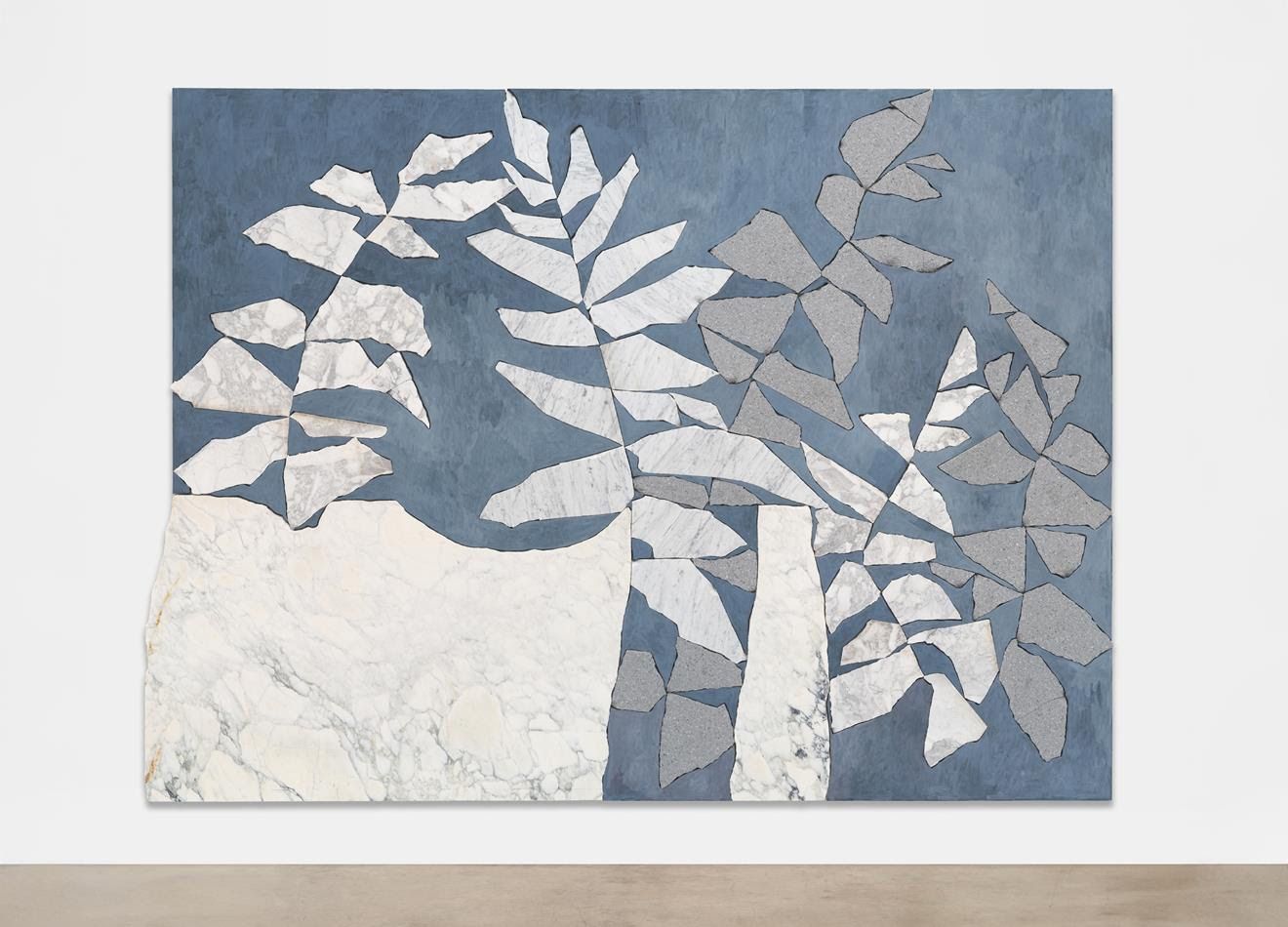
John Baldessari, James Casebere, Julian Charrière, Marcel Duchamp, Katharina Fritsch, Ana González, Laurent Grasso, Rebecca Horn, Callum Innes, Aki Inomata, Idris Khan, Joseph Kosuth, Zac Langdon-Pole, Yornel Martínez, Anthony McCall, Sam Moyer, Diana Fonseca Quiñones, Iran do Espírito Santo, Shahzia Sikander, Frank Thiel, Janaina Tschäpe, Kehinde Wiley, Sun Xun Sean Kelly is pleased to present The Audacity of Scale, a group exhibition that investigates the varied and often unexpected ways artists utilize scale both formally and conceptually. The exhibition considers how scale challenges perception, informs meaning, and influences the viewer's relationship to the work. Spanning painting, photography, video, works on paper, and sculpture, The Audacity of Scale includes a broad roster of international artists and includes works from the microscopic, to the monumental. James Casebere's early photograph evokes the allegory of Plato's cave, whilst referencing the landscape of the American West, blurring boundaries between illusion and reality. Marcel Duchamp's Élevage de poussiere (Dust Breeding) documents the accumulation of dust on the surface of his masterpiece The Large Glass, over the period of one year, whilst evoking images of the Nazca plain and aerial photography. Grand in size, Frank Thiel's photograph of a weathered paint surface, in a preunification Berlin factory, is transformed into an abstracted architectural landscape. Employing worldbuilding, Sun Xun's leporello combines expressionist symbolism with historical narrative, interrogating the construction of individual memory, official history, and state propaganda in contemporary China. Monumental paintings by Sam Moyer and Janaina Tschape are juxtaposed with intimately scaled works by Ana Gonzalez, Zac Langdon-Pole, and Aki Inomata, which explore humanity's relationship with the natural world. Sam Moyer's large-scale painting balances organic forms with architectural corporeality, whilst Janaina Tschape's gestural surfaces evoke biomorphic growth and fluidity. Ana Gonzalez's Euglossa depicts an orchid bee, covered in reclaimed gold, that references extractive mining practices, and reflects upon the longstanding mutual relationship between flora and fauna and immense ecological impacts on the Amazon's ecosystem. Aki Inomata's video examines the relationship between an octopus and a 3D printed shell, considering scale, not only as a matter of physical size, but also a measure of evolutionary time, adaptation, and interspecies relationships. Combining a meteorite, cradled within a delicate nautilus shell, Zac Langdon-Pole connects the depths of the ocean to the vastness of interstellar space. In Diana Fonseca Quinones's video, scale is playfully invoked as the artist's hand traverses Havana's urban skyline. Katharina Fritsch's St. Nicolas subverts devotional imagery, through domestic scale, a vivid fuchsia palette, and stylistic rendering, transforming traditional iconography into a psychologically charged sculpture that subverts perceptual expectations. Rebecca Horn's painting, from her seminal Bodylandscapes series, reflects her investigation into bodily limitation and spatial awareness. Similarly, Callum Innes's Exposed Painting is a masterful example of the largest painting the artist can physically make. Shahzia Sikander's sculpture, Now, represents an evolution of her recurrent motif of an allegorical female figure that embodies feminine strength and self-sovereignty. The work critically engages with and subverts traditional manifestations of patriarchal power, offering a nuanced discourse on gender and authority. Reimagining classical portraiture, Kehinde Wiley draws upon historic European miniatures, the artist conjures the grandiosity of the monumental paintings he is best known for and employs it on a miniature scale. Iran do Espirito Santo transforms an everyday light bulb into a minimalist sculpture using stainless steel and precise replication to investigate perception, light, and the tension between functional design and aesthetic contemplation. Joseph Kosuth's oversized clock, inscribed with Gertrude Stein's quote "If you can do it, why do it," pursues the artist's rigorous conceptual inquiry into the relationship between language and meaning. John Baldessari juxtaposes fragmented photographic imagery and text, collapsing distinctions between the monumental and the mundane, questioning how meaning is constructed through shifts in visual and linguistic framing. Through an intensive process of transformation, Julian Charriere's minimalist mirror repurposes silver from thousands of discarded black-and-white photographs, offering a poignant meditation on memory, preservation, and the recycling of rare minerals. In Laurent Grasso's painting, an ominous cloud envelops a cityscape, merging imagery of the past, with contemporary phenomena extracted from one of his films. Yornel Martinez's work imagines the Earth devoid of all countries and continents except for China. The absence of other countries for context emphasizes the perceived relationship between national and global scale. Anthony McCall's drawing for an unrealized public artwork, Projected Column, blurs distinctions of scale as the modest drawing stands in for a monumental intervention never physically realized. Employing special software, Idris Khan scanned a reproduction of Leonardo DaVinci's masterpiece, the Mona Lisa, to analyze the volume of colors utilized in the original artwork. The ratio of each framed element corresponds exactly to the percentage of each color employed in the original painting. Together, the works in The Audacity of Scale offer a profound exploration of how artists employ scale to construct complex relationships between concept, meaning, and perception. Bringing together widely ranging practices, the exhibition encourages the viewer to consider their own perception of scale, ranging from the intimate and personal to the expansive and monumental.
 PastSoil
Lindsay Adams
Apr 16 – May 31
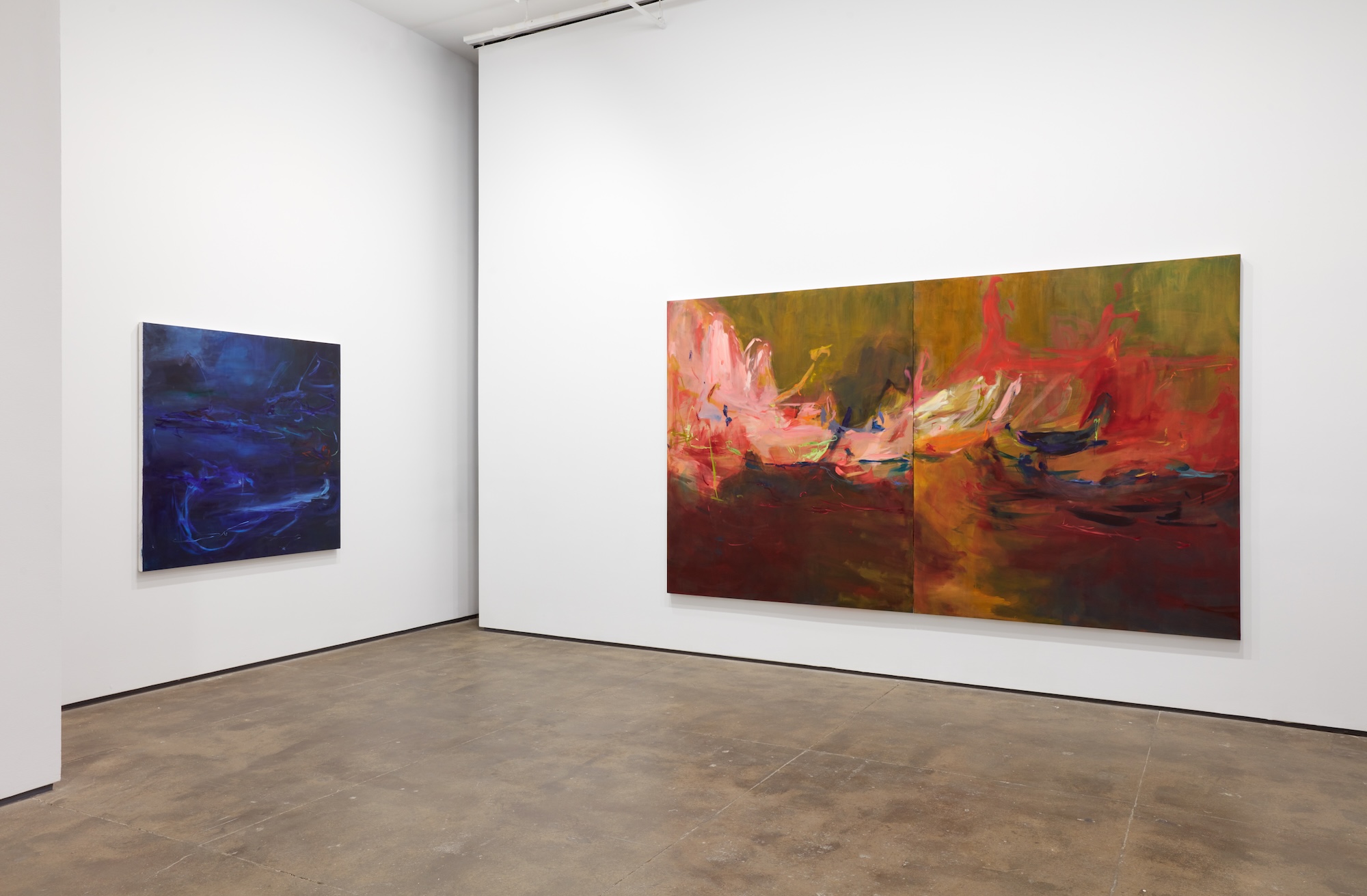
Sean Kelly is delighted to present Soil, Lindsay Adams's second exhibition with the gallery and her New York solo debut. This new body of work delves into Adams's ongoing investigation into how paintings can emerge from a black ground, using darkness, not as absence, but as a generative foundation from which color, gesture, and form unfold. "The sounds of color echo in my dreams. It is the magic I cannot quite explain. The alchemic decisions of line and mark are always connected by color, it is the beginning and end. Colors float through my mind, across time and dimension, where I think of my grandmother, Carrie Blue's, pink peony tree that sat outside of her window, or the green and white house tucked between the mountains of Bedford, Virginia, where I played with cousins on Easter Sunday. I can feel the dark brown coffee that is labeled as black, and the black and white newspaper with small moments of full color sits on the kitchen table I'd see each morning, next to the phthalo table napkins. It is the answer and the questions, forcing me to confront both what I know and don't know. Black - it is both absence and presence. It is there, even when you can't see it. The cover of night, the moments of rest in a cool dark room. It is the soil, the water, and the flowers. It is where I confront my burdens and where I lay my peace. Black understands light and darkness, and accepts all realities. It is both growth and decay, and stands, no matter the condition. Black, the ever beginning. Color, the decided end." —Lindsay Adams At the center of this exhibition is Adams's sustained exploration of color and how it can expand and redefine space. Adams approaches color as a living, shifting material that is built, disrupted, and reimagined through process rather than predetermined meaning. She uses Lamp Black as both a material and conceptual starting point. Rather than functioning solely as ground, black operates as a threshold of visibility. Luminous blues, pinks, and yellows move across the surface in energetic brushstrokes. Color is not fixed but accumulative and responsive, emerging through a process of addition, removal, and rearticulation, with each layer carrying the essence of prior decisions. Adams' gestures defy containment, the marks are unbound. Through chiaroscuro, she activates moments of luminosity and obscurity, allowing forms to emerge, recede, and dissolve within the surface. Adams builds upon a long artistic lineage of artists engaging with the color black throughout the history of painting and abstraction. Painters as diverse as Francisco Goya, Eugene Delacroix, and Kazimir Malevich deployed black to evoke drama, horror, the psychological intensity of violence and struggle, and even spirituality over the ages. Adams repositions this legacy within a broader contemporary conversation among artists such as Mary Lovelace O'Neal and Raymond Sanders, whose practices similarly explore the conceptual and material possibilities of black within abstraction. In Soil, Adams reflects on questions of place, memory, and emotional terrain to create psychological landscapes rather than fixed imagery. In this way, each painting becomes a world built through experimentation, where memory, intuition, and material process converge. Rooted in a deep commitment to the possibilities of painting, the exhibition reveals Adams's continued mastery of color, surface, and gesture, whilst affirming black as a generative ground from which new visual worlds can emerge. Lindsay Adams lives and works in Chicago, IL. Adams received two BAs in International Studies: World Politics and Diplomacy and Spanish from the University of Richmond and an MFA in Painting and Drawing from the School of the Art Institute of Chicago. In 2025, her work was selected to be featured in the Obama Presidential Center opening in June. Adams' work has been featured in a major solo exhibition at the Irene and Richard Frary Gallery, Johns Hopkins University, Washington, D.C., the Baltimore Museum of Art, and the Martin Luther King Jr. Memorial Library. Her work is included in major public and private collections. In 2024, she was recognized with the Helen Frankenthaler Award. She is currently an Artist-in-Residence at Silver Art Projects, the World Trade Center.
 PastThe Simple Act of Positioning
Jose Dávila
Apr 16 – May 31
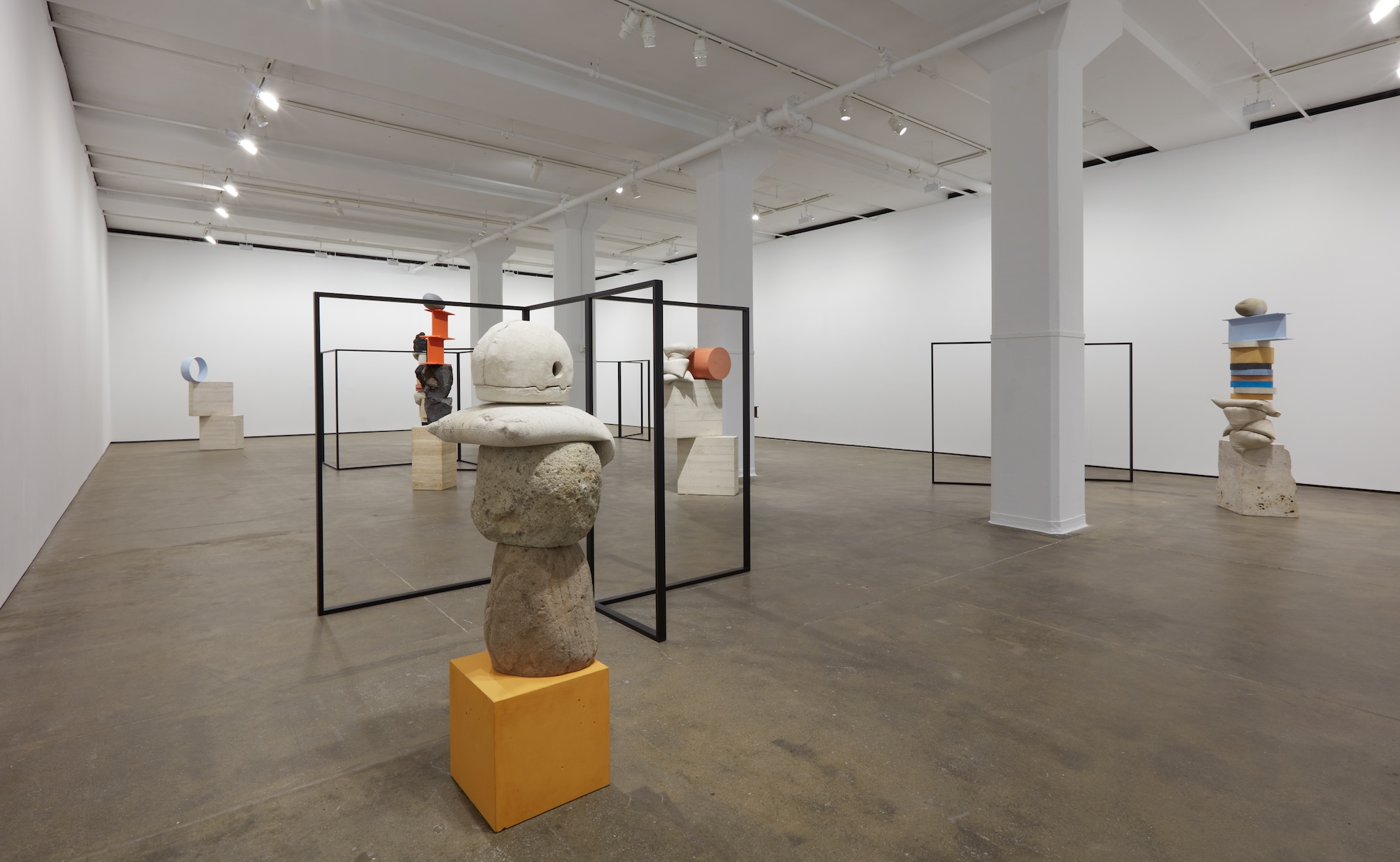
Sean Kelly is delighted to present The Simple Act of Positioning, Jose Davila's fifth solo exhibition with the gallery. With this new body of work, Davila continues his sustained investigation into one of sculpture's most elemental gestures: the fundamental act of placing one thing in relation to another. Rather than transforming materials through carving or modeling, he works through deliberate acts of positioning, arranging elements so that relationships, tensions, and meanings emerge between them. Davila approaches sculpture not simply as an object, but as a situation in which meaning arises through the relationships between materials. His work employs stones, concrete forms, industrial materials, steel beams, sandbags, and geometric volumes, brought together in configurations that appear both precise and improbable. Each element retains its material identity, yet through their arrangement, the works register weight, gravity, and balance in newly perceived ways. This approach resonates with a long lineage within the history of sculpture. Early constructions such as the standing stones of Carnac, in France, or the stone circle of Castlerigg, in England, derived their power not from the transformation of material but from the careful placement of stones within the landscape. Through alignment and orientation, rocks became structures that helped humans situate themselves in relation to space, time, and the cosmos. In the twentieth century, artists including Marcel Duchamp and Jannis Kounellis further demonstrated how meaning can emerge through acts of selection and placement. Duchamp's readymades revealed that repositioning an object could radically shift its significance, while Kounellis explored how materials such as coal, steel, or burlap acquire historical and symbolic weight when placed within carefully constructed contexts. Davila continues this dialogue whilst foregrounding it in the physical realities of weight and gravity. In the studio, materials are moved, rotated, stacked, and repositioned until a relation appears that feels both precarious and inevitable. Gravity becomes an active collaborator in this process: once an object is placed, its consequences are real, and stability is never entirely guaranteed. In The Simple Act of Positioning, the sculptures create situations in which materials encounter one another, and new relationships become visible. In this sense, Davila's work returns to a gesture that lies close to the origin of sculpture itself: the simple act of placing one thing beside another, allowing matter, space, and human attention to converge. Jose Davila has presented solo exhibitions at the Museum Haus Konstruktiv, Zurich, Switzerland; Dallas Contemporary, Texas, United States; JUMEX Museum, Mexico City, Mexico; Hamburg Kunsthalle, Hamburg, Germany and the Museo del Novecento, Florence, Italy, amongst others. His work is in the permanent collection of numerous institutions including the Museo Universitario Arte Contemporaneo (MUAC), Mexico City, Mexico; Museo Nacional Centro de Arte Reina Sofia, Madrid, Spain; Inhotim, Brumadinho, Brazil; the Perez Art Museum, Miami, Florida, United States; the Buffalo AKG Art Museum, Buffalo, New York, United States; the San Antonio Museum of Art, San Antonio, Texas, United States, the Solomon R. Guggenheim Museum, New York, United States; the Centre Pompidou, Paris, France; Hamburg Kunsthalle, Hamburg, Germany; and the Museum of Modern Art, Luxembourg, Germany. Dávila was the winner of the 2016 Baltic Centre for Contemporary Art's New Annual Artists' Award, Artists honoree of the Hirshhorn Museum in Washington DC in 2016, the 2014 EFG ArtNexus Latin America Art Award. Davila has been the recipient of support from the Andy Warhol Foundation, a Kunstwerke residency in Berlin, Germany and the National Grant for young artists by the Mexican Arts Council (FONCA) in 2000. In 2023, Hatje Cantz published a major monograph illustrating the past twenty years of Davila's practice.
 PastRío
Ana González
Feb 26 – Apr 12
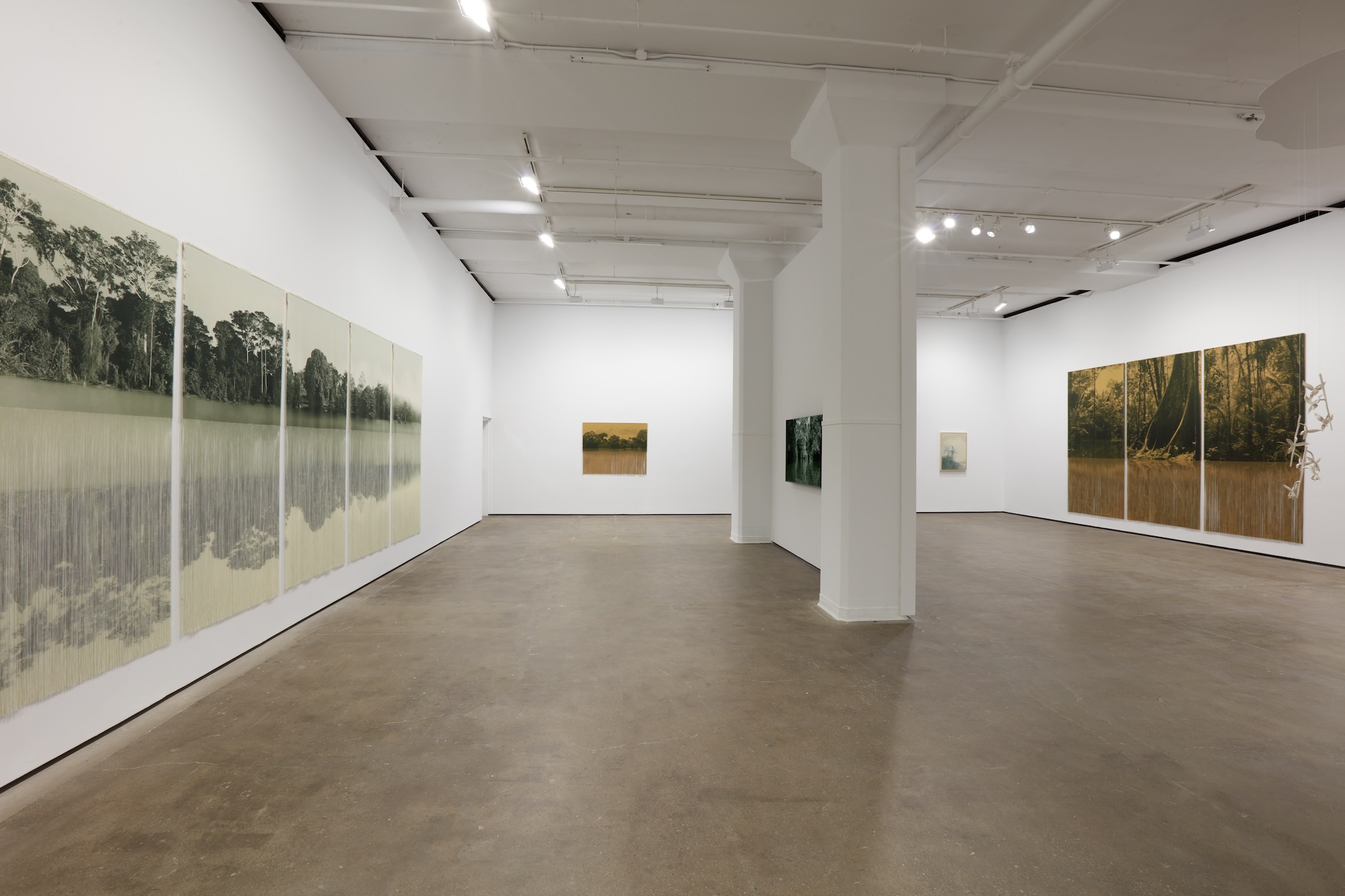
Sean Kelly is delighted to present Río, Ana Gonzalez's third exhibition with the gallery. Conceived as a metaphorical river, Río flows through cascades, forests, and tropical jungles. Employing textiles, painting, porcelain, and video the exhibition conjures memory, emotion, and material transformation. Informed by indigenous cultures and their relationship to the land, water, and forests as living entities, the exhibition offers an immersive meditation on fragile ecosystems and the urgent need to re-sanctify the natural world. The exhibition opens with new works from Gonzalez's Devastations series, created from sublimated photographic images of rivers flowing from the Amazon and the Andes Mountains. Drawing on ethnographic understandings of forests and waterways as sacred territories of abundance and renewal, Gonzalez physically unravels the fabric of each work from the bottom up, thread by thread. This act of deconstruction becomes a powerful metaphor for the slow unweaving of nature under increasing human pressure. In Río, Gonzalez introduces two new color palettes to the series: a rose hue referencing the shifting light of Amazonian sunsets, and a gold palette that alludes to El Dorado and the mythic pursuit of boundless wealth. In her use of gold, Gonzalez reframes the legend, suggesting that it is the region's natural resources that constitute its true treasure. The iconic green tones, evoke both vegetation and currency, underscoring the tension between economic exploitation and the sacred value of life, echoing Alexander von Humboldt's assertion that nature exists as an interconnected fabric, vulnerable to disruption at every point. Gonzalez's paintings, drawings, and watercolors hover between presence and disappearance, dissolving into mist and drizzle like fleeting recollections of paradise. They chart a geography where interior and exterior worlds converge, transforming painting into an act of resistance and a provocation, to preserve what is sacred before it vanishes. Sculptures in Limoges porcelain are suspended as a delicate cascade of heliconias and orchids rendered in luminous white. Historically associated with purity and refinement, porcelain becomes a poetic medium through which the artist addresses ecological fragility. Each sculpture embodies both resilience and vulnerability, revealing how beauty and destruction coexist within the same fragile surface. A new video work further immerses viewers in the rainforest, capturing the ambient sounds of birds and flowing water recorded during Gonzalez's travels by boat. This sensory portrait foregrounds the unseen labor and lived experience behind Gonzalez's practice, reinforcing the exhibition's emphasis on process, and presence. The exhibition concludes with a vitrine displaying small porcelain sculptures alongside travel journals, sketches, and objects carried by the artist on her journeys. Together, these elements form a mnemonic archive of observation and remembrance, bearing witness to the artist's pilgrimage through threatened yet sacred landscapes. Río is ultimately a meditation on loss and persistence, on forests and rivers at risk, yet still alive in collective memory and imagination. Through the sensuality and beauty of the tropics, Gonzalez invites viewers to recognize the places of power embedded within the natural world and to reconsider our responsibility to protect the environments that sustain both life and the spirit.
 PastShort Letter, Long Farewell
Kristy Chan
Feb 26 – Apr 12
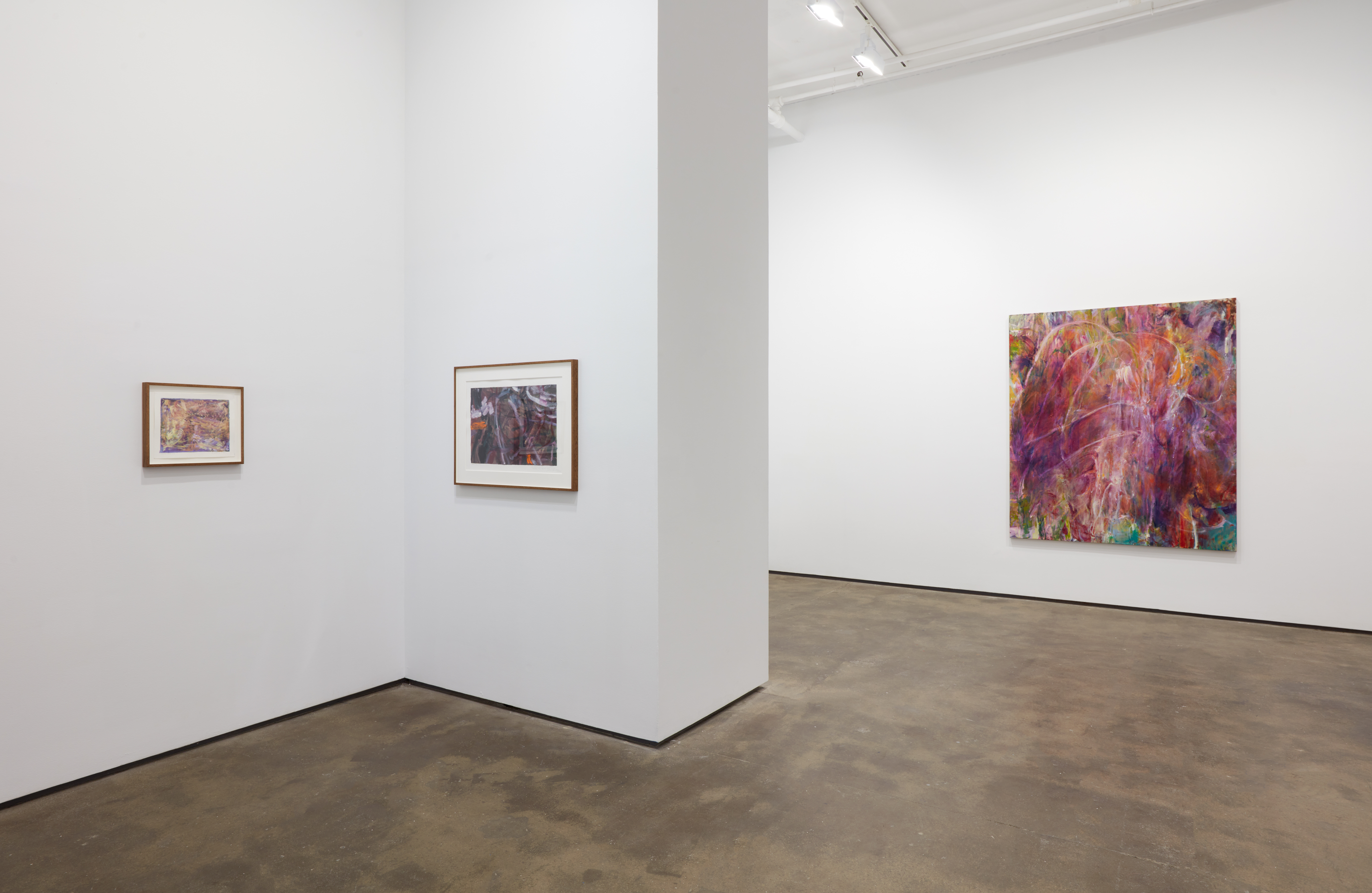
Sean Kelly is delighted to present Kristy Chan’s first solo exhibition in New York. Short Letter, Long Farewell presents a new body of paintings and drawings that meditate on movement, longing, and the quiet intensity of everyday experience. Born in Hong Kong and living in London, Kristy Chan approaches America as both a real and imagined place. The exhibition takes its title from Peter Handke’s novel Short Letter, Long Farewell, and unfolds as a reflective letter to America, the promise of renewal, and the uncertainty that shadows new beginnings. In Handke’s book, America is a place where the possibility of a new life exists alongside the remnants of an old one, a tension that resonates throughout Chan’s work. Several artworks in the exhibition draw directly from literature and cultural memory as frameworks for understanding the self, while others are rooted in moments of observation and lived experience. Together, these approaches give form to themes of inheritance and displacement, and the ongoing negotiation of belonging, memory, and selfhood. Painted between 2024 and 2026, her canvases are inspired by fleeting encounters; a sunset, a walk through the park, or a remembered conversation, inviting a pause to recognize the beauty in the ordinary. In a moment marked by political, social, and environmental flux, the exhibition asks us to remain attentive to what is still luminous and human. Chan’s practice moves fluidly between figuration and abstraction, combining densely applied oil and oil stick with a distinctly intuitive, improvisational approach. As writer Izzy Bilkus observed, Chan’s work carries “a playfulness… but also an echo of the same energy that animates her paintings; a refusal to stagnate.” Kristy Chan was born in 1997 in Hong Kong and currently lives and works in London. She received her BFA from the Slade School of Fine Art at the University College London, and her MA in Contemporary Art from Sotheby’s Institute of Art, London. Chan’s work has been featured internationally in both solo and group exhibitions.
- No imagePastShort Letter, Long Farewell
Kristy Chan
Feb 26 – Apr 12
Sean Kelly is delighted to present Kristy Chan’s first solo exhibition in New York. Short Letter, Long Farewell presents a new body of paintings and drawings that meditate on movement, longing, and the quiet intensity of everyday experience. Born in Hong Kong and living in London, Kristy Chan approaches America as both a real and imagined place. The exhibition takes its title from Peter Handke’s novel Short Letter, Long Farewell, and unfolds as a reflective letter to America, the promise of renewal, and the uncertainty that shadows new beginnings. In Handke’s book, America is a place where the possibility of a new life exists alongside the remnants of an old one, a tension that resonates throughout Chan’s work. Several artworks in the exhibition draw directly from literature and cultural memory as frameworks for understanding the self, while others are rooted in moments of observation and lived experience. Together, these approaches give form to themes of inheritance and displacement, and the ongoing negotiation of belonging, memory, and selfhood. Painted between 2024 and 2026, her canvases are inspired by fleeting encounters; a sunset, a walk through the park, or a remembered conversation, inviting a pause to recognize the beauty in the ordinary. In a moment marked by political, social, and environmental flux, the exhibition asks us to remain attentive to what is still luminous and human. Chan’s practice moves fluidly between figuration and abstraction, combining densely applied oil and oil stick with a distinctly intuitive, improvisational approach. As writer Izzy Bilkus observed, Chan’s work carries “a playfulness… but also an echo of the same energy that animates her paintings; a refusal to stagnate.” Kristy Chan was born in 1997 in Hong Kong and currently lives and works in London. She received her BFA from the Slade School of Fine Art at the University College London, and her MA in Contemporary Art from Sotheby’s Institute of Art, London. Chan’s work has been featured internationally in both solo and group exhibitions.
 PastDe Tierra y Susurros
Hilda Palafox
Jan 8 – Feb 22
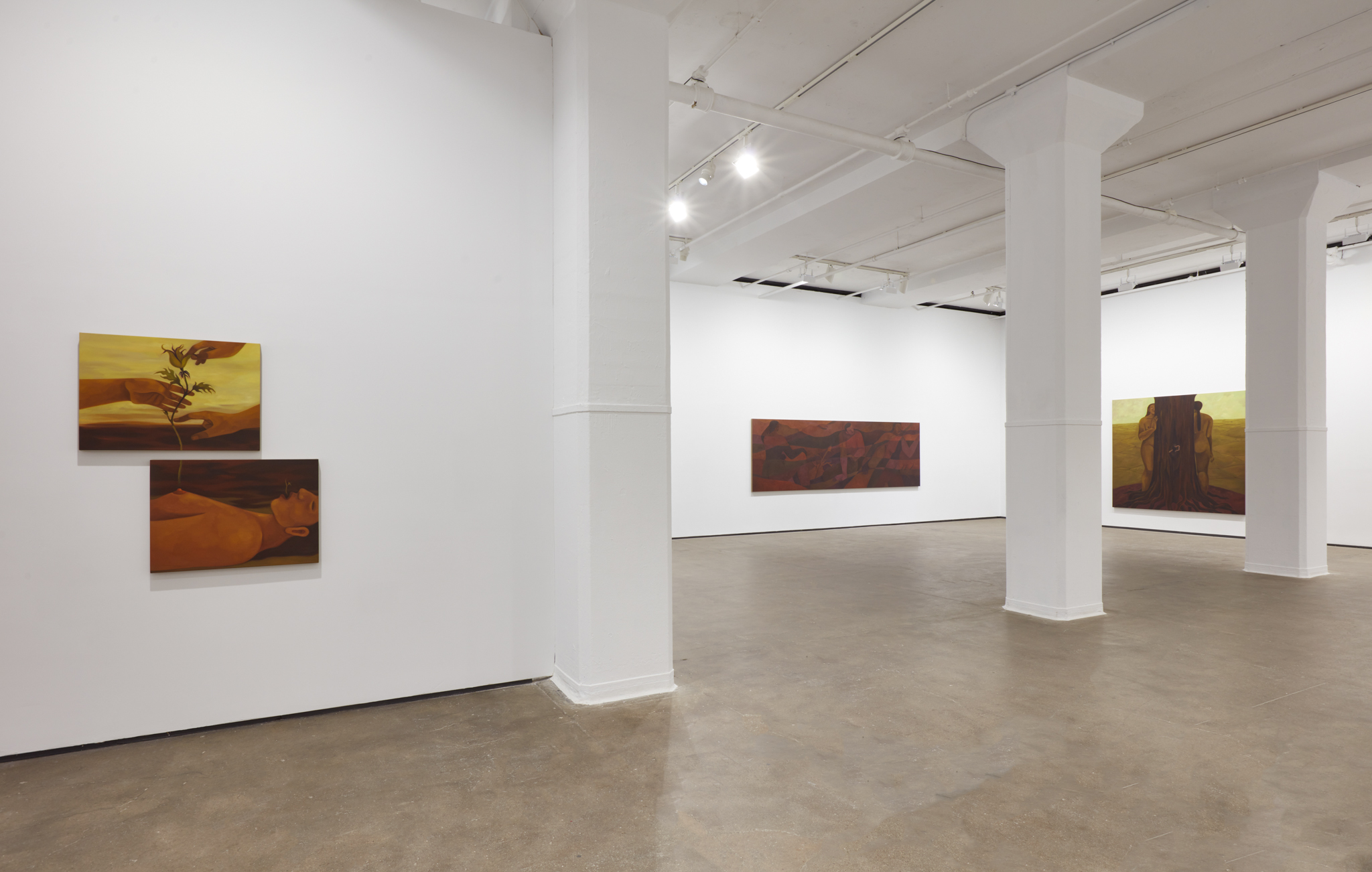
Sean Kelly is delighted to present De Tierra y Susurros, an exhibition of new paintings and sculptural reliefs by Hilda Palafox. In this powerful body of work, Palafox explores a metaphoric and visual language rooted in Latin American folklore and ecofeminist thought. With this series she reflects on humanity’s interdependence with the natural world. Rooted in the human condition, Palafox’s practice addresses themes of identity and resilience through a distinctly feminine lens. Her work unfolds as an inquiry into subjectivity and the body, balancing intimacy with monumentality. Exploring the tension between public grandeur and inner sensitivity, Palafox’s imagery resides between the invisible emotional landscape and its external, formal expression. There is an internal order in her painting, grounded in the solidity of pictorial space, the curvilinear rhythm of her lines, and a palette that creates atmospheres both familiar and otherworldly. Palafox reimagines everyday scenes as meditations on emotion and consciousness, weaving analogies between domestic life and the natural environment. Her figures, often rendered in ambiguous form, become metaphors for collective humanity, transcending gender while anchored in the feminine experience. Taking its title from the Spanish phrase De Tierra y Susurros, which translates to Of Soil and Whispers, the exhibition unfolds as telluric poetry, a visual anthology in which the earth itself becomes both subject and voice, its warm, earthen tones evoking a landscape that speaks and sustains. With this body of work, Palafox draws inspiration from Latin American ecofeminist philosophy, which posits a spiritual and historical connection between women and the earth. “For me, the point where two lines meet, lies precisely there: in the conscious decision to pause, to listen, and to pay closer attention.” Her new works engage this idea gracefully, intertwining ecological awareness with reflections on colonialism, spirituality, and the body’s relationship to land. The stone relief works, or portales, function as a threshold between worlds where the human body becomes a metaphor for pollination, transformation, and consciousness. Each flower is conceived as a passage between matter and spirit, the seen and unseen. References to historical legends and oral traditions echo throughout the exhibition, as Palafox addresses the consequences of humankind’s occupation and alteration of the earth. A painting incorporating wire fencing evokes boundaries, both territorial and mental, inviting reflection on the systems that divide and constrain. Her expressive imagery hints at the oppositional yet intertwined structures of authority and domesticity, technology and nature, proposing a renewed attunement with the environment. Hilda Palafox (b. 1982) lives and works in Mexico City. Palafox graduated from the Escuela de Diseño del Instituto Nacional de Bellas Artes in Mexico City. Her work has been exhibited widely in Mexico, Japan, the United States, Spain, South Korea, and Australia. Her murals can be found in public spaces throughout Mexico, Brazil, the United States, Canada, Japan, Belgium, and Spain.
 PastGround Work (Field Revision)
Jan 8 – Feb 22
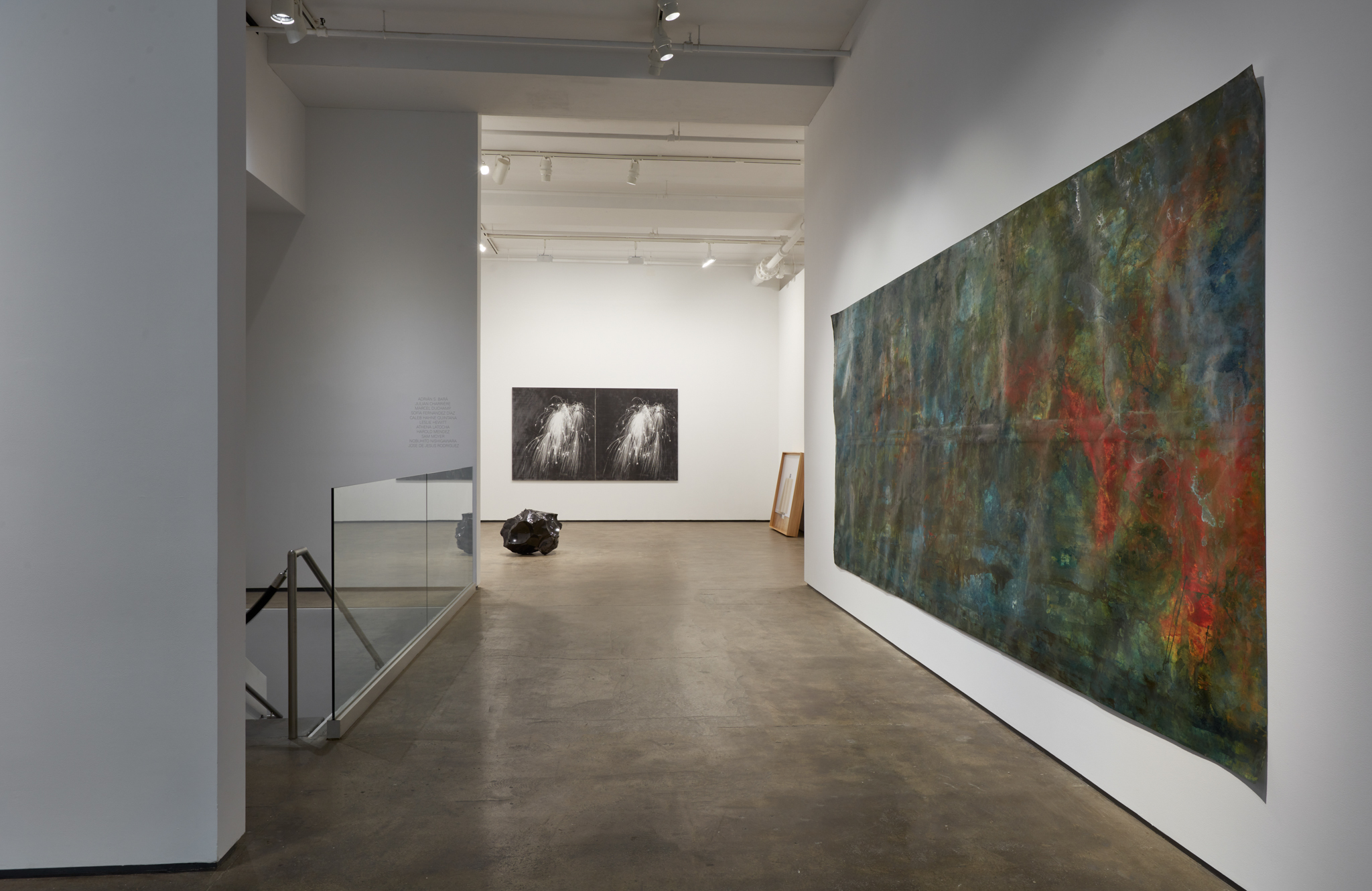
Adrian S. Bara, Julian Charriere, Sofia Fernandez Diaz, Marcel Duchamp, Leslie Hewitt, Athena LaTocha, Harold Mendez, Sam Moyer, Nobuhito Nishigawara, Caleb Hahne Quintana, Jose de Jesus Rodriguez Sean Kelly is delighted to present Ground Work (Field Revision) organized by Los Angeles-based curator and Executive Director of The Cultivist, Joey Lico. The exhibition brings together twelve artists whose practices consider how the earth is held, shaped, remembered, and reimagined. Rather than depicting landscape, the artists work within its materiality. Dust, pigment, metal, and glass function not as metaphors, but as witnesses. Through sculpture, photography, painting, and installation, the exhibition examines how material and psychological terrains shape one another, and how acts of construction, resistance, and renewal emerge from the strata of lived experience. Curator Joey Lico and several of the featured artists will be present. Works by Adrian S. Bara, Sam Moyer, Leslie Hewitt, and Caleb Hahne Quintana address architectures, both literal and internal, through which memory and meaning take form. Bara's precarious constructions echo the instability of the built environment. Moyer's concrete-encased photographs collapse infrastructure and image into a single object, while Hewitt distills memory into spatial grammar, structuring stillness with photographic and sculptural restraint. Hahne Quintana's atmospheric paintings trace displacement across emotional terrain, where figures dissolve into fields of color and distance. Working across photography, assemblage, and material abstraction, Sofia Fernandez Diaz, Marcel Duchamp, Jose de Jesus Rodriguez, and Harold Mendez question what lingers and remains. Fernandez Diaz builds sculptural forms that balance between permanence and collapse, articulating presence through pressure. Rodriguez merges sand, lime, and pigment into vibrating geometries that feel simultaneously built and breathing. Mendez's oxidized surfaces, water-worn wood, and stained textiles function as quiet excavations--objects that mourn disappearance while dignifying what remains. Duchamp's inclusion reveals early fault lines in the language of material residue and abstraction. Addressing the geologies of time, Julian Charriere exposes the sediment of human ambition, rendering planetary transformation through obsidian, heliography, and industrial remnants that glisten with both ruin and renewal. Athena LaTocha presses ash, soil, and industrial residue into sweeping works that collapse geological, historical, and personal timelines. Nobuhito Nishigawara recomposes fractured rock into sculptural acts of repair, in which gold-glazed seams carry ancestral memory and geological persistence forward. Across these distinct practices, Ground Work (Field Revision) asks what it means to inhabit a ground--natural or constructed--that is continually shifting. The exhibition proposes that every surface holds the politics of its making, and that the materials closest to the earth's memory, dust, stone, metal, pigment, are also the ones through which artists articulate resilience, rupture, and renewal.
Past
RadianceMariko Mori
Oct 30 – Dec 21
Sean Kelly is delighted to present Radiance, an exhibition of new work by internationally acclaimed artist Mariko Mori. In this deeply contemplative presentation, Mori unites cutting edge technological materials with ancient cosmologies, drawing inspiration from the enduring spiritual traditions of Japan. Spanning sculpture, installation, and works on paper, the exhibition reflects Mori’s long-standing engagement with metaphysical concepts and technical innovation grounded in her cultural heritage. Radiance is rooted in Mori’s extensive research into Japan’s stone cultures from the Jomon (14,000–300 BCE) and Yayoi (300 BCE–300 CE) periods through the Kofun (250–538 CE) and Asuka eras (538–710 CE). Informed by site visits to sacred geological formations across the Japanese archipelago, including the storied rocks of Okinoshima Island and the shrines of Izumo and Awaji, Mori focuses on these ancestral sites through a contemporary lens. Upon entering the main gallery, visitors are greeted by two luminous stone pillars. These works, from Mori’s Stone series, reimagine Japan’s revered rocks, or Iwakura, which for millennia have been sites of divine presence. Their dichroic surfaces shift with ambient light and the viewer’s movement, reimagining invisible energies that recall the stones’ original function as portals to the sacred. Also in the main gallery, Mori has installed an environment that recreates the spiritual experience of entering shrines in Japan. Presented entirely in white, the installation evokes a space of purity and transcendence. A soft breeze gently moves through the silk veils wrapping the inner sanctum, infusing the work with an almost imperceptible sense of movement and breath. Within this meditative environment are two additional stone works, Kamitate Stone I and Oshito Stone III, their luminous surfaces resonating with the surrounding architecture. Together, the shrine and sculptures form the heart of the exhibition, offering a space of stillness and reflection that connects historic belief systems with Mori’s futuristic vision. Surrounding this sacred core are Mori’s Unity photo paintings which reflect on the interconnectedness of all things. Rooted in rituals and philosophies such as the Chadō (tea ceremony), they embody Mori’s broader practice at the intersection of art, science, spirituality, and technology. As the artist recalls, the series was inspired by an overwhelming vision of radiant light. Mori recalls, “the manifestation of a profound and boundless love—the primordial source from which all life arises… In that sacred moment, I felt a profound connection to the Great Light. My heart overflowed with the realization that no soul is ever truly alone.” Through these works, Mori conveys this eternal bond between the divine presence and all living beings. In the front gallery, Mori presents poetic works on silk and paper that extend the meditative quality of the series. Their refined execution and contemplative scale invite close looking, offering an intimate counterpart to the monumental stones and shrine. Together, these works create a rhythm of immersion and reflection that anchors the exhibition. Radiance expands Mori’s visionary practice, seamlessly intertwining the spiritual and the technological, the material and the immaterial. It invites viewers to journey through spaces of transcendence and reflection, reminding us of the interdependence of humanity, nature, and the cosmos. Mariko Mori lives and works in New York and Tokyo. In the Fall of 2026, the Mori Art Museum, Tokyo, Japan will present a major retrospective of Mariko Mori’s works featuring eighty works spanning three decades. The exhibition is co-curated by Alexandra Munroe, Senior Curator at Large, Global Arts, Guggenheim Museum and Foundation, and Mami Kataoka, Director, Mori Art Museum. Her work has been the subject of solo exhibitions at major international institutions, including the Royal Academy of Arts, London; the Japan Society, New York; The Serpentine Gallery, London; and the Centre Pompidou, Paris amongst others. Mariko Mori’s work is in the collections of the Guggenheim Museum, New York; the Museum of Modern Art, New York; the Tate Modern, London; the Louisiana Museum, Denmark; the ARoS Aarhus Kunstmuseums, Denmark; the Asia Society, New York; the Pinchuk Foundation, Ukraine; the San Francisco Museum of Modern Art, and the Buffalo AKG Art Museum, amongst many others worldwide. Mori has received numerous awards, including the prestigious Menzione d’onore at the 47th Venice Biennale in 1997 and the 8th Annual Award as a promising Artist and Scholar in the Field of Contemporary Japanese Art in 2001 from Japan Cultural Arts Foundation. In 2014, she was named an honorary Fellow of University of the Arts London.
Past
Wherever I Went, I Went When I Was SleepingHarminder Judge
Sep 5 – Oct 19
Sean Kelly is delighted to present Wherever I Went, I Went When I Was Sleeping, Harminder Judge's first exhibition with the gallery. New large plaster-and-pigment panels, works that exist at the intersection of painting, sculpture, and architecture, are presented alongside shaped pieces that hover off the wall like fragments excavated from deep time. For this exhibition, Judge has created a site-responsive floor installation spanning the entire front gallery. Constructed from the same materials as his paintings, the vast slab appears like a geological formation, disorienting in its scale and placement. Together, they create an immersive space where material, image, and architecture converge. Harminder Judge has developed a distinctive practice that merges Indian neo-tantric painting with the legacies of Western abstraction and color field painting. Referring to his works as portals as much as objects, they are informed by ritual, spirituality, and deeply personal experiences. The exhibition's title is drawn from Susan Howe's 1975 poem Chanting at the Crystal Sea and reflects the way Judge's work inhabits an in-between state, hovering between material and immaterial, presence and absence, surface and portal. During a visit to Punjab in early adolescence for his grandfather's funeral, the ceremonial rites impressed upon him the profound transformation of body into ash, matter into spirit. This led to an ongoing meditation on the spaces between life and death, material and immaterial, conscious and subconscious, which resonate throughout his practice. Judge's process is ritualistic and alchemical. He begins his paintings by pouring wet plaster into large tray-like beds, working quickly as the exothermic reaction quickly sets the surface. Into this unpredictable ground, he layers pigments, without at that stage, being certain of the outcome. The asymmetrical diptychs in the exhibition are built on two parallel tables, with each gesture repeated to create mirrored panels, requiring instinctive movement and a simultaneous awareness of both surfaces. The necessity for speed and replication imbues the act of making with a performative quality, the artist's precise yet instinctive motions unfolding like a ritual. After curing, the works undergo many hours of strengthening and laborious layering before they can be revealed. Through extensive sanding, polishing, and oiling, their luminous compositions slowly emerge. Far from a painted illusion, these works operate as sculptures: their surface, structure, and support are one and the same, with pigment crystallized within the material itself. Balancing chance and control, their stratified surfaces recall geological formations while vibrating with radiant color, portals that invite us to look toward larger questions of subject and meaning. Judge's floor installation transforms the act of entering the gallery into a physical and conceptual threshold. Visitors find themselves simultaneously standing upon and surrounded by the very substance of Judge's practice. Made of the same plaster and pigment that constitute the wall works, Judge collapses the distinctions between object and environment. The shaped wall works further intensify this effect, appearing like slabs of rock or portals pried open, deepening the viewer's sense of inhabiting the work rather than observing it. In Wherever I Went, I Went While I Was Sleeping, Judge creates an environment that is both contemplative and immersive, inviting audiences to inhabit a liminal space between painting and sculpture, material and metaphysical, through which to encounter something larger than the self. Harminder Judge, born in 1982, lives and works in London. He graduated from the Royal Academy Schools, London in 2021. His work was recently the subject of a major solo exhibition Harminder Judge: Bootstrap Paradox at moCa Cleveland, OH, from January 24 - June 1, 2025. Judge is represented by The Sunday Painter, London, UK, and Jhaveri Contemporary, Mumbai, India.
Past
CamouflageAnthony Olubunmi Akinbola
Sep 5 – Oct 19
Sean Kelly is delighted to present Camouflage, an exhibition of new paintings by Anthony Olubunmi Akinbola. Marking a pivotal moment in the artist's practice nearly a decade after he first began working with durags as his primary material, this exhibition is the apotheosis of Akinbola's evolving relationship with durags and their cultural associations. Presenting a range of styles, this new body of work reflects a shift from overt sociopolitical commentary toward a more nuanced, materially focused inquiry, centering on the durag's formal potential, chromatic variation, and emotional resonance. Titled in homage to Akinbola's earliest durag works, Camouflage explores the idea of metamorphosis, how a material, like identity, can adapt, evolve, and carry multiple readings at the same time. Akinbola's durag paintings, which once spoke primarily to themes of assimilation, stereotype, and Black identity, now reveal themselves equally as rigorous studies in color theory and abstraction. Drawing on the durag's variability, such as discrepancies born from supply chain idiosyncrasies, Akinbola mines beauty supply stores for unique tones and textures, orchestrating compositions that oscillate between loose improvisation and grid-like formalism. This focus on material experimentation has also allowed Akinbola to imbue his work with greater emotional intimacy. Though the durag remains a politically charged object, the works in Camouflage are less concerned with teaching or critique and more attuned to how color, texture, and gesture can express personal states such as anxiety, grief, or joy. "Color itself is political," Akinbola states, "and strong enough to carry meaning on its own." In this way, the durag becomes both medium and metaphor--camouflaging not only the head but also the intentions behind the work, simultaneously concealing and revealing. Camouflage also introduces a new series of "brick" paintings that signal a conceptual expansion within Akinbola's durag-based practice. Inspired by his time at the Black Rock Residency in Dakar, these works reference the ubiquitous, often incomplete construction projects seen throughout the region--physical symbols of aspiration, labor, and halted progress. Akinbola approaches the brick as both a literal and metaphorical building block: a gesture toward permanence, infrastructure, and legacy. The brick motif also opens a compelling dialogue between textile and architecture. In these works, the stitch becomes mortar, binding fragments into a unified structure that is as much about memory and endurance as it is about form. In Camouflage, Akinbola doesn't abandon the history of the durag but expands its visual language. His paintings speak to transformation, not just of material, but of purpose, intention, and of self. In doing so, he opens new space for the durag to function not only as a symbol of identity, but as a radical vehicle for color and abstraction. Anthony Olubunmi Akinbola was born in Columbia, Missouri, in 1991 and received a BA in communications and media from SUNY Purchase College. In February 2027, his work will be the subject of a two-person exhibition at the Carnegie Museum of Art in Pittsburgh, PA. His work was recently the subject of a major solo exhibition at the SCAD Museum of Art, Savannah, Georgia. He has also exhibited one person and group exhibitions at renowned institutions such as the Guggenheim, New York; the Institute of Contemporary Art San Francisco, San Francisco, CA; Schirn Kunsthalle, Frankfurt, Germany; The Queens Museum, New York; the Randall Recreation Center, Washington D.C.; the August Wilson African American Cultural Center, Pittsburgh, PA; the John Michael Kohler Arts Center, Sheboygan, WI; the Saint Louis Art Museum, St. Louis, MO; Kunsthaus Graz, Graz, Austria; the Bruce Museum, Greenwich, CT; and the Museum of Art and Design, New York, NY, amongst others. His work is included in numerous collections, such as the Solomon R. Guggenheim Museum, New York, NY; the Nasher Museum of Art at Duke University, Durham, NC; The Everson Museum of Art, Syracuse, NY; the Detroit Institute of Arts, Detroit, MI; the Speed Art Museum, Louisville, KY; the Ogunquit Museum of American Art, Ogunquit, ME; the Pizzuti Collection, Columbus, OH; the Beth Rudin DeWoody Collection, West Palm Beach, FL; and the Zabludowicz Collection, London, UK.
Past
Faktura / TektonikaJun 26 – Aug 2
Lindsay Adams, Ernesto Burgos, James Casebere, Marco A. Castillo, Julian Charrière, Wu Chi-Tsung, Jose Dávila, Anthony Olubunmi Akinbola, Donna Huanca, Harminder Judge, Nour Malas, Hugo McCloud, Sam Moyer, Brian Rochefort, Ilana Savdie, Dolores “Loló” Soldevilla, Janaina Tschäpe The exhibition Faktura / Tektonika presents a selection of works that highlight two foundational components of early 20th-century Constructivism: faktura, the material properties of an object, and tektonika, an object's spatial presence. In the lineage of the Constructivist movement, the exhibition foregrounds artists who emphasize material and form as active forces in artistic production. Through a range of practices that include the use of industrial media, alternative photographic processes, and an exploration of the self-reflexive properties of a chosen material, the works on view investigate the ways in which surface, structure, and perception intersect. Bringing together artists from within and beyond the gallery's program, Faktura / Tektonika draws connections between emerging and established artists across multiple generations in the enduring spirit of this revolutionary movement in the history of art. Embodying Faktura / Tektonika is the work of pioneering Cuban artist Dolores 'Lolo' Soldevilla (1901-1971) whose geometric constructions emphasize modularity, spatial relationships, and a Constructivist approach to building form through her use of material and exploration of dimensionality. Works on paper by Marco A. Castillo (b. 1971) are a result of his observations of quotidian materials and bring geometric elements from the historical context of Modernist, Soviet, and Cuban design into the present moment. Similarly, circular forms from throughout art history are graphically employed in the paintings of Jose D avila (b. 1975). Davila's stone and concrete sculptures echo architectural structure and stability, highlighting the Constructivist emphasis of industrial materials. Also engaging with industrial materials are Ernesto Burgos (b. 1979), Harminder Judge (b. 1982), Sam Moyer (b. 1983), and Hugo McCloud (b. 1980). The works of Ernesto Burgos exist at the intersection of painting and sculpture with substrates composed of cardboard, fiberglass, and resin finished with oil and charcoal; these pieces assert themselves into space through their corporeal presence. Harminder Judge layers pigment into wet plaster, sanding, polishing, and oiling his panels to luminous, sensuous effect. Sam Moyer, in contrast, paints plaster-coated canvas to serve as the ground for pieces of salvaged stone embedded into her paintings, which, along with her freestanding sculptures, highlight texture, composition, and assemblage. Hugo McCloud's 'stamped' paintings reference industrial construction and material labor with repetitive patterns that have been impressed on malleable tar paper. While photography is often associated with capturing reality, Faktura / Tektonika foregrounds artists who challenge this assumption by using alternative photographic processes to construct their images rather than simply capture them. James Casebere (b. 1953) builds intricate architectural models, which he then lights and photographs, to create images that reimagine both the context and content of the structures that influence them. Julian Charriere's (b. 1987) heliographs of California oil fields are created with the raw materials of their depicted sites by incorporating naturally occurring tar into a light-sensitive emulsion on highly polished stainless-steel plates. Wu Chi-Tsung (b. 1981) engages with the Constructivist affinity for photomontage and collage in his Cyano-collage series, in which the artist layers torn pieces of exposed cyanotype paper on aluminum panels, blurring the lines between figuration, abstraction and representation. In a rarely exhibited early work by Anthony McCall (b. 1943), the artist carefully burnt documentation photographs of his groundbreaking performance Landscape for Fire, 1972, an act that collapses the dichotomy of ephemerality and permanence by utilizing the enduring effects of a temporal element. A number of the artists exhibited articulate the intersection of faktura and tektonika by engaging with spatial presence through the material substance of their work. Among them are Brian Rochefort (b. 1985), whose sculptures aggregate ceramic and glass across multiple firings. Donna Huanca's (b. 1980), stainless steel freestanding sculptures evoke pierced biomorphic forms, becoming an extension and reflection of the body and space. Likewise, the surfaces of Nir Hod's (b. 1970) paintings, on which layers of chrome and oil paint are built up and worn away, transmogrify the relationship between viewer, space, and the art object itself. Anthony Olubunmi Akinbola's (b. 1991) sewn durag 'paintings' merge the literal and metaphorical fabric of cultural symbolism with formal construction. Canvases by Janaina Tschape (b. 1973), Lindsay Adams (b. 1990), Nour Malas (b. 1995), and Ilana Savdie (b. 1986) emphasize the material qualities of paint. Tschape and Adams' bold use of color and gesture creates abstracted landscapes rooted in emotional experience that blur the lines between imagination and reality. Malas' works feature oil and pastel emerging from the ground of the canvas with a powerful and pulsating palette, reflecting an ever-fluid and turbulent psychic presence. Savdie's vibrant compositions suggest the language of collage with layers of stain-like washes of color, contrasting visible brushwork with smooth applications of paint, and incorporating highly textural beeswax to create dreamlike works with mutable figuration and meaning. Together, the artists and works presented in Faktura / Tektonika underscore the dynamic relationship between materiality, form, and space, and challenge conventional perceptions of how art is made and experienced. Through their innovative use of materials, each artist contributes to a broader dialogue about how both physical and conceptual construction shapes our understanding of the world around us. This exhibition has been curated by Robert Spring.
Past
How to WinSadie Barnette
Jun 26 – Aug 2
Sean Kelly is delighted to present How to Win, a solo exhibition of new work by Sadie Barnette. In this conceptually rigorous presentation, Barnette offers a poetic visual lexicon for navigating contemporary life. Featuring meticulously rendered drawings, candid photography, and text-based sculpture, the exhibition mines the tension between public and private, structure and improvisation, the mundane and the monumental. Barnette's body of work is an investigation of language and legacy. Her "how-to" manuals--modular compositions that explore how we learn to exist within and in resistance to imposed systems--consider not only what it means to "act normal," but who defines the metrics of success, and how those judgments are internalized. Formally restrained yet conceptually expansive, Barnette's drawings eschew gesture in favor of precision and control. Their flat planes of color and detailed linework call attention to the labor of drawing itself. So exacting, they almost conceal the hand of the artist proffering an anti-preciousness that challenges the conventions of artmaking. Presented as polyptychs that combine drawing and photography, these works create layered narratives that span the micro and the macro, the personal and the political. The photographs, ranging in source material from family archives to street scenes and gritty smartphone snapshots, act as documentary fragments of lived experience. Paired with the drawings, they become visual anchors in Barnette's ongoing investigation of the human dilemma: how to be, how to behave, how to belong. A large text-based wall sculpture fuses the words "winner" and "loser" into a single contranym. Styled like a nameplate necklace, this bold text piece embraces duality and contradiction, emphasizing the layered meanings in language and the arbitrary binaries that shape our lives. As Barnette notes, even in an imagined future where world issues may be resolved, we remain entangled in the paradoxes of being human. Through her multidimensional approach, Barnette's work speaks to both internal reflection and broader societal critique. Drawing on the traditions of conceptualism, minimalism, and West Coast vernacular, she distills complex ideas about identity, power, family, and resistance into deceptively simple forms that leave space for doubt, multiplicity, and reinterpretation. Born in Oakland, CA in 1984, Barnette received a BFA from CalArts and an MFA from University of California, San Diego. Her work has been presented in major solo exhibitions at institutions including the ICA Los Angeles; SFMOMA; The Lab and the Museum of the African Diaspora, San Francisco; MCA San Diego; the Manetti Shrem Museum, UC Davis; the Benton Museum of Art at Pomona College; and The Kitchen in New York. Barnette's work has been included in exhibitions at LACMA, Los Angeles, CA; the Solomon R. Guggenheim Museum, New York; Monument Lab, Philadelphia, PA. She has been awarded grants and residencies by The Studio Museum in Harlem, Art Matters, Artadia, Eureka Fellowship, Skowhegan School of Painting and Sculpture, the Headlands Center for the Arts, and the Carmago Foundation in France and was an Artist Fellow at UC Berkeley's Black Studies Collaboratory. Her work is featured in many permanent collections, including the Whitney Museum, The Metropolitan Museum of Art, the Los Angeles County Museum of Art, the Brooklyn Museum, the Perez Art Museum, the Guggenheim Museum, the Oakland Museum of California, the Studio Museum in Harlem, and the Walker Art Center. She is represented by Jessica Silverman, San Francisco. Barnette is currently working on a forthcoming permanent, site-specific commission for the Los Angeles International Airport, CA. The California African American Museum (CAAM) has commissioned Barnette to create a site-specific installation for the Museum's atrium on view August 2025 through August 2027, coinciding with CAAM's 50th anniversary.
Past
Subject to ChangeSam Moyer
May 1 – Jun 15
Sean Kelly is delighted to present Subject to Change, Sam Moyer's fourth solo exhibition with the gallery. Featuring a dynamic body of new work, the exhibition features Moyer's latest stone paintings, highlighting her distinctive combination of reclaimed stone and painted canvas, as well as oil on panel paintings and handmade paper works produced as artist in residence at Dieu Donne in the Brooklyn Navy Yard. Sam Moyer's works merge abstraction and materiality, redefining conventional sculptural forms through her innovative use of natural materials. Inlaying stone into canvas, she blurs the boundaries between painting and sculpture, creating wall-mounted works that emphasize variations in surface and light. In these new paintings, Moyer meditates on the dualities inherent in life--the coexistence of decay and growth, loss and perspective, endings and emergent beginnings. Reflecting on what she describes as a "bifurcation in meaning," the works are born from trying times, capturing a moment of balance between extremities. Moyer describes these dualities in the work as, "The bridge between early life and death, the transformative period between the decline of outdated systems and the emergence of new paradigms." The palette of this body of work draws inspiration from Claude Monet's late paintings. As Monet moved toward a purity of color and light in response to his waning eyesight, Moyer interprets this evolution as an investigation of the essential, a filtering that reduces visual language to its core elements. Through her unique approach, Moyer continues this exploration, using color and light as the fundamental building blocks of abstraction. The Large Payne series, an ongoing body of oil-on-panel paintings initiated in 2020, extends Moyer's long-standing engagement with the effects of light. Evolving from her earlier Payne works on paper, which she began in 2017, these paintings are unified by a restrained palette dominated by Payne's Gray--a color that captures the fleeting glow of the "magic hour," the brief moment between sunset and nightfall when light softens, and contrast intensifies. Reinforcing the sculptural nature of her work, Moyer's tactile application of oil paint, creates surfaces that shift and transform as the viewer moves. In 2024, Moyer was selected as the Dieu Donne Lab Grant Resident, a prestigious year-long program dedicated to advancing the art of handmade paper. Her residency resulted in a series of works composed of multiple layers of paper pulp, each featuring varying materials and hues. By manipulating the wet pulp through removal and layering techniques, Moyer constructed intricate compositions that were then pressed and dried, yielding richly textured and structurally complex works. Concurrent with her exhibition at the gallery, the Hill Art Foundation presents, Woman with Holes, a survey exhibition spanning early dyed canvas works, a monumental stone painting and recent handmade paper works. Presented in dialogue with selections from the Hill Collection, the exhibition examines Moyer's engagement with abstraction and places her work alongside artists including Robert Gober, Liz Glynn, Jasper Johns, Brice Marden, and Isamu Noguchi, from whose sculpture the title of the show is derived.
Past
Advice for Young ArtistsAlec Soth
Mar 7 – Apr 19
Sean Kelly is delighted to present Alec Soth's fifth exhibition with the gallery, Advice for Young Artists which presents a curated selection of images from Soth's recently completed body of work of the same name. Photographed during visits he made to twenty-five undergraduate art programs across the country from 2022 to 2024, the resulting pictures, interior studies, still-lives, and self-portraits depict Soth engaging with his subject while also reflecting, obliquely, on his life as an artist. Although the title might suggest otherwise, Soth's project is less about imparting his ideas to a younger generation and more about engaging with and learning from their creative energy. Instead of providing wisdom or guidance, he presents a fragmented and open-ended meditation on artmaking across different life stages, as well as the connections between photography, time, and aging. "I was just trying to be in the proximity of their energy," Soth reflects. The photographs that emerged out of his visits are deeply empathetic. In his portraits of students at work or in their studios, he not only captures them as subjects but also positions them as artists in their own right. There is an implicit connection between the artist in front of the camera and the artist behind it. This is demonstrated by the ruminative and playful self-portraits that occur throughout the project: Soth situates himself not as an outside observer, but amongst his subjects. Drawing inspiration from iconic American photographer Walker Evans's late Polaroids, Alec Soth's Advice for Young Artists marks a significant evolution in his practice, offering a fresh perspective two decades after the publication of his first book, Sleeping by the Mississippi, in 2004. Much like Evans, who visited universities in the 1970s and photographed extensively with a Polaroid camera, Soth embraces his encounters with students as a way to understand his work from a new perspective. As he describes it, "When I was at a school and totally focused on my work, I had the experience of age falling away." Embedded in the environment of an art school, Soth taps into the zeitgeist and rediscovers his practice anew. In Advice for Young Artists Soth allows an easy humor to enter his photographs and finds surprising juxtapositions, he adapts and reinvents his visual language in response to the dynamic energy of his subjects. In this way, the series marks a moment of innovation in the career of one America's foremost contemporary photographers. Alec Soth lives and works in Minneapolis, Minnesota. His work is the subject of over twenty-five books and including his publications Niagara (2006), Broken Manual (2010), Songbook (2015), I Know How Furiously Your Heart Is Beating (2019), A Pound of Pictures (2022), and most recently Advice for Young Artists (2024). In 2008 Soth started his own publishing company, Little Brown Mushroom, which is based in Minnesota. Soth's work has been the subject of solo exhibitions at international museums including the Deichtorhallen Internationale Kunst und Fotografie, Hamburg; the National Media Museum, Bradford, UK; The Finnish Museum, Helsinki; the Detroit Institute of Arts, Michigan; El museo de Bogota, Colombia; the Fotomuseum Winterthur, Switzerland; the Jeu de Paume, Paris; and the Walker Art Center, Minneapolis. His work is in the permanent collections of institutions including the Museum of Modern Art, New York; the Brooklyn Museum of Art; the Los Angeles County Museum of Art; the Museum of Contemporary Art, Chicago; the Museum of Fine Arts, Houston; the San Francisco Museum of Modern Art; the Walker Art Center, Minneapolis; and the Whitney Museum of American Art, New York, amongst many others.
Past
Future MemoryJoseph Kosuth
Mar 6 – Apr 19
"A work of art is a kind of proposition presented within the context of art as a comment on art." —Joseph Kosuth, 1969 Sean Kelly is honored to present Future Memory, a landmark exhibition celebrating the 80th birthday of Joseph Kosuth, one of the most influential and pioneering figures in conceptual art. This unique exhibition, his seventh with the gallery, distinguishes itself as a presentation about the work of Joseph Kosuth, rather than one conceived by him and features works from every decade of his career. Future Memory encapsulates Kosuth's lifelong engagement with the fundamental questions of art, meaning, and language. Beginning with ‘One and Three Mirrors' (1965) Kosuth established his lifelong commitment to investigating the production and role of language and meaning within art. Meaning is embodied in the relationship between the three parts that make up ‘One and Three Mirrors', image, object and text. By placing a commonplace object, such as a mirror alongside its image and definition within an art context, two of Kosuth's abiding influences, Ludwig Wittgenstein and Marcel Duchamp are strikingly clear. Wittgenstein's contention that meaning is use is an abiding concern throughout Kosuth's career as he continues to question the function of art; a question first posed by Marcel Duchamp. In the most recent work in the exhibition ‘The Question (G.S.)' (2025) Kosuth continues his personal and philosophical reflection on time. Here he both begins and ends with a question positioned on a clock whose hands mechanically carry on, oblivious to the human lives and narratives beyond their measure. Joseph Kosuth's practice redefined the role of the artist, challenging traditional notions of art as object, artist as curator, language as art, and elevating the importance of ideas and critical thought. Future Memory highlights the continuity within his oeuvre and the profound impact of his inquiries into perception, memory, and the processes of thought. By employing language as both medium and message, Kosuth's work continues to defy artistic boundaries, inviting viewers to rethink art's place in culture and society. Joseph Kosuth has influenced generations of artists, philosophers, and cultural thinkers. His work is featured in major private and public collections worldwide including the Museum of Modern Art, NYC; the Tate Gallery, London; the Solomon R. Guggenheim Museum, NYC; the Whitney Museum of American Art, NYC; the Van Abbemuseum, Eindhoven; the Stedelijk Museum, Amsterdam; the Louvre Museum, Paris; the National Gallery of Victoria, Melbourne; the Museum of Contemporary Art, Sydney; the Centre Pompidou, Paris; and the Galleria Nazionale d'Arte Moderna, Rome amongst many others worldwide. His work has been the subject of solo exhibitions at institutions including the Louvre Museum, Paris, France; the Multimedia Art Museum, Moscow, Russia; the Kunstmuseum, Thurgau, Wrath, Switzerland; Haus Konstruktiv, Zurich, Switzerland; and the Australian Centre for Contemporary Art, Melbourne, Australia amongst others. He has also been invited to participate in numerous installations, museum exhibitions, and public commissions, including Documenta and the Venice Biennale on multiple occasions. In 2019 Kosuth installed a permanent public installation at the Miami Beach Convention Center, Miami, FL and the Bill Graham Civic Auditorium, San Francisco, CA. To honor this milestone anniversary, Sean Kelly, New York, Sprüth Magers, London and Lia Rumma, Naples, are dedicating three unique solo exhibitions to Joseph Kosuth in 2025: Sprüth Magers, ‘The Question', January 24–March 15, 2025; Sean Kelly, Future Memory, March 7 – April 18; and Lia Rumma, ‘The Question', April 10 – May. These exhibitions collectively reaffirm Kosuth's enduring international importance and the ongoing influence of his work worldwide.
Past
BrumaAna Gonzalez
Jan 9 – Feb 23
Sean Kelly, New York is delighted to present Bruma, Ana Gonzalez's first solo exhibition in New York. The paintings and prints on fabric in Bruma depict the flora and fauna of Gonzalez's native Colombia and represent the ecosystems under threat from industries seeking to exploit them for their natural resources. Gonzalez's practice opposes the disappearance of these habitats, not only warning us of what will be lost in their destruction but proposing new ways to relate to the natural world. Bruma engages with the vast ecological and human history of these landscapes encouraging the viewer to see our environment in a new way. The works on view in Bruma were developed in response to Gonzalez's travels through the cloud forests of Colombia, an isolated region in the Andes Mountains which is both incredibly biodiverse - only an estimated ten percent of its species have been cataloged - and endangered by deforestation and climate change. In Gonzalez's paintings, the wax palms and other plants native to the Andes Mountains emerge from washes of white paint, referencing the mist that gives the forests and the exhibition their name. These landscapes reappear in the artist's Devastations series, textiles onto which the artist prints photographs of Colombia's vulnerable ecosystems. The monumental five-part work, QUIMBAYA offers a panoramic view of the cloud forest, capturing in monochromatic green the verdant abundance of the forest at an immersive scale. Here, as in all her Devastations works, Gonzalez has partially unraveled the tapestry, disrupting the coherence of the image and physically representing the ravaging of these sites. In her work Gonzalez reflects upon the writings of 18th century German geographer and naturalist, Alexander von Humboldt, who revolutionized the way we understand nature by presenting it as an interconnected web of life. Humboldt observed, "If one thread is pulled, the whole tapestry may unravel," a metaphor that resonates powerfully with Gonzalez's work. Her unraveled Devastations series poignantly embody this concept, suggesting that the destruction of even the smallest part of an ecosystem can threaten the stability of the whole. Devastations presents two possible futures for the ecosystems they depict: preservation and destruction. Gonzalez asks viewers to see both possibilities at once - that while the abundance of life contained within these images is in immediate danger of being lost, there remains the potential for conservation if humanity reprioritizes its relationship with nature. As much as Gonzalez's practice is concerned with the future, it is equally attentive to history. This is most apparent in Gonzalez's decision to title the works in Bruma in the language of the Muisca, the indigenous civilization that inhabited the Colombian Andes from 600-1600 CE. Referencing a pre-colonial past, the titles invoke the spiritual importance that the Muisca placed on the environment, implicitly contrasting them with our contemporary culture of accumulation and consumption. The large-scale work ANGAPACCHA ("Powerful Waterfall," in the language of the Muisca) spills off the wall and into the gallery space. According to Muisca specialist, anthropologist and ethnobotanist Wade Davis, "Waterfalls were seen as places of origin, liminal places, doorways to the divine." ANGAPACCHA performs a similar function within the exhibition, inviting viewers to engage with the natural world as a sacred space. Gonzalez's works in Bruma are at once a return to the past and a reimagining of the future, reactivating ancient ways of interacting with the environment at a moment when they are urgently needed. Ana Gonzalez is a graduate in architecture from Universidad de Los Andes in Bogota, Colombia. She pursued advanced studies in Art and Gender at Trinity College in Dublin, Ireland, and completed a Master's in Arts and Media, focusing on Photography, Printing, and Publishing, at both the École Nationale Superieure des Beaux-Arts and the École Superieure de Commerce de Paris in France. Her work is part of significant private and public collections, including the Patricia Phelps de Cisneros Collection, the Havremagasinet Lanskonsthall Museum in Sweden, the National Museum of Colombia, the Bogota Museum of Modern Art (MAMBO), the Santa Barbara Museum of Art, CA, the JP Morgan Chase Art Collection, NY, and the Museo de la Universidad de Antioquia, Medellin, Colombia. Gonzalez has engaged extensively with Colombian Indigenous communities, implementing social and humanitarian projects with the Sierra Nevada de Santa Marta communities, the Nukak people of Guaviare, and Misak women in Cauca. She is currently collaborating with the Amazon Conservation Team and Cartier to build a traditional healthcare house located in the Colombian Amazon.
Past
Stony the RoadDawoud Bey
Jan 9 – Feb 23
Sean Kelly is delighted to present the exhibition, Dawoud Bey: Stony the Road, the gallery's third exhibition with the artist. The exhibition features the artist's newest photographic series, Stony the Road, (2023), and his related film, 350,000, (2023) which center on Richmond, Virginia, as the historical terrain where African captives first arrived in the United States and were marched into enslavement. Commissioned and first exhibited by the Virginia Museum of Fine Arts in 2023, Bey's Stony the Road series is the third chapter in the artist's ongoing exploration of the deep connections between African American history, the American landscape, and the traumas embedded in those landscapes. Dawoud Bey: Stony the Road marks the series New York debut, opening at Sean Kelly. Bey's landscape trilogy began with Night Coming Tenderly, Black, (2017) a series which depicted both real and imagined locations in northeast Ohio tied to the Underground Railroad. Bey's exploration continued with In This Here Place, (2019) which documented the landscapes of plantations in Louisiana. With Stony the Road, Bey turns his lens to the beginning of the African American experience in America: the arrival of enslaved Africans and their first steps on an unfamiliar and unforgiving land. In an intimate, visual dialogue with the past, Bey's series captures the historical and emotional texture of the Richmond Slave Trail—a well-trodden path of leaves, branches, and waterways that reveal the lingering imprints of the history of enslavement in America. "The ground is still holding its memory and its shape," describes Bey, emphasizing the spirit and tangible presence of the past. "This is ancestor work. Stepping outside the art context, the project context, this is the work of keeping our ancestors present in the contemporary conversation." Central to the photographic series, the exhibition also features the artist's film 350,000, which recalls the estimated 350,000 men, women, and children sold from Richmond's auction blocks between 1830 and 1860. Projected on two large, back-to-back screens, the film takes the viewer on a journey along the Richmond Slave Trail, imagining that landscape as if through the eyes of the 350,000 enslaved Africans. Shot in black-and-white by cinematographer Bron Moyi, the film's visual intensity is amplified by a soundtrack featuring staccato breaths and body percussion, created in collaboration with choreographer and Virginia Commonwealth University Professor E. Gaynell Sherrod. The subtle, rhythmic soundscape echoes the weight of the journey, resulting in a psychologically poignant sonic landscape that resonates with the sense of history and memory. Together, Bey's film and photographic works offer a reflection into the psychic and physical landscapes of enslavement in America, and the enduring legacies these sites hold within the American consciousness and social fabric. Through this work, Bey contributes essential Black perspectives and experiences into contemporary discourse about landscape. Bey's ability to re-envision key historical sites through photography and film offers viewers space for reflection and remembrance. Groundbreaking artist and MacArthur Fellow Dawoud Bey examines the Black past and present. His photographs and film installations have been exhibited in museums and galleries throughout the United States and Europe. Bey's work has been the subject of numerous solo museum exhibitions, including Dawoud Bey: Street Portraits (2024-2025) at the Denver Art Museum, Dawoud Bey: An American Project organized by the San Francisco Museum of Modern Art and the Whitney Museum of American Art (2020-2022), and Elegy at the Virginia Museum of Fine Arts (2023-2024) and New Orleans Museum of Art (2026). He has been the subject of several monographs, including Elegy (Aperture/VMFA, 2023), which chronicles Bey's history projects and landscape-based work. Bey is the recipient of numerous awards including five honorary doctorates, and in 2024, the artist was inducted into the American Academy of Arts and Sciences. His forthcoming solo exhibition, Dawoud Bey: Street Portraits, opens at the Denver Art Museum in November 2024. Bey lives and works in Chicago and New York. He is currently a Critic at Yale University, where he received his Masters in Fine Arts, and is Professor Emeritus at Columbia College, Chicago.
Past
ArtificialisLaurent Grasso
Oct 24 – Dec 22
Sean Kelly is delighted to present Artificialis, Laurent Grasso’s sixth solo exhibition with the gallery. Grasso’s oeuvre blurs the line between temporalities, combining historical references and futuristic anticipations to create new, ambiguous, realities. The exhibition features the US premiere of Grasso’s films, Artificialis and Orchid Island, along with two groups of new paintings related to each film. One of the series draws inspiration from the prominent 19th century American artist Frederic Edwin Church’s evocative landscape paintings of the Hudson River Valley. The exhibition confronts the rapid changes and existential challenges of our world where human cultural impact on nature is now indelible; it places viewers in a realm where distinguishing between the real and the artificial is questioned. The film Artificialis originated from an invitation from the Musée d’Orsay, in Paris, France, asking Grasso to produce a large-scale work in response to the museum’s exhibition centered around Darwin’s legacy and the perception of nature. Both exhibitions were on view at the museum simultaneously in 2021, creating a dialogue between the historical and contemporary perspectives on exploration and our understanding of the natural world. Grasso’s film examines how 21st-century explorers document the world using modern tools, merging real and virtual worlds to envision a post-Anthropocene future. Produced with advanced vision instruments like Lidar scanners and hyperspectral cameras, Artificialis generates images that blur reality, nature, and artifice. The film challenges the possibility of exploration in a hyperconnected world, mapped by satellites and compressed in space and time, questioning traditional notions of exoticism. Described by Grasso as a “film-machine,” it evolves like a code, drawing information from the world as a database to spotlight areas where nature has mutated due to human impact. Musician Warren Ellis composed the soundtrack while watching the film in real-time, adding a dynamic layer to the film, while graphic creations by M/M lend a futuristic dimension. Part of Grasso’s process involves creating films that serve as the basis for other art forms, such as paintings and sculptures, resulting in a cohesive yet multifaceted oeuvre. New works from his Future Herbarium series, paintings of double-headed flowers, draw upon imagery from Artificalis which are reproduced in oil and palladium leaf on wood. The mutations are transformations from a future that exists only in the artist’s imagination, creating “a sense of strangeness where beauty and anxiety intertwine,” states Grasso. Orchid Island, 2023, examines the idealization of nature in art history juxtaposed with contemporary climate issues. Set against Taiwan’s seemingly pristine landscapes, the film introduces a mysterious, levitating black rectangle, which casts its shadow on the area over which it flies. The film questions Western representations of exotic, imaginary settings, oscillating between archive footage and futuristic projections. With this work Grasso seeks to “activate an altered state of consciousness similar to that of hypnosis.” The music, composed by Nicolas Godin, blends an ethereal melody with the subtle pulse of a synthesizer, casting a surreal and otherworldly tone over the film. The accompanying paintings, part of Grasso’s series Studies into the Past, incorporate natural or supernatural phenomena – most often borrowed from his own films – into apparently historical canvases, creating an uncanny feeling of déjà-vu. Inspired by one of the most widely recognized painters of the Hudson River school, Frederic Edwin Church, Grasso’s paintings closely recall his idyllic nineteenth-century landscape paintings. Church was significantly influenced by the Prussian explorer and scientist Alexander von Humboldt, whose seminal work Cosmos articulated the interconnectedness of science, the natural world, and spiritual concerns. Humboldt’s dedication to landscape painting and his belief in the artist’s role in scientifically portraying nature, deeply impacted Church. This historical context aligns with Grasso’s interest in the sciences and his artistic exploration. By introducing a discordant element such as a large black rectangle into these idyllic landscapes, Grasso disrupts the traditional perception of nature. Without delivering a direct message, he invites the viewer to engage in a space for projection and reflection on our current fears. Grasso’s new Studies into the Past paintings also continue his long-established exploration of time travel and the viewer’s perception of reality. Laurent Grasso is the recipient of the Meru Art*Science Award in Bergamo, Italy, the Chevalier de l’ordre des Arts et des Lettres, and the Marcel Duchamp Prize. Grasso’s work has been the subject of solo exhibitions at international institutions, including the Abbaye of Jumièges, in France, Tao Art in Taiwan, the Collège des Bernardins and the Musée d’Orsay in Paris, the Centre Pompidou x West Bund Museum in Shanghai, the Jeonnam Museum of Art in Gwangyang, South Korea, the Palais Fesch, Musée des Beaux-Arts in Ajaccio, France, the Hermès Foundation in Tokyo, the Kunsthaus Baselland in Switzerland, the Musée d’Art Contemporain in Montréal, the Jeu de Paume and Palais de Tokyo in Paris, the Bass Museum of Art in Miami, and the Hirshhorn Museum and Sculpture Garden in Washington D.C. amongst others. He has also participated in several international biennials, such as the 21st Sydney Biennale, Australia; EVA International, Ireland; the Kochi Biennale, India; the Gwangju and Busan Biennales, South Korea; Manifesta 8 Cartagena/Murcia, Spain; the Sharjah Biennial, UAE; and the Moscow Biennale, Russia. Laurent Grasso has recently created several permanent installations in public spaces including Solar Wind on the Paris ring road, and a group of sculptures entitled Roots of the Future, which was installed for the 2024 Paris Olympic Village. Grasso was also commissioned to create a permanent site-specific installation for the ceiling of the new train station in Châtillon-Montrouge, as part of the Grand Paris project.
Past
A Sky Filled With Clouds and the Smell of Blood OrangesJanaina Tschäpe
Sep 6 – Oct 20
Sean Kelly is delighted to present A Sky Filled With Clouds and the Smell of Blood Oranges, Janaina Tschäpe’s fourth solo exhibition with the gallery. This exhibition marks an exciting evolution in Tschäpe's artistic journey, emphasizing a profound personal exploration, with a focus on the scale and fluidity of mark-making that characterize the artist's vigorous abstractions. Coinciding with the exhibition, a major new monograph on Janaina Tschäpe’s work, featuring an erudite and informative essay by distinguished art historian Joachim Pissarro, is being published by Hatje Cantz and Sean Kelly. Tschäpe's latest body of work underscores the artist’s fascination with the emotional and poetic potential of art. In this exhibition, she explores the interplay between scale and intimacy, featuring works in oil and oil stick on canvas and works on paper in various scales, including multi-paneled paintings. In the diptych, Lion colored hills, 2024 and triptych, Walking through fields (Passeando no tempo), 2024, each painting functions both independently and as part of a unified narrative. Tschäpe’s artistic expression intertwines the sublime vastness of German landscapes with the vibrant essence of Brazilian culture, blending philosophical tenets from polymath Friedrich Schiller, the inspiring poetry of Octavio Paz, and the concept of observing and celebrating nature advocated by geographer Alexander Von Humbolt. Tschäpe’s works become sites of intense emotional and intellectual inquiry—the space between passion and reason—where the act of painting is both a meditation on and a resistance to its constraints. The paintings in this exhibition compose an environment in which each work converses with the next, fostering a continuous and evolving narrative. They showcase Tschäpe’s mastery harnessing the fluid dynamics of painting to depict a landscape that is both internal and external, mirroring the complexities of human emotion and perception. As Joachim Pissarro states in his essay, “Tschäpe’s canvases serve as arenas wherein the visible intermingles with the visceral, inviting us to traverse conceptual depths through layers of paint and memory that subtly insinuate rather than explicitly reveal.” Her paintings transform nature's experiences into abstract movements, where air and light become extensions of her gestures. Each piece, rooted in layered memories of landscape, uncovers new connections and energies across the canvas. A Sky Filled With Clouds and the Smell of Blood Oranges highlights the different types of mark-making and media Tschäpe has incorporated throughout her work, spanning bold and dynamic brushwork to fine, drawing-like strokes and expansive, gestural applications of oil paint and oil stick. The exhibition also features her delicate watercolors and pastel works, creating a dialogue between different media and enhancing the interplay amongst her works. Inspired by the evocative, dreamlike qualities of August Strindberg's landscapes, Tschäpe titled some of the new works with names influenced by the Swedish playwright and painter, such as flowers by the shore (after Strindberg), 2024. Strindberg’s ability to evoke the ethereal and the mystical in his depictions of the natural world resonates deeply with Tschäpe’s vision. Blending elements of lyrical abstraction with themes drawn from the natural world, Tschäpe’s use of color and form creates a visual language that is both deeply personal and universally resonant. Janaina Tschäpe’s work has been the subject of solo exhibitions at the Den Frie Center of Contemporary Art, Copenhagen, Denmark; the Sarasota Art Museum, Florida; the Musée L’Orangerie, Paris, France; the Museum of Contemporary Art, Tucson, AZ; Kasama Nichido Museum of Art, Kasama, Japan; the Irish Museum of Modern Art, Dublin, Ireland, and the Contemporary Museum of Art, St. Louis, MO. She has been featured in numerous group exhibitions at venues including NCA Taipei, Taiwan; Whitechapel Gallery, London; TBA21-Augarten, Austria; CCBB, Rio de Janeiro, Brazil; Centre D’Art Contemporain de Normandie, France; 21st Century Museum of Contemporary Art, Kanazawa, Japan; Instituto Tomie Ohtake, São Paulo; National Museum of Women in the Arts, Washington D.C.; Ronnebaeksholm, Denmark; Museum of Fine Arts Boston, MA; and Museum of Contemporary Art Taipei, Taiwan. Her work is found in important public collections including the Centre Pompidou, Paris, France; Museo Nacional Centro de Arte Reina Sofía, Madrid, Spain; Harvard Art Museum, MA; Museu de Arte Moderna do Rio de Janeiro, Brazil; Moderna Museet, Stockholm, Sweden; Thyssen-Bornemisza Art Contemporary, Vienna, Austria; and the Solomon R. Guggenheim Museum, New York, amongst others.
Past
The Color of ShadowsIlse D'Hollander
Jun 26 – Aug 3
Sean Kelly is delighted to present The Color of Shadows, the fifth solo exhibition of Ilse D’Hollander with the gallery. Spanning the latter half of her career, the exhibition includes a selection of oil paintings from the artist’s estate, including To Goethe, 1991, one of only three known serial bodies of work made by the artist. This exquisite curation of intimate paintings emphasizes the harmonious and transformative essence of D’Hollander’s oeuvre — qualities inherent to the processes found in nature that influenced her approach as a painter. Drawing inspiration from Johann Wolfgang von Goethe’s “Theory of Colours,” 1810, D’Hollander’s suite of four oil paintings titled To Goethe anchors the exhibition. In his research, Goethe theorized the complexity of color and how human perception and psychological experience influence its interpretation. In her series, D’Hollander’s color associations exude a poetic and sensitive quality that invites the viewer to be an active participant by completing the work with their own interpretations. “The viewer who turns [their] gaze on my paintings remains even more fundamental,” stated D’Hollander. It is with a skillful hand and delicate approach that D’Hollander’s masterful interplay of hues evokes profound connections far beyond the spectrum of color. As a painter, D’Hollander’s intuition led her to arrive at a practice that combined total abstraction with discernable elements of the natural world. Found within her paintings are the flourishing landscapes of the Flemish countryside rendered with bursts of thick pigments, resulting in a geometric precision that documents her quaint studio life. D’Hollander’s canvases offer an immersive experience, where each layer of brushstroke reveals nuanced shifts in hue and delicate lines of color, illustrating a deep engagement with the dialogue between representation and abstraction. Her refined palette and minimalist compositions underscore a tangible and sensual exploration of the medium, imbuing each piece with a profound humanistic touch. In her sole written reflection, D’Hollander observed, “A painting comes into being when ideas and the act of painting coincide. When referring to ideas, it implies that as a painter, I am not facing my canvas as a neutral being but as an acting being who is investing into the act of painting.” This philosophical approach enabled D’Hollander to traverse seamlessly between subtle representation and pure abstraction, harmonizing her internal and external artistic realms. Her work invites deep contemplation, serving as a remarkable testament to the fundamental and generative nature of painting. D’Hollander’s legacy continues to captivate and inspire, offering a poignant exploration of the interplay between form, color, and emotion. Born in Belgium in 1968, Ilse D’Hollander graduated from the Hoger Instituut voor Schone Kunsten, Antwerp, in 1988 and the Hoger Instituut voor Beelende Kunsten, St. Lucas, Ghent, in 1991. Her work has been the subject of solo exhibitions at institutions including The Arts Club, London; FRAC Auvergne, Clermont-Ferrand, France; and M Museum, Leuven, Belgium. She has also been featured in group exhibitions at the Museum Dhondt-Dhaenens, Sint-Martens-Latem, Belgium; the Provinciaal Cultuurcentrum Caermersklooster, Ghent, Belgium; and the Center for Contemporary Non-Objective Art, Brussels, Belgium amongst others.
Past
Seeds of TimeJames Casebere
Jun 26 – Aug 3
Sean Kelly is delighted to present Seeds of Time, James Casebere’s ninth solo exhibition with the gallery. Continuing Casebere’s ever-evolving exploration of form at the intersection of architecture, sculpture, and photography, this new body of work celebrates three fundamental principles: biomorphic design, social responsibility, and environmental sustainability. Through a meticulous process of artistic reinterpretation, Casebere transforms architectural designs into striking two-dimensional images. The exhibition delves into contemporary architectural trends, using water as a central theme to evoke an awareness of climate change. Each structure in Seeds of Time is surrounded by water, often a symbol in Casebere’s work for the unconscious, the passage of time, and memory. These new works internalize the urgency and emotional context of the climate crisis and celebrate human ingenuity. Drawing inspiration from Indian-born Pritzker Prize-winning architect Balkrishna Doshi, the photographs Balconies and Stairs, are based on Doshi’s vibrant color drawings of his low-cost housing development, The Aranya, in Indore, India. Unlike many public or low-income housing projects in India, which were often bleak, Doshi’s designs were lively and intended for modification by their inhabitants. Casebere intensified the colors in his works to echo the transformations made by residents. Both Cavern with Skylights images reference Amdavad ni Gufa, an underground art gallery designed by Doshi. The concept was to create an open building that blurs the boundaries between formal and informal spaces while increasing interaction with nature. These images emphasize the natural geological forms to highlight the biomorphic qualities of the architecture. Casebere further explores biomorphic forms in Patio with Blue Sky and School to create works that focus on the integration of natural and synthetic elements in an interpretation of Burkinabé-German architect Francis Kéré’s “Startup Lions Campus” in Kenya. Greenhouse extends the bio-morphic design language by merging sculptural forms with natural foliage, creating a living sculpture set within a pond. Beach Huts (Day) and Beach Huts (Night), draw on Kéré’s innovative complex in Burkina Faso. These photographs depict colorful huts that explore themes of community and the needs of marginalized populations, a testament to the dynamic relationship between individual creativity and social group dynamics. Likewise, Chulah Cookstove is inspired by Pakistani architect Yasmeen Lari’s innovative design, which highlights the need for elevated outdoor stoves designed to mitigate flooding and improve health in impoverished areas. The exhibition showcases James Casebere's unique ability to intertwine artistic vision with pressing contemporary issues. In Seeds of Time, Casebere reflects on the potential of architecture to foster sustainable and socially responsible solutions. His use of water, both as a symbol and a material, underscores the delicate balance between human innovation and environmental stewardship. This body of work not only celebrates architectural ingenuity but also challenges us to consider our role in shaping a sustainable future. James Casebere was the winner of the American Academy in Rome Abigail Cohen Rome Prize Fellowship for 2019-20 and has been the recipient of numerous fellowships, including three from the National Endowment for the Arts, three from the New York Foundation for the Arts and one from the John Simon Guggenheim Memorial Foundation. His work is in permanent collections of institutions including the Whitney Museum of American Art, New York; the Solomon R. Guggenheim Museum, New York; the Metropolitan Museum of Art, New York; the Walker Art Center, Minneapolis; the Los Angeles Museum of Contemporary Art; the Los Angeles County Museum of Art; and the Victoria and Albert Museum, London, England, among many others. In 2016, Casebere was a New York Foundation for the Arts Hall of Fame Honoree and the subject of important survey exhibitions: Fugitive at the Haus der Kunst in Munich, curated by Okwui Enwezor; Immersion at Espace Images Vevey in Switzerland; and After Scale Model: Dwelling in the Work of James Casebere, at the Bozar/Centre for Fine Arts in Brussels, Belgium. James Casebere lives and works in New York.
Past
As For NowHugo McCloud
May 10 – Jun 23
Sean Kelly is delighted to present As For Now, Hugo McCloud’s fifth solo exhibition with the gallery. Marking a shift in his methodology, McCloud revisits earlier bodies of work armed with a deeper understanding of the materials he employs and how they interact, as well as new insights informed by recent life experiences. He reinterrogates these materials and subject matters, exploring how past events have transformed both him and his artistic process. Occupying the front and main galleries, the exhibition presents new works from his signature plastic and tar stamped painting series, highlighting his fluid movement between figuration and abstraction. At its core, the exhibition represents a departure from previous presentations which drew inspiration from external experiences and shifts towards a more inward-looking examination of self, process, and materiality. McCloud’s abstract stamped paintings combine unconventional industrial materials such as aluminum sheeting, silver aluminum butane paint, and black liquid tar on tar paper with traditional pigments and woodblock printing techniques. Transitioning from the elaborate ornamentation of previous works in this series, McCloud has simplified the design to a single, minimal repeating shape. Streamlining this process has allowed for a repetitive, though more nuanced, intuitive approach. This change reflects a newfound confidence in his artistic vision, prompting him to question the necessity of each element within the composition. McCloud also embraces a more vibrant palette inspired by his time in Mexico. As McCloud revisits his Burdened Man series, he finds himself more personally connected to the imagery, seeing his reflection in carrying the burden of life’s experiences within the works. Despite the meticulous and exacting creative process – using hundreds, even thousands, of small cut-out pieces of single use plastic to “paint” the compositions – these new figurative works incorporate abstract elements, embracing a sense of freedom in his approach to representational imagery. McCloud's flower series, on view in the front gallery, were initially begun as a daily meditative practice during the pandemic to document the passage of time. The works are constructed of single-use plastic with oil paint to accentuate the blossoms. There are also watercolors on the wax paper McCloud uses in the fabrication of his plastic paintings. As with all of McCloud’s oeuvre, material regeneration is a prevalent connection within his work. His ability to elevate industrial elements into fine art materials is consistent throughout the exhibition, serving as a linear narrative that underscores his dedication to pushing boundaries and exploring the breadth of his creativity. Hugo McCloud lives and works in Los Angeles. His work has been the subject of solo exhibitions at The Aldrich Contemporary Art Museum in Ridgefield, Connecticut, The Arts Club, London, and Fondazione 107, in Turin, Italy. He has also been featured in group exhibitions at the Virginia Museum of Contemporary Art, Virginia, the Studio Museum in Harlem, New York, and The Drawing Center, New York. His work is in the collections of the National Museum of African American History and Culture in Washington, D.C., the North Carolina Museum of Art, the Detroit Institute of the Arts, The Margulies Collection at the Warehouse, the Nasher Museum of Art at Duke University, the Brooklyn Museum, the Mott Warsh Collection, and The Joyner/Giuffrida Collection.
Past
273 DaysNatasza Niedziółka
Mar 14 – May 5
Sean Kelly is delighted to present 273 Days, Natasza Niedziółka’s first exhibition with the gallery. Niedziółka’s formally vigorous and sensual works occupy a space between drawing, painting, and textile. Her repetitive patterns of multi-colored threads are hand-stitched onto various fabrics, often accentuated with colored pencil or ink. Presented in the front gallery, the exhibition features a selection of new works from her Zero and At One series and debuts a new series by the artist titled, Protest Song. Over the past decade, Natasza Niedziółka’s practice has featured hand-stitched thread on supports made from different materials including linen, cotton duck, and silk, highlighting the interplay between irregular manual embroidery and uniform structure. In her works, Niedziółka employs techniques of hatching and flat chromatic gradations. With each puncture of the needle, Niedziółka integrates modernist traditions into her interpretations, calling to mind artists such as Agnes Martin or Marcia Hafif. Her distinct materiality, use of subtle color, and intricate textures distinguishes Niedziółka’s work from more orthodox techniques, and offers the viewer meditative, visual experiences. Niedziółka’s series Zero draws inspiration from the 1950s-60s German artist collective of the same name, whose radical postwar modernism was characterized by their intrinsic use of common materials, monochromatic colors, and repetition. Incorporating subdued variations in fields of color and repeating minimalistic patterns, Niedziółka’s compositions employ similar aesthetics to demonstrate her relationship with time. Abstract forms and color shifts create an optical illusion that give a fluidity to the work. Reflecting on the series, Niedziółka stated, “The work is about committing, allowing, and letting go.” Whereas the series Zero is a personal examination of time, At One encompasses a state of unity wherein the artist searches to create equilibrium. Often planned and designed before its execution, the work is composed of panels of color in her signature embroidery technique. In response to political unrest brought on by current events worldwide, Niedziółka’s newest series, Protest Song considers how language is used as an act of protest. Writing in English, Polish and Ukrainian, the artist is inspired by the lyrics of songs that have come to represent a resistance to the abuses of power, empowerment, or glimpses of hope. From Stephan Czarnecki’s 1914 Ukrainian folk song Czerwona Kalina (Red Viburnum) to Lil Baby’s 2020 song of solidarity The Bigger Picture, the series spans a vast range of history defining moments. With careful precision, Niedziółka embroiders each word using reclaimed Italian silk in various hues. The verses weave across the canvas, occasionally leaving behind loose ends of thread, obscuring other words, evoking a sensual haptic quality. Armed with a needle and thread, Niedziółka’s intricate and laborious stitching offers a nuanced reflection on time, collective consciousness, and resistance. Blurring the lines between the personal and the political, the artworks in 273 Days are a visual representation of the interwoven connections between self, one another, and society. Natasza Niedziółka lives and works in Berlin, Germany. In 2020, Niedziółka received a grant from the Pollock-Krasner Foundation, and she was an artist in residence at the Gyeongju Art Centre in South Korea in 2018.
Past
After...Idris Khan
Mar 14 – May 5
Sean Kelly is pleased to present After..., Idris Khan’s fourth solo exhibition with the gallery. This presentation coincides with his first major museum exhibition in the US at the Milwaukee Art Museum. After... showcases several exciting developments in Khan’s practice. The exhibition introduces a process whereby the artist deconstructs art historical masterpieces to rich pallets of color, referencing the volume and importance of the original painting’s power. Khan’s newest explorations focus on color and music, and their abilities to contain a world of memories, associations, and emotions which resonate on a universal level. Utilizing technology as complex as it is sensitive and poetic, Khan scans photographic reproductions of these artworks into a sound software that reveals their tone and color density. He then creates separate oil and water-based ink works with the dimensions of each color corresponding to the percentage in which it appears in the original painting. Each artwork is comprised of a grid-like structure of individually framed elements denoting the original work’s specific color palette. Khan also assigns musical notations to each hue and transcribes them to create a score for each painting. The panels are repeatedly stamped, in Khan’s signature style, with each works distinctive notation and overlaid with collaged sheet music, carefully selected for its shape and pattern. With this new body of work, Khan moves from representing a collapse in time to making evident the soundscape of each masterpiece. After... takes as its source iconic paintings so familiar that they now form part of the collective unconscious, including Leonardo da Vinci's Mona Lisa, Johannes Vermeer's The Milkmaid, and his Girl Reading a Letter at an Open Window. Idris Khan’s oeuvre draws on diverse cultural sources–literature, history, art, and music–to shape a distinctive narrative featuring densely layered images that metaphysically condense time into single moments. After... marks an important evolution in Idris Khan’s artistic practice and pays homage to the twentieth anniversary of Every..., Khan’s MFA exhibition from the Royal College of Art in London. It signifies a compelling shift in Khan's artistic paradigm, inviting viewers to take a nuanced and multi-level approach to how they perceive a work of art. The exhibition includes a selection of new oil and water-based ink works and gesso on aluminum panel paintings, for which Khan is known, incorporating into the work a striking new palette. Idris Khan lives and works in London, United Kingdom. His work has been the subject of major solo exhibitions at international institutions, including Chateau la Coste, France; The New Art Gallery Walsall, Walsall, UK; the Whitworth Gallery, the University of Manchester, UK; Gothenburg Konsthall, Sweden; the Museum of Contemporary Canadian Art, Toronto, Canada; Kunsthaus Murz, Mürzzuschlag, Austria, and K20, Dusseldorf, Germany. Khan’s design for Abu Dhabi’s memorial park, Wahat Al Karama, was awarded the 2017 American Architecture Prize, and he was appointed an OBE for services to Art in the 2017 Queen’s Birthday Honors List. His work is in the permanent collections of many institutions worldwide, including the Los Angeles County Museum of Art; the Albright-Knox Museum, New York; The British Museum, London; the National Gallery of Art, Washington, D.C.; the San Francisco Museum of Modern Art; the Solomon R. Guggenheim Museum, New York; the Norton Museum of Art, Palm Beach, FL; the Tel Aviv Museum of Art, Israel; the Art Gallery of New South Wales, Sydney, Australia; the Philadelphia Museum of Art; the de Young Museum, San Francisco; and the Centre Georges Pompidou, Paris, France.
Past
Buried SunshineJulian Charrière
Jan 11 – Mar 3
Sean Kelly is delighted to present Julian Charrière’s Buried Sunshine, the artist’s third solo exhibition with the gallery in New York. Capturing the delirium of the petroleum industry and the burning of lithic landscapes, Charrière brings his film Controlled Burn together with sculptures and a new series of heliographic photographs to unearth the ‘fossilized sunshine’ upon which the mythos of Los Angeles was built. Examining the material reality of hydrocarbons and how our modern world is organized around the energy they provide, the exhibition draws parallels between the image-making machine of Hollywood and our dependence on fossil fuels, both of which exert gravitational forces that bend our perceptions of reality. In his new photographic series Buried Sunshines Burn, Charrière reveals the City of Angels as a spatial anomaly: a place built not only by hydrocarbons, but on top of them, with 5,000 active oil wells beneath the second largest city in the United States. Employing heliography, one of photography’s oldest techniques, first developed by French inventor Nicéphore Niépce in 1822, Charrière uses a light-sensitive emulsion incorporating naturally occurring tar collected from the La Brea, McKittrick, and Carpinteria Tar Pits in California to create photographic imprints of local oil fields. Shot from a bird’s eye perspective, the images— printed on highly polished stainless-steel plates—survey some of the state’s largest reserves, including the immense Kern River Oil Field in the San Joaquin Valley, the Placerita and Aliso Canyon Oil Fields in Santa Clarita, and the giant Inglewood Oil Field situated in the heart of the city. Charrière’s film Controlled Burn invites viewers on a cosmic journey, soaring through an aerial landscape of imploding fireworks. Filmed using a drone, this disorienting voyage takes place in open pit coal mines, decommissioned oil rigs, and rusting cooling towers. Amid whirling smoke and fire, implosions are intercut by flashing images of primordial ferns and fluttering moths—beings that evolved during the carboniferous geological period. Charrière cites these organisms as spirit guides and living tokens for the vitality of fossil fuels, and markers for how the agency of coal, oil, and tar has come to haunt our contemporary imagination. Linking celebratory pyrotechnics with architectures of extraction, explosive momentum, and technological obsolescence, Controlled Burn stages the fantasy of a dramatic return to sources of energy via implosion. Also featured in the exhibition are two obsidian sculptures, Thickens, pools, flows, rushes, slows. Made from large pieces of polished volcanic glass–cooled magma which has erupted from the Earth’s core. Charrière draws on this material as an ancient means of divination. A readily available resource in Mesoamerica, both Mayan and Aztec civilizations believed obsidian to unlock doors to other times and realms; the hardness of the glass also made it one of the earliest materials to be traded across vast distances. In the present, the dark vitality of obsidian is eerily reminiscent of our technological black mirrors, themselves questionable portals beyond the present. As an exhibition, Buried Sunshine expands upon Julian Charrière’s ongoing inquiry into how our species inhabits the world, and how it in turn inhabits us. Charrière combines a unique industrial history with a historic form of image-making, creating an immersive landscape where our most urgent ecological concerns can be addressed. Utilizing photography, film and sculpture, Buried Sunshine investigates sense of place through the lens of geological time, in the process urging viewers to reflect on how our relationship with the materials we appropriate as fuel come to inform how we perceive the world around us. Julian Charrière’s work has been the subject of solo presentations at major international institutions, including SFMoMA, San Francisco; Langen Foundation, Neuss; Dallas Museum of Art, Dallas; MAMbo, Bologna; Berlinische Galerie, Berlin; Parasol Unit Foundation, London; Musée des Beaux-Arts, Lausanne; and Centre Culturel Suisse, Paris. Charrière has also been prominently featured at the 59th Biennale di Venezia; 57th Biennale di Venezia; the Antarctic Biennale; the Taipei Biennial; the 12th and 16th Biennale de Lyon; Centre Pompidou, Paris; Sprengel Museum, Hannover; Aarhus Kunstmuseum, Aarhus; Schirn Kunsthalle, Frankfurt; Hayward Gallery, Southbank Centre, London; and Palais de Tokyo, Paris. Julian Charrière is a former participant of the Institute for Spatial Experiments, an experimental education and research project at the Berlin University of the Arts led by Olafur Eliasson. A nominee for the Prix Marcel Duchamp in 2021, in 2022 Charrière received the 14th SAM Prize for Contemporary Art.
Past
Drowning in HarmonyJohn Guzman
Jan 11 – Mar 3
Sean Kelly Gallery is delighted to present John Guzman’s solo exhibition Drowning in Harmony. Guzman's visceral artworks deconstruct the body to navigate the unpredictable, unusual, and at times, unbearable moments of life. Featuring a compelling series of new large and small oil paintings and works on paper, the exhibition delves into the complexities of the human experience. Drowning in Harmony presents Guzman’s distinctive style and thought-provoking narrative to explore his unique visual language. His innovative approach to painting serves as a form of documentation, revealing the transformative nature of the body by reducing it to textured lines and muted colors. Drawing from lived experiences in the Southside of San Antonio, Texas, Guzman's paintings abstract the human figure to reflect the unrecognizable transformations of the body resulting from stress. Guzman's mastery of form, color, and conceptual depth is evident in this new series of works which demonstrate his ability to push artistic boundaries. The works on paper further highlight Guzman's versatility, translating intricate concepts into a more intimate medium. Positioning his figures within domestic architecture, Guzman intricately weaves links between the environment and its inhabitants. In his paintings, Guzman assembles distorted, tangled figures confined in cramped domestic spaces, creating a visual language for the condition of existence at the edge of survival. The exhibition creates a link between the environment and its inhabitants as Guzman explores space, style, subject matter, and line, addressing the fragility of the psyche and altered landscapes. John Guzman received formal training from the Southwest School of Art, Austin, TX. In June 2022, he had his first museum solo exhibition, John Guzman: Flesh and Bone at Blaffer Art Museum, Houston, TX. He is a graduate of NXTHVN’s Fellowship Program in New Haven, CT, which had its culminating exhibition, Undercurrents at Sean Kelly, New York in June 2022. He currently lives and works in New Haven, CT.
Past
Venas Del CapulloDonna Huanca
Nov 9 – Dec 24
Sean Kelly is delighted to present Venas Del Capullo, the highly anticipated, inaugural exhibition by Donna Huanca at Sean Kelly, New York. This multi-sensory exhibition expands upon Huanca’s continuing exploration of themes including the body, the cycles of life, and the chaos of the natural world. This site-specific installation, in which the gallery space is enveloped in a recyclable membrane, includes large-scale paintings on canvas and sculptures in stainless steel and mixed media, as well as sound and scent. For this exhibition, Huanca envelops the walls of the gallery with a translucent, biodegradable membrane, which she likens to a “womb space that functions like a petri dish in which primal sensory signals proliferate.” The gallery is punctuated throughout with large-scale paintings and various sculptures. Each of them unites natural and synthetic materials and carries traces of the human body that reflect the interactive nature of her performances. Installed throughout the main gallery, the exhibition also features chrome and metal sculptures, ranging from highly reflective pierced mirror silhouettes to totemic aluminum castings alluding to the constant metamorphosis of the human body. The organic shapes, contours, and impressions of these sculptural works take on an anthropomorphic quality, both welcoming visitors into the space and standing as totems for those absent. Embracing her Bolivian heritage rooted in Indigenous rituals, Huanca adorns her sculptures with ornamental piercings and braids, the latter referencing the quipu, a knot-based record-keeping device of the ancient Incan civilization’s system of communication, bringing traditional practices into a contemporary framework.
Past
Delirium of AgonyAwol Erizku
Sep 8 – Oct 29
Sean Kelly is delighted to present Delirium of Agony, Awol Erizku’s first solo exhibition at Sean Kelly, New York. With this exhibition, Erizku examines the construction of cultural iconography through the lens of contemporary hip-hop, street culture, art history, sports, and entertainment. Occupying the entire gallery, the exhibition features paintings, neon installations, photographs, sculptures, and works on paper. A series of basketball hoops are transformed into a pan-African flag; a coffin into a human-sized mouse trap; and an ancient Egyptian bust into a gleaming disco ball. Erizku transforms the linguistic conventions surrounding music, popular culture, and sports symbolism into images and sculptures that offer an alternative to the Western gaze. By remixing cultural signifiers, he weaves together different narratives that interrogate the canons of art history, philosophy, and linguistics, creating unexpected connections that highlight the artist’s interest in contranyms found within the hip-hop vernacular. A recurrent theme throughout Erizku’s practice is the questioning of Eurocentric standards of beauty and art historical tradition, to create work that represents a uniquely Afrocentric aesthetic, one the artist refers to as “Afro-Esotericism.” Riffing on forbears as varied as Marcel Duchamp and David Hammons, Erizku uses a postcard of Leonardo da Vinci’s Mona Lisa, 1503, as his point of reference. Informed by Duchamp’s infamous readymade, L.H.O.O.Q., 1919—comprised of a similar postcard upon which the artist drew a mustache and beard on the Mona Lisa—Erizku in his work depicts the infamous subject with a zipper adhered to her face, also a knowing reference to artist David Hammons’ iconic Fly Jar, 1996. Appropriating the presentation of Leonardo da Vinci’s painting of the Mona Lisa in the Louvre, Paris, Erizku similarly encases his work behind thick bulletproof glass, drawing attention to the value placed upon the original within the canon of Western art history, while simultaneously addressing issues of race, representation, and value in the arts. The exhibition also includes a series of large-scale paintings featuring the insignia of popular sports teams. Erizku’s paintings are derived from the addition, removal, and obfuscation of logos associated with individuals found within street culture. Again, mixing visual emblems, tropes and metaphors from disparate cultures, such as ancient Egyptian manuscripts in which the original writing is removed, yet traces are left behind, in these works Erizku borrows his aesthetic from Los Angeles’ urban culture. As acclaimed writer, Doreen St. Félix, has observed, “as much as Erizku is drawn to creation, he is also thinking about obliteration as a means of reflection.” By creating a palimpsest of urban history and youth culture, he informs and shapes local identity. Inspired by the fantastical coffin culture of Ghana and the duality of hip-hop language, the exhibition also features two traditional fantasy coffins and a sculptural installation created in collaboration with celebrated Ghanaian coffin maker, Paa Joe. The coffins take the form of a bottle of promethazine cough syrup (otherwise known as “Lean”) and a mouse trap. In these hand-carved and painted works, Erizku remixes and expands the implications and connotations of words beyond their initial meanings. Each of the sculptures acts as a catalyst that plays on slang language and the underpinnings of grim realities that infiltrate the hip-hop industry. Incorporating symbols, imagery, and references, Erizku portrays stories, emotions, and subjects prevalent in the music genre, making them visually accessible and relatable to audiences. In doing so, he highlights the rich histories and nuances of these communities, creating a medium that blends the auditory and visual, while also acknowledging and preserving vernacular heritage drawn from African and African American diasporas. Awol Erizku’s newly released first monograph, Mystic Parallax was recently published by Aperture. This comprehensive monograph spans Erizku’s career, examining his studio practice in tandem with his work as a highly in-demand editorial photographer and cultural commentator. The publication features essays by critically acclaimed writers Ishmael Reed and Doreen St. Félix, curator Ashley James, and interviews with artist Urs Fischer and critic, curator, and writer Antwaun Sargent. Born in Gondar, Ethiopia, in 1988, Erizku attended The Cooper Union before receiving his MFA from Yale University. He has had solo exhibitions with the Public Art Fund, New York, and The Flag Art Foundation, New York. His work has been exhibited at prominent institutions, including the Museum of Modern Art, NY; the Studio Museum Harlem, NY; the Crystal Bridges Museum of Art, Bentonville, AR; the Irish Museum of Modern Art, Dublin; the Museum of Contemporary Art, Toronto; the Museum of the African Diaspora, San Francisco; and the Flag Art Foundation, NY, amongst others. His work is in the permanent collection of many institutions worldwide, including the Museum of Fine Arts, Boston, MA; the Norton Museum of Art, Palm Beach, FL; The Flag Art Foundation, NY; the Santa Barbara Museum of Art, CA; LACMA, Los Angeles, CA; The Metropolitan Museum of Art, NY, and The Whitney Museum of American Art, NY.
Past
ReclamationNXTHVN
Jun 29 – Aug 12
Anindita Dutta, Donald Guevara, Ashanté Kindle, Athena Quispe, Edgar Serrano, Capt. James Stovall V Sean Kelly and NXTHVN are proud to present Reclamation, a group exhibition featuring works that embody the multiplicities of human experience through painting, drawing, collage, sculpture, installation, and performance. This culminating exhibition presents artists from NXTHVN’s Cohort 4 Fellowship Program. These artists have created forms that contradict the viewer’s expectation of recognizable materials and icons, as a means to challenge the perceptible limits of our social conditioning and humanity. Throughout Reclamation, each artist interrogates and reclaims the power of Western consumption as it relates to notions of beauty, art history, religion, spirituality, and sexuality. Edgar Serrano's paintings critically confront the canon of traditional Western art and artistic portraiture by critiquing European art's misappropriation of indigenous artistic and cultural traditions in Africa and Latin America. Serrano's works deceive the eye with loose expressionistic brushstrokes and tightly woven embroidery-like patterns that call attention to the surface of the canvas. Through his methodical style and play with optical appearances, his paintings incite reactions of amusement, trickery, and wonder as they slowly reveal meaning. Athena Quispe re-indigenizes the discourse of painting. Rooting her work in Peruvian pre-Hispanic painting and artistic production, Quispe creates sculptural paintings to honor her ancestral bloodline through blood memory and inherited knowledge. This act intrinsically deconstructs European interdictions of pre-columbian art and traditions. Ashanté Kindle utilizes the textures, curl patterns, and styling of Black hair to envision new realities of personal existence that defy standards of conformity. Through her abstract paintings and video work, she challenges easily digestible ideas of Black femininity. By magnifying the hair strand on canvas, accentuated by stylish adornments, the cellular properties of the hair follicle begin to symbolize the infinite space of the cosmos. Donald Guevara constructs vignettes of AFK (away from keyboard) glitch spaces, where images of cultural and religious icons, bodily forms, team sports, magazine ads, and trading cards are twisted, wrapped, layered, and superimposed into complex and, at times, contradictory composites. Guevara utilizes collage, drawing, and painting as visual methods of interrogation into the glitch to explore how dissonant matters can forge a cyborg amalgamation where culture, race, and gender openly coalesce together. Capt. James Stovall V creates a relatable image of Christ and other biblical figures to comment on the relevancy of these idols’ appearance to the spiritual experience. By masking the figure, Stovall V intervenes in the correlation between whiteness and divinity, employing images that contradict the traditional physical appearance of these figures. His compositions also challenge convention as the tag-like drawing style and partially rendered figures refute religious iconographic historical paintings. Anindita Dutta’s sculptural and performance practice centers around reclaiming silenced voices, untold stories, and concealed horrors. Through her new series, "Sex, Sexuality, and Society: Chapter Two," she retrieves the memories of objects that remain silent witnesses to sexual trauma. Utilizing sensuous materials such as used clothes, boots, shoes, rawhide, horns, silk, and velvet, Dutta gives voice and power to these mutated materials. The works included in Reclamation remind viewers to be critical of the things we covet as a means of unearthing the systems that prescribe our longing. These artists show us the potential to liberate desire and image from corrupted ideologies that inform our understanding of art, history, beauty, religion, and sexuality. The new forms they create demonstrate to the viewer the necessity for reclaiming power structures to break through into new realms of human experience beyond simple classifications.
Past
HavanaKehinde Wiley
Apr 27 – Jun 18
Sean Kelly is delighted to present Havana, Kehinde Wiley’s highly anticipated new exhibition at the gallery. Featuring new paintings, works on paper and a three-channel film, this body of work is informed by Wiley’s focus on the evolution of Black culture globally. Inspired by two visits Wiley made to Cuba, this new body of work explores the phenomenon of the carnivalesque in Western culture. Referencing artists as diverse as Toulouse-Lautrec, Picasso, Calder, and Western European depictions of the carnivalesque, the circus, and the power of street performance and dance, the Havana paintings focus on the circus as a site of disruption for the rational mind and circus performers who embrace a dynamic and vibrant way of living and being in the world. The works in the exhibition create a timeline in which political realities, economic hardship, artistic freedom, and the thirst for self-discovery become the catalyst for exploring a nation and culture through painting. In his study of art history and artists who were influenced by the circus, Wiley focused on the carnival as a metaphor for an attenuated and heighted state of being. Circuses are often places in which those who are cultural, religious, or social outcasts find their center. Similarly, artists themselves often occupy a space of being both within culture and on its periphery. In Wiley’s view, depictions of the circus offer a type of self-portraiture that many artists have employed over time. “I took that and wanted to expand it into a much larger exhibition that starts to look at the story of self-invention as a means to get to a closer truth about Cuba,” the artist stated. Taken from an African or African diasporic point of view, the circus and the carnivalesque have historically been opportunities for the formerly enslaved to engage in moments of freedom and grace that were generally forbidden. The carnival, Mardi Gras, and street procession were events in which chaos could arise, love could be expressed, and a spiritual embrace of religious traditions could be manifest. During his first visit to Cuba in 2015, Wiley visited the Escuela Nacional de Circo Cuba. Before 1959, Cuba had a strong tradition of circus arts including several family circuses which were nationalized and unified, at present there is only one recognized professional company: the National Circus of Cuba, Circuba. During Wiley’s second visit to Cuba in 2022, he met with performers from Raices Profundas, which is widely regarded as one of the world’s most authentic performing ensembles in the Yoruba tradition. The dancers and musicians have an intense dedication to their company, their art, and its traditions. Wiley’s film, installed in the lower gallery, features interviews and performances by members of Raices Profundas who give insight into the journey through time of Cuba’s rich cultural history, from its deepest Afro-Cuban roots to Latin dance of previous generations and contemporary salsa dancing. Cuba is an important cultural, emotional, and artistic site of exploration at the crossroads between the European worlds of the enslaver and the diasporic worlds of Africa. It maintains a strong commitment to its religious traditions, most often during the carnival season and moments of rapture that occur in street processions and in traditional variations of Yoruba religious practices. Through these interventions Black and Brown people have historically been able to communicate love and joy in a radical act of defiance. Cuba, for this reason, presents a singular opportunity to explore not only the history of western representations of the carnivalesque, but also a true embrace of Afro-Caribbean culture, representing an indictment of the enslavement of Black bodies and a celebration of the youth, vibrancy, and broader evolution of Black culture. The African aesthetic is woven into Wiley’s work in Cuba, in addition to his oeuvre more broadly. These new works not only take the shapeshifting narrative that underpins African history, but also looks specifically at Afro-Caribbean survival strategies and amplifies them. “Black people are survivors, we’re shapeshifters,” states Wiley. “The very delightful and delicious ways in which we survive have created the Blues, and so many other cultural traditions at the leading edge of American creative culture, whether it be Jazz or Hip Hop, soul food, or African American fashion sensibilities.” In Havana, Wiley explores those traditions, their power, and abiding influence. Kehinde Wiley holds a BFA from the San Francisco Art Institute, an MFA from Yale University and honorary doctorates from the Rhode Island School of Design and San Francisco Art Institute. Wiley’s work is currently on view in a solo exhibition at the de Young Museum, San Francisco. His work has been the subject of exhibitions worldwide, most recently at the Fondazione Giorgio Cini, Venice, Italy, a collateral event of the 59th International Art Exhibition, La Biennale di Venezia (2022); and The National Gallery, London, England (2022). His work is featured in the permanent collections of numerous international museums and public collections. In 2018, Wiley’s portrait of Barack Obama was added to the permanent installation of presidential portraits in the Smithsonian’s National Portrait Gallery, making him the first African American artist to paint an official U.S. Presidential portrait. In October of the same year, he was honored with Harvard University’s W.E.B. Du Bois medal for his significant contributions to African and African American history in culture and his advocacy for intercultural understanding and human rights. Wiley is also the recipient of the U.S. Department of State’s Medal of Arts and France’s Chevalier dans l’Ordre des Arts et des Lettres (Knight of the Order of Arts and Letters). In 2019, Wiley founded Black Rock Senegal, a multidisciplinary artist-in-residence program that invites artists from around the world to live and create work in Dakar, Senegal. Wiley lives and works in Beijing, Dakar, and New York.
Past
Heaven on EarthCandida Höfer
Feb 23 – Apr 16
Sean Kelly is delighted to present Heaven on Earth, an exhibition of work by Candida Höfer curated by award-winning architect Toshiko Mori. Spanning nearly thirty years of Höfer’s practice, Mori has selected images that exemplify the range of spaces Höfer has photographed throughout her career from libraries and museums to public theatres and churches. In the text below, Toshiko Mori describes her selection process and viewing Höfer’s work through an architectural lens: It is the ultimate wish of an architect to create an idealistic spatial experience for each project. We compose the aspirations of humanity into the static form of buildings by arranging proportion, detail, materiality, and sequencing into an orchestrated experience. Many times, we aspire to transcend further and transport inhabitants into the realms outside of daily life. These hidden agendas may not relate to the efficient function of buildings, but as architects, we can weave them into the programs of our architecture by adding to the breadth and depth of ineffable elements and creating silent yet visceral experiences of place. Candida Höfer’s photographs distill these moments of architects’ aspiration. To create a sense of ‘heaven on earth’ - moments of sublime spatial experience - our eyes and bodies must ‘feel’ completely, sensing the temperature of a space, smelling it, reading its colorations, and seeking the depths of its chiaroscuro. We may be visiting a concert hall, we may be reading in a library, or we may be in a place of worship; our present is always experienced emotionally and even spiritually. These are the moments which are often difficult, if not impossible, to describe. Candida presents these moments objectively and with detachment. Yet, ironically, her work itself is inviting and habitable. Often devoid of human presence, these images become an empty vessel for our imagination. We enter into Candida’s photographs. We look at her art and imagine being there, vicariously experiencing all of the details, materials, and light within. For the same reason, there is a sense of melancholy and fragility, even of nostalgia, in her work. We do not know how these spaces will survive. Photography captures fluid time as a static image; it is always about a past moment, ephemeral and elusive. The original program and intent of buildings will continue to evolve with our ever-shifting societies. Libraries were once the bastion of protected knowledge; today they have been transformed to fit the needs of contemporary society, becoming beacons of accessibility by providing free and democratic distribution of knowledge. I call this exhibition Heaven on Earth because Candida captures these fleeting moments in a sober light, as if the architectural experience itself is an object to marvel at. While majestic and grand in scale, Candida’s photographs have an appeal that is powerfully personal and intimate. To architects, attraction to her photography is natural, not only because of the transcendent power of her subject matter, but because Candida captures our hope that our buildings act as silent witnesses to civilization, speaking volumes through architecture and light. We hear the voice of architecture through her photographs, projecting architects’ desire to create heavenly moments during our short life on earth. Candida Höfer lives and works in Cologne, Germany. Her internationally recognized work has been shown in solo exhibitions at the Paul Clemen Museum, Kunsthistorisches Institut Bonn, Bonn, Germany; Museum of Photography, Berlin; Hall Art Foundation | Schloss Derneburg Museum, Derneburg, Germany; the Kunsthalle, Basel; the Museum Folkwang, Essen; the Louvre, Paris; the Irish Museum of Modern Art, Dublin; and the Kunstmuseum, Luzerne. Her work has also appeared in group exhibitions at The Museum of Modern Art, New York; the Power Plant, Toronto; Kunsthaus Bregenz; Museum Ludwig, Cologne; the Guggenheim Museum, Bilbao; and Documenta XI, Kassel. Höfer represented Germany at the 2003 Venice Biennale. Her photographs are included in major public and private collections worldwide. Toshiko Mori is the principal of Toshiko Mori Architect, and founder of Vision Arc, a think-tank promoting global dialogue for a sustainable future. She is the Robert P. Hubbard Professor in the Practice of Architecture at Harvard University Graduate School of Design since 1995 and was chair of the Department of Architecture from 2002 to 2008. She is a member of the American Academy of Arts and Sciences as well as the American Academy of Arts and Letters. Her recent awards include the 2022 MASterworks Award for Best Restoration for the Brooklyn Public Library Central Branch, the Isamu Noguchi Award in 2021, the Louis Auchincloss Prize in 2020 from the Museum of the City of New York, and the AIA/ASCA Topaz Medallion for Excellence in Architectural Education in 2019. Mori was featured in a 2022 film by ArchDaily titled Women in Architecture, a semifinalist at Cannes Film Festival, and is the guest editor for Domus: the Magazine for Architecture, Design and Art in 2023.
Past
Labyrinth of the Soul: Drawings 1965-2015Rebecca Horn
Jan 7 – Feb 19
Sean Kelly is delighted to present Labyrinth of the Soul: Drawings 1965-2015, a major exhibition featuring fifty years of drawing by Rebecca Horn. This historical presentation, which includes rarely seen works on paper, will open in the New York gallery in January before traveling to Sean Kelly, Los Angeles in March, two cities in which Horn lived and for which she has a strong affinity. Horn’s first exhibition with the gallery in nine years, this significant survey will be the first opportunity for visitors to see many of these critically important works, most of which have never been shown in the United States. The occasion also marks the thirty-four-year professional relationship between Rebecca Horn and Sean Kelly. This extraordinary exhibition, which includes 55 works on paper, is the first dedicated exclusively to this aspect of Rebecca Horn’s practice, and the most extensive presentation of her work in the United States since her major retrospective at the Guggenheim Museum, New York, in 1993, curated by Germano Celant. From her earliest stages as an artist, drawing has been foundational and informed every aspect of Horn’s multi-faceted oeuvre, ranging from performances, which utilize bodily extensions, to feature films, poems, dynamic sculptures, and site-specific installations. Throughout her career, drawing has occupied a central role, with Horn working serially at different moments to create specific bodies of work, ranging from smaller, more intimate pieces to the later, large Bodylandscape works on paper. The earliest works in the exhibition, dating from the mid-1960s, evince Horn’s concern with the human form, bodily appendages, states of transformation, mechanization, and machinery, making evident her dedication to the aesthetic form of performance. In 1968, Horn was hospitalized for a debilitating lung condition brought on by certain sculptural materials she was using. A subsequent period of convalescence at a sanitorium inspired a series of sculptures concerned with the body, isolation, and physical vulnerability. These themes became the artist’s subject, and her proposals for sculptures are documented in these early drawings. Other works, from the 1980s, 1990s, and 2000s, demonstrate the myriad approaches Horn has taken to the form, with each cycle of drawings having a distinct tempo, like the cadence of the poetry or rhythm of the music that have continuously inspired her. For her smaller drawings, Horn often worked simultaneously across multiple sheets of paper laid out before her, adding marks and details as she moved delicately and quickly, fluttering across the paper’s surface like a butterfly, touching down on each sheet at various intervals to make her marks. From around 2003-2015, Horn produced an impressive group of large-scale works referred to as Bodylandscape, paintings on paper that extended her interest in the body as machine into an autobiographical, performative arena. Incorporating pencil, acrylic, and watercolor and gouache with text, these energetic works are scaled to the artist’s own proportions, defined by the limit to which her arms could extend when building the sometimes-frenzied compositions through the movements and actions of her own body. Horn’s progression from attaching performative apparatus to her body in her early work, to creating mark producing automatons and sculptural machines, is synthesized in these stunning works, which replace the replicant machine with the body of the artist, bringing the arc of her career full circle. In 2015, Horn suffered a devastating stroke, which sadly left her unable to continue making drawings, resulting in these psychologically charged works being among the final and finest works on paper that she produced. Following the New York installation of Labyrinth of the Soul, the exhibition will travel to Sean Kelly, Los Angeles, marking a homecoming of sorts for the artist. Rebecca Horn lived in Los Angeles from 1972-73 and was active with a circle of artists including John Baldessari and Eric Orr, amongst others. This will be the most significant presentation of Horn’s work on the West Coast since her 1990 exhibition at MOCA, Los Angeles, entitled Driving through Buster’s Bedroom, which was curated by Elizabeth Smith. Labyrinth of the Soul will provide viewers newfound insight into the artist’s practice and offer intriguing discoveries regarding Horn’s formal and informal relationships with artists ranging from Joseph Beuys, Marcel Duchamp, Jean Tinguely, Méret Oppenheim, Willem deKooning, and Hans Bellmer, amongst others. Horn has been the subject of major solo exhibitions at venues around the world, including the Museum Tinguely, Basel; Centre Pompidou-Metz, France; Lehmbruck Museum, Duisburg, Germany; Tate Modern, London; the Multimedia Art Museum, Moscow; the National Gallery of Modern Art (NGMA), New Delhi; the Harvard Art Museums, Cambridge; Fondation Cartier pour l’art contemporain, Paris; the Irish Museum of Modern Art, Dublin; MOCA, Los Angeles; the Neue National Galerie, Berlin; the Kunsthalle Wein; the Serpentine Gallery, London; the Solomon R. Guggenheim Museum, New York; the Museum of Contemporary Art, Chicago; the Centre d’Art Contemporain, Geneva; the Kunsthaus Zürich; and the Anthology Film Archives, New York, amongst others. She has been included in group exhibitions at institutions including LACMA, Los Angeles; MoMA P.S.1, Long Island City, New York; The Whitney Museum of American Art, New York; The Hirshhorn Museum and Sculpture Garden, Washington, D.C.; the Royal Academy of Arts, London, UK; San Francisco Museum of Modern Art, CA; Martin-Gropius-Bau, Berlin, Germany; and MAMbo – Museo d’Arte Moderna di Bologna, Bologna, Italy amongst others. Horn’s work has been presented at this year’s 59th Venice Biennials, as well as the 47th and 42nd editions and at documenta 5 and documenta 9. Her work is included in public collections including the Museum of Contemporary Art, Los Angeles; The Museum of Modern Art, New York; the San Francisco Museum of Modern Art; the Solomon R. Guggenheim Museum, New York; the Stedelijk Museum, Amsterdam, Netherlands; the Tate Gallery, London, United Kingdom; Van Abbenmuseum, Eindhoven, Netherlands; the Walker Art Center, Minneapolis, Minnesota; the Castello di Rivoli Museum of Contemporary Art, Turin, Italy; the Centre Georges Pompidou, Paris, France; and the Centro Andaluz de Arte Contemporáneo, Seville, Spain, to name a few. She has been the recipient of numerous awards including the 2017 Willhelm Lehmbruck Prize, Lehmbruck Museum; the 2016 Ordre pour le mérite des Arts et des Sciences, France; the Grande médaille des arts plastiques from the Académie d’architecture de Paris, 2011; the 2010 Premium Imperiale Prize, Japan, and the 1988 Carnegie Prize.
Past
TondosCallum Innes
Nov 3 – Dec 18
Sean Kelly is pleased to present Callum Innes’s exhibition Tondos, his eighth solo exhibition with the gallery, which introduces a remarkable new development in his oeuvre. The exhibition presents Innes’s iconic Exposed Paintings, Split Paintings and Shellac Paintings in an entirely new format. Made on plywood panels, these circular and oval paintings mark a dramatic departure from the artist’s rectangular format and invite a range of new interpretations, both psychologically and formally. The tondos, presented in the main gallery, will be accompanied by a group of new works on paper in the front gallery. While his working methodology remains consistent—the repeated addition and removal of pigment in the Exposed Paintings and Split Paintings and the interaction of two different materials in the Shellac Paintings— these new paintings have necessitated a number of important evolutions in the way that Innes makes the work. Using a smaller, rounded brush the physicality of these paintings is completely different, allowing for more fluidity and enabling him to have more direct contact with the work. In particular, the oval Split Paintings emphasize the materiality of the work as the natural grain of the wood comes through on the exposed side of the painting, adding yet more layering and depth. Each of the works has a beveled edge, which returns from the canvas at about a forty-five-degree angle. This plane gives the illusion that the exposed portions of the paintings are larger, changing our perceptions of light and space and emphasizing their circular shape, making for a very physical, object like presence. As is the case with all of his paintings, in these new works Innes explores the boundaries between control and chaos. He has observed, “Chance is involved, but… it’s organized chance, because I’m controlling it the whole way,” remarking elsewhere that “the paintings are all about mark making; about human contact; about the physicality of standing in front of a painting.” This sensibility is also present in Innes’s works on paper, in the front gallery. Comprised of ethereal squares of complexly layered color painted with the dexterity and sensitivity for which the artist is known, the work’s visually charged edges reveal glimpses of the individual colors in their pure form, giving the viewer an understanding of how these layers of color interact to create the finished work. Innes is as one of the most significant abstract painters of his generation, achieving widespread recognition in major solo and group shows worldwide. Innes was awarded the Jerwood Prize for Painting in 2002, and the Nat West Prize in 1998. In 1995 he was short listed for the Turner Prize. His work is included in significant public collections worldwide including: the Tate Gallery, London; the Kunstmuseum, Bern, Switzerland; the National Galleries of Scotland, Edinburgh; the Solomon R. Guggenheim Museum, New York; the Centre George Pompidou, Paris; The Irish Museum of Modern Art; the Museum of Modern Art, Fort Worth; The San Francisco Museum of Modern Art; The National Gallery of Australia, Canberra; the Albright-Knox Art Gallery, Buffalo; and the Art Gallery of Ontario, Toronto, Canada, amongst many others. In 2016, Innes was the subject of a major retrospective survey exhibition and accompanying monograph, I’ll Close My Eyes, at the De Pont Museum in Tilburg, Netherlands.
Past
A Different Kind of ParadiseLandon Metz
Sep 7 – Oct 23
Sean Kelly is pleased to present Landon Metz’s second solo exhibition at the gallery. This new body of work reflects Metz's ongoing enquiry into the relationship between form and its absence. Paintings are the primary vehicle through which Metz invites a heightened awareness of presence, one mirrored in both the execution of his work and the viewing experience itself. His visual language is a mediation on the relativity of experience, emphasizing the connection between polarities: subject to object, figure to ground, and materiality to immateriality. Metz’s works both inhabit space and address the construction of space. His process, how the dye he uses responds to the conditions of its pour, the surface tension of the canvas, and the pigment’s absorption into the fibers of the canvas to produce an image, are as intimately considered as the installation of the works in the space itself. A Different Kind of Paradise is as much a ritual space as it is a contemplative one. Visitors are greeted by a two-panel work flanking the entrance to the main gallery. Taking inspiration from a nijiriguchi, the small, square portal through which guests enter a traditional Japanese tea ceremony room, Metz has created an environment, without physically altering the gallery’s architecture. His installation centers on the relationship between the viewer and their surroundings, embodiment and opticality. The largest work on display, is comprised of eight panels and a multi-colored palette. Metz has discussed this work’s format in relation to Monet’s Water Lilies, referencing their historical legacy and panoramic presentation which engulfs the viewer in the work. This painting immerses the viewer within pictorial space, whereas the more intimate entry diptych incorporates the empty volume of the gallery’s passage into its composition. Within the matrix of the show, the smallest panels, of which there are three, are counterpoised by their scale and material density. With these spatial and optical compositional strategies, Metz extends ideas that have long driven his practice. A Different Kind of Paradise offers viewers an intimate experience, providing moments of meditative respite and contemplation from the otherwise frenetic landscape of daily life. Landon Metz was born in Phoenix, Arizona, and currently lives and works in New York. His work has appeared in solo exhibitions in Norway, Italy, Denmark, and Canada. In 2014, he was the artist in residence at the ADN Collection in Bolzano, Italy, and in 2018, Metz was the subject of a solo exhibition at Museo Pietro Canonica in Rome. Metz was recently featured in group exhibitions at The Nassau County Museum of Art, Roslyn, New York, and the Villa Medici in Rome, Italy.
Past
Natural BeautyAnthony Akinbola
Sep 7 – Oct 23
Sean Kelly is delighted to present Natural Beauty, a solo-exhibition of new work by Nigerian-American, Brooklyn-based artist Anthony Akinbola. This presentation, occupying the front and lower galleries, includes the artist’s signature Camouflage paintings, single and multi-panel works that utilize the ubiquitous du-rag as their primary material. Universally available and possessed of significant cultural context, the du-rag represents for Akinbola a readymade object that engages the conceptual strategies of Marcel Duchamp and other significant artistic predecessors. Born in Columbia, Missouri, Anthony Akinbola, is a first-generation American raised by Nigerian parents in the United States and Nigeria. His layered, richly colored compositions celebrate and signify the distinct cultures that shape his identity. In the front gallery, an array of Camouflage paintings explore the du-rag as both a material for art-making and as commentary on larger issues of identity, respectability, and commodification of African American culture. The subtle variations in color throughout the works were often subject to supply chain availability. Individual canvasses range from subtle variations on a single, subtle tone, to richly contrasting fields of color, evoking artists as varied as Morris Louis and Ad Reinhardt. In the lower gallery, Akinbola will install a single, multi-panel work positioned in dialogue with a taxidermized goat, an action that both pays homage to Robert Rauschenberg’s revolutionary Combine, Monogram, 1955-59—which featured a stuffed Angora goat, engulfed in a rubber tire, standing on a painting—and functions for the artist as a conceptual self-portrait. In Nigeria, goats hold a significant place in the culture and are commonly used for their hides, meat and in religious festivals for ritual sacrifice. There is a ubiquitous fetish associated with goats and their totemic significance. Throughout his work Akinbola unpacks the rituals and histories connecting Africa and America, addressing the power of fetishization around cultural objects. Anthony Akinbola was selected for the Anderson Ranch Art Center Residency in 2017 and created a monumental wall collage for The Queens Museum in 2018. In 2019, Akinbola was awarded the Van Lier Fellowship and named the eighth Museum of Arts and Design Artist Fellow, which resulted in a solo exhibition at the museum. Akinbola will be featured in forthcoming group exhibitions at the Kalamazoo Institute of Arts in September 2022 and the Baltimore Museum of Art in March 2023. His work has been featured in exhibitions at The Queens Museum, NY; the Bronx River Art Center, NY; The Zuckerman Museum of Art, GA; and The Verbeke Foundation, Belgium, amongst others. Following his exhibition at the Museum of Art and Design, NY in 2020, Akinbola mounted a significant solo exhibition in early 2021 at the Kohler Arts Center, WI. Akinbola received a BA in communications and media from SUNY Purchase College. His work is included in the Pizzuti Collection, Columbus, OH, the Beth Rudin DeWoody Collection, and The Everson Museum of Art, Syracuse, NY amongst others.
Past
UndercurrentsNXTHVN
Jun 9 – Aug 6
Layo Bright, John Guzman, Alyssa Klauer, Africanus Okokon, Patrick Quarm, Daniel Ramos, Warith Taha Organized by Curatorial Fellows Marissa Del Toro and Jamillah Hinson Sean Kelly and NXTHVN are delighted to present Undercurrents a group exhibition that explores the nuanced relationship between materiality, human longing, and collective memory. This culminating exhibition features artists from NXTHVN’s Cohort 03 Fellowship Program. Featuring a range of media including painting, sculpture, video and photography, the Cohort 03 artists reveal the present undercurrents of poignant topics within the contemporary moment, including investigations of how familial legacies and lineages, cultural hybridity, and collective memory shape personal experience. Through the examination of their material processes, Undercurrents presents notions surrounding transformation and the many ways in which human longing is manifest. Using ubiquitous materials alongside exploratory techniques, the artists layer and mold their media to give visibility to nuanced, depth-filled narratives. This exhibition positions the artists in intimate conversation with one another while examining both the intricacy and range of their practices. Layo Bright is a Nigerian sculptor whose works explore themes of migration, inheritance, legacy and identity through portraits, textiles and mixed media. In Horizon Line (1) and Horizon Line (2), Bright contrasts quotidian plastic checkered bags, which are often linked with migrants around the world, with crushed glass, addressing overlooked histories and notions of class. By fusing these materials, she considers suppressed histories and the inevitability of migration in the current global climate. In her Visions series, the artist merges visages with foliage, taking inspiration from the natural environment and ancestry to create sculptural works that examine notions of nurture and legacy. Made from glass, these forms mirror fragile, yet complex relationships connected to colonial histories. John Guzman’s large-scale oil paintings deconstruct the body, hands, feet, knees, and teeth as a way to explore unfamiliar possibilities of the human form and interpret the unpredictable, unusual, and at times unbearable moments of life. In Purge he reveals an aggressive fight scene with swirls of black bold lines accentuating the gnarled body parts of hands, feet and a nose enmeshed together. John reveals the visceral transformations the body may take by reducing it to textured lines and muted colors. Alyssa Klauer’s dreamlike works feature layers of saturated yet transparent paint, intuitively combined to create a ghostly, iridescent luminosity. Through her varied techniques of splattering, dying, and stenciling, Klauer mediates on “Queer time” the idea that Queer individuals often experience a delayed or second adolescence when encountering time-bending experiences such as coming out later in life. In Allegory of Painting and other works, this narrative emerges through colors evocative of DIY tie-dye, smoky, sky-written foliage, and swirling sparkles reminiscent of fairy tales. This magic envelops the figures and distorts them within the disembodied, surrealist non-spaces they inhabit. Africanus Okokon works with the moving image, performance, painting, assemblage, collage, sound, and installation to explore the dialectics of forgetting and remembrance in relation to culture—as well as shared and personal mediated histories. As in his films, Okokon’s paintings are derived from a montage of docufiction and educational films which are painted, bleached, and scratched to create a hybrid image that hovers between abstraction and representation. His interdisciplinary practice deals with loss, the assumed truth of the recorded document and the moral function of memory. Patrick Quarm is a Ghanaian painter who employs a juxtaposition of traditional Western-style painting with politically charged African print fabrics as a metaphor to engage dialogues of cultural hybridity. His works in Undercurrents were created through processes of layering, cutting, and erasing, characterizing his paintings with a visual topography that references the merging point of multiple cultures and how identity and the body transform across time and space. Daniel Ramos centers the people in his life—working-class and immigrant family, friends, coworkers—as the subjects of his work. He uses photography as a vehicle to amplify their presence in the world and has recently begun incorporating his photography into three-dimensional sculptures, large-scale collages and mixed media installations; in Faith And Fate Go Hand In Hand and Memories Of An Artist As A Young Man, Ramos combines his own photographs, family heirlooms, memorabilia and archives and places them directly on or among discarded doors and porch awnings, which are taken from his family home in Monterrey, Mexico. By revealing his own history, Ramos aims to remind his viewer that the natural world is free from politics, and if we preserve our own legacy, we have control of our history. Warith Taha’s practice draws from a diverse field of research ranging from the aesthetics of visual abstraction, self-portraiture and autobiography to 90’s Black Inches magazines, found family photos and domestic objects. These points of interest become anchors in an ongoing autobiographical exploration that often touches on his relationship to American history, race, gender, sexuality, and class. His works carry a significant sense of care and consideration towards the minutiae of everyday life moments and objects, especially those overlooked such as pennies, rainbows, and rain droplets. He uplifts and foregrounds the value of these objects by coalescing them into a collective whole where their presence is undeniable. NXTHVN is a groundbreaking institution that combines the best of arts and entrepreneurship. Through access, education, programming, and impact investing, NXTHVN launches the careers of artists and curators and strengthens the livelihood of its local community. Located in the historically African-American Dixwell neighborhood of New Haven, CT, the expansive adapted-reuse campus houses gallery, studio, office, performance and living spaces. Cornerstone programs include a renowned fellowship to educate and accelerate emerging and underrepresented artists, paid arts apprenticeships for local teens and business incubation to nurture cultural and capital value in the neighborhood. Co-founded in 2018 by acclaimed visual artist Titus Kaphar and private equity investor Jason Price—both longtime residents of New Haven—NXTHVN represents a new national arts model for developing an equitable society.
Past
Dark OpticsDavid Claerbout
Apr 26 – Jun 5
Sean Kelly is delighted to present Dark Optics, a solo exhibition by Belgium-based artist David Claerbout. The exhibition is the US premiere of Claerbout's two most recent film works, The Close, 2022 and Aircraft (F.A.L.), 2015-2021, alongside a series of works on paper relating to each film. The Close is conceived as a journey traversing the past and future of the camera. It brings together a reconstruction of amateur film, circa 1920, and a digital 3D rendering of that footage. Reminiscent of so-called city symphonies during the early days of film, which marked the proliferation of the movie camera into daily life, the film opens with a street scene whose occupants are muted twice - socially and again, technically. Claerbout poetically attempts to restore their voices at the end of the film with a recording of 24 spatially distinct singers performing Arvo Pärt's 2004 vocal composition Da Pacem Domine, thus surrounding an isolated child, who has become the focus of the film, with an architecture of voices. The Close oscillates between sensorial cohesion and fragmentation, the familiar and the estranged. Intended as a short, emotional history of the camera, The Close reflects on what Claerbout refers to as 'dark optics,' a profound if chaotic recalibration of the beliefs we share regarding image, information, and language. David Claerbout recorded Aircraft (Final Assembly Line) with a camera in an empty factory hall and generated the image of the aircraft with the aid of an elaborate 3D model. The result is a hybrid representation that creates the illusion of a photographic reality. Throughout his work in virtual photography, Claerbout has discussed the effect of having materials stripped of their context and content which results in the loss of optical confidence. "Working with synthetic images is operating in an extremely fragmented world where masses of details pretend to be a totality," explains Claerbout, referring to the work of neuropsychologist Iain McGilchrist and his theory of divided attention. "The synthetic image with its overreliance on language and computing has something pathological about it, bringing to mind the fragmented sensorial world of the schizophrenic patient." Aircraft (F.A.L.) features a brand-new object that looks simultaneously unfinished and redundant. In the same way, the factory hall, a place of production for the future, is interchanged with the museum, where the past is often presented. The only intermediary between this past and the future is the echoing sound of the guard’s footsteps, reminiscent of a museum guard, which punctuate the film. Claerbout studied at the Nationaal Hoger Instituut voor Schone Kunsten in Antwerp from 1992 to 1995 and participated in the DAAD: Berlin Artists-in-Residence program from 2002 to 2003. Claerbout's work is included in major public collections worldwide, including Centre Georges Pompidou Musée National d'Art Moderne, Paris, France; Pinakothek der Moderne, Munich, Germany; Art Gallery of Ontario, Toronto, Canada; The Museum of Contemporary Art, Los Angeles; Walker Art Center, Minneapolis; Hirshhorn Museum and Sculpture Garden, Washington D.C; SFMOMA, San Francisco; S.M.A.K, Ghent, Belgium; The Margulies Collection, Miami, Florida; Collection François Pinault, Italy; FRAC Nord Pas de Calais, France; Galerie Neue Meister, Dresden, Germany; GAM Galleria D'Arte Moderna e Contemporanea, Turin, Italy, and many others. He has been the subject of numerous solo exhibitions internationally, including the De Pont Museum of Contemporary Art, Tilburg, The Netherlands; the Pinakothek der Moderne, München, Germany; Talbot Rice Gallery, University of Edinburgh, Scotland; Schaulager, Basel, Switzerland; Kunsthalle Mainz, Mainz, Germany; Secession, Vienna, Austria; Tel Aviv Museum, Tel Aviv, Israel; SFMOMA, San Francisco; Wiels, Brussels, Belgium; De Pont Museum of Contemporary Art, Tilburg, The Netherlands; Pompidou Center, Paris, France; Kunstmuseum, St. Gallen, Switzerland; MIT List Visual Arts Center, Cambridge, Massachusetts and Van Abbemuseum, Eindhoven, The Netherlands. David Claerbout will have a concurrent exhibition at Esther Schipper, Berlin, from April 28 – May 28, 2022. To coincide with David Claerbout's participation in the 2022 Venice Biennale and solo exhibitions in various cities including Berlin, Budapest, Munich and New York, Hannibal Books has published a new monograph on Claerbout's works. The Silence of the Lens offers a unique insight into the creative process behind Claerbout's recent video works including The Close, Aircraft (F.A.L.), Wildfire (meditation on fire), The Confetti Piece and The Pure Necessity.
Past
PerformativeMarina Abramović
Mar 3 – Apr 17
Sean Kelly Gallery is delighted to present Performative, Marina Abramović's ninth solo exhibition at the gallery. Presenting four distinct turning points in Abramović's five-decade career, the exhibition chronicles both the development of her oeuvre and how it has influenced performance art globally. The earliest work in the exhibition, in the main gallery, will feature Abramović's iconic early performance, Rhythm 10, 1973. Also in the main gallery will be Abramovic's acclaimed 2010 MoMA performance, The Artist is Present, represented by a video installation. The front gallery will include a selection of Abramović's "transitory objects," which visitors to the exhibition can use. A screening of Abramović's film the 7 Deaths of Maria Callas, will be in the lower gallery. Presented together, these different bodies of work demonstrate how Abramović has shaped the trajectory of performance art over the last five decades and changed the public's perception of and interaction with this art form. From the beginning of her career in Belgrade in the early 1970s, Marina Abramović has pioneered performance as a visual art form. It was at this time that she created some of the most important early works in her practice, including Rhythm 10. Installed on the North wall of the main gallery, the piece documents the performance in which Abramović splayed her left hand on a large scroll of white paper and began to rhythmically stab the spaces between her fingers with a knife at increasing speed until she cut herself, paused, picked up a new knife and resumed the performance. Accompanying the images will be the sound recording of the performance. One of her first performance works, Rhythm 10, marked a pivotal moment when Abramović first began to consider herself a performance artist. She states, "This was the first time that I understood [the] energy of the audience, and how actually this energy, I could take and transmit it into my own and give it back. And it was the first time that I didn't feel pain or any kind of discomfort doing it, that I understood that in performance, my body is object and subject, and I can push the limits in front of the public as far as I can, much more than if I would do in my own private life." These first early solo performances pushed the boundaries of self-discovery, both for herself and her audience. They tested the limits of physical endurance, exploring ritual, gesture, even pain, to interrogate the parameters of art and challenge the fundamental relationship between performer and audience. Originally presented in 2010 at the Museum of Modern Art, New York, The Artist Is Present was inspired by Abramović’s belief that extending the length of a performance beyond expectations serves to alter our perception of time and foster a deeper engagement with the experience. For a total of 716 and a half hours, eight hours a day, over nearly three months, Abramović sat silently at a wooden table across from an empty chair, as visitors to the museum were invited to take turns sitting across from her. Installed in the main gallery will be six film projections documenting, in real time, the performance at MoMA. On the left wall are the faces of each of the individuals who took a seat opposite Abramović, while the right wall shows the artist's face. The back wall features a monitor showing Abramović and visitors seated at the table together. In 1988, after completing one of her more grueling durational performances in which she walked nearly 3,000 kilometers from one end of the Great Wall of China to its center point, Abramović began to create what she refers to as "transitory objects." In these works, the artist incorporated natural materials into interactive objects to transmit the various energy levels of different minerals. Four chairs, utilizing different materials and three quartz "pillows" the public can interact with will be installed in the front gallery. The public is invited to use these objects to become the performer and thus complete the pieces. Such works marked the first time the artist invited the public to participate in her practice directly. Abramović states, "All the transitory objects have one thing in common: they do not exist on their own; the public must interact with them. Some objects are there to empty the viewer, some to give energy, and some to make a mental departure possible." For its New York premiere, the film of Abramović's 2020 operatic production the 7 Deaths of Maria Callas, will be presented in the lower gallery. This one-hour, one-minute, and thirty-second performance was a continuation of the artist's lifelong meditation on the female body as a source of both power and pain. In it, Abramović turns her focus to renowned opera singer Maria Callas, whose stunning soprano voice captivated audiences around the world in the mid-20th century. Through a mixture of narrative opera and film, Abramović recreates seven iconic death scenes from the American-born, Greek singer's most important roles—in La Traviata, Tosca, Otello, Madame Butterfly, Carmen, Lucia di Lammermoor, and Norma—followed by an interpretive recreation of Callas' own death performed onstage by Abramović herself. Marina Abramović was one of the first performance artists to become formally accepted by the institutional museum world, with major solo shows throughout Europe and the US for almost 50 years. In 2010, Abramović was the first performance artist to be the subject of a solo exhibition at MoMA, and in 2023, Abramović will be the first woman to have a solo exhibition across the entire Main Galleries at the Royal Academy, London. Abramović's first European retrospective The Cleaner was presented at Moderna Museet in Stockholm, Sweden in 2017, followed by presentations at the Louisiana Museum of Modern Art in Copenhagen, Denmark, 2107, Henie Onstad, Sanvika, Norway, 2017, Bundeskunsthalle, Bonn, Germany, 2018, Centre of Contemporary Art, Torún, 2019, and Museum of Contemporary Art Belgrade, Serbia, 2019. Her work has also been the subject of solo exhibitions at institutions including the Sakıp Sabancı Museum, Istanbul, Turkey; the Benaki Museum, Athens, Greece; SESC, Pompeia, São Paulo, Brazil; the Serpentine Gallery, London, UK; the Contemporary Art Museum, Kumamoto, Japan; the Contemporary Art Center, Malaga, Spain; the Park Avenue Armory, New York; Kunsthalle Wien, Vienna, Austria; Padiglione d'Arte Contemporanea, Milan, Italy; the Garage Center for Contemporary Culture, Moscow, Russia; the Museum of Modern Art, New York, and the Guggenheim Museum, New York. Abramović has participated in many large-scale international exhibitions, including the Venice Biennale in 1976 and 1997, for which she was awarded the Golden Lion for Best Artist, and Documenta VI, VII and IX, Kassel, Germany in 1977, 1982, and 1992. Abramović has received numerous awards, most recently, the Princess of Asturias Award for the Arts, 2021. She also received the Globart Award in Vienna, 2018; the Ordre des Arts et des Lettres Officier for work in Bolero, Paris, 2013; and the Austrian Decoration of Honor for Science and Art in Vienna, 2008, amongst others. Installation images: Jason Wyche
Past
A Pound of PicturesAlec Soth
Jan 13 – Feb 27
Sean Kelly is delighted to present A Pound of Pictures, Alec Soth’s fourth solo exhibition at the gallery. This new body of work brings together images Soth completed between 2018 and 2021. As is often his custom, Soth began A Pound of Pictures by taking a series of road trips, in this case on a quest to further explore a deeper connection between the ephemerality and physicality of photography as a medium. Depicting a vast array of subjects—from Buddhist statues and birdwatchers to sun-seekers and a bust of Abraham Lincoln—this series reflects on the photographic desire to pin down and crystallize experience, especially as it is represented and recollected by printed images. Throughout this kaleidoscopic sequence of images runs the iconography of daily life: souvenirs, mementos, and images of images. Soth describes this narrative, writing, “If the pictures…are about anything other than their shimmering surfaces…they are about the process of their own making.” Soth, who is not only a photographer, but an inveterate collector of photographs, describes the works in this exhibition as arising out of a wish to understand the “weight” of photography both philosophically and metaphorically, as in the emotional weight of images. The exhibition takes its title from a vendor Soth discovered on his travels in Los Angeles who sells photographs by the pound. Both poetic and prosaic, the images that comprise A Pound of Pictures demonstrate Soth’s and others’ longing to “memorialize life while life continues to keep flipping by.” Mining the history of his own oeuvre, from the first major series, Sleeping by the Mississippi, to more recent images, A Pound of Pictures, becomes a deeply self-reflective interrogation of Soth’s entire body of work. Alec Soth lives and works in Minneapolis, Minnesota. He is the subject of over twenty-five books, including his first critically acclaimed monograph Sleeping by the Mississippi, in 2004. He has gone on to publish titles such as Niagara (2006), Fashion Magazine (2007), Dog Days, Bogotá (2007), The Last Days of W (2008), Broken Manual (2010), Songbook (2015), Gathered Leaves (2015) and most recently I Know How Furiously Your Heart Is Beating (2019). In 2008 Soth started his own publishing company, Little Brown Mushroom, which is based in Minnesota. Soth’s work has been the subject of solo exhibitions at international museums including the Deichtorhallen Internationale Kunst und Fotografie, Hamburg; the National Media Museum, Bradford, UK; The Finnish Museum, Helsinki; the Detroit Institute of Arts, Michigan; El museo de Bogotá, Colombia; the Fotomuseum Winterthur, Switzerland; the Jeu de Paume, Paris; and the Walker Art Center, Minneapolis. His work is in the permanent collections of institutions including the Museum of Modern Art, New York; the Brooklyn Museum of Art; the Los Angeles County Museum of Art; the Museum of Contemporary Art, Chicago; the Museum of Fine Arts, Houston; the San Francisco Museum of Modern Art; the Walker Art Center, Minneapolis; and the Whitney Museum of American Art, New York, amongst others. A Pound of Pictures will have concurrent presentations at Weinstein Hammons Gallery, Minneapolis, January 28 – March 26, 2022, and Fraenkel Gallery, San Francisco, February 3 – March 26, 2022. To coincide with the exhibitions MACK Books will publish a new monograph entitled A Pound of Pictures. The publication is a reflection on the images we make and live with day to day, in the form of a winding road trip throughout the US. It includes extensive notes and texts by Soth, further illuminating the practice and philosophy of one of the most important photographers working today. Each book will contain five randomly selected vernacular photographs loosely inserted within the pages.
Past
Jing-AtmospheresWu Chi-Tsung
Nov 4 – Dec 19
Sean Kelly is delighted to present Jing-Atmospheres, Wu Chi-Tsung’s first solo exhibition at the gallery and indeed the United States. Chi-Tsung’s innovative body of work encompasses a broad range of media including photography, video, installation, and painting, in which he combines traditional and contemporary forms and methodologies to explore perceptions of the physical and natural worlds. This exhibition features new Cyano-Collages, videos, and an immersive film installation. Wu Chi-Tsung was trained from an early age in the traditions of Chinese calligraphy, Chinese ink painting, watercolor, and drawing, and worked in these time-honored idioms for many years. While those practices still inform his process, Chi-Tsung’s current work seeks to understand how media and technology are manipulated to represent our relationship to the world. In the main gallery, there are new iterations of his Cyano-Collage series, in which he connects Eastern and Western culture and art to integrate traditional aesthetics within a striking contemporary language. His Cyano-Collages replace the traditional ink and brush used in Chinese shan shui paintings—literally, “mountain-water-pictures”—with experimental photography to reinvigorate the traditional landscape language. To create these stunning images, Chi-Tsung prepares hundreds of cyanotype photographic papers—Xuan paper treated with a photosensitive coating—that are crumpled, exposed to sunlight, and then mounted onto aluminum, creating a spectrum of tonalities. The results are collaged images that resemble the mountainous landscapes often found in Chinese shan shui paintings, but which are produced using completely a contemporary process. Utilizing video, installation, and photography, Wu Chi-Tsung discovered in these new media compelling conceptual stratagems that spurred new and dynamic approaches to image making. Featured in the main gallery are two new films from Wu Chi-Tsung’s Still Life series, that conceptually translate motifs of traditional cut-branch flower painting into time-based moving images. Describing these works, Chi-Tsung stated that they are inspired, “by a cherished memory of painting; however, the mourning over this lost memory might not be limited to painting only. Some nameless emotions and memories unconsciously and slowly dissipate until, to our surprise, they are far away and cloaked by a white mist, their appearances obscured.” In the front gallery, is a work from Wu Chi-Tsung’s Wire series, begun in 2003. Applying a structure similar to a magic lantern—an early type of image projector that used a light source, pictures printed on transparent plates, and one or more lenses—Chi-Tsung’s Wire VI, uses an automated mechanical control to repeatedly adjust the focal length of a camera trained on a single piece of wire mesh. A strong light illuminates the mesh and is directed through a large camera lens that projects a continually evolving image onto the wall. The result is a moving image that suggests an exquisite Chinese landscape. With this work, Wu Chi-Tsung explores how images change the way we see and imagine the outside world. In the lower gallery, Chi-Tsung’s 2006 installation, Dust, investigates the artist’s deep concern with our relationship to images. A camera, positioned at one end of the darkened gallery, has its lens focused on the light of a projector installed at the opposite end of the room. The camera is focused on the center of the room and sends a live video signal to the projector. Thus, a recording of the reflection of the circulation of dust particles moving about the room are projected on the wall, wavering and glimmering. As viewers progress through the space, disrupting the flow of air, the images of flickering dust change constantly and instantaneously. The emerging and hidden images in Chi-Tsung’s work suggests a new relationship between artist and media, image and viewer. Born in 1981 in Taipei, Wu Chi-Tsung currently lives and works in Taipei, Taiwan and Berlin, Germany. He was the recipient of the Liu Kuo Sung Ink Art Award, Hong Kong and Taiwan, 2019, the WRO Media Art Biennial, 2013 and the Taipei Arts Award, 2003. He was short-listed for the Prudential Eye Awards, 2015 and the Artes Mundi, 2006. His work has been included in international exhibitions at institutions such as the Mori Art Museum, Japan; the National Museum Cardiff, United Kingdom; the Long Beach Museum of Art, Los Angeles; the Casino Luxembourg – Forum d’art Contemporain, Luxembourg; the Museo Del Palacio De Bellas Artes, Mexico; the Central Academy of Fine Arts (CAFA) Art Museum, Beijing, China; Shanghai Art Museum, China; the Seoul Museum of Art, South Korea; the Minsheng 21st Century Museum, Shanghai, China; the Museum of Contemporary Art Yinchuan, China; the Hiroshima City Museum of Contemporary Art, Japan; the Ullens Center for Contemporary Art (UCCA), Beijing, China and the Taipei Fine Arts Museum, Taiwan amongst others. His work is included in renowned collections such as the Arario Museum, Seoul, South Korea; the Borusan contemporary, Istanbul, Turkey; the M+ Museum, Hong Kong, China; the Arario Museum, Seoul, South Korea; the Borusan Contemporary, Istanbul, Turkey; the Santa Barbara Museum of Art, Santa Barbara, California; the Spencer Museum of Art, Lawrence, Kansas; the The University of Salford Art Collection, Salford, United Kingdom; the Ullens Center for Contemporary Art, Beijing, China; the White Rabbit Gallery, Chippendale, Australia; the Yu Hsiu Museum of Art, Nantou, Taiwan and the Post Vidai Collection, Ho Chi Minh City, Vietnam.
Past
In This Here PlaceDawoud Bey
Sep 10 – Oct 24
Sean Kelly is delighted to present In This Here Place, Dawoud Bey's inaugural exhibition at the gallery. Bey's new body of work focuses on plantations in Louisiana, continuing the artist's ongoing examination of African American history and his efforts to make the Black past resonant in the contemporary moment. Widely heralded for his compelling portraits depicting communities and histories that have largely remained underrepresented, these new large-scale photographs visualize the landscape and built environment where the relationship between African Americans and America was formed. The exhibition also marks the debut of Evergreen, a three-channel video, which continues Bey's visual investigation of memory and place within the Black imagination. In This Here Place is the third project in Dawoud Bey's history series. Working his way back in time, Bey's first series, The Birmingham Project, (2012), paid tribute to the victims of the 16th Street Baptist Church bombing in Birmingham, Alabama. The second series, Night Coming Tenderly, Black (2017), departed from figuration as Bey made the landscape his subject with photographs of real and imagined locations along the Underground Railroad. This third, new body of work portrays the physical sites of the forced labor of enslavement. Taken at sites with an unfathomably traumatic past, this series represents a deep witnessing and rich visual description, evoking the past in now unpopulated landscapes. The photographs were all made in Louisiana, along the west banks of the Mississippi River and at the Evergreen, Destrehan, Laura, Oak Alley, and Whitney Plantations. With the exception of Evergreen, all of the plantations have been significantly altered over time. For all of their historical horror, these sites present themselves mutely, and the scale of the narratives they witnessed can now only be suggested. Spending time at each location and creating this series brought Bey face to face with the challenge of conveying this moment in history. Bey questions how to visualize and make resonant the history of Black bodies in captivity and the heightened emotions that linger throughout these haunted landscapes and buildings. Through shifts in scale from intimate to vast, a heightened formal language and a descriptive materiality, the narratives of these spaces are evoked within the two-dimensional space of the black and white photographs. Evergreen, Bey's three-channel video, is a poetic examination of the landscape of Evergreen Plantation. Imani Uzuri’s vocals create a sonic landscape adding a moving and human presence to the unpopulated film. Evergreen and eight photographs from In This Here Place will be exhibited as part of Prospect.5 Yesterday We Said Tomorrow in New Orleans, October 2021. Bey’s work is currently the subject of a major career exhibition Dawoud Bey: An American Project, currently on view at the Whitney Museum of American Art, through October 3, 2021. This exhibition was co-organized by the San Francisco Museum of Modern Art and the Whitney Museum of American Art and also traveled to the High Museum of Art, Atlanta. In 2017 Dawoud Bey was awarded the MacArthur Foundation "Genius" Fellowship. He is also the recipient of fellowships from United States Artists, the John Simon Guggenheim Memorial Foundation, and the National Endowment for the Arts, amongst other honors. Bey's work is the subject of numerous monographs and publications, including Class Pictures (Aperture, 2007), Harlem, USA (Yale University Press, 2012), Picturing People (Renaissance Society at the University of Chicago, 2012), and Dawoud Bey: The Birmingham Project (Birmingham Museum of Art, 2013). In 2018 a major forty-year retrospective publication, Dawoud Bey: Seeing Deeply, was published by the University of Texas Press, and in 2020, Dawoud Bey: Two American Projects was be published by Yale University Press and SFMOMA. In addition, Dawoud Bey's work has been featured in important solo and group exhibitions worldwide. It is included in the permanent collections of the Addison Gallery of American Art, the Art Institute of Chicago, the Brooklyn Museum, the Detroit Institute of Arts, the Fogg Art Museum at Harvard University, the High Museum of Art, the J. Paul Getty Museum, the Museum of Contemporary Art Chicago, the Museum of Contemporary Photography, the Museum of Modern Art, NY, the San Francisco Museum of Modern Art, the Solomon R. Guggenheim Museum, the Studio Museum in Harlem, the Tate Modern, and the Whitney Museum of American Art amongst others.
Past
Balancing into the DeepJanaina Tschäpe
Jun 26 – Aug 7
Sean Kelly is delighted to present Balancing into the Deep, Janaina Tschäpe’s second solo exhibition with the gallery. This bold new body of work features exuberant drawings and the artist’s largest canvases to date. Richly painted using large scale oil sticks in addition to the water-based pigments she previously employed, it marks a fresh direction in Tschäpe’s oeuvre. This material shift allows the artist to “draw” as one would with a pencil or pastel, rather than painting with a brush, yielding a body of work that represents a fundamental shift into larger and more resolute movements. Perhaps the most important shift affecting Tschäpe’s recent work was brought on by the pandemic, when she left the city to work in nature. Whilst her work has always referenced the natural world, it was primarily through an interior dialogue, in the studio, conjuring memories and associations. Now, physically surrounded by nature, Tschäpe experienced what the German Romantics referred to as The Sublime, the sense of awe or wonder aroused by one’s feeling of relative insignificance in the face of nature’s vast and grand beauty. Emphasizing the overlap between human nature – emotional turbulence, expression and freedom – and that of the physical world, this body of work is, for Tschäpe, also inspired by the late 18th century German literary movement Sturm und Drang, which exalted nature, feeling, and human individualism. These new works are energized by the play of color, shape, and pattern found in the environment; observations processed and incorporated within Tschäpe’s visual language illustrate how the formal aspects of her paintings intersect with the natural world. In discussing her process Tschäpe states, “Whether feeling unsettled, surprised, or in awe, I can explore how that feeling becomes a gesture, a color, and an expression. In nature, you expose yourself to the uncontrollable, the sublime; you do not switch off the sun, stop the wind, or silence the noises.” These new works demonstrate a vibrancy and richness enhanced by the use of the oil sticks creating a dynamic and vigorous presence. The immediacy, conviction and confidence of her vigorous, expansive gestures are demonstrable as Tschäpe engages unrestrained actions utilizing this vivid and conspicuous material. She presents a series of works that, despite the anxiety and hardships of the past year, emerge as both forceful and beautiful. Janaina Tschäpe lives and works in New York. She will be part of a two-person exhibition with Ursula Reuter Christiansen opening at the Den Frie Center of Contemporary Art in Copenhagen on June 24, 2021. Tschäpe’s work has been the subject of solo exhibitions at the Sarasota Art Museum, Sarasota, Florida; Musée L'Orangerie, Paris, France; the Museum of Contemporary Art Tucson, Arizona; Kasama Nichido Museum of Art, Kasama, Japan; the Irish Museum of Modern Art, Dublin, Ireland, and the Contemporary Museum of Art, St Louis. She has been featured in numerous group exhibitions at institutions including The Lewis Glucksman Gallery, Cork, Ireland; NCA Taipei, Taiwan; Whitechapel Gallery, London; TBA21-Augarten, Vienna, Austria; CCBB, Rio de Janeiro, Brazil; Centre D’Art Contemporain de Normandie, France; 21st Century Museum of Contemporary Art, Nanazawa, Japan; and Instituto Tomie Ohtake, São Paulo, amongst other. Her work can be found in notable public collections including Centre Pompidou, Paris, France; Museo Nacional Centro de Arte Reina Sofía, Madrid, Spain; Harvard Art Museum, Cambridge, Massachusetts; Museu de Arte Moderna do Rio de Janeiro, Brazil; Moderna Museet, Stockholm, Sweden; Thyssen-Bornemisza Art Contemporary, Vienna, Austria; and the Solomon R. Guggenheim Museum, New York, among others. She has completed public commissions in New York City; Miami Beach, Florida; São Paulo, Brazil; and Holbæk, Denmark.
Past
The Circularity of DesireJose Dávila
May 7 – Jun 20
Sean Kelly is delighted to present The Circularity of Desire, Jose Dávila’s third solo exhibition at the gallery. The exhibition is based upon research Dávila conducted during the pandemic into the iconography of the circle and its presence throughout art history in the 20th and 21st centuries. Remarking on the phenomenon, Davila observes, “I’m interested in the circle as the most platonic of forms, it has been a constant human desire. The circle is the symbolic element of human progress.” Comprised of new paintings, sculptures, and silkscreens on cardboard, themes of circularity and the recurrent influence and circular forms throughout art history unite these three interrelated bodies of work. The canvases on view in the main gallery, constructed of silkscreen print and vinyl paint on raw linen, are the largest single presentation of Dávila’s paintings to date. The works contain texts regarding the use of light as a compositional tool, juxtaposed with circular elements appropriated and recontextualized from paintings by artists including Hans Arp, Willys de Castro, Sonia Delaunay and Frank Stella, amongst others. These paintings employ a unique procedure linking images and texts which otherwise would not intersect, enabling the viewer to generate personal connections between what is seen and what is read. Dávila’s new sculptures are focused on themes that prevail consistently throughout his practice; a visual articulation of the force of gravity through precarious balance, and a desire to draw attention to art historical references that have particular meaning for the artist. Expanding upon these two concerns by incorporating the idea of circularity, Dávila has created new vocabulary with which to address themes of balance, poetic intuition, the symbolic nature of materials and important art historical moments. The material nature of Dávila’s works play a central role in his sculpture and allude to human need and aspiration to construct our environment. The volumes, geometry and lines that define his sculptures suggest an alternate, spatial notion of painting and drawing in space. Natural and manufactured elements such as wood, steel, stone, glass and metal coexist; some have been used for centuries to shape our life—others only since the Industrial Revolution. Dávila incorporates all these elements in their primary form with minimal intervention, resulting in compositions that allow for dialogue between the materials in an unfettered state. In the lower gallery are a series of silkscreens printed on found cardboard incorporating existing logos and markings on the material. Dávila’s circular graphics reference pop art and draw attention to the recycling of material and mass consumption. Jose Dávila has been the subject of major solo exhibitions at Dallas Contemporary, Dallas, TX; the Museo Amparo, Puebla, Mexico; Sammlung Philara, Dusseldorf, Germany, Kunsthalle Hamburg, Hamburg Germany and Marfa Contemporary, Marfa, TX amongst others. His work is in the permanent collection of numerous institutions including, the Centre Pompidou, Paris France; Solomon R. Guggenheim Museum, New York, NY; the Perez Art Museum, Miami, FL; the Boston Museum of Fine Arts, Boston, MA; the Museo Universitario Arte Contemporáneo (MUAC), Mexico City, Mexico; Museo Nacional Centro de Arte Reina Sofía, Madrid, Spain; Inhotim, Brumadinho, Brazil; Albright-Knox Museum, Buffalo, New York; the Zabludowicz Collection, London, United Kingdom; the Cisneros Foundation, New York, NY and Miami, FL; the Museum of Modern Art, Luxembourg; San Antonio Museum of Art and The Moody Center for the Arts, Rice University, Houston. Dávila was the winner of the 2017 BALTIC Centre for Contemporary Art’s Annual Artist Award, the 2014 EFG ArtNexus Latin America Art Award, he has been the recipient of support from the Andy Warhol Foundation, and the National Grant for young artists by the Mexican Arts Council (FONCA) in 2000. In 2017 the Getty Foundation awarded the Los Angeles Nomadic Division a grant to develop a mid-career survey of Dávila’s work.
Past
ToneSam Moyer
Mar 12 – Apr 25
Sean Kelly Gallery is delighted to present Tone, Sam Moyer's third solo exhibition with the gallery. This new body of work, featuring a series of intimately scaled paintings and sculptures, is focused on connection, contemplation, and exploring the boundaries of the relationship between maker and material. Created partly in response to her major installation Doors for Doris (currently on view at the entrance to Central Park on the Doris C. Freedman Plaza), Moyer’s new paintings and sculptures represent a reaction to that work’s monumentality and relate directly to the proportions of the body, with a heightened sense of the corporeal. Due to limitations and constraints imposed by the pandemic, these new works, fabricated in Moyer’s studio, focus on a more intimate scale. Reflecting on the title, she observes, "I liked the flexibility of the word tone, it’s light, it’s color, it’s mood. In the early days of the pandemic in the city, there was a tone. It was so quiet…it was the tone that we couldn't break away from, sort of the intangible experience we all shared." Known for a unique artistic vocabulary in which stone and canvas, painting and sculpture are employed to create powerfully expressive works, Moyer considers her new wall-mounted pieces to be emphatically about qualities of painting, surface light, and layers. The new works bring in a plaster component that references the historic surface of fresco while simultaneously representing construction and stucco, the bridge of materials between the industrial and art. Still incorporating stone remnants as an integral part of the composition, the paintings' surfaces are more intimate, rich, complex and painterly. Building layers with hand-applied plaster, Moyer creates richly nuanced surfaces, thickly impastoed in certain areas, smooth and glossy in others. Moyer relates her creative process to "going with the flow," a journey of acceptance and moving forward. Taking inspiration from external stimuli—the materials she uses and the space between herself and the world—Moyer follows an instinctual guiding force. She states, "It's a relaxation into the given path, but that doesn't eliminate the pain of the terrain.” With these new works, Moyer delves deep to create paintings that reflect a very personal process. The sculptures on view in the front gallery, each composed of joined panels held together by tension visually mirror the act of codependency. The works serve as both complement and counterpoint to the paintings in the main gallery. Juxtaposing forms that alternate between the biomorphic and geometric, they are composed of soapstone remnants from the artist’s home, terrazzo and aggregate concrete, partnered with hand-poured concrete segments. The exposed concrete joints reveal an assemblage of stones gathered from beaches along the Long Island Sound. Sandblasted to echo found fragments of sea wall near the artist's home, the markings emphasize the passage of time represented through erosion. Sam Moyer's first solo public art installation, Doors for Doris, commissioned by Public Art Fund, is on view at the entrance to Central Park on Doris C. Freedman Plaza through September 12, 2021. Her works are featured in prominent public collections, including the Whitney Museum of American Art, New York; the Yale University Art Gallery, New Haven; the Morgan Library, New York; the Museum of Modern Art, New York; the Louis Vuitton Foundation, Paris; The Aïshti Foundation, Beirut; and the Davis Museum, Wellesley College, Massachusetts. Moyer has exhibited her work at The Drawing Center, New York; The Bass Museum, Miami, FL; University of Albany Art Museum, New York; The Public Art Fund, New York; White Flag Projects and The Contemporary Art Museum, St. Louis, MO; LAND, Los Angeles; and Tensta Konsthall, Stockholm. Moyer has participated in important group exhibitions, including Inherent Structure, Wexner Center for the Arts, Columbus, OH; Painting/Object, The FLAG Art Foundation, New York, NY; and Greater New York Between Spaces at PS1 Contemporary Art Center, Queens. In 2018 she was the subject of a large-scale solo presentation at Art Basel Unlimited.
Past
Tension FieldIlse D'Hollander
Mar 12 – Apr 25
Sean Kelly is delighted to present Tension Field, the gallery's third solo exhibition of Belgian artist Ilse D'Hollander (1968 - 1997). The exhibition highlights five remarkable paintings on cardboard, which are amongst the largest works she ever created. Painted in 1991, the same year D’Hollander graduated from the Hoger Instituut voor Beeldende Kunsten, St. Lucas, Ghent, these works have never before been exhibited in the United States. The exhibition will also feature a selection of rare works on canvas and paper. All of D'Hollander's works reveal an acute understanding of the nuances of composition and color. Her larger body of work is distinguished by its subtle tonalities, depicting variations in scale and surface that give her work its contemplative tranquility, ethereal quality, and brilliant, deceptive simplicity. Indeed, the majority of D'Hollander's paintings on canvas and works on paper are typified by a subdued palette and what might be considered a simplicity of form. By contrast, the early mixed media works on cardboard featured here, which incorporate collage, pencil, oil, acrylic, and ballpoint pen amongst other elements, are defined by a vibrant palette of greens and lively tension of form. In his essential essay, Ilse D'Hollander: early and unknown work, Eric Rinckhout observes that, “Ilse D’Hollander’s paintings are one enormous tension field… Falling somewhere between abstraction and figuration, Ilse D’Hollander’s oeuvre is an accumulation of horizontals, verticals and diagonals, of rotated and tilted surfaces, and of curves and waves. Sometimes these evoke the stillness of a room … and, at others, a mad garden of colours.” These extremely rare works reveal that from the beginning, D’Hollander was a remarkably sophisticated—and resourceful—painter. The genesis of this series arose out of highly practical concerns: shortly after D'Hollander completed her graduate studies in Ghent, she discovered a local paper factory planning to discard a sizable number of large sheets of cardboard. Perhaps feeling less intimidated by this modest material, in these works D’Hollander unleashed a freedom of expression, color and scale that had not previously been evident in her work. Born in Belgium in 1968, Ilse D’Hollander graduated from the Hoger Instituut voor Schone Kunsten, Antwerp, in 1988, and the Hoger Instituut voor Beelende Kunsten, St. Lucas, Ghent in 1991. Her work has been the subject of solo exhibitions at institutions including The Arts Club, London; FRAC Auvergne, Clermont-Ferrand, France; and M Museum, Leuven, Belgium. She has also been featured in group exhibitions at the Museum Dhondt-Dhaenens, Sint-Martens-Latem, Belgium; the Provinciaal Cultuurcentrum Caermersklooster, Ghent, Belgium; and the Center for Contemporary Non-Objective Art, Brussels, Belgium amongst others.
Past
BurdenedHugo McCloud
Jan 22 – Feb 28
Sean Kelly Gallery is delighted to present Burdened, Hugo McCloud’s third solo exhibition with the gallery. The works in the exhibition—created over the last nine months whilst McCloud quarantined at his studio in Mexico—are composed entirely of the ubiquitous, but overlooked material, single use plastic bags. Another distinguishing element of this new body of work is that it marks McCloud’s first foray into figuration. Occupying all three galleries, this exhibition addresses the human and economic cost of labor worldwide, geopolitics, the environmental impact of single use plastic and McCloud’s preoccupation with finding beauty in the everyday. Hugo McCloud is well known for his abstract paintings which utilize materials often omitted from fine art practices – tar paper, scrap metal, solder, and industrial materials – things the artist refers to as “discarded, disregarded and devalued.” Continuing his interest in working with overlooked materials, this new series is meticulously composed using hundreds, even thousands, of small cut-out pieces of single use plastic, collaged to create the compositions. Using plastic bags as the “paint” that comprises his palette, McCloud carefully constructs the images building layers from varied hues of plastic to achieve the desired result. McCloud uses plastic as a metaphor to understand our similarities and differences as human beings; to connect to our environment; and to highlight the negative impact on our shared planet of our carbon footprint. He addresses the economics of labor through the medium of plastic and how it passes through the hands of individuals at every level of society. Through his process of recycling materials in these works, McCloud questions the politics of down-cycling and its impact upon inequality, migration and the resources available to each of us. Originally drawing inspiration from photographs of people he encountered during his travels, when Covid-19 travel restrictions were put in place McCloud was forced to pivot and source images from the internet. McCloud’s paintings in the main gallery focus on workers performing their daily tasks. His subjects, their gaze concealed or averted, are engaged in labor critical to their survival, whether it be collecting refuse, transporting fruit and other goods, or recycling oil. He states that this new body of work is “about the idea of the person that is burdened in life, trying to survive, or make ends meet. I think in some regards, everybody is burdened in their own way in life.” In the front gallery, McCloud depicts images referencing the Mediterranean refugee crisis, migrants adrift at sea, attempting to make the perilous journey to another country to escape the unbearable conditions in their homeland—risking their lives in the hope of a better future for them and their families. In the lower gallery, McCloud exhibits a series of intimate, elegiac images of plants and flowers that he refers to as his “quarantine drawings.” He notes that as the lockdown continued, we were all bombarded with negative news and as our movements were increasingly restricted, it was important for him to “find a moment in each day for something that was in a sense still beautiful and still light.” In June 2021 McCloud’s work will be the subject of a major exhibition at The Aldrich Contemporary Art Museum in Ridgefield, Connecticut. Within the past year, his work has been acquired by the Brooklyn Museum, New York and the Nasher Museum of Art at Duke University, North Carolina. His work is in the collections of the National Museum of African American History and Culture in Washington, D.C.; the North Carolina Museum of Art; the Detroit Institute of the Arts; and The Margulies Collection, Miami. McCloud has been the subject of solo exhibitions at The Arts Club, London and Fondazione 107, in Turin, Italy. He has also been featured in group exhibitions at the Studio Museum in Harlem, New York and The Drawing Center, New York, amongst others.
Past
Weeping Willows, Liquid TonguesShahzia Sikander
Nov 5 – Dec 20
Sean Kelly is delighted to present Shahzia Sikander’s inaugural exhibition with the gallery and her first exhibition in New York City in nine years. Weeping Willows, Liquid Tongues is an expansive, in-depth look into Sikander’s recent work, featuring the artist’s dynamic large-and-intimately-scaled drawings, a captivating new single channel video-animation, luminous, intricate mosaics and her first ever free-standing sculpture. Shahzia Sikander takes classical Indo-Persian miniature painting as the point of departure for her work. From premodern beginnings to contemporary influences, it is precisely this historical continuum and its continuous capacity for reinvention that has sparked Sikander’s visually rich engagement in multiple media. The works in the exhibition explore tensions between power and powerlessness to present transformative ideas. Sikander's interest in sociology, psychoanalysis, and the examination of how culture and society shape the imagination is all fodder for her work. The ways in which violence, systemic racism, class and cultural fears are deeply entrenched in media and political representations, be it the fear of the unknown, the migrant, the immigrant, the Muslim, the LGBTQ community, the ‘other’ and the various fault lines of race, class and gender also intersect within her work. In this tangled web, the extractive nature of capitalism appears to promise liberty and happiness, but too often bestows debt and despair. These ideas are all explored in her new series of paintings The Shroud, 2020 and Oil and Poppies, 2020, which emerged whilst the artist was researching symbols of extraction. Sikander’s first major sculptural work, Promiscuous Intimacies, borrows its title from Gayatri Gopinath’s forthcoming essay on Sikander’s practice. This bronze sculpture, with its sinuous entanglement of a Greco-Roman Venus and an Indian Devata, explores in Gopinath’s words, “the promiscuous intimacies of multiple times, spaces, art historical traditions, bodies, desires, and subjectivities.” In their suggestive embrace, the intertwined female bodies bear the symbolic weight of communal identities from multiple geographic terrains. They evoke non-heteronormative desires that are often cast as foreign and inauthentic, and instead challenge the viewer to imagine a different present and future. The backward glance of the lower figure “demands that we understand ‘tradition,’ ‘culture,’ and ‘identity’ as impure, heterogenous, unstable, and always in process,” disrupting “taken-for-granted national, temporal, and art historical boundaries.” Presenting a comprehensive overview of Sikander’s films, the exhibition will feature three animations: Parallax, 2013, Disruption as Rapture, 2016, and her most recent film, Reckoning, 2020. The new film, made from multiple drawings, reveals the cyclical theme of struggle through kinetic forms. In it, Sikander considers the relationships between migrant-citizen, conflict-erosion, memory-myth, warfare-fatality, father-son, and human - nature. The musical score accompanying Reckoning is written by the inimitable composer Du Yun, awarded the Pulitzer in Music in 2017, and features the Pakistani singer Zeb Bangash. Du Yun and Sikander’s decade-long collaborations (including Parallax and Disruption as Rapture) span Shanghai, New York, Sharjah, Istanbul, Hong Kong and Pakistan and speak to their ‘creative intimacy,’ female agency and shared passion for finding common ground through multiple languages. While questioning the very concept of national culture, Sikander provides deep aesthetic reflections on the history of colonialism, capitalism and the formation of racialized identities in the present. Our ecological condition is a mirror of social conditions: erosion of climate, borders, rising waters, rising heat, and displacement of bodies amongst others. All resources are gathered in the rubric of monetization: language, labor, human intelligence and human attention. Sikander reimagines the United States’ foundational claims of freedom and liberty, that were never applicable to all, by presenting overlapping diasporas and using art to imagine the possibilities of a more just and livable future. Sikander’s work is not about hybridity. It is not fusing cultures or aesthetics. The multiple juxtapositions reflecting gender, race, class, and language differences are arranged and rearranged to imagine visual forms that challenge fixed narratives and break binary thinking in all its forms. Sikander's work is the antithesis of the fictions of purity and authentic national culture. Sikander lives and works in New York City. Her innovative artistic practice led to her meteoric rise internationally in the mid-nineties with survey exhibitions at the Renaissance Society at the University of Chicago, 1998, the Kemper Museum of Contemporary Art 1998, the Hirshhorn Museum and Sculpture Garden 1999, and the Whitney Museum of American Art 2000. Sikander has had major solo exhibitions throughout the world, including most recently at the Asian Art Museum, San Francisco, 2017; the Aga Khan Museum, Toronto, 2017; MAXXI | Museo nazionale delle arti del XXI secolo, Rome 2016; the Asia Society Hong Kong Center, Hong Kong, 2016; the Guggenheim Museum, Bilbao 2015; the Smithsonian American Art Museum, Washington D.C. 2012; the Museum of Contemporary Art, Tokyo, 2010; the Irish Museum of Modern Art, Dublin, 2007; the Museum of Contemporary Art, Sydney, 2007; the Pérez Art Museum Miami, 2005; and at the San Diego Museum of Art, California, 2004 amongst others. Sikander has been invited to participate in significant international biennials such as the Lahore Biennale 01, Pakistan; the Karachi Biennale 17, Pakistan; the 6th Moscow Biennale of Contemporary Art, Manege, Russia; the 8th and 13th Istanbul Biennial, Turkey; the 5th Auckland Triennial, New Zealand; the Sharjah Biennale 11, Sharjah Art Foundation, UAE; the 54th and 51st International Art Exhibition of La Biennale di Venezia, Italy; and The Whitney Biennial, New York amongst others. In addition, she has been included in notable group exhibitions at institutions such as the National Museum of Modern and Contemporary Art, Seoul; Martin-Gropius-Bau, Berlin; the Museum of Modern Art, New York. Amongst the numerous awards, grants, and fellowships Sikander has received are the KB17 Karachi Biennale Shahneela and Farhan Faruqui Popular Choice Art Prize, 2017; the Religion and the Arts Award, 2016; the Asia Society Award for Significant Contribution to Contemporary Art, 2015; the National Medal of Arts Award presented by U.S. Secretary of State, Hillary Rodham Clinton, 2012; the John D. and Catherine T MacArthur Foundation Achievement ‘Genius’ award, 2006; and Tamgha-e-Imtiaz, the National Pride of Honor Award presented by the Pakistani Government. Shahzia Sikander will be the subject of a traveling retrospective titled Shahzia Sikander: Extraordinary Realities. The exhibition will open at The Morgan Library, New York in June 2021 followed by the RISD Museum, Rhode Island in November 2021, and MFA Houston, Texas in Spring 2022. On the occasion of these exhibitions, there will be a major new monograph printed. Extraordinary Realities, is an exhaustive examination of Sikander’s work from 1987 to 2003, charting her early development as an artist in Lahore and the United States, and foregrounding her critical role in bringing miniature painting into dialogue with contemporary art. Edited by Jan Howard and Sadia Abbas, with contributions by Gayatri Gopinath, Faisal Devji, Kishwar Rizvi, Sadia Abbas, Jan Howard, Vasif Kortun, Dennis Congdon, Bashir Ahmed, Rick Lowe and Julie Mehretu.
Past
Existential TimeJoseph Kosuth
Sep 10 – Oct 25
Sean Kelly is delighted to present Existential Time, Joseph Kosuth’s eighth solo exhibition with the gallery. This presentation, which approaches the problem of time and existence employing a selection of literary references, brings together a series of new works throughout the main gallery. Joseph Kosuth, one of the pioneers of Conceptual art and installation art, has initiated language-based works and appropriation strategies since the 1960s. His work has consistently explored the production and role of language and meaning within art. His reflection on time stems from both a personal and philosophical concern with finding meaning within the various contexts and narratives life provides. It is thus also an investigation into the process of making meaning in artistic practice. Kosuth anchors and provides the tempo for the viewer/reader’s fluid experience of the exhibition through the use of the analogue clock. Time is thus referenced both literally and figuratively. Kosuth removes the necessity of an objective shared truth while experiencing the work and highlights the freedom, choice, and responsibility inherent in everyday experience as well as in an artistic practice in general. The exhibition as a whole is a reflection on the gap that holds together beginnings and ends. Kosuth’s ‘Existential Time’ endeavors to punctuate the lack, limits, and surplus of meaning surrounding the narrative experience of time and life, while exploring the powerful and finite territory of the present. Kosuth states, “As artists we all begin to construct with what is given. We appropriate fragments of meaning from the detritus of culture and construct other meanings, which are our own.” Joseph Kosuth lives and works in New York and London. Kosuth’s internationally recognized work has been the subject of solo exhibitions at institutions including the Multimedia Art Museum, Moscow, Russia; the Kunstmuseums Thurgau, Warth, Switzerland; Haus Konstruktiv, Zurich, Switzerland; the Australian Centre for Contemporary Art, Melbourne, Australia; and the Louvre Museum, Paris, France amongst others. He has also been invited to participate in numerous installations, museum exhibitions, and public commissions including Documenta V, VI, VII and IX (1972, 1978, 1982, 1992) and the Biennale di Venezia in 1976, 1993, 1999 and 2007. Most recently, in 2019 Kosuth installed a permanent public installation at the Miami Beach Convention Center, Miami, Florida and Bill Graham Civic Auditorium, San Francisco, California. His work is featured in major private and public collections including the Museum of Modern Art, NYC; the Tate Gallery, London; the Solomon R. Guggenheim Museum, NYC; the Whitney Museum of American Art, NYC; the Van Abbemuseum, Eindhoven; the Stedelijk Museum, Amsterdam; the Louvre Museum, Paris, France; the National Gallery of Victoria, Melbourne; the Museum of Contemporary Art, Sydney; the Centre Pompidou, Paris; and the Galleria Nazionale d’Arte Moderna, Rome amongst many others worldwide.
Past
Existential TimeJoseph Kosuth
Mar 26 – May 3
Sean Kelly is delighted to present Existential Time, Joseph Kosuth’s eighth solo exhibition with the gallery. This presentation, which approaches the problem of time and existence employing a selection of literary references, brings together a series of new works throughout the main gallery. Joseph Kosuth, one of the pioneers of Conceptual art and installation art, has initiated language-based works and appropriation strategies since the 1960s. His work has consistently explored the production and role of language and meaning within art. His reflection on time stems from both a personal and philosophical concern with finding meaning within the various contexts and narratives life provides. It is thus also an investigation into the process of making meaning in artistic practice. Kosuth anchors and provides the tempo for the viewer/reader’s fluid experience of the exhibition through the use of the analogue clock. Time is thus referenced both literally and figuratively. Kosuth removes the necessity of an objective shared truth while experiencing the work and highlights the freedom, choice, and responsibility inherent in everyday experience as well as in an artistic practice in general. The exhibition as a whole is a reflection on the gap that holds together beginnings and ends. Kosuth’s ‘Existential Time’ endeavors to punctuate the lack, limits, and surplus of meaning surrounding the narrative experience of time and life, while exploring the powerful and finite territory of the present. Kosuth states, “As artists we all begin to construct with what is given. We appropriate fragments of meaning from the detritus of culture and construct other meanings, which are our own.” Joseph Kosuth lives and works in New York and London. Kosuth’s internationally recognized work has been the subject of solo exhibitions at institutions including the Multimedia Art Museum, Moscow, Russia; the Kunstmuseums Thurgau, Warth, Switzerland; Haus Konstruktiv, Zurich, Switzerland; the Australian Centre for Contemporary Art, Melbourne, Australia; and the Louvre Museum, Paris, France amongst others. He has also been invited to participate in numerous installations, museum exhibitions, and public commissions including Documenta V, VI, VII and IX (1972, 1978, 1982, 1992) and the Biennale di Venezia in 1976, 1993, 1999 and 2007. Most recently, in 2019 Kosuth installed a permanent public installation at the Miami Beach Convention Center, Miami, Florida and Bill Graham Civic Auditorium, San Francisco, California. His work is featured in major private and public collections including the Museum of Modern Art, NYC; the Tate Gallery, London; the Solomon R. Guggenheim Museum, NYC; the Whitney Museum of American Art, NYC; the Van Abbemuseum, Eindhoven; the Stedelijk Museum, Amsterdam; the Louvre Museum, Paris, France; the National Gallery of Victoria, Melbourne; the Museum of Contemporary Art, Sydney; the Centre Pompidou, Paris; and the Galleria Nazionale d’Arte Moderna, Rome amongst many others worldwide.
Past
Towards No Earthly PoleJulian Charrière
Jan 30 – Jun 1
Please follow us @SeanKellyNY on Instagram and visit skny.com/news-events every day to stay connected while the gallery is temporarily closed. --- Sean Kelly is pleased to present Towards No Earthly Pole, Julian Charrière’s second solo exhibition with the gallery. Recognized as one of the most innovative and prominent artists of his generation, Charrière is renowned for a complex discipline that links artistic and scientific inquiry, coalescing ecology, geology, archaeology, physics, historical inquiry, and nomadic exploration. Centered around the US premiere of Charrière’s video work of the same name, the exhibition continues Charrière’s exploration into how human civilization and the natural landscape are inextricably linked. Charrière conceived the film, Towards No Earthly Pole, while aboard a Russian research ship for the first Antarctic Biennale. The powerful impression made on him by the Antarctic landscape and his readings of accounts of early 20th-century exploration led him to focus on Iceland, Greenland, the Rhône and Aletsch glaciers and Mont Blanc in France. This meditative 102-minute film, the result of a series of expeditions made between 2017-2019, combines footage taken from each of the locations. Filmed at night, the dazzling landscapes Charrière captured are dramatically lit by a spotlight carried on a drone; as light tracks across the dark terrain, incredible shapes and tonalities of an almost otherworldly nature are revealed. Towards No Earthly Pole offers a unique vision of polar landscapes, inviting a unique consideration of their mythos, delicate ecology, and fraught geopolitical condition. Exhibited in conjunction with the film will be four sculptures titled Not All Who Wander Are Lost, 2019. A series of perforated boulders, which rest atop beds of core samples that were drilled and removed from each mass, reflect on the movement of matter. They were inspired by a geological paradox Charrière encountered on several occasions during his travels. Referred to as “erratics,” these large boulders, found in the middle of otherwise empty fields, differ in size and type from the rocks native to the surrounding area. An enigma to previous civilizations, scientific study has revealed that these peculiar objects are deposits left behind by glacial ice as it glided across vast distances. In addition to these sculptures and a suite of related photographs in the front gallery, Charrière’s film And Beneath It All Flows Liquid Fire, 2019 will be on view in the lower gallery. Filmed in Lugano, Switzerland, the video shows the Antonio Bossi Fountain in the Piazza Riziero Rezzonico at night, spewing fire to create a sense of ambiguity. Society has regarded fossil fuels as limitless, however, the exhaustion of these resources and the consequences of their destructive forces becomes inevitable. Charrière’s fountain combines these themes to stress the coexistence of both elements and forces. Throughout the exhibition, in direct and complex ways, Charrière juxtaposes fire and ice, harnessing their oppositional nature to symbolize change and transformation. Born in Morges, Switzerland in 1987, Charrière currently lives and works in Berlin. A participant of the Institut für Raumexperimente (Institute for Spatial Experiments), Charrière has exhibited his work – both individually and as a part of the Berlin-based art collective Das Numen – at museums and institutions worldwide, including MAMbo- Museo d’Arte Moderna di Bologna, Italy; MASI Lugano, Switzerland; the Parasol Unit Foundation for Art, London; the Musée des Beaux-Arts de Lausanne, Switzerland; the Centre Culturel Suisse, Paris; Haus der Kulturen der Welt, Berlin; Kunsthalle Wien, Vienna; Thyssen-Bornemizsa Art Contemporary, Vienna; the Neue Nationalgalerie, Berlin; the Reykjavik Art Museum, Iceland; the K11 Foundation, Shanghai; and the Museum of Contemporary Art, Tokyo amongst others. His work has been featured in the Kochi-Muziris Biennale, India; the 12th Biennale de Lyon, France; the 13th International Architecture Exhibition, Venice; the 57th Venice Biennale, Venice; the inaugural Toronto Biennial of Art, Canada; and the 14 Bienal de Artes Mediales de Santiago, Chile. In 2013 and 2015, Charrière was awarded the Kiefer Hablitzel Award / Swiss Art Award and in 2018, was the recipient of the GASAG Art Prize.
Past
On The Water's EdgeJames Casebere
Dec 12 – Jan 26
Sean Kelly is delighted to present On the Water's Edge, James Casebere's eighth solo exhibition with the gallery. In this arresting new series of images, Casebere continues his ever-evolving exploration of form at the intersection of architecture, sculpture and photography. In previous, well-known bodies of work, the artist depicted buildings and interiors based primarily on extant structures; this series, however, is distinguished by a marked change in Casebere's conceptual approach. To create these salient new images, Casebere became the architect, often designing and building the structures he produced and then photographed. Over the course of forty years, James Casebere has developed a unique and increasingly complex language of "constructed photography" in which he builds structural models, which he then lights and photographs. Based on art historical, cinematic and architectural sources, his table-sized constructions are made of simple materials and pared down to essential forms. Throughout his practice, Casebere's images have expanded to accommodate his exploration of different aesthetic and technical challenges. For instance, Casebere's previous series of images, inspired by world-renowned Mexican architect Luis Barragán, embraced modernist architecture's use of space, color and light to create images that engendered warmth, meditation, and reflection. In this new body of work, Casebere continues with a nod to the influence of Barragán, but also architect Paul Rudolph in his visionary mid-century modern Florida homes and later shift to Brutalism. In these images, Casebere re-imagines both the context and the content of the original structures. The works in this series are hybrids of public/private spaces. Geometrically designed edifices rendered in a rich and vibrant palette; these buildings appear simultaneously concrete and abstract; they are open, even unfinished buildings of the sort that provide sanctuary, such as beach houses, cabanas, bathhouses. Neither utopian nor dystopian, these images are meant to inspire an appreciation of pure beauty coupled with a twinge of uncertainty. Indeed, in these unmoored, flooded pavilions, Casebere sees human ingenuity in the face of global warming. Acknowledging the imminent unknown future these pictures embody, he also insists that we "can't afford to throw our hands up in…resignation." In fact, Casebere acknowledges that these structures are about tenacity, adaptation, ingenuity, and perhaps, optimism, describing them by saying, "there is such a playful atmosphere to them. It feels like an expression of the indomitable human spirit. These things could be rising out of the water like the first creatures to emerge from the sea and live on solid ground.” James Casebere is the winner of the American Academy in Rome Abigail Cohen Rome Prize Fellowship for 2019-20. In addition, he has been the recipient of three awards from the National Endowment for the Arts, three from the New York Foundation for the Arts and one from the John Simon Guggenheim Memorial Foundation. His work is featured in international museum collections, including the Whitney Museum of American Art, New York; the Solomon R. Guggenheim Museum, New York; the Metropolitan Museum of Art, New York; the Goetz Collection, Munich, Germany; the Walker Art Center, Minneapolis; the Mukha Museum, Antwerp, Belgium; the Los Angeles Museum of Contemporary Art; the Los Angeles County Museum; and the Victoria and Albert Museum, London, England, amongst many others. In 2016, Casebere was a New York Foundation for the Arts Hall of Fame Honoree and the subject of the important survey exhibitions: Fugitive, at the Haus der Kunst in Munich, curated by Okwui Enwezor; Immersion, at Espace Images Vevey in Switzerland; and After Scale Model: Dwelling in the Work of James Casebere, at the Bozar/Centre for Fine Arts in Brussels, Belgium. James Casebere lives and works in New York. James Casebere’s photographs will be featured in the forthcoming group exhibition Paradise Lost – Gazing at Contemporary Urban Civilization and its Metaphor at the JUT Art Museum, Taipei, Taiwan, on view December 21, 2019 – April 5, 2020.
Past
OttOLaurent Grasso
Oct 24 – Dec 8
Sean Kelly is delighted to present OttO, Laurent Grasso’s third solo exhibition with the gallery. Centered around a remarkable film commissioned for the 21st Biennale of Sydney, which will have its US debut at the gallery, the exhibition presents new paintings, video and sculptures related to themes explored in the film. The eponymous film OttO, Grasso’s most ambitious to date, was shot in November 2017 on four aboriginal sacred sites in the Northern Territory of the Australian desert. When it premiered at the 21st Biennale of Sydney in March 2018, it was an acknowledged highlight of the biennale. OttO was shot in collaboration with the Warlukurlangu Artists Aboriginal Corporation and the community of Yuendumu, its “traditional owners.” Grasso employed thermal and hyperspectral cameras as well as drones in an attempt to capture the electromagnetic radiation being emitted from these remarkable places, assembling a visually stunning story that intertwines fiction, reality, faith and science. OttO offers spectators an aerial viewpoint on these extraordinarily ancient Australian landscapes following a group of futuristic, floating spheres. For Grasso, these translucent orbs traveling silently across each location represent abstract materializations of secret stories; imagining spiritual “Dreaming” places as vital and conscious forces. This fictional encounter between cutting-edge film technology and a narrative cartography—imperceptible to the non-initiated—proposes a voyage in time marked by immaterial presences, representations of the myths and energies emanating from sacred aboriginal sites. The title of the film has a dual reference: OttO is the first name of Otto Jungarrayi Sims, the “traditional owner” who granted Grasso access to these sites and whose silhouette appears in the film. Simultaneously, OttO refers to Winfried Otto Schumann (1888–1974), a German physicist who in the 1950s postulated the existence of resonance frequencies in the Earth’s electromagnetic field. These so-called Schumann resonances, which were not technically measured and verified until the 1960s, represent for the artist, the possibility of scientifically transcribing into reality what, for many people, remains an unseen article of faith. Continuing Grasso’s exploration of new perspectives on the world, the exhibition presents paintings on palladium panels, onyx and marble sculptures, and glowing glass orbs filled with argon gas. Solar Wind is a three-meter-high video-sculpture that makes visual solar activity on the sun, from data provided by four international observatories, in real time. It provides the viewer with an abstract portrait of human apprehension in the face of invisible energy. This presentation of scientific data echoes the recording of the electromagnetic readings presented in OttO and Grasso’s interest in the intersection of science and fiction. Each work in the exhibition is connected through Grasso’s methodical, scientific, rational approach to his practice, which contemplates the intersection of the material and immaterial worlds. He worked from the idea that an ‘active presence’ could be contained in a territory, following, among others, Eduardo Kohn’s proposal “to step out, for a moment, of our doubt-ridden human housing to open ourselves to those wild living thoughts beyond the human” (How Forests Think, 2013). The exhibition simultaneously engages a diverse range of philosophies spanning the scientific, historical, religious and spiritual. Grasso states, “My work isn’t paranormal or esoteric. Rather, it’s…the work of an observer, with a certain distance. Looking at things as if they could, in the end, become real.” Time Perspective Concurrent to the exhibition, Laurent Grasso will present Time Perspective, a special collaboration with Bernard and Stéphane Clavreuil, exhibiting briefly an exceptional selection of extremely rare books related to the theme of perspective alongside his artworks. On several occasions, Laurent Grasso has combined his work with other historical or contemporary works, choosing to upend the classic codes of museography to create a particular framework of immersion. He worked with Librairie Clavreuil previously, including for his major retrospective Uraniborg in 2012 at Jeu de Paume, Paris. This special project will be on view in the lower gallery from October 25 – 26, 2019. OttO was first exhibited at the 21st Sydney Biennale; it has subsequently been shown at the Shenzhen Contemporary Art Museum, Shenzhen, China; 13th Havana Biennial, Havana, Cuba; École nationale supérieure d’Architecture, Versailles, France and Art Basel Unlimited, Basel, Switzerland. Grasso is the recipient of the Meru Art*Science Award in Bergamo, Italy, the Chevalier de l’ordre des Arts et des Lettres and the Marcel Duchamp Prize. His work has been the subject of solo exhibitions at international institutions including the Palais Fesch, Musée des Beaux-Arts, Ajaccio, France; the Hermès Foundation, Tokyo, Japan; Kunsthaus Baselland, Muttenz, Switzerland; the Musée d’Art Contemporain, Montréal, Canada; Jeu de Paume, Paris, France; the Bass Museum of Art, Miami, Florida; the Hirshhorn Museum and Sculpture Garden, Washington D.C., and Palais de Tokyo, Paris, France. Grasso has been included in several international biennials including the 21st Sydney Biennale, Australia (2018); EVA International, Limerick, Ireland (2018); Kochi, India (2014); Gwangju 9th, South Korea (2012); Manifesta 8, Cartagena/ Murcia, Spain (2010); Sharjah, United Arab Emirates (2009); Moscow, Russia (2009); and Busan, South Korea (2004 and 2006). In addition, he has created numerous public installations, including the permanent and monumental artwork Solar Wind (2016), placed on the Calcia silo’s wall in the suburbs of the 13th arrondissement of Paris, and recently at the Institut de France where he inaugurated a set of onyx sculptures in the inner courtyard. Currently he is showing a 30-meter-long neon light entitled Visibility is a Trap at the Toronto Biennale.
Past
Constructing Her UniverseLoló Soldevilla
Sep 5 – Oct 20
Sean Kelly is delighted to present Constructing Her Universe: Loló Soldevilla, the first comprehensive exhibition ever mounted in the United States devoted to the work of this pioneering Cuban artist. Dolores "Loló" Soldevilla (1901- 1971) was one of the only women to be prominently associated with the development of geometric abstraction in Cuba, and one of the key figures responsible for promoting its development from the 1950s onward. Featuring over 60 artworks, including painting, sculpture, works on paper and constructions, as well as rare historical documents, photographs and personal ephemera, this wide-ranging survey will examine the breadth of Loló’s entire career. Concurrent to the exhibition, a fully-illustrated monograph featuring essays by Rafael DiazCasas and Olga Viso will be published, the first book devoted solely to Loló’s life and work. There will be an opening reception on Thursday, September 5, 6-8pm. Loló Soldevilla was a passionate, largely self-taught artist whose career blossomed in the 1950s. A self-styled impresario and autodidact, she was a formidable artistic talent and an astute cultural promoter. Following earlier professional turns as a musician, political activist and party politician in Cuba, Loló was appointed the country’s cultural attaché to Europe in 1949. Residing in Paris, she began studying in the ateliers of prominent European artists. Although she did not take up painting and sculpture until her late forties, she quickly gained command of her métier and was soon exhibiting her work in Parisian galleries and Salons transitioning from figuration to abstraction. By 1950, Loló was producing abstract paintings and sculptures inspired by geometric forms. In the ensuing years, Soldevilla developed her groundbreaking Color Luz theory that opened pathways to her Reliefs Lumineux, unique constructions that incorporated light as a working element in abstract designs, which premiered in Paris at the 1955 Salon des Réalités Nouvelles. Her paintings, collages and panel constructions explored the dynamics of light, shadow and relief, suggesting movement and rhythm through the use of geometric pattern and color. After returning to Havana in 1956, Loló played an active role as an artist, curator, and gallery owner. A fierce advocate for social justice, women’s rights and the working class in the 1930-40s, she began championing abstraction through ambitious international projects, gaining attention for her voice within the island’s abstractionist landscape and serving as a vital link between Cuba, Europe and Latin America. She organized the important exhibition Pintura de hoy: Vanguardia de la Escuela de Paris (Painting Today: The Avant-Garde of the School of Paris) at the Palacio de Bellas Artes, Havana, which featured the work of forty-six leading Hard-Edge, Op and Kinetic artists, including Jean Arp, Sonia Delaunay and Jesús Rafael Soto, amongst others. This pivotal exhibition introduced Cuban audiences to international abstract art for the first time. In October 1957, Soldevilla along with fellow artist Pedro de Oraá founded the Galería de Arte Color Luz, a venue instrumental in fostering the development of abstract art in Cuba and solidifying the presence of the concrete art movement on the island. The gallery served as the incubator for a group of artists who would name themselves “10 Pintores Concretos,” of which Loló was the sole female member, its most public face, and strongest force. As Castro’s revolution began to transform Cuban culture, abstraction, though never explicitly censored, was deemed “obsolete” and “out of touch with the new society.” Although Loló’s activities around the visual arts diminished, she stayed active, establishing a new association, Grupo Espacio, and continued to paint and exhibit her work until her death in 1971. Sean Kelly states, “we are delighted to have organized Loló Soldevilla’s first retrospective survey in the U.S. and the first outside of Cuba. This exhibition and the major monograph we have published position her as one of the strongest Latin American artistic voices in the years after World War II, as well as one of the first women to bring postwar abstraction to Latin America, firmly establishing her as a key figure in the development of abstraction in Cuba, Latin America and, indeed, the world.”
Past
Abstract by NatureJun 27 – Aug 3
Callum Innes Markus Karstieß Song Hyun-Sook Su Xiaobai Wu Chi-Tsung Sean Kelly is delighted to present Abstract by Nature, a group exhibition featuring major works by an international group of artists, each of whom engages both traditional and non-traditional methods to produce meditative works that have a distinctly timeless quality. Working with a broad range of media including painting, sculpture, ceramic, film and video, the artists included in Abstract by Nature share an interest in creating works that reflect, evoke or transform elements of the natural world into pure poetic forms, in balance with, and inspired by, natural and cultural environments. Abstract by Nature features a diverse roster of emerging, mid-career and established artists including Callum Innes, Markus Karstieß, Hyun-Sook Song, Su Xiaobai, Wu Chi-Tsung and a selection of historic Chinese, Korean and Japanese ceramics. Positioning contemporary works of art alongside antiquities from the Heian Period, Tang Dynasty, Song Dynasties, and Muromachi periods, the exhibition proposes a dialogue between modern practices and traditional aesthetics. Callum Innes (born 1962, lives and works in Edinburgh, Scotland) One of the most internationally significant and revered abstract painters of his generation, Innes creates his paintings through a process of addition and subtraction, often removing sections of paint from his canvas’s surface with turpentine to leave only the faintest traces of the pigment and memories of what was there before. The play between this seemingly simple, but unique process, simultaneously making and unmaking, underlies his extremely sophisticated body of work. Markus Karstieß (born 1971, lives and works in Düsseldorf, Germany) Karstieß’s abstract ceramic sculptures draw from a wide range of firing techniques, in which irregularities of the material and the direct imprint of the artist's hand lead to the shape and form of the sculptures. In many cases his work is intended to be exhibited in relationship to plants specified by the artist. ‘If you work with clay, you work with nature,’ Karstieß states. ‘You work with the past and the future at the same time.’ Song Hyun-Sook (born 1952, lives and works in Hamburg, Germany) Song’s distinctive style and technique blends elements from both the West and the East. In her paintings, she uses tempera to create almost transparent, brushstrokes with each stroke representing a single movement. The works can be approached from both an abstract-meditative perspective and a figurative-symbolic viewpoint. Su Xiaobai (born 1949, lives and works in Shanghai, China, and Düsseldorf, Germany) In 2002, Su began painting with lacquer—a centuries-old material and technique synonymous with East Asian culture—on linen and bricks, later experimenting with oils, sackcloth, clay, vines, and wood as a substitute for oil on canvas. These thick layers of vibrantly colored lacquer create a balanced composition, while simultaneously integrating the artists own unique cultural and historical take on his heritage. Wu Chi-Tsung (born 1981, lives and works Taipei, Taiwan and Berlin, Germany). Wu’s body of work spans a wide variety of media, including photography, video, installation art, painting, and set design. Devoted to an analytical methodology used to produce and interpret images, he engages everyday objects and phenomena integrated with traditional aesthetics and distinctly contemporary post conceptual stratagems to create his unique work.
Past
Blue RhythmsIdris Khan
May 3 – Jun 23
Sean Kelly is delighted to present Idris Khan’s second solo exhibition with the gallery, Blue Rhythms, featuring a new body of paintings, photographs and sculpture that continue the artist’s investigation into the passage and collapse of time and its use within textual, musical and visual bodies. The density and precision of Khan’s compositions, defined by his technique of imposing multiple layers of image, text and music upon one another, allude to the excessive proliferation of information in the technical age whilst simultaneously advocating for a slower, more considered way of looking. Retaining traces of what has gone before or what has been left behind, Khan’s works speak to a layering of experience that harbors palimpsests of the past whilst suggesting entirely new possibilities. Inspired by the writing of poets including Emily Dickinson, T.S. Elliot and Phillip Larkin, to create one group of paintings Khan obsessively stamped his own writings repeatedly onto heavily gessoed aluminum panels, ultimately eradicating the meaning of the original text to construct an abstract and universal visual language. Perhaps best known for his monochromatic work in all media, for this body of work Khan has used more color, specifically blue. Each of the works in the exhibition is unified by a palette limited to varying shades of blue. In Rhythms, a monumental work consisting of thirty-six paintings on enlarged panels of sheet music, the artist sharply masked out the musical notations with dense passages of blue oil paint. Revealing only the vivid white lines between the bars of music, which creates a new rhythmic language that alludes to a shifting horizon line running throughout the larger body of work. For Khan, the significance of the color blue lies in how “it can have an immediate effect on emotion. I think it can have a positive or negative effect on the eye." In these new works, color becomes a major protagonist, mapping an emotional context onto images that compress into a single frame many passages of experience and time. This is clearly articulated in Khan’s new sculpture entitled my mother, 59 years. To produce this work, Khan compiled every printed photograph he could find of his late mother taken in her lifetime (around 360), and cast the group in jesmonite to form an abstract monument that collapses memory and time into a singular column. Later this year, a parallel sculpture will be installed as a major public installation in London. Constructed in the same fashion as my mother, 59 years, although finally cast in aluminum, this work will be made with photographs produced by Khan over the past five years of his own life: it will number over sixty-five thousand images. This startling contrast serves as a record not only of Khan’s own obsessive image making, but a marker indicating our restless society’s collective obsession with documenting every moment of its quotidian lives. Idris Khan lives and works in London, United Kingdom. Khan has been the subject of major solo exhibitions at international museums including The New Art Gallery Walsall, Walsall, United Kingdom; the Whitworth Gallery, the University of Manchester, United Kingdom; Gothenburg Konsthall, Sweden; the Museum of Contemporary Canadian Art, Toronto, Canada; Kunsthaus Murz, Murzzuschlag, Austria and K20, Dusseldorf, Germany. He has also been featured in numerous group exhibitions at the Solomon R. Guggenheim Museum, New York; Tate Britain, London, England; the Hayward Gallery, London, England; Espace Culturel Louis Vuitton, Paris, France; Baibakov Art Projects, Moscow, Russia; the Institute of Contemporary Arts, London, England; the San Francisco Museum of Modern Art; the National Gallery of Art, Washington, D.C.; and the Helsinki Kunsthalle, Finland, amongst others. Idris Khan’s design for Abu Dhabi’s memorial park, Wahat Al Karama was awarded the 2017 American Architecture Prize. He was appointed an OBE for services to Art in the 2017 Queen’s Birthday Honours List. His work is in the permanent collections of many institutions worldwide including the British Museum, London; the National Gallery of Art, Washington, D.C; the San Francisco Museum of Modern Art; the Solomon R. Guggenheim Museum, New York; the Tel Aviv Museum of Art, Israel; the Art Gallery of New South Wales, Sydney, Australia; the Philadelphia Museum of Art; the de Young Museum, San Francisco; and the Centre Georges Pompidou, Paris, France.
Past
?Do Geese See God?Kris Martin
Mar 21 – Apr 28
Sean Kelly is delighted to announce Kris Martin’s first solo exhibition with the gallery, ?Do Geese See God?, an unprecedented exhibition and artistic intervention occupying two distinct venues. This groundbreaking two-part exhibition will occur simultaneously at Saint Bavo’s Cathedral in Ghent, Belgium, home to the world-renowned painting by Hubert and Jan van Eyck, Adoration of the Mystic Lamb, commonly referred to as the Ghent Altarpiece, and at Sean Kelly Gallery in New York. In a unique collaboration, Martin has been granted exclusive access to work in St. Bavo’s, integrating his site-specific artwork into the very fabric of the cathedral. Remarkably, he has even been allowed to insert an art work into the armature of the Ghent Altarpiece itself. In parallel to Martin’s extraordinary access in the cathedral, he will install corresponding works in the front and lower galleries at Sean Kelly, New York. This unique dual exhibition juxtaposes Martin’s work in both a historic Gothic site of worship and a 21st century contemporary art gallery. An early Renaissance masterpiece, The Ghent Altarpiece is inarguably one of history’s most influential artworks. It is also the most stolen. Since its completion in 1432, it has been the target of 13 different crimes; it has been smuggled, censored, ransomed and attacked by iconoclasts. The altarpiece, which is currently undergoing extensive conservation and restoration has, since World-War II, been reconstructed and is on view with the exception of one crucial missing element. The lower left panel, known as The Just Judges, is currently represented by a high-resolution photographic reproduction. For his exhibition, Martin will cover this panel with a mirror, at once inducting the observer as an active participant, while simultaneously implicating the viewer as one of the “just judges.” This type of gesture is typical in Martin’s lyrical and conceptual practice which engages, amongst many ideas, that of the readymade. Through subtle acts of appropriation and intervention, Martin radically shifts the meaning of an object. He once stated, “I see every piece as an invitation for the viewer to reflect: trying to activate one’s individual thoughts about one’s own life, without having any intention to force one’s thoughts to go in a certain direction.” Throughout the exhibitions there will be a series of objects at once familiar, and uncanny. The duality of mirroring—literally and conceptually—is at the crux of this exhibition: each work on view in Ghent will have its “double” on view at the gallery in New York. Conflating the sacred space of the Cathedral in Ghent with the secular space of the New York Gallery, Martin creates a compelling and subversive group of works infused with humor and wit that continue his ongoing investigation into major questions of human experience and spiritual belief. Kris Martin, born in 1972, lives and works in Mullem, Belgium. Martin has been the subject of solo exhibitions at international museums including the Kunstmuseum Bonn, Germany; the Aargauer Kunsthaus, Aarau, Switzerland; Kestnergesellschaft Hanover, Germany; the Kunstsammlung Nordrhein-Westfalen, Düsseldorf, Germany; the Kunsthistorisches Museum, Vienna, Austria; the Lehmbruck Museum, Duisburg, Germany; the Wattis Institute for Contemporary Arts, San Francisco, California; the Aspen Art Museum, Aspen, Colorado; the Museum Dhondt-Dhaenens, Deurle, Belgium; and MoMA P.S.1, New York amongst others. His work has been featured in numerous group exhibitions including the Museum Morsbroich, Leverkusen, Germany; the Louvre, Paris, France; the Tate Modern, London, United Kingdom; the Centre Pompidou, Paris France; the 4th Berlin Biennale, Berlin, Germany; the Museum Folkwang, Essen, Germany; the KW Institute for Contemporary Art, Berlin, Germany; and The Jewish Museum, New York. His work is included in prominent public and private collections such as the Burger Collection, Hong Kong; The David Roberts Art Foundation, London, United Kingdom; K21, Dusseldorf, Germany; the Museum of Contemporary Art Chicago, Chicago, Illinois; the Olbricht Collection, Berlin, Germany; Sammlung Boros, Berlin and Sammlung Philara, Düsseldorf, Germany; the Stedelijk Museum voor Actuele Kunst (S.M.A.K.), Ghent, Belgium; the Walker Art Center, Minneapolis, Minnesota; The Warehouse, Dallas, Texas; and the Zabludowicz Collection, London, United Kingdom.
Past
I Know How Furiously Your Heart Is BeatingAlec Soth
Mar 21 – Apr 28
Sean Kelly is delighted to announce Alec Soth’s third solo exhibition with the gallery, I Know How Furiously Your Heart Is Beating. Comprised of recent large-scale color portraits and images of interiors, the exhibition focuses on Soth’s depiction of the individual, posing questions about what these images reveal about both the sitter and photographer. Celebrated as one of the most important US photographers working today, Alec Soth is known for iconic photographs concentrating on the people and landscapes of suburban and rural communities, often taken during road trips throughout Middle America. In contrast, this new body of work was produced after an extended hiatus during which the artist stopped traveling and photographing to reflect upon and reconsider his creative process. Unlike previous series, which offer a more documentary account of particular locations or individuals, Soth’s new body of work is far more personal. He explains, “When I returned to photography, I wanted to strip the medium down to its primary elements. Rather than trying to make some sort of epic narrative about America, I wanted to simply spend time looking at other people and, hopefully, glimpse their interior life.” Over the course of one-year Soth photographed individuals in the United States, the United Kingdom, Europe and Eastern Europe. All of the pictures are portraits of subjects taken in their own homes or interior spaces. Influenced by the openness of Peter Hujar’s photography, these sensitive images disclose a higher degree of subjectivity and intimacy than is typically found in Soth’s work. Featuring a range of subjects hitherto unknown to the artist who were introduced to him through third parties, the sitters include artists, writers and choreographers, the majority of whom the artist met on his travels. As Soth states, “This project isn’t about geography, nationality, or other ways we conceptually try to understand each other. It’s simply about walking into another person’s room and beholding the fragile, enigmatic beauty of another person’s life.” Beguiling in their simplicity, these photographs stand as quiet meditations on the poetic mysteries unleashed from nothing more than a quiet encounter in a stranger’s room. Alec Soth lives and works in Minneapolis, Minnesota. He has published over twenty-five books, including his first critically acclaimed monograph Sleeping by the Mississippi, in 2004. He has gone on to publish titles such as Niagara (2006), Fashion Magazine (2007), Dog Days, Bogotá (2007), The Last Days of W (2008), Broken Manual (2010), Songbook (2015) and Gathered Leaves (2015). In 2008 Soth started his own publishing company, Little Brown Mushroom, which is based in Minnesota. His work has been the subject of solo exhibitions at international museums including the Deichtorhallen Internationale Kunst und Fotografie, Hamburg; the National Media Museum, Bradford, UK; The Finnish Museum, Helsinki; the Detroit Institute of Arts, Michigan; El Museo de Bogotá, Colombia; the Fotomuseum Winterthur, Switzerland; the Jeu de Paume, Paris; and the Walker Art Center, Minneapolis. His work is in the permanent collections of institutions including the Brooklyn Museum of Art; the Los Angeles County Museum of Art; the Museum of Contemporary Art, Chicago; the Museum of Fine Arts, Houston; the San Francisco Museum of Modern Art; the Walker Art Center, Minneapolis; and the Whitney Museum of American Art, New York, amongst others. To coincide with the exhibition MACK Books will publish a new monograph on March 15, titled I Know How Furiously Your Heart Is Beating, the exhibition and the book take their title from the final line of Wallace Stevens’ poem “The Gray Room.” The publication features a conversation between the artist and the celebrated novelist and Editor-in-Chief of T: The New York Times Style Magazine, Hanya Yanagihara. On Thursday, April 4, Soth will be in conversation with writer, curator and photography critic Vince Aletti at the gallery. The conversation will be followed by a book signing, copies will be available for sale through the gallery for $65. In addition, there is a special limited edition (edition of 150) which features a signed and numbered photograph by Alec Soth available for $400. I Know How Furiously Your Heart Is Beating will have concurrent presentations at Weinstein Hammons Gallery, Minneapolis, March 15 – May 4, 2019; Fraenkel Gallery, San Francisco, March 23 – May 11, 2019; and Loock Galerie, Berlin, March 15 – April 18, 2019.
Past
Naked as the GlassSam Moyer
Feb 21 – Mar 17
Concurrent to the fair is a special presentation of new glass works by Sam Moyer on view at Sean Kelly, New York in the lower gallery. Her first exhibition of fused glass panels, Naked as the Glass continues Moyer’s investigation into the nature of materiality as well as her interests in architecture, light and space. Drawn to glass for its simultaneously fluid and solid states, Moyer exerts a high degree of control in making her compositions but embraces the uncertainty that occurs once they are fired in the kiln. The artist describes these works as having neither front nor back; they are displayed floating on the wall, allowing the light reflected on their surfaces and the patterns created by light passing through them, to become active and integral components of their meaning. This element of transparency echoes the fragility of glass, but the objects themselves represent aesthetically strong gestures. Mirroring the spirit of these works, Moyer cites Jean Burden’s poem Second Sight included in her poetry collection, “The Naked Glass,” which inspired the exhibition’s title. Second Sight Jean Burden Beloved, I can see you twice: another self hangs luminous above your head, violet as sun upon the sea after the sun has set. The dark cloud of mind blown by lets free a second sight: what you appear to be, and what you are run toward me in the light. In sleep and death, In love, the shadow springs alive from ground and wall- the heart sees double, if it sees at all. Sam Moyer’s works are included in prominent collections including the Whitney Museum of American Art, New York; the Yale University Art Gallery, New Haven; the Morgan Library, New York; the Louis Vuitton Foundation, Paris; The Aïshti Foundation, Beirut; and the Davis Museum, Wellesley College, MA. Moyer has exhibited her work at The Drawing Center, New York; The Bass Museum, Miami, FL; University of Albany Art Museum, New York; The Public Art Fund, New York; White Flag Projects and The Contemporary Art Museum St. Louis, MO; Land, Los Angeles; and Tensta Konsthall, Stockholm. Moyer has participated in important group exhibitions including, “Inherent Structure,” Wexner Center for the Arts, Columbus, OH; “Painting/Object,” The Flag Art Foundation, New York, NY; "Greater New York" and “Between Spaces” at PS1 Contemporary Art Center, Queens. In 2018 she was the subject of a solo presentation at “Art Basel Unlimited.” For additional information on Sam Moyer, please visit skny.com. 10% of sales made from Naked as the Glass will be donated to the Women’s Prison Association. The WPA works with women throughout all stages of criminal justice involvement; from providing alternatives to incarceration and helping women living in the community avoid arrest or incarceration by making positive changes in their lives, to being a resource and source of support to them as they plan for release. After incarceration, WPA helps women build the lives they want for themselves and their families in the community.
Past
In MexicoCandida Höfer
Feb 2 – Mar 17
Sean Kelly is delighted to present Candida Höfer – In Mexico, the artist’s second solo exhibition with the gallery. Internationally recognized for her meticulously composed, large-scale color images of architectural interiors, Höfer traveled to Mexico in 2015 to make this body of work as part of the cultural exchange program Mexico-Germany Dual Year, which brought different cultural, scientific, musical and educational projects to Mexican audiences in 2016-17. Over the course of a four-decade career, Candida Höfer (born in Eberswalde, Germany, 1944) has produced a photographic oeuvre that explores the psychological impact of architecture by focusing attention on the contrast between its intended and actual uses. Her archetypal images capture the interiors of grand spaces including libraries, theatres, churches and museums—spaces of public congregation that in her photographs are rendered devoid of people. In describing her work and the role of these missing inhabitants Höfer observed, “I realized that what people do in those places – and what the spaces do to them – is more obvious when nobody is present, just as an absent guest can often become the topic of conversation.” For her first project in Mexico, Höfer traveled throughout the country photographing a diverse group of buildings that range from the Baroque extravagance of the Museuo Nacional del Virreinato to the Neoclassical order of Palacio de Bellas Artes Ciudad de México, with its Art Nouveau and Art Deco interiors. Capturing over 600 years of architectural history from her precise perspective, Höfer’s photographs document not only the physical details of these interiors but also capture the spirit and essence of each space. In addition to her iconic large format photographs, the exhibition includes a selection of works that capture the intimate, hidden spaces and unique details of the buildings she explored, taken with a hand-held camera the artist always carries with her. From the subtle light breaking through a doorway entrance to the harsh shadows cast by the sun on an exterior wall, these quiet yet emotional images enhance the dialogue between the micro and the macro and bring to our attention the details in spaces that are often overlooked or inaccessible. Candida Höfer lives and works in Cologne, Germany. Höfer's internationally recognized work has been shown in solo exhibitions at the Kunsthalle, Basel; the Museum Folkwang, Essen; the Louvre, Paris; the Irish Museum of Modern Art, Dublin; and the Kunstmuseum, Luzerne. Her work has also appeared in group exhibitions at The Museum of Modern Art, New York; the Power Plant, Toronto; Kunsthaus Bregenz; Museum Ludwig, Cologne; the Guggenheim Museum, Bilbao; and Documenta XI, Kassel. Höfer represented Germany at the 2003 Venice Biennale. Her photographs are in major public and private collections worldwide. Höfer’s Mexico project was organized in collaboration with Galeria OMR and the Amparo Museum, Puebla, Mexico with support from the Goethe Institute of Mexico. This body of work has been exhibited in Mexico at the Antiguo Colegio De San Idelfonso, Mexico City; Centro de las Artes, Monterrey, México; Museo Amparo, Puebla, Mexico and was most recently on view in the United States at the North Carolina Museum of Art. To document this body of work, there was a catalogue published with the generous support of UBS.
Past
Split SecondAnthony McCall
Dec 13 – Jan 27
Sean Kelly is delighted to announce Split Second, Anthony McCall’s sixth solo exhibition with the gallery. Occupying the entire space, the exhibition features two new ‘solid-light’ installations, McCall’s seminal horizontal work Doubling Back, 2003, and a curated selection of black and white photographs, a number of which will be exhibited in the US for the first time. Anthony McCall is widely recognized for his ‘solid-light’ installations, a series he began in 1973 with the ground-breaking Line Describing a Cone, in which a volumetric form composed of projected light slowly evolves in three-dimensional space. In Split Second, McCall further expands the development of this series, creating a dialogue between two new works, Split Second and Split Second (Mirror). Split Second consists of two separate points of light emanating from the top and bottom of the gallery’s back wall. The projections expand to reveal a flat blade and an elliptical cone, which combine to create a complex field of rotating, interpenetrating planes in space. Split Second (Mirror) is a single projection in which the “split” is created by interrupting the throw of light with a wall-sized mirror. The plane of light is reflected back onto itself, creating a shifting volumetric cone, which exists seamlessly both in real space and as a reflected object. Doubling Back, 2003, first exhibited in the 2004 Whitney Biennale, is on view in the lower gallery. This work marked McCall’s return to making art following a more than twenty-year hiatus and was the genesis of a new series of films. The piece is distinguished by the direct way in which it uses the architecture of the gallery as a framing device. Consisting of two identical animated wave drawings, the forms intersect as they travel slowly through one another, one moving horizontally, the other vertically to produce curving chambers and pockets of light that unfold against one side of the gallery. Each solid-light installation occupies a space where cinema, sculpture and drawing overlap. The visibility of these works is dependent upon mist produced by a haze machine, inducting the spectator into a three-dimensional field where forms gradually shift and turn over time. The selection of photographs in the front gallery includes images from McCall’s most recent series, Smoke Screen, 2018, which explores moments of intersection between smoke, projected light, and photography. These images relate to McCall’s photographs from the early 1970s, a selection of which will also be on view. Anthony McCall lives and works in New York City. In the past year, his work has been recognized with solo exhibitions at The Hepworth Wakefield, United Kingdom, and Pioneer Works, Brooklyn, New York. McCall’s solo exhibitions include: Serpentine Gallery, London, United Kingdom; Hamburger Bahnhof, Berlin, Germany; Hangar Bicocca, Milan, Italy; Musée de Rochechouart, Rochechouart, France; the Eye Filmmuseum, Amsterdam, The Netherlands; LAC Lugano Arte e Cultura, Lugano, Switzerland; Les Abattoirs, Toulouse, France; the Nevada Museum of Art, Reno, Nevada; Moderna Museet, Stockholm, Sweden; and Tate Britain, London, United Kingdom. His work has been featured in group exhibitions at the Museum Moderner Kunst, Vienna, Austria; Kunsthaus Zurich, Zürich, Switzerland; Hamburger Bahnhof, Berlin, Germany, the Hirshhorn Museum, Washington, DC; the Museum of Modern Art, New York and the Whitney Museum of American Art, New York. McCall’s work is represented in numerous collections including, amongst others, Tate, London, United Kingdom; the Museum of Modern Art, New York; the Museum für Moderne Kunst, Frankfurt, Germany; the Hall Art Foundation, New York; the Kramlich Collection, San Francisco, California; the Museu d’Art Contemporani de Barcelona, Spain; Art Gallery of New South Wales, Sydney, Australia; the Baltimore Museum of Art, Baltimore, Maryland; the Hirshhorn Museum and Sculpture Garden, Washington, DC; the Institut d’Art Contemporain, Villeurbanne/Rhône-Alpes, France; The Margulies Collection, Miami, Florida; the Moderna Museet, Stockholm, Sweden; the Musée National d’Art Moderne, Centre Georges Pompidou, Paris, France; the Museum für Moderne Kunst, Frankfurt, Germany; Sammlung Falckenberg Collection of Art, Hamburg, Germany; SFMoMA, San Francisco, California; Thyssen-Bornemisza Art Contemporary, Vienna, Austria; and the Whitney Museum of American Art, New York.
Past
HumidGray and ShadowLakeJanaina Tschäpe
Oct 25 – Dec 9
Sean Kelly is delighted to announce HumidGray and ShadowLake, Janaina Tschäpe’s first exhibition since joining the gallery. Comprising large-scale paintings and watercolors, these evocative compositions demonstrate Tschäpe’s assured approach and deft ability to handle delicate media while painting on an impressive scale. Born in Munich, Germany and raised in São Paulo, Brazil, Janaina Tschäpe received a Master’s in Fine Arts studies from the Hochschule fur Bilende Kuenste, Hamburg, Germany and an MA from the School of Visual Arts in New York, the city she has called home for over twenty years. Tschäpe has become recognized for a multivalent body of work, embracing film, photography, sculpture and performance, as well as painting and drawing. It is the latter discipline which serves as the core element in Tschäpe’s practice and connective tissue relating all of her work. Over time, Tschäpe has developed a distinctive language of abstraction in which organic forms, evocative of the natural world, suggest growth, transition and metamorphosis. It is her distinct use of color, and the allusion to landscape and memory, present throughout her work, that forms both the inspiration and imagery for these new works. Tschäpe explains that her compositions always begin with a color, “an idea of color developing into a landscape,” which is laid down on the canvas in casein, a water-soluble paint derived from milk proteins. The drawing that follows is imposed in watercolor pencil on the surface of the more “traditional landscape” becoming, in her words, more like “cartography,” a system of mark-making that she likens to “telling the story of that day.” In MorningGreen the viewer is drawn in with sweeping brushstrokes of greens, blues, and yellows, that evoke the sensation of movement in the wind or underwater. The detailed lines that overlay the composition underscores this, their biomorphic shapes and gestural marks functioning as emotive signifiers of the artist’s interior thoughts. In Kleine Nachtmusik, she teases a semblance of the night sky with two stars punctuating an alternately navy, light blue and white field; in the foreground passages of green and white flow across the canvas, creating depth of field and the illusion of land and sky. All of the works in this exhibition reveal how Tschäpe has clearly mastered the technical and aesthetic demands of translating the delicacy and precision of her drawing practice into the challenging scale of her new paintings. As she describes it, “the drawing is a constant compositional element; it is very controlled [and] precise. The gesture may be light, a caress versus a more aggressive punctuation, [but] it becomes a bit like language: an alphabet of different marks of different length.” Janaina Tschäpe has presented solo exhibitions at the Museum of Contemporary Art Tucson, Arizona; Kasama Nichido Museum of Art, Kasama, Japan; the Irish Museum of Modern Art, Dublin, Ireland and the Contemporary Museum of Art, St. Louis, Missouri. She has been featured in numerous international group exhibitions at venues including Whitechapel Gallery, London; the TBA21-Augarten, Vienna, Austria; Instituto Tomie Ohtake, São Paulo, Brazil; Centre D’Arte Contemporain de Normandie, France; the 21st Century Museum of Contemporary Art, Kanazawa, Japan; the Storefront for Art and Architecture, New York, NY; the National Museum of Women in the Arts, Washington D.C.; Kunsthal KAde, Amersfoort, The Netherlands; Museum of Fine Arts Boston, Massachusetts; and the Museum of Contemporary Art Taipei, Taiwan to name a few. Her work is included in important international public collections including the Centre Pompidou, Paris, France; the Museo Nacional Centro de Arte Reina Sophía, Madrid, Spain; Harvard Art Museum, Cambridge, Massachusetts; Museu de Arte Moderna do Rio de Janerio, Brazil; Moderna Museet, Stockholm, Sweden and the Guggenheim Museum, New York, NY amongst others.
Past
Asymmetrical SymmetryLandon Metz
Sep 6 – Oct 21
Sean Kelly is pleased to announce Asymmetrical Symmetry, an installation of newly created paintings by Landon Metz. For his inaugural exhibition with the gallery, Metz has created a new body of work in direct response to the architecture of the space. Site-responsive rather than site-specific, each canvas functions simultaneously as an independent work and a constituent component of a larger, experiential environment. Chance and repetition are consistent themes informing Metz’s various bodies of work and qualities that connect the five distinct groups of paintings in this exhibition. Rendered in four unique colors, two of which are new to the artist and will debut in this exhibition, Metz’s paintings are displayed in an atypical manner, in this instance progressing through the gallery in a serial fashion, moving both horizontally and vertically across the space. Displayed as diptychs and triptychs, alone and in larger groups, the canvases echo specific measurements taken from the architecture of the gallery. The works proceed throughout the gallery and onto the ceiling, encouraging the viewer to experience the exhibition in different ways. Just as Metz’s approach to presentation departs from the traditional, his method of composition is uniquely distinctive. Rather than paint in the typical manner, Metz uses a specially devised pigment dye, which he pours onto unprimed canvas, coaxing the liquid into vaguely biomorphic shapes. This labor-intensive process is lengthy as the dyes take many hours to evaporate and dry. The elements of time and action that infuse the making of his paintings distinguish Metz’s practice as both meditative and performative. This technique yields paintings of spare elegance, yet they are visually dynamic. The absence of the artist’s hand in the finished work is one Metz likens to Duchamp’s concept of the ready-made, in which selection and repetition displace the aura of artistic originality. Chance and uncertainty also play a role in the production of Metz’s paintings, further linking his work to that of John Cage, who similarly relied on principles of repetition and time as essential constituents of his compositions. Metz’s work has been exhibited in solo exhibitions in Switzerland, Norway, Denmark, and Canada and most recently at the Museum Pietro Canonica, in Rome, Italy. He will be the subject of a solo exhibition next year at MOSTYN, a contemporary arts center in North Wales. Metz was the artist in residence at the ADN Collection in Bolzano, Italy in 2014. Metz was born in Phoenix, Arizona and currently lives and works in Brooklyn, New York.
Past
Ravelled ThreadsJun 22 – Aug 4
Igshaan Adams, Joël Andrianomearisoa, Ayan Farah, Aboubakar Fofana, Alexandra Karakashian, Abdoulaye Konaté, Lawrence Lemaoana, Senzeni Marasela, Zohra Opoku, Athi-Patra Ruga Sean Kelly is delighted to present Ravelled Threads, a thematic exhibition of recent work by ten artists from Africa who utilize fabric to create textiles, weavings, embroidery, performances and installations. These disparate artists are united in their backgrounds, both living and working throughout Africa. Each artist is distinguished by the diverse and complex relationships that run through their varied geographical, political, and gendered narratives. Ravelled Threads is organized in collaboration with Mariane Ibrahim. Perhaps more so than in any other place in the world, cloth in Africa plays a critical role as signifier, storyteller, and recorder of history. It infuses distinct traditions across the continent, reflecting personal, political and social concerns, serving simultaneously as functional and artistic material. The works included in Ravelled Threads dispense entirely with functionality, positioning these traditional methodologies firmly in the realm of artistic expression. The varied compositions these artists realize may express socio-political resistance, address issues of assimilation and family lineage, ponder issues of cultural and sexual identity, or explore myth. One of the principle issues explored in Ravelled Threads is how artists use material to denounce post-colonial agency and attempt to unravel homogeneous conceptions of what African patterns look like, since much of that conforms to an imperialist aesthetic predominately conceived and marketed in Europe. These artists challenge popular ideas that there is a unitary “Africa” in terms of visual, intellectual and sartorial forms of expression, using fabric to reflect new aesthetics and the complex modalities of expression encountered in the richly-varied and complex communities that comprise present-day African cultures. Igshaan Adams (born 1982, Cape Town, South Africa; lives Cape Town) Adams’s cross-disciplinary practice combines performance, weaving, sculpture and installation to investigate hybrid identity in relation to race and sexuality. Raised by Christian grandparents in a community classified as ‘colored’ under apartheid, he remains an observant, but liberal, gay Muslim. Joël Andrianomearisoa (born 1977, Antananarivo, Madagascar; lives Antananarivo and Paris) Andrianomearisoa is known for his boldly colored artworks using paper and textiles in a wide-ranging practice that encompasses sculpture, installation, design and performance. Using diverse media, his work explores the nuances of space, texture and dimensionality, often with an emphatically singular use of the color black. Ayan Farah (born 1978, Sharjah, UAE; lives and works London and Berlin) Farah creates large paintings that are stained, soaked and dipped with natural pigments sourced from across the world – plant dyes, clay, mud, terracotta, ash and India ink. Farah’s practice is informed not only by the history of landscape and color field painting and aspects of land art, but by various traditions of weaving, quilting and embroidery. Aboubakar Fofana (born 1967, Bamako, Mali; lives Bamako) Fofana worked for many years as a calligrapher and a graphic designer before following a childhood dream of discovering how to make indigo cloth using ancient techniques indigenous to West Africa. After many years of research, study and practice in Mali, Guinea, Burkina Faso, Senegal, Ivory Coast and Japan, he is now one of the world’s foremost practitioners of fermented indigo vat dyeing and mineral mud-dyeing techniques. Alexandra Karakashian (born 1988, Johannesburg, South Africa; lives Cape Town) Karakashian explores the metanarrative of various current and historical societies’ relationships to landscape, both in Southern Africa and further abroad. Her practice confronts binaries of ‘black and white’ against a backdrop of neutral tones, referencing both South Africa’s complex history on these terms and her own understanding of ongoing racial discrimination in South Africa and abroad. Abdoulaye Konaté (born 1953, Diré, Mali; lives Bamako) Combining the aesthetics of the local with global subject matter, Konaté merges political commentary and traditional craftsmanship. Employing woven and dyed cloths native to Mali, Konaté creates large-scale abstract and figurative compositions. His work often questions the ways in which societies and individuals have been affected by factors such as war, the struggle for power, religion, globalization, ecological shifts and the AIDS epidemic. Lawrence Lemaoana (born 1982, Johannesburg, South Africa; lives Johannesburg) Lemaoana produces graphic fabric works that critically engage with mass media in present-day South Africa. Seeing the relationship between media and the ‘people’ as inherently problematic, he identifies and repurposes existing control apparatuses using his trademark cynicism. Lemaoana’s embroidered works are emblazoned with appropriated political dictums woven in kanga fabric – a material with its own complex ancestry. Senzeni Marasela (born 1977, Thokoza, South Africa; lives Soweto) Marasela uses photography, photocopy transfers, silk-screening and handicraft to explore collective and personal memory. Her choice of ‘raw’ (unprocessed) fabrics like calico, set against the highly worked quality of lace have, for her, strong ties to colonialism. The labor-intensive process of hand stitching is her way of inscribing herself into this past she wishes to explore, as well as attempting to elevate her chosen imagery into a realm of the cherished and respected. Zohra Opoku (born 1976, Altdöbern, Former GDR; lives Accra, Ghana) Opoku examines the political, historical, cultural, and socio-economic influences in the formation of personal identities, particularly in the context of contemporary Ghana. Her socially engaged practice includes installation, performance and visual media. It is centered around textiles and traditional Ghanaian fashion modes, which have been an inherent part of the country’s identity and industry throughout West Africa’s complex history. Athi-Patra Ruga (born 1984, Mthatha, South Africa; lives Capetown and Johannesburg) One of the few artists working in South Africa today whose work has adopted the trope of myth as a contemporary response to the post-apartheid era, Ruga creates work that explores the borders between fashion, performance and contemporary art. Bursting with eclectic multicultural references, carnal sensuality and a dislocated undercurrent of humor, his performances, videos, costumes and photographic images create a world where cultural identity is no longer determined by geographical origins, ancestry or biological disposition, and is increasingly becoming a hybrid construct.
Past
The Pure NecessityDavid Claerbout
Oct 26 – Dec 17
Sean Kelly is delighted to present The Pure Necessity, 2016, a new work by David Claerbout. Based in Antwerp, Claerbout is recognized as one of the most innovative artists working today in the realms of film, photography, and digital media. This will be the artist’s second exhibition with Sean Kelly and marks the US premiere of this video, which had its debut this June at Unlimited—Art Basel. For The Pure Necessity, Claerbout and a team of professional artists redrew the frames of the 1967 classic animated film The Jungle Book to create an entirely new, hour-long video. Devoid of narrative, comic antics, and anthropomorphic animals, Claerbout focuses on the wildlife as they move through the jungle accompanied by the sounds of their natural habitat. As Claerbout notes, something that at first glance might seem familiar has been “transformed into a different reality, a different being.” Continuing his investigation into the cinematic nexus where issues of labor and temporality often collide, The pure necessity serves as a moving meditation on the gulf between sentimental fantasy and mundane reality. Claerbout’s work is included in major public collections worldwide, including: Centre Georges Pompidou Musée National d’Art Moderne, Paris, France; Pinakothek der Moderne, Munich, Germany; Art Gallery of Ontario, Toronto, Canada; The Museum of Contemporary Art, Los Angeles; Walker Art Center, Minneapolis and many others. He has been the subject of numerous solo exhibitions internationally, including: Schaulager, Basel; MNAC, Barcelona (2017); Städel Museum, Frankfurt; KINDL, Berlin (2016); De Pont museum of contemporary art, Tilburg, The Netherlands (2009) and (2016); Kunsthalle Mainz, Mainz, Germany (2013); Secession, Vienna, Austria (2012); Tel Aviv Museum, Tel Aviv, Israel (2012); SFMOMA, San Francisco (2011); WIELS, Brussels, Belgium (2011); Pompidou Center, Paris, France (2007); Kunstmuseum, St. Gallen, Switzerland (2008); and Van Abbemuseum, Eindhoven, The Netherlands (2005); Claerbout studied at the Nationaal Hoger Instituut voor Schone Kunsten in Antwerp from 1992 to 1995 and participated in the DAAD: Berlin Artists-in-Residence program from 2002 to 2003.
Past
Wide WakeSam Moyer
Oct 26 – Dec 17
Sean Kelly is pleased to present Wide Wake, an exhibition of impressive new work by Sam Moyer. Recognized for a diverse practice that draws inspiration from architectural space and natural materials, Moyer fashions compelling hybrids that abstract the languages of painting and sculpture. This will be Moyer’s first exhibition with Sean Kelly and her first solo exhibition in New York since 2014. For this exhibition, Moyer has produced a series of vibrant, large-scale paintings, a dramatic, architectural sculpture, and drawings in oil on paper. Each of Moyer’s large paintings is a unique composition of variegated and multi-hued sections of repurposed marble, slate and stone combined with fabrics in a spectrum of colors. Although Moyer has used dyed textiles and industrial fabrics in previous bodies of work, this is the first time she has hand-painted the canvas. A dominant centerpiece of the exhibition is a monumental painting measuring eighteen feet in length, comprised of dozens of individual elements. Compositionally related to nine other paintings on view in the main gallery, it is among the most ambitious works Moyer has ever produced. In the front gallery, Moyer will present a major architectural installation composed of immense sheets of stone carefully hinged and arranged to create a portal or gateway, which bisects the space. The monumentality of this sculpture serves as perfect contrast to what lays beyond: a compositional grid of 32 intimately scaled drawings. Each of the drawings is executed in the same materials and embrace a similar tonal range. The variety of forms and gestures incorporated reveals Moyer's abiding interest in her artistic forebears ranging from David Smith to Robert Smithson, Agnes Martin to Eva Hesse. Indeed, the title of the exhibition, WIDE WAKE, is an acknowledgement of the inspiration Moyer has taken from these and other artists. She adopts the phrase wide wake to acknowledge “the breadth of that influence,” likening its affect to following in the wake of a boat on the water. She continues, “I think of this body of work as very personal and internal, while making direct reference to those that came before me, the artists and artworks that have imprinted themselves on my mind, and their ghosts that I have incorporated into my practice.” While acknowledging such inspiration, Moyer’s new paintings, sculpture and drawings reveal a powerful aesthetic and refreshing assurance. Evincing beauty, humor, and a careful equivalence of the readymade and handmade, Wide Wake brings together disparate aspects of Sam Moyer’s practice. Sam Moyer’s works are included in prominent collections including Whitney Museum of American Art, New York; Yale University Art Gallery, New Haven, CT; Louis Vuitton Foundation, Paris, France; and The Aïshti Foundation, Beirut, Lebanon, amongst others. Her work has been exhibited at The Drawing Center (New York, NY), The Bass Museum (Miami, FL), University of Albany Art Museum (Albany, NY), The Public Art Fund (New York, NY), White Flag Projects and The Contemporary Art Museum St. Louis (St. Louis, MO), LAND (Los Angeles, CA), Tensta konsthall (Stockholm, SW), Cleopatra’s Greenpoint (Brooklyn, NY), and Société (Berlin, DE). She has also participated in "Greater New York" and “Between Spaces” at PS1 Contemporary Art Center, Queens. Moyer received her BFA from the Corcoran College of Art and Design and her MFA from Yale. She lives and works in Brooklyn.
Past
ShiftIran do Espírito Santo
Sep 7 – Oct 22
Sean Kelly is delighted to present Shift, a major one-person exhibition by Brazilian artist Iran do Espírito Santo. Known for his wryly-subversive sensibility and precisely defined practice, this will be Espírito Santo’s first solo presentation in New York since 2012 and his fifth with the gallery. Shift debuts three new bodies of work comprising sculpture, site specific wall drawings, and works on paper. Continuing to engage the illusory effects of perception and scale, Espírito Santo will present ten pristine stainless steel sculptures in the main gallery space. Based on the specifications of standard industrial nuts and bolts, each work has been meticulously produced at a scale of 1:20, in two fully functional parts weighing 600 lbs. total. Installed throughout the gallery in a gridlike pattern that underscores their mechanical precision, these elegant and surreal works are milled by machine and then painstakingly handfinished. Simultaneously lush and austere, these works embody the paradoxical qualities that define all Espírito Santo’s work in disparate media. Like the minimalist artists that preceded him, Espírito Santo treats the floor as an integral element for his industrially produced sculptures, though he makes clear the distinction between his own work and minimalism. “I don’t make conscious reference to minimalism in particular, but certainly those registrations are embedded, [sharing qualities of] repetition, industrial materials, and industrial finishing. There is a fundamental difference, however, which is representation, a quality minimalism opposes.” In a related but different vein, Espírito Santo will also produce sitespecific, monochromatic wall drawings in each of the main gallery’s four corners. Painted in 56 carefully calibrated shades ranging from white to black, the works gradate subtly from light to dark, creating a perspectival illusion that suggests the wall is gently curving into the corner. Titled Compression/Clockwise, the four drawings suggest a clockwise movement that parallels the movement of a nut and bolt, linking them closely to the sculptures throughout the gallery. The artist and a team of assistants will create these laborintensive works over a threeweek period leading up to the opening of the exhibition. Grounding the mechanical in the domestic and vice versa, a group of watercolors that reference geometric patterns of parquet flooring will be presented in the front gallery. Espírito Santo also sees these works linked to the sculptures, noting that those industrially made objects might bring to mind the factory floor or world of heavy machinery, whereas the watercolors have a domestic format and are informed by personal memories of places he has lived. Alongside these will be shown fastidiously rendered line drawings that allude to the spinning motion of the industrial lathes used to produce the bolts on view in the main gallery. Although these drawings have the crisp facture of computer-generated diagrams, they are carefully handdrawn using ink and templates the artist projected and cut especially for this series. Espírito Santo’s works are included in the collections of many prominent international museums including The Museum of Modern Art, New York; Solomon R. Guggenheim Museum, New York; Museum of Modern Art, San Francisco; Museum of Contemporary Art, Chicago; Museu de Arte Moderna de São Paulo, Brazil; Museu Nacional Centro de Arte Reina Sofía, Madrid, Spain; and the Irish Museum of Modern Art, Dublin, amongst others. His work was featured in the 2007 Venice Biennale and in a touring retrospective that included stops at MAXXI, Museo Nazionale delle arti del XXI Secolo, Rome; The Irish Museum of Modern Art, Dublin; and the Pinacoteca do Estado de São Paolo. Espírito Santo’s work was also included in the 28th São Paolo Biennale in 2008 and the Mercosul Biennial in Porto Alegre in 2009. In 2011, Espírito Santo was the subject of a major exhibition featuring sitespecific wall works at the Illingworth Kerr Gallery in Calgary. Espírito Santo's first public work in the United States, Playground, was installed in Manhattan by The Public Art Fund in September of 2013 and is currently on view at The Fields Sculpture Park at OMI International Arts Center in Ghent, New York. Espírito Santo lives and works in São Paulo, Brazil.
Past
Time SpySun Xun
Sep 7 – Oct 22
Sean Kelly is pleased to present an exhibition of new works by Sun Xun, widely considered to be one of China’s most talented and ambitious young artists. A major new 3-D animated film entitled Time Spy, produced in late 2016, will be presented alongside a selection of the woodcuts used to create the film. This will be Sun Xun’s second exhibition with the gallery. Composed of thousands of images of individual hand-carved woodcuts, Time Spy marks an evolution in the artist’s practice. Constantly developing new techniques in his process, Sun Xun adopts a different medium for each of his animations. For this film, he produced thousands of woodcuts and then transformed images of each woodcut into 3-D film, with each frame of film requiring eighteen pictures per second to pass in front of the camera lens The film employs images of traditional Chinese themes such as the five elements—metal, wood, water, fire, and earth—in a symbolic exploration of the nature of time and how we try to make sense of it. Motion is a leitmotif of the film, as a violin with wings flies through a sky filled with spinning moons, while rotating machinery gives way to strange landscapes and oscillating pressure valves. Sun Xun’s films do not have a “story,” but their themes usually arise out of trips he takes to other countries. In the case of Time Spy, inspiration came from an excursion to the town of Le Brassus, home to Audemars Piguet, the Swiss watchmaker who commissioned this work. Sun Xun described it as one of the best places on Earth to watch the stars. “The people that watch the stars stop thinking about life. Space is huge but we are limited…. Only Time can be both huge and limited…. This is my starting point.” In this exhibition, viewers will be able to view the woodcuts in tandem with the film, gaining insight into not only the artist’s creative process, but also the seemingly magical ability of film to transpose concrete form into ephemeral imagery. Sun Xun has held multiple solo exhibitions around the world. Most recently his work Time Spy was featured as the 2017 Midnight Moment installation Times Square, New York. Other notable exhibitions include the Yuz Museum, Shanghai; Macao Museum of Art, Macao; the Hammer Museum, Los Angeles; The Hayward Gallery, London; The Drawing Center, New York; the Kunsthaus Baselland, Basel; the A4 Contemporary Arts Centre, Chengdu; the Minsheng Art Museum, Shanghai; and the Louis Vuitton Taipei Maison, Taipei. He has most recently exhibited his work at the Metropolitan Museum of Art, New York; the Shanghai Biennale, Shanghai; The Vancouver Art Gallery, Vancouver; and The Solomon R. Guggenheim Museum New York. His films have been screened at numerous festivals worldwide, including the Holland Animation Film Festival & City Hall, Utrecht, The Netherlands, the 25th Torino Film Festival, Torino; the 8th Seoul International Film Festival, Seoul; the 53rd International Short Film Festival, Oberhausen; and the MECAL International Short Film Festival, Barcelona.
Past
SelectedJun 22 – Jul 29
Marina Abramović, Bernd and Hilla Becher, Los Carpinteros, James Casebere, Julian Charrière, Jose Dávila, Edgar Degas, Marcel Duchamp, Awol Erizku, Iran do Espírito Santo, Douglas Gordon, Antony Gormley, Laurent Grasso, David Hammons, Rebecca Horn, Tehching Hsieh, Marine Hugonnier, Callum Innes, James Joyce, Idris Khan, Yves Klein, Joseph Kosuth, Peter Liversidge, Édouard Manet, Anthony McCall, Mariko Mori, Yasumasa Morimura, Sam Moyer, Zanele Muholi, Shirin Neshat, Rocío Olivares, Simon Patterson, Julião Sarmento, Shahzia Sikander, Alec Soth, Frank Thiel, James White, Sun Xun Sean Kelly is delighted to present Selected, a special group exhibition, curated collectively by the entire gallery staff. For Selected, each member of staff was invited to delve into the Sean Kelly archives and choose two works that touched, surprised, inspired, intrigued, or perhaps even unsettled them from the history of the gallery’s exhibitions or the gallery’s collection. Their fascinating choices range from pieces they had previously worked with during a past exhibition, to things they knew were in the collection but had never seen installed, to works they had no idea were even part of the gallery’s history but discovered through this process. A personal statement addressing what it is about the work that they find meaningful will accompany each piece. The resulting exhibition—like the people who work at the gallery—is eclectic and surprising. And whilst their choices reflect their individual tastes, the forty-plus works presented come together to form a cumulative portrait of the gallery; mirroring both the extraordinary and diverse program that Sean Kelly is known for and the multitude of backgrounds and voices of the people that work here.
Past
TricksterKehinde Wiley
May 5 – Jun 18
Sean Kelly is delighted to present Trickster, an exhibition of monumental new paintings by Kehinde Wiley. A departure from Wiley’s practice of painting anonymous sitters, these portraits include a select group of extraordinary contemporary artists––Derrick Adams, Sanford Biggers, Nick Cave, Rashid Johnson, Glenn Ligon, Kerry James Marshall, Wangechi Mutu, Yinka Shonibare, Mickalene Thomas, Hank Willis Thomas, Carrie Mae Weems, and Lynette Yiadom-Boakye. This will be Wiley’s second exhibition with the gallery and his first in the gallery’s new space. In Trickster, Wiley explores the range of ways that artists engage with and draw from the world around them. He employs the mythological trickster trope––existent in nearly every culture’s folklore––to not only examine how artists disrupt the status quo and change the way in which we think, but as a signifier of how people of color navigate both real and symbolic social boundaries inherent to their blackness. As Lewis Hyde wrote in the book Trickster Makes This World, “…boundary creation and boundary crossing are related to one another, and the best way to describe trickster is to say simply that the boundary is where he will be found––sometimes drawing the line, sometimes crossing it, sometimes erasing or moving it, but always there, the god of the threshold in all its forms.” Wiley views the artists portrayed––amongst the most important and influential of their generation––as having navigated, pushed and redefined boundaries to establish a new canon within the history of Western art. Wiley, as is central to his practice, draws on the historically Eurocentric Western art canon as a point of departure for Trickster. Influenced by Goya’s infamous Black Paintings, a series of fourteen powerfully haunting murals, striking in both their dark subject matter and palette, Wiley has restricted his use of color and incorporated barren landscapes into these new canvases. Here, the field becomes a sepia shadow mirroring the subjects’ flesh and enveloping them in a darkness that could be interpreted as either menacing or embracing. The result is a dance between light and dark, perfection and imperfection, hero worship and human frailty. Kehinde Wiley’s work has been the subject of numerous exhibitions worldwide and is in the permanent collections of many museums including: the Metropolitan Museum of Art, New York; the Studio Museum in Harlem; the Denver Art Museum; the Los Angeles County Museum of Art; The Hammer Museum, Los Angeles; the Walker Art Center, Minneapolis; the High Museum, Atlanta; the Columbus Museum of Art; the Phoenix Art Museum; the Milwaukee Art Museum; the Jewish Museum, New York; and the Brooklyn Museum, New York. In 2015, Wiley was awarded the US State Department Medal of Arts from then Secretary of State John Kerry. That same year he was the subject of a mid-career survey exhibition at the Brooklyn Museum in New York, entitled A New Republic, which continues to travel the country and is currently on view at the Toledo Museum of Art in Toledo, Ohio. A catalogue on Trickster, published by Sean Kelly and Hatje Cantz Verlag, featuring an interview with Thelma Golden, Director of the Studio Museum in Harlem, an extensive essay by Cheryl Finley, Associate Professor of Art History at Cornell University, and creative piece of writing by Poet Saeed Jones, is forthcoming. Kehinde Wiley lives and works in New York.
Past
ÉlyséeLaurent Grasso
May 5 – Jun 18
Sean Kelly is delighted to present Élysée, a new film by Laurent Grasso. This will be the first time the work will be shown in the US. In Élysée, Grasso creates an intimate and profoundly elegant portrait of power through a sweeping visual exploration of the Salon Doré (or Golden Room), the office of the President of the French Republic at the Élysée Palace in Paris. Grasso was invited to create the work by the Archives Nationales for the exhibition Le Secret de l’Etat (The Secret of the State) at the Hôtel de Soubise in Paris and was the first artist to receive special authorization to film inside this historic and enigmatic room, where the future of the nation is decided. In this immersive and spellbinding film, the camera slowly and methodically pans over the sumptuous surfaces of the Salon Doré, relishing its gilded splendor. It is a transcendent and disorienting visual feast of royal regalia, interrupted only by the presence of routine office items––piles of paperwork, a telephone, ballpoint pens, etc. The juxtaposition of fantasy and reality, past and present, interrogates the continuity of power, primarily how it exists above and beyond its incarnation manifested in any one individual. The first of a series of films that Grasso plans to devote to places of power, Élysée was produced by a professional film crew and features an original score composed by Nicolas Godin, one half of the critically-acclaimed French electronica duo Air. Hypnotic and mesmerizing, the film offers a poignant reflection on the aesthetics of authority during an era of political upheaval and uncertainty––from the impact of Brexit to the unknown outcome of the current French elections. Grasso’s work has been exhibited worldwide, with recent solo exhibitions at the Palais Fesch - musée des Beaux-Arts, Ajaccio, France (2016); Fondation Hermès, Tokyo, Japan (2015); Kunsthaus Baselland, Muttenz Switzerland (2013); Musée d’Art Contemporain, Montréal, Canada (2013), which traveled from the Galerie nationale du Jeu de Paume, Paris, France (2012); the Bass Museum, Miami (2011) and at the Hirshhorn Museum and Sculpture Garden, Washington, DC (2011). He has also been featured in major group shows at the Massachusetts Museum of Contemporary Art, North Adams, Massachusetts; the Centre Pompidou-Metz, Metz, France; the Centro National de las Artes, Mexico City; the Mori Art Museum, Tokyo, Japan; the Contemporary Jewish Museum, San Francisco, California; Blueproject Foundation, Barcelona, Spain; and at ZKM, Center for Art and Media, Karlsruhe, Germany, amongst others. Grasso has created several public installations, including Solar Wind, which was inaugurated in early 2016. A monumental light installation mapping the cosmic flow of charged particles from the Sun, the work is projected onto the walls of a pair of concrete silos next to the Boulevard Périphérique in Paris’ 13th arrondissement. Grasso’s work has been included in numerous international biennials, including the Gwangju Biennial, South Korea; the Moscow Bienniale, Russia; and the Sharjah Biennale, United Arab Emirates, amongst others. Most recently, Grasso was selected to participate in the 21st Biennale of Sydney in 2018. In 2016, Grasso was the subject of a major solo exhibition, Paramuseum, at the Musée des beaux-arts au Palais Fesch in Ajaccio, Corsica. The accompanying catalogue, featuring Élysée and related works, will be available for purchase at the gallery during the exhibition. Élysée was co-produced with Archives Nationales, France, and Edouard Malingue Gallery; with support from Digital District Art.
Past
With CurveCallum Innes
Mar 16 – Apr 30
Sean Kelly is delighted to announce With Curve, a major one-person exhibition of new work by acclaimed artist Callum Innes. The exhibition will occupy each of the gallery’s three spaces with an extraordinary presentation of new paintings and works on paper representing four different bodies of work, most never before exhibited. This will be Innes’ first exhibition in New York since 2013. The exhibition’s title, With Curve, is inspired by Innes’ newest series of paintings made on large-scale, asymmetric aluminum panels. Presented in the main gallery, the works are a subtle sculptural extension of the site-specific, monochromatic wall paintings Innes first created for his recent survey exhibition at the De Pont Museum in Tilburg, Holland. Each geometrically shaped painting is subtly distorted by an almost imperceptible curve on one or more sides. The large-scale panels both occupy and activate the walls on which they hang, expanding the pictorial field of the viewer, creating subtly undulated spatial and perceptual references. A related series of new pastel works on paper will be on view adjacent to the panel works. Initially, these pieces may appear as straightforward, abstract rectangular compositions of flat color. But a deep richness rapidly reveals itself upon closer inspection. Deep black and vibrant hues of red, blue, and yellow pastel chalks have been heavily worked and rubbed into the handmade paper, nearly covering the entire surface with a seductive and velvety texture. Hints of underlying layers of contrasting color are most evident at the decalled edges of the works, exposing traces of the human gesture and their inherent fragility. In the front gallery, Innes continues his interrogation of bisected canvases with the most rigorous, meditative and elegant works yet in his series of Untitled Lamp Black Paintings. Vertically split in half, he applies two separate colors across the entire surface and then fastidiously removes paint from one side. One half of the painting is left covered in a deep, resonant black whilst the other half is a smoky violet, or dark blue, pigment that has been intricately altered by the process. Intensely dark and brooding, these works combine Innes’ formal precision with a poetic, contemplative beauty. In the lower gallery Innes will present three new large-scale paintings from his renowned and ongoing series of Exposed Paintings. In these works, a single tone of blue pigment, created by the artist, is painted on to the canvas. Turpentine is then repeatedly applied by brush to remove the paint before it dries, washing away or, as Innes has described it, "unpainting" the surface, leaving all but the faintest vestigial traces of color. The result reveals varied veils of alluring color buried deep within the seemingly monochromatic single pigment, glowing with intense luminosity. Callum Innes is without question one of the most important abstract painters in the world. His work can be found in major public collections worldwide, including the Tate Gallery, London, England; the Kunstmuseum, Bern, Switzerland; the National Galleries of Scotland, Edinburgh; the Solomon R. Guggenheim Museum, New York; the Centre George Pompidou, France; The Irish Museum of Modern Art; the Museum of Modern Art, Fort Worth; The San Francisco Museum of Modern Art; The National Gallery of Australia, Canberra; the Albright-Knox Art Gallery, Buffalo; the Art Gallery of Ontario, Toronto, Canada; and Deutsche Bank. Recent critically acclaimed museum exhibitions include From Memory, which traveled throughout Europe and Australia in 2008-9, Callum Innes: Recent Work at the National Galleries of Scotland, Edinburgh in 2010 and Callum Innes at the Whitworth Art Gallery in Manchester, England in 2013. In 2016, Innes was the subject of a major retrospective survey exhibition and accompanying major monograph published by Sean Kelly and Hatje Cantz, I'll Close My Eyes, at the De Pont Museum in Tilburg, the Netherlands. The catalogue will be available for purchase at the gallery during the exhibition. Callum Innes lives and works in Edinburgh, Scotland.
Past
Blue OrchidsJohan Grimonprez
Jan 26 – Mar 12
Sean Kelly is delighted to present Blue Orchids (2017), a new film directed by artist Johan Grimonprez. This will be the first presentation of Blue Orchids in the US and will be Grimonprez’s first exhibition of new work at the gallery since 2009. In Blue Orchids, Grimonprez creates a portrait diptych of two experts on opposite sides of the same issue––the global arms trade. The stories of Chris Hedges, the former war correspondent of The New York Times, and Riccardo Privitera, a former arms and equipment dealer of Talisman Europe Ltd (now dissolved), provide an unusual and disturbing context for shocking revelations about the industry of war. In the process of interviewing individuals for Grimonprez’s recently released feature length film, Shadow World, it became clear that these two men were describing the same anguish but from paradoxical perspectives. One has dedicated his life to unmasking lies and the other has built his life on lies. Making use of both their personal and political histories, Grimonprez gradually reveals the depths of trauma and duplicity, situating the arms trade as a symptom of a profound illness: greed.
Past
Emotional ArchitectureJames Casebere
Jan 26 – Mar 12
Sean Kelly is delighted to announce Emotional Architecture, a major one-person exhibition by James Casebere. This will be Casebere’s first solo presentation of new work in New York since 2010 and his first in the gallery’s new space. In Emotional Architecture, Casebere will present an entirely new body of work inspired by world-renowned Mexican architect Luis Barragán. The title of the exhibition references the name given to the style of modernist architecture conceived by Barragán and the artist Mathias Goéritz, who, frustrated by the cold functionalism of Modernism, embraced space, color and light to create buildings that engendered warmth, meditation, and reflection. In this new body of work, Casebere returns to his career-long interrogation of interior architectural spaces to explore Barragán’s sumptuous use of color, dramatic light and simple haptic, planar surfaces. These new works evoke the serene austerity that inhabited Casebere’s early series of work examining societal power structures through the interrogation of prisons cells. However, the sense of isolation and enforced confinement that defined those works has been replaced with an atmosphere of joy and beauty that characterizes Barragán’s unique oeuvre. Casebere's innovative work has established him at the forefront of artists to work with what would become known as constructed photography. His practice over the last four decades reveals the influence of film, architecture, and art history on him, in both the simple and the complex models that he creates in his studio. His table-sized constructions are made of everyday materials, pared down to their essential forms in order to create ambiguous, evocative, and, on occasion, unsettling environments. Devoid of human figures, the resulting images invite viewers to project into and inhabit the spaces he has created, relying on their imagination and memory to fill in the gaps. Casebere is the recipient of numerous fellowships, including several from the National Endowment for the Arts, the New York Foundation for the Arts and the John Simon Guggenheim Memorial Foundation. His work is collected by museums worldwide, including the Whitney Museum of American Art, New York; the Solomon R. Guggenheim Museum, New York; the Metropolitan Museum of Art, New York; the Walker Art Center, Minneapolis; the Los Angeles Museum of Contemporary Art; the Los Angeles County Museum; and the Victoria and Albert Museum and the Tate Gallery in London, England, among many others. In 2016, Casebere was a New York Foundation for the Arts Hall of Fame Honoree and the subject of important survey exhibitions: Fugitive at the Haus der Kunst in Munich, curated by Okwui Enwezor; Immersion at Espace Images Vevey in Switzerland; and After Scale Model: Dwelling in the Work of James Casebere, at the BOZAR/Centre for Fine Arts in Brussels, Belgium. The exhibitions were accompanied by major publications, which will be available at the gallery during the exhibition.
Past
VeiledHugo McCloud
Dec 9 – Jan 22
In Veiled, McCloud will occupy each of the gallery’s three exhibition spaces with a stunning presentation of over twenty new, large-scale abstract works from four different series. Drawing inspiration from a recently completed two-month artist residency at Bellas Artes Projects in the Philippines, these new works further McCloud’s visceral reclamation of painting with unconventional industrial materials combined with traditional oil pigment and woodblock printing techniques. The exhibition’s title, Veiled, is taken from McCloud’s most recent series, in which he has obscured the vibrant, detailed surfaces of his paintings with sheets of aluminum foil. The opaque, mirror-like quality that dominates the resulting composition provokes an instinctive search for self-reflection, yet prohibits a true impression of the viewer. The work begs one to consider what is hidden and what is revealed, both within the work and within ourselves. Expanding McCloud’s investigation into the limits of utilitarian materials and interest in confronting aesthetic perceptions, the exhibition will feature a new suite of the artists’ hand-stamped paintings in a gold and white palette. The works, on tarpaper, have been torched, hammered and branded with hand-carved wooden blocks made during McCloud’s residency in the Philippines. The exhibition will also present a series of exquisite new works McCloud created from exceptionally humble and commonplace materials––industrially manufactured polyethylene sacks he collected from waste pickers in the Philippines. By deconstructing and reimagining an object globally associated with refuse and waste, McCloud has engendered extraordinary works that exist somewhere between painting, assemblage, and sculpture. On the occasion of this exhibition, Sean Kelly and Hatje Cantz Verlag will publish the first major monograph of the artist’s work. Featuring an essay by Isolde Brielmaier, this 96-page full-color catalog will be available for purchase at the gallery in late January 2017. Born in in Palo Alto, California in 1980, Hugo McCloud currently lives and works in Brooklyn, New York. His work is included in the permanent collection of several international institutions, including the North Carolina Museum for Art, Raleigh, North Carolina; the Zabludowicz Collection, London, England; and the National Museum of African American History and Culture, Washington, DC. His work has been exhibited globally, including at The Studio Museum in Harlem, New York; The Arts Club, London; Fondazione 107, Turin, Italy; the Museo Nazionale di Capodimonte, Naples, Italy; and at the MoCADA Museum, Brooklyn, NY.
Past
Stones Don't MoveJose Dávila
Oct 27 – Dec 4
Sean Kelly is delighted to announce Stones Don’t Move, a one-person exhibition of new work by Jose Dávila. This will be Dávila’s second exhibition with the gallery. In Stones Don’t Move, Dávila will occupy each of the gallery’s three exhibition spaces with a powerful presentation of his signature photographic cutouts, sculptures, and paintings. Expanding upon his career-long investigation into how the modernist movement continues to be interpreted, appropriated, and reinvented, the work on view will address the tenets of architecture, art history, and physical geometry, whilst demonstrating the extensive range of Dávila’s practice. In the front gallery, a selection of mobiles in various colors and sizes will be suspended from the ceiling at different heights, creating an immersive kinetic installation. The works, part of Dávila’s ongoing series entitled Homage to the Square, are examples of his longstanding fascination with Josef Albers' renowned theories on the perception and interaction of color through a mathematically determined format of squares. In them, Dávila advances Albers inquiry by establishing the square as a three-dimensional object, existing in a dynamic state of motion. In the main gallery, Dávila will present a series of large-scale photographic cut-outs based on Roy Lichtenstein’s Femme d'Alger, 1963, which was inspired by Pablo Picasso’s The Women of Algiers, 1955, which in turn was inspired by Eugène Delacroix's 1834 painting The Women of Algiers in their Apartment. Reminiscent of the Picasso series, which included fifteen oil paintings and several hundred sketches, Davila’s cut-outs are presented in thirteen variations. Beginning with a complete image, key elements of the image are progressively removed until the work is reduced to its essential structural elements, inviting the viewer to pause and consider the importance of both what is no longer present and what remains. A number of new freestanding glass and marble floor sculptures complete the installation in the main gallery. The sculptures expand upon Joint Effort – Dávila’s ongoing series of gravity defying works utilizing readily available building materials. Juxtaposing these materials in a literal and metaphorical moment of tension, the works create a powerful interplay of fragility and strength, balance and equilibrium. A series of works on paper, entitled A Copy Is a Meta-Original, will be on view in the downstairs gallery. Dismantling any logical relationship between form and content, Dávila superimposes playful childlike marks – evoking the physicality and poetry of an artist such as Cy Twombly – over taxonomical frameworks from various academic textbooks. In the center of the space a sculpture comprised of found stones, placed on a clean blue packing blanket, evinces a sense of the fundamental building blocks of Dávila’s work. Utilizing the horizontal plane, the piece foregrounds Dávila’s entire sculptural oeuvre and acknowledges the minimalist notion of “sculpture as place," as conceived of by artists such as Carl Andre and Richard Long. Dávila’s work is in the permanent collection of numerous institutions including: the Museum Voorlinden, Wassenaar, Netherlands; the Centre Georges Pompidou, París, France; the Thyssen-Bornemisza Art Contemporary, Vienna, Austria; the Pérez Art Museum, Miami, Florida; the Museo Universitario Arte Contemporáneo (MUAC), Mexico City, Mexico; the Museo Nacional Centro de Arte Reina Sofía, Madrid, Spain; Inhotim, Brumadinho, Brazil; the Albright–Knox Art Gallery, Buffalo, New York; the Zabludowicz Collection, London, Great Britain; and the Museum of Modern Art, Luxembourg. Dávila has been the recipient of support from the Andy Warhol Foundation, a residency at Kunstwerke in Berlin and at the Ecole cantonal d’art du Valais in Switzerland, the National Grant for young artists by the Mexican Arts Council (FONCA) and was the winner of the 2014 EFG ArtNexus Latin America Art Award. Most recently, the Getty Foundation awarded the Los Angeles Nomadic Division a grant for Dávila to create a major public installation as part of the Getty’s Pacific Standard Time: LA/LA initiative, which is planned for fall 2017.
Past
Freeze, MemoryJulian Charriere
Sep 10 – Oct 23
Sean Kelly is delighted to present Freeze, Memory, an exhibition of recent work by Berlin-based, Swiss artist Julian Charrière. This will be Charrière’s first exhibition in New York and his first exhibition with Sean Kelly. Freeze, Memory will present three different bodies of Charrière’s work together for the first time, each exploring how human civilization and the natural landscape are inextricably linked. In the front gallery space, Charriere’s photographic series entitled Polygon will be on view. Inspired by J.G. Ballard’s science fiction short story The Terminal Beach, the artist travelled to Semipalatinsk, Kazakhstan, the primary nuclear testing site for the Soviet Union. Shot on medium format film, Charriere exposed the negatives to radioactive soil gathered from the area, also known as "The Nuclear Polygon," before developing them. These hauntingly beautiful images evoke ghosts of the area’s nuclear past, whilst also revealing one the most remote and inaccessible locations on the planet. The Polygon works will be juxtaposed alongside pieces from Charrière’s Tropisme series. In this body of work, the artist has taken ferns, orchids and various succulents, plants known to have existed 65 million years ago during the Cretaceous period, and dipped them in liquid nitrogen. Shock-frozen at -196 degrees centigrade, the plants are then displayed in sealed glass vitrines and kept refrigerated at -20 degrees centigrade, transforming them from ordinary houseplants into delicate "living fossils." Preserved indefinitely in a state between life and death, the works represent an interface between the past and the future and address ideas about ephemerality, the passage of time, and humankind’s attempts to dominate the environment. Charrière’s most recent series, titled “Metamorphism,” will transform the downstairs gallery space into a cabi-net of geological curiosities. Displayed in vitrines like topological fragments from a futuristic natural history mu-seum, Charrière has melted down the internal elements from various technological devices (main boards, hard drives, CPUs, RAMs, etc. from laptop computers and smartphones) with molten lava, returning them to their geological origins. Beautiful aesthetic objects in their own right, these magnificent polychromatic sculptures reflect upon the mining and use of raw materials and the future of our civilization’s artificial by-products. “The precious metals contained in these sculptural stones—the ecologically problematic and economically contro-versial basis of our digital world—are mined in the furthest reaches of the Earth, and ultimately have been re-turned in Charrière’s metaphorical transformation process to their original form.“ (Julia Brennacher, “Living in The Anthopocene,” in The Forces Behind the Forms: – Geology, Matter, Process in Contemporary Art, Co-logne: Snoeck. Germany. 2016). Born in Morges, Switzerland in 1987, Julian Charrière currently lives and works in Berlin. A former student of Olafur Eliasson and participant of the Institut für Raumexperimente (Institute for Spatial Experiments), Charri-ere has exhibited his work – both individually and as a part of the collective Das Numen – at museums and in-stitutions worldwide, including the Parasol Unit Foundation for Art in London, Musée des Beaux-Arts de Lau-sanne in Switzerland, Centre Culturel Suisse in Paris, Haus der Kulturen der Welt in Berlin, Kunsthalle Wien in Vienna, Thyssen Bornemizsa Art Contemporary in Vienna, Neue Nationalgalerie in Berlin, The Reykjavik Art Museum in Iceland and at the Museum of Contemporary Art in Tokyo. In 2012, Charrière collaborated with the artist Julius von Bismarck on the site specific performance piece Some Pigeons Are More Equal Than Others for the 13th International Architecture Exhibition – La Biennale di Venezia. Charriere was awarded the Kiefer Hablitzel Award / Swiss Art Award in both 2013 and 2015.
Past
TwofoldPeter Liversidge
Sep 10 – Oct 23
Sean Kelly is delighted to present Twofold, an exhibition by London-based artist Peter Liversidge. Known for his conceptually based practice wherein each work begins as a typewritten proposal, Twofold will present twelve of Liversidge’s proposals and ten realized works. Utilizing a wide range of mediums, including drawing, painting, performance, photography, and sculpture, the works on view in Twofold play with duality, both through their tangible materiality — being composed or consisting of two items, parts, etc., together — and in their psychology — having a double character or nature. Liversidge says, “No matter how close, in subject or proximity, two separate nearly identical images or objects cannot be seen with the same level of detail and concentration at exactly the same time. It is in this conscious act of looking at or between two similar images / objects that is integral to the work.” A focal point of the exhibition will be Liversidge’s Polaroid diptychs, presented together as a series for the first time. Using a hand-held instant film camera, Liversidge takes two images — the initial shot guides the composition of the second, which is taken mere moments after the first image has fully developed in an attempt to replicate what is captured at the exact point of the original exposure. Inevitable differences between the pair become evident and are essential to the works, not only in their reading, but also through their record of the passing of time — a quality not present in the individual images on their own. The exhibition will feature a pair of Liversidge’s bulb sign sculptures, BEFORE/AFTER & Day’s End, installed like bookends with one at the front entrance and one at the back of the main gallery. BEFORE/AFTER is operated on a random timer so that at any moment the lights switch between the two words. The switching between the two is the key to the work, inviting viewers to question at what point they are in the experience – before the event or after? Day’s End directly references the title of a work made in 1973 by Gordon Matta Clark. Liversidge’s work is an invitation to think about something very specific without presenting a defined sense of what Day's End actually is, was, or will be. The exhibition will also include performative works that will involve visitors and gallery staff. In Coin Drop invited guests will be invited to drop 25,000 brand new pennies onto the gallery’s floor during the 3 hours leading up to the opening reception, thereby creating a readymade sculpture. The arrangement of the coins will change throughout the duration of the exhibition, shifting placement as visitors walk over them. In Sleeping Performance, one person from the gallery’s staff will be invited to sleep directly on the floor of the gallery every day throughout the run of the exhibition at selected times designated by Liversidge. Participants will be free to choose where in the gallery they would like to lay down and for how long they wish to engage in the work. Peter Liversidge’s work has been exhibited at a diverse range of institutions across the globe, including the Tate Gallery, London; the Centre d’art Santa Mónica, Barcelona; Bloomberg SPACE, London; the Scottish National Gallery of Modern Art, Edinburgh; the Whitechapel Gallery, London; and at the Van Abbemuseum, Eindhoven. He has developed site-specific projects for the Europalia Festival in 2007, Tate Liverpool in 2008, Edinburgh’s sculpture park, Jupiter Artland, in 2009, The Scottish National Gallery of Modern Art, Edinburgh in 2010, the Armory Art Fair in 2011, and the Edinburgh Art Festival in 2013. In 2016, the Tate Gallery commissioned Liversidge to write a unique cycle of songs in response to the Tate Modern's new building, its history and its place in contemporary life. A choir of 500 people performed The Bridge (Choral Piece for Tate Modern) in the Tate’s Turbine Hall as the centerpiece of the opening weekend’s events. Liversidge's first solo museum exhibition in the United States is currently on view (through February 5, 2017) at The Aldrich Museum in Ridgefield, Connecticut. Part of Site Lines: Four Exhibitions Engaging Place, Liversidge wrote sixty proposals for the exhibition, including performances and physical artworks across a variety of mediums, guided by the concept of connecting the interior of the Museum with both the surrounding landscape and the community. Of these, twenty-four were selected for realization and are being presented at the Museum and in the surrounding neighborhood. Twofold, 2016, published by Sean Kelly and Hatje Cantz Verlag, featuring the first comprehensive survey of the artist’s photographic diptychs, will accompany the exhibition and be available for purchase at the gallery. The artist will be available to sign copies during the opening reception on September 10, 2016.
Past
ConstructAntony Gormley
May 6 – Jul 30
Sean Kelly is pleased to present Construct, a major one-person exhibition of new and key early works by world-renowned artist Antony Gormley. Acclaimed for his sculptures, installations and public artworks that investigate the relationship of the human body to space, Gormley’s fifth solo exhibition with Sean Kelly engages the grid to evoke the experience of inhabiting a human body at “the other side of appearance.” The exhibition begins with a life-size work from Gormley’s series of ‘Bodycases,’ Bridge (1985), in the front gallery space. This is one of the earliest works made from a plaster mould of the artist’s body, strengthened with fiberglass and encased in a skin of lead. Gormley sees Bridge as an objective mapping of the subjective space of the human body. The visible soldering lines on its surface form clear horizontal and vertical axes: the body is treated as the location of physical and spatial experience. Bridge is presented alongside the wall relief Mother’s Pride IV (1982, remade in 2012), in which an impression of the artist’s body in the foetal position has literally been eaten out of a tightly packed grid of slices of industrially produced ‘Mother’s Pride’ white bread. Also on view alongside these works is Scaffold (2015), a recent work in which Gormley has translated the grid of horizontal and vertical lines of Bridge into a freestanding, three-dimensional mapping of the internal volumes of the body. Together these three works propose that we consider the body less as an object and more as a site and agent of transformation. In the main gallery, the artist’s exploration of the potential of the ‘mapping’ of body space continues with boldly physical sculptures that increase the dynamic between space and mass. Visitors will encounter five new monumental works from Gormley’s recent ‘Big Beamer’ series. These previously unexhibited works deconstruct and reassemble the interior volume of the body through interlocking steel beams that run in all three axes. Created at one-and-a-half-times life-size, they represent a body in five unstable moments of rest—from crouching to fully erect. In spite of their grand scale, the works remain remarkably playful. Construct concludes in the lower gallery space with two new ‘Stretched Blockworks.’ These works continue the artist’s engagement with the massive volumes of architecture by using rectangular iron blocks to translate body space into mass. Unlike the ‘Big Beamers,’ these volumes are stretched along a single axis to echo the forms of classic New York high-rises of the early twentieth century. Concurrent with the exhibition at Sean Kelly, Gormley's latest site-specific permanent public installation, Chord, will be on view at the Massachusetts Institute of Technology in Building 2—which houses the Department of Mathematics and sections of the Department of Chemistry—beginning April 23, 2016. A 40- foot-high spiral column made from a myriad of polyhedra, the work connects the floor of the building’s central staircase to the skylight. In contrast to the fixity of the classical column or Brancusi's Endless Column, which make a solid bridge between above and below, Chord evokes a dynamic relationship between matter and energy in connecting earth to sky. Gormley's work has been exhibited worldwide with exhibitions at Forte di Belvedere, Florence (2015); Zentrum Paul Klee, Bern (2014); Centro Cultural Banco do Brasil, São Paulo, Rio de Janeiro and Brasilia (2012); Deichtorhallen, Hamburg (2012); The State Hermitage Museum, St Petersburg (2011); Kunsthaus Bregenz, Austria (2010); Hayward Gallery, London (2007); Malmö Konsthall, Sweden (1993) and Louisiana Museum of Modern Art, Humlebæk, Denmark (1989). He has also participated in major group shows such as the Venice Biennale (1982 and 1986) and Documenta 8, Kassel, Germany (1987). Permanent public works include the Angel of the North (Gateshead, England), Another Place (Crosby Beach, England), Inside Australia (Lake Ballard, Western Australia), Exposure (Lelystad, The Netherlands) and Chord (MIT – Massachusetts Institute of Technology, Cambridge, MA, USA). Gormley was awarded the Turner Prize in 1994, the South Bank Prize for Visual Art in 1999, the Bernhard Heiliger Award for Sculpture in 2007, the Obayashi Prize in 2012 and the Praemium Imperiale in 2013. In 1997 he was made an Officer of the British Empire (OBE) and was made a knight in the New Year's Honours list in 2014. He is an Honorary Fellow of the Royal Institute of British Architects, an Honorary Doctor of the University of Cambridge and a Fellow of Trinity and Jesus Colleges, Cambridge. Gormley has been a Royal Academician since 2003.
Past
Light/WorkDavid Claerbout
Mar 18 – May 1
Sean Kelly is delighted to present a major one-person exhibition by Belgium-based artist David Claerbout. Light/Work will present an overview of Claerbout’s recent film works—from his seminal work Travel to his newest piece Olympia — alongside a new group of rarely exhibited drawings. This will be Claerbout’s first exhibition with the gallery and his first solo exhibition in New York since 2008. One of the most innovative and acclaimed artists working in the realm of moving images today, David Claerbout’s oeuvre exists at the intersection of photography, film and digital technology. Fusing together the past, present and future into stunning moments of temporal elasticity, his works present profound and moving philosophical contemplations on our perception of time and reality, memory and experience, truth and fiction. Light/Work will feature Oil Workers (from the Shell company of Nigeria) returning home from work, caught in torrential rain (2013), a video work meticulously reconstructed from a small photograph found on the Internet of workers taking shelter from monsoon rains under a bridge. The image appears straightforward until one notices that the viewpoint is slowly rotating around the men in three-dimensional space, whilst the picture remains still. As the focus of the image shifts from the men to the water and back again, so do the psychological implications of the work. The longer one looks, the more the men appear to be stuck, literally and metaphorically. Of the work, Claerbout has said, “Of all the manifestations of time, waiting is one of the most difficult, because it implies being unproductive. The price tag attached to minutes, hours and days makes time expensive. Yet duration can only be free when it is unproductive. Drought, conflict and poverty surround Africa like a cloud of flies, determining the picture we have of a continent. It is rarely portrayed as wet. In this piece however, water is the starting point for a picture about the oil industry." The exhibition will also present King (after Alfred Wertheimer’s 1956 portrait of a young man named Elvis Presley), 2015-2016, a silent, black and white projection based on Alfred Wertheimer’s iconic 1956 photograph of Elvis Presley, taken at a time that marks Presley’s transition from ordinary citizen to superstardom and when photography was still believed to be a mirror of truth. In this three-dimensional video animation of a two-dimensional photograph, Elvis’s body has been digitally reconstructed in the round, built from hundreds of fragments of original photographs of the star. In a technique similar to that employed in Oil Workers, the vantage point moves in and around the figures and their environment, whilst the scene itself remains still. The work allows us an intimate, albeit artificial, closeness to one of the world’s most charismatic and worshipped figures. KING is a reflection on the manufactured image, using technology to recreate a casual, authentic moment in the most controlled and calculated way. A focal point of the exhibition will be Claerbout’s newest work, Olympia (the real time disintegration into ruins of the Berlin Olympic stadium over the course of a thousand years), which will be on view for the very first time as part of this installation. Utilizing a similar technology to that used in the engineering of video games, Claerbout has created a parallel, virtual world centered on Berlin’s Olympic stadium—originally constructed by architects Werner and Walter March in 1936 as a physical symbol of Hitler’s thousand year Reich. In this work, Claerbout has meticulously reproduced a replica of the stadium and its environs, exactly as it exists now; every stone, tree, weed, etc. corresponds with the actual location of the structure in Berlin, but with one very important exception – it is a landscape devoid of people and human intervention. Through this piece, nature will be allowed to take its course in real-time, affected by the real atmospheric conditions unfolding around the stadium in Berlin. Beginning at the opening reception and continuing for the next thousand years (programmed for the next fifty years, at present), this monumental stadium, a supposedly indestructible physical manifestation of the Third Reich, will slowly disintegrate into ruin. David Claerbout studied at the Nationaal Hoger Instituut voor Schone Kunsten in Antwerp from 1992 to 1995 and participated in the DAAD: Berlin Artists-in-Residence program from 2002 to 2003. His work is included in major public collections worldwide, including: Centre Georges Pompidou Musée National d’Art Moderne, Paris, France; The Pinakothek der Moderne, Munich, Germany; The Art Gallery of Ontario, Toronto, Canada; The Museum of Contemporary Art, Los Angeles; The Walker Art Center, Minneapolis and many others. He has been the subject of numerous solo exhibitions internationally, including: Marabouparken Konsthall, Sundbybert, Sweden (2015); Nederlands Fotomuseum, Rotterdam (2014); Kunsthalle Mainz, Mainz, Germany (2013); Se-cession, Vienna, Austria (2012); The Tel Aviv Museum, Tel Aviv, Israel (2012); SFMOMA, San Francisco (2011); WIELS, Brussels, Belgium (2011); The De Pont museum of contemporary art, Tilburg, The Netherlands (2009); Pompidou Center, Paris, France (2007); The Kunstmuseum, St. Gallen, Switzerland (2008); and The Van Abbemuseum, Eindhoven, The Netherlands (2005). David Claerbout: Drawings and Studies, a comprehensive overview of Claerbout’s drawings created over a period of two decades, co-published by Sean Kelly and Hatje Cantz Verlag with an introduction text by Christian Viveros-Fauné, will be available for purchase at the gallery during the exhibition. Sean Kelly would like to thank Epson for it's generous support of the exhibition.
Past
ASPECT:RATIOJames White
Feb 11 – Mar 13
Sean Kelly is delighted to present a major solo exhibition of new paintings by London based artist, James White. Known for producing finely wrought, luminous black and white oil paintings, White’s masterfully rendered moments of everyday life bear comparison to the quietude of paintings by the Flemish masters and Lucian Freud’s early interiors, whilst the distilled forms that inhabit them reflect a more contemporary, ritualized, minimalist sensibility. Painted on aluminum, wood, or plastic, his practice has its origin in photographs taken of his immediate environment, both domestically and whilst traveling — a door that is slightly ajar, a glass of water left on a bathroom sink, a broom leaning against a wall. The seemingly ordinary objects in the paintings imply a narrative arc that, similar to a cutaway shot in film, create a psychologically Hitchcockian sense of suspense and pause for thought on the nature of the actions that could be occurring just outside the frame. The paintings White presents in this exhibition reimagine the still life as a chance freeze-frame instead of a carefully arranged composition of selected elements. Playing with scale, this new body of work employs the ubiquitous widescreen format of modern television and computer screens to amplify the intensity of a moving image that has been arrested. The exhibition also presents paintings in which, for the first time, White has begun to choreograph the narrative by pairing two seemingly separate scenes onto the same surface, creating a self-contained dialogue filled with ambiguous tension. In each work, White has intentionally left strips of surface area completely blank, emphasizing the arbitrary cutting, cropping, and breaking of images — a regular feature in contemporary visual language, and one to which we have become increasingly inured. James White received his BA from the Wimbledon School of Art in 1989 and his MA from the Royal College of Art in 1991. Recent exhibitions include James White: New Paintings, The Goss-Michael Foundation, Dallas; NATURE MORTE: Contemporary Artists reinvigorate the Still Life at Ha gamle prestegard, Stavanger, Norway; The Adventure of Reality: International Realism, Kunsthal, Rotterdam, The Netherlands; Go for It! Art from the Olbricht Collection, Weserburg Museum of Modern Art, Bremen; and All Tomorrows Pictures, Institute of Con-temporary Art (ICA), London. White was a John Moores 24 prizewinner in 2008 and the subject of a major monograph, James White: Paintings, with essays by Martin Herbert and Jeremy Millar, published in 2011 by FUEL. Concurrent with this exhibition, Sean Kelly will present an exhibition of new paintings focusing on the Cuban land-scape by Havana based artist Alejandro Campins in the front and downstairs gallery spaces.
Past
LapseAlejandro Campins
Feb 11 – Mar 13
Sean Kelly is delighted to present a solo exhibition of new paintings by Havana-based artist Alejandro Campins. This will be Campins’ first solo exhibition in the United States and the first time he is presenting works exclusively focused on the Cuban landscape. His practice is informed by a singular, painterly vision. Ambitiously drawing on history, architecture and the collective memory of his home country, Campins mixes media — oil, watercolor, pencil — to create hauntingly evocative, atmospheric paintings inhabiting a metaphysical space between reality and fiction. His enigmatic canvases allude to the anachronistic poetry and surrealist beauty of Cuba’s changing cultural landscape. When asked about this new work, Campins stated, “I am interested in the idea of impermanence and how it manifests itself in nature and its relationship with architecture. The rural and urban landscape reflect the mental state of society, in these works I approach scenarios which for me have an "anonymous" aspect, sites that have lost their identity and express disinterest, transformation and the failures of ideologies.” Alejandro Campins graduated from the Academia Profesional de Artes Plásticas “El Alba” Holguín, Cuba in 2000 and from the Instituto Superior de Arte, Havana, Cuba in 2009. Since then he has multiple solo exhibi-tions at galleries in Spain and Cuba and has been featured in numerous international group exhibitions, includ-ing Q & A the IDB Cultural Center Gallery in Washington, DC (2015); Cuba Contemporaine. Arte de la grande ile des Caraibes, Le Centre culturel du Manoir, Cologny, Geneva, Switzerland (2013); MEETING Havana Cul-tura: CHAPTER I // GULLIVER, at the Freies Museum, Berlin, Germany (2012); Inside confluences, the second edition of Contemporary Cuban Art at the National Hispanic Cultural Center, New Mexico (2009); and Far Far Away, Co-Lab, Copenhagen, Denmark (2008). Campins work was featured at the 11th Havana Biennial, Havana, Cuba (2012), the 12th Cairo Biennale, Egypt (2010), and Portugal Arte 10 EDP biennial, Lisbon, Por-tugal (2010). Campins was a finalist for the Farber Foundation’s inaugural Young Cuban Artist of the Year award in 2015.
Past
Diana Fonseca QuiñonesDiana Fonseca Quiñones
Jan 7 – Feb 7
Sean Kelly is delighted to present a solo exhibition of paintings, sculptures, and video works from Havana-based artist Diana Fonseca Quiñones. This will be the first solo exhibition of Quiñones’ work ever presented outside of Cuba. Quiñones’ practice is built on using simple, commonplace objects and experiences from daily life to devise narratives that mix reality and fiction. Drawing on seemingly regular, everyday moments, such as sharpening a pencil or lighting a match, Quiñones’ work employs poetic metaphors that cleverly comment on broader social issues and universal human desires. Featured in the exhibition will be the video titled Pasa Tiempo. Through the device of a playful childhood pastime — sewing her own hand with superficial stitches — Quiñones presents a metaphor about the collective longings of Cuban society, who dream of being able to travel or own their own house or car. Using the palm, Quiñones deliberately draws on the symbolism of the hand and its mystical associations as a map of the future. The exhibition will also present three paintings from a series of work titled Degradación. For these works, Quiñones peels fragments of paint from the facades of buildings in old Havana and builds them up in layers until they transform into beautiful and unique abstract compositions. The title reflects the parallels between the literal degradation of colors in the paint fragments and, in the most pejorative sense of the word, as a synonym of deterioration, specifically in relation to Havana. Diana Fonseca Quiñones graduated from the Instituto Superior de Arte, Havana, Cuba in 2000 and from the Academia de Bellas Artes de San Alejandro, Havana, Cuba in 2005. Since then she has had three solo exhibitions in Cuba and has been featured in numerous international group exhibitions, including Sean Kelly’s 2015 summer group exhibition, By the Book; Dilated Biography: Contemporary Cuban Narratives at The School of the Museum of Fine Arts, Boston (2013); Spray, The Hochhaus Kokerei Hansa Museum, Dortmund, Germany (2011) and Inside confluences, the second edition of Contemporary Cuban Art at the National Hispanic Cultural Center, New Mexico (2009). Quinones work was included in the 12th Havana Biennial, in Havana, Cuba (2015) and she is the recipient of the 2015 EFG ArtNexus Latin America Art Award.
Past
Ilse D'HollanderIlse D'Hollander
Jan 7 – Feb 7
Sean Kelly is delighted to present a one-person exhibition of over 60 paintings and works on paper by Belgian artist Ilse D'Hollander (1968 – 1997). This will be the first comprehensive solo exhibition of D’Hollander’s remarkable body of work ever presented in the United States. Created during a very brief period, from 1989 until her early, unexpected and tragic death at the age of 29, D'Hollander’s oeuvre exhibits a highly developed sense of color, composition, scale and surface, through the use of subtle tones and pared down compositions. An artist’s artist, her canvases and works on paper favor abstraction, yet subtly allude to the everyday, hinting at nature and the landscape of the Flemish countryside where she spent the last and most productive years of her life. D’Hollander’s subtly evocative canvases have drawn comparisons to work as various as that of early Piet Mondrian, Nicolas de Staël and Raoul De Keyser – whom she regarded as a friend – her work is distinguished by its contemplative tranquility, ethereal quality and brilliant, deceptive simplicity. The intimate scale of her canvasses invites the viewer to embrace a highly personal relationship with the work, where multiple layers of paint, visible brushstrokes and trembling lines of color reveal D’Hollander’s tangible and sensual exploration of the act of painting. In the only text she penned about her work, D’Hollander wrote that, “A painting comes into being when ideas and the act of painting coincide. When referring to ideas, it implies that as a painter, I am not facing my canvas as a neutral being but as an acting being who is investing into the act of painting. My being is present in my action on the canvas.” D’Hollander’s work has rarely been exhibited outside of Europe and, until now, the work has not been afforded the recognition it deserves. This major exhibition addresses that inequity, allowing a remarkable talent, which was silenced all too soon, the place it justly deserves on the international stage. Two major monographs, Untitled, and Works on Paper, discussing D’Hollander’s life and works, will be available for purchase at the gallery during the exhibition.
Past
UniqueRobert Mapplethorpe
Nov 6 – Dec 20
Sean Kelly is delighted to present Unique, an exhibition of carefully selected Polaroid photographs taken between 1970 and 1975 by legendary American photographer Robert Mapplethorpe. The exhibition includes over twenty-five examples of Mapplethorpe's early use of instant photography. Featuring self-portraits, figure studies, still lifes, and portraits of his lovers and friends, Unique offers a glimpse at Mapplethorpe's formative years as a photographer and reveals the themes that would inspire him throughout his career. Marked by a spontaneity and creative curiosity, these intimate photographs offer an illuminating contrast to the carefully crafted and controlled studio images for which the artist subsequently became known. Mapplethorpe once said, photography “was the perfect medium, or so it seemed, for the ‘70s and ‘80s, when everything was fast. If I were to make something that took two weeks to do, I’d lose my enthusiasm. It would become an act of labor and the love would be gone.” The Polaroid process was particularly appealing to Mapplethorpe for its immediacy and accessibility, providing him with the freedom to experiment and test the limits of picture making. These early images offer a window into Mapplethorpe’s creative development and his initial exploration of intimacy, composition, structure and design. Robert Mapplethorpe was born in 1946 in Floral Park, New York. He earned a BFA from Pratt Institute in Brooklyn; where he produced artwork in a variety of media, mainly collage. The shift to photography as Mapplethorpe’s sole means of expression happened gradually during the mid-1970s. He became known for his portraits of artists, architects, socialites, stars of pornographic films, members of the S&M community and an array of other characters, many of whom were personal friends. During the early 1980s, his photographs shifted to emphasize classical formal beauty, concentrating on statuesque male and female nudes, flowers, still lifes and formal portraits. Mapplethorpe died from AIDS on March 9, 1989, in Boston, at 42. Since that time, his work has been the subject of innumerable exhibitions throughout the world, including major museum traveling retrospectives. His vast, provocative, and powerful body of work has established him as one of the most important artists of the twentieth century. Robert Mapplethorpe: Unique was organized in collaboration with The Robert Mapplethorpe Foundation, which the gallery represents.
Past
Agnosia, an Illuminated OntologyJoseph Kosuth
Nov 6 – Dec 20
Sean Kelly is delighted to announce ‘Agnosia, an Illuminated Ontology,’ a major installation of neon works over five decades by internationally acclaimed Conceptual artist Joseph Kosuth. This will be Kosuth’s first exhibition at the gallery since 2011 and his first exhibition in the new space. The opening reception will take place on Friday, November 6, from 6 to 8pm, the artist will be present. Featuring over forty works dating from 1965 to the present, the installation simultaneously chronicles Kosuth’s fifty-year investigation into the role of language and meaning in art, and his consistent use of neon. The exhibition includes historic early works, featuring one of the most important neons Kosuth ever made, ‘Five Fives (to Donald Judd)’ [blue], (1965), alongside more recent works such as his ‘Camus Illuminated’ series (2013). Installed in a response to the gallery’s specific architectural space, ‘Agnosia, an Illuminated Ontology’ will employ areas never before activated for exhibition purposes, creating an all-encompassing and profound experience for the viewer.
Past
OvertureIdris Khan
Sep 10 – Oct 25
Sean Kelly is delighted to announce Overture, a solo exhibition of new work by London-based artist Idris Khan. This will be Khan’s first exhibition with the gallery and his first solo exhibition in New York since 2010. Overture will present over 25 new works exploring philosophical and theoretical ideas surrounding global displacement and conflict, demonstrating Khan's profound interrogation into language and meaning over a wide array of media — painting, sculpture, photography, works on paper, and, for the first time in his career, works on glass. Khan has developed a unique narrative drawing on diverse cultural sources including art, literature, philosophy and music. His densely layered imagery inhabits the space between abstraction and figuration that speaks to themes of history, cumulative experience and the metaphysical collapse of time into single moments. In this new body of work, Khan overlays thousands of lines of writing until all of the words meld into a single image, obscuring any one viewpoint and eliminating a definitive reading of the text. Whether it is on large gesso panels, in a photograph or onto glass, Khan’s multilayered approach creates a sense of expanded time, allowing the viewer to contemplate a deeper meaning buried within language. Through a continuous process of creating and erasing, adding new layers, whilst retaining traces of what has been, Khan creates something entirely new by way of superimposition and repetition. Two highlights of the exhibition will be a monumental sculpture comprised of seven panes of glass suspended in an aluminum framework – each pane containing words, which form an abstract radial constellation – and a large-scale site-specific wall drawing that Khan will be creating at the gallery.
- No imagePastDuration Drawings, 1972 - 2013
Anthony McCall
Jun 25 – Aug 1
Sean Kelly is delighted to announce Notebooks and Duration Drawings, 1972 - 2013; an exhibition of works on paper by renowned artist Anthony McCall. The exhibition will also feature a select group of McCall’s studio notebooks, from the 1970s and the last ten years. McCall's rarely seen drawings explore his installations from conception through production. Included are scores and sequential studies for his seminal solid light works, for his performances, and for proposals for various public works. The exhibition will also display the three-dimensional storyboards McCall developed for his most recent solid light work, Face to Face, which debuted at Sean Kelly in 2013. This exhibition marks the debut of the book Anthony McCall: Notebooks & Conversations, which features over one hundred hitherto unseen working drawings from dozens of McCall’s numerous notebooks, many of which will be on view in the exhibition. It was in the notebooks that his sculptural forms and cinematic structures first began to take shape. As the authors of the book, artists Graham Ellard and Stephen Johnstone, put it, “the notebooks contain diagrams, charts, storyboards, sketches, plans, scripts, projections, logs, graphs, inventories, maps, drafts, notations, scores, instructions, reflections, calculations, blueprints, doodles, basic programmes, scrawls, scribbles and crossings-out.” McCall has exhibited at, amongst others: Centre Pompidou, Paris, 2004; Tate Britain, London, 2004; Institut d’Art Contemporain, Villeurbanne, France, 2006; Musée de Rochechouart, France, 2007; SFMoMA, 2007; Serpentine Gallery, London, 2007-8; Hangar Bicocca, Milan, 2009; Moderna Museet, Stockholm, 2009; Serralves Foundation, Porto, 2011; Hamburger Bahnhof, Berlin, 2012; Tate Modern, London, 2012; Les Abattoirs, Toulouse, 2013; Kunstmuseum St Gallen – Lokremise, 2013; the Eye Film Museum, Amsterdam, 2014; and MONA, Tasmania, 2015. McCall currently has work on view in the exhibition Formes Simples at the Mori Art Museum, Tokyo; in Light Show at the Museum of Contemporary Art, Sydney; and in Immateriality at SESC Belenzinho, Sao Paulo. Upcoming exhibitions include Anthony McCall: Solid Light at the Museo Cantonale d'Arte, Lugano, opening September 2015. Anthony McCall: Notebooks & Conversations, published by Lund Humphries in association with Kunstmuseum St Gallen, and Anthony McCall: 1970s Works on Paper, a monograph published by Walther König with text by noted historian Anne Wagner, will be on view and available at the gallery during the run of the exhibition. Concurrently, in the main gallery space, Sean Kelly will present By the Book, a group exhibition of contemporary works inspired by literature and, in the front gallery, esteemed German publishing house Hatje Cantz will present a “pop-up” bookshop.
Past
By the BookJun 25 – Aug 1
Caroline Bergvall, Los Carpinteros, James Casebere, Marcel Duchamp, Iran do Espírito Santo, Diana Fonseca Quiñones, Fernanda Fragateiro, Chitra Ganesh, Ian Hamilton Finlay, Candida Höfer, Rebecca Horn, Roni Horn, William Kentridge, Idris Khan, Anselm Kiefer, Joseph Kosuth, Glenn Ligon, Peter Liversidge, Jorge Méndez Blake, Shirin Neshat, Claudio Parmiggiani, Mary Reid Kelley, Tim Rollins and K.O.S., Ed Ruscha, Charles Sandison, Julião Sarmento, Kiki Smith, Valeska Soares, Sun Xun, Javier Tellez Sean Kelly is delighted to announce By the Book, a group exhibition that explores the influence of literature in contemporary art and features works that utilize this idea as their source of inspiration. From the literal to the conceptual, the exhibition will embrace a range of work in diverse media and forms. Many of the works on view in By the Book employ metaphor, allusion, and allegory as structures to evoke a powerfully symbolic visual language, while others are inspired more directly by literary texts and fictional narratives. During the opening reception, Peter Liversidge will present his “Gin Performance”. From the artist’s bespoke gin stand, we will be serving gin & tonics in limited edition ‘GIN’ glasses, hand etched by the artist. This per- formance event, supported by Brooklyn Gin, will last the duration of the gin supply; once the bottles and glasses are empty, the performance will be over! For the duration of the exhibition, acclaimed German publishing house Hatje Cantz will present a “pop-up” bookshop in the front gallery space. Known for creating exceptional publications produced in close collaboration with artists and curators, the Hatje Cantz pop-up shop will feature art, photography, design, and architecture books, as well as selected collector’s editions. Concurrently, in the lower gallery, Sean Kelly will present the exhibition Anthony McCall: Notebooks and Duration Drawings, 1972 – 2013. The artist will be present at the opening reception and will be signing copies of his most recent publications, Anthony McCall: Notebooks & Conversations and Anthony McCall: 1970s Works on Paper. The gallery would like to extend its gratitude to the Zabludowicz Collection and additional supporters who wish to remain anonymous for donating and shipping some of the books included in Peter Liversidge’s work, Ex Libris.  Special thanks to Brooklyn Gin for sponsoring Peter Liversidge’s Gin Performance.
Past
From DüsseldorfCandida Höfer
May 7 – Jun 21
Sean Kelly is delighted to announce From Düsseldorf, a solo exhibition of recent work by prominent German photographer Candida Höfer. This will be Höfer’s first exhibition with the gallery and her first exhibition in New York since 2013. On view for the first time in the United States, the photographs presented in this exhibition were all taken in Düsseldorf, Germany — the city where Höfer first studied photography under Bernd and Hilla Becher and which, to this day, remains an important influence on her work. In the mid 70s, Höfer and her peers at the exalted Kunstakademie, known as The Düsseldorf School of Photography, created one of the most remarkable artistic movements in Germany since the Bauhaus. In the years following, Höfer has continued to photograph Düsseldorf with a fresh eye, revealing an entirely new, and unexpected, minimalist direction in her work. Alongside the meticulously composed, large-scale, color images of interiors for which Höfer is known, the exhibition presents photographs from the artist’s remarkable new body of work. Höfer’s latest compositions focus primarily on architectural detail and structure, color and form, utilizing extreme angles and close-ups to interrogate abstract forms. These fascinating new images juxtaposed against the Baroque churches, Rococo halls, and Modern opera houses, quintessentially representative of Höfer’s oeuvre, create an exciting visual dialogue that explores the past, present, and future of both the city and the artist.
Past
CyclicscapeMariko Mori
Mar 20 – May 3
Sean Kelly is pleased to announce Cyclicscape, an exhibition of new work by world-renowned artist Mariko Mori. This will be Mori’s first exhibition with the gallery. Cyclicscape will present ten new sculptures exploring Mori’s interest in Möbius forms and the endless universe of new physics theory. Variously called “ekpyrotic” or “cyclic” cosmology, this theory posits that the universe did not begin from one singular “Big Bang” but that our cosmos is filled with continuously repeating cycles of evolution, including possible parallel universes and an ever-expanding formation of new galaxies and planets. In Cyclicscape, Mori’s sculptural works play with the infinite loop of the Möbius strip as a visualization of our universe’s never-ending renewal of invisible energy. Futuristic and ethereal, the large-scale aluminum and stainless steel works seem to transcend their physical matter. With no beginning, middle, or end, the forms symbolize an eternal cycle of existence — of nature and the universe in perpetual motion. Inspired by nature’s invisible energy, the eight computer-generated photo-paintings in the exhibition are based on drawings Mori made in front of the ocean on Okinawa Island. Focused on a microscopic cosmos we can only imagine, Mori’s swirling particles and rotating atoms seem to radiate a phenomenal light and electricity. From the primal particle to the multiverse, Cyclicscape deepens Mori’s ongoing investigation into the interconnectedness of all things and a belief in a fundamental symbiosis between art and technology. Mariko Mori is widely regarded as one of the most important artists to emerge from Japan in the past fifty years. Solo exhibitions of Mori's work have been organized by institutions worldwide including: Espace Louis Vuitton in Tokyo, Japan; the Japan Society in New York, United States; the Royal Academy of Arts, London, United Kingdom; the Aros Aarhus Kunstmuseum, Aarhus, Denmark; the Groninger Museum, Groningen, Netherlands; Kunsthaus Bregenz, Bregenz, Austria; the Museum of Contemporary Art, Tokyo, Japan; the Centre Georges Pompidou, Paris, France; the Prada Foundation, Milan, Italy; the Brooklyn Museum of Art, New York; the Museum of Contemporary Art, Chicago; the Serpentine Gallery, London; and the Los Angeles County Museum of Art, California. Her work has also been included in major biennales around the globe such as Venice, Istanbul, Sydney, Shanghai, São Paolo and Singapore. In 2013, as part of a partnership between La Fenice Theatre in Venice and the Venice Biennale, Mori was commissioned to design the costumes and sets for a production of Madame Butterfly. On February 8, 2015, the exhibition Rebirth: Recent Work by Mariko Mori will open at The Art Gallery of Western Australia, Perth.
- No imagePastSongbook
Alec Soth
Jan 29 – Mar 15
Sean Kelly is pleased to announce Songbook, an exhibition of over twenty-five new, monumental black and white photographs by Alec Soth. This will be the Minnesota based artist’s first solo exhibition in New York since Broken Manual in 2012 and his first exhibition in the gallery’s new space. On Saturday, January 31, from 3:00 to 6:00pm, the gallery will host a book signing with Soth and copies of his new publication, Songbook, will be available for purchase. Known for his haunting portraits of solitary Americans in Sleeping by the Mississippi and Broken Manual, Alec Soth has recently turned his lens toward community life in the United States. To aid in his search, Soth, accompanied by his friend the writer Brad Zeller, assumed the increasingly obsolescent role of small-town newspaper reporter. From 2012-2014, Soth traveled state by state whilst working on his self-published newspaper, The LBM Dispatch, as well as on assignment for The New York Times and other organizations. From upstate New York to Silicon Valley, Soth attended hundreds of meetings, dances, festivals and communal gatherings in search of authentic human interaction in an era of widespread virtual social networking. With Songbook, Soth has stripped these pictures of their news context in order to highlight the longing for personal connection at their root. Evocative, fragmentary, funny and sad, the work is a lyrical depiction of the tension between American individualism and the desire to be united. Songbook presents a profound exploration of the shifting landscape of early 21st century American culture. The exhibition will have three concurrent presentations, each with slight content variations. The first exhibition will open at Sean Kelly, NY on January 30, followed by openings at Fraenkel Gallery, in San Francisco, on February 5 and Weinstein Gallery, in Minneapolis, on February 20. For the duration of the New York presentation, Soth will take over Sean Kelly’s official Instagram account. Beginning January 30, Soth will post pictures from his daily life using only the camera on his phone. Follow @SeanKellyNY and search the hashtag #SKNYtakeover to see the images. Soth has been featured in numerous solo and group exhibitions, including the 2004 Whitney and Sao Paolo Biennials. In 2008, a large survey exhibition of Soth's work was exhibited at the Jeu de Paume in Paris and the Fotomuseum Winterthur in Switzerland. In 2010, the Walker Art Center mounted a comprehensive exhibition with an accompanying catalogue entitled From Here To There, Alec Soth’s America. His first monograph, Sleeping by the Mississippi, was published by Steidl in 2004 to great critical acclaim. Since then, Soth has published NIAGARA (2006), Fashion Magazine (2007), Dog Days, Bogotá (2007), The Last Days of W (2008), Broken Manual, (2010) and now Songbook (2015). Soth has been the recipient of numerous fellowships and awards, including the Guggenheim Fellowship (2013). In 2008, Soth started his own highly regarded publishing company, Little Brown Mushroom. His work is in the permanent collections of numerous museums, including the Museum of Modern Art, New York; the Brooklyn Museum of Art; the Los Angeles County Museum of Art; the Museum of Contemporary Art, Chicago; the Museum of Fine Arts, Houston; the San Francisco Museum of Modern Art; the Walker Art Center, Minneapolis; and the Whitney Museum of American Art, New York, amongst others. Soth became a nominee of Magnum Photos in 2004 and a full member in 2008.
- No imagePastPalindrome
Hugo McCloud
Jan 29 – Mar 15
Sean Kelly is pleased to announce Palindrome, an exhibition of new work by Brooklyn-based artist Hugo McCloud. Sean Kelly is also delighted to announce that the gallery now represents Hugo McCloud. For his first solo exhibition with Sean Kelly, McCloud has created eleven new, abstract works, mixing unconventional industrial materials—aluminum sheeting, silver aluminum butane paint, and black liquid tar—with traditional pigment and woodblock printing techniques. A self-taught artist, unbound by classical academic strictures, McCloud approaches his work in a visceral, physical way, privileging blowtorches and hammers as much as brushes and palettes. In this exhibition, McCloud furthers his search for beauty in the overlooked and perfection within imperfection. Drawing on the rawness of the urban environment, McCloud works on tarpaper instead of canvas, enveloping it in layers of liquid tar, foil and aluminum roof coating. The surfaces are prepared on the floor, torched, painted, hammered and stamped until extraordinary transformations take place. The resulting works push the limits of their utilitarian materials and challenge the viewer’s perceptions. Palindrome will be divided thematically in two different exhibition spaces. Six silver works will be on view in the front gallery and five black works will be on view in the lower gallery. Included among these are two monumental, sculptural wall pieces constructed from the rough-hewn woodblocks McCloud used to stamp the paintings in the exhibition. These instruments of production are reimagined, becoming works unto themselves and deepening McCloud’s compelling exploration of object regeneration. Sean Kelly recently presented McCloud’s work in the gallery’s 2014 summer group exhibition, From Pre-History to Post-Everything, and in the gallery’s presentation at the 13th edition of Art Basel in Miami Beach.
Past
The Time VivariumSun Xun
Dec 12 – Jan 25
Sean Kelly is pleased to announce The Time Vivarium, an exhibition in two stages by Chinese artist Sun Xun. This will be the artist’s first exhibition at the gallery and his first solo exhibition in New York since 2009. In the first phase of the exhibition, Sun Xun will display a new series of richly colored, dynamic large-scale paintings, murals and a painted Chinese folding album. Throughout the month of December, the artist and his assistants will be in residence at the gallery creating new work — murals, drawings and paintings — that will transform and extend the initial exhibition. During this time, visitors will have a rare behind-the-scenes opportunity to experience the daily activities of the artist and his transplanted animation studio developing a new film work in progress. Questions and dialogue with the artist will be encouraged. Drawing on his father’s recollections of living through China’s Cultural Revolution, his own experiences as a modern Chinese citizen and his interactions with people during the show, Sun Xun hopes visitors to the exhibition will discover a different point of view regarding China’s complex history. The concept grew out of Sun Xun’s preoccupation with global history, culture and politics. He is especially interested in the way historical events are perceived and remembered by ordinary citizens versus how they are officially presented by public agencies and the media. Sun Xun’s work addresses these ideas in a symbolic and surrealist way, often choosing to use animals and insects as the main characters of the story instead of people. The title, The Time Vivarium, was inspired by a recent visit to the American Museum of Natural History’s exhibition halls. Sun Xun was struck by the idea that official Chinese accounts of the past have many parallels to the dioramas in the Natural History Museum. The exhibits, like state history, are designed with a socio-political agenda, heavily influencing notions of cultural identity. Unlike the dioramas in the museum, The Time Vivarium will by definition be “a place of life”. The work Sun Xun will make whilst in the gallery, combined with thousands of images produced in the six months prior, will be filmed sequentially — culminating in an expressionistic, stop-motion animated film, pulsating with creative energy. On completion of the film in early January, the second phase of the exhibition will begin with a complete reinstallation of the galleries transforming it into a theater space. The film will simultaneously be shown through four synchronized projectors onto the main gallery walls and will fill the space with an extraordinary sensorium of color, light, music and sound. The newly created artworks and the film will be on view through January 24. Sun Xun studied printmaking at the China Academy of Fine Arts, and founded Pi animation studio in 2006. In 2010 he was awarded the Best Young Artists award by the CCAA, the Young Art Award by Taiwan Contemporary Art Link and the Arts Fellowship by Citivella Ranieri Foundation (Italy). Sun Xun has held multiple solo exhibitions around the world, most notably at the Hammer Museum, Los Angeles; The Hayward Gallery, London; The Drawing Center, New York; the Kunsthaus Baselland, Basel; the A4 Contemporary Arts Centre, Chengdu; the Minsheng Art Museum, Shanghai; and the Louis Vuitton Taipei Maison, Taipei. He has most recently exhibited his work at the Metropolitan Museum of Art, New York; the Shanghai Biennale, Shanghai; and The Vancouver Art Gallery, Vancouver. His films have been screened at numerous festivals worldwide, including, the 25th Torino Film Festival, Torino; the 8th Seoul International Film Festival, Seoul; the 53rd International Short Film Festival, Oberhausen; and the MECAL International Short Film Festival, Barcelona.
Past
The Lightness of WeightJose Dávila
Oct 23 – Dec 7
Sean Kelly is pleased to announce The Lightness of Weight, an exhibition of new work by Jose Dávila. An opening reception will take place on Thursday, October 23 from 6:00-8:00 pm. The artist will be present. For his first exhibition with Sean Kelly, Dávila has created an exciting new body of work, which includes sculpture, photographic works and works on paper. In the exhibition, Dávila furthers his ongoing fascination with equilibrium, form and function, as well as his interest in architecture, minimalism and conceptual art. In the front gallery, Dávila will present Look Mickey, a monumental sculpture made specifically for the space, comprised of three marble slabs, counterbalanced with industrial ratchet straps. Look Mickey is entirely freestanding, the marble slabs are held in place by gravity and their own equilibrium. Their balance however, is accompanied by tension, as the sculpture appears on the verge of collapse. As the title of the exhibition suggests, Dávila imbues his works with a remarkably light presence, emphasizing their diametrically opposed qualities. Dávila further accentuates this tension in Joint effort, which is made of glass and demonstrates how this material can be at once both extremely fragile and strong. A similar juxtaposition is emphasized in Dávila’s new cutout photographic works. Dávila removes visual information from familiar images to generate new meaning; rather than expressing weight and presence they now exemplify weightlessness and absence. Dávial’s work is in the permanent collection of numerous institutions including, the Museo Univer- sitario Arte Contemporáneo (MUAC), Mexico City, Mexico; Museo Nacional Centro de Arte Reina Sofía, Madrid, Spain; Inhotim, Brumadinho, Brazil; Albright-Knox Museum, Buffalo, New York; the Zabludowicz Collection, London, Great Britain; and the Museum of Modern Art, Luxembourg. Dávila has been the recipient of support from the Andy Warhol Foundation, a Kunst-werke residency in Berlin, and the National Grant for young artists by the Mexican Arts Council (FONCA) in 2000. The Getty Foundation has recently awarded the Los Angeles Nomadic Division a grant to develop a mid-career survey of Dávila’s work.
Past
GeneratorMarina Abramović
Oct 23 – Dec 7
“The new type of art will be more like a power station, a producer of new energy.” -Alexander Dorner (1893-1957) Sean Kelly is delighted to present Generator, a new installation by Marina Abramović, whom the gallery has represented since 1991. This will be the artist’s first solo exhibition in New York since her major retrospective at The Museum of Modern Art in 2010, and her first performative work in a gallery since The House with the Ocean View at Sean Kelly in 2003. The preview will take place on Thursday, October 23 from 6:00-8:00 p.m. The artist will be present. In Generator, Abramović will focus on “nothingness.” She will transform the main gallery into a space of sensory deprivation, an opportunity for forced introspection. In order to create an uninterrupted, quiet, physical and mental state, visitors will be required to leave their cellphones, watches, bags, etc. in a locker before entering the gallery. Assisted by trained facilitators, visitors will don noise canceling headphones and blindfolds. A maximum of sixty-eight people will be allowed in at a time. Abramović will create what she has previously described as “full emptiness,” a term derived from Tibetan teachings of oneness. Dealing with both the meditative and the communal, Generator will be a unique environment for visitors to push the boundaries of their self-awareness and inner-consciousness, as they are confronted with nothing but themselves and the palpable energy in the room. In recent years, Abramović’s work with the public has become increasingly immaterial. She has shifted the focus of her work from her own performances, to the audience and their particular experience. This is especially true of Generator, which builds on 512 Hours, her recent ten-week exhibition at The Serpentine Gallery in London, and The Artist is Present, her three-and-a-half-month long performance and exhibition at MoMA. As with these previous two exhibitions, visitors are no longer mere spectators, but an active and indeed crucial element of the exhibition. As the title suggests, Generator is about creation - namely the production of energy and its transmission. As Thomas McEvilley explained in the catalogue for The House with the Ocean View: Abramović wanted to do a performance free of any artworks, objects, props, or scenarios that could “get between her and her ‘viewer.’ Instead, the viewers would be invited to enter into an ‘energy relationship.’” More than a decade later, in an even more radical form, this is precisely what Abramović intends to achieve in Generator. Abramović has participated in large-scale international exhibitions including Documenta VI, VII and IX in Kassel, Germany and the Venice Biennale in 1976 and 1997, for which she was awarded the Golden Lion for Best Artist. She also received the New Media Bessie award in 2003 for The House with the Ocean View and the AICA-USA award for Best Exhibition of Time Based Art in 2007 for her performance, Seven Easy Pieces at the Solomon R. Guggenheim Museum, New York. More recently, Abramović was the subject of a major retrospective at The Museum of Modern Art, New York (2010) and at the Garage Center for Contemporary Culture in Moscow, Russia (2011), as well as the recent exhibition 512 Hours at The Serpentine Gallery, London, England (2014).
- No imagePastSoleil Double
Laurent Grasso
Sep 12 – Oct 19
Sean Kelly announces Soleil Double, an exhibition of new work by Laurent Grasso. This will be the artist’s first solo show in New York since his critically acclaimed SoundFossil of 2010 and his first solo exhibition in the gallery’s new space. An opening reception will take place on Friday, September 12 from 6:00 to 8:00 p.m. The artist will be present. The exhibition will be an ambitious installation in which Grasso transforms the gallery into an immersive environment, a multimedia labyrinth that includes new sculpture, paintings, photographs, neon works and video (the eponymously titled film will make its US debut in this exhibition). Grasso filmed Soleil Double in EUR, a city district of Rome originally developed in the 1930s. EUR was to be an important complex of the 1942 Worlds Fair and was to act as an homage to the 20th anniversary of Fascism. However, the Worlds Fair never took place due to World War II. Eventually, in the ensuing decades, some of the buildings were completed in their original design while others were added in a more contemporary style – creating an architectural environment that appears to exist in multiple simultaneous timeframes. The two suns shining over the plaza in the film suggest that some sort of natural disaster or phenomena is occurring – a phenomena that is also referenced in the paintings with double suns included in the exhibition. The themes addressed in Soleil Double are not just about the proposed phenomena of two suns in axis around the earth but on a more symbolic level, about the concepts of duplicity and ubiquity, the idea that reality could be something other than what it appears to be at first glance, than what we take for granted as “true” and “right”. These shifting perceptions of reality and the investigation of the territory between what is known and unknown are subjects common throughout Grasso’s oeuvre. In addition to Soleil Double, which will be shown in the lower level gallery, a focal point of the installation in the main gallery will be a large-scale projection of Grasso’s film, Uraniborg, which examines the scientist Tycho Brahe’s discoveries in astronomy in the 16th century and, specifically, the astronomical observatory that Brahe built in 1576 on the island of Ven in Sweden. The development of astronomical science at this time signified a capacity to understand and represent the universe. For Grasso, the focus in the film, as in much of his work, is about how the study of astronomy was linked to the idea of power in the 16th and 17th centuries. This narrative is further explored through the paintings and photographs included in the exhibition, such as the silver bromide prints from Grasso’s Specola Vaticana series. These works depict historical photographs of the pope looking through a telescope – an instrument that symbolizes observation and knowledge and, through them, control – installed in the Vatican observatory, originally established by the Holy See in the late 1700s. Grasso will present the Sean Kelly exhibition with a simultaneous iteration of the Soleil Double exhibition at Galerie Perrotin, Paris, from September 6 to October 31, 2014. Grasso was awarded the Prix Marcel Duchamp in 2008 and is the subject of a major monograph – Laurent Grasso: The Black-Body Radiation – published by les presses du réel. Recent solo exhibitions have included Laurent Grasso: Disasters and Miracles, at the Kunsthaus Baselland, Basel Switzerland (2013); Uraniborg at the Musée d’Art Contemporain, Montréal, Canada (2013) which traveled from the Musée du Jeu de Paume, Paris, France (2012); Laurent Grasso: Portrait of a Young Man, at the Bass Museum, Miami (2011) and Laurent Grasso at the Hirshhorn Museum and Sculpture Garden, Washington, DC (2011). Grasso is currently included in the group exhibition, Curiosity: Art & The Pleasures of Knowing, on view at the de Appel Arts Center in Amsterdam, through September 14, 2014. Grasso’s US public art debut, Infinite Light, was installed on the exterior of the Hunter College Lexington Avenue pedestrian walkway in New York in 2008. His acclaimed Nomiya project was installed on the roof of the Palais de Tokyo, Paris, from 2009 through 2011. He has participated in several biennials, most recently: the Gwangju Biennial, Gwangju, South Korea (2012); Manifesta 8, Carthagène-Murcie, Spain and Manif d'art 5, Québec City Biennial, Quebec, Canada (2010); the Moscow Bienniale, Moscow, Russia (2009); and the 9th Sharjah Biennale, Sharjah, United Arab Emirates (2009).
- No imagePastAn answer about the sky
Isabel Nolan
Sep 12 – Oct 19
Sean Kelly announces An answer about the sky, an exhibition of new work by Isabel Nolan. This will be the artist’s first solo exhibition in New York. An opening reception will take place on Friday, September 12 from 6:00 to 8:00 p.m. The artist will be present. An answer about the sky will include new hand-made sculptures, paintings, a text piece and Nolan’s newest large-scale textile work, The emptied room: A rug for the 20th Century. The works are exemplary of the artist’s restless investigation of the omnipresent aesthetic compulsion to find order, to generate a material record of place and time and thus secure an understanding of the world. The exhibition title is from the Strugatsky Brothers’ novel Definitely Maybe (1974), referring to a thwarted effort to find the answer to one question and receiving information on an entirely different matter. Nolan sees this as a metaphor for productive artistic research: “Artworks thrive in a space of necessary failures and missed objectives. They are willful and stubbornly refuse to be fully instrumentalised or to ever be wholly in control of their own meaning or ends. I thought I was making a show that considered disintegration and failure. In the process, I learned more about the treachery of beauty than disintegration. For instance, I wanted to make a rug prompted by the meditative, virtually monochrome painting Convolvulus by Paul Nash. Made in 1930, the painting alludes to the demise of civilizations and of nature’s vitality and indifference to culture. Yet somehow I conceived a sumptuous rug rich in colour and an almost obscenely lovely vision of a deliquescent, defunct architectural space.” The fracturing of representational form and structure into poetic abstraction is common to many of the featured works in the show. The hand-tufted wool rug occupies both the wall and floor. The architectural imagery of the upper section seems to melt, dripping to the lower half where pattern solidifies into an irregular floor-scape. The sculptures are presented on solid stone plinths but have a quality of cultivated uncertainty. In their oscillation between representation and abstraction the paintings also conjure a sense of unease or shifting perspectives. In the text work, A Sun So Hot, a central theme of the show is elucidated. Nolan writes, “It is wise to beware beauty. It is treacherous. It aids in reconciling us to living in an irrational, thrilling, difficult and dull world and quite often beauty makes bearable and thinkable that which is quite rightly very difficult to bear or think.” An answer about the sky is an exhibition precipitated by the seductive narratives of brilliant failures and the way in which art contrives to make the world more beautiful. Nolan again, “I asked a question about disintegration and the answer I got was art.” Nolan’s exhibition at Sean Kelly coincides with the artist’s solo exhibition, The weakened eye of day, on view at The Irish Museum of Modern Art, Dublin, through September 21, 2014. The museum exhibition will then travel to the Contemporary Art Gallery, Vancouver and Mercer Union, Toronto. Recent solo exhibitions by Nolan include: Musée d’art moderne de Saint Etienne, France (2012); and the Return Gallery, Goethe Institute, Dublin (2012). Other solo shows include: Project Arts Centre (2005), Dublin: the Studio, Glasgow International (2006); and Artspace, New Zealand (2008). She represented Ireland at the 2005 Venice Biennale in a group exhibition, Ireland at Venice 2005. Her work has been presented in group exhibitions at institutions internationally, including the Irish Museum of Modern Art, Dublin and Palais de Tokyo, Paris, as well as international biennials including The Yugoslav Biennial for Young Artists, Vrasc, Serbia-Montenegro, and Mediation Biennale, Poznan, Poland.
Past
From Pre-History To Post-EverythingJun 26 – Aug 9
Isaac Brest, Sarah Crowner, Luca Dellaverson, Thomas Fougeirol, Dean Levin, Hugo McCloud, Landon Metz, Evan Nesbit, Kasper Sonne, Patricia Treib, Artie Vierkant, and Abstract Prehistoric Stone Objects Sean Kelly announces From Pre-History to Post-Everything, a group exhibition that presents ancient objects alongside contemporary paintings, providing the opportunity for a visual dialogue between the forms found in ancient cultures and the forms being investigated by today’s youngest generation of painters working with abstraction. The ancient objects in the exhibition are geographically diverse, originating from the pre-Columbian Americas to China. The objects fall into several categories: the earliest are flint tools from the Paleolithic Era, whose rough-hewn shapes seem sculptural to us today, but were functional for their makers. Also included are pieces that were used for ritual purposes—such as Chinese Bi disks, axes and congs—made of carefully polished, hand-worked jade. Other ritual objects include the exquisitely detailed Taino scepters, in stark contrast to the smooth, abstracted forms of the Chinese ax blades, which appear to be tools but in fact had ceremonial significance. While diverse in age and region, all of these objects share a purity of form and material that are a direct reflection of the time and culture in which they were created. Likewise, many of today’s brightest young artists are exploring both time-tested traditions as well as new processes to create abstract work that exemplifies the current zeitgeist. Whether woven, hand-dyed, sewn or made from industrially manufactured materials, like the works of Hugo McCloud, Evan Nesbit, Landon Metz and Sarah Crowner, or painted via hands-off processes such as the work of Dean Levin, Luca Dellaverson, and Isaac Brest, or referencing current technological media as in the work of Artie Vierkant, many artists today are expressing a renewed interest in the potential inherent in abstraction. While their ancient forebears may have turned to abstract form as a vehicle to explore the divine, artists today approach abstraction as a language, rich with references to contemporary culture.
Past
The Vertebrae OracleRebecca Horn
May 9 – Jun 22
Sean Kelly announces The Vertebrae Oracle, an exhibition of new work by renowned German artist Rebecca Horn. This will be the artist’s first solo show in New York since her critically acclaimed Raven’s Gold Rush of 2011. An opening reception with the artist will take place Friday, May 9 from 6:00 to 8:00 p.m. The Vertebrae Oracle will include a group of new sculptures and large-scale paintings on paper. As with much of Horn’s oeuvre, and particularly with the works in The Vertebrae Oracle, both nature and the passage of time are thematic constants. Revelation of a Tree, one of the largest sculptures in the exhibition, consists of a substantial cast bronze tree branch, on which brass claw-like rods are arranged in a circle. Their formation suggests that the claws both embrace and protect the tree branch. Horn’s references to nature and her lyrical mark making—gestural actions determined by the artist’s physical reach—are evident throughout the major paintings on paper in the exhibition, such as Moon to a Vertebrae Oracle. The title of the exhibition is taken from a poem of the same name that Horn composed for her friend, Meret Oppenheim, in honor of what would have been Oppenheim’s 100th birthday in 2013. Horn explains that “Meret had this lightness, so that a poetic wind could open up the bones of her spine to leave behind messages in her world.” The individual elements that comprise Horn’s creative output—poems, drawings, paintings, sculptures, and films—are all evinced in the exhibition. Science and alchemy, the rational and the intuitive, and the mechanical and the sensual have characterized her work over the last four decades, resulting in one of the most important and distinct oeuvres in the world. Horn’s work is included in major public collections worldwide including: The Solomon R. Guggenheim Museum, New York; The Museum of Modern Art, New York; the Museum of Contemporary Art, Los Angeles, Castello di Rivoli Museum of Contemporary Art, Turin; the Tate Gallery, London; the San Francisco Museum of Modern Art, San Francisco; the Musée National d’Art Moderne, Centre Georges Pompidou, Paris; the Stedelijk Museum, Amsterdam; the Van AbbeMuseum, Eindhoven and many others. She has participated in Documenta and the Venice Biennale on a number of occasions; she has been the subject of a major retrospective at The Solomon R. Guggenheim Museum, New York and was awarded Japan’s prestigious 2010 Praemium Imperiale Prize in Sculpture and the Grande Médaille des Arts Plastiques 2011 from the Académie d’Architecture de Paris. This spring, Hatje Cantz will publish a monograph of Horn’s selected poems and texts from 1972 to 2013. The book will be presented for the first time at the opening reception of Horn’s exhibition in New York. On November 16, 2014, the Busch-Reisinger Museum will unveil a site-specific sculpture by Horn in the Harvard Art Museums’ new facility designed by Renzo Piano Building Workshop.
Past
Forms of AttractionKjaerholm, Tenreiro and Selected Works
May 9 – Jun 22
Sean Kelly announces Forms of Attraction: Kjærholm, Tenreiro and Selected Works. This exhibition includes iconic pieces by furniture designers Poul Kjærholm (Denmark) and Joaquim Tenreiro (Brazil) along- side works by significant modern and contemporary artists such as Edgar Degas, Los Carpinteros, Olafur Eliasson, Ellsworth Kelly, Iran do Espírito Santo, Donald Judd, Pietro Roccasalva, and Frank Thiel, amongst others. This is the gallery’s third exhibition featuring Kjærholm and the first time that it has shown pieces by Tenreiro. Forms of Attraction... provides the viewer an opportu- nity to establish correlations between the two designers’ unique approaches to form and materials which, to- gether with the carefully curated selection of fine art, creates a compelling dialogue between furniture, art and installation. This exhibition is co-presented with R & Company. Forms of Attraction: Kjærholm, Tenreiro and Selected Works will run concurrently at Sean Kelly with Rebecca Horn: The Vertebrae Oracle. About the designers: Poul Kjærholm (1929-1980) was the final major figure to emerge from the Danish furniture tradition and one of the most profound furniture designers of the 20th century. Originally trained as a cabinetmaker, Kjærholm stud- ied at the School of Arts and Crafts in Copenhagen, where he developed a vision of modern furniture that com- bined craft techniques with industrial production. After a series of experiments with molded materials, Kjærholm developed his mature method: treating steel construction with the delicacy and precision of traditional wood- working techniques. Kjærholm's aesthetic revolved around open modular structures in which ornament and historical references were stripped away to reveal the beauty of the materials and the quality of the construc- tion. Joaquim Tenreiro (1906-1992) was the pioneer of modernist Brazilian furniture making. A forerunner in the use of rediscovered raw materials as well as the creator of a new formal language in 20th century Brazilian furni- ture design, he drew on the lessons of past furniture making as a vital source, not only in the mastery of tech- nical and constructive solutions, but also in the aesthetic experience, craftsmanship, and the cultural meaning of his production. His exquisitely crafted pieces evoke a refined coexistence of traditional values and modern aesthetics, strongly bound to the Brazilian cultural milieu.
Past
Terra IncognitaJulião Sarmento
Mar 27 – May 4
Sean Kelly announces Terra Incognita, an exhibition of new sculptures and paintings by Julião Sarmento. Terra Incognita is Sarmento’s first exhibition in the gallery’s new space and his first major exhibition in the US since 2011.The title of the exhibition refers to the “unknown territory” of a fictitious relationship between two great masters, Edgar Degas and Marcel Duchamp, whom Sarmento refers to as “giants of art history.” The fictitious relationship between Degas and Duchamp is represented in the exhibition as a dialogue between three major sculptures by Sarmento. Two of the works take Degas' Petite danseuse de quatorze ans as their inspiration. However, in Sarmento’s versions, the young dancer’s form is that of a nude woman, placed in the context of large, multimedia installations. In Sarmento’s Third Easy Piece and Big Easy, the figures are in the same iconic stance as Degas’ Little Dancer, but as opposed to being cast in bronze, they are produced with contemporary 3-D printing technology. The title of the larger figure, Big Easy, is a play on words, a nod to Duchamp’s trademark turns of phrase. Duchamp’s influence is also evinced in the exhibition’s third major sculpture by Sarmento, Parce Que Rose, which is based on Duchamp’s Why Not Sneeze Rose Sélavy?. Terra Incognita also includes the debut of a new series of paintings, some of Sarmento’s most sublime to date. Seven paintings will be hung in the main gallery, which feature delicately rendered triangular shapes based on the fundamental principles of fractal geometry. Small details of the human form are present in some of the paintings, evoking parallels between these two-dimensional works and the sculptures in the exhibition. Terra Incognita functions both as an exhibition of individual works and as a single large–scale installation. In Sarmento’s words, “each of the works in the exhibition represents a separate chapter which stands on its own, but in the context of the exhibition, these chapters become a novel.” Together, they tell the story of a connection, crafted by Sarmento, between two of art history’s towering geniuses. Julião Sarmento has been included in two Documentas and three Venice Biennales. His work is represented in public and private collections worldwide, including: The Hirshhorn Museum and Sculpture Garden, Washington, D.C.; the San Francisco Museum of Modern Art, San Francisco; The Solomon R. Guggenheim Museum, New York; The Museum of Modern Art, New York; the Musée National d’Art Moderne Centre Georges Pompidou, Paris, France; the Stedelijk Van Abbemuseum, Eindhoven, The Netherlands; the Tate Modern, London, UK and the Hara Museum of Contemporary Art, Tokyo, Japan. Recent major solo exhibitions have included the aforementioned 2011 show, Julião Sarmento: Artists and Writers / House and Home, at The Parrish Art Museum, Southampton, New York, as well as Julião Sarmento: White Nights at the Serralves Museum of Contemporary Art, Porto, Portugal in 2012 and Una Forma Extrema de Privacidad, at the Museo de Arte Carrillo Gil, Mexico City, Mexico in 2013. This summer the artist will be the subject of solo exhibitions at two European museums. From June 12 through August 31, an exhibition of the artist’s work will be on view at GAM Galleria Civica d’Arte Moderna e Contemporanea in Torino, Italy, followed by an exhibition at MAMAC Musée d'Art Moderne et d'Art Contemporain in Nice, France, from June 27 through November 30, 2014.
- No imagePastA Movement in Africa
MeLo-X
Mar 20 – Mar 23
MeLo-X is a multimedia artist based in New York City. From the beginning of his professional career eight years ago, MeLo’s work has included many unique projects, seamlessly blending the worlds of art, music, fashion and design. This multidisciplinary approach to his creative practice came out of necessity. At a young age MeLo would record his own music, compose photographs, design album covers and build websites. Not being able to afford the top of the line equipment and programs of the day, MeLo turned to dated music gear, vintage film cameras and obsolete computer programs to support his artistic approach. This allowed him to experiment with the way his art was viewed and received by a young, new media generation. He quickly gained a following of both ardent fans and fellow innovators. MeLo-X studied at The Institute of Audio Research and has worked closely with many new media and contemporary artists in New York City. MeLo's live performances are often a blend of modern art collaborations, impromptu live musical remixes, sound design and electronic production. This mixture of studied technique, experimental expression and a DIY mindset allows MeLo's work to stand out as that of a Renaissance man pushing boundaries. In 2012 MeLo journeyed to Equatorial Guinea with a group of close friends and artistic collaborators. A Movement in Africa documents this group of prominent cultural figures traveling to a place that, until this trip, had only inspired their creativity from afar. MeLo photographed these moments using 35mm film, giving the images a vintage quality, in direct juxtaposition to their contemporary subject matter. The emotion, adventure and lessons learned during the group’s first trip to Africa were captured in the resulting photographs and video that comprise A Movement in Africa. The works in the exhibition at Sean Kelly gallery tell the visual story of a return to Africa by a unique group of individuals: Jesse Boykins III, Trae Harris, Mara Hruby, Kwasi Kessie, Moruf, GFC Saint, Kenji Summers, Jarrett Woo, Street Etiquette (Travis Gumbs and Joshua Kissi) and MeLo himself. MeLo’s images of the trip include the group being greeted by children in traditional Equatorial Guinean garb at the airport, visiting the jungle on the islands off the coast of Sipopo Beach, spending time in the capital, Malabo, experiencing the inherent paradox of the city's wealthy suburbs and visiting the local orphanage Nuestra Señora de la Almudena. A particularly poignant moment of the trip was when the group visited the Slave Cave in the port of Malabo, which was the last place slaves were harbored before boarding European vessels during the Atlantic slave trade. MeLo captures this moment in a photograph of a group prayer filled with emotion and tears, titled The Prayer to our Ancestors. The trip was organized by Passport Life, which is the brainchild of Kenji Summers. Passport Life is part of a movement to help under-resourced people get passports, travel and participate in global culture. The exhibition is sponsored by Visual Supply Co (VSCO), an app and online community that creates beautiful and efficient tools for the modern creative. For more information please visit the MeLoXtra website.
- No imagePastNowhere is a Place
Frank Thiel
Jan 30 – Mar 23
Sean Kelly announces Nowhere is a Place, an exhibition of new work by Frank Thiel. For the past two decades, Thiel has recorded the changing architectural landscape of post-reunification Berlin with densely textured, large-scale color photographs. Nowhere is a Place marks the international debut of Thiel’s latest work, in which he has turned his camera on the massive glacial ice formations in Argentine Patagonia. The images that comprise the exhibition are a haunting meditation on the strength and majesty, as well as the fragility and endangerment, of the natural world. The show takes its name from a book co-written by Bruce Chatwin and Paul Theroux in 1992 about their impressions of Patagonia. Thiel visited Patagonia for the first time fifteen years ago and the overwhelming power of this extreme place stayed with him. He returned in 2011 and 2012 for several site visits and, ultimately, to create these images. The exhibition includes Thiel’s largest work to date, a 30-foot long, five-panel photograph of the leading edge of the Perito Moreno glacier in Los Glaciares National Park, which is part of the Southern Patagonian Ice Field, the third largest ice cap in the world. The expansive size of the photographs is crucial for Thiel, as he hopes to give the viewer an understanding of the imposing physicality of the glacial configurations and to see the seemingly endless variations in tones – from deep blue to slate grey – of the ice wall. The exhibition also includes an image of the terminus of the Piedras Blancas glacier, revealing the almost lunar-like landscape of the rocky, barren ground remaining as the glacier recedes. Thiel’s trademark eye for detail and composition, and his painterly sense of abstracted texture, are present throughout the extraordinary new works in this exhibition. Together the images that Thiel has created for Nowhere is a Place provide an opportunity for the viewer to experience the timeless and raw beauty of one of the purest landscapes on earth. Thiel’s work is in the collections of major international museums, including: Museo Nacional Centro de Arte Reina Sofía, Madrid, Spain; Moderna Museet, Stockholm, Sweden; Art Gallery of Ontario, Toronto, Canada; Hirshhorn Museum and Sculpture Garden, Washington D.C.; and the Corcoran Gallery of Art, Washington, D.C. In addition to the 48th Biennale in Venice, Italy, the XXV Bienal de São Paulo, Brazil and the 14th Biennale of Sydney, Australia, Thiel has been included in exhibitions at Mori Art Museum, Tokyo, Japan; National Gallery of Canada in Ottawa; Museo Nacional de Bella Artes, Havana, Cuba; Centre Pompidou-Metz, France; Neue Nationalgalerie, Berlin, Germany; and The Phillips Collection, Washington D.C., among others. Thiel was recently invited to be a part of the second Elton John AIDS Photography Portfolio project.
- No imagePastSaints and Sinners
Robert Mapplethorpe
Dec 13 – Jan 26
This December will mark the twenty-fifth anniversary of the landmark exhibition Robert Mapplethorpe: The Perfect Moment. On the occasion of the anniversary of that defining juncture, not just in Mapplethorpe’s career, but also in the larger dialogue regarding freedom of expression in the arts, Sean Kelly brings together twenty-seven pairings of Mapplethorpe images exploring the theme of Saints and Sinners. While some pairings in the exhibition may have more obvious connections, others are more ambiguous in their associations. The fifty-four images that comprise Saints and Sinners, some of which have rarely been exhibited, afford the viewer an opportunity to find personally meaningful connections in the work. Mapplethorpe himself deftly subverted any moral implications by presenting his subject matter in an objective, even classical manner, putting the onus on the viewer to draw their own conclusions. Mapplethorpe’s Self-Portrait (1980) in drag is paired with a portrait of the singer and actress, Amanda Lear (1976) – two unique depictions of female sexuality. The profile of a marble sculpture of Ermes (1988) is shown next to a vanitas-like composition of a human skull (1988); the former perhaps represents an ideal of physical perfection whilst the latter reminds one of the realities of mortal existence. Bruce Mailman (1981) and Christopher Holly (1980) are, in different guises, potentially perceived as either playful or nefarious – in each case the viewer is called upon to decide the implications for themselves. Together, the photographic pairings in Saints and Sinners offer the possibility of seemingly endless personal interpretations of the work and a fresh perspective on Mapplethorpe’s practice and his fearless contribution to contemporary photography. Robert Mapplethorpe was born in 1946 in New York. He earned a B.F.A. from Pratt Institute in Brooklyn, where he produced artwork in a variety of media, mainly collage. The shift to photography as Mapplethorpe’s sole means of expression happened gradually during the mid-1970s. He took his first photographs using a Polaroid camera, and later became known for his portraits of artists, architects, socialites, stars of pornographic films, members of the S&M community and an array of other characters many of whom were personal friends. During the early 1980s, his photographs shifted to emphasize classical formal beauty, concentrating on statuesque male and female nudes, flowers, still lifes and formal portraits. Mapplethorpe died from AIDS on March 9, 1989, in Boston, at age 42. Since that time, his work has been the subject of innumerable exhibitions throughout the world, including major museum traveling retrospectives. For media inquiries, please contact: Katrina Weber Ashour at FITZ & CO at 212.627.1455 or via email at katrina@fitzandco.com. Concurrently, Sean Kelly will present Slater Bradley: A Point Beyond the Tree. Sean Kelly represents the Robert Mapplethorpe Estate in the Americas.
- No imagePastA Point Beyond the Tree
Slater Bradley
Dec 13 – Jan 26
Sean Kelly announces A Point Beyond the Tree, an exhibition by Slater Bradley that comprises new photographic works and a two-channel video installation. The photographs in the exhibition belong to a series of intimate portraits of Alina, Bradley’s muse over a two-year period beginning in 2011, in which she is presented as his idealized woman. The images in A Point Beyond the Tree mark the culmination of that series. The works are manipulated, either dusted in palladium leaf or blocked out with marker, concealing any possible identifying references from the background, positioning the work outside a specific time or place. These labor-intensive works require Bradley to spend a great deal of time modifying the imagery, thence reconnecting himself to the original fleeting moment captured in the photograph. For Bradley, the images suggest themes of longing, loss and unconditional love. Alina is also featured in Sequoia, a two-channel video that will be installed in the lower gallery. The film includes footage from Chris Marker’s La Jetée, the 1962 French science fiction film, Alfred Hitchcock’s Vertigo from 1958, and Bradley’s 2013 homage to the Marker film, she was my la jetée. In Sequoia, Bradley builds on a series of references, isolating a dialogue in Marker’s film that is based on a scene in Vertigo in which the two main characters look at a display of the cross section of a sequoia tree, whose rings are used as a historical timeline. In Marker’s film, the protagonist has traveled back through time to seek out the woman with whom he has become obsessed, explaining to her that he comes from “a point beyond the tree”. The mirrored sequences from the two iconic films are interwoven with footage of Bradley’s muse – his la jetée – shot in super 8 to suggest a timeless quality. Bradley employs a freeze frame technique in replaying both his footage and the Vertigo sequence to closely mimic the still photographs of Marker’s film, further conflating the individual films and underscoring his interest in blurring the boundaries between photography and the moving image. Using experiences unfolding in the present day of his own life, Bradley explores the universal narrative of lost love through his photographic and video works. A Point Beyond the Tree presents a focused view on these deeply personal reflections. Slater Bradley’s work is in the permanent collection of numerous institutions, including: the Solomon R. Guggenheim Museum, New York; the Museum of Modern Art, New York; the Los Angeles County Museum of Art; the Whitney Museum of American Art, New York; the UBS Collection, Zurich, Switzerland; and the Jumex Collection, Mexico City, Mexico. Currently, Bradley is the subject of a solo exhibition on view through December 22nd, at the Johnson Museum of Art, Cornell University, Ithaca, New York. His video, Female Gargoyle, is part of a group exhibition, City of Disappearances, on view through December 14th at the CCA Wattis Institute for Contemporary Arts, San Francisco. For media inquiries, please contact: Katrina Weber Ashour at FITZ & CO at 212.627.1455 or via email at katrina@fitzandco.com.
- No imagePastSelected Works, 1995-2005
James Casebere
Oct 25 – Dec 8
Sean Kelly announces James Casebere: Selected Works, 1995-2005, a special selection of some of the artist’s most iconic images from sold out editions, spanning a decade of his almost four-decade long career. Throughout his oeuvre, Casebere has built models of increasing complexity based on art historical, architectural and cinematic sources, photographing them in the highly controlled environment of his studio. This exhibition provides a unique insight into the development of Casebere’s thinking during a specific ten-year period of growth. The earlier pared down forms of works such as Arcade (1995) and Two Bunk Cell (1998) were photographed in muted, subtle tones, as Casebere made the transition from the black and white imagery of his early works to the vibrant color images with which he is now associated. Four works from the early 2000s are a part of the exhibition as well, including Pink Hallway #3 and Monticello #3, from a series based on Thomas Jefferson’s home and other structures from the American colonial period. In these images, Casebere replicates the interiors in exacting detail, but floods them – an effect achieved with a resin used in architectural models to represent water – a statement to some extent on the discrepancy between the founding principles of American democracy and their selective and imperfect realization. The most recent work in the exhibition, the haunting Abadia (From Lower Left), (2005), was inspired by a trip to Southern Spain and is an important precursor to a later series of works called The Levant, which is based on buildings in the eastern region of the Mediterranean. Casebere’s photographs have often dealt with themes of social control and the history of institutional spaces. The particular works brought together for this exhibition explore the creation and development of certain cultural institutions – and practices – such as education, incarceration, and economic relations, while pointing to the continuing relationship between our secular and religious histories. James Casebere is represented in public and private collections worldwide including the Museum of Modern Art, New York; the Solomon R. Guggenheim Museum, New York; the Metropolitan Museum of Art, New York; the Whitney Museum of American Art, New York; the National Gallery of Art, Washington, DC; the Los Angeles County Museum of Art, Los Angeles; the Musée d’Art Contemporain de Montréal, Canada; the National Gallery of Canada, Ottawa; the Goetz Collection, Munich, Germany; the Mukha Museum, Antwerp, Belgium; the Victoria and Albert Museum, London, England; and the Tate Modern, London, England. In addition to his participation in the Seville Biennial, Seville, Spain, and the 2010 Whitney Biennial, Casebere has been included in The Pictures Generation exhibition at the Metropolitan Museum of Art in 2009, Haunted: Contemporary Photography/Video Performance at the Solomon R. Guggenheim Museum and After the Gold Rush at the Metropolitan Museum of Art, both in 2010. Currently his work is included in Classless Society, on view at the Francis Young Tang Teaching Museum and Art Gallery at Skidmore College in Saratoga, New York. Casebere was commissioned by The New York Times Magazine to create the cover image for their May 5, 2013 issue. A major monograph on his work, James Casebere, Works 1975-2010, edited and with an interview by Okwui Enwezor, an essay by Hal Foster, and a foreword by Toni and Ford Morrison, was published by Damiani in the fall of 2011, and is available at the gallery. Concurrently, Sean Kelly will present Liminal, an exhibition of new paintings by Callum Innes. For sales inquiries, please contact: Cécile Panzieri at SEAN KELLY at 212.239.1181 or via email at cecile@skny.com. For media inquiries, please contact: Katrina Weber Ashour at FITZ & CO at 212.627.1455 or via email at katrina@fitzandco.com. Gallery hours are Tuesday through Friday from 11am until 6pm and Saturday from 10am until 6pm
- No imagePastLiminal
Callum Innes
Oct 25 – Dec 8
Sean Kelly announces Callum Innes: Liminal, an exhibition of the artist’s most recent work from both the Exposed Paintings and the Untitled Lamp Black Paintings series. In Innes’s work, layers of paint are laid down on meticulously gessoed canvas and ultimately covered in black. Innes then uses turpentine to remove the layers from sections of the painting, revealing the luminous color that lies underneath. The process is repeated several times, alternating between application and removal. In the Exposed Paintings, the residue from this process is left on the canvas’s surface directly below the “exposed” section, creating another layer of color altogether. In the Untitled Lamp Black Paintings, the picture plane is split in half vertically; the colors are painted and left to dry before the black paint is applied and subsequently taken off on one side. The candescence of these works comes from the initial color itself, altered by the removal of the black. In a recent interview with the Wall Street Journal, Innes explained “I make a painting and work with the surface, then dissolve it, taking it off with turpentine. In many ways, I am dissolving an image that is in my head…With the paintings, [I] make a black made of many colors…until I dissolve it. Then the colors separate so that color will be revealed.” Innes has achieved an intense luminosity with the paintings that comprise Liminal, so much so that the works almost appear to be lit from within. The new Exposed Paintings include some of Innes’s largest to date, measuring over seven and a half feet in height. The creation of the works is physically arduous as they have to be completed in a single day. The Untitled Lamp Black Paintings include the eponymously named color, a matte black of particular richness and depth. The muted surface of this matte black on one half of the paintings stands in stark contrast to the ethereal glow of the chromatic intensity on the other half. The resultant works of both series are spare, elegant canvases that combine a formal precision with an intense poetic beauty and conceptual complexity. Callum Innes has emerged as one of the most significant abstract painters of his generation, achieving widespread recognition through major solo and group shows worldwide. He was awarded the Jerwood Prize for Painting in 2002, and the Nat West Prize in 1998. In 1995 Innes was shortlisted for the Turner Prize. Recent critically acclaimed museum exhibitions include From Memory, which traveled throughout Europe and Australia in 2008-9, Callum Innes: Recent Work at the National Galleries of Scotland, Edinburgh in 2010 and Callum Innes at the Whitworth Art Gallery in Manchester, England in 2013. Callum Innes: Materials and Process, at the Neues Museum in Nürnberg, Germany and Guerlain Donation at the Centre George Pompidou in Paris, France are both currently on view. In 2012, Innes created a permanent commission for the Edinburgh Art Festival, entitled The Regent Bridge. Innes’s work is included in many major public collections worldwide, including: the Tate Gallery, London, England; the Solomon R. Guggenheim Museum, New York; the Centre George Pompidou, Paris, France; the Kunstmuseum, Bern, Switzerland; the National Galleries of Scotland, Edinburgh, Scotland; the Museum of Modern Art, Ft. Worth, Texas; and the Albright-Knox Art Gallery, Buffalo, New York. Concurrently, Sean Kelly will present James Casebere: Selected Works, 1995-2005. For sales inquiries, please contact: Cécile Panzieri at SEAN KELLY at 212.239.1181 or via email at cecile@skny.com. For media inquiries, please contact: Katrina Weber Ashour at FITZ & CO at 212.627.1455 or via email at katrina@fitzandco.com. Gallery hours are Tuesday through Friday from 11am until 6pm and Saturday from 10am until 6pm
- No imagePastFrom Memory: Draw a Map of the United States
Sep 13 – Oct 20
Arakawa, Jed Bark, Mel Bochner, Juan Downey, Alex Hay, Jasper Johns, Joseph Kosuth, Jeffrey Lew, Jane Logemann, Brice Marden, Gordon Matta-Clark, Richard Nonas, Robert Petersen, Robert Rauschenberg, Dorothea Rockburne, James Rosenquist, Keith Sonnier, Hisachika Takahashi, Cy Twombly, Susan Weil, Lawrence Weiner, Robert Whitman and Don Wyman. Sean Kelly announces From Memory: Draw a Map of the United States, a project conceived and produced by Hisachika Takahashi. From 1971 through 1972, Takahashi, a Japanese artist living in New York, asked twenty-two fellow artists to each draw or paint a map of the United States entirely from memory on the handmade Japanese paper he provided. This exhibition presents, for the first time in New York, those twenty-two works and Takahashi’s own drawing, in addition to material from Takahashi’s archives, providing a unique glimpse into the New York art world during this period. In addition to being a studio assistant to both Robert Rauschenberg and Lucio Fontana, Takahashi was also a chef at Gordon Matta-Clark's restaurant Food; he was an accomplished artist in his own right and a friend to many of the most well-known artists on the New York scene in the 60s and 70s. As an immigrant with limited English skills at the time, Takahashi was interested in these artists' conceptual ideas of their own country, as manifested in a visual form of universal expression that transcended language. During this period, the visual and conceptual were becoming increasingly intertwined in the plastic arts, with maps serving as a known point of departure. The exercise of drawing something as iconic as the shape of the United States from memory provided an opportunity for Takahashi to further investigate the perceived identity of his new home country. The various contributions are as diverse as the artists themselves: Mel Bochner’s map is a carefully rendered and accurate representation of the U.S., meticulously labeling all of the states; Dorothea Rockburne conceived the U.S. as a gridded three-dimensional cube, listing seemingly random locales such as Chambers St., Rio, Germany and Black Mountain, North Carolina along its horizontal axes; James Rosenquist’s United States is a check drawn on the “Fantastic National Bank of America”, made out to Takahashi, in the sum of the number one followed by so many zeros that it had to be continued on the verso of the drawing; Jasper Johns’s U.S. is composed of a series of deli- cate lines suggesting the footprint of the map with the placement of the larger states and the Great Lakes; Cy Twombly’s single, continuous line forms a pared-down silhouette of the country, with only one period at the end of the hand-written letters “USA”; and Joseph Kosuth’s version of the states is composed solely of two points – indicating the locations of New York and Los Angeles. These drawings reveal a certain sense of shared nascent conceptual consciousness, without formal limitation, in their widely varied responses to Takahashi’s request. The works that comprise From Memory exemplify the undercurrent of artistic thought in this period by virtue of the idea of a single iconic structure – the map – recalled only from memory and subsequently represented as a direct translation of an idea that surpassed linguistic dependence. This special project was facilitated with the kind assistance of Milan Spierenburg and Agathe Gonnet. It will be on view concurrently with ‘Pataphysics: A Theoretical Exhibition. For sales inquiries, please contact: Betsy Bickar at SEAN KELLY at 212.239.1181 or via email at betsy@skny.com. For media inquiries, please contact: Katrina Weber Ashour at FITZ & CO at 212.627.1455 or via email at katrina@fitzandco.com.
- No imagePast‘Pataphysics: A Theoretical Exhibition
Sep 13 – Oct 20
Ai Weiwei, Darren Bader, Joseph Beuys, Olaf Breuning, Los Carpinteros, Maurizio Cattelan, Marcel Duchamp, Iran do Espírito Santo, Peter Fischli and David Weiss, Kate Gilmore, Rodney Graham, Laurent Grasso, David Hammons, Institute for Creative Destruction, International Necronautical Society, Paul Etienne Lincoln, Peter Liversidge, Kris Martin, Jonathan Monk, Yoko Ono, Matthew Ritchie, David Shrigley, Alexandre Singh, Slavs and Tatars, Tavares Strachan, Javier Téllez, Jorinde Voigt and Hennessy Youngman. Sean Kelly announces ‘Pataphysics: A Theoretical Exhibition, a group exhibition focusing on pataphysical sensibilities in contemporary art, exploring the impact of this quirky and deeply influential philosophy originated at the end of the 19th century by the French poet and playwright Alfred Jarry. Though the definition of ‘Pataphysics – a school of thought that playfully rejects the objective truths of empiricism – is intentionally vague, its implications run deep through many of the important philosophical movements of the 20th century. While existing quietly in the background for decades, recent contemporary art has found alignments with its absurdist principles. Including works from both contemporary artists and their pataphysical forebearers, the exhibition will examine ‘Pataphysics and its legacy in contemporary art. First run editions of some of Jarry’s books, such as his seminal Ubu Roi ou Les Polonais, form the cornerstone of the exhibition. Marcel Duchamp, one of the earliest members of the College de 'Pataphysiques, is represented in the exhibition with several works, among them the artist’s iconic Rotoreliefs, a set of six double sided two-dimensional discs that spin to create an illusion of depth. More recent explorations of the absurdist nature of the movement are found in Kate Glimore’s video, Sudden as a Massacre, in which a group of women dressed in heels and floral print dresses strenuously pull apart a large block of wet clay, hurling handfuls of it at the surrounding environment, and in Iran do Espírito Santo’s Street Pole, a life-size recreation of a common street lamp, made of solid granite, rendering it useless for its original purpose. Kris Martin's Apocalypse, an antique typewriter with an etching in its carriage, embodies the pataphysical conflation of visual and verbal puns. Humor is evident in many of the works in ‘Pataphysics: A Theoretical Exhibition; Slavs and Tatars’ oversized balloon, A Monobrow Manifesto (Hot/Not), uses perceptions of this facial feature – as “hot” or “not” – to “demystify the conflict between East and West”, while Hennessy Youngman – the alter ego of artist Jayson Musson – created Art Thoughtz, a series of YouTube videos in which Youngman directly addresses the audience, insightfully critiquing various aspects of the elite art world as a faux-outsider. Matthew Ritchie’s contribution to the show – oil on linen paintings with mylar decal extensions – addresses another aspect of the pataphysical, particularly Jarry’s interest in games of chance and knowledge systems that “lie beyond metaphysics”. The artists included in the exhibition engage the core sensibilities of 'Pataphysics, evoking its irreverent and often light- hearted exploration of the world. Works that establish novel systems of representation are juxtaposed with works that, through absurdist actions and objects, manifest pataphysical conceptions of reality. ‘Pataphysics: A Theoretical Exhibition will be on view concurrently with From Memory: Draw a Map of the United States. *Please note: The Institute for Creative Destruction will be present at the opening to discuss its work while demonstrating its mission on documents or other material deemed to be in need of generative obliteration. For sales inquiries, please contact: Janine Cirincione at SEAN KELLY at 212.239.1181 or via email at janine@skny.com. For media inquiries, please contact: Katrina Weber Ashour at FITZ & CO at 212.627.1455 or via email at katrina@fitzandco.com.