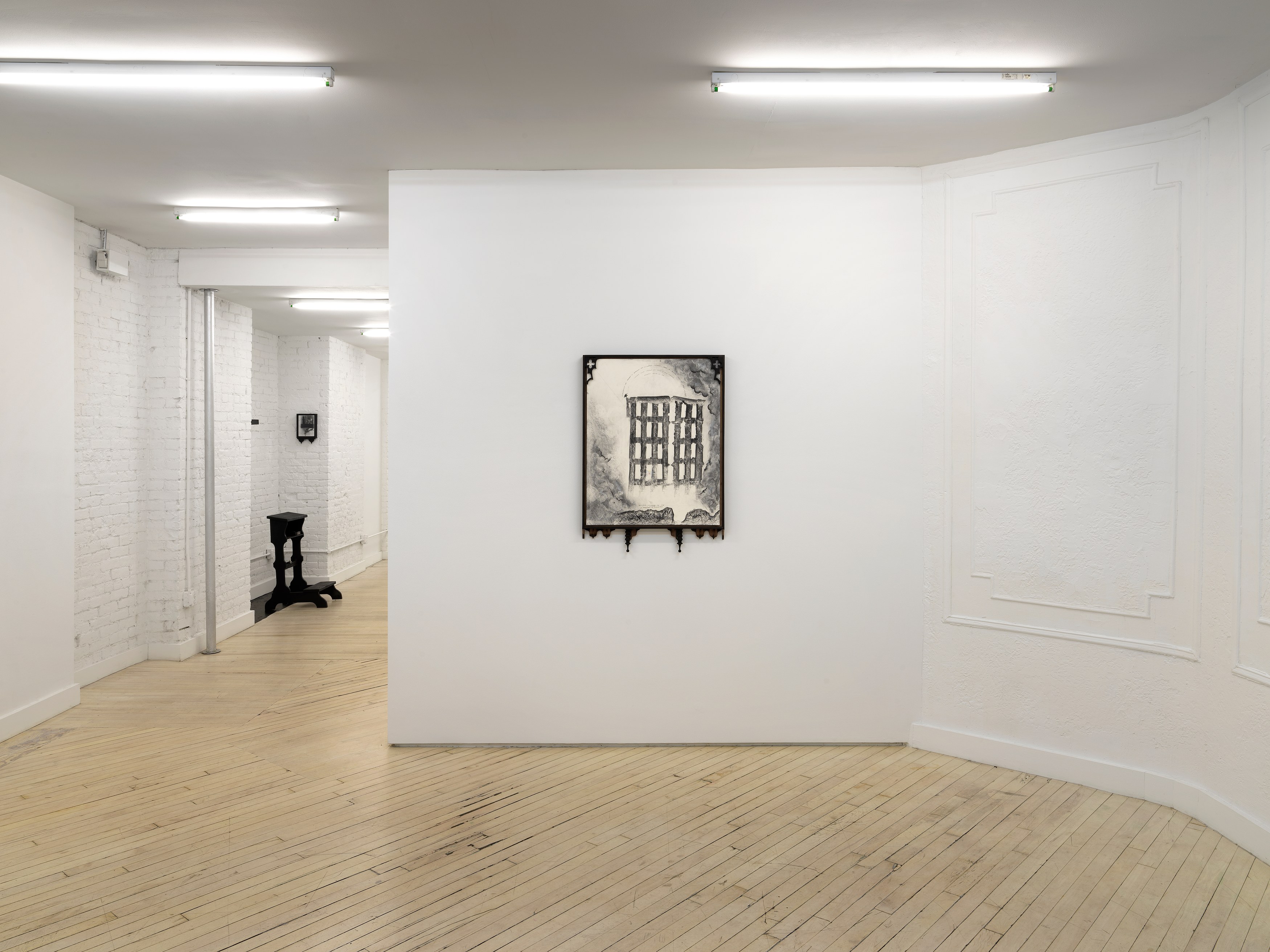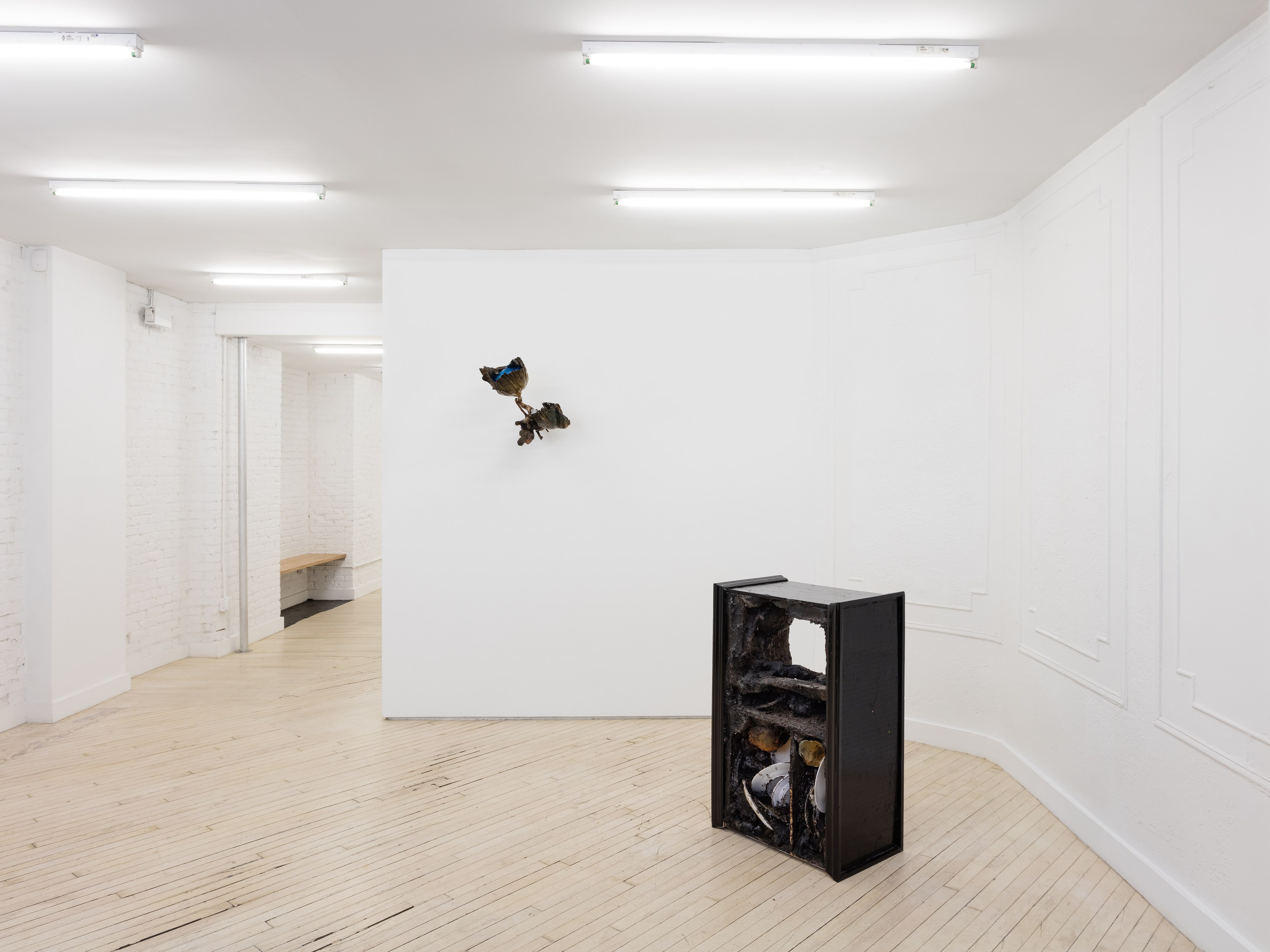
Bureau
Tribeca, Downtown, NY
112 Duane St
Sign in to save this gallery, log a visit, or add a show to a shared list.
Exhibitions
- I, Sunflower
Kyung-Me
Jun 12 – Aug 1
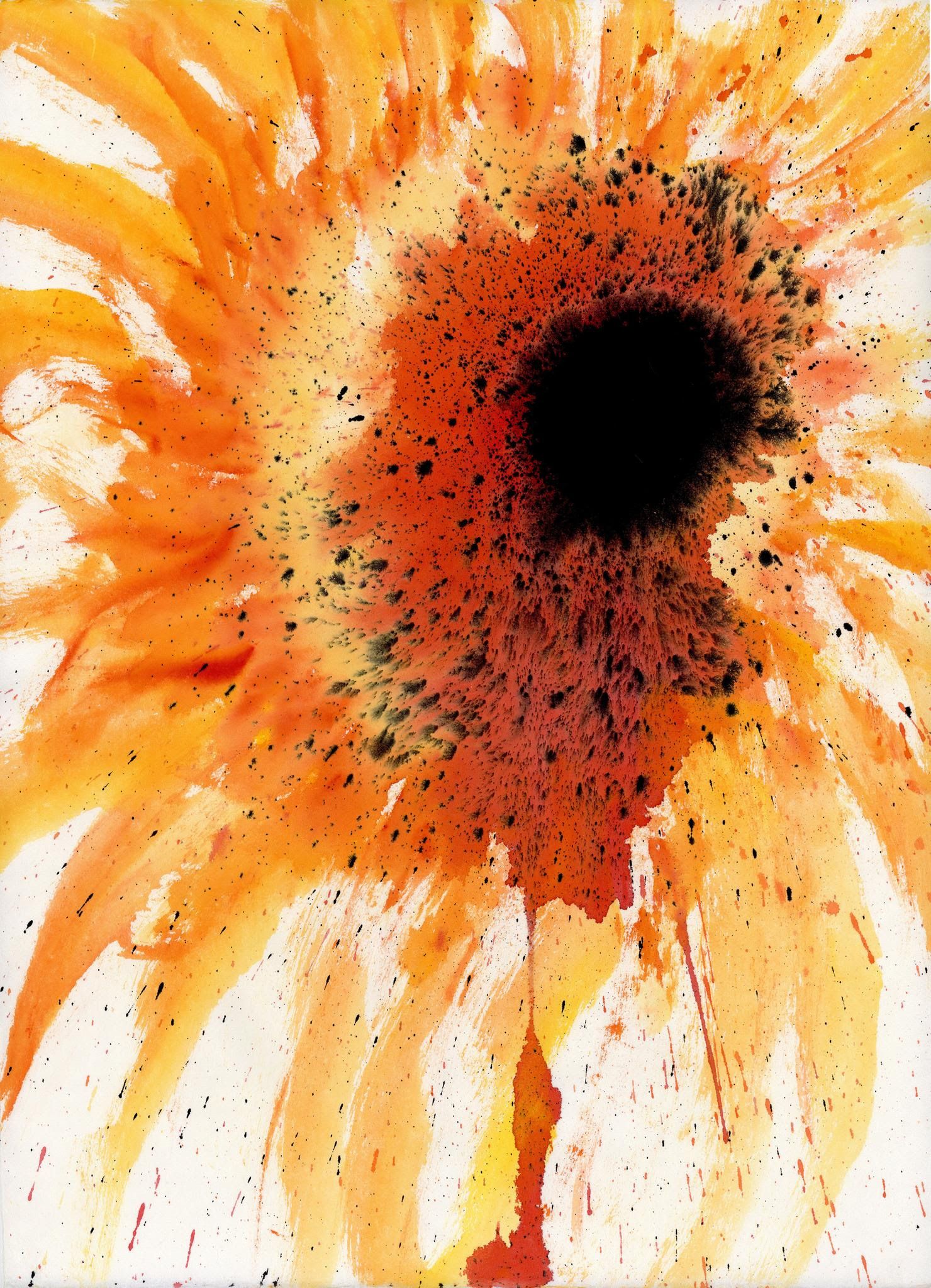
This series of paintings marks a shift from my earlier ink drawings. In an effort to move beyond a mindset ruled by control and precision, I turned to ink painting, a medium that requires presence, spontaneity, and surrender. In this tradition, the artist must observe the subject, internalize it, then channel its spirit through the brush. For the first few months, I acquainted myself with the brush, making black marks on paper. I was learning to breathe, listen to my body, and follow its movement. The ink was startlingly sensitive—every flicker of doubt and surge of agitation ran through it. Whatever I felt was reflected in the mark. One day, I added yellow to the black. A sunflower appeared. With petals like rays of light bursting from a dense, dark center, the sunflower reminded me of the solar eclipse—a collision of opposing energies. From birth to decay, the sunflower experiences every emotion before bowing its head and returning to earth. For the next two years, I painted sunflower after sunflower. They became vessels for my joy, pain, and hope, each one guiding me through a different state. Some days, I painted with lightness and clarity. Some nights, I wilted in turmoil. Every morning, the sun rose again. —Kyung-Me Kyung-Me (b. 1991) lives and works in Queens, NY. She received her MFA from Yale School of Art, New Haven, CT (2018). Solo and two-person exhibitions include The House in the Trees, Kiang Malingue, Hong Kong, China (2023); Sister, Bureau, New York, NY (2022); Coniunctio, with Harry Gould Harvey IV, Bureau, New York, NY (2019); Poor Thing, with Sydney Shen, Hotel Art Pavilion, Brooklyn, NY (2018); Theatre of Cruelty, with Ashton Hudgins, Museum Gallery, Brooklyn, NY (2018); Copy Kitty, Selena Gallery, Brooklyn, NY (2017); and Bad Korean, 17 Essex Gallery, New York, NY (2016). She is the author of Bad Korean, published by Spaceface Books (2016), and Copy Kitty, published by 2d Cloud (2020). In 2022 she received the Picture Collection Artist Fellowship at The New York Public Library. Her work is in the collection of the Baltimore Museum of Art, Baltimore, MD; Magasin III, Museum for Contemporary Art, Stockholm, Sweden; and the Whitney Museum of American Art, New York, NY. Kyung-Me is also an educator who teaches at the Rhode Island School of Design and New York University. The artist wishes to extend special thanks to the AHL Foundation, Hyundai Art Lab, Silver Arts Projects, and Triangle Art Foundation.
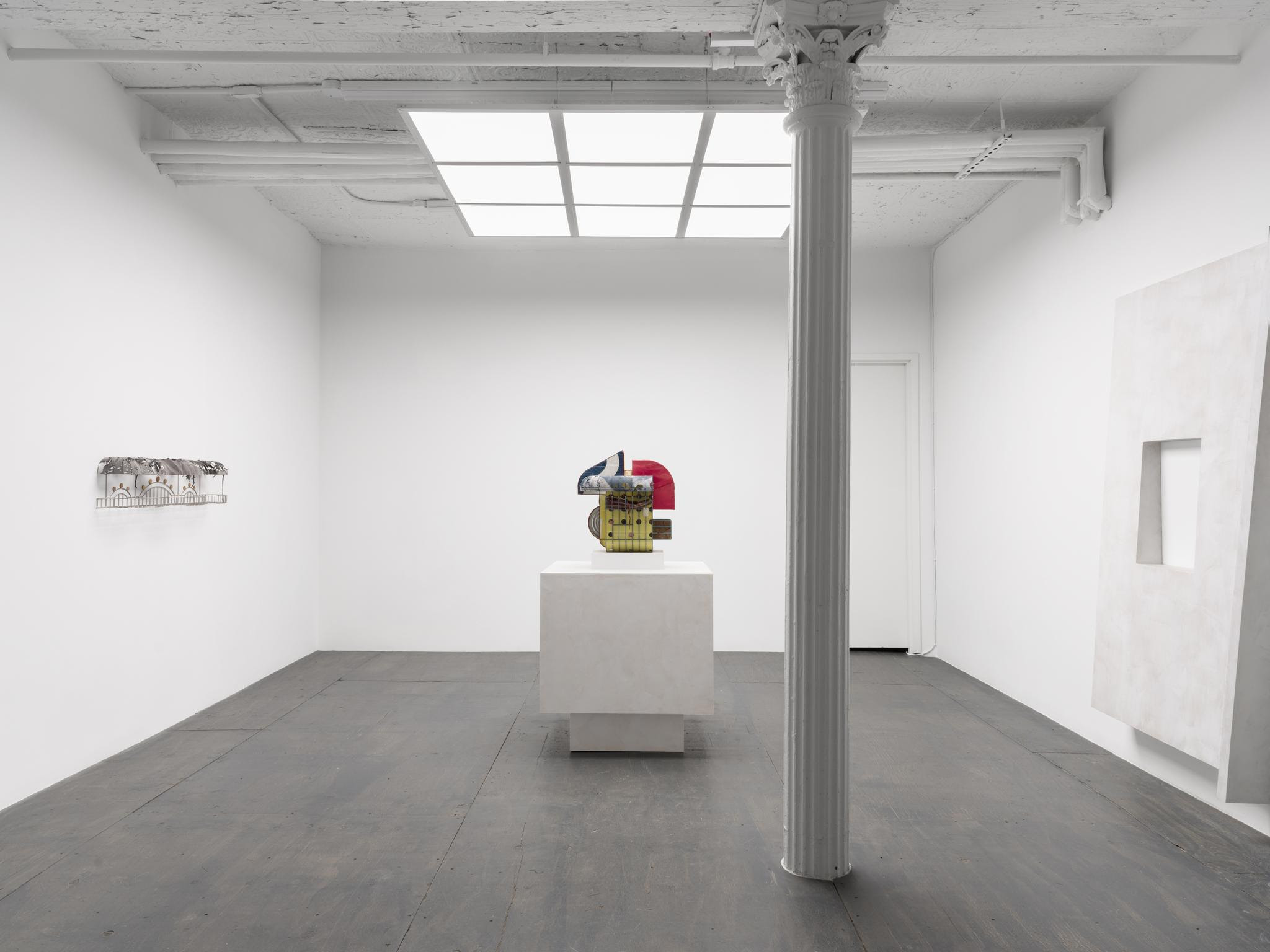 PastBottle and Hole
Greg Carideo
Apr 25 – May 31
"If you're lucky, you may find a small pothole in the city, with a bottle smashed perfectly inside. I have seen it happen exactly six times. It's a remarkable thing, the separate lives of a bottle and hole, how they found each other. The bottle is one of many, made in some factory, possibly far away. It traveled all around, eventually to be bought by someone in New York, who then let it go for one last trip down the road. The road is flat and solid, repelling the world, moving things along. Nothing is meant to stay. Roads are perhaps the opposite of a container, until they open up. A hole will only hold onto something that fills it." —Greg Carideo Greg Carideo (b. 1986, Minneapolis, MN) lives and works in New York, NY. He received a BFA from Minneapolis College of Art & Design, Minneapolis in 2008 and an MFA from New York University in 2015. Selected solo exhibitions include groundwork, Public Gallery, London, United Kingdom (2025); Nave, In Lieu, Los Angeles, CA (2024); Dog Eared Reverie, Foreign & Domestic, New York, NY (2023); Storefront, FR MoCA, Fall River, MA (2022); and Framework, Grimm, New York, NY (2021). His work has been featured in recent group exhibitions at The Flag Art Foundation, New York, NY (2025); Jack Barrett Gallery, New York, NY (2025); Silke Lindner, New York, NY (2024); Pangée Gallery, Montreal (2024); 12.26 Gallery, Dallas, TX (2024); Galerie Nicolas Robert; Montreal, Canada (2024); Margot Samel, New York, NY (2024); Public Gallery, London, United Kingdom (2024); The Institute of Contemporary Art at Maine College of Art & Design, Portland, ME (2024); and International Objects, New York, NY (2023); among others.
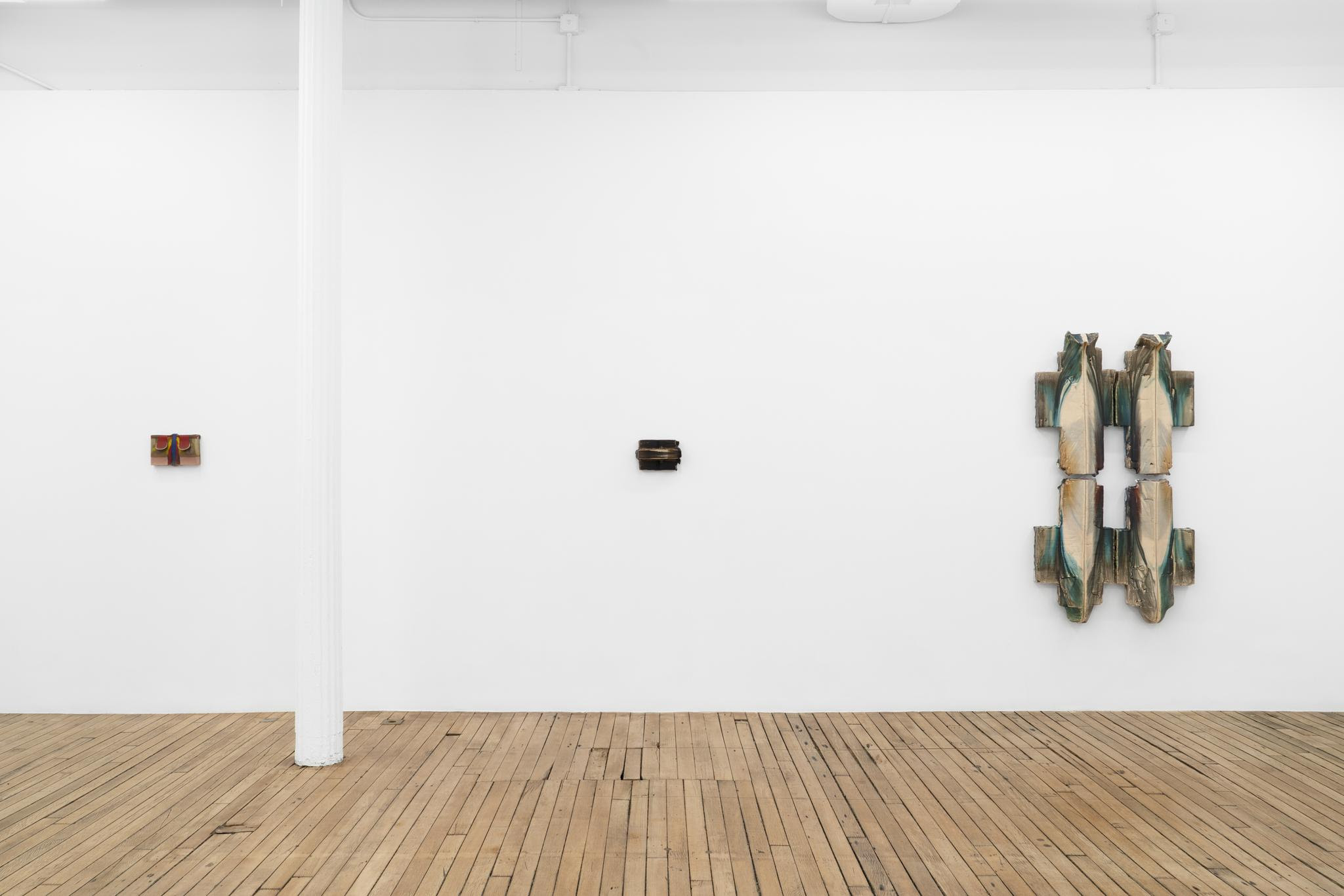 PastSports
CrossLypka
Apr 25 – May 31
I recently met a guy who has this thing where he can't make pictures in his mind from words. It's called “aphantasia.” When I looked the condition up online, I read that doctors often describe it as being in a library full of blank books. Containers exist, but they contain nothing in their interior. This would create, I imagine, a kind of constant visual contingency, a non-fixed relationship to images in which semantic associations must be constantly reapplied. That came back to me while reading a text Kyle Lypka wrote in preparation for this exhibition, in which he expressed a fatigue around how oversaturated life has become with images. I feel the same way; I feel crushed by an ever-compounding density of images. It feels like we are at some kind of tipping point with the role language plays in contemporary art, the researched image, the representative image, the allegorical image—they aren't registering anymore. CrossLypka's works come together without a singular directive, inviting projection. To make their work, Tyler and Kyle pass pieces back and forth, starting with a line drawing, translating to a ceramic form, and applying glazes, each work is transformed by the artists' respective touch. The results are almost biological forms, rendered in a just-off symmetry informed by heat, gravity, and chance. Their process removes narration from the image and gets at something greater. It reminds me of something I heard Fred Moten say, reading from his poem/essay Come on, get it!: “Improvisation is how we make nothing out of something.” Collaborating with the unpredictable effects of fire, the delicacy of glass, and also each other, the resulting works have this oblique quality. I'm drawn to the space opened up by that lack. Looking at the dark silhouettes in bbbb, each defined by abutting fields of blue and yellow, I think about nature. I think about how it feels to happen upon a shell on the beach and experience that strange awareness which triggers one to stop, recognize something, and then reach down to take it in the palm of your hand. In San Francisco, I asked Kyle if he and Tyler ever fight about creative decisions while making their work. He said not really, only occasionally. Then he said, “I guess the question we are asking is if it's possible to share intuition with another person. And the answer is sort of, but never completely.” In The Life of Forms in Art, the French art historian Henri Focillon proposed form as an analogue of space. Images are not always symbols meant to hold information, but sometimes a container or a transmission of some physicality. “This is our relationship” Kyle wrote about the duo's collaborative work, and maybe that's the information we are looking at. —Theadora Walsh CrossLypka is a collaborative duo comprising Tyler Cross (b. 1992 in Lancaster, CA) and Kyle Lypka (b. 1987 in Philadelphia, PA); the artists live and work in Oakland, CA. Recent solo exhibitions include In the opening, Chris Sharp Gallery (2025); 00, april april, Pittsburgh (2025); Tarantula, House of Seiko, San Francisco, CA (2024); Gravity Corner, BlunkSpace, Point Reyes, CA (2022); and I Surrender, pt.2 Gallery, Oakland, CA (2020). Group exhibitions include Galerie Greta Meert, Brussels, BE (2025); Kadist, San Francisco, CA (2024); Anthony Meier, Mill Valley, CA (2023); Marin MoCA, Novato, CA (2022); and Berkeley Art Center, Berkeley, CA (2022). Work by CrossLypka can be found in the collections of the Berkeley Art Museum and Pacific Film Archive, and Kadist.
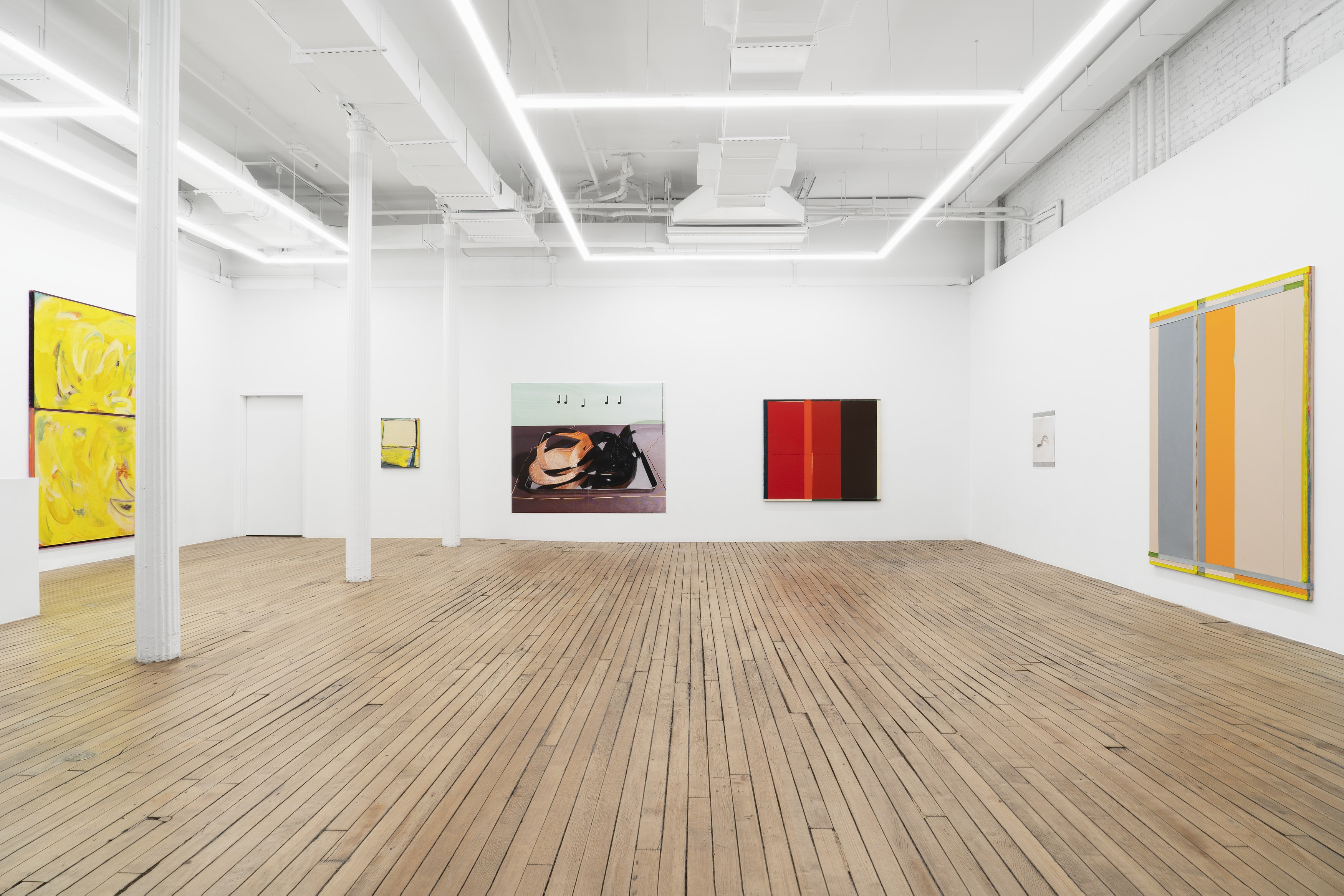 PastField Recordings
Lucas Blalock, Julia Rommel
Mar 6 – Apr 12
LaKela Brown, Andrew Chapman, Jacob Kassay, Alex Kwartler, Jennifer Macdonald, Erin O'Keefe, Kerry Schuss Field Recordings brings together one work by each of seven artists: LaKela Brown, Andrew Chapman, Jacob Kassay, Alex Kwartler, Jennifer Macdonald, Erin O'Keefe, and Kerry Schuss. These artists take pieces of the physical world as primary sources, making imperfect copies that reach beyond the conceptual boundaries of the original. Inscribing embodied phenomena onto objects, images, and surfaces, they evade the reductive nostalgia embedded in the notion of “analog” without losing its potency as a descriptive category. LaKela Brown embeds plaster casts of dollar coins into a wall-relief, linking a human body and the abstract monetary value expressed by minted coins. Erupting out of the smooth plaster surface, the coins speak to the absurdity of this exchange—a life for a wobbly stack of metal. Andrew Chapman paints in a palette developed to evoke two faded mid-century reproduction techniques: the industrial stencil oil-card, and the Kodak box. His painting behaves as a textural and pictorial archive of reproduction methods—a hall of mimetic mirrors. Jacob Kassay places diaphonized chameleons embalmed for laboratory research into a photographic enlarger, using their bodies as negatives. His photogram preserves and dissolves the image of this prototypical shape-shifter, first drained of its color, then given it back, by the photo-chemical process. Alex Kwartler makes a gestural painting of plaster on canvas, into which he embeds a tuna can and prints of pennies and spinning powerballs. These circular echoes spit out ideas both cosmic and routine: it's just lunch! A bad penny! Try your luck! Jennifer Macdonald casts a fragment of found chair caning in bronze: an exercise that inevitably results in voids and gaps in the pattern, as the metal tries to flow through the thin reeds. The polished bronze sculpture puts the inherent qualities of the wispy original and its solid copy in a funny relation: a permanent copy of ephemeral trash. Erin O'Keefe's digital photograph performs a sly illusion using collaged paper and wood: a rectangular block is in fact a flat panel, and the red lid leaning against it in the foreground is a paper parallelogram on the same plane. These simple shapes invoke the contradiction of perspectival space, surface vs. depth, and reveal the mind's tendency to make “sense” of sensory data. Likewise Kerry Schuss's foreshortened vessel, cast in bronze from a visibly hand-fashioned pattern, slips between pictorial and dimensional space. Schuss's sculpture draws from the shapes of tantra paintings he was researching at that time, and to his own practice throwing pottery, but its illusory quality touches the universal legibility of the visual magic trick. In these seven artworks, field work means close encounters, strange phenomena, living with consequences. Field work is curious about the mechanics but doesn't stop there. Field work is jagged edges, spills and splashes, thumbprints and dust, an odd smell, background noise, room tone, an eerie resemblance. All entendres double, all loops corrupted, all puns intended. —Mamie Tinkler
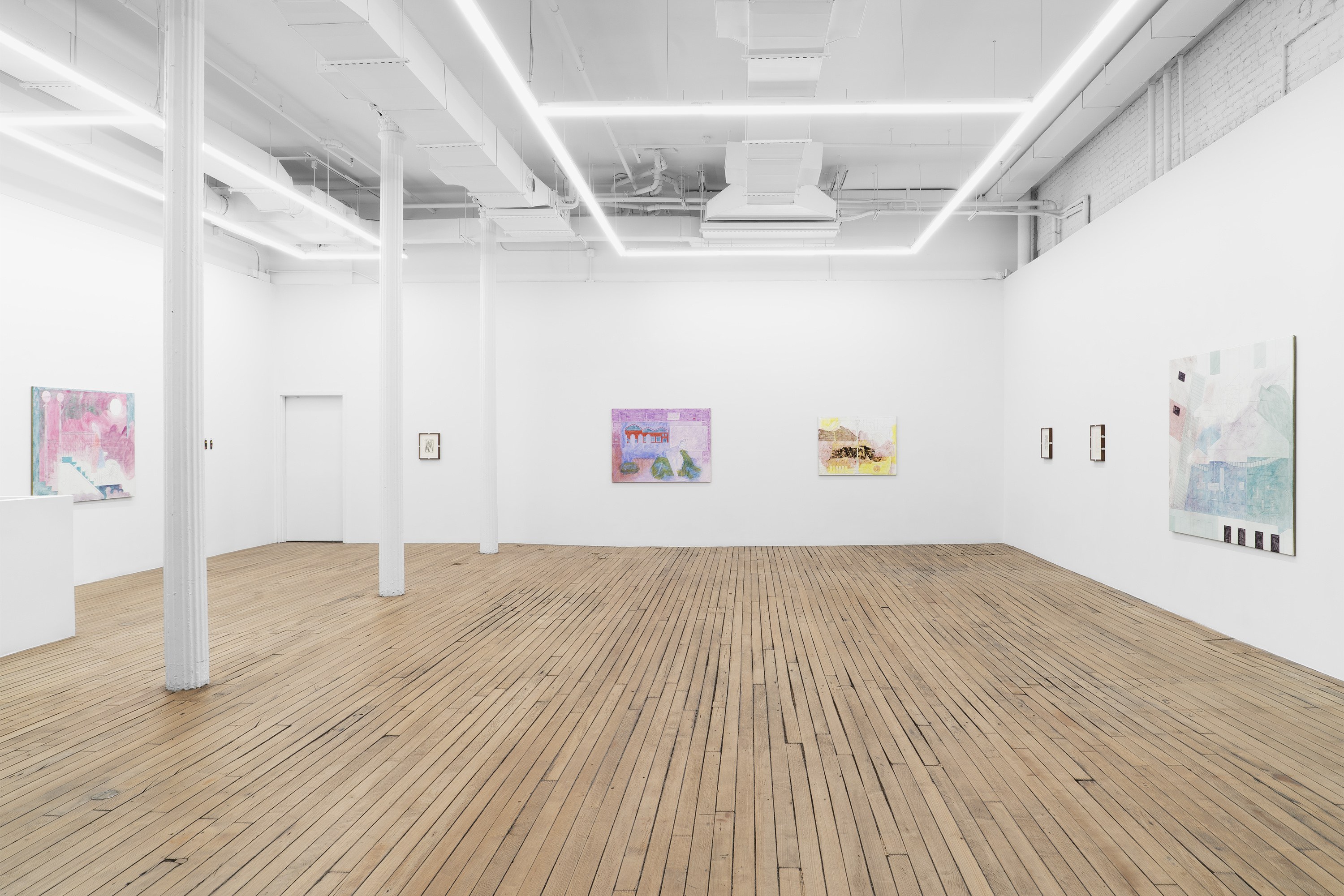 PastWith Drawing
JM Howey
Mar 6 – Apr 12
Toward the end of my years living in the city, most of the days I spent in the studio were dedicated to making mechanical pencil drawings on paper. In these works I pictured ways some of New York's recent and suddenly ubiquitous fixed-use leisure infrastructure might be mobilized toward more elaborate, convoluted ends. Could a Citi Bike be used as a spontaneous blockade during rush hour, altering certain flows if only for a few minutes? Yes, if you had the right bike locks, but this might get complicated given that your personal information has already been noted by the bike you're reappropriating. I suppose if you've reached the point where this feels like a meaningful gesture, you may no longer care, but some people are just trying to get to work. Through a certain lens, would it be justified to covertly harvest a private community garden if it were in a really posh neighborhood? I certainly understand the sentiment, but this is ultimately questionable, given that we have no idea who these plots actually belong to. Still, the use of the word free on the little free library was a bit misleading. Now that all evidence of their existence has been erased, is there a secondary market for used Revel scooters? In their absence, have their components attained some sort of collector's item status? After making quite a few drawings, some of which are in this show, my attention eventually turned back to painting. In doing so, I once more became interested in the indeterminacy of freehand, loose painting, and the odd subjectivity of making color decisions. The thin graphite line of the drawings, when applied to painting, could still carry the work's pictorial infrastructure while also serving as a formal restraint to bump up against, run parallel to, or complicate as I applied additional paint and experimented with the limits of my agency. As an artist, I tend to gravitate toward procedural restrictions, suspecting that within them I'll find malleability. I've knowingly consented to expressive tools that openly assert their predetermined defaults. A little like some of the figures in these pictures, I'm experimenting with approaches for mitigating the integrity of otherwise rigid presets. In doing so, I inadvertently admit to a belief in the possibility of an utterance, an artwork, perhaps even an existence beyond a received inevitability.
 PastHunks
Lucas Blalock & Julia Rommel
Jan 17 – Feb 22
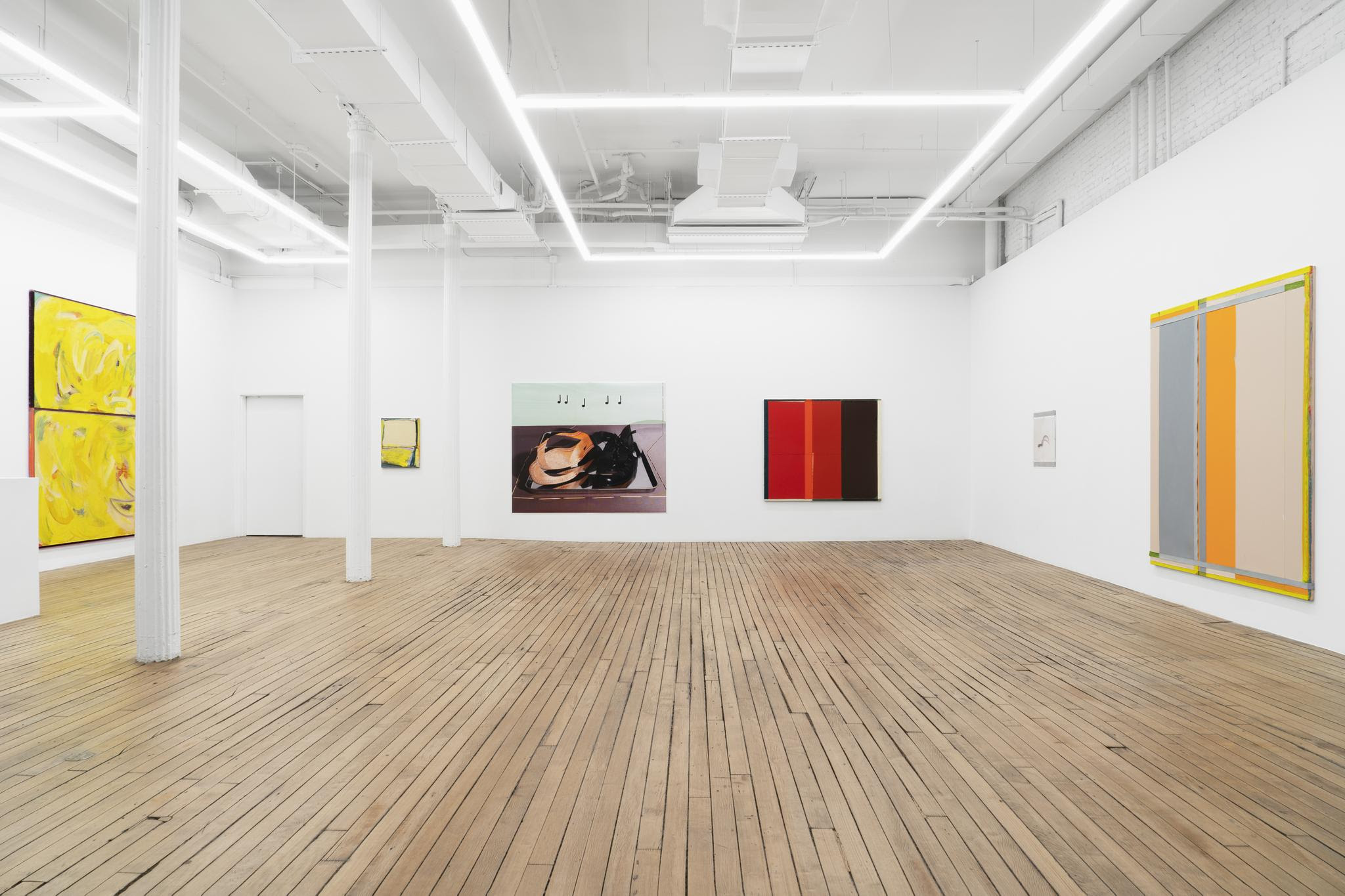
1. Swiss scholar Heinrich Wölfflin popularized the use of dual slide projectors in art historical lectures. The intensity of the black-and-white images was piercing in the dark of the auditorium; his students likened the experience to approaching the sun. Casting pictures side-by-side, the projectors primed viewers to see through a dialectic of similarity and difference. The compare and contrast framework of art criticism has been attributed to this origin. 2. Consider the two-person show, distinct practices paired to extend each other and call attention to details otherwise set aside. At first glance, Lucas Blalock's and Julia Rommel's works are nothing alike. Then we look more closely at the painterly trails in a cartoonish wedge of cheddar that call across the gallery to turbulent fields of yellow. We think again. 3. Is the artwork ever perceived singly, for itself, out of context? Painter R. H. Quaytman emphasizes that her compositions participate in series—exhibitions as chapters, individual works made meaningful by triangulation with their neighbors. In their relationality, they are akin to language. 4. The most basic form of narrative is a numbered list. 5. What does a beginning look like? A cursor blinking out letters; a TIFF of a lightbulb angling from stacked butter sticks; gesso-hardened fabric, stiffening around a dimensional form? Or do we need to go back earlier still to the object under the lights, the unstretched substrate, the hard-edged computer keys as they wait to rattle out their alphabetic strings? Once started, it's hard to ignore the false moves that call for correction. But how to trick yourself into making a mark, capturing the image, writing anything at all? 6. For Rommel and Blalock, the opening paces of each work follow a set procedure. In Rommel's studio, raw linen articulates across planar forms—stretcher bars, steepled columns, rectangular prisms; then comes the gesso; finally, paint. She removes the staples and unfolds the fabric to see what groundwork she has laid. In Blalock's practice, it's a matter of staging and lights. The shutter's blades rise and fall in concert. The negatives are sent for processing and return. The artists look again, this time searching for cracks that have the potential to widen into a recursive sequence of gestural moves, each with their own accidents and intents. 7. There are no rules to scissors and staples, clone stamp and eraser tool, exhumations and obstructions, layered JPEGs and Gamsol rags. Keep at it until the field of possibility is played out, the decision-tree dwindled to a single lonely branch. Sometimes the work's done as soon as it's started. Other times, it seems never to end. 8. The artists test the limits of their media. Blalock re-asserts the photographer's presence, turning post-production editing into a form of mark-making and, even, occasionally inserting his body (or its fragmented parts) into the frame. By contrast, Rommel has resisted the brushstroke's expressive connotations, disguising her hand in the worked dimensionality of near-monochrome panels. Gradually, this control has loosened into considered effusions, neatly contained within the bounding perimeters of the stretcher bars or stapled linen strips. 9. To add is to overwrite what came before. Nostalgia seeks the traces of those first moves, excavates viridian streaks from gray and gold planes, reconstructs whole forms from digital rupture. Discrete temporalities are toothpick-sutured, stapled, stitched, and zipped. These hints of the past do not cohere into a reassuring order of operations, but persist in anachronistic simultaneity. The marks seem to cleave into other worlds. The dress shoe doubles, trebles. Months-old zips of oil paint superimpose themselves before the additions of yesterday. 10. The verb tense of painting and photography is the past. Yet Rommel's and Blalock's works rehearse their production self-reflexively—surfaces with the sounds of their own making. Blalock quotes Jean-Luc Godard: “every film is a documentary of its actors acting.” Rommel's works have been called paintings of paintings. The artists stage a Barthesian burlesque, authorial presence concealed and disclosed within the time-based theatrics of accreted material. When we look at Blalock's photographs or Rommel's paintings, do we see the curtain or the stage? —Nicole Kaack
 PastCouplet
Kate Spencer Stewart
Nov 7 – Dec 21
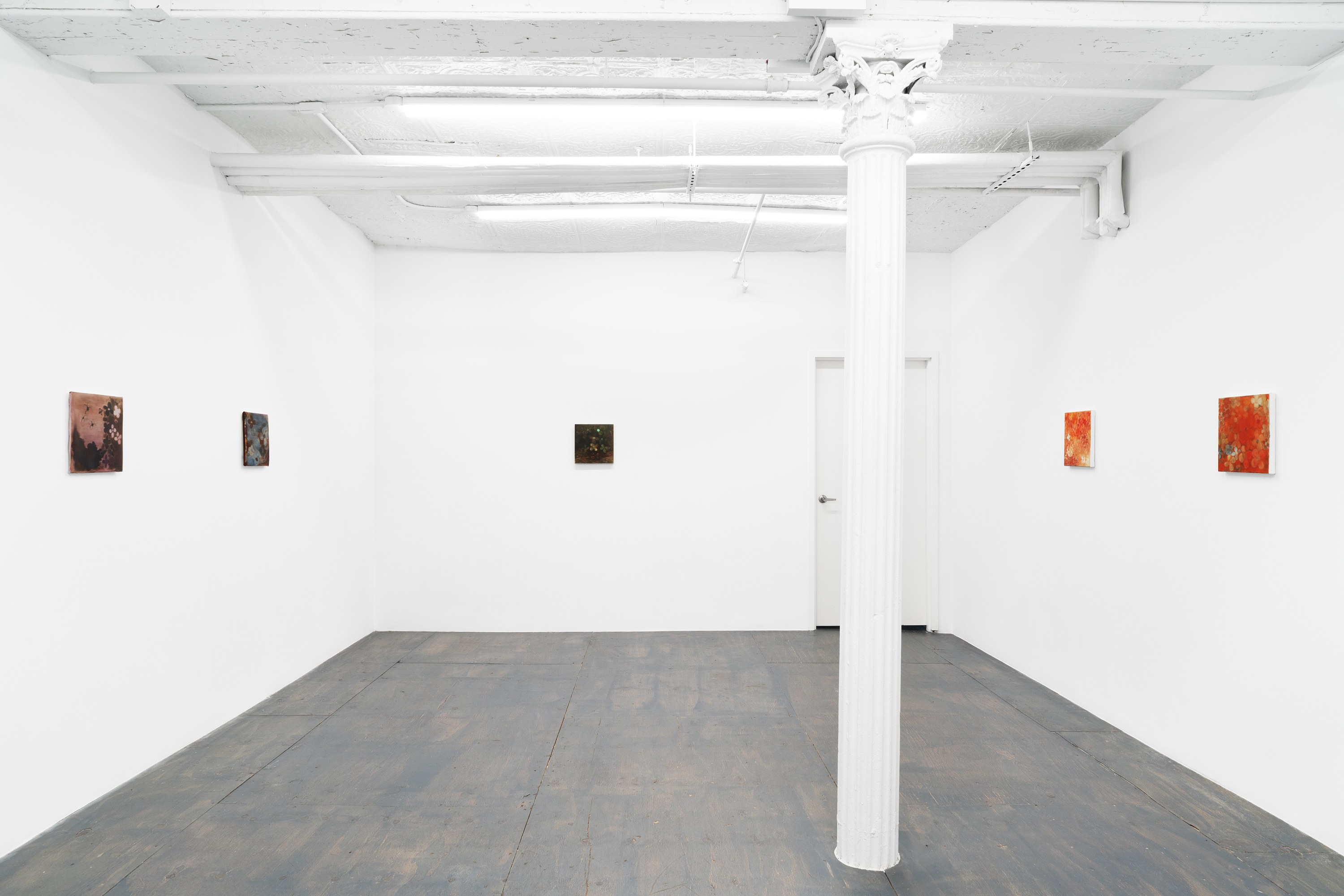
Bureau is pleased to present Couplet, Kate Spencer Stewart's second solo exhibition with the gallery. Its title references the poetic form in which two lines with the same meter complete one another, a structure echoed throughout the show in a mirrored composition: six large-scale atmospheric abstractions above and six intimate flower paintings below. Within a consistent square format, the paintings converse through subtle formal affinities and abrupt deviations in fugue-like correspondences. Painting, for Stewart, is an act of surrender and devotion: each work develops through cycles of repeated actions and careful observation, negotiated within a prolonged engagement of escalating material interactions. Her paintings are made up of traditional pigments in oil, layered over underpaintings either as pentimento or fields of near-obliteration. Conceived as pairs in different studios, first during summer in upstate New York and later upon returning to Los Angeles, her works trace a process of divergence, carrying echoes of their counterparts while developing their own attributes. In the large paintings, vertical and horizontal gestures recur across this suite, along with a compositional acknowledgement of the canvas's edge. Ritual (all works 2025) rises sharply in strokes of red and green that seep into a dappled, muted pink, while Verily Verily builds a dense vermillion field amongst looping figure-eights of green. Morning Star evokes a vast sky of Venusian clouds that coalesce and concentrate near the bottom, distorting under their own gravity. Sovereign glows purple from glazes of lapis lazuli, bright reds and deep violets, unifying a still and contemplative plane within its surface. Downstairs, a collection of small flower paintings acts as a counterpoint to the abstract works above. Each presents a proliferation of generic flower forms, the motif composed of four simply drawn petals which rotate and brush up against each other. The shapes recall Gothic quatrefoils or crosses, evoking historical and symbolic precedents while remaining provisional and brutally blunt. Blooms compress and spread across the surfaces in patterns that reaffirm their inherent flatness, signaling an agnostic attitude towards figurative portrayal. In the studio they develop alongside the other works as meditations on accuracy and color, serving as a pressure valve against the intensity of abstraction. Each work is singular yet contributes to an evolving web of poetics. Kate Spencer Stewart (b. 1984 Phoenix, AZ) lives and works in Los Angeles, CA. Stewart received her BFA from Otis College of Art and Design, Los Angeles, CA (2006), and MFA from University of California, Los Angeles, CA (2017). Solo and two-person exhibitions include Nuit, Kate Spencer Stewart & Odilon Redon, Emalin, London, United Kingdom (2025); AIR FORCE, Paul Soto, Los Angeles, CA (2025); Disintegration Suite, Paul Soto, New York, NY (2023); Diurne, Emalin, London, England (2023); Youth, with Chadwick Rantanen, Hakuna Matata, Los Angeles, CA (2023); Convention, Bureau, New York, NY (2022). Recent group exhibitions include land marks, Pace, Los Angeles, CA (2025); Taking Care, Hannah Hoffman, Los Angeles, CA (2025); Revival, Francesca Minini, Milan, Italy (2025).
 PastPreaesns
Jerónimo Rüedi
Sep 5 – Oct 26
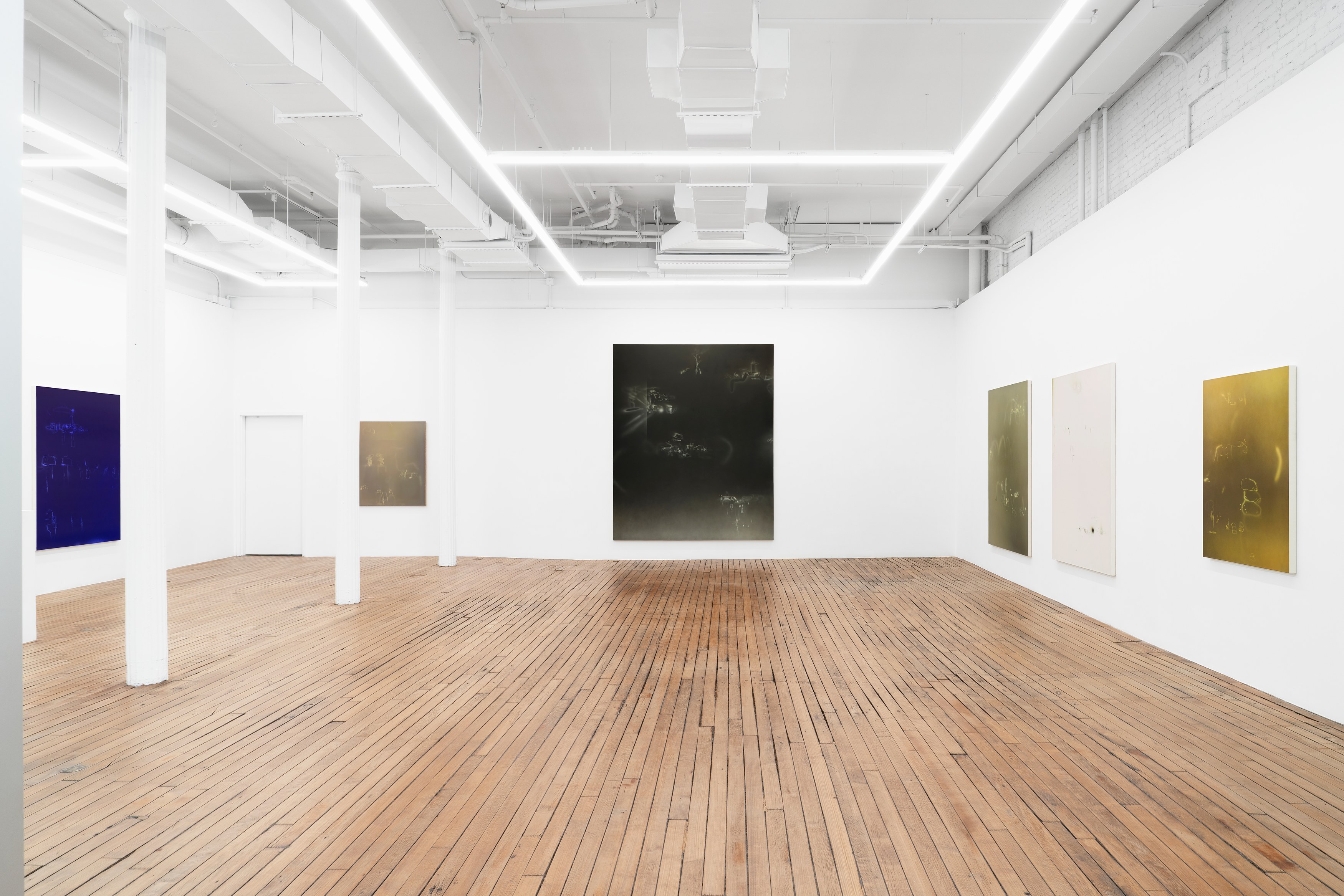
In Preaesns, Jerónimo Rüedi’s first solo exhibition in the US, a suite of new paintings portray the unquiet vectors and orbital delays through which the mind can make a whole universe out of however little it sees. Vast expanses punctuate clusters of quickly rendered marks, made by hand and airbrush, that warp any clear-cut distinction between text and image, ligament and limb. In this limbo, they shape the teetering way that, in desiring meaning, relations between space and sight are clairvoyantly received. The titles of the works themselves attest as much, frying the logic of sense-making with recombination, resemblance, and playful anti-diction, to limn the multilingual world in which Rüedi, who lives between Mexico City and Berlin, paints: Aulcinnation gets close to the word for ‘hallucination’ in both English and Spanish, but is neither; Siegtemas might read as specifically as ‘victory theme’ in German or as generically as syntagma, the linguistic principle from the Greek, meaning ‘phrase,’ that the artist’s contraction almost obliterates. Rüedi has long explored how viewers might be invited into his paintings, rather than confronted by their supposed exterior. Two of the works on display—Whgos Theroy and Oirgn 01—use encaustic technique, which involves encasing his canvases of aluminum and wood with a mixture of beeswax, resin, dry mineral pigment, and paint that Rüedi manufactures in his studio, along with the tools he uses to apply them. Lacy scribbles spread into curls or corners and glow like neon light against wide, empty ground, that, on close inspection, is revealed to be a dense, molten build-up it would be a mistake to call a surface. The result is a meticulous inversion of painting’s material properties and the comfy, clumsy vocabularies with which we want to describe what we see in them: the flatness of surface slacks concave and perforates; the speed of a light mark doubles as depth; empty space becomes a solicitation, as by a pool or a portal. In the past, Rüedi has described his paintings as portraits of the time and space in which they are made. But these new paintings, many of which loom larger than human-size, are also portraits of our absorptive encounter with them. They insist on their own presence, and suggest a mutually constitutive relationship between the world and the tools, like science, or art, or language, we use to know it. The same thing happens in life. Try, for instance, using an extremely powerful device to clarify the hurtling movement of the night sky. An entire galaxy might crisply appear before you. What you are looking at, you see, is a smudge. —Shiv Kotecha Jerónimo Rüedi (b. 1981 Mendoza, Argentina) lives and works in Mexico City, Mexico. Rüedi attended the Escola Massana, Art and Design Centre, Barcelona, Spain; and received a Fine Art Degree from the Universidad Nacional de Cuyo, Mendoza, Argentina. Recent solo exhibitions include And Between us Occurs the Following Conversation, Galerie Nordenhake, Berlin, Germany (2025); Yanhuitlán, Museo del Ex-Convento de Yanhuitlán, Oaxaca, Mexico (2024); Tabula Rasa, Museo de arte contemporáneo de Oaxaca, Oaxaca, Mexico (2024); Systems, Galerie Nordenhake, Mexico City, Mexico (2024); Khōra, Galerie Nordenhake Stockholm, Sweden (2023); To see through all things clearly is to see through all things dimly, Galerie Nordenhake, Mexico City, Mexico (2022); Drawing the Boundaries of a Fire, Galería Karen Huber, Mexico City, Mexico (2021); In the Beginning the World Was Completely Real, Colector Gallery, Mexico City, Mexico (2020). Recent group exhibitions include Works by Colección Jumex, Museo Jumex, Mexico City, Mexico (2024); Tiempo compartido, Museo de Arte Carrillo Gil, Mexico City, Mexico (2023); Tamayo Bienal, Museo Tamayo, Mexico City, Mexico (2019); Tamayo Bienal, Museo de Arte Contemporáneo de Oaxaca, Oaxaca, Mexico (2019). Rüedi’s work is held in the collection of Museo Jumex, Mexico City, Mexico. In recent years, Rüedi has been a resident artist at Casa Wabi (2023), the Museo Experimental El Eco (2016), and produced stage scenery for the play Jazz Palabra by Juan José Gurrola (LA Theater Center, Los Angeles, California, 2015 / Casa del Lago, Mexico City, 2014). Rüedi has published three books: Tuning the Sky, Zolo Press (2024); Colorless green ideas sleep furiously, Gato Negro Ediciones (2020); and The stuff dreams are made of, Macolen (2017). He is one of the co-founders of Aeromoto, the public library for contemporary art and culture in Mexico City, Mexico.
 PastNow's Your Chance
Erica Baum, Mary Lum, Lee Mary Manning
Sep 5 – Oct 26
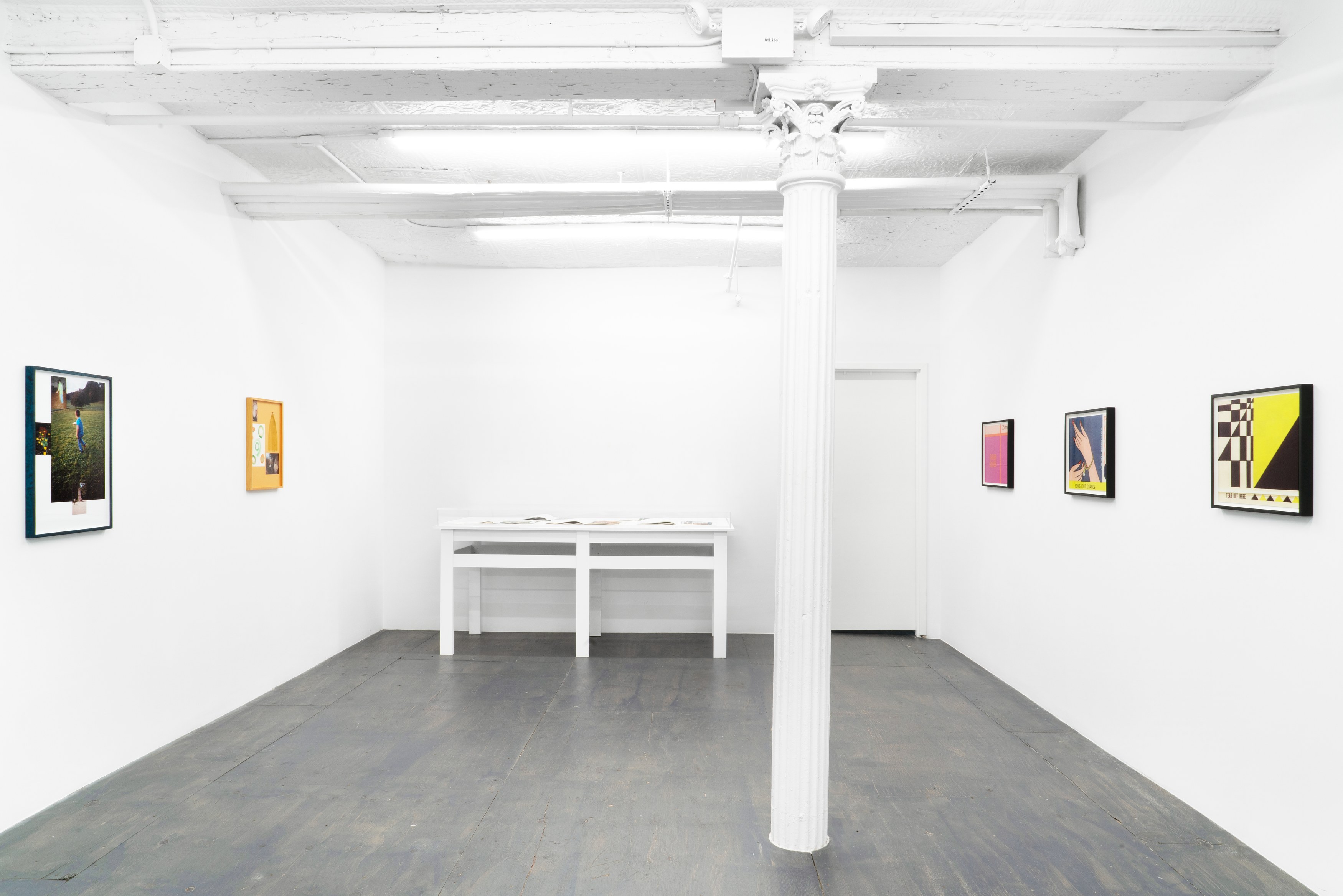
Erica Baum Mary Lum Lee Mary Manning There is a photograph taken from the inside of the gallery included in this exhibition. The photograph has been set into a dialogue with other images and mementos, thanks to their arrangement inside of a shared frame. Lee Mary Manning took this 35mm photograph of the sidewalk without knowing it would end up here. This method of working is in turns diaristic, unprecious, and recursive. Things land in their right place, always after the fact. Their practice is also situational, keen to everyday phenomena as they unfold—setting oneself up for generative encounter and exchange. In Manning’s work, the vastness of the city and other landscapes meet with quieter, more private images. Scenes of connection, reverence, even tenderness. In another photograph here, there is a child ambling in a field. Through their stillness and singularity, moments resonate, where they otherwise might register mundane. Directives from the urban environment—both spatial and linguistic—shape the motion and structure of Mary Lum’s collages: Merge, turn, narrow, accelerate, descend, detour, exit, wait. In one page of an artist’s book on display, there are a series of hand-drawn circles moving in a procession, rendered in tempered shades of colored pencil. These forms are bracketed off by an assortment of cut-out comic book graphics, collaged and colliding: partial views of a criss-crossing bridge or cell tower, extraterrestrial machinery, and cuts from a superhero’s back. Despite their comic splendor, these are reframed as unheroic pictures. Lum’s arrangements of material are pulled from mixed up sources and cities, rearticulated through chance studio procedures. Interpretation and meaning-making arrive belatedly. Elsewhere in a collage, there is a printed iPhone snapshot of Manhattan’s trash waiting for collection, and a person walking toward 27th Avenue in Queens. This interplay between handmade mark, mass reproduction, and the photographic fragment resembles the disordered movement and psychical intake of the traveling city occupier. Comic book panels and their gutters serve to discharge this tension and contain it. Whoosh, Boom, Brroom. These onomatopoeic words can be read and seen here as much as heard through the semiotic stew outside on the sidewalk. In another photograph in this exhibition, there is an illustration of a slender wrist, adorned with a golden bracelet and red-painted fingernails. Below it, anchored in a cautionary yellow strip, are the words Now’s Your Chance. This is, in some ways, a found image—or rather, the ‘original’ printed source, reproduced and enlarged by a camera, was itself found. Erica Baum extracted this blow-in from her ever-expanding archive of mid-century craft and sewing magazines, which were originally manufactured to seduce the at-home-hobbyist with tutorials mobilizing the commodities at their disposal. Lesson plans in everything from cooking to crocheting, embroidering, knitting, stitching, sewing. DIY galore with just enough to educate, propagate desire, and sell. Blow-ins were designed to interrupt the readers’ automatic flow while gazing at the magazines’ spreads. One-time offers for subscriptions, coupons with expiration dates, and incessant free promotional offers. These are quick and disruptive pieces of cardstock, processed during the fractional second of turning the page. Act fast! Or don’t. Baum’s practice is one of acting in the now and refining later. She is constantly searching for wide-ranging printed matter, which she tactfully mines to generate new compositions and structural positions. Magnifications, crops, and folds function as techniques of creative revival. Poetry lives in these chance encounters with the overlooked details of materials already in existence and in waiting. Another blow-in, shot close-up and expanded, features a pattern of black and white rectangles narrowing in on each other, as if headed into a harsh corner or a traffic jam. Running underneath this maze of forms are the words Tear Off Here. —Michael Moore Erica Baum (b. 1961, New York, NY) lives and works in New York, NY. Baum received her MFA from Yale University, New Haven, CT (1994) and her BA from Barnard College, New York, NY (1984). Recent solo exhibitions include Off The Cuff, Bureau, New York, NY (2024); Off the Hook, Klemm’s, Berlin, Germany (2024); the bite in the ribbon, Galerie Crevecoeur, Paris, France (2022); A Method of a Cloak, Square is the Chatter, Markus Lüttgen, Düsseldorf, Germany (2020); A Method of a Cloak, Klemm’s, Berlin, Germany (2020). Group exhibitions include Made in Düsseldorf: Photographs From the Stadtsparkasse Stiftung, Kunstpalast Düsseldorf, Germany (2025); New Directions: Recent Acquisitions, George Eastman Museum, Rochester, NY (2024); True Pictures?, Museum für Photographie Braunschweig, Germany (2021); Pictures, Revisited, The Metropolitan Museum of Art, New York, NY (2020); Making Knowing, Whitney Museum of American Art, New York, NY (2019); Anna Atkins Refracted, The New York Public Library, New York, NY (2018); Photo-Poetics: An Anthology, Solomon R. Guggenheim Museum, New York, NY (2015); Reconstructions, The Metropolitan Museum of Art, New York, NY (2015); and The Imminence of Poetics - the 30th Bienal de São Paulo, Brazil (2012). Her work is held in the collections of the Museum of Modern Art, New York, NY; Whitney Museum of American Art, New York, NY; Solomon R. Guggenheim Museum, New York, NY; The Metropolitan Museum of Art, New York, NY; MIT List Visual Arts Center, Cambridge, MA; San Francisco Museum of Modern Art, San Francisco, CA; MAMCO, Geneva, Switzerland; Buffalo AKG Art Museum, Buffalo, NY; CNAP, Paris, France; FRAC Île de France, Paris, France; among others. Baum will be the subject of a one-person museum exhibition, the bite in the ribbon—a paper show, at the George Eastman Museum, Rochester, NY this fall (2025). Lee Mary Manning (b. 1972, born in Alton, IL) lives and works in New York, NY. Manning holds a BA from Southern Illinois University, Carbondale, IL (1994). Recent solo exhibitions include Kiss of the Sun, Canada, New York NY (2024); Veedon Fleece, St Carthage Hall, Lismore Castle, Ireland (2024); In Excelsis, Complesso Monumentale di San Nicolò, Spoleto, Italy (2023); Spora, Swiss Institute, New York (2023); Ambient Music (2022) and Love (2018), Canada, New York NY; Blueprints, Sibling, Toronto (2018); and Trees Is As Good As Anything, Cleopatra’s, Brooklyn, NY (2017). Recent group exhibitions include A landscape longed for: The garden as disturbance, Crisp-Ellert Art Museum, St. Augustine, FL (2024); Trust Me, Whitney Museum of American Art, New York NY (2023). In 2022, Manning curated Looking Back: The 12th White Columns Annual at White Columns, New York. Manning's work is included in the collections of the Whitney Museum of American Art, New York, NY, and the Carnegie Museum of Art, Pittsburgh, PA. Manning is represented by Canada, New York. Mary Lum (b. 1951, St. Cloud, MN) lives and works in North Adams, MA. Lum received her BFA from the University of Michigan and her MFA from the Rochester Institute of Technology. Selected solo exhibitions include temporary arrangements, Yancey Richardson Gallery, New York, NY (2024); The Moving Parts &, Harvard Radcliffe Institute, Cambridge, MA (2023); Assembly: Lorem Ipsum, Mass MoCA, North Adams, MA (2017); Shifting Perspective, Savannah College of Art and Design, Savannah, GA (2011); New Work, Barn Gallery, St. John’s College, University of Oxford, UK (2009). Selected group exhibitions include Enter, ICA at Maine College of Art and Design, Portland, ME (2024); Lived Space: Humans and Architecture, DeCordova Museum and Sculpture Garden, Lincoln, MA (2018); Tell It To My Heart, Museum fur Gegenwartskunst, Basel, Switzerland, traveled to Lisbon, Portugal and Artists Space, New York, NY (2013). Lum has been the recipient of numerous awards, including a Harvard Radcliffe Institute Fellowship (2022), Guggenheim Fellowship (2010), the Radcliffe Fellowship for Advanced Study (2004-2005), and a MacDowell Colony Fellowship (2012). Her work is in the public collections of the Baltimore Museum of Art, Baltimore, MD; DeCordova Museum and Sculpture Garden, Lincoln, MA; MoMA Library, New York, NY; Oxford University, UK; Savannah College of Art and Design, GA; and the Wallace Memorial Library, Rochester Institute of Technology, Rochester, NY; among others. Lum is represented by Yancey Richardson Gallery, New York.
Past
Bureau Fifteen-Year Anniversary ShowJun 12 – Aug 2
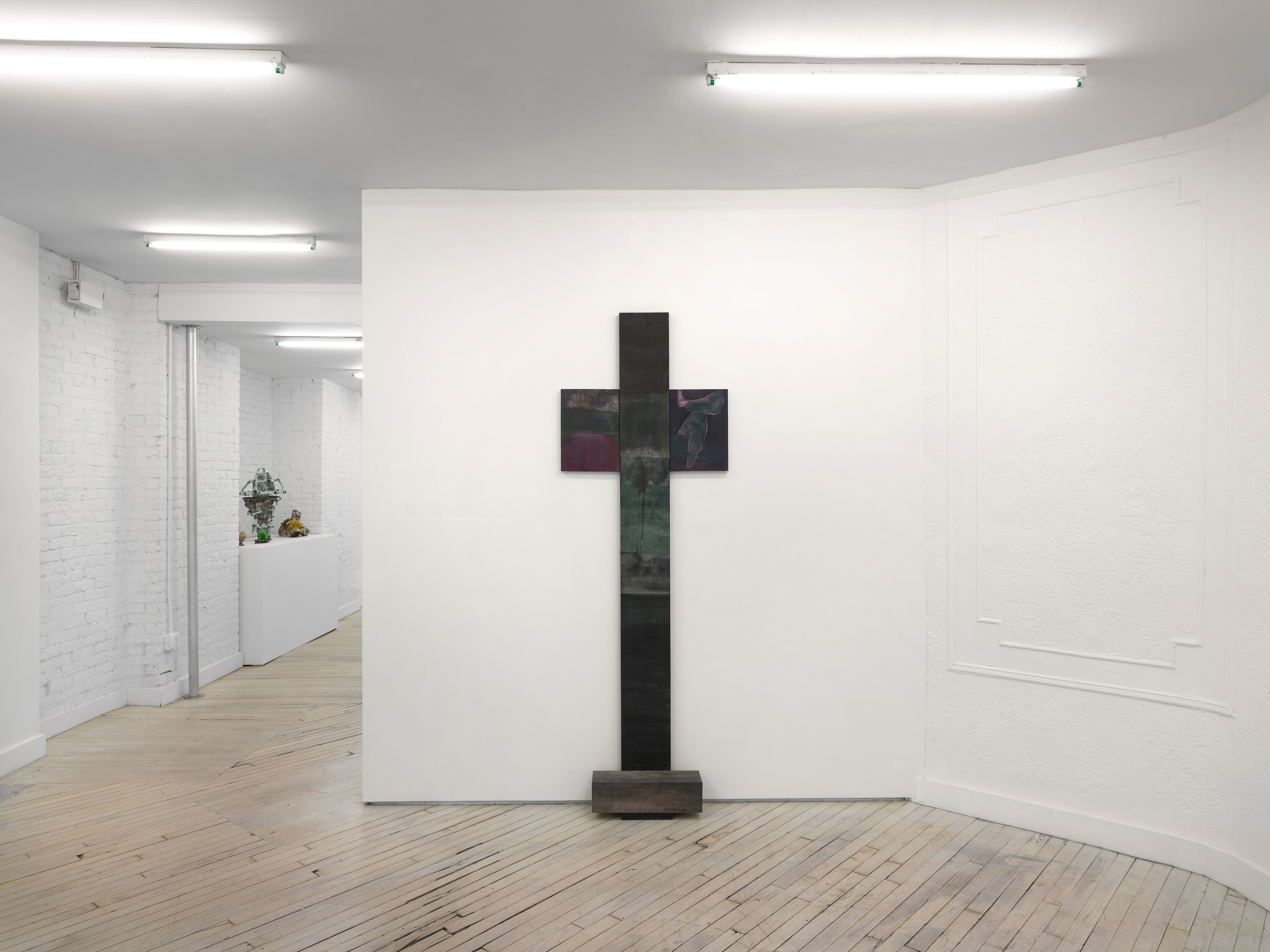
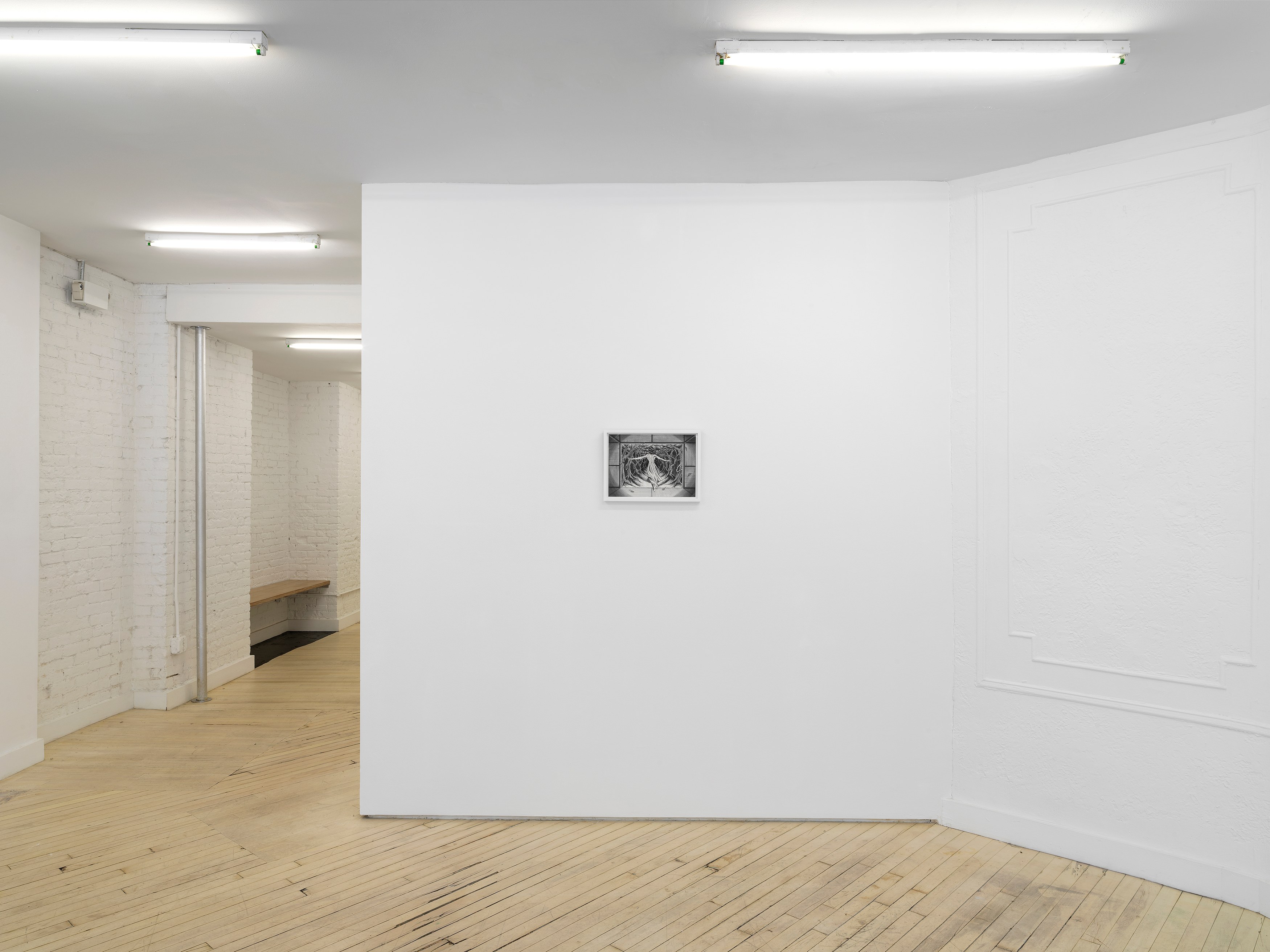
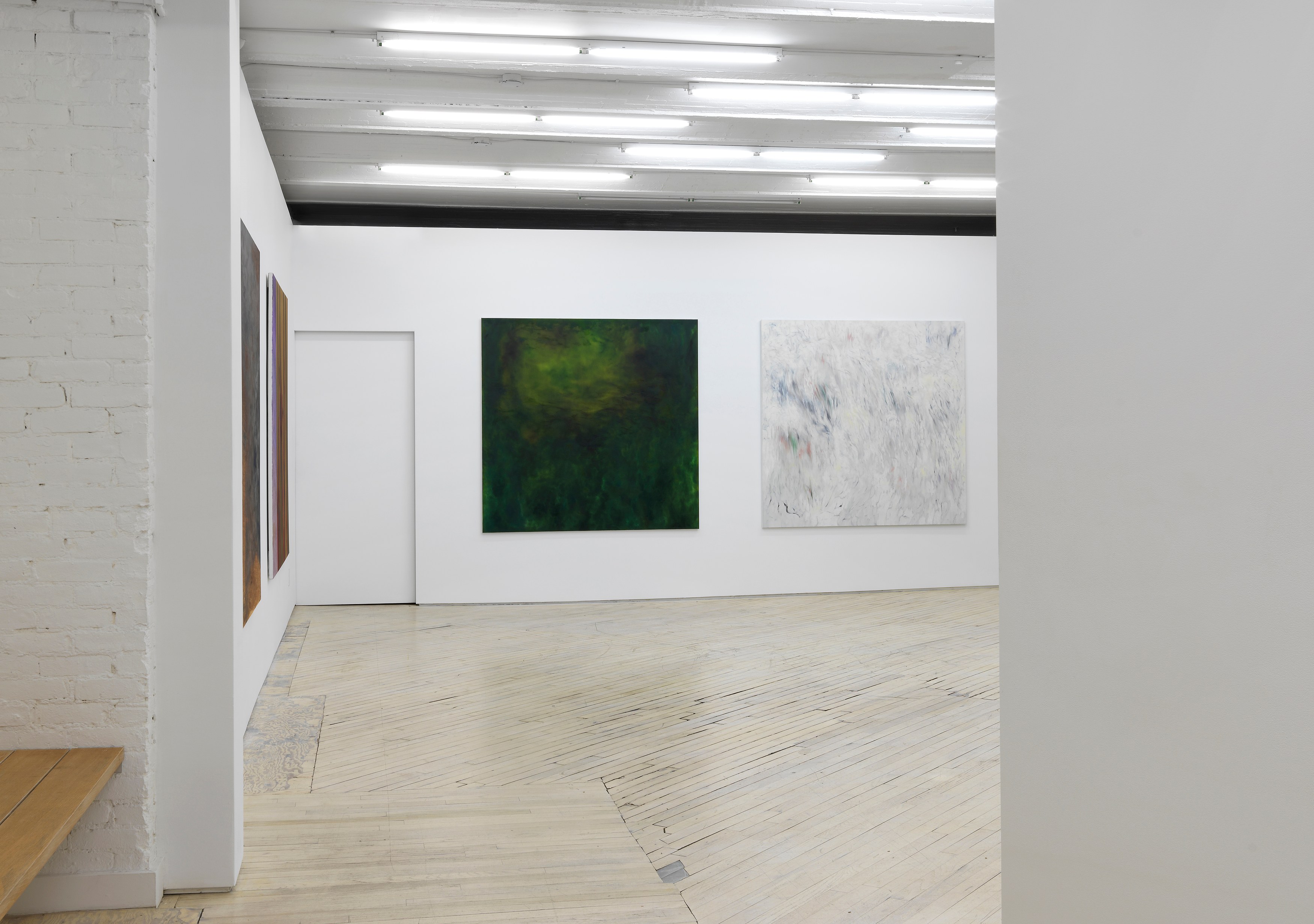
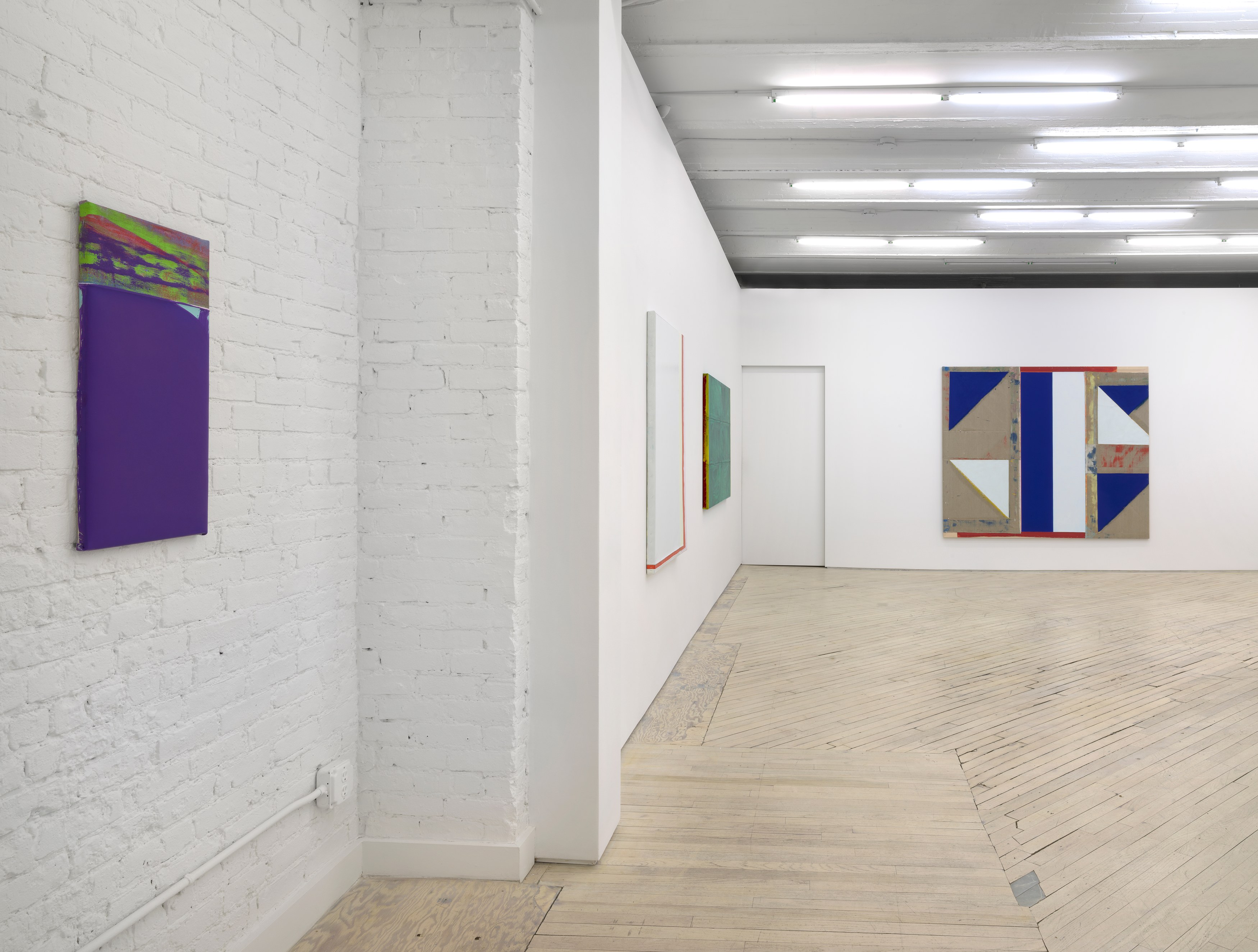
Wojciech Bąkowski, Erica Baum, Eduardo Berliner, Caleb Considine, Constance DeJong, Ellie Ga, Vivienne Griffin, Tom Holmes, JM Howey, Matt Hoyt, Lionel Maunz, Kyung-Me, Ian Miyamura, Christine Rebet, Julia Rommel, Libby Rothfeld, Kate Spencer Stewart, Patricia Treib, Thiang Uk Bureau opened its doors fifteen years ago, but the doors were already open. Bureau's doors were Dispatch's doors before, and Erica Baum, Ellie Ga, Tom Holmes, Matt Hoyt and Lionel Maunz had already walked through. Ellie surprised me, as if I had seen a ghost, walking up Henry Street though I thought she was still in France, following her six-month expedition into the polar night. Erica debuted her Naked Eye series and Kenny Goldsmith read the weather. Tom shared two funerary options, highlighting the relationship of a cinder block to a box of kid's cereal, and Matt brought in his bedroom bookshelves to support his small sculptures. Lionel took part in an unruly, three-part ritual, filling 127 Henry Street to its maximum capacity. The doors had been opened, thanks to myriad conditions. With the flat file in place and the printer in the bathroom, on May 9, 2010, we opened our inaugural group show about inanimate things. Vivienne Griffin showed two sculptures made of stone, water, wood and brass. It was Mother's Day and we had a vase of fuchsia peonies. Howie Chen brought a pineapple. Jill was there. It was a crowd. Bureau came into being with the sun in Taurus, like a number of our artists, in the year of the metal tiger. The articles of organization were published April 24, 2010, in the Brooklyn Daily Eagle. But it was all gestating well before all that. Well beyond me, or Dispatch, well beyond the Swiss Institute, beyond Hunter College on 41st Street, or Columbia, watching the New Human's play, reverberating along connected lines. Beyond getting the chance to work with Steven Parrino and affirm a love for black paintings. Or learning to say yes as much as possible when an artist you believe in has a crazy idea. We dropped the ceiling for Libby Rothfeld, and put a sloshing tumbler full of old tennis shoes up there. We scratched up the floors with Lionel's cast iron and concrete. We let Andrea Merkx and Nathan Gwynne—with innumerable collaborators—force a view of one-point perspective and stage a rock opera. We built walls and took them down, worked in the dark and played sounds that are still stuck in our heads. In 2012, Julia Rommel's small studio in Greenpoint was just the right size to prepare a suite of tiny paintings for 127 Henry Street; the show flyer featured the artist, in black and white, sunbathing on a beach in Delaware. For our final show on Henry Street, Constance DeJong turned the space into a limited-capacity theater for SpeakChamber. On the way to FedEx on East Houston, we spotted a space that was for rent, with light pouring in at the back from a skylight and little garden. We threw a dance party before renovation. Our plants flourished. Eventually, the Lenin statue moved from across Houston Street to our roof. On the five-year anniversary, we debuted Christine Rebet's inky fever dreams from Haiti and her father's nightmares of war on another Mother's Day. Ten years in we were grateful to have a project to work on that included all of our artists, because we were losing our minds in lockdown. But now, five years later we have opened our new doors at 112 Duane Street. Our inaugural show debuted a new body of work by Erica, and Kyung-Me drew our cast-iron facade, still sporting its chained-up plywood entryway. Now we have a glass vestibule. This anniversary show is the first one we've staged in a space and, for including every single artist on our roster, I think it turned out surprisingly well. —Gabrielle Giattino
 PastSinuations
Patricia Treib
Apr 26 – Jun 1
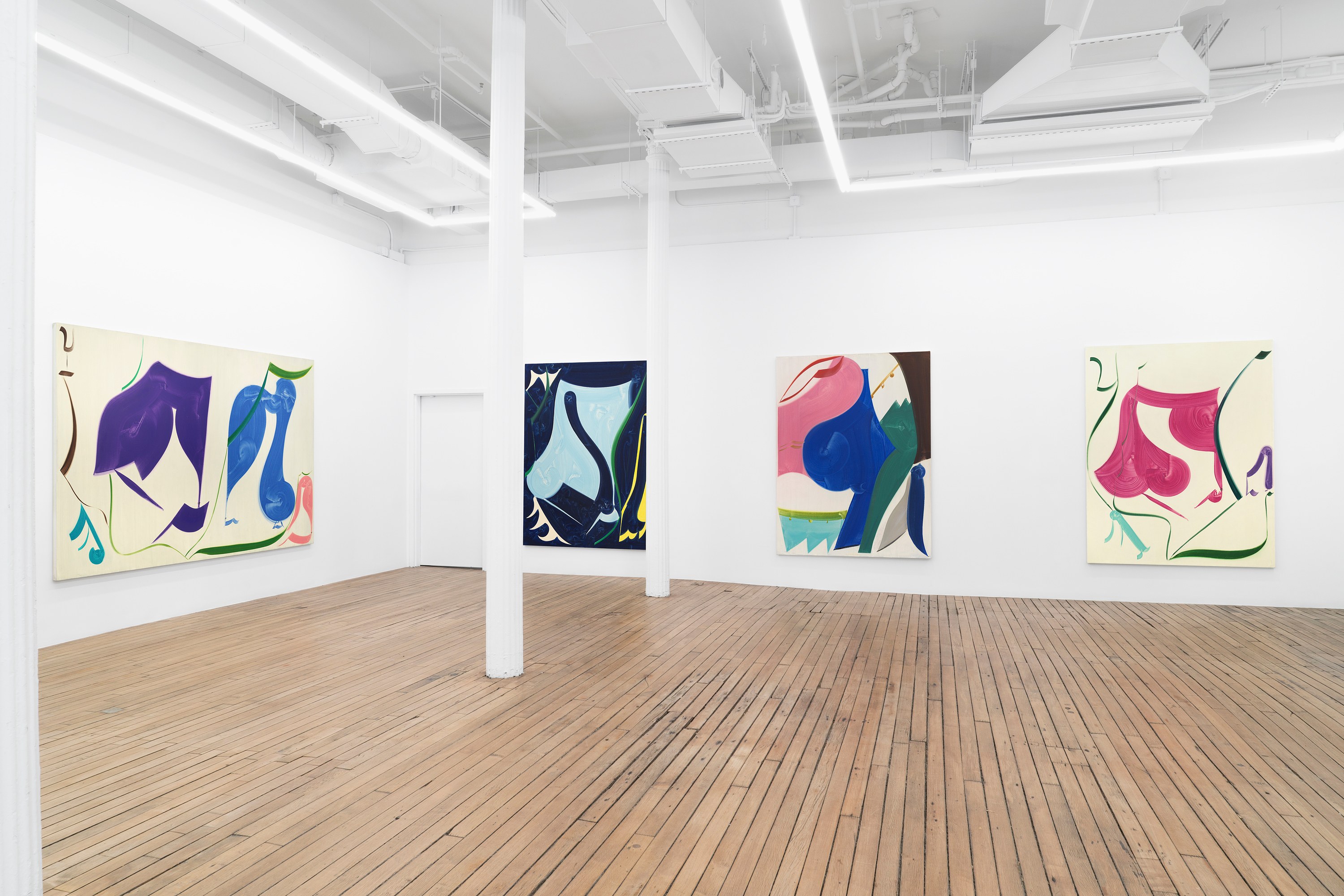
Bureau is pleased to present our third solo exhibition with Patricia Treib, Sinuations. The exhibition covers both floors of the gallery and features a suite of large oil paintings along with framed paintings on paper. Accompanying the exhibition is a new text about Treib's work by art historian Erin Kimmel, below. The shapes in Patricia Treib's paintings are wet and buoyant. Pools of pigment, they bend and bulge, unfurling themselves in one plump lobe and then another (and sometimes another). Just as soon, they pinch and squeeze, tapering into creases with razor sharp edges. Sometimes they are suspended alone, or in doubles, that dominate the always alive picture plane. Often, they nestle into one another or curl into active grounds. Succulent lines slide around these shapes in quick, buttery succession and often end after a flourish or flit. In Sinuations, these elements hang together in strange orchestrations that recall a vocabulary of ornament: arabesques, curlicues, volutes, pedestals, garlands, ribbons and rosettes. But it's the uncanny side of ornament at play here, the mystery of adornment's arcane origins and enduring appeal. Treib's paintings model the occult subjectivity of the hand-made mark—an integral part of being alive. By turns quietly radiant and boldly urgent, snaking configurations and arching lines appeal to the flexibility of the eye and the body's mobility. In canvases like Le Cinture and Fuchsia Sleeve, off-white illuminated surfaces lend airy syncopation. As if in rejoinder, the sensuous and earthen grounds of other canvases push forward into the viewers' space. In Antiparian, a watery mocha field eddies and swirls, and does a few hard-edge turns, around a large turquoise brooch, peach flutes and a bombastically lush emerald green foliation. It's lavish and odd, carnal and ethereal too. Just as Treib's shapes frustrate language—or perhaps, demand a certain lexical acumen—there is a jarring yet well-whetted dissonance to her use of color. Similarly high-keyed on the value scale, she deploys combinations that ring in the same manner as a minor chord. In Sheer Sleeve, for example, the nebulous, icy blue of the dominant shape is enveloped by a midnight blue so clarion it beckons one to dive in. But a screeching yellow tendril and rich shamrock lines interrupt the clarity of that call. At once consonant and ghostly, the painting, like the show writ large, scintillates with studied, enigmatic exuberance. —Erin Kimmel Patricia Treib (b. 1979 Saginaw, MI; lives and works in Brooklyn, NY) received her BFA from The School of the Art Institute of Chicago (2001), and an MFA from Columbia University (2006). Recent solo exhibitions include Icon Arms, ARCH, Athens, Greece (2024); Enfold, Kate MacGarry, London, United Kingdom (2024); Undulations, Galerie Nordenhake, Stockholm, Sweden (2023); Oscillations, Galerie Nordenhake, Mexico City, Mexico (2022); Variations, F, Houston, TX (2021); Sleeve Variations, Overduin & Co., Los Angeles, CA (2021); Arm Measures, Bureau, New York, NY (2020); Limbs, Kate MacGarry, London, United Kingdom (2019); Grotesquerie, Galerie Nordenhake, Stockholm, Sweden (2018); Crown Point Press, San Francisco, CA (2018); Interstices, Bureau, New York, NY (2017). She has participated in residencies at Arch Athens (2021); the American Academy in Rome (2017), the Dora Maar House (2014), and MacDowell (2013). Treib was a recipient of the 2017 Artadia Award and a 2020 Guggenheim Fellowship. Her work is held in the collection of the Aïshti Foundation, Jal El Dib, Lebanon; Colby College Museum of Art, Waterville, ME; the Achenbach Foundation for Graphic Arts, Fine Arts Museums of San Francisco, San Fransisco, CA; The Morgan Library & Museum, New York, NY; the National Gallery of Art, Washington, D.C.; the Rollins Museum of Art, Rollins College, Winter Park, FL; and the RISD Museum, Providence, RI.
Past
ObedienceLionel Maunz
Mar 1 – Apr 13
Bureau is proud to present our seventh solo exhibition with Lionel Maunz, Obedience. The exhibition features three major sculptures, The Performance, The Pig, and A Model for a Furnace and a Model For an Adult. Through these pieces—looking into the work of Otto Muehl, Harry Harlow, R.D. Laing, among others—Maunz confronts failures of art, psychiatry, and religion to heal or transcend. Accompanying the exhibition is the artist's text, which introduces the themes and subjects explored in the work. I wanted this show to be maximal. I wanted a larger, more complete sense of cataclysm—something more environmental, less fragmentary, more total. Thinking about how narrative can be a means of using specificity to close, to limit access to interpretation. "You put monkeys, isolate in pits, ripped apart by total deprivation. What followed, putting in only as much care as was removed, a failure to rehabilitate that broken animal panic. You set to liberate your communards with sex and fracture until it was only your contempt that answered their freedom. You chained your hallucinating patients together for days, on all fours to feed, naked, to heal through a total encounter with stunted being. Do you have contempt for the feelings that motivate you? Have you tried to no longer see the damage so viciously?" My thinking had been consolidating around Otto Muehl, the artist and Friedrichshof commune leader; Harry Harlow, the primate researcher; and Elliott Barker, head psychiatrist at the Oak Ridge Asylum for the criminally insane and, importantly, a student of R.D. Laing. So the work starts there—trying to bring them together, or rather, collide them. "They're eating their fingers now, sexless and insane. Deprivation or indulgence, still broken. Youth as butchered memory, as butchering inevitability. All the fathers, all the mothers and it feels so much like hatred. Do you want to see the healing that doesn't exist? A metered power, a violence that isn't so complete and perfect?" Broadly, I'm looking for instances where things fail into the precise opposite of intent—also at confinement, and at asymmetrical power dynamics—in an effort to extract my deep ambivalence around power and to clarify the joy that transforms it into cruelty. "When and where did you fail? Did you track it creep or did it just trample? Senseless, quivering, terrorized by botched instinct. Are you ashamed of what you've done or just who you've become?" Confinement exists in the world as family, religion, culture, need, law, fear, love. And as much as it's an absolute and insulting reality, one still wallows in it. The problem being how willing the submission—and I have a real contempt for that—and begin to valorize the jailor over the inmate and identify with power, and from there the impulse is destructive. This aligns with the most salient impressions of my youth in preparing for and ultimately longing for cataclysm. "Is this dominion? Is failure cessation? Is love? And where exactly did you become an animal? You've made sure they can only ever move backwards, away from all this. Each terminus of psychiatry." The Performance started with two men wrestling—thinking about Muehl's early Aktions where he's aggressively manipulating another body. Typically, I've worked with naked bodies, where they're at their ugliest and most vulnerable, but I wanted clothes here to more precisely indicate shame and also reference the garments of patients and inmates. Impulsively, I began sculpting a pig head to sit atop the bodies to try and break or distort the image. But it's not an image: it's a thing in the world, interfering, competing with your body. Sculpture is the most finite, constrained, and, as a result, the most connected to biological reality of any of the arts, closest to death. Despite my resistance to metaphor, the pig seemed to work as a reference to the use of animals in the Aktions, as well as Muehl's swinish public image and, finally, to the sycophantic communards, which by the end he answered only with conceit, contempt and abuse. The title refers to the general performativity of psychiatry as well as, specifically, the transformation of the psychiatric "work" of acting out traumas in the commune, to Aktions ultimately being curated to entertain rather than be therapeutic. "Was there growth in their decline, comprehension in their obstruction? Achievement in that incandescent defacement? Why the punitive rage, the gloating, the hideous excitement of watching it crawl into a pain dampened only with denial?" The Pig started with the previously discarded pig head. I went through a number of conceptual iterations of the pig via Nietzsche, via the correction of an older work referencing a Michael Gira text and, finally, uncomfortably landing on Robert Pickton. He's a slob and an idiot, but unconstrained. And in his Piggy Palace, he unites prostitution and abattoir, architecturally satisfying my interest in how and where sex and violence coalesce, or rather meet and fracture into expanding personal definitions in front of legal ones. By the end of it, the pig is a landscape of birth and death, the standing figure an oblique reference to Pickton, but more so to the theme of the tyrant—of naked, unrepentant power and aggression. Oppositionally, the enormity of the acts one might commit weighed against the smallness of the needs satisfied. "The sex here is only as much as the disgust in it. The power transfixed by joy into cruelty." A Model for a Furnace and a Model For an Adult is based on a combination of diagrams—of my family tree, a crematorium, and the building where Sabine Dardenne was kept. The furnace is where this all ends, where the ugliness is consumed and where Muehl burned all the communards' journals in advance of his prosecution, coating large paintings with the ashes. "Do you want a definition of strength that doesn't resolve as discipline or atrocity? Are you looking for something that isn't flattened by experience, that can stand scrutiny without remove into safety or sentiment?" Punitive or protective? Love? It's a complex response to childhood. To mine, to the children of the commune, the destroyed Capuchins, the victims of the inmates at Oak Ridge. Muehl and Laing via Barker are up to the same thing with the family and love—skinning them. Proving, then recapitulating the damage. "Health? You want to see a need for destruction, more sentience, rather than careless lapse. How selfish are you? Beyond the threshold of convalescence, these real impossibilities of recovery or growth." —Lionel Maunz Lionel Maunz (b. 1976, Washington D.C.; lives and works in New York, NY) received his BFA and MFA from Southern Methodist University in Dallas, TX. Solo and two-person exhibitions include Forest Passage, Darja Bajagić & Lionel Maunz, Downs & Ross, New York, NY (2022); Where the Body Ends, Bureau, New York, NY (2022); In the Sewer of Your Body, Bureau, New York, NY (2018); Discovery of Honey / Work of the Family, The Contemporary Austin, Austin, TX (2017); Fealty, Bureau, New York, NY (2016); Lionel Maunz, MoMA PS1, New York, NY (2016); Deluge, Bureau, New York, NY (2014); Receipt of Malice, Bureau, New York, NY (2012); Wail Eternal Scorn of Geologic, Bureau, New York, NY (2011). Maunz's work is in the permanent collection of the Whitney Museum of American Art, New York, NY; Museum of Modern Art, New York, NY; and the Blanton Museum of Art, Austin, TX.
Past
Shadow’s EdgeThiang Uk
Mar 1 – Apr 13
Bureau is proud to present Thiang Uk's first solo exhibition in New York, Shadow's Edge. Uk's paintings are luminous and tumultuous, evoking mythical expanses of sea, sky, and land. Light glistens on his surfaces like prismatic raindrops over tempestuous waters. Flames leap across cresting mountains, and smolder amidst spiraling winds. His painterly technique approaches gestural abstraction with vibrant palettes and rhythmic mark-making, yet he retains illusionistic space in his otherworldly vistas. Many compositions feature pictorial elements – candles, hands, animals – floating at the edges and in the foreground, framing his compositions and introducing symbolic motifs. His paintings are deeply influenced by childhood memories of growing up in Myanmar, and the animist myths of his region. These oral traditions were passed down to him by his grandmother and formed the foundation for Uk to explore notions of shapeshifting and the interconnection of the land and its beings. As a young person, Uk migrated from Myanmar to the U.S. with his family fleeing political violence and instability. Recent paintings reflect this fracture, featuring formal divisions and doubling of images, which stem from Uk's direct experience of the trauma of migration and mutability of identity. Uk's paintings bear the mark of grief but also invite contemplation of a boundless space where opposites conflict and merge. Creation and chaos mingle in his compositions, as raw, destructive energy meets with a sumptuous and sensory abundance. Thiang Uk (b. 1993, Hakha, Myanmar; lives and works in Baltimore, MD) received his AA from Daytona State College, Daytona, FL (2014); BFA from Hunter College, New York, NY (2017); MFA from Maryland Institute College of Art, Baltimore (2021); and attended the Skowhegan School of Painting and Sculpture, Skowhegan, ME (2023). Recent group exhibitions include New Voices: Julia Callis, Jen P. Harris, Claudia Pena Salinas, Thiang Uk, Abattoir Gallery, Cleveland, OH (2025); Scorched Petals to Pages, The Nicholson Project, Washington, D.C. (2024); It Never Entered My Mind, curated by Michael Sherman, Sean Kelly Gallery, Los Angeles, CA (2024). Forthcoming solo exhibitions include Silber Art Gallery, Goucher College, Towson, MD (2025).
 PastThey Learned to Look Up and Down
Ian Miyamura
Jan 10 – Feb 16
Meaning in painting is like a spider. It might hide under a piece of something, waiting to be revealed in the act of overturning. Maybe it has been there, in the corner of the room, for days. Clearly and plainly. I like when it lowers itself onto a shoulder, silently going long moments until it is discovered—then with a start! Or never fully is. The only thing being felt—along the sides of the mind—are those nearly invisible wisps... like impossibly small corridors of wind. The artist is an insect. It is an inheritor of a complex environment in which it must find a way to navigate, one among many others. Because successful navigation largely depends on when, when not, and how to be seen, insects have developed behaviors that can be looked at as strategies of defense. Some choose to quietly blend into their surroundings, mimicking a twig or a leaf. Others pattern their wings with the faces of that which makes prey out of their predators. Interestingly, there exist behaviors that are self-defeating and end up encouraging unwanted attention. Then there are those performed in the total absence of a threat. What this confusing logic between one and the other might reveal is that the insect's prime interest is in fact compulsive industriousness not as self-preservation, but as a means of assimilation into its environment—one that is now devouring by its nature. Where the self is and is not. A spider is not an insect. Unlike the insect, the work that it occupies itself with—the weaving of its web—is contingent on whether or not another walks into it—and in what way. Most simply, the web either ensnares, or it does not. But this is a poor way of looking at things. In actuality, the web is all: it is at the same time marvelous and knowable. It is a trap, indeed. And so it is a tomb—to both the spider and its other. It is also a network of lines between points. It is a support. Yet it is not there, it is covered in dust, it is made new each day. —Ian Miyamura Ian Miyamura (b. 1991 Kailua, HI; lives and works in Brooklyn, NY) received his BFA from The School of the Art Institute of Chicago in 2013, and an MFA from Maryland Institute College of Art in 2019. Solo exhibitions include Chaos Spawn, François Ghebaly, Los Angeles, CA (2024); Bureau at the Paris Internationale, Paris, France (2023); October 31, 4th Ward Project Space, Chicago, IL, 2022. Group exhibitions include My Condolences, M+B Gallery, Los Angeles, CA, 2023; A Tournament of Lies, The Wassaic Project, Wassiac, NY, 2022. In 2021, Miyamura attended Mass MoCA's artist residency program as a fellowship recipient. In 2022 he was awarded a FST Studio Projects Fund grant. He is a recipient of the Luminarts Cultural Foundation of Chicago Fellowship (2013), as well as the LeRoy E. Hoffberger Foundation Fellowship (2017). This is the artist's first solo exhibition with the gallery.
Past
RemainsJan 10 – Feb 16
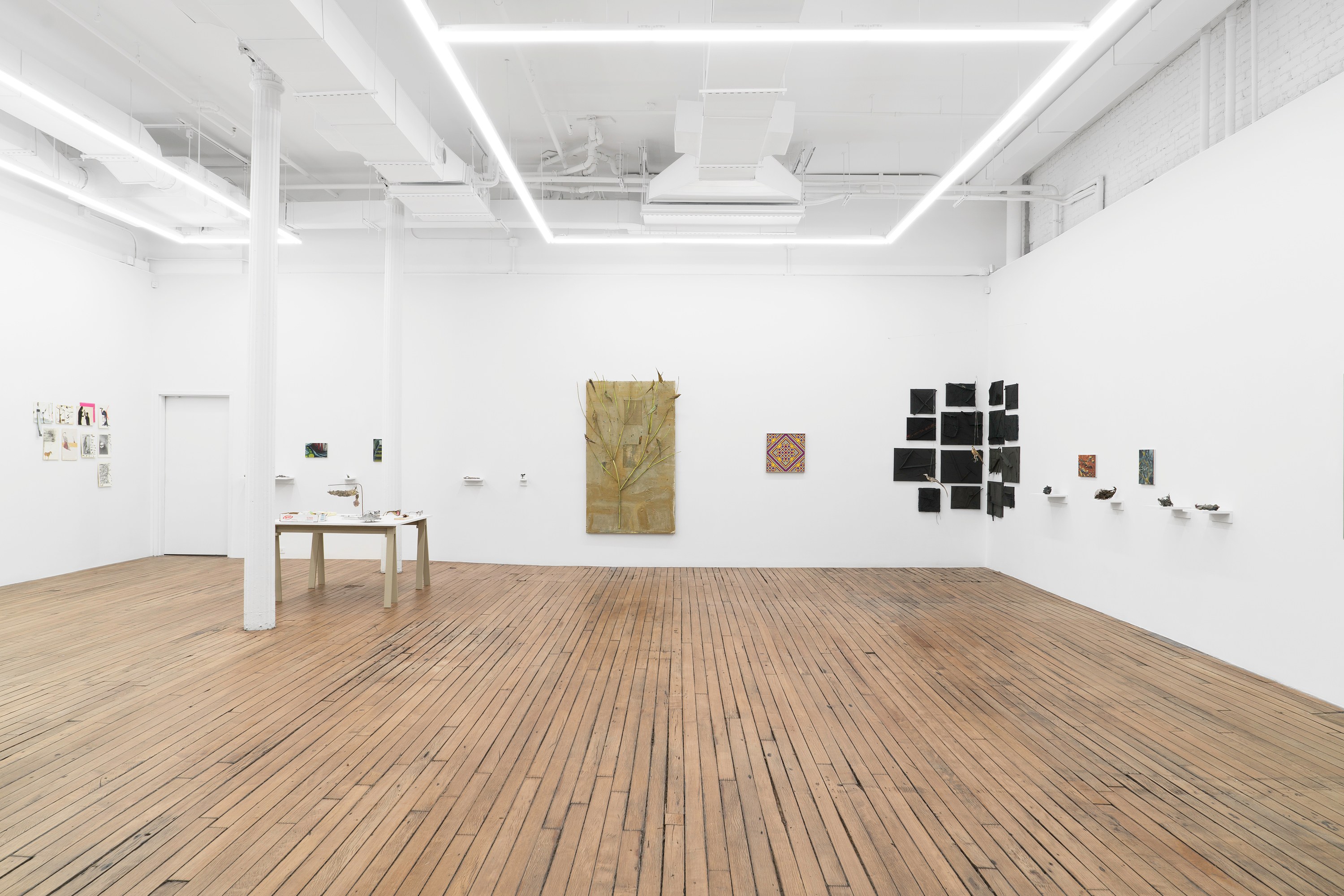
Beverly Buchanan, James Castle, Cathy Lebowitz, Liz Magor, Monique Mouton, Em Rooney Bureau is pleased to present a group exhibition featuring Beverly Buchanan, James Castle, Cathy Lebowitz, Liz Magor, Monique Mouton, and Em Rooney. Given the certainty of impermanence, what remains? The artworks in this exhibition could be seen as material mementos of inevitable transience. Through varying procedures, the pictures and objects here display the erosion and wear of time, and of fading memory. Origins and spirits linger like relics, evoking specific histories and locales. For some, gesture and mark-making is abrupt, frenzied, and ephemeral—like enunciative acts of opening and closure. We see a deposed corpse of a bird, irregular polyhedrons, a gust of paint, a procession of trees and passing road signs, handmade wooden shacks, long swept away. Temporary shelters are evoked by irregular planks of wood, the soft sides of well-worn cardboard, and the repurposed objects of home. There is something not-quite-perfect or "resolved" in each of them. And, something brightly fleeting about their shared terrain. Beverly Buchanan (b. 1940, Fuquay, NC; d. 2015, Ann Arbor, MI) received a MS (1968) and MPH (1969) from Columbia University, New York, NY. Recent solo and retrospective exhibitions include Beverly Buchanan: I Broke the House, ETH Zurich, Switzerland (2024); Beverly Buchanan: Shacks and Legends, 1985 - 2011, Andrew Edlin Gallery, New York, NY (2021); Beverly Buchanan: Habitat For Humanity, Paul R. Jones Museum, Tuscaloosa, AL (2019); Beverly Buchanan: Ruins and Rituals, 1976 - 2013, Brooklyn Museum, Brooklyn, NY (2016). In 2011 Buchanan received the Women's Caucus for Art Lifetime Achievement Award. Her work is in the collections of The Baltimore Museum of Art, Baltimore, MD; Carnegie Museum of Art, Pittsburgh, PA; High Museum of Art, Atlanta, GA; Metropolitan Museum of Art, New York, NY; and Museum of Contemporary Art, Los Angeles, CA; among others. James Castle (b. 1899, Garden Valley, ID; d. 1977, Boise, ID) was born deaf and believed never to have learned how to read, write, or sign. Castle is well known for his drawings, books, and constructions. He has been the subject of a number of solo retrospectives and exhibitions including James Castle: The Experience of Every Day, Minneapolis Institute of Art, Minneapolis (2016); Untitled: The Art of James Castle, Smithsonian Museum of American Art, Washington DC (2016); and James Castle, Show and Store, Museo Nacional Centro de Arte Reina Sofia, Madrid (2011). His work is in the collections of Art Institute of Chicago, Chicago; Columbus Museum of Art, Columbus; Museum of American Folk Art, New York; National Gallery of Art, Washington DC; and The New York Public Library, NY; among others. Cathy Lebowitz (b. 1965, Philadelphia, PA; lives and works in New York, NY) received a BA from Smith College, Northampton, MA (1987); attended the New York Studio School, New York, NY (1989-1992); and received an MFA in Creative Writing from The New School, New York, NY (2011). Solo exhibitions include Dark Skies, Rocks, Skoto Gallery, New York, NY (2024), When I Was a Bird, Skoto Gallery, New York, NY (2021). Group exhibitions include Fairy Tales and Illusions, Skoto Gallery, New York, NY (2024); and Thirty Years, Skoto Gallery, New York, NY (2022). Lebowitz held an editorial position at Art in America from 1987 to 2017. Liz Magor (b. 1948, Winnipeg, Manitoba; lives and works in Vancouver, British Columbia) studied at University of British Columbia, Vancouver, British Columbia (1966 - 68); Parsons School of Design, New York, NY (1968 - 70); and Vancouver School of Art, Vancouver, British Columbia (1970 - 71). Recent solo exhibitions include The Rise and The Fall, Fondazione Giuliani, Rome, Italy (2023); The Separation, MOCA, Toronto, Ontario (2023); I Have Wasted My Life, Andrew Kreps Gallery, New York, NY (2021); Downer, Catriona Jeffries Gallery, Vancouver, British Columbia (2021); Liz Magor: Blowout, Carpenter Center for the Visual Arts, Cambridge, MA (2019); Xhilaration, Marcelle Alix, Paris, France (2019); and you, you, you, Musée d'Art modern et d'Art Contemporain, Nice, France (2017). Her work is in the public collections of the Art Gallery of Ontario, Toronto, Ontario; Lafayette Collection, Paris, France; Migros Museum of Contemporary Art, Zurich, Switzerland; Musée d'art contemporain de Montréal, Québec; National Gallery of Canada, Ottawa, Ontario; Pinault Collection, Venice, Italy; among others. Monique Mouton (b. 1984, Fort Collins, CO; lives and works in New York, NY) received a BFA from Emily Carr Institute, Vancouver, British Columbia (2006); and received an MFA from Bard College, Annandale-on-Hudson, NY (2014). Solo and two-person exhibitions include a vista, Monique Mouton & Covey Gong, Bel Ami, Los Angeles, CA (2024); Art Basel Statements, Bridget Donahue, Basel, Switzerland (2024); Destiny Cornucopia, Nancy Lupo & Monique Mouton, VEDA, Florence, Italy (2022); Inner Chapters, Bridget Donahue, New York, NY (2021); Braid, VEDA, Florence, Italy (2020); Scene, Kayne Griffin Corcoran, Los Angeles, CA (2019); The Theme is Green, Bridget Donahue, New York, NY (2018); More Near, Bridget Donahue, New York, NY (2016). Her work is in the permanent collection of the Davis Museum, Wellesley College, Wellesley, MA. Em Rooney (b. 1983, lives and works between Canaan, CT and New York, NY) received her BA from Hampshire College, Amherst, MA (2005), an MFA from Tyler School of Art, Philadelphia, PA (2011); and attended the Skowhegan School of Painting and Sculpture, Skowhegan, ME (2012). Solo exhibitions include Imagined Beauty Begins Now, Derosia, New York, NY (2024); Double Portrait, Paena, Mexico City, Mexico (2023); Entrance of Butterfly, Derosia, New York, NY (2022); Women in Fiction, Francois Ghebaly, Los Angeles, CA (2020); You, Too, Know That You Live, Fons Welters, Amsterdam, The Netherlands (2019); Ordinary Time, Bodega (Derosia), New York, NY (2018); The Word for Forest, Bodega (Derosia), New York, NY (2016). Her work is in the permanent collection of the Museum of Modern Art, New York, NY.
 PastI Want to Climb Through the Windows of My Eyes and Become Static Electricity
Matt Hoyt, Tom Thayer
Nov 2 – Dec 14
Past
I Want to Climb Through the Windows of My Eyes and Become Static ElectricityMatt Hoyt & Tom Thayer
Nov 2 – Dec 15
The first time I encountered Tom Thayer was around 2007. He was participating in an evening of performance at Issue Project Room in Brooklyn, which I believe Jay Sanders had organized. Tom's performance is the only thing I can clearly remember from that night. Tom, a tall and lanky guy, was standing over a phonograph player placed on the floor. He made a quick introduction of himself, mentioning something about his father, then proceeded to manipulate a cardboard marionette resembling a bird; a stork or a heron, perhaps? The long, scrawny neck of the bird, controlled by some sort of jury-rigged wire contraption, lunged up and down, poking its beak at an LP spinning on the turntable near its feet. Apparently a phonograph needle was attached to the tip of the beak. Loud bursts of all sorts of screeching, skipping, stuttering, scratching noises were released out into the room for, maybe, five minutes. I wasn't sure what I thought of this artwork or this guy in general. Months or years later, after our social circles had overlapped, Tom gave me a copy of a record he had recorded in Nashville. He told me he'd spent approximately a year working on this with the intention of it being used in his performances, or “scenographic plays” as he calls them. This is the record that those jarring blips of bird noise were coming out of. For me, this record served as a key to understanding Tom and his work. There are a lot of artists who would make a record, but Tom is an artist who would make a record in order to make a play. In conversations about our own artistic influences and formative experiences, Tom has mentioned his recollection of seeing a certain exhibition at the Museum of Contemporary Art Chicago in 2004. This exhibition, titled Kai Kein Respekt (Kai No Respect), was the first museum survey of the multimedia artist Kai Althoff. Tom recalls being impressed, not only by the overall sensibility of Althoff's work, but specifically by the artist's ability to skip from one medium or discipline to another with seamless success. While there is a clear affinity in this regard between the two artists, I can't get myself to use the terms “multimedia” or “interdisciplinary” when describing what Tom does. Instead, I'd say there is an amorphous spirit at the core of it all, possessing the ability to temporarily assume various forms. Slipping in and out of each with ease, as a hermit crab may squat a shell for the time being. Like a ball of mercury, as soon as one thinks they've put their finger on it, the thing splits, darting back into its own elusive nature. This unshakable affinity with all things that will forever remain elusive, or ineffable, is the common ground between my creative pursuit and that of Tom Thayer. —Matt Hoyt, Yorktown Heights, NY, 2024 An artist will never see their work the way their audience does. They see it muddled with the hopes, failures, reworkings, surprises, undetectable influences, etc., of its coming into being. So, artists maintain consortiums of trusted eyes and minds who can see the work with the clarity of an audience. For fifteen years, Matt Hoyt and I have been trusted eyes and minds for one another. Throughout those years, Matt and I bonded over our shared interests in art and music. We've talked for hours on end about Maria Martinez's pottery, Forrest Bess's paintings, the Philadelphia Wireman's sculpture, Jean Dubuffet's music, Jean Arp's poetry, Yutaka Tanaka's Post-Industrial cassettes, C.O.B.'s Spirit of Love, Fluxus music, Modernism, contemporary art, Art Brut, art therapy, children's art, tempera paints, the sound of rain, the sound of the wind, the sound of rocks—but what we mostly talked about is our artwork. I've always been drawn to artwork that serves a function, as its functional aspect can occupy the artist's mind, freeing the more critical aspects to be made from a deeper place. Matt's paintings and sculptures are functional. His paintings are created through a meditative and therapeutic process, and his sculptures are made as an exercise in dealing with fears. Their functions make way for the development of secondary lines of communication that feel at once alien to my mind and familiar on a cellular level. Matt's work embraces being multiple things at once. It is natural and artificial. It is hard-edged and wonky. It is of this world and alien. It reminds me of looking at a newborn infant and seeing a form that isn't fully set in this world. The first time I saw one of his sculptures, I couldn't tell if I was looking at the skeleton of something someone had come across in the woods or an antenna for some unknown transmission. I now realize that, for me, those two scenarios are the same thing in Matt's work. It's not that the work doesn't hit me over the head with answers; it's that the work reminds me that no matter what we are clinging to in this life, there are no answers, and there never, ever will be. Matt and I are two individualistic artists exploring personal, handcrafted worlds. We are both somewhat outsiders, which can be a lonely place to work, so we are lucky to have one another. —Tom Thayer, Maum Sinn, NJ, 2024 Matt Hoyt (b. 1975, Mount Kisco, NY; lives and works in New York) received a BFA from the School of Visual Arts in New York. Solo and two-person exhibitions include Vessels and Lights, Bureau at ECHO, Cologne, Germany (2022); Note To You, Bureau, New York, NY (2021); Einig, with Tom Thayer, Stations, Berlin, Germany (2019); Six Winds, Bureau, New York, NY (2019); Chrysalis, Bureau, New York, NY (2017); Recent Past, 2010-2016, Buffalo AKG Art Museum, Buffalo, NY (2016); One Another, Art in General, New York, NY (2015); It's Always Nice to Meet You, Bureau, New York, NY (2014); 2006-2011, Bureau, New York, NY (2012); Escalator to Common Art, with Mark Van Yetter, Dispatch, New York, NY (2008). Group exhibitions include Mystics of the World Unite, organized by Bob Nickas, Sevil Dolmaci, Istanbul, Turkey (2023); Looking Back: White Columns Annual, selected by Mary Manning, White Columns, New York, NY (2022); Objects Like Us, curated by Amy Smith- Stewart and David Adamo, The Aldrich Contemporary Art Museum, Ridgefield, CT (2018); Strange Attractors, curated by Bob Nickas, Redling Fine Art, Los Angeles, CA (2017); Sunlight arrives only at its proper hour, curated Mitchell Algus and Olivia Shao, 356 Mission, Los Angeles, CA (2017); 2012 Whitney Biennial, Whitney Museum of American Art, New York, NY (2012); Greater New York, MoMA PS1, New York, NY (2010); Looking Back: White Columns Annual, selected by Jay Sanders, White Columns, New York, NY (2008). In 2013 Hoyt received the Grants to Artists Award from the Foundation for Contemporary Arts. His work is in the collections of the Whitney Museum of American Art, New York, NY, and the Buffalo AKG Art Museum, Buffalo, NY. Tom Thayer (b. 1970, Chicago Heights, IL; lives and works in New Jersey) is a Professor of Painting, Drawing, and Diverse Media at the City College of New York. Solo and two-person exhibitions include What you wonder about is what you know– as well as the other way around., Derek Eller Gallery, New York, NY (2022); Einig, Matt Hoyt & Tom Thayer, Stations, Berlin, Germany (2019); Make a Pinch Pot Out of Your Mouth, Derek Eller Gallery, New York, NY (2019). Group exhibitions include Le Contre-Ciel, curated by Olivia Shao, Empty Gallery, Hong Kong (2024); Nurikabe, Tetsuo's Garage, Nikko, Japan (2019); I got the Moon in the Morning and the Sun at Night, WallRiss Gallery, Fribourg, Switzerland (2019); 2012 Whitney Biennial, Whitney Museum of American Art, New York, NY (2012); Looking Back: The White Columns Annual, selected by Jay Sanders, White Columns, New York, NY (2008). Performances include Tom and Henry Thayer for Abasement 66, organized by Joe Frivaldi, Artists Space, New York, NY (2023); Matt Hoyt and Tom Thayer, Loong Mah, New York, NY (2021); An Evening with Tom Thayer, Modern Mondays, curated by Stephanie Webber, Museum of Modern Art, New York, NY (2013). His work is in the collections of Philadelphia Museum of Art, Philadelphia, PA; The Frances Young Tang Teaching Museum and Art Gallery at Skidmore College, Saratoga Springs, NY; The Museum of Fine Arts, Houston, TX; and The Columbus Museum of Art, Columbus, OH.
 PastQuina Viva
Eduardo Berliner
Sep 6 – Oct 20
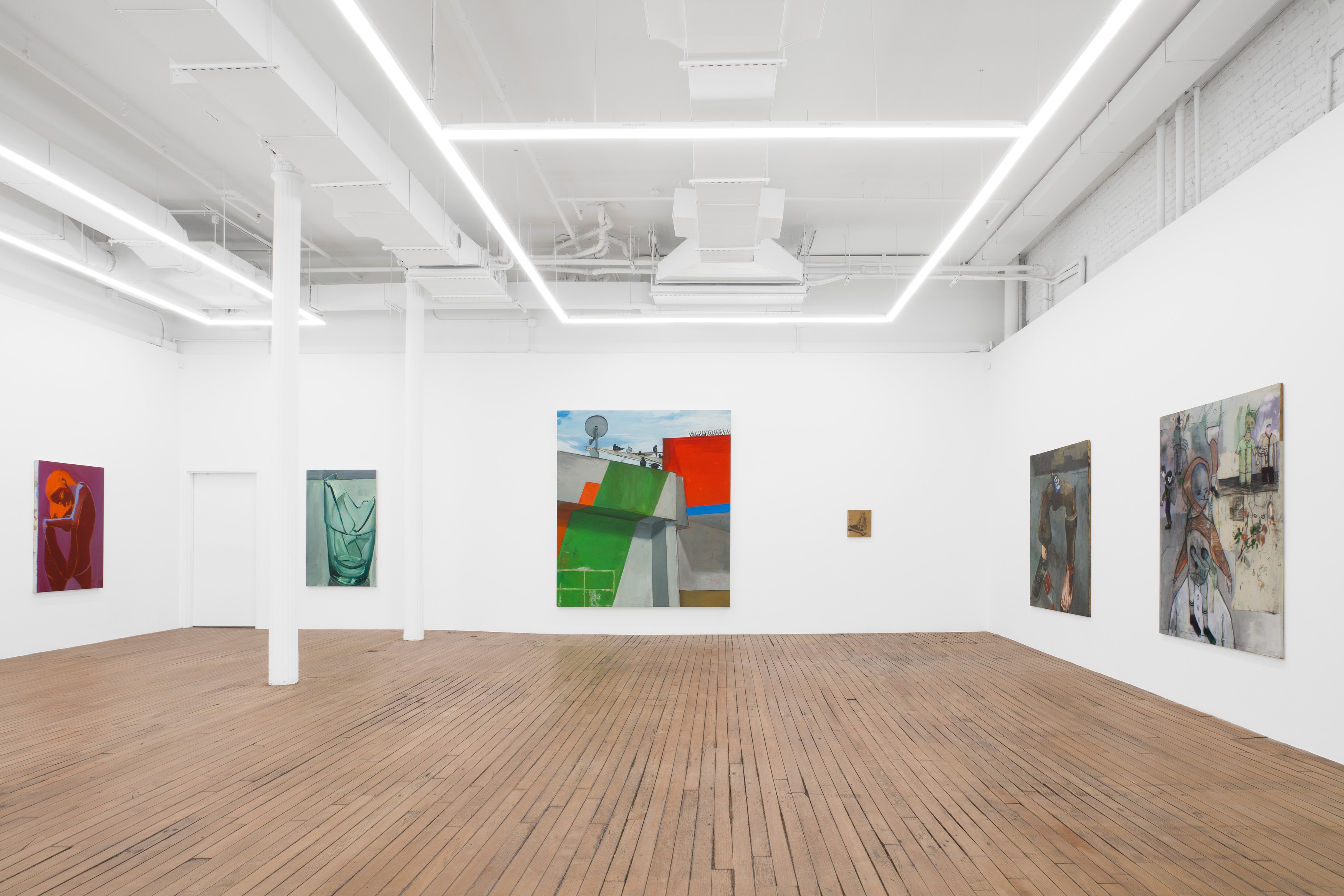
Bureau is pleased to present the solo exhibition Quina Viva (Sharp Corners) by Brazilian artist Eduardo Berliner (b. 1978, Rio de Janeiro). Quina Viva is the first solo exhibition by Berliner in the United States, following numerous gallery and institutional shows in his native Brazil. The exhibition spans both floors of the gallery and comprise paintings and drawings in a variety of scales and media. Berliner is a voracious observer and image maker. He mines his own photographic chronicles in and around Rio, as well as develops imagery from his interior life. He draws and paints with an obsessive, diaristic focus, using his pen and brush to translate his personal observations, experiences, and memories. The exhibition, like Berliner's oeuvre, has an effusive heterogeneity. Paintings from observation are complemented by more fragmented and disquieting scenes, featuring ensembles of creatures and objects. His works offer a gritty, sometimes fantastical realism. Bodies—parts and whole, human and animal—mingle and intersect with inanimate objects. Even his more austere depictions of everyday objects hold a striking tension. Some works may evoke the gruesome intensity of Goya or Beckmann. However, there is a humanist sensitivity to even the darkest scenes. Many reflect a macabre reverie, like the dark whimsy of children's fairy tales. Berliner finds inspiration everywhere, even in his surfaces: sometimes he will build a line from the trace of wood grain or along the edge of a discarded textile on the studio wall. Negative expanses of color and form give way to new silhouettes, appearing out of the abstract space. Berliner offers a complex vision, unbounded by the concrete world, ever attuned to the way lived experience morphs into memory and mingles freely with imagination. I perceive a great power that arises from the borderline territory between what I see and what l imagine; between what the things are and how they function as a mirror of what lives in my thoughts and my memory. But a moment comes during the process when I begin to be guided by the material information on the canvas and by the relationship between my body and the support. I believe that throughout the painting process something unforeseeable needs to happen: it is at these moments that a painting comes into its own. —Eduardo Berliner Eduardo Berliner (b. 1978, Rio de Janeiro; lives and works in Rio de Janeiro) received his Master in Typeface Design from the University of Reading, UK; and a Bachelor of Industrial Design/Visual Communication from the Pontifícia Universidade Católica do Rio de Janeiro. Solo exhibitions include Right under My Bones, Casa Triângulo, São Paulo, 2023; Eduardo Berliner: Drawings, Museu Lasar Segall, São Paulo, 2022; The Shape of the Remains, Casa Triângulo, São Paulo, 2019; Corpo em Muda, Casa Triângulo, São Paulo, 2016; A Presença da Ausência, Fundação Eva Klabin, Rio de Janeiro, 2015; Ferrão, Instituto Tomie Ohtake, São Paulo, 2015; Pinturas, curated by Hans-Michael Herzog, Casa Daros, Rio de Janeiro, 2014; Sala A Contemporânea, Centro Cultural Banco do Brasil, Rio de Janeiro 2013. His work was included in the 30th Bienal de São Paulo, curated by Luis Pérez Oramas, São Paulo, 2012. His work is held in the collections of the Museum of Modern Art, New York; K 11 Art Foundation, Hong Kong; Fiorucci Art Trust, London, UK; MALBA, Buenos Aires; Daros Latinamerica AG, Zurich; Coleção Gilberto Chateaubriand/Museu de Arte Moderna, Rio de Janeiro; Coleção Banco Itaú S.A., São Paulo; Museu de Arte Moderna de São Paulo, São Paulo; Museu de Arte do Rio, Rio de Janeiro; and Pinacoteca do Estado de São Paulo, São Paulo.
 PastThe Song of Lies
Vivienne Griffin
Jul 11 – Aug 17
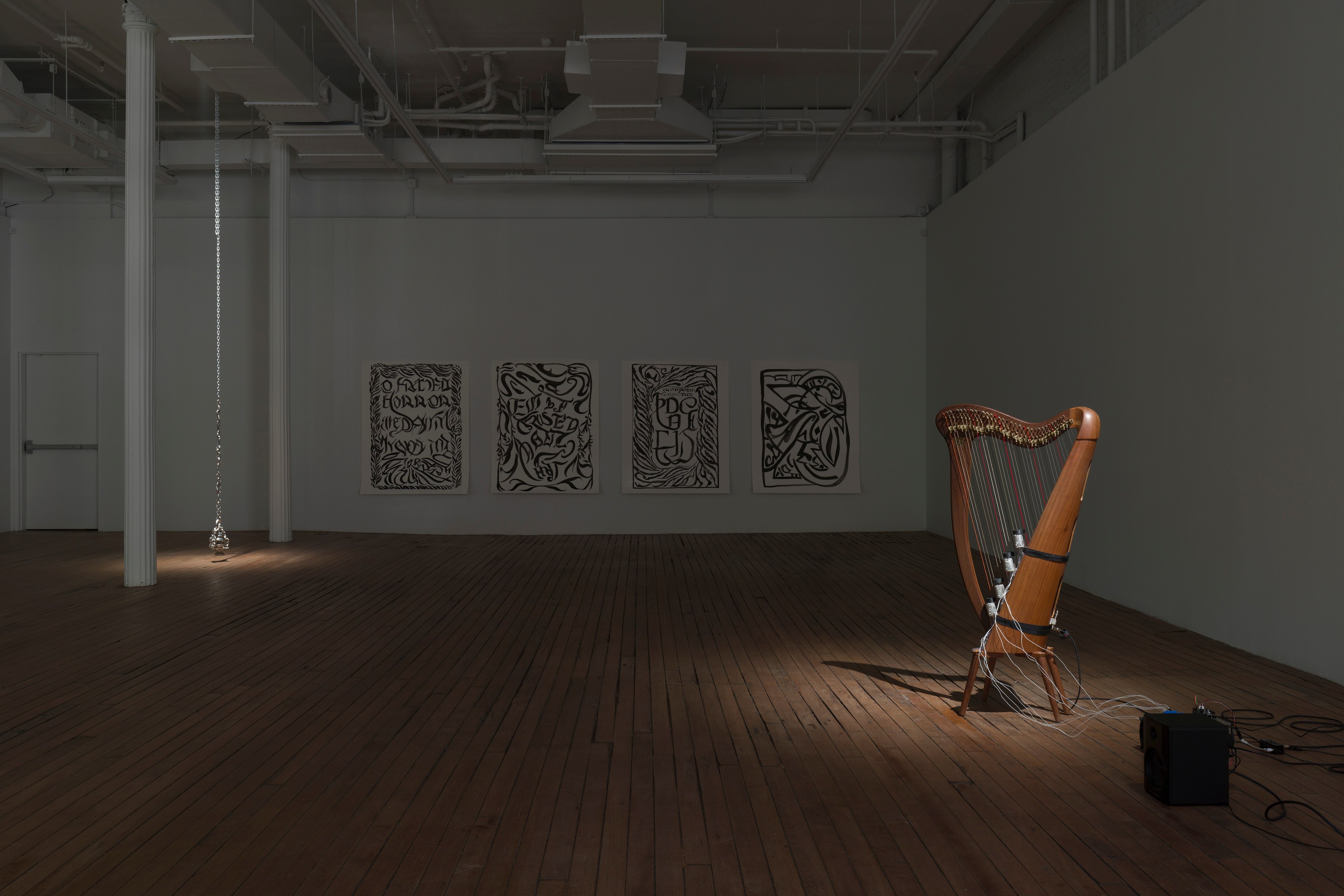
Bureau is pleased to present a solo exhibition by Vivienne Griffin, The Song of Lies. The exhibition is their fourth with the gallery, and features works in multiple media including video, sound, drawing, and sculpture. On the lower level Griffin's major video work, Mercy (2021-23), is screening. Made over the period of two years, this video is the culmination of extensive scholarly research and technical experimentation during the course of their PhD work at SARC, the Center for Interdisciplinary Sound Research in Belfast, Ireland. Mercy is a video work in two parts. The first section is a text based video work allegorizing a collective unconscious nervous breakdown. The opening black and white text video consists of multiple voices communicating about disparate subjects. One voice describes the potential smell of a digital rose; another voice recounts a ten second video they viewed online; yet another is an internal monologue on speed. The second part of Mercy was made with Turing Institute researcher, lawyer and court advocate Cari Hyde-Vaamonde. Part two uses visual metaphors in a virtual world to describe complex systems in Cari's research. For example, the maze describes black box Ai; the rubbish in the maze refers to datasets which are dirty. The stairways within Mercy refer to decision tree branching algorithms. Through this work the idea of the despotic binary is explored. The despotic binary refers to the binary on/off, yes/no, 0/1, that in some way explains the polarization of politics, and the echo chambers that exist online. However, within the sound, the text and the virtual world there is also a constant search for the emancipatory prompts within technology, machine, and human interaction. Upstairs, two objects are spot lit in the dimmed gallery: an automated harp emitting a mechanical score, and a low hung pewter incense burner. In The New Note, a clarsach (Celtic harp) is automated to self-play continuously throughout the exhibition with a programmed score, less melodic and more machine-like. A Heavy Metal Incense Burner reclaims a ritualistic object for a secular space. This solid pewter incense burner was sandcast and hand made by the artist, supported by a chain, each link individually cast by hand. Frankincense incense is burned throughout the duration of the show, this ancient aromatic tree resin, has been used for over 5,000 years. A small framed ink drawing of an ornate confessional box is accompanied by larger drawings developed using AI models trained on a dataset of Griffin's drawings. Within the context of extractive capitalism and data capitalism, AI becomes both a resource and a self annihilating prophecy for the production of image making. The drawings are hand drawn on a large scale—a labor intensive process. The vacuous outputs of the Ai models are reconfigured by Griffin when they insert text phrases back into the drawings. Titles within this series Trusted Evil, Horror We Design, point to a post-apocalyptic future paradise. Vivienne Griffin (they/them) (b. 1975, Dublin, Ireland; lives and works in London UK) received an MFA from Hunter College at City University of New York supported by a Fulbright Scholarship in 2009 and a BFA from Crawford College of Art and Design, Cork, Ireland in 2004. Recent shows and performances include Assembly, Somerset House, London, 2024; Doyenne, Ormside Projects, London, 2024; Quantum listening, Camden Arts, Centre with Ignota books, 2023; Transmediale, Berlin, 2023; Kings College Ai Festival, 2023; On Paper, Echo, Cologne, 2022; Latent Joy, St Mary Le Strand, with Paul Purgas and invited guests, 2022; Poet Slash Artist at Manchester International Festival, 2021; the AGM in Somerset House, 2021. Exhibitions at Bureau include I should be doing something else right now (featuring Jenny Carson, Cian McConn, Kristen Jensen), 2017; She Said, 2015; and The Me Song for Now Here, 2013. Griffin won an Oram Award in 2021, and are a resident at Somerset House Studios, London. They completed a one year DPhil at the Royal College of Art, where they are now an Associate Lecturer and are a PhD candidate in music at SARC the Center for Interdisciplinary Sound Research in Belfast.
 PastHeart on the Trail
Wojciech Bąkowski
May 24 – Jun 30
Bureau is pleased to present Heart on the Trail, a solo exhibition of new work by Polish artist Wojciech Bąkowski. Heart on the Trail is Bąkowski's second solo exhibition with Bureau, and his first solo show in New York since 2016. Bąkowski is prolific in many media: known in Poland as a musician and poet, he also makes audio work, sculpture, hand-drawn animation, and drawings. Heart on the Trail features a number of new drawings and a sound-object. Bąkowski's drawings in pastel and charcoal on cardboard depict dream-like visions through a hazy half-light. In these scenes, interiors and exteriors become interchangeable: the portal in Parents Room is at once a door and a window, with a sea horizon at the bottom; in Landscape with a Red Lamp, light pours through a doorway to reveal a forest within. The built environment structures Bąkowski's unconscious—memories of his childhood housing block in Poznan suffuse his interior life with densely symbolic imagery. The artist cultivates the practice of lucid dreaming, a technique that allows him to invoke images from his past deliberately. In this liminal state between the conscious and unconscious mind, familiar sights like train cars, apartment buildings, city streets with bicycles or children at play, layer over each other, overlapping in time and space, shifting scales, mapping the tangled logic of the mind's eye. To prepare his surfaces for drawing, Bąkowski sands heavy cardboard to give it a rough texture, then draws with charcoal or pastel to create smoky atmospheres from which his figures and places emerge. His use of color—a new development in his drawings—softens the emotional tone of his starker scenes, enhancing their sensory power. Pale yellows and dusky purples describe pools of light and shadow, evoking times of day or feelings of safety or danger. A ring of blue flames has the scale of a huge bonfire but the shape of a tiny burner on a gas stove. In a diptych and triptych included here, scenes are depicted from different points of view, with the simultaneity and shifting perspective common to dreams and memory alike. The exhibition shares its title with the sound-object Heart on the Trail. A speaker embedded in this wall-relief plays a recording of a mechanical clock from Bąkowski's grandparents' home. This type of Soviet-manufactured clock was common in post-War Poland, and its metallic ticking registers on multiple levels—as the hallucinatory soundtrack to the artist's childhood dreams; as a poetic signifier for the Cold War era in Eastern Europe; and as a universal reminder of time's relentless passage. Wojciech Bąkowski (b. 1979, Poznan, Poland; lives and works in Warsaw) earned an MFA (2005) and a PhD (2018) from the University of Fine Arts in Poznań. Recent solo exhibitions include Route Phantom, Neuer Essener Kunstverein, Essen (2023); A Couple of Details, Stereo, Warsaw (2023); Holiday Power Supply, SVIT, Prague (2016); Hideout in the Corner of Level 6, Bureau, New York (2016). Bakowski's work has been included in numerous biennials and museum exhibitions including: Procedures for the head: Polish Art Today, Kunsthalle Bratislava, Slovakia (2015); Propotypes, XII Baltic Triennial, Vilnius, Lithuania (2015); State of Life, National Art Museum of China, Beijing, China (2015); As You Can See: Polish Art Today, Museum of Modern Art, Warsaw, Poland (2014); The Generational: Younger than Jesus, New Museum, New York (2009). His animation films have also been included in film festivals in New York, Toronto, Vienna, Ann Arbor, Wroclaw, and have been presented at Anthology Film Archives, New York. In 2015 he was awarded the Grand Prize at the International Short Film Festival Oberhausen, Germany. His work is held in the public collections of Museum of Modern Art, Warsaw; Muzeum Sztuki, Lodz; and CCA Ujazdowski Castle, Warsaw.
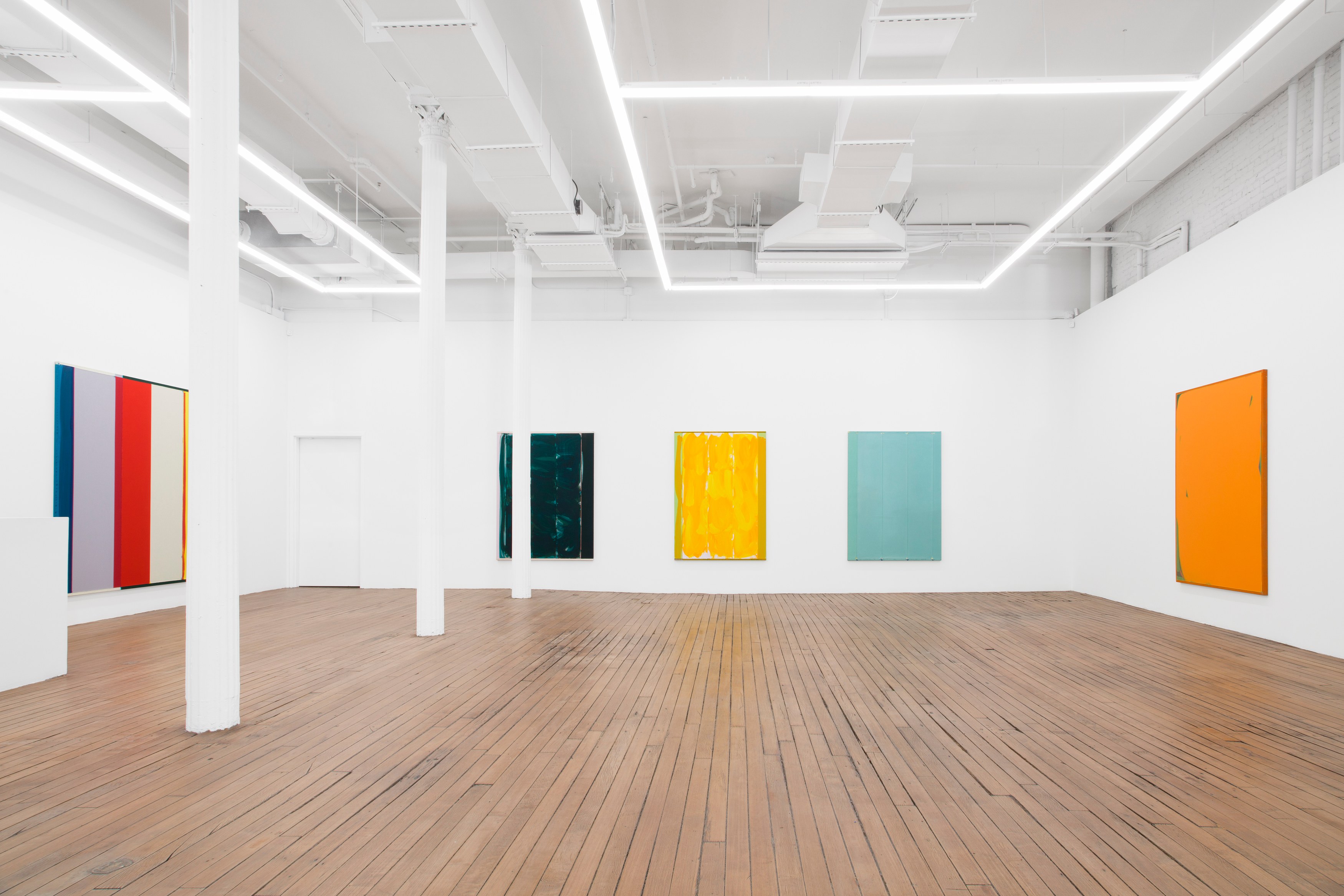 PastStaples
Julia Rommel
Apr 19 – May 19
"I've been searching for similar surprises to thwart my own hand ever since." —Julia Rommel Bureau is pleased to present Julia Rommel: Staples, in its new Tribeca location. Bureau's sixth solo presentation of Rommel's work includes a number of new, large-scale paintings made in the past year. Rommel's new paintings could be called sure-footed if painting's ground weren't so permanently shaky. Some seize on color theory, deploying an Albersian exploration of greens, reds, blues across an almost architectural expanse. Some forefront the painterly mark, with gestural scribbles scrubbed rather than brushed onto patches of ground; others perform the inverse operation—almost wholly obscuring the gesture with a flat, smooth field of color that sits on linen like a hardened candy shell. But each work remains rooted in the most fundamental of painterly tasks—the stretching and priming of the substrate. The deeply habitual labor of this common activity still anchors and propels Rommel's work after over a decade of playful investigation. Her earliest abstractions turned the corner of the stretched canvas into a compositional unit and since then, staples, seams, folds, and corners have played as figures in what could otherwise be described as color fields. Her work has always made a gentle joke of the modernist obsession with the picture plane. In an inversion of perspectival logic, what is wrapped-around becomes flattened; a volume becomes a plane; and the very edges of the painting are repurposed as painterly marks. Rommel's paintings feel like walking backward down the hallway of pictorial history—reversing the progression from flatness to depth. The paintings in Staples introduce a new compositional unit; Rommel creates 'lines' on her paintings with a subtly raised ridge that she generates by stretching linen around a wooden column. She primes the linen on these bulky boxes, with gesso making a low peak at the corner where it's been applied, sanded, applied, sanded again, then removed and re-stretched. As light rakes across this relief, a gradient invokes other media—photography, photoshop, or airbrush—then reverts back to physical presence. In some paintings, the ridgeline demarcates areas of color; in others, it's a geometric register across a gestural surface. Tension registers at the juncture of this smoothly painted skin with rough, pigment-soaked linen. Rommel has often spoken of her search for a way of painting that is fresher, less worked, more immediate. But again and again, she has returned to the studio's functional labor as her choreographic script. Every elegant moment has been coaxed into being through the execution of all the layers hidden beneath it: a dance between 'doing' and 'allowing'. In their improvisational approach, her paintings synthesize intention, happenstance, and material fact. Here, practice doesn't make perfect; practice makes mistakes, and mistakes make form. —Mamie Tinkler, 2024 Julia Rommel (b. 1980 in Salisbury, MD; lives and works in Brooklyn, New York) received her BS from the University of Richmond, VA; and her MFA from American University, Washington, D.C. Solo and two-person exhibitions include Just a Splash, Standard (Oslo), Oslo (2022); Uncle, Bureau, New York (2022); Long Leash, Overduin & Co., Los Angeles (2020); Fall Guy, Standard (Oslo), Oslo (2019); Candy Jail, Bureau, New York (2019); Twin Bed, Bureau at Tanya Leighton, Berlin (2018); Stay-at-Home Dad with Mathew Cerletty, Standard (Oslo), Oslo (2017); Man Alive, Bureau, New York (2016); A Cheesecake With Your Name On It, Overduin & Co., Los Angeles (2016); Two Italians, Six Lifeguards, The Aldrich Contemporary Art Museum, Ridgefield (2015). Her work is in the collection of the Albright Knox Art Gallery, Buffalo; Astrup Fearnley Museet, Oslo, Norway; Hammer Museum, Los Angeles; Kadist, Paris and San Francisco; Kistefos Museum, Jevnaker, Norway; Museum of Modern Art, New York; San Francisco Museum of Modern Art, San Francisco; The Metropolitan Museum of Art, New York; Walker Art Center, Minneapolis; and the Whitney Museum of American Art, New York.
Past
Off The CuffErica Baum
Mar 16 – Apr 14
Bureau is proud to present the inaugural exhibition at 112 Duane Street, Off The Cuff, by Erica Baum, the artist’s sixth solo show with the gallery, featuring her latest series, Fabrications. Over the past three decades, Erica Baum has focused her practice on capturing serendipitous instances of found poetry, incidental beauty, and humor, which would otherwise go unseen. The Fabrications series has grown out of the artist’s recent body of work, Patterns, which looks closely at the graphic qualities, textures, and compositions of the tissue-like printed layers of sewing guides. In looking for this type of vintage pattern over the past several years, Baum collected numerous specialty magazines from the 60s and 70s aimed at the domestic housewife, featuring fashion, sewing, cooking, and home hobby projects. These pages contained a wealth of material, from elegant and stylish spreads to positively zany handmade creatures. Baum’s photographic fabrications recognize and amplify the materiality of her subject matter—both the textiles depicted and the printed paper sources themselves. The new pieces are composed from fragments and slivers of the magazines’ pages, and the resulting works embody a mysterious or whimsical sense of elegance. Many of the greyscale works feature glimpses of the human figure reminiscent of those from her celebrated Naked Eye series. The more colorful works offer levity with vivid slashes of halftone color, filled with unusual materials and bizarre characters. While the idiom “off the cuff" is popularly understood as an expression suggesting improvisation, it evolved out of a need for certainty. The phrase’s apocryphal origin story comes from early 20th-century vaudeville, when actors scrawled words onto their detachable cuffs to remember their lines. The phrase's history, which once meant to stay on script but now means its opposite, resonates with Baum's playful manipulation of the printed word, and its unfolding meaning within the context of texture and fabric. Baum’s Fabrications series is also the subject of her recently published, limited edition Artist Book with Three Star Books, Paris, which has been acquired by numerous institutions including the Museum of Modern Art, New York; Whitney Museum of American Art, New York; The Tate, London; Getty Museum, Los Angeles; The New York Public Library, New York; CCS Bard, Annandale-on-Hudson, New York; Frac Sud, Marseille; among others. The gallery will host a reading with poets Kim Rosenfield and Laynie Browne in the exhibition on March 29th, 2024 at 6:30 PM. Erica Baum (b. 1961, New York; lives and works in New York) received her MFA from Yale University and her BA from Barnard College. Recent solo exhibitions include the bite in the ribbon, Galerie Crevecoeur, Paris, 2022; A Method of a Cloak, Square is the Chatter, Galerie Markus Lüttgen, Düsseldorf, 2020; A Method of a Cloak, Klemm’s, Berlin, 2020; A Long Dress, Bureau, New York, 2019; The Following Information, Bureau, New York, 2016. Group exhibitions include Pictures & After, MAMCO Genève, Geneva, 2023; True Pictures?, Museum für Photographie Braunschweig, Braunschweig 2021; Pictures, Revisited, The Metropolitan Museum of Art, New York, 2020; Making Knowing: Craft in Art, 1950–2019, Whitney Museum of American Art, New York, 2019; Anna Atkins Refracted: Contemporary Works, The New York Public Library, New York, 2018; The Arcades: Contemporary Art and Walter Benjamin, The Jewish Museum, New York, 2017; Photo-Poetics: An Anthology, Solomon R. Guggenheim Museum, 2015; Reconstructions: Recent Photographs and Video from the Met Collection, The Metropolitan Museum of Art, New York, 2015 and the 30th Bienal de São Paulo: The Imminence of Poetics, São Paulo, 2012. Her work is held in the collections of the Museum of Modern Art, New York; Whitney Museum of American Art, New York; Solomon R. Guggenheim Museum, New York; The Metropolitan Museum of Art, New York; MIT List Visual Arts Center, Cambridge; San Francisco Museum of Modern Art, San Francisco; MAMCO, Geneva; Albright‐Knox Art Gallery, Buffalo, New York; CNAP, Paris; FRAC Île de France, Paris; and Yale University Art Gallery, among others.
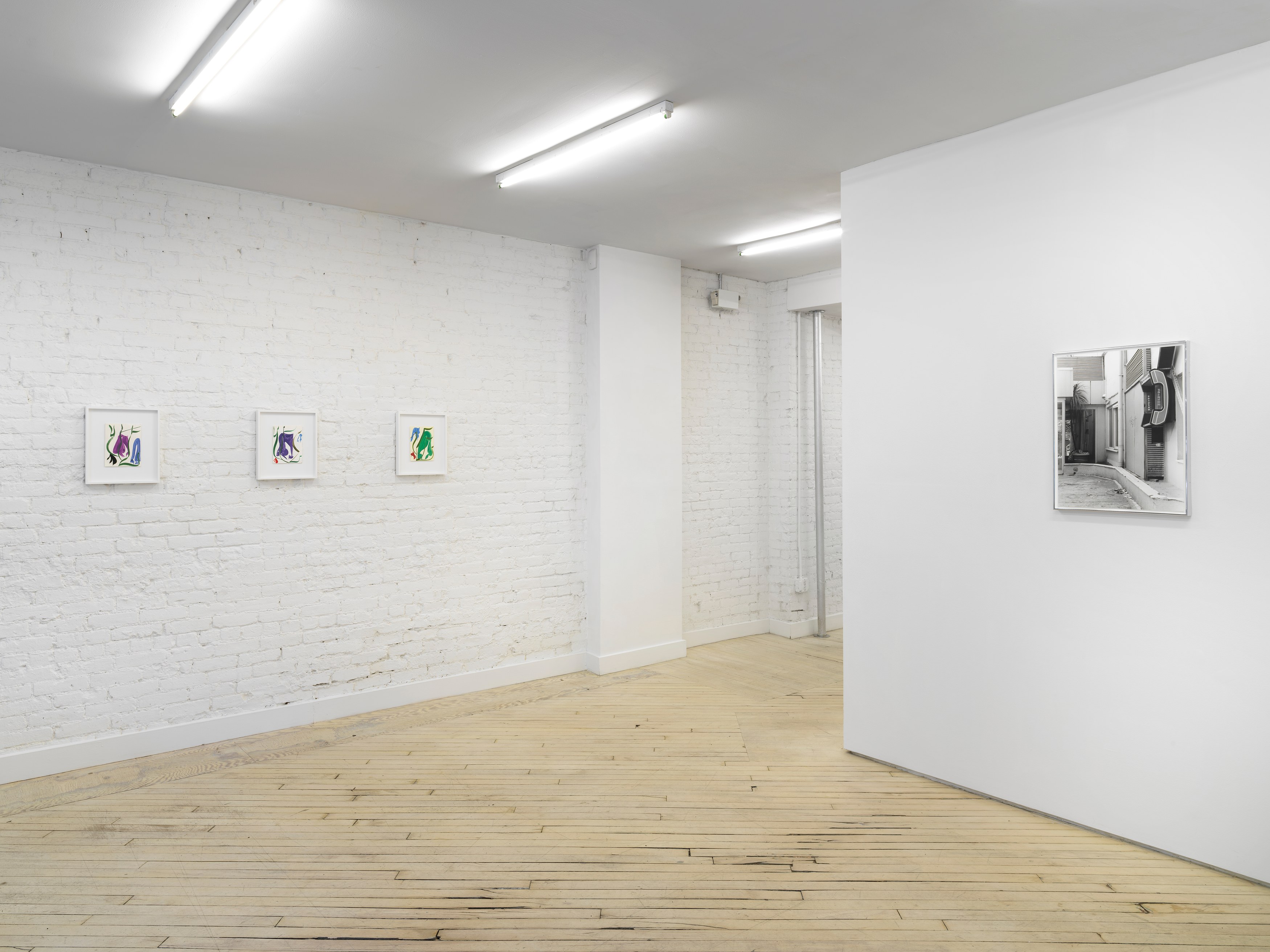 PastThroughline
Nour Mobarak, Claudia Peña Salinas, Davina Semo, Jeffrey Stuker, Patricia Treib, Viola Yeşiltaç
Jan 14 – Feb 25
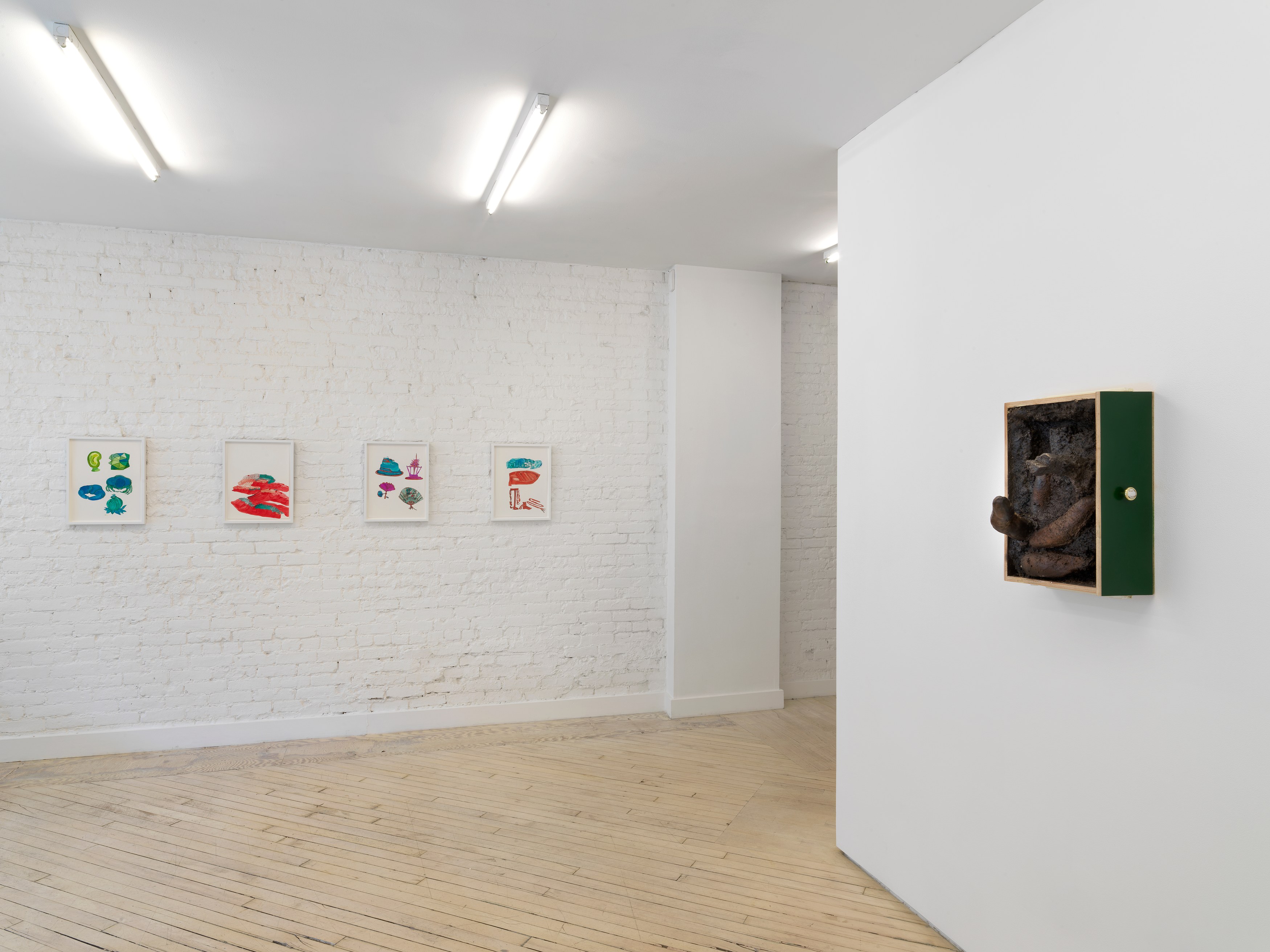 Pastuntitled Arrangement
Tom Holmes, Kyung-Me, Brandon Ndife, Christine Rebet, Julia Rommel
Jun 26 – Aug 6
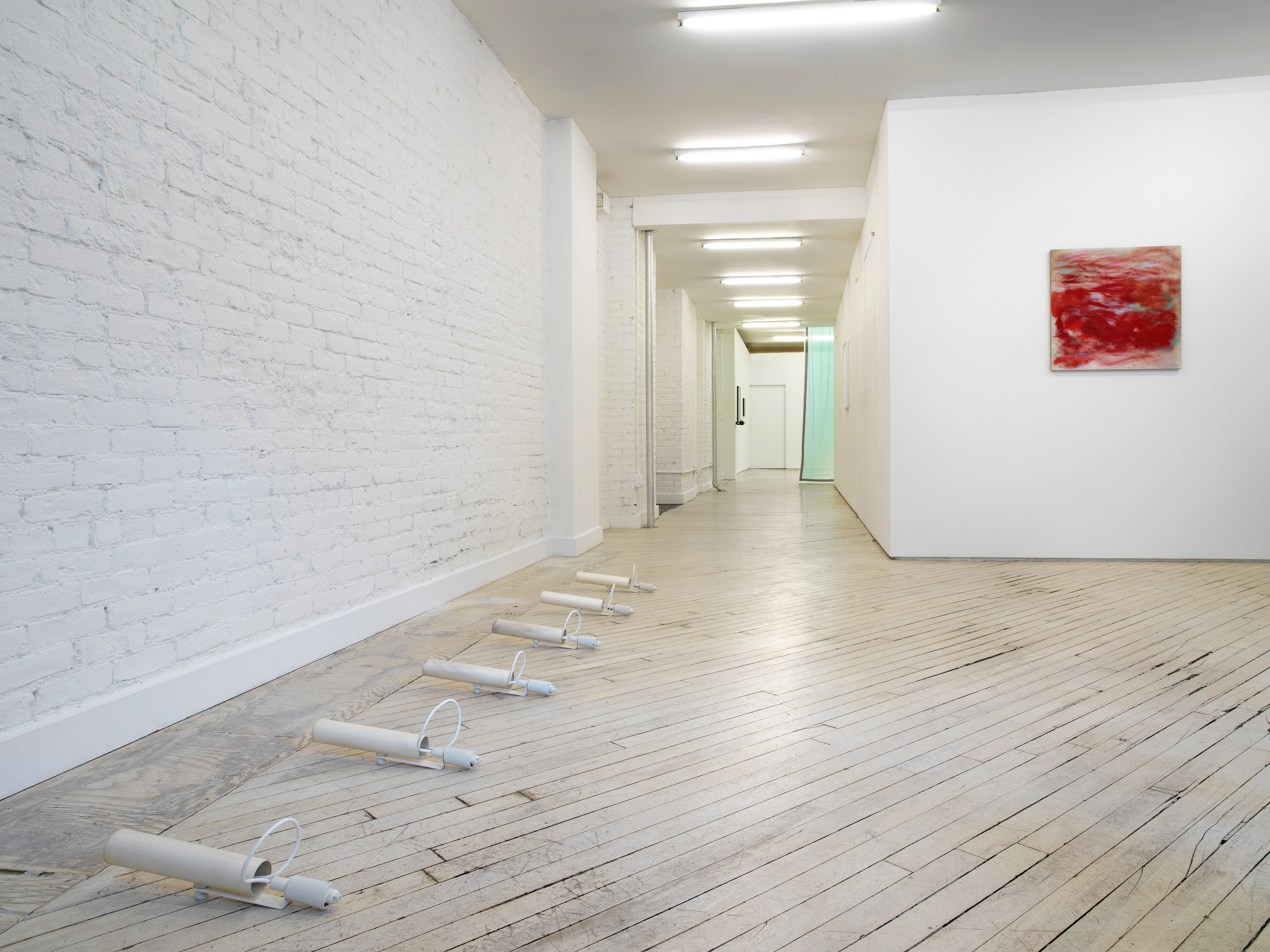 PastSoft As Velvet Eyes Can See
Ketuta Alexi-Meskhishvili, Grant Mooney, Kate Spencer Stewart
Mar 18 – May 8
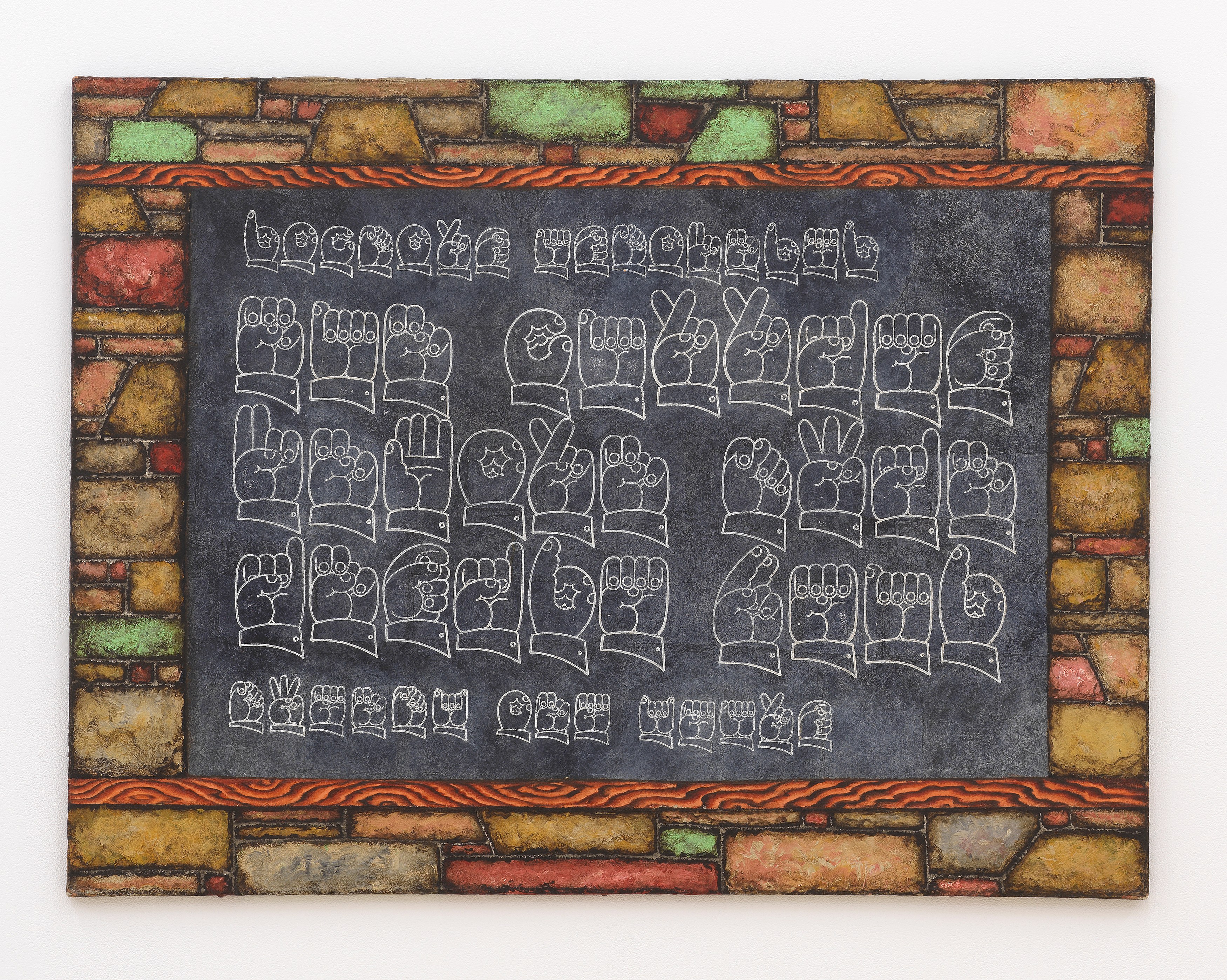 PastBeauty Can Be the Opposite of a Number
Uri Aran, René Daniëls, Rochelle Feinstein, Peter Hujar, Quintessa Matranga, Libby Rothfeld, Martin Wong
Jan 31 – Mar 8