The Hole
Chinatown, Downtown, NY
86 Walker St
Sign in to save this gallery, log a visit, or add a show to a shared list.
Exhibitions
- On viewGlass Class
May 9 – Jun 15
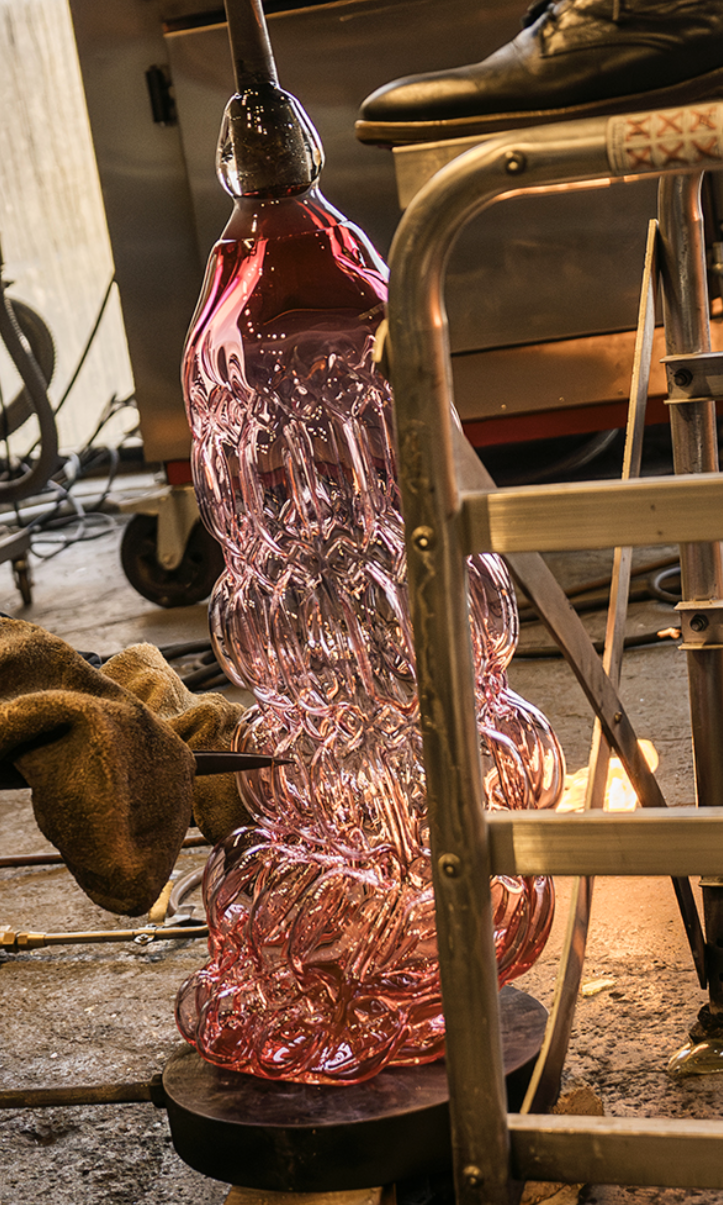
Akeylah Washington, Anthony Coleman, Barry McGee, Cody Hoyt, Deborah Czeresko, Elliott Todd, Eric Sullivan, Grace Horan, Hanna Hansdotter, Henry Baumann, Henry Richardson, Jessica Tsai, Jillian Mayer, James Bouché, Jonny Campolo, Kelly Witmer, Klaus Moje, Matt Eskuche, Matthew Palladino, Maxwell Jacobs (Kinda), Mike Raman, Ryan Jenkins, Shingo Yamazaki, Thaddeus Wolfe, Tom Fruin The Hole is pleased to present Glass Class, a group show focusing on the medium of glass curated by glass artist and collector, Eric Sullivan. From flameworked glass to kiln forming, casting to microwaved borosilicate, paintings and paraphernalia, Glass Class showcases glass in all its endless potential. Incorporating plexiglass, fiberglass, resin and paint, there are works depicting glass and works exploring the various properties of glass in other media. This exhibition continues our tradition of medium-specific survey shows from Clay Today (2018) to Not a Photo (2015) to Thread Count (2025). Including works by both established and emerging artists from the late Klaus Moje (1936-2016), one of the most significant innovators in the medium to Hannah Hansdotter (above) whose rebellious vessels remain defiantly craft-oriented in their techniques, our most fragile group show to date gives you the best of glass today and a crash course on the medium. During the run of the show we will host a variety of workshops and events to include the public in learning about and experimenting with glass—stay tuned!
 PastGentle Oddities
Nick Dahlen
Mar 13 – Apr 26
The Hole is pleased to present a special solo exhibition by Minneapolis-based artist Nick Dahlen. His signature paintings of daily life have appeared in many of our group exhibitions over the years, and now we can devote our full attention to this intriguing artist. From a Giant Pencil Jar to a Trash Cat, Dahlen captures both the texture of city streets and the neighbors who make a neighborhood. The works on canvas feel as honest and unedited as a pencil sketch, and his imagery is familiar to any city-dweller, the strong shadow work pumping the paintings full of volume and ripeness. Dahlen’s style draws from Surrealists like De Chirico, Cubists like Léger, and Modernists like Tarsila do Amaral. His colors feel retro—think 70s design or Miró palettes—everything slightly yellowed and browned, giving the work a vintage atmosphere. The subjects can feel retro as well: playing chess in the park, pitching a baseball, making pizza—nothing in the scenes clearly marks the 21st century. Given the vitality of the city life depicted, it feels like a magical moment before everyone was on their phones. The paintings feel improvisational, like jazz—funky, soulful, and unpretentious. In his depictions of regular people the work feels populist and democratic. Minneapolis—the epicenter of major social justice movements this century—is certainly a theme in the show, and a print by the artist is being released during the exhibition to benefit a local food donation charity. Nick Dahlen lives and works in Minneapolis, Minnesota. He has exhibited in group shows at The Hole since 2021. Recent solo exhibitions include Student of Life at Gallery Commune, Tokyo, and Everyday Weird at Pamplemousse Gallery, Richmond, VA. Alongside painting, Dahlen’s multidisciplinary practice spans printmaking and illustration, with over a decade of international commissions. His work has appeared in The New York Times and on snowboards, books, and album covers.
Past
False ProphetGrgur Akrap
Dec 23 – Feb 15
The Hole is pleased to present False Prophet, the first solo exhibition in the United States by Croatian painter Grgur Akrap, following his stateside debut at the Independent art fair this spring. Comprising eleven new paintings, the exhibition expands Akrap's distinctive pictorial universe—lush, uncanny, and insistently unresolved—where familiar figures drift toward the archetypal and images hover between doubt and revelation. Built through layered applications of oil and wax, Akrap's paintings seduce with color while quietly resisting clarity. Winged figures fall, boys drift in boats, animals surface and disappear, masked faces peep at us. Certain characters recur from earlier works—the boater-hatted man, Icarus, the salamander—while new presences emerge here, including harpies and gold masks rendered in an even more acidic, volatile palette. The imagery feels both ancient and personal, as if filtered through half-remembered myths, alchemical diagrams, and distant echoes of Impressionist and Post-Impressionist painting. Akrap's work openly grapples with the problem of painting now: how to make images that resist the flattening certainty of algorithmic narratives and visual manipulation. The exhibition's title, False Prophet, gestures toward that tension. These paintings promise meaning without delivering doctrine; they lead the viewer somewhere uncertain, asking whether revelation itself can still be trusted. Water appears repeatedly throughout the exhibition, functioning less as a landscape than as a destabilizing mental space. Symbols are slippery, forms blur, and images seem to materialize only momentarily before dissolving again. One painting takes Titian's Rape of Europa as a distant point of departure; elsewhere, motifs shift through repetition, refusing a single, fixed interpretation. As Akrap notes, "Through repetition, the golden mask gradually becomes the true face and ceases to be a mask. The painting resists a single meaning; each time it shifts slightly." Material process is central to this instability. Akrap mixes wax into oil paint, applying it cold in both thin and thick layers. The surface remains open yet resistant, forcing a slow, recursive working rhythm. "A painting doesn't happen all at once," he explains. "In that rhythm of slowing down, the figure appears like a memory that isn't entirely reliable." Wax allows light to be held within the surface while maintaining transparency and drag, producing images that feel luminous but withheld. Akrap cites Odilon Redon and Pierre Bonnard as formative influences, but his world is firmly his own—hermetic, dreamlike, and quietly obstinate. In False Prophet, control loosens and listening takes precedence, resulting in a body of work that feels like new territory while remaining committed to the same elusive pursuit: grasping what continually slips away. Grgur Akrap (b. 1988) lives and works in Zagreb, Croatia. In 2013, he graduated from the Academy of Fine Arts at the University of Zagreb. Akrap's work has since been featured in various solo and group exhibitions internationally, including HAGD Contemporary, Aalborg; CAN Art Fair, Ibiza; UVNT Art Fair, Madrid; Galleria Richter Fine Art, Rome. Akrap was awarded the Museum of Contemporary Art Award at the 51st Zagreb Salon (2016) and the Young Artist Award at the 3rd Painting Biennial (2015).
Past
Model Shop, Union: The Portrait MarketKembra Pfahler
Nov 25 – Dec 1
Please visit us in Tribeca for a special one-week piece by Kembra Pfahler inspired by the Jacques Demy film “Model Shop” (1969). For this piece visitors get to pose and draw and photograph Girls of Karen Black in costume in the gallery. Evoking groundbreaking performance pieces from Yoko Ono’s “Cut Piece” (1964) to Marina Abramovic’s “Rhythm 0” (1974) this work highlights the power dynamic between model and artist, actor and filmmaker, performance artist and gallery visitor, sex worker and john. From the artist: "Hello, my name is Kembra Pfahler. I'm an artist currently based in NYC and the founder of The Voluptuous Horror of Karen Black. I've wanted to re-do “Model Shop” for the last decade and I wanted to thank the Hole for letting me use the historical Walker Street space to start to iron out the cracks and add new ones... to the idea behind the actual "model shop" business illustrated in this film... but applicable to 2025. I was asked to write a one-page description but I always prefer to address you all in letter form, it's homier…. I'm grateful to Kathy Grayson owner of the Hole gallery, one of the very few female-run commercial gallery spaces in NYC. The fact that she's allowing me to experiment a little bit and invite you all to participate says everything. This happened very spontaneously and quickly... in great contrast to the bureaucratic mechanics of most shows these days. It's a testament to this gallery's beliefs... and the film it's based on... in a Los Angeles that no longer exists... saluting the divinity of the Jacques Demy movie... what we'll get to do for a New York minute around the Thanksgiving Holiday. Anyhow... see you soon...."
Past
False ProphetGrgur Akrap
Nov 22 – Jan 11
The Hole is pleased to present False Prophet, the first solo exhibition in America of Croatian painter Grgur Akrap following his stateside debut at Independent this spring. His colorful paintings—formed through layers of oil and wax—seduce and provoke spectators by seamlessly merging imagery that is both familiar and mythical. Akrap confronts the inherent limitations of painting in an era dominated by algorithmic narratives and visual manipulation—begging the question if Akrap himself is a "false prophet" where is he leading us? Grgur Akrap (b. 1988) lives and works in Zagreb, Croatia. In 2013, he graduated from the Academy of Fine Arts at the University of Zagreb. Akrap's work has since been featured in various solo and group exhibitions internationally, including HAGD Contemporary, Aalborg; CAN Art Fair, Ibiza; UVNT Art Fair, Madrid; Galleria Richter Fine Art, Rome. Akrap was awarded the Museum of Contemporary Art Award at the 51st Zagreb Salon (2016) and the Young Artist Award at the 3rd Painting Biennial (2015).
Past
The Dialectical Third: Torso, Sex Parts, Ladies and Gentlemen, Querelle, Self Portraits and Other PolaroidsAndy Warhol
Oct 24 – Nov 16
The Hole is collaboration with the Grove Foundation for the Arts is pleased to present an exhibition of works by Andy Warhol The Dialectical Third: Torso, Sex Parts, Ladies and Gentlemen, Querelle, Self Portraits and other Polaroids. This exhibition features numerous works that received limited exposure during Andy Warhol's lifetime due to social and sexual taboos, and thus remained largely unknown to the broader public. On display are 148 Polaroids, including those from the Ladies and Gentlemen (1975), Sex Parts (1976), and Torso (1977) series, as well as the Polaroids from Querelle (1982). This primarily-Polaroid exhibition is supplemented by two screen prints from the Sex Parts series, one from Querelle, and two graphite drawings; one belonging to the Torso series, and the other is an earlier hand drawing depicting three studies of the male torso. This is the inaugural exhibition by the Grove Foundation for the Arts, and it is central to their mission of expanding access to contemporary art. The foundation loans major works to exhibition venues around the world each year. This initiative improves public access to key pieces and increases visibility for works vital to art history and scholarship. Read more about the foundations work here. This exhibition includes nudity, viewer discretion is advised.
Past
Time Traveller and Other Fragile DetoursPablo Benzo
Sep 5 – Oct 12
The Hole is pleased to present Time Traveller and Other Fragile Detours the New York solo debut of Berlin-based Chilean painter Pablo Benzo (b. 1982, Santiago), opening next Friday in our Tribeca space. The exhibition features five new paintings and six works on paper, inspired by works from the Peggy Guggenheim collection and her groundbreaking New York gallery Art of This Century. That 1940s venue introduced Surrealism and Cubism to a New York audience hungry for new ideas, and its experimental spirit will be echoed here in the design of the show and in the opening night celebration. Benzo’s paintings carry that avant-garde spirit forward into the present. Working in brushy, stippled oils with a muted palette of greens and yellows, magentas and soft blues, he builds volumetric, cubist-inspired forms that shift restlessly between categories. Interiors become theatrical stages where figures, furniture, and foliage fold into one another. A favored motif is the “pancake plant,” its near-circular leaves punctuating compositions with biomorphic rhythm. In one of the show’s most compelling canvases, a woman stands in her living room gazing out the window, while beside her hangs a painting of a Modigliani-esque nude — a painting within a painting that turns the domestic space into a layered meditation on looking at and collecting art. “I’m constantly searching for balance: between abstraction and figuration, softness and structure, silence and suggestion.” Pablo’s personification is plump, lush and lovely, in And Then She Did What She Did the sofa odalisques with bodily bumps, belly buttons and curves and a flurry of feet underneath. In Memory Lanes a canvas on an easel oscillates between landscape of pink rolling hills and a perky pink bottom. The sumptuous roundness of the forms throughout are balanced with moments of perspective; crisp corners of canvases, window frames, foregrounds and backgrounds. With a sprinkle of logic Benzo makes the surreal start to appear possible. This interest in nested images and “pictures within pictures” directly recalls Guggenheim’s era of radical reinvention, when artists like Picasso and Braque first destabilized perspective and invited viewers into unstable visual spaces. Benzo embraces that lineage not as mere quotation, but as what he calls a “sensory inheritance.” His compositions allow objects and figures to merge and dissolve, creating an ambiguous space where memory, imagination, and perception intermingle. Born in Santiago, Chile, Benzo studied graphic design before turning to painting full-time. His work carries with it the memory of Chile’s intense natural light and tactile everyday textures, refracted through a distinctly European frame. Since 2013 he has lived and worked in Berlin, where the city’s density of artistic exchange and its layered modernist histories have shaped his painterly vocabulary. His paintings absorb both these geographies: the warmth of South America and the critical rigor of Berlin, fused into a practice that is intuitive, cerebral, and deeply atmospheric. In bringing this body of work to New York, Benzo situates himself in dialogue with the radical modernist histories that Guggenheim helped foster, while also extending them into the present. The title of the exhibition Time Traveller and Other Fragile Detours, captures the sense of timelessness in Benzo’s work, as if painting from another era, past or future. “I see it not just as a historical reference, but as an emotional inheritance.” These are not nostalgic exercises but contemporary interiors, soft in color yet sharp in structure, where people, plants, and paintings coexist in mutable volumes. For his debut in New York, Benzo invites us into a world that is at once personal and historic, intimate and cosmopolitan — a reminder that the avant-garde spirit of reinvention remains alive in the city today. “I suspect I’m painting memories I haven’t actually lived yet — scenes or feelings I somehow expect to become part of me. In that sense, the title reflects the strange elasticity of time in the emotional landscape of painting: the future echoes into the past, and the past folds into the present.” Pablo Benzo (b. 1972 Santiago de Chile) studied Graphic Design at University of Chile. After graduating, he moved to Berlin in 2013, where he has since lived and worked. His works, known for merging surrealism and cubism, have been exhibited internationally including recent solo exhibitions at NAC Gallery, Chile; This weekend room, Seoul; Dio Horia, Shanghai; and Steve Turner, Los Angeles. His work is held in the collections of Deji Museum, Nanjing, China; Xiao Museum, Rizhao, China; X Museum, Beijing, China; Colección Casa, Santiago, Chile; Colección Solo, Madrid, Spain; and Fundación Medianoche0 / Granada, Spain.
Past
Guest of a GuestJul 23 – Aug 31
Adèle Aproh, Carly Owen Weiss, Colin Radcliffe, Etty Anderson, Jonni Cheatwood, Mark Frygell, Michael McGregor, Noa Ironic, Scout Zabinsky The Hole is pleased to present Guest of a Guest, our summer exhibition at the Tribeca location. In past summers we’ve presented single-vision guest curated shows: Sasha Bogojev’s Universes 5, Tania and Thomas Asbaek’s Monomythology, Andrew Woolbright’s Density Betrays Us to name a few. But this time instead of inviting a single guest curator, we invited a bevy of them: artist friends, collector friends, gallerist friends, foundation friends and curator compadres, each tasked with bringing a +1 to the group. The result is a kind of curatorial potluck dinner that is both an experiment and a commitment to conviviality. We gave our curators a loose theme: dinner parties, afterparties or just people coming together. New faces we should know from our curators in-the-know, our guests include Noa Ironic painting a raucous poker night, Jonni Cheatwood with a birthday party scene of ambiguous origin; Scout Zabinsky stages a detailed luncheon tête-à-tête, and Carly Owen Weiss paints a giant, ghostly chicken—the unnerving centerpiece of a surreal dinner. Colin Radcliffe’s figures lay around nude, taking pictures, playing music and looking at their phones, while Adèle Aproh draws an army of self-portrait doppelgangers, a party of one turned into a buzzing crowd. Some selections hit the mark with precision: steak frites at a bistro in Le Marais is an experience we have definitely shared with artist Michael McGregor, and with the curator Julianna Vezzeti who selects him. Mark Frygell’s painting, selected by curator Natasha Schlesinger, shows a cast of enigmatic figures gathered around a black void (image above). With the title Hole Gathering it might just be the most mathematically perfect curation I’ve ever seen. I suppose I curated the curators? I have a hard time letting go, but it is important to foster the foregrounding of others’ voices and choices. Besides, artists often discover new talent before galleries do from their propensity to gather in like-minded groups; enthusiastic collectors frequently beat me to the studio visit (grrr!); and independent curators, yes, still exist and need activation. We plan to host a conversation during the show about the important role of a curator but also what that word still can mean, as it has been flattened to include "curated" skincare or smoothies. For now, join us next Wednesday to celebrate this group experiment-slash-party at the opening night.
Past
Sam'sSamantha Rosenwald
May 31 – Jul 11
The Hole is pleased to present Sam's, a solo exhibition by Samantha Rosenwald. For this special thematic exhibition, Rosenwald transforms the humble pinball dive bar into a colored-pencil-on-canvas fantasia—an adult playground of noise, indulgence, and, most crucially, loneliness. Though the bar is full, no one is really there. Patrons are faceless and fragmented, reduced by compositional amputation to body parts or accessories. In Four of Cups, despite a seven-foot-wide canvas, we only see bodies from neck to elbow. In Bottoms Up, it's mostly just legs and floor: the only eye contact in the entire show comes from a dog and some googly eyes stuck to a napkin holder. Stripped of identity, the characters become defined by brands and visual cues—a girl's Ganni shoes, an Online Ceramics tee—material signs of shallow cultural meaning. Six works are modeled on vintage pinball machine headboards—overlooked art forms that Rosenwald reimagines as autobiographical games. These canvases remix retro aesthetics into hyper-personal, anxious vignettes. Fun House Mirror Stage becomes a circus of body dysmorphia; Lock Down Rage Cage confronts an ex during covid; Shy Spy Leg-O-Vision gamifies social anxiety. With each piece, Rosenwald builds a psychological funhouse, a self-portrait by way of pinball cabinet. The show is deeply immersive and eerily cohesive. Though inspired by a real L.A. bar, Sam's feels wholly invented. Custom pint glasses, printed coasters, even a toilet paper holder covered in graffiti—all reinforce this strange parallel world. Paintings reference each other, Easter eggs abound, and the whole exhibition glows under a neon-lit umbrella. Titles and compositions often emerge from that glow, then accumulate meaning as Rosenwald obsessively renders every detail. Though it appears playful, Rosenwald's chosen medium—colored pencil—is anything but easy. "There's a performative element to it," she says. "Each mark is visible. You can see the exhausting perfectionism in every stroke." What looks like digital polish from afar reveals, up close, an almost manic density of hand-drawn texture. The inadequacy of the medium becomes part of the meaning: reaching for greatness using something fragile, childlike, and inherently limited. Loneliness—declared a public health crisis in the U.S. in 2023—haunts the show. Dive bars, typically built for revelry, become cruelly ironic when you're alone: pretzels, hot dogs, cocaine and cigarettes appear as props in a disorienting, joyless theater of dissociation. These vices, meant to bring pleasure, instead seem to underscore a failure to connect. "We all seek joy, connection, and freedom," Rosenwald writes. "But sometimes we realize we're more alone than we thought. The neon flickers off, the ‘open' sign flips to ‘closed,' and the buzz becomes a hangover. These moments of public joy—seen through beer-colored glasses—turn out to be fleeting and shallow." Samantha Rosenwald (b. 1994, Los Angeles) lives and works in LA. She received her BA in Art History from Vassar College and her MFA from California College of the Arts. She has exhibited internationally, with solo shows at Stems Gallery (Brussels), Sebastian Gladstone (Los Angeles) and Arsenal Contemporary (New York). Previous group shows at The Hole include Nature Morte and Storage Wars. Her work has been featured in New American Paintings, Art of Choice, and Franchise Magazine.
Past
LFGApr 5 – May 25
Bezimienny, Ry David Bradley, Kevin Bray, Bryant Girsch, Gao Hang, Botond Keresztesi, Magda Kirk, Ksawery Kirklewski, Mashine, Luke Murphy, Tabor Robak, Grant Stoops, Janne Schimmel, Mathew Zefeldt The Hole is proud to present LFG, a group show of video game aesthetics in art. Centered around Kevin Bray's epic video-sculpture, this show immerses you in the world of gaming through painting, sculpture, and installation. The art world may be large, but the gaming world makes it look minuscule. Of all the creative experiences shaping us in 2025, video games probably rival music in reach—followed by social media, movies, and TV—while somewhere down with "poetry" sits "contemporary art." So yes, doing an art show about gaming might seem silly because of scale: the diversity of games is so vast it's barely containable, and trying to address their full aesthetic range through painting alone feels futile. Each frame of an open-world game like GTA could be its own painting—just as evocative, and far more influential. That being said: When the other option is obsolescence or irrelevance, I choose to jump in. Not just because I grew up in the '80s, weaned on the Atari 2600 and Commodore 64, with the NES as the lodestar of my childhood in 1986. I drifted away when the Z axis debuted in Star Fox in 1993 or so, but still found myself sucked back in over the years—Minecraft, or even mobile war games, like a dweeb. I've also been curating exhibitions on this for over twenty years: from getting my college to fund a trip to New York in 2001 to visit BitStreams at the Whitney Museum, to bringing Super Mario Movie by Cory Arcangel and Paper Rad to Deitch Projects in 2004. At The Hole, I think if I curate one more "Post Analog" exhibition someone is going to revoke my curatorial license. There aren't enough galleries or museums engaging with this topic—and that lack of institutional support means artists exploring these themes often can't afford to keep going. If you know how to code, you'll make more money designing actual games than showing video art in a gallery. The hierarchy of mediums is remarkably weather-resistant: I have to sell scores of paintings to afford shipping a giant video sculpture from France. Even at major museums—like the Buffalo AKG's recent Electric Op show I visited—early digital works still get barely any exposure. I've been chasing this type of work for decades and still feel like I haven't seen much. Or at least, not nearly enough. Anyway—this show: It includes some of the most interesting current art exploring video games' aesthetics, logic, and cultural impact. "LFG" originated as "Looking For Group" but these days more often means "Let's Fucking Go," the rallying cry of gamers launching a group quest, raid, attack, etc. Multiplayer games, especially RPGs, have made gaming surprisingly social: I had an older brother to play endless hours of Super Mario Kart with in 1992, but years later, coordinating attacks with ten strangers across five continents on a Discord call felt crazy and awesome. Whether storming a dungeon to loot rare armor, healing your tank while dodging area-of-effect fireballs, reviving your squadmate mid-firefight in Call of Duty, dancing on the corpses of your enemies in Fortnite, defending a fortress from Creepers in Minecraft, syncing getaway cars for a casino heist in GTA, or just grinding XP in the desert while getting made fun of—we have found our teams. Video games have shaped an entire generation of artists—not just visually, but cognitively, emotionally, socially. They’ve trained us to think in systems, to obsess over world-building, to collaborate across vast distances, to inhabit avatars and alternate realities. For many younger artists, games aren’t just a medium—they’re a foundational aesthetic language like cinema or the internet. And it isn’t nostalgia or novelty—it’s infrastructure. The logic of a final boss, grinding, looting, leveling up, and glitching through walls are woven into how we see and make now. For artists raised on LAN parties and lag, boss fights and battle passes, it’s only natural that video games show up in the studio—not just as references, but as frameworks. At long last, the artists: Our war team includes Polish trio Bezimienny, Mathew Zefeldt, Kevin Bray, and a wonderful little Bryant Girsch painting titled Battle Boy, where a medieval-helmed fellow reveals his nipple-ringed bare chest. Probing the contrast between human player and game avatar, Bezimienny paints a warrior princess; Zefeldt's blue babe wields a bow and arrow at a robot while Kevin's chimeric beast clangs an axe in endless, fragmented motion. Matching Bezimienny's sculptural little plants are Gao Hang's First Aid Kits—a relief to refill your stamina after the battle. Code, light, and glitch are covered by Ksawery Komputery's interactive, sound-sensitive LED jellyfish Atolla in the rear gallery, and Luke Murphy's crumpling and slouching LED panels, their custom software endlessly unraveling. Mashine's painting of a horrifying JD Vance Pikachu is like a glitch in reality—a dank meme culture artifact where lack of oxygen or perhaps hygiene breeds cultural mutants. The nine-screen new AI piece by Tabor Robak also inhabits a dark part of this liminal zone where things go very, very wrong: Dave & Buster's meets detention camp, as armed guards force prisoners to play strange games. Skin and texture are the focus of Grant Stoops and Magda Kirk, both building figures for battle and leaving them smoothed and unarticulated, skimming them with an iridescent finish or a suit of overlapping tattoos. Botond Keresztesi manages to paint his own unique textures—gilded, pearlescent—to suit a vivid imagination that looks like a computer dreaming. Janne Schimmel is the only artist to provide us an actual game to play. In a beautiful metal and crystal sculpture, Janne created a strange and boring video game on an old Game Boy—a poetic, odd journey of a little girl in a house, in a forest, with evocative chiptune music composed by the artist. To me, this work encapsulates my own relationship to gaming: forged in 8-bit, seeking materiality, memory, and the poetry that emerges from limited hardware and software. It's about slowing down the future—resisting obsolescence and skirting death. For people my age, we fell in love with the radical potential of what technology could be. We don't want to wind back the clock to feel like kids again—we want to go back so we can take a different path: one of hackers and mods, not the morass of social media and corporate gaming culture. This show is a glimpse of what that path might look like—artists using the tools, textures and myths of gaming not to escape reality but to reprogram it. It's messy, ambitious and unresolved, like any good game still in beta.
Past
Prix FixeFeb 15 – Mar 30
Alli Conrad Hugo Ciappi Kevin Bray Theo Rosenblum Younguk Yi A carefully-planned menu can be a work of art; an elegant, measured experience with each course delivered with precision and intent. A group show is often more like a banquet, spoiled for choice but without focus or depth. We sought to provide more, so that you could sink your teeth into six new artists in three mini-shows; however, as global shipping permits, these dishes are coursed out, plated and served throughout the month. The theme of our menu is time, and debuting this weekend is the appetizer course. Theo Rosenblum is always cooking up something highly experimental and though we did pass on the "Stool Stool" made of illusionistic excrement, we are happy to offer two sculptures and a wall relief that use black humor to address the passage of time. If the aging pumpkin doesn't appetize, the infinite hot dog might. Alli Conrad exhibits four new paintings of playfully posed feet. In shiny Mary Janes or Buster Browns, they are ambiguous in age, catalogue-ready but coy in purpose. We feature this artist in our current group show in L.A. but thought New York should have a taste as well. Also in the center room is a substantial mini-show by Younguk Yi, first to arrive from Korea (somehow). These meticulous and exacting paintings are deeply uncanny as the artist uses a type of digital cubism to show us many positions superimposed in one. There is something arachnid in all the eyeballs, a hint of body horror amongst the proliferating digits and limbs. But let his happily-wagging dog tail reassure you: the artist is experimenting like Futurist Giacomo Balla's painting "Dog on a Leash" (1912) and with the same brashly optimistic view of technological progress. Primo piatto next week is the Italian artist Hugo Ciappi with three large works from Florence that instruct us a bit on how to be human. You would think we would have it down by now! Stretched out across the painted vignettes, we can learn "how to be a painter", "six types of hug" or the curious "evolution of the hat". Main course the following week is heavy: a gigantic Kevin Bray video sculpture filling the center of the main room. This piece, like Younguk's paintings around it, looks at digital cubism using 3D printing, video and audio to make a dynamic, clanging beast endlessly chopping away with an axe. Each frame of this motion is elaborated at once, as the video plays across the white surface of the sculpture. You can see the chef's intention with this special pairing of movement, technology and fractured time. The dessert course is to remain a surprise, so check back as the menu progresses to see what comes out of our kitchen.
Past
Cherry PickingBarry McGee
Jan 14 – Jan 31
The Hole is proud to present Cherry Picking, an underground show (literally) by Barry McGee in our Tribeca gallery basement. Comprised of painting, sculpture and collected artworks and errata by friends and strangers (let's call it 'community organizing') the show is short but pungent. Our goal at The Hole is to make art magic happen whenever the opportunity arises. Without fussing too much over traditional timelines and long-lead marketing, we see a hole and we run through it. A good plot, very good friends, can’t lose. I would surmise that the philosophy that runs through McGee’s practice from tagging through to traveling museum retrospectives is a similar opportunism and enthusiasm for unstructured mayhem. Whenever we get lulled to sleep with the conventions of the gallery world and the prosaic expectations of the market we thank people like Barry for kicking over the table and waking us up to why we do this in the first place.
Past
Fata MorganaAlexis Mata & Raul De Lara
Dec 14 – Jan 26
The Hole is proud to present a special two-person exhibition combining paintings by Alexis Mata and sculpture by Raul De Lara: Fata Morgana. For this exhibition we juxtapose seven new oil paintings by Mexico City-based artist Alexis Mata with seven sculptures by New York-based Mexican artist Raul De Lara. The works are hung on increasingly dark walls as the sun sets and the sculptures are nestled in sand pits: as the show provokes your imagination, a mirage of the desert might appear. A "Fata Morgana" is a complex mirage visible just above the horizon. Named after Morgan le Fay a sorceress from the legend of King Arthur, Fata Morgana mirages tend to look like stretched out or floating castles, ships or mountains. Mata's subjects are based on hallucinations of his own: traveling to the three different deserts near Mexico City, the artist took medicinal plants to draw his compositions and be more receptive to color and interiority. Meanwhile in De Lara's White Passing he incorporates tz'ite seeds from Zompantle trees which are used for divination ceremonies, poison and protection and also have hallucinogenic properties. Mask-makers use the wood from this tree for traditional carvings, eating tz'ite seeds for visions of what to create. "The paintings are all about the glitch and the error, when your eyes look too long at the same thing your mind makes the change" —Alexis Mata While the exhibition plays tricks with your eyes, De Lara's technical prowess is palpable, utilizing a myriad of highly labor intensive traditional wood carving techniques to cut, carve and sand each detail manually. The artist's hand and knowledge are evident, unlike the output of CNC we tend to see; in Saguaro #2 eleven hundred tantalizing hand-carved spikes make a splinter appealing. De Lara was in a woodshop by the age of 10 and has worked with woodworkers and taught in shops throughout his career. Only recently he has begun using tools to digitally draw his sculptures in space, sketches that allow him to visualise the work in advance before gravity gets involved. Mata's multidisciplinary practice, however, has explored digital interventions for years: here we see glitching frames generated with AI, like moments of memory loss and the implementation of error to distort through an analogue-digital process. The reinvention of the real as fiction by erasing the limits between the virtual and the palpable, the original and the replica. From personal still life images, this series revolves around the poetics of disappearance. Featuring the transmutation of flowers facing the promise of change, the pieces no longer only expose flaws and errors, but also become deformed to the point of abstraction, disappearing amidst their infinite forms. With some works like Volar para observar no longer reading as landscapes but patterns. Scale is key in both artists' new body of work. For Alexis these are the largest canvases he has painted to date, the landscapes sprawling and the horizons unclear, and the wide horizontal paintings wrapping around us in a panorama. De Lara's scale from towering to tiny functions with familiarity, reflecting how scale becomes lost or at least vague with memory. In the childlike size of the rocking horses Torito and Leticia or the rocking chair The Wait (Again) we feel scales shift with age, how your childhood bed felt huge at one time. Subtly running through the exhibition is the artists' pride for their homeland. From the prominence of nopales (cactus found in Mexican flag) and CDMX-specific fruits and flowers in Mata's painting to the highly personal narratives carved into each of De Lara's sculpture, both artists are imbuing their art with their Mexican heritage. De Lara immigrated from Mexico to the United States at the age of 12 and is a DACA recipient, currently still unable to freely travel outside the United States, and his work reflects on ideas around nationality, queer identity and the immigrant experience. Together we see patriotism through the respect of landscape and life, representations of the diversity of landscape we are losing, conserving places and preserving home through their practice with a show that feels very much alive. "The works in this show are still breathing" "Wood expands and contracts all it's life, if installation shots were at a microscopic level maybe we could see it". —Raul De Lara Alexis Mata (b. 1981, Mexico City, MX) is a multidisciplinary artist whose work explores the intersection of digital and analog mediums. His work has been exhibited widely in museums internationally including solo shows "Tiempo Vivo" at Museum of Tamaulipas in Meixico City and "Pensamientos Vagos" at the CECUT Museum Tijuana, as well as group shows "Mexico: Pintura Recreativa" at Carrilo Gill’s Art Museum in Mexico City, "Persistencia de la Memoria” at MUCA Rome Museum, Mexico City, "La raíz de mi falla" Exhibition Hall of Fine Arts, Puebla. Mata has previously exhibited with name his other commercial art galleries here. Raul De Lara (b. 1991, Culiacán, Sinaloa, MX) is a New York City-based sculptor who immigrated from Mexico to the United States at the age of 12. He earned his BFA in Studio Art from The University of Texas at Austin in 2015 and went on to earn an MFA in Sculpture and Extended Media from Virginia Commonwealth University in 2019. His work has been exhibited widely across the US including solo exhibitions at Reynolds Gallery in Richmond, Virginia; Ethan Cohen Gallery in New York City and Beacon, New York; Fine Arts Work Center in Provincetown, Massachusetts; Prizer Gallery in Austin, Texas; and has an upcoming solo exhibitions in 2025 at the SCAD Museum of Art in Savannah, Georgia and and The Contemporary Austin in Austin, TX . He has been included in group exhibitions including The Hole, the Wharton Esherick Museum in Paoli, Pennsylvania, MINT Gallery in Munich, Half Gallery and Honor Fraser Gallery. He has collaborated with brands such as Hermes and his work has been reviewed in Art in America and ARTnews.
Past
New PaintingsIvan Seal
Oct 26 – Dec 8
Seal paints ensembles of objects that don’t quite parse logically: the flowers are thick and meaty, the vases look like hornet nests, his still lifes might be cat scratching posts. Constructed abstractions from memory are camouflaged as depicted realities. Painted from intuition, free association and altered memories, the works evoke instability and a twisted reality from another dimension. Enhancing this feeling is an installation in the back gallery of tiny figures and a sound installation by Caretaker, a frequent collaborator with the artist. Ivan Seal (b. 1973 Stockport, United Kingdom) lives and works in Berlin and has been exhibited in solo and group shows in Milan, Zürich, London, and New York. He had solo shows with Allouche Benias in Athens 2022, James Fuentes in 2020 and Monica de Cardenas in 2019, as well as numerous shows with Carl Freedman Gallery in England. Echoing his surrealistic approach to painting and sound art, Seal’s works take their titles from computer-generated words that appear scientific but are actually pure nonsense.
Past
As You Weren'tTaylor White
Sep 3 – Oct 20
The Hole is pleased to present As You Weren’t, Taylor White’s, New York solo debut. With ten paintings and a wall of works on paper, the show brings the intensity: combining spray paint, oil stick, crayon, acrylic and oil paint, White’s chosen medium is ultimately repetition. Drawing on canvas and paper he creates tense, cartoonish imagery, layering error and edit, with a result something closer to a GIF or animation clip. Starting his process with rapid oil stick drawings, the haste and the anxiety is preserved in the large canvasses. Toes are tapping and teeth are chattering, while faces with too many eyeballs and mouths are panting in anticipation. As if he were working with a time limit—as in a game of Pictionary—White seems to be depicting everyday objects as quickly as possible to an audience on the edge of their seats. In “Navigation, Green” or “Navigation, Red”, we are presented with feet, Feet!; in “High Vibration, Night” we are being shown a house, drawn over a few times with insistence. I’m a huge fan of stupidity: I view the term positively, and when I see it in art, it is high praise. Like 'That’s so stupid I love it’. I really like that sense of freedom and absurdity that is possible in the art world” White is a fan of both stupidity and a whiff of the apocalyptic, à la Cormac McCarthy, the tightrope teetering between humor and doom. We see goofy, sinister smiles in his canine and human protagonists: in “Both Dogzzz” the razor teeth are funny and violent, in “Trifocus”, above, the smile is crazed, deranged, but probably harmless. The title of this exhibition is a nod to White’s time in the military, and an invitational wink to keep doing things the wrong way. He began making art relatively late in life at 35, untainted by art school or the gallery world’s incubation of emerging artists. His two kids are his most important critics, without notions of right and wrong or lines you aren’t supposed to cross. Taylor White (b. 1978, San Diego) lives and works in Richmond, Virginia. Recent solo exhibitions include Meat Dream at L21 Gallery, Mallorca, Instructions for Remaining Upright at Marquee Projects, NY and Invisible Cities at Roberts Projects, LA. White has also been featured in fairs including Taipei Dangdai, KIAF Seoul, and Art Busan with G. Gallery.
Past
MonomythologyJun 29 – Aug 25
Brittney Leeanne Williams, Cathrine Raben Davidsen, Chris Oh, Evren Tekinoktay, Salomé Chatriot, Shona McAndrew, Laust Højgaard, Maria Rubinke, Martin Brandt Hansen, Miju Lee, Noah Umur Kanber, Urara Tsuchiya, Zevs The Hole is proud to present Monomythology our yearly guest-curated summer group show in Tribeca, this year from The Asbæks who own and run Collaborations an art consultancy and contemporary art space in Copenhagen. Monomythology looks at a new generation of religious avatars and idols, with artists creating their own religious visual language and deeply subjective images of “God”. Thomas and Tania Asbæk began as art advisors. Seeking a fresh feel to the dynamic between advisors and galleries, they created a space where they could break their own limits. Both Kathy Grayson and Julien Pomerleau (with Scroll) have curated shows in their gallery in Copenhagen, and we are extremely pleased they are returning the favor this summer.
Past
Early Man 2May 3 – Jun 23
Adam Parker Smith, Amalia Angulo Alvarez, Barry McGee, David Shrigley, Ellon Gibbs, Eric Louie, Hunter Amos, Jim Joe, Joe Bradley, Katherine Bernhardt, Luke Murphy, Misaki Kawai, Ohad Meromi, Théo Viardin, Ugo Rondinone, Xavier Baxter The Hole is proud to present Early Man 2, the sequel to our 2014 exhibition Early Man on the Bowery. Taking early art making (as in Upper Paleolithic) as a jumping off point, artists in this show use various strategies to create meaning, from the barely rudimentary to the highly sophisticated. Ten years on, this version includes several of the original Early Man artists: Katherine Bernhardt, Misaki Kawai, Barry McGee or David Shrigley alongside many new names like Ellon Gibbs to Amalia Angulo Alvarez or Théo Viardin. Adam Parker Smith’s newest carpet painting Paleolithic Horses begins at the beginning, drawing mankind’s first artworks with his finger in shag carpet. This mode of making reflects our human resourcefulness pre-Blick to get our feelings out there fast, while Barry McGee captures the most primal human urge of scribbling on surfaces—something graffiti writers are intimately familiar with— asserting our existence upon the world around us. Caveman style, Misaki Kawai’s Steamy Dinner and Meaty Bone benches and Joe Bradley’s Untitled (Human Form) silhouettes provide strange new glyphs for our puzzlement. Are we dancing? Are we signaling danger? Ohad Meromi illustrates the former in larger-than-life sculpture The Spirit of the Dance allowing us to ponder whether the first art making was perhaps choreography. In the very rear of the space, Luke Murphy’s FirePile sculpture illuminates our dark neanderthal night using LED Matrix Panels and video hardware. Eric Louie’s oil and acrylic paintings surround us in a sparkle cave of minerals while some bold and gestural human forms are painted at pace by Xavier Baxter and Hunter Amos. Katherine Bernhardt, Magically Delicious, gives us a confused alien surrounded by cereal, just as obtuse as her 2014 pizza and coffee maker painting: symbology detached from meaning like the marshmallowy Lucky Charms. JIM JOE makes a uniquely New York glyph for us: a hybrid of the NYPL lion and a rat. And Ugo Rondinone shows us just a rock, but one that we literally cannot help ourselves projecting a face and human qualities onto. Ellon Gibbs is a sincere standout amongst the detached: two figures marvel at the sky and the unspoiled natural world around them, evoking the kind of wonderment one might imagine early man experienced when everything was still to be discovered. We are assembling this team because they have a shared vibe but diverse output: I used to do more shows like this—that questioned artmaking itself—and thus I used to write much longer press releases: The first artworks made by humans exist in a context-less void, where artistic intention is indeterminate; they are rich for speculation, perplexing and tantalizing. To early art experts, even, interpretation is baffled as many readings all present themselves as equally valid. Cave paintings could have apotropaic religious intent, they could have narrative or storytelling intent, they could be fanciful and decorative. The earliest figurative sculptures—the various Venuses—are interpreted alternately as religious artifacts, early porn, or the first female self-portraits. Perhaps one of the most interesting interpretations of early art is that the significance was in creating the painting or sculpture and the final work was incidental. Looking at artworks across chasms of millennia negates all our traditional tools for art analysis and we are drawn most to this elusive “why”. It is ubiquitous for young artists to brood over the question of “why put another painting into the world” and such questions lead ultimately to “what is art for anyway”; a question for which people often look to first art making for an answer. The evolutionary birth of the human impulse to make art seems to be a good place to figure out why we are all super into this art thing. The accepted story is that art went from being functional craft to being capital-A Art around the Renaissance, so it would be impossible for us to look at prehistoric art properly from our historical vantage point. Symbolic practicality seems to be our cultural knee-jerk; but is “art for art’s sake” so impossible to imagine for Early Man? The patterns of petroglyphs and pictograms seem to prove the pleasure of iteration early on. The accomplishment of verisimilitude in 30,000-year-old animal paintings in Chauvet or Lascaux seems to evince the simple enjoyment of rendering accurately. Other than real-world early art impulses, the stock character of the Cave Man holds a lot of appeal for young artists; the idea that art was urgent, crucial, important enough to make time for during a strenuous day of hunting or running from mammoths or whatever. Maybe artists are interested in the idea of a cultivated ignorance or the appearance of uncivilized behavior; maybe artists also like the fantasy that their work will be something generations will puzzle over in the future, or are just into the idea of being willfully confusing, their intentions unexplained, the way a 23,000 year old Baton de Commandement could be a spear thrower or a midwife calendar or a dress fastener or an arrow straightener. I think I was originally drawn to making a thematic show around these ideas after seeing a lot of aggressive, raw and rugged painting over the past year, made even with the artist’s hands, really getting in there and seeking what you could call gymnastic authenticity. I saw these paintings as like literally wrestling meaningfulness and cramming it into an artwork. But since then and as this show came together I have been more drawn to the pre-symbolic and the obtuse, creating a work that can hover outside of time and interpretation, that deflects the exhausted and exhausting pathways of looking at art that bore the shit out of me sometimes. Drawing on the tradition of Modernity and all its offshoots sometimes feels tail-chasey; Primitivism is patronizing; what about just getting down with artworks made by the first humans?
Past
Ghost LadderKevin Christy
Mar 16 – Apr 28
The Hole is pleased to present Ghost Ladder, a solo exhibition by Kevin Christy, the artist's second with the gallery. With nineteen new oil paintings, Christy explores the human response to loss and the fleeting moments that often hold more meaning than we know. His compositions tell stories of action frozen in time with a healthy dose of wit and skepticism. Journalistic and reflective, they depict surrealist musings, haunting and humorous points of view and half-realized dreams of what could be. "The images in the show represent a kind of visual time capsule of a moment not yet understood, but that I think will be looked back at as the tipping point before a fundamental shift in most of what we think of as normal. But in the meantime most of society is still trying to grab hold of a ladder that’s not there. A “Ghost Ladder” essentially." Exploring visual memory is a continuation of a yearslong practice for Christy: the absurdity of existence in our crumbling system, a societal decline. "Every form of information is harmful if you want to use it that way. The Truth is harmful. Lies are harmful. There are no parameters anymore. Everyone I know is freaked out. It's not even a specific age group.” While we all freak out, Christy seems sure. With his background as an actor and standup comedian he's got his lines down—or in this case, paintings. Each piece is succinct, both the direct one-liners and the more meandering story lines. The exhibition, too, has a beautifully clear and nuanced plot with the gallery set gladly in the 80s with shiny silver frames and pink walls. In Out of Town and A Room Full of Elephants we see the gleam of Ziggy Stardust and 80s album cover graphics across the canvas, the slight haze of iconic early Interview Magazine covers. A visual nostalgia accessible to those who weren't even there. Kevin Christy (b. 1977) is a Los Angeles-based fine artist whose work has been exhibited at galleries in New York City, San Francisco, Los Angeles as well as Europe. He debuted at The Hole in 2021 with his New York solo Memories Are Weapons. Captivated by drawing from a young age, Christy refined his art practice at Pasadena Art Center College of Design. Christy is most well-known for his professional roles as an actor and stand-up comedian, two endeavors interwoven with his career as an artist. Christy’s work has been featured in publications such as The Atlantic, McSweeney’s, The New York Times, The New York Times Magazine, Nylon and has an extensive interview with Ed Templeton in this month’s Juxtapoz. In addition to his media features, Christy has published an artist book under Cederteg Publishing titled, “Who’s Laughing Now.”
Past
SunsetsMatt Belk
Jan 20 – Mar 10
The Hole is pleased to present Sunsets, Matt Belk’s first New York solo exhibition. Belk creates landscape paintings that portray the natural world through an uncanny gaze with a complexity and precision that belies the distinction of real and imagined. With nine new paintings and a decoy duck sculpture, Belk continues his fantastical depiction of rural America and the flora and fauna encountered in the sport of hunting. Each painting contains a setting sun or rising moon and the exhibition design breaks up the gallery into afternoon, sunset and evening. A sockeye salmon is carried off by a hawk as the sun starts to descend; pink spoonbills wade in the dusk as the last orange leaves the sky; constellations appear overhead and on the dark surface of the water as the moon begins to rise. Using airbrush, tape and X-acto knife, Belk layers plants, animals and unexpected guests with precision and wit. Giving image to the wild using a digital aesthetic, Belk hand-makes compositions that contain two worlds in crisp contrast: above and below the water line. These realms merge reality and fancy as cars drive underwater and Canada geese mix with cacti above, or a tiny volcano erupts next to a wading mountain lion. These paintings are more animal portraits than paintings of prey. Each animal's face holds expression and emotion, often staring right back at the viewer, we see side eye from a duck and an inquisitive deer giving “what are you looking at?” And the fish! Many with human faces and human eyes staring, they smile coyly, gape blankly, smooch and get carried off by predators. Based in Omaha, Nebraska and raised hunting, Belk brings lived experience to his paintings. A painter of prowess without the traditional art world training, Belk simultaneously makes art and trains hunting dogs. He notes politely the occasionally condescending nature of the city folk, and from his outside-the-artworld position chooses to make his work more playful, inviting and accessible to those who may be unfamiliar or dismissive of the culture and history of hunting. Matt Belk (b. 1988, Omaha, NE ) received his BFA from the University of Nebraska. He first showed with The Hole in 2022, in Manscaping in New York, Los Angeles and at Superzoom in Paris. He had a solo booth at NADA New York in 2022 and has shown at fairs internationally including, Taipei Dangdai, Zona MACO, Art Cologne and NADA Miami. Following Sunsets his first New York Solo Show Belk heads to Blidö, Sweden for a residency with Carl Kostyal Gallery.
Past
Secrets of the GardenMathew Tom
Dec 2 – Jan 14
The Hole is pleased to present Secrets of the Garden, Mathew Tom’s debut solo with the gallery. A master of monochrome, Tom is known for meticulous and labor-intensive paintings in various tones of a single color. Through a moon gate archway built into the gallery, this Brooklyn-based artist continues his exploration of cultural iconography in considered color. By mixing motifs drawn from his mixed background, combining tones and time periods, Tom provokes the viewer’s imagination with compositions that look like we are witnessing something secret. Throughout his work in oil on linen, Tom seeks to incorporate images that hold symbolic significance for both Eastern and Western cultures, inviting viewers to consider how different cultural traditions can be brought together to create something new and meaningful. Tom has been developing a world through his paintings called the "Society of Friends," since 2011 where he combines elements from Asian and European artistic traditions to create his own utopian vision. In this world, humans and animals form part of a larger mythology that pursues Tom’s idyllic community. Growing up in Florida with friendly Orlando neighbors Mickey Mouse and Donald Duck, Tom was influenced by Disney and other cartoon characters with respect to their role as modern-day religious icons. By juxtaposing these images with art historical icons, Tom examines notions of cultural appropriation and their broader significance in a global imaginary. His training in Korean minhwa painting in Gwangju, Korea, has also influenced his style, which incorporates imagery from a wide range of sources, including Japanese Ukiyo-e prints, Tibetan thangkas, European botanical illustrations and Korean still-life paintings. Borders of leafy palms frame the canvases while creating a veil of privacy for the protagonists as he turns the viewer into a peeping Tom of sorts. In the above work a pink panther smoking a cigarette leans up against bending Geisha in a suggestive manner. The nudity of the bodacious odalisques in another painting is diffused throughout by color and play; cheeky rather than naughty, the bodies rendered appear boneless and their physicality more cartoon than flesh, reminding us this is a safe space where no harm can happen. Mathew Tom (b. 1984, Sarasota, FL) lives and works in Brooklyn, New York. He holds an MFA from Goldsmiths, University of London, and has also studied at the School of the Art Institute of Chicago. Tom has been the recipient of several prestigious fellowships and residencies, including the Starr Fellowship from the Royal Academy in London. Tom has participated in numerous group shows in the US and abroad including Manscaping at The Hole in New York, Los Angeles and at Superzoom in Paris.
Past
Untune a StringMaria Kreyn
Oct 21 – Nov 26
The Hole is excited to present Untune a String an exhibition of new paintings by Maria Kreyn. For her first solo show in Tribeca, Maria Kreyn has been brewing some storms for us this summer from her Williamsburg studio. Her elemental atmospherics situate her works alongside historic landscape paintings of the early 19th Century with a high Romantic palette of vigorous color and dynamic compositions. Violent and ethereal, these new oil paintings portray centrifugal storms where sea meets sky: a ship or hint of a mast on the horizon puts our minuscule human scale on display. Chaotic tumbles of paint and luminous colors belie a sense of the apocalyptic sublime, capturing a sense of collective anxiety in the face of extreme weather and warming oceans. According to the artist: "These paintings take direct root in Shakespeare’s The Tempest. I became interested in weather and its many representations as a metaphor for the human experience and the mind. Since Shakespeare always parallels epic global phenomena with the internal human psyche, it felt like a mixing of worlds and levels—as above, so below. Thus I’m zooming out from the figure into the atmosphere of planetary weather to the point where the human being is no longer seen, but the patterns of the mind and heart are hopefully still felt." Celebrating the sublime power of both nature and digital culture, Kreyn’s works are a combination of historical citation and digital diffusion output, all carefully arranged and interwoven to create luminous vortexes where reality and illusion are entangled. She distills her compositional studies of 16th Century painter El Greco, 18th Century artist Vernet and early 19th Century painter Turner alongside patterns of real planetary storms to make a multifarious vision of weather where water and the firmament fuse. The gestural, human marks and many layers of translucent paint encourage a unique bodily resonance and prolonged engagement with the image. Maria Kreyn (b. 1987, Nizhny Novgorod, Russia) studied math and philosophy at the University of Chicago and is a self-taught painter. Kreyn’s public works include a collection of eight monumental paintings based on Shakespeare, commissioned by Andrew Lloyd Webber and now on permanent display in the lobby of London’s historic Theater Royal Drury Lane. Most recently, she is having a solo show titled Lensing a Storm at Ministry of Nomads in London. Her work has been featured in Vanity Fair, the Wall Street Journal, The Art Newspaper, The Financial Times, and many others. Maria’s painting Alone Together drives the plot of Shonda Rhimes’ ABC television show The Catch; and her Shakespeare Cycle paintings appear on the award-winning show The Crown.
Past
MicroclimatesJoe Reihsen
Sep 5 – Oct 15
The Hole is proud to present Microclimates our third solo exhibition of paintings by Joe Reihsen. The following essay by writer Janelle Zara exposes the energy and logic behind this bold and nuanced new series. In his ongoing exploration of abstraction as a reflection of nature, Reihsen embraces the inherent and material properties of paint. Where it moves on its own accord, the painter follows. In these new works, washes of water-based pigments embed the physical properties of nature into the surface of the canvas, splashing and pooling according to the forces of gravity and the tension between liquid and fiber. The artist’s process then becomes one of world-building, where the sheer deposits of color form a topography of islands, fault lines and other abstracted landmasses. Imagine California on a map; its shape is defined by both the straight lines of manmade borders and the organic boundaries of coastline and river. Similarly his task in navigating the canvas’s terrain is both yielding to its existing contours and imparting his own painterly intervention. Reihsen applies a second layer of paint to the pigment-stained canvas that is in many ways an inversion of the first; it’s oil where the other is water; opaque where the other is sheer; bright where the other is muted; applied by brush rather than by chance. The mark-making however is as much in dialogue as it is an inversion, striking a balance of opposing wills. Horizontal brushstrokes impose order on the land, using the weft of the canvas as an organizing principle, then where the brush meets the land’s chaotic edges, the order frays, deferring instead to the will of the coastline. The work nods to both the gestural fluidity of Helen Frankenthaler’s soak stains and Etel Adnan’s jubilant distillation of the landscape into blocks of color. Note that although this is a new process within the artist’s practice, it embodies signature features of previous bodies of work. These include dramatized sensations of distance and depth and where areas of paint appear to recede beyond the physical plane of the canvas. Note also that these hand-painted elements meet at soft but deliberate edges, cut organically by the artist’s handling of the brush rather than the sharp edges of masking tape. These edges are the meeting of friendly territories rather than hostile borders. Compositions within compositions. Microclimates. Regional dialogues. —Janelle Zara Joe Reihsen (b. 1979, Minnesota), holds an MFA from UC Santa Barbara and lives and works in Los Angeles. Solo exhibitions at Praz-Delavallade in Paris, LA and Brussels; Brand New Gallery in Milan; Anat Ebgi in Los Angeles; group shows at Arsenal in Montreal, with Lawrence Van Hagen in London and here at The Hole; art fairs around the world; all have established Reihsen as an important new voice in abstract painting.
Past
Title IXJun 21 – Aug 28
Alvin Armstrong, Andrea Bergart, Celia Croft, Didi Rojas, Elena Redmond, Ellen Hanson, Eric Yahnker, Evgen Čopi Gorišek, Fay Sanders, Felandus Thames, Gao Hang, Hamish Chapman, Jake Troyli, Jeremy John Kaplan, Julius Hofmann, Kristine Moran, Laura Nova, Mattia Guarnera-MacCarthy, Max Heiges, Misaki Kawai, Monica Kim Garza, Nikko Washington, Noel W Anderson, Olivier Souffrant, Rachael Bos, Ricardo Partida, Sheena Rose, Quinci Baker, Wendy White The Hole is proud to present Title IX a sports-themed group show across our two New York galleries, Bowery and Tribeca, curated by Charlotte Grüssing. The exhibition’s title references the policy that requires educational institutions to treat all sexes and gender identities equally, widely known for its impact on expanding opportunities for women and girls in sports. While celebrating women and historically excluded groups in sports, the exhibit highlights both Title IX’s impacts and shortcomings while more broadly exploring the politics, pleasure and power of sports. June 23rd, 2023 marks the 51st anniversary of Title IX. When signed into law in 1972 less than 300,000 girls nationwide played high school sports; that number is now more than three million. Despite the monumental impact on participation for women, white women have been the overwhelming beneficiaries while Black female athletes are still underrepresented in most programs. Addressing only one category of bias, and lacking language on the intersectionality of race, sexuality and income, Title IX is just the starting line for a more critical and inclusive look at sports. From elite gymnastics to tennis and swimming, certain sports are still not commonly associated with Black participation and excellence. In Simone Waits (above) and The Hindrance we see two of the USA’s most decorated female athletes, Simone Biles and Venus Williams who have broken records in predominantly white spaces. In Quinci Baker’s video work The Hindrance we see Williams penalized for beads falling out of her hair during a serve at the Australian Open, a call made by the white male umpire. It is the bodies not the voices of athletes that most fans care about, yet the voices of athletes are more powerful than ever: when QB Colin Kaepernick knelt during the national anthem as a protest against social injustice, especially the death of African-Americans at the hands of police brutality, his silent protest made global noise and sparked strong reactions from supporters and critics alike. Many believe politics should be kept out of sport ("shut up and dribble”), craving pure entertainment, awe inspiring athleticism, sublime skill and the spectacle of what the human body can achieve. But sport, even during the most nail-biting matches and penalty shoot outs does not exist in a vacuum. “You want my politics out of sports? Take your politics out of sports.” —Colin Kaepernick The fascination and objectification of athletes' bodies have long been a major player in sports culture. Across the two galleries we see athletes in all shapes and forms, from Celia Croft's strong female bodybuilder flexing her guns, to Misaki Kawai’s playful tennis-playing teddy. In Die Tennisspierlen Julius Hofmann points to the sexualisation of the female body in both art history and sports. Hoffman’s title references German Artist Anton Räderscheidt’s 1926 painting, featuring a clothed man watching a nude, female tennis player from behind a fence. Hofmann’s take removes the male voyeur while adding a Nike logo shaved into her pubic hair, transforming her nudity into a branded uniform. In considering apparel worn in competition, female athletes have historically worn much skimpier uniforms than men, enforced both by regulations set by men and intended to inspire viewership by men. In Real Girls Playing Real Golf, Elena Redmond depicts the very real, very practical attire of two female golfers, topless and shoeless. Title IX is currently in the news with respect to gender identity. In the last two years, at least eighteen states have introduced or passed laws to ban transgender and nonbinary students from competing in sports. The Biden administration has proposed amendments which have divided the athletic community. Wendy White paints the debate depicting Billie Jean King who proudly supports the inclusion of trans athletes as well as Martina (c. 1981; Retitled), Martina Navratilova who has championed women's sport yet opposes the inclusion of Trans Athletes. The struggles and stereotypes, trends and triumphs we see play out in sports reflect what we see at scale in the arena of the everyday. Like in sports there are opposing sides, unfair advantages and obstacles to participation. There is also much to celebrate; victory laps to be had and pride to be taken.
Past
Fucked for LifeBenjamin Reichwald & Jonas Rönnberg
May 21 – Jun 3
The Hole is proud to present Fucked for Life, Benjamin Reichwald and Jonas Rönnberg’s first collaborative exhibition. The two artists have worked side by side to create a series of haunted sigils and a symbolic language in pigment. Their paintings assemble as a corrupt lacquer glaze, dense with overlapping marks but still shimmering like a smog-ridden halo. Also known as highly influential and iconoclastic musicians, Bladee and Varg2™, Reichwald and Rönnberg share the same self-abiding attitude and interdisciplinary approach to their work that is nothing short of world-building. Both often mediate between the visual and the aural in their respective musical practices. With cartoon sigils, they make otherwise ineffable ideas manifest; using painting as a form of architecture for their songwriting. FFL is made with a mix of precious and canonised mediums (oils, resin, and gold leaf) as well as the cheap, errant tools of 3 AM wandering like grease pens, spray paint and broken pencils. Each painting balances baroque aspiration with a broke-ass disregard for institutionalized value. Oils and acrylics mix dis-affectionately in a naive impasto style. Resin is dripped and dragged in all directions creating a sickly lacquer glaze. Gold leaf is sometimes crumpled and pasted underneath, glimmering like a smog-ridden halo or a candy wrapper in the gutter. Canvas edges are often left raw, and occasionally, checkerboards line the perimeters like crude frames. A paint pen is loosely taped to the side of a canvas like evidence left casually at a crime scene. The act of making is viscerally felt in the presentation, much like the DIY qualities of their music. When painting, Rönnberg and Reichwald like to work side by side. They collage on top of one another quickly and without hesitation. Similar to the act of crossing out another vandal or being buffed by the law, their techniques mimic the persistent layering of urban wall-scrawling. It is the lack of discretion for what they cover that creates new forms within each piece. Using subtractive pencil marks in wet paint, they reveal trickster mandalas. Smiling demonic faces are juxtaposed with runic tags, chains and crosses. The use of symmetry and loosely derived Christian occult symbols call back to the painters of Sweden’s past, from the Rosicrucian-affiliated polymath Johannes Bureus to the mystical abstract painter Hilma Af Klint. The works are instilled with the sense-making of older imagery but accelerate towards a contemporary moment that is both neon and pitch black. Reichwald and Rönnberg’s densely stained canvases capture the fleeting, seditious moments of a digital age. Benjamin Reichwald (b. 1994, Stockholm, Sweden) has created a prolific body of work and gained global notoriety under the pseudonym Bladee. Oscillating between his praxis as a musician, designer and visual artist, his work is evolving and highly inventive, amplifying a potent combination of dream-logic, spiritual aspiration and lived experience across various mediums. Reichwald has released eight solo projects and three further collaborative albums with fellow members of the music collective Drain Gang. His catalog entangles a wide web of collaborators including Skrillex, Yung Lean, Evian Christ, Mechatok, CharliXCX, and Ecco2k to name a few. As a designer, he has produced capsule collections for American-Swedish brand Gant as well as the subversive luxury fashion house Marc Jacobs. Jonas Rönnberg, otherwise known as Varg2™, is a musician and interdisciplinary artist based in Stockholm. Over his career, Rönnberg has established himself as a prolific producer and provocative force in Stockholm’s cultural scene and beyond. In his music, Rönnberg is unafraid to challenge listener expectations, freely moving between hyperpop-infused rap, heavyweight techno and complex ambient soundscapes. His list of collaborators is equally uncompromising, including Whitearmor, Bladee, Ecco2k, RX Papi, Drew Mcdowall, Puce Mary and Croatian Armor. Rönnberg founded the record label Northern Electronics in 2013 with Anthony Linell and has recently launched the imprint Cease 2 Exist.
Past
Big Fat SummerLeo Park
Apr 29 – Jun 18
The Hole is pleased to present Big Fat Summer, our first solo exhibition of new paintings by the Swedish artist Leo Park (b. 1980). Advancing the tradition of the nude in landscape, Park’s latest body of work is a postcard from the Scandinavian countryside, an invitation to indulge and a deliciously decadent exploration of desire. A saturated palette places the paintings firmly in the bright sunshine of a hot summer day. The sun is directly overhead beaming tight shadows of mid afternoon onto rosy figures, almost certainly not wearing enough sunscreen, reminding us of the joys of June. In Madeleine ice cream melts, in Woman On The Grass a contemporary odalisque lounges on her phone and in The Lovers two bodies tangle nude in the grass. Each canvas is filled nearly edge-to-edge with fleshy bits and a maximalist joy that is reflected in the show’s title inviting the viewer to also indulge, to picnic in the park, to snooze in the sun, topless tan or have a summer fling. Park begins each canvas according to the rules of classical composition before abandoning logic, letting figures take form from intuition. The contortion of Park’s figures and the placement of their tattoos offer pathways into and out of his compositions: he describes the intended effect as a kind of visual möbius strip. The jumbled limbs of Park’s entangled forms feel liberated, free from clothing, gravity and reality. Where a hand grasps a forearm or a toe touches a tit, the atmosphere is full of tenderness. Biological sex is articulated through an assortment of parts, though not often predictably: fingers and breasts might come in threes, a nipple is indistinguishable from a maraschino cherry, arms go boneless to encircle a lover. Across the twelve paintings all the figures sport tattoos. Interested in the way a tattoo’s flatness can compress history, Park depicts the human body as a canvas capable of carrying a plethora of context: A forearm as a plane that can feature hieroglyphs, runes and cartoons with a unique proximity. He cites Jean Miró, Hilma af Klint, and the Swedish artist Öyvind Fahlström as pioneers of this kind of multilayered, icon-infused painting. Leo Park (b. 1980) works and lives in Stockholm. He holds an MFA from Konstfack University of Arts, Craft and Design. Park has his roots in both art history and pop culture, collecting motifs and stylistic influences from past to present. Since his solo debut at Gallery Steinsland Berliner in Stockholm 2021, he has participated in various international shows in Berlin, Cologne, London, New York, Los Angeles, Paris, Shanghai, Mexico City and Taipei. He has shown in art fairs such as the Armory Show, Market Art Fair and Zona Maco.
Past
Well, Look at ThatJeremy Shockley
Feb 25 – Apr 23
The Hole is thrilled to present its debut solo exhibition of new paintings by Jeremy Shockley, Well, Look at That. Shockley was born in Travelers Rest, SC, a town pocketed in the foothills of the Blue Ridge Mountains, known as a haven for tired livestock drovers. No wonder then that he makes nature paintings that each contain a secret respite for the eye. Shockley, who has a background in art conservation, was helping to restore a Lucio Fontana painting when he decided to incorporate the renowned Spatialist's slashed-canvas imagery into his own practice. After experimenting with actual cuts he arrived at his signature tromp l'oeil technique, beginning each canvas in big exuberant strokes with four- or five-inch housepainting brushes, then progressing to eyelash-thin ones to simulate frayed threads along fake slits in skies and oceans. He describes his first large series—painted flaps suggesting two eyes and a smiling mouth—as a response to the renaissance in portraiture that coincided with Covid lockdown. "I put faces on the beautiful landscapes as a way of saying that in the future people may want to go back to looking at them instead of people. We might be all right," he says, "but perhaps the landscapes won't be." The works in this show push the theme further: the natural world becomes a curtain to be tugged, a veneer to be peeled back, or a series of ever-darkening portals that nonetheless contain a dose of optimism. We are invited to think about alternate dimensions, about the structural materiality of the painted canvas, and about our kitten-like propensity to just hang in there. Jeremy Shockley (b.1982) considers painting a form of storytelling. Influenced by the literary techniques of magical realist writers, he renders the impossible and the surreal in a matter-of-fact way. He lives and works in Los Angeles.
Past
The Midnight HourJan 7 – Feb 19
Olga Abeleva, Dan Attoe, Jason Birmingham, Jose Bonell, Krzysztof Grzybacz, David Hamilton, Anthony Iacono, Paul-Sebastian Japaz, Claudia Keep, Sung Hwa Kim, Jean Lee, Lindsay Merrill, Susan Metrican, Keita Morimoto, Francesco Pirazzi, Cait Porter, Nastaran Shahbazi, Masamitsu Shigeta, Aaron Michael Skolnick, Mai Ta, James Ulmer, Mikey Yates The Hole is delighted to present The Midnight Hour, a group exhibition organized by Scroll. The Midnight Hour is about nighttime rendered in landscape, domestic settings, still life, and portraiture. In these paintings, darkness is uniquely dimensional, with celestial blues and blacks composed of—and deepened by—a range of hues. Here you’ll find the coolness of the night sky offset by the warm incandescence of street lights, a shop window, or a billboard, and complemented by the silvery glow of the moon. Indoors it’s an LCD display, a candle, a shaded lamp. The works depict all facets of the night, from nocturnal contemplation and solitude to after-hours festivities, some barely glimpsed in the shadows, some vivid and bustling. Not all the subjects in these paintings appear to partake in the recommended eight hours of sleep. Instead, The Midnight Hour presents happenings mostly outside of the bedroom, from Dan Attoe’s moonlit foragers to Paul-Sebastian Japaz’s late-night cigarette smokers. Whether through interpretations of dreams or by picturing the people we become once the sun sets, the exhibition reveals all that goes unseen during the day. Founded by Julien Pomerleau and Rachel Ng, Scroll is a New York–based curatorial project focused on fostering community and uplifting the works of emerging and overlooked artists. Following their inaugural exhibitions in September and November 2022, The Midnight Hour is its largest show to date, bringing together twenty-two artists from around the world.
Past
Five Ways to Reverse a CurseCarolyn Salas
Nov 3 – Jan 1
We are pleased to present a solo exhibition by Carolyn Salas, the artist’s first with the gallery. Salas, who is represented by Mrs. Gallery, creates sculptures in iconographic dialogue with art history and ancient material culture. Also embedded within her practice are recurring themes on the conflicting expectations and possibilities of womanhood and feminine identity. In this exhibition, Salas works entirely in laser-cut, powder-coated aluminum at a thickness optimized for permanent outdoor display. Her sculptures are carefully balanced compositions inspired by the visual lexicon of healing therapies and dream analysis. There is a deliberate vulnerability and resilience in these assemblages of signs: Salas shows us that her stacked and curving geometries, like the caryatids of antiquity, can have great physical and symbolic staying power. Carolyn Salas was born in Hollywood, CA, and lives and works in Brooklyn and Upstate NY. Salas earned a BFA in sculpture from the College of Santa Fe and an MFA from Hunter College. She has attended residencies at the Abrons Art Center A.I.R. Space Program and The NARS Foundation, New York, NY; Blue Mountain Center, Blue Mountain Lake, NY; the Vermont Studio Center, Johnson, VT; and the Santa Fe Art Institute, Santa Fe, NM. She has also been a Chashama Studio Space recipient, and an Elizabeth Foundation Studio Program/Space awardee. Selected exhibitions include the Berkshire Museum, Berkshire MA; Torrance Art Museum, Torrance, Santa Barbara Contemporary Arts Forum, Santa Barbara; Ever Gold [Projects], San Francisco, CA; Casey Kaplan, Koenig & Clinton, Brookfield Arts, Spring/Break Art Show and Kate Werble Gallery, New York, Mrs., Maspeth, NY; Terrault Contemporary and Towson University, Baltimore, MD; Páramo Gallery, Guadalajara, Mexico; and NADA Special Projects, Miami, FL. Salas was named an Artist-in-Residence at Google in 2021 and most recently completed a newly commissioned piece for the US Open, Billie Jean King National Tennis Center in conjunction with Armory Off-site and Mrs. Gallery.
Past
Five Ways to Reverse a CurseCarolyn Salas
Nov 3 – Jan 1
The Hole is proud to present a solo exhibition by Carolyn Salas the artist's first with the gallery. Salas creates sculptures in iconographic dialogue with art history and ancient material culture. Also embedded within her practice are recurring themes on the conflicting expectations and possibilities of womanhood and feminine identity. In this exhibition, Salas works entirely in laser-cut, powder-coated aluminum at a thickness optimized for permanent outdoor display. Her sculptures are carefully balanced compositions inspired by the visual lexicon of healing therapies and dream analysis. There is a deliberate vulnerability and resilience in these assemblages of signs: Salas shows us that her stacked and curving geometries, like the caryatids of antiquity, can have great physical and symbolic staying power. Carolyn Salas was born in Hollywood, CA, and lives and works in Brooklyn and Upstate NY. Salas earned a BFA in sculpture from the College of Santa Fe and an MFA from Hunter College. She has attended residencies at the Abrons Art Center A.I.R. Space Program and The NARS Foundation, New York, NY; Blue Mountain Center, Blue Mountain Lake, NY; the Vermont Studio Center, Johnson, VT; and the Santa Fe Art Institute, Santa Fe, NM. She has also been a Chashama Studio Space recipient, and an Elizabeth Foundation Studio Program/Space awardee. Selected exhibitions include the Berkshire Museum, Berkshire MA; Torrance Art Museum, Torrance, Santa Barbara Contemporary Arts Forum, Santa Barbara; Ever Gold, San Francisco, CA; Casey Kaplan, Koenig & Clinton, Brookfield Arts, Spring/Break Art Show and Kate Werble Gallery, New York, Mrs., Maspeth, NY; Terrault Contemporary and Towson University, Baltimore, MD; Páramo Gallery, Guadalajara, Mexico; and NADA Special Projects, Miami, FL. Salas was awarded an Artist-in-Residence at Google in 2021 and most recently completed a commissioned piece for the US Open, Billie Jean King National Tennis Center for Armory Off-site presented by Mrs. Gallery.
Past
Mirror ProxiesAnne Vieux
Sep 6 – Oct 30
The Hole is proud to present an exhibition of paintings and video by Anne Vieux: Mirror Proxies. For her second solo show with The Hole, Vieux extends and deepens the parameters of her practice, which centers on the longstanding artistic tradition of using tools wrong. She begins each large prismatic canvas by feeding holographic paper into a scanner, confounding the diodes in its CCD array. The resulting images are an explosion of refractions, which she reproduces through a rigorous layering of techniques, including hand-painting winding channels that mimic the effect of Photoshop's "heal" tool. Vieux’s new video work, which fills three walls of the rear gallery, uses animating software to bring movement to the digitally captured gestures that are the foundation of her painted works. Vieux is careful to alter her machine-generated images with the same logic and precision as the tech she deploys. It’s often impossible to tell which parts of her canvases are hand-rendered and which aren't, which are random and which are deliberate. And that is partially the point: from where we're sitting, at this hallucinatory junction of technology and human virtuosity, it doesn't really matter. This show comprises the artist's latest strategies for slowing the experience of the virtual while speeding up perception in painted space. It is a challenge, both to the flow of attention as mediated by our devices and to the way we’ve been trained to look at art. Distortions of light, distortions of time: in this body of work, each reveals a spectrum of possibilities. Anne Vieux (b. 1985, East Lansing, MI) lives and works in Brooklyn, New York. She received an MFA from Cranbrook Academy of Art and a BFA from Kansas City Art Institute. Her recent shows with The Hole include Bio Tech (2021), Paper View (2019), Post Analog Studio (2019), and Command Field (2018). Other recent exhibitions include Phygital Reality (G Gallery, 2022), The Artist is Online (König Galerie, 2021), Tennis Elbow 73 (The Journal Gallery, 2021), and Unfamiliar Again (Newcomb Art Museum, 2017).
Past
Universes 5Jun 25 – Aug 7
Kristina Schuldt, Lucien Murat, Julie Mauskop, Cai Zebin, Ji Xin, Tamara Malcher, Nigel Howlet, Evgen Čopi Gorišek, Philip Akkerman, Martin Kačmarek, Juan de Dios Morenilla, Clayton Schiff, Leo Park, Heesoo Kim, Yuichi Hirako, Mari Sunna, Zatara McIntyre, Roxanne Jackson, Kazuhito Kawai, Daniel Mandelbaum, Joakim Ojanen, Ahn Tae Won, Koen Tasselar, Bayne Peterson, Natalia Arbelaez, Kévin Bray The Hole presents the 5th iteration of the Universes group exhibitions conceptualized and fostered by Saša Bogojev. After the initial presentation in Imola, Italy, in 2018, Amsterdam in 2019, Hong Kong in 2020, and the big Paris show in 2021, Universes 5 is the largest one in the series bringing a selection of 26 artists that work with painting, sculpture, and installation. Transforming all the rooms and floors of the gallery’s Tribeca space into a carnival of aesthetics, techniques, and approaches, the first-ever Summer edition of the show is casually reimagining the increasingly popular concept of multiverses through the gutsy prism of artistic headspaces. From its humble inaugural edition which included the works by the likes of Ana Barriga, Edgar Plans, or Superfuturekid, these shows were focused on the artists that strongly rely on creating their own spectrums of characters, settings, and/or events. Driven by the success and the interest in the concept, the second edition introduced Anna Park, Pedro Pedro, Baldur Helgason, and Trey Abdella, among others, proposing the figure-based aspect of the work as the strong connecting point and setting a new course for contemporary figuration. And as those artists trailblazed through the art world on their own, the third iteration featuring Young Lim Lee, Laurens Legiers, Marisa Adesman, Hiejin Yoo, etc, introduced the existence of whole different dreamscapes, realities, and beings, as well as a range of unusual ways of seeing everyday life. Mirroring the cosmic impetus to construct and accumulate similar styles, techniques, or subject matters, the art world called for an expansion of the concept into a sculptural sphere. The last year’s edition included Drew Dodge, Bridget Mullen, Jason Boyd Kinsella, and Ákos Ezer to name a few, presenting the type of work that blends the imagination and technical accomplishment into an unusual and novel sensory treat. Still focused on exploring their own individual worlds located in an unusual environment and/or populated with distinctive inhabitants, these artists are constructing entire galaxies through their practices, often touching on common philosophies or goals along the way. Among the dominating selection of paintings in Universes 5, the iconic Dutch painter Philip Akkerman will provide us with a taste of his exceptional world that’s been exclusively built on self-portraits for over four decades now. Also, interested in the subject of the artist’s relationship with his practice and work, Chinese artist Cai Zebin will introduce his vision of such dynamic, and so will the German painters Kristina Schuldt and Tamara Melcher. Another way of self-reflection will be presented through the work by NYC-based Zatara Mcintyre or Korean Heesoo Kim, while Martin Kačmarek will introduce his vision of the forgotten Slovakian countryside. And pushing us into a fantastical, imaginary sphere, Spanish Juan de Dios Morenilla or Finnish Mari Sunna will challenge our minds with their perspective and reinvention of reality. Such challenging will surely intensify through the sculptural works by the Korean Ahn Tae Won or the multi-colored hand-carved works by American Bayne Peterson. The melting of minds is to be expected while experiencing the incredible ceramic work by Japanese sculptor Kazuhito Kawai, or finally while immersing in the digi-phisycal installation by the brilliant French mastermind that is Kévin Bray.
Past
SoftwareVickie Vainionpää
May 12 – Jun 19
The Hole is pleased to present Software, the debut solo exhibition of Montreal-based visual artist, Vickie Vainionpää. Starting with a generative computer script and ending as oil on canvas, the work depicts softly textured, organic shapes that fold and twist on themselves to create hyper-real forms reminiscent of microorganisms or intestinal tangles. Inspired as much by biomorphic abstraction as the vaporwave aesthetics of early-2000s Tumblrs, Vainionpää uses code as a medium to create infinitely random relationships between diameter, curve and entanglement resulting in unique forms that relate to the dynamics of internal biology. The relationship between the body and technology is integral to Vainionpää’s symbiotic practice, through which the possibility of the virtual finds grounding in the texture of reality. Vainionpää finds creative freedom in the delicate balance between control and randomness that results from the generative process. A continuation of Vainionpää’s “Soft Body Dynamics” series, the paintings for Software feature curvilinear shapes that bend and protrude, twisting into biomorphic forms that are non-representational yet familiar. With their cool, fleshy tones and plush texture, a certain exuberance exists in the work, giving way to a sense of techno-optimism that binds the dual process of code and paint. In addition to this series of paintings, the exhibition will also feature the artist’s first immersive video piece mapped across three walls in the back “apse” of the gallery, titled “Dark Mode”. Contrasting Vainionpää’s traditionally light, ethereal, and optimistic style of painting, the video installation plays with colors, textures, and lighting that are moody and nocturnal. The 5-minute long 4K looping video is accompanied by a unique synth score written specifically for the project by Montreal musician Nick Schofield to create a sensory experience. As the show’s title hints, Vainionpää embraces a type of cyborgism by uniting the virtual and the real, and exploring the symbiosis of humans and technology in a body of work that could only have been made through an interdependent collaboration between human and machine. Vainionpää’s Software exemplifies the remarkable innovation that our transitory present fosters, showing us a glimpse of the amorphous hyper-reality that awaits us in the post-human future. Generated in code and rendered materially in paint, Vainionpää embraces the forward momentum of technology in a world that is, in the words of Alan Watts, “a marvelous system of wiggles.” [1] Vickie Vainionpää’s practice considers the impact of technology on the process of painting and investigates the relationship between natural forces and digital processes. In her ongoing Soft Body Dynamics series, twisting, tubular forms are systematically created using generative 3D modeling software. The software randomly generates a set number of splines per day, from which the artist selects to create final compositions which are painted by hand using oil on linen. By embracing new digital means of reading space and content, the works draw attention to the ever-changing relationship between the human body and digital technology. 1 - Alan Watts, “A Conversation with Myself”, 1971 Available on Youtube.
Past
You Know What, You Are Loved :)Kpe Innocent
Apr 2 – May 8
The Hole is proud to present our first solo exhibition by Ghanaian artist Kpe Innocent. Ten new square paintings sprout for spring and warm up our Tribeca gallery with ochre and burnt sienna, dusty reds and rusty oranges. A self-taught artist working in the greater Accra region, Innocent has just begun to exhibit work in the past two years. Educated in journalism, Innocent was drawn to the Bauhaus movement and a minimalist aesthetic from the very beginning. He likes focusing on form and architecture with directness and straightforwardness, inspired by greats like Hockney and Hopper as well as contemporaries like Geoff McFetridge. A few pop culture references creep into Innocent's work—flip flops or Nike t-shirts—giving the protagonist of his paintings a bit of personality and place. Taking their titles from snippets of Corinthians 13:4-7 and with a message of love, these paintings include areas of flat expanse, brushy texture or rounded volumes. Anatomically inventive, and quite massive, his semi-autobiographical protagonist doesn't do much besides chill around the house. A slight angle in the shoulders, or bent knee creates a mood very poignantly, despite our being given really just an arrangement of geometric shapes to build upon. An occasional grey cloud darkens his sky, making the message "you know what, you are loved :)" seem directed at his melancholy creations as well as his audience.
Past
Dead of WinterDan Attoe
Feb 5 – Mar 27
The Hole is proud to present a luminous solo show of neons by Northwestern artist Dan Attoe. Come bask in the artificial glow of these six new beauties, produced and installed by our Tribeca neighbor Lite Brite Neon. For this exhibition Attoe revisits an important aspect of his oeuvre, the neon wall drawing. Known for painting immaculate and haunting miniature oil on canvas works of man and nature, Attoe nonetheless has always maintained active engagement with the medium of neon. I remember in 2008 showing a great neon work by him with Deitch Projects in Miami; "There is electricity in your head." The texts are always provocative non-sequiturs that set off the edge of the image paired with it. In this piece above, for example, we can ponder whether nature is telling Death they love his work, Death is complimenting nature on their work, or perhaps the artist is just reflexively repeating a phrase often overheard at art openings. The other works in the show are perhaps less literally lodged in the "Dead of Winter" however they capture that bleak and interminable holding pattern of humanity that counterintuitively occurs in the shortest month of the year, February. Seasonal Affective Disorder sufferers (aptly abbreviated as SAD) wander the snowy streets or most likely hide at home. "We knew this could happen." Everyone is miserable ("Tough shit Tiffany") and doomed like the melting snowman in the back gallery. Two illuminating ladies offer some light at the end of the winter tunnel, tho perhaps quixotically. One Lady Godiva in jeans shorts straddles what looks like a horse drawn by someone who has never seen a horse. The other is a pretty princess, insipidly offering "all the light in the universe." These works bring us back to the reason Attoe has maintained a relationship to neon which is its ability to connote both Las Vegas seduction and dive bar philosophy; we are drawn to the flame but it provides no comforting warmth.
Past
Gao Hang!Gao Hang
Dec 16 – Jan 30
The Hole is proud to present our first solo exhibition by Texas-based artist Gao Hang (b. 1991, China). He presents a show of new works looking at contemporary life with one foot in the 90s and one in the future. Gao's visual language comes from early video gaming where volumes were rudimentary polygons and textures were applied in broad strokes. When designers started programming 3D first-person shooters instead of flat, side scrolling games, the expansion into the third dimension was clunky—and gorgeous. These periods of growing pains where the technology was in an in-between state and designers were sailing fast into uncharted waters provide a lot of visual excitement that, especially in hindsight, is darkly comedic. While the style is very specific to mid-90s gamer culture, the existential themes in the work are timeless, or at least date from the Pop era where depth was found in shallowness. The artist aligns himself with the Neo-Pop movement, pushing a palette of primary neons and surfaces from blurred airbrush to hard-edge. If oil painting was invented to paint the illusion of living flesh, acrylic is a great way to make it look dead: neon paint has enjoyed a resurgence as well for kids who grew up staring at screens, as it is the easiest way to make a painting look lit-up. The human eye is drawn to backlit or glowing things, and these paintings both entice and repel. I would call them dystopian but I personally find them so fun and upbeat; I guess it depends whether you like the thrill of the ground disappearing beneath you as you accelerate into the unknown future! This is the first solo show in New York for this Texas-based artist, and thus he also presents himself, as reflected in the show title, Gao Hang! He has exhibited in his home town of Houston, TX as well as London and with us in East Hampton, NY this summer.
Past
Inner Demon DelectatioMatthew Hansel
Oct 15 – Dec 6
The Hole is proud to present our second solo exhibition by Brooklyn-based painter, Matthew Hansel. In our Tribeca gallery Hansel exhibits fourteen new oil paintings depicting his most exotic menagerie yet. For "Inner Demon Delectatio" Hansel mines his inner world of depravity and weirdness. Creating a grotesquerie along the lines of Hieronymous Bosch but scaled up to disrupt the cuteness of these monsters, Hansel depicts nudists, demons, cocktail parties, orgies, sea creatures, corpses and cheese—lots of cheese! In fact the rear room of the gallery is a bit of a cheese cave where the soft geometric forms pile like chiseled landscapes and have all manner of little demons crawling over them. The works attract and repel in equal measure as they blend amazing oil painting skill with the irrational mind. Letting himself be seduced by his demons, Hansel creates artworks that allow us to safely contemplate things that normally scare or disgust us, like death and monsters, while also considering what is contemporary about these vintage uglies. In his own words: "Recently I had this experience when reexamining the work of Hieronymus Bosch. I had previously categorized Bosch as one of the artists I left behind after removing posters of his work from the walls of my childhood bedroom. It wasn’t until the unprecedented events of 2020 altered our world to such a degree that I saw his work anew. It suddenly seemed as though his bifurcated worlds of heaven and hell felt more like possibilities than illustrations. Bosch’s work seemed to be a perfect metaphor for this moment and made me ask: why when confronted with one of his diptychs in which the work is evenly split between the bountiful delights of heaven and chaotic misfortunes of hell, my eye continually wandered back to the netherworld, constantly searching out the next act of cheeky depravity? Why was I finding delight in the grotesque creatures who were meant to fill me with the anxiety of eternal damnation? The miniature worlds conveyed a morbid splendor and frankly, the demons seemed to be having a lot more fun." As fans of beautiful oil painting we are already immediately enraptured just by the gorgeous colors and careful shadows, delicate blending and photographic accuracy. If we so choose, we can then enjoy abandoning the coldness of classical beauty to indulge guilt-free in the allure of the repulsive. Matthew Hansel (b. 1977) holds an MFA from Yale University and has shown at Brand New Gallery, Galerie Droste, PM/AM, Padre Gallery, Joshua Liner and many more, including his 2019 debut solo show at The Hole "Giving Up the Ghost."
Past
BaguettesMonica Kim Garza
Sep 8 – Oct 10
The Hole is proud to present the New York solo debut by Monica Kim Garza. In twelve paintings and three works on paper this show is big and bodacious, large enough to satisfy everyone's curiosity about this amazing artist they might have only heard about. In Baguettes, Monica's signature nonchalant characters return in new oil paintings on canvas and works on paper, gathering to feast, drink, smoke and celebrate. Each figure is rendered in broad, bold strokes, often highlighted with collage materials such as wool, yarn and glitter. Full of camaraderie and joie de vivre, Baguettes includes not only long, delicious loafs of bread but also refers to "chopsticks" in French and calls to mind the community with which we share our meals. Garza's charming heroines convene for more than sustenance: they beam with fulfillment and pleasure as they sip from their glasses and graze upon various carbs, many of which take on the undeniably phallic shape of French bread. The preparation and consumption of food is not just a way to dabble in hedonism but is also closely tied to personal tradition and nostalgia, which is reflected in the layered process of Garza’s painting. Gradually building up the surface by applying thick strokes of paint over and over again, the artist is perhaps immersed in fond memories of moments spent with her loved ones. Monica Kim Garza (b. 1988 New Mexico) has gained widespread recognition through her vibrant portrayals of women of color. The Mexican-Korean artist rejects the male gaze, celebrating confident and uninhibited women through her figurative works. Visually her paintings are lively and instantly recognizable, presenting brown-skinned, curvy women engaging in leisurely activities. Garza experiments with form and contour, reimagining the classical female nude in oil, acrylic and collage on canvas. She has exhibited at V1 gallery and New Image Art for many years and recently also Ruttowski 68 in Cologne and Galerie Julien Cadet in Paris.
Past
Density Betrays UsJun 29 – Aug 15
Andrew Woolbright, Angela Dufresne, Caitlin Cherry, Cajsa von Zeipel, Carl D’Alvia, Carol Rama, Chris Coy, Claudia Bitran, Didier William, Du Jingze, Duane Slick, Emma Stern, Geoff Chadsey, Joiri Minaya, Katherina Olschbaur, Mala Iqbal, Michael Jones McKean, Michael Robinson, Nicole Miller, Peggy Ahwesh, Sun Yitian, Terrance James Jr., William E. Jones, Yasue Maetake The Hole is proud to present Density Betrays Us a guest-curated exhibition by Andrew Woolbright, Angela Dufresne and Melissa Ragona. Developing out of a 2020 article by Andrew in Whitehot Magazine, “Phantom Bodies”, this theme and many of the artists exhibited began with thinking about the body in the digital age. Seeing artworks that treat the skin like a computer “skin” questions our ideas about corporeality and weight or even gravitas. In the words of the curators: The body has entered a realm of endless modification and anonymity—producing endless persona, worlds of saved games and respawn points. The works featured in Density Betrays Us conflate and confound figure and ground, individual and mass, weight and weightlessness, and visual and non-visual elements and events. Less interested in skin as an organ, than as an image-average, this exhibition excavates how surface—as force, as affect—is activated across several contemporary projects. To borrow from Gilles Deleuze, Spinoza’s idea of “spiritual automata” was a convincing way to present “our power of acting or force of existing.” The latter exists, he argues, in a continuous line of variation. The complex surfaces and body-oriented works of this exhibition embrace such dissimilitude, cutting across the incongruities of mediated translations. As initially articulated in Woolbright’s “Phantom Body: Weightless bodies, Avatars, and the End of Skin” the body, specifically its canonical depiction as flesh, is being re-imagined in post-humanist terms.* Many contemporary artists represented here have left the physical body behind and exchanged it for variable virtual models. Emma Stern downloads open-source 3D models of young girls, overtly sexualized by their anonymous designers. Stern takes these models and attempts to give them personhood, naming them and introducing them into invented environments. At times they are chimeric—as in the work of Carl D’Alvia and Chris Coy—integrating animals and objects into their own 3D skin in a way that is in line with Donna Haraway’s concept of a Cyborgian hybrid being. Similarly, there is Didier William, who is using paint to reinvestigate what seems like the glistening, weightless environmental landscapes of early World of Warcraft games. Their low-res limitations are transformed by the material sensations created from dripping paint over carved wood panels- treated with such gravitas, detail, and commitment that we are forced to consider them as organic and social realities rather than as ephemeral effects. Density Betrays Us also presents artists who explore the figure dematerializing in or folding into the landscape (and vice versa), as in the work of Joiri Minaya, Peggy Ahwesh, Sun Yitian, William E. Jones and Michael Robinson. Starting back as early as William Blake, who wanted his figures to appear hollow to advance his concepts of ecology or moving forward to Jacob Lawrence who tracked black bodies in transit—joined through kinetic color, moving, seemingly without conventional density—through a racist, troubled landscape, the artists presented here create spaces where figure and ground are sometimes grafted to each other, at other times, interdependent, but almost always—in constant motion. The background and foreground of Angela Dufresne’s work shimmer, undulate, forming phenomenological meshes. Figuration is developed by the negative space it inhabits. The figures and landscapes are at times indecipherable, ecological; creating an electric force that charges the surfaces of her paintings. Or Nicole Miller’s video work which highlights the physical effects of social and political realities, while operating as portals for escape, invocation and revelry. Caitlin Cherry similarly shows a body affected by its environment, and her work floats between the sensual body and the sonic as she flexes her expert handling of color, camouflage, as well as visual and social noise. Finally, we must remember that the term “digital” was already used in the 15th century. It referred to calculations or “cuts” that could be done using ten fingers, a knowledge understood at the edges of one’s body. In step with earlier innovations, we have included a master of corporeal intensities, the great Italian artist Carol Rama (1918-2015). Her work builds on, but moves beyond realistic representations of the body, or to borrow from Paul Preciado, she “irreverently incorporates a visceral, bodily sensibility into the history of modern painting, while injecting industrial and profane implications into its scope.” As avatars, chimeras, as kinetic force fields, the works in this exhibition challenge conventional notions of figurative art, tied as it is to positivist ideas about presence, subjectivity, and materiality. The work of these artists rejects canonical, patriarchal histories of portraiture, reaching beyond representations of a neo-liberal subject into worlds where bodies become open systems of affect, gateways to new technological forms of being-in-the-world.
Past
Cantaloupe and KokomoPedro Pedro
May 19 – Jun 20
The Hole is proud to present our second show by L.A.-based artist Pedro Pedro. His 2020 summer debut, Still Life, featured cluttered studio and domestic interiors made while under quarantine, while this summer’s still life decisions seem decidedly sunnier. Cantaloupe and Kokomo features eight new paintings full of fruit, flower and the intoxication of a tropical fantasy. On the faux-wood-paneled walls of the gallery, seven of these eight compositions feature wood grain; breakfast trays, bowls, tables and chairs are covered with the squiggly pattern of Pedro-painted wood. We almost shag carpeted the space to go full 70s finished basement, but we were too hot. The vintage vibe in the works is highlighted as these brand new pieces def have a broken-in vibe: their muted tonality and soft focus comes from Pedro’s technique of applying textile paint onto unprimed linen. Instead of the paint sitting on top of the gessoed fabric these works have the pigment soak into the fibers, dyeing them. The artist paints the image in a few passes to get these gorgeous colors; from hot pink grapefruit to spring pea green, cherry pie red to bright lemon yellow. Speaking of hot, this body of work shows just how sexy still life painting can be. The works have healthy cherries and peach posteriors with melons that will make you blush. A tied up hog of lunch meat and the puffed pink buttholes of his grapefruit halves are not shy. A drop of whipped cream, a dripping ice cube, a slippery egg yolk—there’s literally a bottle of lotion on the lunch table: everything is engorged and there are emollients everywhere. Of course with Pedro there is always a bit of "agro" in the "dolce": most melons are stabbed through with knives, his rotisserie chicken is extra carcass-like: a thermometer and Kleenex grace the breakfast try, while a hairbrush next to a lone spaghetti noodle looks extra disturbing. Cigarettes, oxycodone and nail clippers surround his salad, and what is more poignant than the one sad flap of bologna dangling from the lower rung of his chair? The artist has said these works show the continuity of virtues and vices: the sweet is not so sweet without the sour. Los Angeles-based artist Pedro Pedro (b. 1986) specializes in capturing the playful anxiety of our everyday milieu. His still life paintings include fruit bowls, lavish spreads of food or clothes chaotically strewn about. In Pedro’s painted universe, wholesomeness coexists with disquiet tension, underscored by the artist's skewed perspective and flat planes upon which all objects look ready to fall off the canvas. Most important to Pedro’s practice is his intuition: drafted from a collage of images, his scenes come together as he goes along, allowing his inner thoughts to shine through while also leaving space for our own.
Past
Pure ModeEric Shaw
Apr 1 – May 16
The Hole is proud to present our first solo exhibition in Tribeca by Eric Shaw. His last solo show with us was cut short by the pandemic and was up when we went dark. A year later as we emerge from the haze and grow into a new second gallery space, we do so with joy and color and Pure Mode. For this exhibition Shaw will exhibit ten vibrant new acrylic paintings throughout our new 1800 sq. ft. gallery. This body of work made during the fall and winter of pandemic times will bloom into spring on fresh walls at a fresh address! To go with our more modestly-sized space, and in accordance with our more delicate proportions, these paintings are petite and perfect. Mostly 2-3ft in size, the bulk of the show is not bulky: zippy with implied motion and exuberant in color activity, these paintings provide fresh exercise for your eyeballs. Inventive shapes drawn from street signage, logos, biological diagrams and even his grandmother's paintings, these canvases are pungent lozenges of activity. The artist chose "Pure Mode" to express his approach to painting "with no real plan and working through it with a natural instinct and knowledge of my own unconscious idiosyncrasies." If you scan the QR code on the card you can hear the mix of new age and adult contemporary music that he listens to in the studio :)