
Ulterior
SoHo, Downtown, NY
424 Broadway, #601
Sign in to save this gallery, log a visit, or add a show to a shared list.
Exhibitions
- On The Air
Jun 13 – Jul 18
JJJJJerome Ellis, Kima / Lauren Kima Graycar, Lily Greenham & Andrew Walsh-Lister, Yusuf Hassan / BlackMass Publishing, Institute for the Study of the Urtext, Craig Leonard, Hanne Lippard, Glen Rubsamen & Rita McBride, Rick Myers, Aki Onda, Rujuta Rao “On the air” is a colloquialism which originated in early radio, but it’s also a precise description of how broadcasting works. Sound is transmitted on a medium, which though invisible, is nevertheless physical. The air is what we have in common, where the audible word lives, and it’s where we make public. On The Air is a show about spoken words becoming artworks, and artworks that are only fully realized when they appear in public. It draws a parallel between dictation and publication as two ways of making the inner outer—how a thing can be spoken into being, and strategies of a work’s exit from the studio and into the world. The common element in these practices is immediacy, the need to bypass more formal or planned modes of display in favor of the rawness of an idea. The spoken word is often the most accessible and instantaneous way to do this, it is literally at the tip of the tongue. Likewise, to “publish” a work requires no gallery, formal distribution network, or even a knowing audience. Instead it is a tactic to give a work life—to enable it to move outside of the constraints usually placed on artworks. The published works in this show are not books and magazines, but itinerant artworks that happen to stop here for a moment, before they continue their journey of being passed hand to hand, or worn around town, or even stepped on in the street. —Darling Green During the exhibition, a rotating presentation of artworks by gallery artists is being installed in the viewing room; creating a dialogue between the gallery's program and On The Air.
 PastDeconstructed Bodies
E’wao Kagoshima
Apr 24 – Jun 7
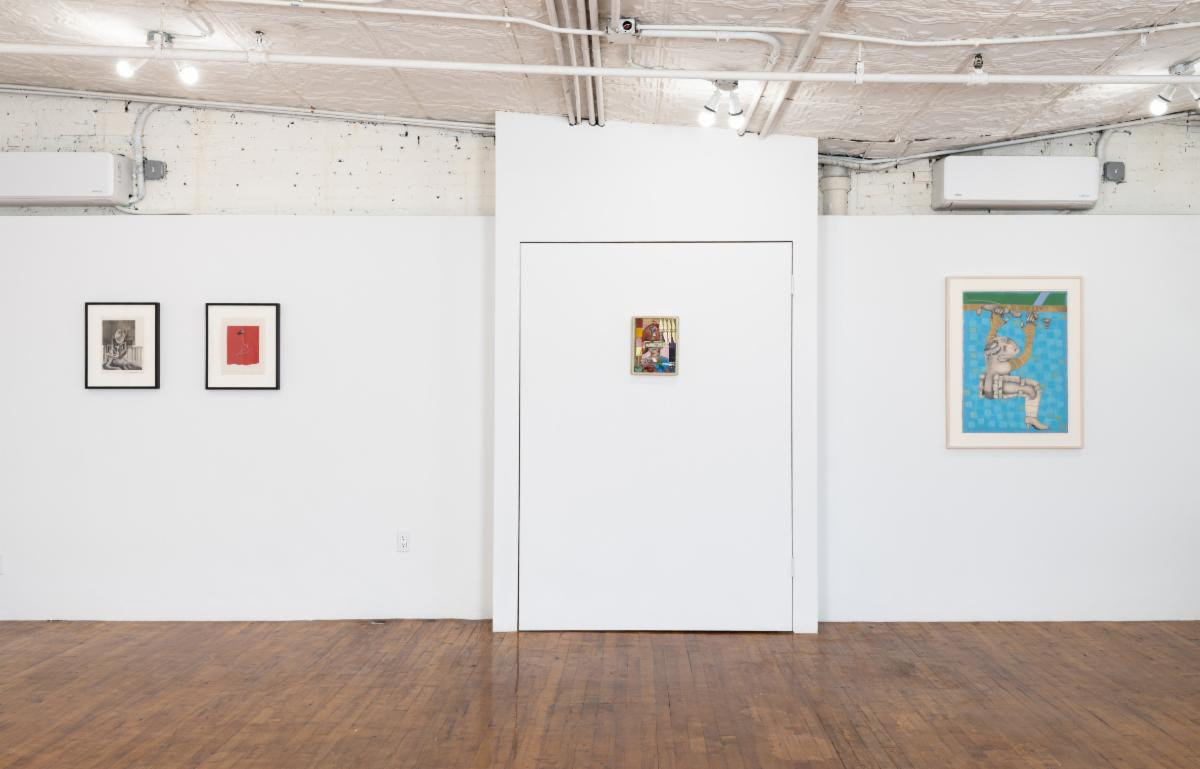
Ulterior Gallery is pleased to present Deconstructed Bodies, E’wao Kagoshima’s first solo exhibition with the gallery. Following Kagoshima’s institutional exhibition with the Center for Art, Research and Alliances (CARA) in New York last year, Animated Minds, this exhibition brings forward lesser-known works by Kagoshima to the contemporary discourse. The exhibition features Kagoshima’s mixed-media drawings and collage works from the late 1970s and early 1980s, created a few years after his move from Tokyo to New York in 1976. His experiences in the city had a fundamental effect on him as he established his practice. The selection focuses on Kagoshima’s interests in figuration as a conduit to introspection. Through surrealistic imagery and ideas inspired by the Vienna School of Fantastic Realism, he developed depictions of the human body in states of flux—disintegrating, transforming, and reforming. Kagoshima’s mixed-media drawings imagine the figure as broken, splayed, and recomposed, morphing into cyborgian articulations of the human form. In Untitled, 1976-1980 (image above), he depicted a figure with bandaged arms and legs in casts, clinging to crumbling stone. Yet the figure remains suspended in ambiguity: it is unclear whether he/she is climbing upward or falling. The defenseless face can be read in multiple ways, functioning like a Noh mask whose expression shifts depending on the action and context of the play, and how it’s activated. The collage works highlight Kagoshima’s ingenuity in handling diverse materials, vivid graphic sensibility, and a sharp sensitivity to imagery. Some incorporate images of male bodies sourced from vintage gay erotica magazines, a reflection of Kagoshima’s time living in the West Village in NYC, while others reduce the figure to drawn or painted fragments that interact with cut paper forms. In one example, he includes a fragment of Japanese: “A work of art is a form of cutting-edge, whether large or small …” (芸術作品は、形の大小を問わず一種の先端的…). Indeed, this work in a modest size demonstrates his morphological ambition that characterizes his oeuvre from this period. Kagoshima’s gesture—cutting, unfurling and peeling back sections so that the pictorial matrix merges with the underlying support—is the material that makes these inventive collage works intimate, vulnerable, and strikingly genuine. In his 1981 collages, the source material he used become increasingly more figurative, perhaps inspired by his discovery of American popular culture in the printed form, especially magazines. The density of his earlier abstractions is dramatically eased and a complex and enigmatic dialogue between human bodies and other iconographies emerges. The human body in Kagoshima’s 1981 works—dissected, assembled, and at times interrupted—function as scaffolds through which he inserts imagery juxtaposing objects and diagrams. The resulting figurative composites are artificially situated within a new environment. Echoing his personal experience as an artist in a new environment, the deconstructed bodies of this exhibition embrace change and mutability through material and visual contradiction. E'wao Kagoshima (b. 1945) is a Japanese-born, New York-based artist whose practice encompasses painting, sculpture, and collage. He has presented solo exhibitions at Nagai Gallery, Tokyo (1976); the New Museum, New York (1983); Mitchell Algus Gallery, New York (1997, 2008); Galerie Gregor Staiger, Zurich (2016); The Box, Los Angeles (2018); and Greenspon Gallery, New York (2018). His works have been featured in exhibitions at the Institute of Contemporary Arts, London (1982); White Columns, New York (2011); SculptureCenter, New York (2013); the Jewish Museum, New York (2014); the Baltic Triennial at the Contemporary Art Centre, Vilnius (2018); and MoMA PS1, New York (2021). Most recently, in 2025 he was given a retrospective at the Center for Art, Research and Alliances (CARA), New York. His works are in the collections of the Asian American Art Centre, New York; the Japanese American Cultural & Community Center, Los Angeles; the Princeton University Art Museum, New Jersey; and the Zuzeum Art Centre, Riga.
- No imagePastCeruse
Jen Mazza
Feb 27 – Apr 12
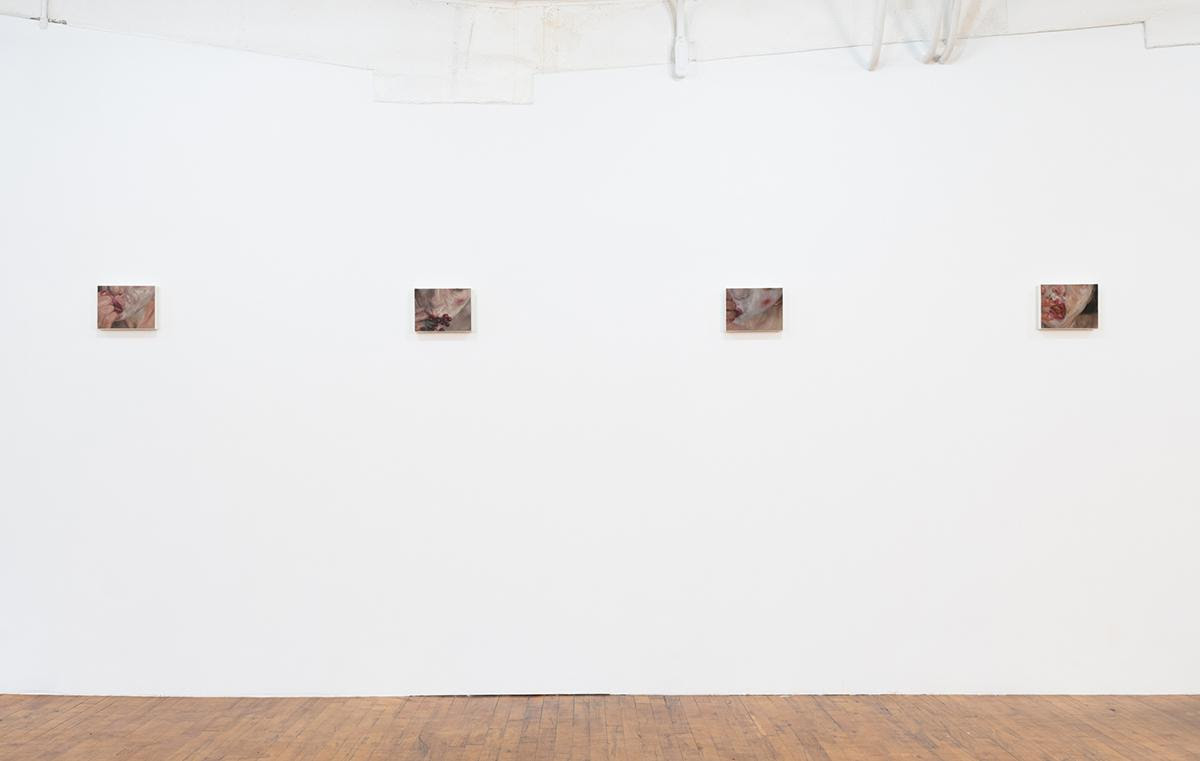
Ulterior Gallery is pleased to present an exhibition of works by Jen Mazza. Comprised primarily of a group of previously unseen figurative paintings from the 2000’s, this show presents those works in conjunction with a few of Mazza’s most recent works, connecting her practice, past and present. Mazza’s Ceruse paintings are a series of works similar in size and imagery that show fragments of a face in extreme close-up views. Seen together, these works form a connected sequence which is highly performative. Seemingly unwelcome gestures compress and twist her flesh in closely cropped and pantomimed images of emotional theater that are intimate, yet slightly unnerving. Fingers mold and manipulate the flesh of cheeks and lips, as in Equivalence (2008), where a hand forcefully presses red berries to distort the plump, exaggerated, rouged lips. Not intended as self-portraits, these images defamiliarize the facial features, rather than prompt recognition. This extreme proximity of the viewer to the painted face creates a feeling of vulnerability. The title, Ceruse, comes from the 16th century facial cosmetic made by mixing white lead with vinegar, historically used to the brighten the skin of the aristocracy. This representation of a material once prized for its connection to beauty, also alludes to its toxicity. Mazza’s most recent work, “In a Station”, illusionistically depicts a page of text from Alice Notley’s book The Descent of Alette. In Notley’s celebrated feminist narrative poem, a narrator named Alette descends underground, not to hell, but into a network of scenes that resemble NYC in the late 80’s. The rhythm and tension of Notley’s words and pauses draw in the viewer in much the same way as Mazza’s images create an atmosphere that feels urgent and unsettling. The linear hanging of this show emphasizes a kind of confounding repetition that obscures more than it reveals. Jen Mazza (b. 1972, Washington D.C.) received an M.F.A. from Mason Gross School of the Arts at Rutgers University in 2001 and is currently based in New York, NY. A committed educator, as well as an avid thinker and writer, Mazza draws her inspiration from a range of disciplines including philosophy, literature, and visual culture. Her work has been a subject of numerous solo and group exhibitions, and she had a mid-career retrospective at The James Gallery at the Center for the Humanities (Graduate Center, CUNY) in 2018 and also presented her works as part of her talk on art and nature at the Getty Museum in 2021. She is a recipient of a 2026 New York State Council on the Arts Grant. Mazza’s work has been reviewed in Two Coats of Paint, the New York Times, Art in America, Art News, Artforum, and Hyperallergic.
 PastCeruse
Jen Mazza
Feb 27 – Apr 12
Ulterior Gallery is pleased to present an exhibition of works by Jen Mazza. Comprised primarily of a group of previously unseen figurative paintings from the 2000’s, this show presents those works in conjunction with a few of Mazza’s most recent works, connecting her practice, past and present. Mazza’s Ceruse paintings are a series of works similar in size and imagery that show fragments of a face in extreme close-up views. Seen together, these works form a connected sequence which is highly performative. Seemingly unwelcome gestures compress and twist her flesh in closely cropped and pantomimed images of emotional theater that are intimate, yet slightly unnerving. Fingers mold and manipulate the flesh of cheeks and lips, as in Equivalence (2008), where a hand forcefully presses red berries to distort the plump, exaggerated, rouged lips. Not intended as self-portraits, these images defamiliarize the facial features, rather than prompt recognition. This extreme proximity of the viewer to the painted face creates a feeling of vulnerability. The title, Ceruse, comes from the 16th century facial cosmetic made by mixing white lead with vinegar, historically used to the brighten the skin of the aristocracy. This representation of a material once prized for its connection to beauty, also alludes to its toxicity. Mazza’s most recent work, “In a Station”, illusionistically depicts a page of text from Alice Notley’s book The Descent of Alette. In Notley’s celebrated feminist narrative poem, a narrator named Alette descends underground, not to hell, but into a network of scenes that resemble NYC in the late 80’s. The rhythm and tension of Notley’s words and pauses draw in the viewer in much the same way as Mazza’s images create an atmosphere that feels urgent and unsettling. The linear hanging of this show emphasizes a kind of confounding repetition that obscures more than it reveals. Jen Mazza (b. 1972, Washington D.C.) received an M.F.A. from Mason Gross School of the Arts at Rutgers University in 2001 and is currently based in New York, NY. A committed educator, as well as an avid thinker and writer, Mazza draws her inspiration from a range of disciplines including philosophy, literature, and visual culture. Her work has been a subject of numerous solo and group exhibitions, and she had a mid-career retrospective at The James Gallery at the Center for the Humanities (Graduate Center, CUNY) in 2018 and also presented her works as part of her talk on art and nature at the Getty Museum in 2021. She is a recipient of a 2026 New York State Council on the Arts Grant. Mazza’s work has been reviewed in Two Coats of Paint, the New York Times, Art in America, Art News, Artforum, and Hyperallergic.
 PastPlural Is a Kite That Goes Left or Right
Jonathan Ehrenberg
Feb 27 – Apr 12
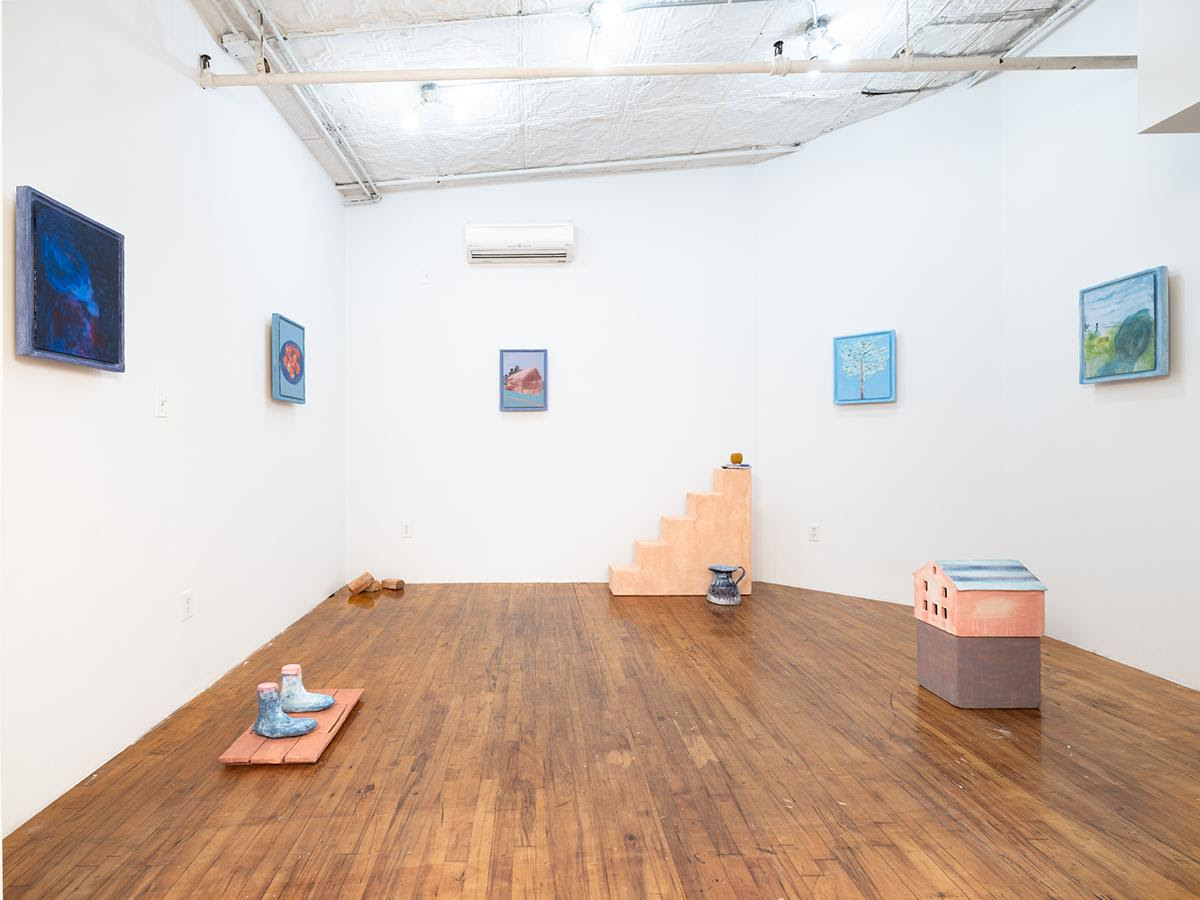
Jonathan Ehrenberg has been drawing us to the edge of the lamp light for more than two decades. Beginning with films of peopled, hand-made worlds; through digital-sculptural tweeners; and arriving here with clay sculptures of common objects ringed by small paintings. Through all these permutations Ehrenberg's work has never lost the sense that there is a dramaturg furiously writing in the wings. And indeed wings feel an apt metaphor as here too, aside the proscenium, there is much that is just out of view. In fact, this presentation of objects and paintings is merely the hummock of the iceberg the artist has been crystalizing over the elongated years since the pandemic, and his concurrent entry into fatherhood. It is not the first public showing of this work but the first of this particular constellation rife with sympathies and buzzy with the feeling of thinking. I am drifting a little here but that is in part because my initial iceberg metaphor is only one way to describe the waterline in Ehrenberg's work. Another, leaning more heavily on psychoanalysis, might posit that this waterline is the very boundary of sublimation; of language and form attempting to account for the vast deterritorialized depths. Coming to Ehrenberg's work is something like returning to consciousness or a recovery from amnesia. It is tied up in a familiarity that also involves recalling the names of things. What year is it? When was my mother born? How many times have we met? All the time doing one's best to keep front of mind just what it is like to be plural. —Lucas Blalock Jonathan Ehrenberg's work has been included in exhibitions at MoMA PS1, SculptureCenter, The Drawing Center, Nicelle Beauchene Gallery, Essex Flowers (New York), Futura Center (Prague), The B3 Biennial (Frankfurt), Temnikova & Kasela (Tallinn), and Nara Roesler (São Paulo). He has participated in residencies at LMCC Workspace, Harvestworks, Skowhegan, Triangle, The Fine Arts Work Center in Provincetown, Glenfiddich in Scotland, and Shandaken: Storm King, and his work has been reviewed in publications including The New York Times, The New Yorker, and Art in America. He received a BA from Brown University, and an MFA from Yale, and teaches at Lehman College, CUNY. He was born in New York, NY, where he currently lives and works.
 PastCartographic Affinities
Jan 16 – Feb 22
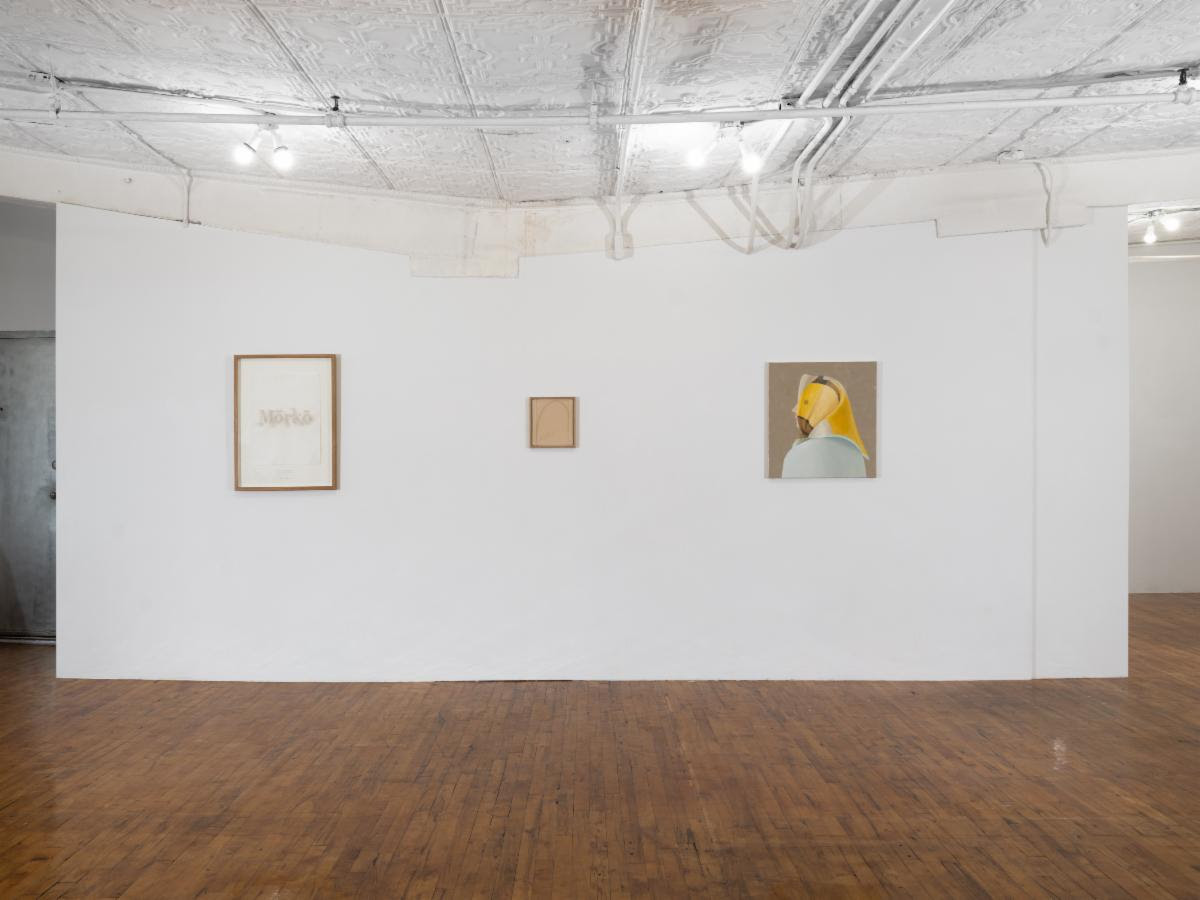
Noora Schroderus Päivi Takala Elina Vainio Ulterior Gallery is thrilled to present Cartographic Affinities, a group exhibition featuring three artists from Finland: Noora Schroderus, Päivi Takala, and Elina Vainio. Together, Schroderus, Takala, and Vainio explore the shifting space between humans, animals, and the natural world. Noora Schroderus embroiders the names of dogs with their own hair, drawing a wry and poignant analogy that questions how humans understand their relationships with other nonhuman beings. Using actual dog fur, her embroidery works become intimate portraits of companionship and co-existence. The names given to animals—weather fantastical (Mörkö), spiritual (Koitto), or human (Robbie)—reveal how language binds humans to their companions in deeply personal and emotionally charged ways, often reflecting who we are or who we aspire to be. In contrast with this intensely bound connection, Päivi Takala’s paintings adopt a quieter, more contemplative approach to human-animal connections. She depicts female figures wearing scarves with eyes that look out at us, disguising the creatures hidden beneath, and blurring the boundary between humans and the non-humans. Takala’s work reflects on the strange coexistence of these beings and the characteristics and emotions humans often project onto animals. Takala’s recurring motifs, such as depictions of horses and birds, meditate on the nature of that intimacy between species, but also on the unbridgeable expanse that separates them. Elina Vainio’s delicate beeswax reliefs bring forward the tension and fragility inherent in these connections. Using beeswax—a material produced through the collective labor of honeybees—Vainio embeds artificial and handmade objects within its surface, creating tenuous visual and material relationships. In Earthquake (Yamamura Koka), the inlaid black-and-white image is a reproduction of Yamamura Koka’s sketch of the destruction caused by the 1923 Great Kanto Earthquake. While beeswax appears visually frail, it is materially resilient, prompting viewers to reconsider what they know about the space nature occupies around and within us. The boundaries between culture and nature, as well as humanity’s assumptions about permanence, are quietly questioned. Rather than offering a fixed understanding of these relationships, the works of Schroderus, Takala, and Vainio reveal an unstable terrain. Cartographic Affinities maps out that realm, revealing the inconsistencies, uncertainties, and vulnerabilities of humankind’s coexistence in nature’s ecosystems. This exhibition is co-organized with The Finnish Cultural Institute in New York and the Consulate General of Finland in New York through their partnership with the New Art Dealers Alliance. This collaboration, which is made possible with the support of a grant by Jane and Aatos Erkko Foundation, Finlandia Foundation National, and The Ministry of Education and Culture in Finland, underscores a shared commitment to fostering international dialogue between the contemporary art scenes of Finland and New York. Noora Schroderus (b. 1982) lives and works in Salo, Finland. She received an M.F.A. from the Academy of Fine Arts in Helsinki in 2014. Interested in different materials and their possibilities, Schroderus stretches meanings and examines humanity, power, and gender, never far from self-irony and humor. Schroderus has held several solo exhibitions, most recently at Galerie Anhava, Helsinki, Finland (2024); Passagen Konsthall, Linköping, Sweden (2023); and Kunsthall Grenland, Porsgrunn, Norway (2019). She has participated in various group exhibitions, including at Hämeenlinna Art Museum, Hämeenlinna, Finland (2024) Borås Art Museum, Borås (2022); and Wäinö Aaltonen Museum, Turku, Finland (2021). Schroderus’s works are included in collections such as Kiasma Museum of Contemporary Art, Tampere Art Museum, Jenny and Antti Wihuri Foundation, City of Norrtälje, the Gösta Serlachius Art Foundation, and the Lars Swanljung Collections. In 2025 Schroderus was awarded the Finland Prize by the Ministry of Education and Culture. Päivi Takala (b. 1970) lives and works in Helsinki, Finland. She studied at Hochschule der Künste, Berlin, and at University of Art and Design, Helsinki. In her works, she observes human existence together with other living beings with a critical yet gentle eye and soft brushstrokes. Her recent, faded palette is a nod to the early Renaissance frescoes to which she returns time after time. Takala has exhibited in numerous solo and group shows, including at Cecilia Hillström Gallery, Stockholm, Sweden (2025); Galerie Anhava, Helsinki, Finland (2024); Malmö Art Museum, Malmö, Sweden (2021-24); Emma Espoo Museum of Modern Art, Espoo, Finland (2020-23); and the XXVI Mänttä Art Festival, Mänttä, Finland (2022). Works by Takala are included in many important Nordic public collections, such as the HAM Helsinki Art Museum, the Museum of Contemporary Art Kiasma, the Saastamoinen Foundation, the Sara Hildén Art Museum, and the Malmö Art Museum collections. Takala has worked as Lecturer in Painting at the Academy of Fine Arts in Helsinki since 2014. Elina Vainio (b. 1981) lives and works in Helsinki, Finland. She received her M.F.A. from the Academy of Fine Arts, Helsinki, in 2013. Prior to her graduate studies, she studied in London and earned a B.F.A. with honors from Chelsea College of Art & Design. Vainio’s artistic practice operates in the shadow zones of the modern Western, human-centered worldview. Her works often foreground the limits of knowledge and language in our attempts to understand the world, while questioning the fragility of life and the interconnectedness of humans and nature. Her work has been featured in numerous exhibitions, including Espoo Museum of Modern Art, Espoo, Finland (2025); Seoul Museum of Art, Seoul, Korea (2025); Wäinö Aaltonen Museum, Turku, Finland (solo, 2020); Helsinki Art Museum Gallery, Helsinki, Finland (solo, 2020); and Triangle Art Association, New York (2016). In 2024, Vainio participated in residency programs at Hamuro mAiR in Awara, Japan; The time she spent there informs the new works presented in this exhibition.
Past
Come to CountryMaryam Amiryani
Oct 24 – Dec 7
Ulterior Gallery and Rebecca Camacho Presents are pleased to co-present Come to Country, a tandem exhibition of new paintings by Maryam Amiryani, opening simultaneously on the East and West Coasts. This marks Amiryani’s fourth solo exhibition with Ulterior and her first with Rebecca Camacho. “What is an American?” As a political refugee from Iran via France, and a member of the Iranian diaspora now living in West Texas, Amiryani explores the idea of Americanness, with the curiosity and precision of a social anthropologist. She teases out the fictionalized cultural image with the harsh realities of actually working on a ranch and raising cattle. Her fascination is tempered by an inimitable wit. The icon of the rugged, lonesome, cowboy entered American popular imagery with the Marlboro Man advertisements that first appered in 1954. Seeking to market filtered cigarettes, Philip Morris and Leo Burnett, a Chicago advertising executive, crafted a manly archetype that would become one of the most legendary campaigns in history. The image was inspired by Leonard McCombe’s 1949 Life Magazine photographs of Clarence Hailey “C.H.” Long (1910—1978) , a young Texan cowboy whose likeness came to embody the figure of the Marlboro Man. McCombe, a European-born photographer from the Isle of Man, inextricably tied his incarnation of the cowboy, with America’s romanticized view of the West. As Louise Nevelsen once said, “Every artist is a collector.” Amiryani follows this tradition. Amiryani draws from her own archive of Marlboro advertisements from Come to Marlboro Country to examine the cowboy and his mythical status. Her paintings juxtapose McCombe’s stark black-and-white imagery with the vast, color-saturated skies of Marfa, Texas, leading viewers to the visual threshold where the reality and myth intertwine. Amiryani had dedicated this series to her neighbors Mem and Jeanne Hall, whose daily lives working with cattle and wearing actual spurs and chaps embody the actual, unvarnished and onerous life of the cowboy. On view concurrently on both coasts, Come to Country extends the nostalgic yet unsettled legend of what it means to be a cowboy—and by extension, an American—in this sprawling landscape. Maryam Amiryani was born in Shiraz, Iran in 1967. Follwing the Iranian Revolution in 1979, Amiryani and her family relocated to Paris, France. Several years later, she moved to the United States, where she completed her education, obtaining a MFA in painting from the New York Academy of Art, New York, NY, in 1995. She also holds a BF in Graphic Design from the Art Center College of Design, Pasadena, CA, and a BS in Asian History from Georgetown University, Washington, D.C. Amiryani lives and works in Marfa, TX.
Past
Pidgingo-no-InkoGaku Tsutaja
Sep 5 – Oct 19
"Pidgin [noun] pi-jen : a simplified speech used for communication between people with different languages"[1] Ulterior Gallery is pleased to present Pidgingo-no-Inko, the fourth solo exhibition by Gaku Tsutaja. A Japanese artist based in New York, Tsutaja reinterprets historical trauma and established narratives through a contemporary lens. The exhibition title, Pidgingo-no-Inko (Pidgingo’s Parakeet) is also the title of the new video sculpture installation featured in the show. “Pidgingo” refers both to “pidgin language” and “after pidgin” (“go” meaning “language” and “after” in Japanese). The parakeet—an evolving character in Tsutaja’s work for nearly a decade—functions as both a metaphor for immigrants who mimic language and a satirical figure that reflects the repetition of history. More broadly, “pidgin” denotes a contact language that naturally arises between local populations and foreign traders to enable communication. The video installation Pidgingo-no-Inko, is presented alongside the two- and three-dimensional works that appear within it. In the video, the conversations are in English, but the names of countries, events, and places are rendered in a mixture of Japanese and local languages, mimicking how pidgin functions. The narrative unfolds through three voices: a child, a man, and an elderly woman. Rooted in the intimate setting of the family—the smallest unit of community in human society—this constellation also echoes Tsutaja’s own family structure in the United States. She interweaves histories of war, colonization, and weapons development with fragments of personal anecdotes, weaving a nonlinear narrative that merges reality and fantasy. In doing so, she explores overlapping symbols and dialogues across time and space, seeking to dismantle fixed frameworks of thought and to invent a new pidgin language within her work. The video is projected from a large sculptural structure resembling a human head, finished with ears made using traditional Japanese dry-lacquer techniques. Within this structure are miscellaneous elements: broken eggshells, tiny birds, an empty rib cage, and a monstrous black spider spreading its limbs in the center. Conceived as a planning model by the imaginary parakeets, the structure allegorically seeks to reorder histories of mass violence. These symbolic forms also reflect on the information technology industry and censorship—how information enters and exits our attention, and the skeletal systems through which it is monitored. Tsutaja draws inspiration from the overwhelming speed and volume of information circulating on social media, as well as from the simultaneous rise of voices from historically oppressed peoples and their interconnected struggles. What do we see, what do we fail to recognize, what traps us, and what do we endlessly repeat—both historically and in the present? Tsutaja’s work urges us to examine modes of communication, confront systemic violence, and engage collectively with the recurring patterns of human history. Gaku Tsutaja, born in 1974 in Tokyo, Japan, earned her MFA from SUNY Purchase College in 2018; she is currently based in Queens, NY. Following the 2011 Tohoku Earthquake and nuclear accident, she began investigating the history of nuclear development, uncovering the untold stories of atomic bombings and nuclear weapons testing through interviews with Hibakusha (nuclear victims in Japan, the U.S., and the colonies), as well as with experts on nuclear issues and war. Central to her practice is the act of bringing stories often excluded from mainstream history into an alternative collective memory platform as an artwork, while questioning how social structure may contribute to their erasure. Her work interrogates the influence of visual culture on censorship and propaganda, and the workings of international warfare. Tsutaja has gained increasing international recognition, including solo presentations at Ulterior Gallery, New York, NY (2017, 2020, 2023); Maruki Gallery for The Hiroshima Panels, Saitama, Japan (2022); the Rubin Center for Visual Arts at UTEP, El Paso, TX (2021); and Shirley Fiterman Art Center at BMCC, New York, NY (2019). She also participated in the Hawai’i Triennial 2022, Honolulu, HI. Tsutaja’s exhibitions and artworks have been widely reviewed in numerous outlets including The New York Times, Artforum, Bijutsu-Techo, and NHK Broadcast, among others. Currently, her work is featured in two major museum exhibitions in Japan: Between Memories and Objects: Monuments, Museums, and Archives at Hiroshima City Museum of Contemporary Art, and The Myth of Tomorrow: Atomic Bomb x Art at Taro Okamoto Museum of Art in Kawasaki City, Kanagawa. 1 - Merriam-Webster online dictionary
- No imagePastPidgingo-no-Inko
Gaku Tsutaja
Sep 5 – Oct 19
"Pidgin [noun] pi-jen : a simplified speech used for communication between people with different languages"[1] Ulterior Gallery is pleased to present Pidgingo-no-Inko, the fourth solo exhibition by Gaku Tsutaja. A Japanese artist based in New York, Tsutaja reinterprets historical trauma and established narratives through a contemporary lens. The exhibition title, Pidgingo-no-Inko (Pidgingo’s Parakeet) is also the title of the new video sculpture installation featured in the show. “Pidgingo” refers both to “pidgin language” and “after pidgin” (“go” meaning “language” and “after” in Japanese). The parakeet—an evolving character in Tsutaja’s work for nearly a decade—functions as both a metaphor for immigrants who mimic language and a satirical figure that reflects the repetition of history. More broadly, “pidgin” denotes a contact language that naturally arises between local populations and foreign traders to enable communication. The video installation Pidgingo-no-Inko, will be presented alongside the two- and three-dimensional works that appear within it. In the video, the conversations are in English, but the names of countries, events, and places are rendered in a mixture of Japanese and local languages, mimicking how pidgin functions. The narrative unfolds through three voices: a child, a man, and an elderly woman. Rooted in the intimate setting of the family—the smallest unit of community in human society—this constellation also echoes Tsutaja’s own family structure in the United States. She interweaves histories of war, colonization, and weapons development with fragments of personal anecdotes, weaving a nonlinear narrative that merges reality and fantasy. In doing so, she explores overlapping symbols and dialogues across time and space, seeking to dismantle fixed frameworks of thought and to invent a new pidgin language within her work. The video is projected from a large sculptural structure resembling a human head, finished with ears made using traditional Japanese dry-lacquer techniques. Within this structure are miscellaneous elements: broken eggshells, tiny birds, an empty rib cage, and a monstrous black spider spreading its limbs in the center. Conceived as a planning model by the imaginary parakeets, the structure allegorically seeks to reorder histories of mass violence. These symbolic forms also reflect on the information technology industry and censorship—how information enters and exits our attention, and the skeletal systems through which it is monitored. Tsutaja draws inspiration from the overwhelming speed and volume of information circulating on social media, as well as from the simultaneous rise of voices from historically oppressed peoples and their interconnected struggles. What do we see, what do we fail to recognize, what traps us, and what do we endlessly repeat—both historically and in the present? Tsutaja’s work urges us to examine modes of communication, confront systemic violence, and engage collectively with the recurring patterns of human history. Gaku Tsutaja, born in 1974 in Tokyo, Japan, earned her MFA from SUNY Purchase College in 2018; she is currently based in Queens, NY. Following the 2011 Tohoku Earthquake and nuclear accident, she began investigating the history of nuclear development, uncovering the untold stories of atomic bombings and nuclear weapons testing through interviews with Hibakusha (nuclear victims in Japan, the U.S., and the colonies), as well as with experts on nuclear issues and war. Central to her practice is the act of bringing stories often excluded from mainstream history into an alternative collective memory platform as an artwork, while questioning how social structure may contribute to their erasure. Her work interrogates the influence of visual culture on censorship and propaganda, and the workings of international warfare. Tsutaja has gained increasing international recognition, including solo presentations at Ulterior Gallery, New York, NY (2017, 2020, 2023); Maruki Gallery for The Hiroshima Panels, Saitama, Japan (2022); the Rubin Center for Visual Arts at UTEP, El Paso, TX (2021); and Shirley Fiterman Art Center at BMCC, New York, NY (2019). She also participated in the Hawai’i Triennial 2022, Honolulu, HI. Tsutaja’s exhibitions and artworks have been widely reviewed in numerous outlets including The New York Times, Artforum, Bijutsu-Techo, and NHK Broadcast, among others. Currently, her work is featured in two major museum exhibitions in Japan: Between Memories and Objects: Monuments, Museums, and Archives at Hiroshima City Museum of Contemporary Art, and The Myth of Tomorrow: Atomic Bomb x Art at Taro Okamoto Museum of Art in Kawasaki City, Kanagawa. 1 - from Merriam-Webster online dictionary.
Past
Time, as a SymptomLily Wong
Sep 3 – Oct 4
“Precipice Don’t lose your footing The wall might be a floor” I type this list into my Notes app as I visit Lily Wong’s studio. In her work, she plays with the tenses and outlines of narrative. There is a flexibility here. A reliable narrator is not to be found. The older you get, the less sure you are of your fixed personhood. How open can you leave a story? One piece in particular, Moonflower, contends with all of this. The main figure is not simply mirrored but divided into three. Scale is thrown into question by the small (?) figure in the distance, holding the stem of a giant (?) flower, the bloom of which enters the room along with the main figure. Her foot is entangled in another stem, and she seems to be taking a step forward without solid grounding. Lily’s studio is neat. Large sheets of paper are pinned to the walls, methodically layered with thin strokes of acrylic paint over weeks and months. Remnants of wiping off her brush or testing a color/mark surround the pieces like Seurat frames. These colors have become more complex than previous works. Much more interconnected, surprising colors often reflect onto other portions of the paintings. References abound. A woodprint, Suzaku Gate Moon, from Tsukioka Yoshitoshi’s 100 Aspects of the Moon; A small, oddball George Tooker, The Groping Hand; Bosch’s The Pedlar; stills from a Patty Chang performance video. These are images that are potent, Lily has kept these taped to her studio wall for years, or in spreads ready to be poured over in her library of art books, ruminating on them and allowing them to seep into her work and transform. The Source is one of two paintings that not only point to outside artworks but consider that very action of pointing. Before the reclining artist, waiting to be taped to the wall with the recognizable blue artist tape, are prints of a Louise Bourgeois etching, one of Lily’s own works, and an artwork that was in the Met’s recent exhibition, Mandalas: Mapping the Buddhist Art of Tibet. This last reference is the most interesting as it inspired Wong to make the painting within the painting, on the wall behind the artist. There she renders her own versions of the gridded deities. Time, as a symptom takes its title from a Joanna Newsom song, the last track on her 2015 album Divers. That particular album is a closed circuit, the last sound/syllable leads into the first, forever in a loop. Time is a dominant theme, both in the ways that it could exist beyond our understanding, spatially and dimensionally, as well as the weight that joy and terror place on our experience of it. Two types of nostalgia are defined by Svetlana Boym in her 2001 study, “The Future of Nostalgia.” The latter is ‘reflective’ and here is where I believe Wong’s work is situated. Boym explains: “Reflective nostalgia thrives in algia, the longing itself, and delays the homecoming- wistfully, ironically, desperately. … Reflective nostalgia dwells on the ambivalences of human longing and belonging and does not shy away from the contradictions of modernity.” As Boym describes: “Reflective nostalgics see everywhere the imperfect mirror images of home, and try to cohabit with doubles and ghosts.” Sometimes Wong’s figures read as self-portraits, other times variants on a type. They split and haunt each other. Like the reflective nostalgic, Wong “desires to obliterate history and turn it into private or collective mythology, to revisit time like space, refusing to surrender to the irreversibility of time that plagues the human condition.” Here poses recur. Inside space is cavernous, outside constricted. I guess cats and dogs exist in an ambivalent space as well: humans change them and they change us, but neither is fully domesticated to the other. There is always a push and a pull, a conflict. In Soliloquy the artist again arranges references, both with physical print-outs and drawings, as well as attending to the glow of her iPhone. She is crouched over in an impossible form (notice the spacial fuckery of her body in relation to the floor boards), with her cat, Louis, perched on her back. He seems to guide her, or at least anchor and ground her. A dog nips at the figure's leg in Wayfarer, possibly attempting to stop her, either from leaving or from entering. The pose with dog is a reference to depictions of the pedlar figure, in a famous Bosch painting and other imagery of the time. Ants that once populated Wong’s world return here, crawling at the end of the pedlar’s staff. Like the nostalgic that can never return home, the ants can return but they don’t necessarily mean the same thing. Once entering Wong’s older work to consume the rotting excesses of food, now they seemingly encourage the pedlar forward, even as the scrappy dog tries to prevent that movement. I think of other species’ sense of direction. That there are paths that aren’t comprehensible to us. Our proprioception is found lacking. A braid suggests patience, and the making of a new form from the thousands of individual strands of hair on a given head. In front of the extremely long, horizontal Time goes both ways, Wong spoke about the scroll as having a different temporality than other works of art. Not meant to be seen all at once, but rather in smaller sections the viewer would roll and search for, back and forth across the document. Despite showing the entire scene in her piece, Wong allows space and time to be inconsistent across the passage. I am again reminded of Boym’s ideas of nostalgic imagery. She states: “A cinematic image of nostalgia is a double exposure, or a superimposition of two images-of home and abroad, past and present, dream and everyday life. The moment we try to force it into a single image, it breaks the frame or burns the surface.” I feel like Lily revels in the breaking of the frame. It’s not just a dream space, it’s too coherent for that. Maybe these are memory spaces, each time reconstructed by our mind. Each past altered by the present, each time. Tooker’s The Groping Hand is reaching for something. The something isn’t legible and isn’t necessary to understand the painting. It’s about the reaching. The artist in Soliloquy is also reaching, across time and across images, trying to tap into a wavelength and transform. The rain clings to the window in pearly drops. Condensation longing to return to a deep body of water. Iris Dement sings “I think I’ll let the mystery be.” Kate Bush sings “See those trees / Bend in the wind / I feel they've got a lot more sense than me / You see I try to resist… If I could learn to give like a rubberband/ I’d be back on my feet.” —Anthony Cudahy
Past
RainEric Heist & Kazumi Tanaka
Jun 6 – Jul 12
Project Room Ulterior Gallery is pleased to present Rain by ±, a collaborative project by the artist duo Eric Heist and Kazumi Tanaka. This exhibition debuts their vision, developed out of their studios in upstate New York, where they share a space for creative discourse. "My recent work incorporates the skulls of land animals and sea creatures’ shells into sound-producing sculptures– a visceral, sensory connection to the natural world. By placing my worktable with Eric’s maze painting, the room transforms into a psychological space connecting the outer world with the created sound space. When I look at a line of pine trees in front of a bank of fog, I can see a clear order, but when the fog lifts the clarity disappears. Returning to moments of that clarity through names, numbers, and colors recall the ephemeral nature of our connection to the unseen. Over the hills, we can go into the cool shady pine forest where we find animal bones here and there. There is evidence of a natural cycle in the aftermath of coyote feasting on deer or other small animals. At night, we hear their howls echoing through the trees. The existence of deer upstate is serene as the fog, their gentle figures emerging suddenly. Sometimes they pause to gaze at us, assessing whether we are a threat, their eyes seeing through to our bones. When I was in grade school, I made mazes to pass to other students– an intimacy made possible through games. The maze I made in relation to the natural objects on the table represents the connection between us and the natural world." —±
Past
Flicker / Reform / DissolveJun 6 – Jul 12
Rachael Catharine Anderson Annabel Daou Selena Kimball Ulterior Gallery and signs and symbols are pleased to present Flicker / Reform / Dissolve, a group exhibition bringing together works by Annabel Daou, Selena Kimball, and Rachael Catharine Anderson. Spanning cut paper, painting, and collage, the exhibition brings together three artists whose practices engage the language of fracture—whether political, material, or perceptual—and examine what persists in the aftermath. Annabel Daou's intricate works probe the tensions between permanence and impermanence, belonging and dislocation. Produced through a labor-intensive process of cutting away negative spaces, words and images appear caught in delicate nets of microfiber paper, held momentarily, like fragments of thought or memory suspended in air. For Daou, the act of cutting is both a gesture of revelation and concealment, uncovering what lies beneath while simultaneously withholding it. The recurring motif of thistles, which are native to her homeland of Lebanon, have appeared in her work over the years during times of personal difficulty or collective struggle. Here, their spiky needles pierce through the hand-cut lattices, evoking resilience and vulnerability. Through it all, language quietly asserts itself, puncturing the surface to declare: this side of history. Selena Kimball’s archival collages disrupt fixed narratives by recombining historical debris into speculative, open-ended tableaux. While Daou’s practice reflects temporal fragility, Kimball’s ongoing series Atlas of Air (2020–present) explores what can be lost in the ever-shifting rhythm of daily life. The works are composed of skies clipped from the front pages of The New York Times—images stripped of headlines, captions, or any trace of the catastrophic events unfolding beneath them. Published daily, these emotionally charged photographs have fleeting lifespans, quickly submerged by the tide of news cycles. Yet the sky endures—a neutral, connective space linking event and viewer, reality and perception. By excising these skies from their original contexts and extending their temporal resonance, Kimball invites us to consider what is preserved, what is forgotten, and how meaning is shaped in what we see every day. In contrast with the lengthy and long-drawn-out reflective processes of Daou and Kimball, Rachael Catharine Anderson's paintings trace the geometry of forms as she paints her subjects in situ. Each canvas is both a record and a spatial meditation made with perception, memory, and time. For this exhibition, the artist created three new paintings — a selection of plein air studies of narcotic, psychoactive, and poisonous plants as well as nude studies informed by emotional affects of jouissance, hysteria, and melancholy in reaction to environmental stimuli. The dialogue created between the three artists explores the intimate and political architectures of memory, language, and form. Though distinct in practice, each artist shares an interest in fragmentation—of narrative, material, and experience—and in reassembling what has been dismembered or obscured. Together, Daou, Kimball, and Anderson create a conversation around what endures and how? Where do we find coherence—in form, in memory, in trace—inviting viewers to consider how we shape and are shaped by the stories we inherit and the structures we build. These artists offer no fixed answers, but instead open a space where meaning might flicker, reform, or dissolve. Rachael Catharine Anderson is a 2022 MFA graduate from the Painting and Printmaking program in the Yale School of Art. She makes thematic oil paintings that relate emotional affect to environmental stimuli. Made intuitively and by direct observation of things in space, the paintings blur distinctions between thinking and feeling. Anderson’s care-full approach revels in enchantment and nuance, uncertainty, wonder, and worldly fascination. In the fall of 2023, Anderson had her first solo exhibition at signs and symbols, followed by part two of this exhibition in the spring of 2024. Her work has been shown in Italy, Canada, and the United States, including at Jeffrey Deitch Gallery in New York. Her paintings are included in major private collections in the US and Europe. She currently lives and works in New Haven, Connecticut. In 2024, signs and symbols published the artist's first monograph featuring essays by Barry Schwabsky and Dr. Kathy Battista. Annabel Daou's work takes form in paper-based constructions, sound, performance, and video. Daou suspends, carves out, or records the language of daily life: from the ordinary or mundane to the intimately personal and urgently political. In her performance work she explores questions of trust, intimacy, cross-cultural exchange, and the operations of power. Her work frequently evokes moments of rupture and chaos but with the tenuous possibility for repair. Daou was born and raised in Beirut and lives in New York. Recent solo exhibitions include War Games at Galerie Tanja Wagner, DECLARATION at Ulrich Museum of Art, and Global Spotlight: Annabel Daou at Museum of Contemporary Art Arlington. Recent residencies include the Pollock-Krasner award at ISCP in New York and Haus Des Papiers in Berlin. A monograph of her work was published by Distanz Publishing Berlin in 2025. Selena Kimball is a visual artist whose work transforms historical materials—books, newspapers, photographic archives—into deeply personal reconfigurations that question the authority of these materials to define our knowledge of landscape, territory, and place. Kimball is driven by an intimate understanding of how mediated representation often fails to capture lived reality. Her process deliberately disrupts the established visual record, honoring instead the body's complex and often unshareable way of knowing and remembering. Recent exhibitions include the Katonah Museum of Art, the Portland Museum of Art in Maine, the Center for Contemporary Art, Warsaw, and the Museum of the Romanian Peasant, Bucharest. Her most recent solo exhibition at Ulterior Gallery was captured in Bomb Magazine by Anton Ginzberg. Kimball has been awarded numerous grants, and this year, she has been named a 2025 Guggenheim Fellow and 2025 Robert Rauschenberg Foundation Archives Research Fellow. Kimball splits her time between Maine, where she was born and raised, and Brooklyn, New York where she lives and works.
Past
The DrowningCelia Eberle
Apr 25 – Jun 1
Ulterior Gallery is pleased to present The Drowning, a solo exhibition by Celia Eberle. This marks Eberle’s first solo exhibition with the gallery and her debut solo presentation in New York. Hailing from a small town in Texas and exhibiting in the region since the late 1980's, Celia Eberle creates work that is candid and vulnerable—charged with fear, anger, and humor—while deeply rooted in the cultural and geographical circumstances of a woman of her upbringing. Eberle works with a range of materials and is known for her ingenuity and experimental use of it. Her materials and techniques may be humble, but it supplies consistently honest and quietly powerful dialogue. At Ulterior, the viewer encounters a sweeping installation of ceramic fish that cascade across the gallery walls. The fish—some with mouths agape, as if grasping for air or naturally filtering water—form an undulating wave that collects at the base of the wall. There, the mass that accumulates at the foot of the cascade is attended by a grieving youth. Inspired by the Statuette of a Dead Youth (ca 475 BC, Greece) in the collection of the Getty Museum, two figures flank the ceramic fish waterfall. Fragile and naked, these forms—limp and exposed—echo both Icarus’ doomed fall and Goya’s The Sleep of Reason Produces Monsters. They stand as elegiac spirits, metaphors for innocence and morality that reference a central idea in Eberle’s practice: the inexorable patterns, the rise and fall, of existence, and our persistent failures to escape them. In this immersive installation, while falling is the dominant motif, there also simultaneously exists the faint possibility of ascension, or floating. Eberle notes, “I often tackle dark subjects with beauty or humor. The Drowning is an elegy for this moment. It's a reflection on the effects of extreme circumstances on youth, presented in mythic terms—Spirits are swamped by a flood of catastrophe.” Celia Eberle was born in 1950 in East Texas and grew up in Piney Woods—“a place more Southern Gothic than many people would imagine when they think of Texas,” as she puts it. Eberle received her BFA with Honors from Stephen F. Austin State University in 1974, and began exhibiting professionally in the 1980s, primarily in Texas. From 1987 to 1992, she was an active member of 500X Gallery, one of the longest-running artist-run co-ops in the country, where she had a particularly experimental and productive period. Now in her 70s, Eberle is experiencing a formidable and vibrant chapter in her career. In 2022, her solo exhibition Nasher Public: Waiting for Robot was presented at the Nasher Sculpture Center in Dallas, TX. Last year, she was invited to be a resident artist at Artpace in San Antonio, TX, where she realized another solo museum exhibition titled She. Her work has also been featured in numerous important solo and group exhibitions across Texas, including; Amon Carter Museum of Art, Fort Worth, TX (2017); the McNay Art Museum, San Antonio, TX (2017); and Art Museum of Southeast Texas, Beaumont, TX (solo, 2014). Eberle’s honors include the Adolph and Esther Gottlieb Individual Support Grant (2019); the Joan Mitchell Foundation Painters and Sculptors Grant (2015); the Nasher Sculpture Center Microgrant (2015); the Dozier Travel Grant from the Dallas Museum of Art (2002); and an MAAA/NEA Fellowship Award (1994). Public collections include The Dallas Museum of Art, the San Antonio Museum of Art, the Art Museum of Southeast Texas, and the J. Wayne Stark Gallery at Texas A&M. Eberle works daily in her studio, a garage next to her house, in a rural area in Ennis, TX.
Past
ExposureMar 7 – Apr 6
Michele Araujo, Daniel Bodner, Anna Campbell, Joy Episalla, Thomas Fougeirol, Craig Jun Li, Linda Matalon, Linn P. Meldt, David Nelson, Hol Ogram, J Pasila, Carlos Reyes, Jo-ey Tang In this historic moment of fracture and collapse, sustenance comes from connections with others and a cobbled-together sense of community that emerges through our exposure to each other. Each of these artists engage with different forms of exposure. I am thinking about the multiple and layered meanings of exposure: beginning with photographic exposure as a process and extending outwards to the objects, and how they travel through the world—permeable, always precarious, provisional, never unscathed, and subject to the variables of weather, handling, chance, climate and light. Several of the artists know each other more intimately than I know them. Some only know one or two of the others. Two are collaborative entities. One is the parent of half of one of those entities. Some share long histories. One was the student of another. One is no longer with us. Together, they/we form a particular constellation of affinities. —Carrie Yamaoka
Past
Vicissitudes of NatureJen Mazza
Jan 10 – Feb 23
Ulterior Gallery is pleased to present Vicissitudes of Nature, a solo exhibition by Jen Mazza. This marks Mazza's first solo exhibition with the gallery. Vicissitude, the quality or state of being changeable, is often used to describe the weather. The title is a tribute to philosopher Richard J. Bernstein, who wrote about philosophy's "quest for some fixed point, some stable rock upon which we can secure our lives against the vicissitudes that constantly threaten us." Mazza's large-scale painting, Portent, on view at the gallery, comes with a kind of indescribable dizziness. This 67 by 87 inch painting absorbs the viewer into an unsettling yet mesmerizing scene, one that evokes a sense of vertigo. At first glance, the viewer may think they recognize what they see—a line, a color, the rippling surface of water… but do they really? Portent becomes a vast, absorbing expanse. Like the ocean itself it layers time, events, and emotions within it. The inspiration for Portent lies in Titian's The Submersion of Pharaoh's Army in the Red Sea, a 12-block woodcut from the 16th century. In both Mazza's and Titian's works, the water has already closed over the lost army, leaving only a calm, enigmatic surface. Mazza distills this historical reference into a landscape that meditates on absence, obscuring the line between past and present. The works in this show are united through their connection with nature; many are drawn from historical images and texts, sources include Virginia Woolf, Abraham Ortelius and particularly John Ruskin. For the installation of works on paper titled Ruskin's Landscape, Mazza culled texts from the manuscript of the British art critic's Brantwood Diary (1876-1884). Ruskin's record of nature's unpredictability also becomes the record of his internal landscape and psyche. "Worse and worse" he writes on September 27, 1877 and he writes the same again on Sept. 28; while these dark spells feel interminable to Ruskin, he also describes momentary encounters with the sublime: "Rosie light on snow," "Brighter," and "Beauty." Jen Mazza (b. 1972, Washington D.C.) received an M.F.A. from Mason Gross School of the Arts at Rutgers University in 2001 and is currently based in New York, NY. A committed educator, as well as an avid thinker and writer, Mazza draws her inspiration across a range of disciplines which include philosophy, literature, and visual culture. Her work has been recently exhibited in a mid-career retrospective at The James Gallery at the Center for the Humanities, in a digital project for Artist Alliance Inc., and as part of her recent talk on art and nature at the Getty Museum. Mazza’s work has been reviewed in the New York Times, Art in America, Art News, and Hyperallergic.
Past
VoyageNov 15 – Dec 22
E’wao Kagoshima Kazumi Tanaka Mamie Tinkler Ulterior Gallery is pleased to present Voyage, a group exhibition featuring E’wao Kagoshima, Kazumi Tanaka, and Mamie Tinkler. The exhibition title, Voyage, is drawn from Mamie Tinkler’s newest oil painting, Malachite Voyage. Her work features a small animal’s skull rendered in dynamic colors and dramatic lighting, abstracted as if melting into the surrounding scene. Known for her work in watercolor, Tinkler exhibits oil paintings for the first time in her career, exploring a new realm in a time-honored material. Utilizing the traditional still-life vocabulary, she employs photorealism as a part of her process. The shift in medium has allowed her to forge a fresh, richly textured connection between her artistic vision and the history of painting, as well as the history of optics. At the center of the gallery, Kazumi Tanaka’s sculpture, Star, presents a contrasting perspective on natural remnants. Crafted from a male deer skull found at Magitoga’s Woodland Garden in Garrison, NY, Tanaka transformed this artifact into an artwork that also functions as a harp. In engaging with the skull, Tanaka sought to attune herself to the object, discovering what it “needed” to sustain itself. The result is a piece that, although skeletal and silent on its own, regains a surreal vitality as it interacts with the living. E’wao Kagoshima’s works create a sense of playful disorientation, moving freely between divergent images and formats. His surrealist compositions often lead viewers down unexpected narrative paths, each image building on the next. In his 2016 painting, Utopia / Dystopia, a baby is sleeping between the horizon and a shaded moon, floating in an ambiguous space. These visual and conceptual associations reflect his exploration of personal and cultural narratives—as he draws and paints, Kagoshima dissects his own interpretations of his images and stories. The title Voyage also evokes the journey of celestial navigation, once guided by luminous stars in the dark night sky. Through unconventional materials and diverse styles, Kagoshima, Tanaka, and Tinkler guide viewers on a journey that blurs the line between objective reality and the irrational. Each artist, in their own way, invites us into a realm where objects, memories, and landscapes take on new, otherworldly significance. E'wao Kagoshima (b. 1945, Niigata, Japan) graduated from Tokyo National University of Fine Arts in 1969. He has been exhibiting extensively since moving to New York in the mid-1970s, where he continues to live and work. Currently, his work is on view in Legacies: Asian American Art Movements in New York City (1969-2001) at 80WSE, New York University, NY, through December 20, 2024. Kagoshima’s work has appeared in numerous exhibitions including: MoMA PS1, Queens, NY (2021, 2010); The Box, Los Angeles, CA (2018, solo); the Contemporary Art Centre, Vilnius, Lithuania (2018); Greenspon Gallery (2018, solo), New York, NY; Galerie Gregor Staiger, Zurich, Switzerland (2016, solo); the Jewish Museum, New York, NY (2015); the Sculpture Center, New York, NY (2013); Mitchell Algus Gallery, New York, NY (2008, 1997, solo); the New Museum, New York, NY (1983); the Institute of Contemporary Arts, London, UK (1982); Japan Society, New York, NY (1979); Nagai Gallery, Tokyo, Japan (1976, solo); and Tokyo Gallery, Tokyo, Japan (1971) among others. Kazumi Tanaka (b. 1962, Osaka, Japan) graduated from Osaka University in 1985 and moved to New York in 1987, studying sculpture at the New York Studio School until 1990. A recipient of a 2017 Tiffany Foundation Grant and a 2023 Pollock Krasner Foundation Grant. Tanaka is preparing new work for Believers: Artists and Shakers, opening in February 2025 at the ICA Boston, MA. She has participated in notable residencies including: Skowhegan School of Painting and Sculpture (1990) and McDowell (2013). Tanaka exhibits at museums and galleries internationally including Fridman Gallery, Beacon, NY (2022, solo); Civetella Ranieri for the Venice Biennale, Italy (2019); Kunming Art Biennale, Yunnan Art Museum, Yunnan, China (2018); Miyauchi Foundation, Hiroshima, Japan (2015); Fabric Workshop and Museum, Philadelphia, PA (2011, solo); the Aldrich Contemporary Art Museum, Ridgefield, CT (2002); the Portland Institute of Contemporary Art at Maine College of Art, Portland, MA (1997); the New Museum of Contemporary Art, New York, NY (1996 & 1993 solo); and Kent Gallery, New York, NY (1995, solo). Mamie Tinkler (b. 1978, Memphis, TN) grew up in Brighton, TN and lives and works in New York, NY. She earned her BA from Columbia University in 2000 and an MFA from Hunter College in 2005. Tinkler’s exhibitions and works have received coverage in the New York Times, Artforum, Patron Magazine, and Modern Painters, among others. Her work will be included in the upcoming group exhibition at LA MoCA, Ordinary People: Photorealism and the Work of Art since 1968, curated by Anna Katz..Tinkler has exhibited at; Ulterior Gallery, New York, NY (2023, 2020, solo); Tops Gallery, Memphis, TN (2023, solo); The Armory Show, New York, NY (2020); The Suburban, Oak Park, IL (2015, solo); Mitchell-Innes & Nash (2014); and Rachel Uffner Gallery (2011) among others.
Past
LatencyDouglas Goldberg
Sep 6 – Oct 20
Ulterior Gallery presents Latency, Douglas Goldberg’s second solo exhibition with the gallery. The ongoing Fear series explores the contours of anxiety. Hand-carved entirely out of marble, Goldberg’s sculptures take the form of objects draped with shrouds. Despite the apparent stillness of stone, works in the exhibition vibrate at ambivalent frequencies. Goldberg both eschews and provokes representation. He mobilizes marble’s seductive tactility to execute a trompe l’oeil—its capacity to assume the liquid qualities of fabric, yet evoke the contours of the object that appears to lie beneath. But of course there is no object, there is no behind-the-curtain. Just as the Wizard of Oz is revealed to be simply a man sheltering behind his projections, the anxiety radiating from the concealed entity and the mechanism of its obfuscation are one and the same. In The Kiss (all works 2024), the shrouded object’s ambiguity resolves in the form of two skulls locked in a kiss. Without lips, nerves, or muscles, what remains is the clack of bone on bone (or rather, stone on stone). For queer men coming of age in the late 1980’s and early ‘90s, homosexuality amounted to a death sentence–love and desire, comorbid with illness and mortality. Despite movements toward destigmatization and advances in medical treatment, queerness remains haunted by precariousness, as if amidst ripples in a pool of water or bedsheets rumpled by a departed lover. Is the shroud a censor or a shelter? Like clandestine lovers sneaking a kiss beneath the sheets, hiding from God’s all-seeing eye, or simply the mischievous eroticism of sharing a private act. There is a peculiar intimacy to the skeletal embrace, deeper than skin deep. Goldberg’s hand allows the viewer, an outsider, to witness the topology of this impossible kind of touch through the marble scrim, enabled by his labor-intensive and self-taught practice. A sequence of wall-mounted sculptures imply draped frames or mirrors. The artist refers to these thwarted images as self-portraits, each describing, perhaps mourning, a different period in his coming-of-age. Here, the malleability and multiplicity of marble comes to the forefront. Variously fleshy, veined, velvet, or matte, as a sequence, the panels present an implicit narrative. They imbue the striations and sediments–incidents of material–with incidents from Goldberg’s own life. And yet, there remains a shying-away inscribed in the paradox of representation and obfuscation presented by the sculptures. When the source of repulsion is located in the self, we are left with the uncanny notion that the call is coming from inside the house.
Past
Inside Out Upside DownCarrie Yamaoka
May 17 – Jun 30
Ulterior Gallery proudly presents Inside Out Upside Down, Carrie Yamaoka’s second solo exhibition at the gallery, marking five years since her last solo exhibition in New York. The artist draws from a history of working with photography and photographic ideas, embedded to varying degrees, in materials, processes and conceptual underpinnings. A thread of revisiting and returning to earlier works runs throughout this exhibition. Yamaoka peels, excavates, and reconfigures works from 5 or 10 or 25 years ago. Excavating to reveal the verso, the side previously hidden within the work, she unlocks a time capsule, revealing a palimpsest, adding new dimensions and expanding the work’s presence. New works are built on the physical residue of earlier works. An earlier painting is destroyed and becomes a sculpture, a record of transformation and regeneration. A single work has been broken into 2 parts, and may be configured differently, from one site to the next. And there are also new works that push further methods and processes she has been developing. Yamaoka rubs up against and resists the idea of a work ever being finished, opening up questions around iteration, seriality, mastery, and endpoints. And if the viewer returns and sees the work on another day, at a different time, in different weather— how might what they see differ? Carrie Yamaoka is a visual artist engaged with the topography of surfaces, materiality and process, the tactility of the barely visible and the chain of planned and chance incidents that determine the outcome of the object. Her work engages the viewer at the intersection between records of chemical action/reaction and the desire to apprehend a picture emerging in fleeting and unstable states of transformation. Their work has been featured in exhibitions at the ICA (Philadelphia), MoMA/PS1 (New York), Palais de Tokyo (Paris), the Henry (Seattle), Artists Space (New York), Centre Pompidou (Paris), the Wexner (Columbus), Leslie Lohman Museum (New York), Victoria and Albert Museum (London), Fondation Ricard (Paris), and MassMoCA. Writing about her work has appeared in the New York Times, Artforum, Art in America, Artnews, The New Yorker, Time Out/NY, Hyperallergic, Interview and Bomb. Their work is included in the collections of the Buffalo AKG, Art Institute of Chicago, Dallas Museum of Art, Henry Art Gallery, and Centre Pompidou. Yamaoka is the recipient of a John Simon Guggenheim Fellowship (2019) and an Anonymous Was A Woman award (2017). She is also a founding member of the queer art collective fierce pussy. Yamaoka lives and works in New York.
Past
MeridianSarah Tortora
Apr 5 – May 12
Ulterior Gallery is thrilled to present Meridian, Sarah Tortora’s first solo exhibition in New York City. Central to this exhibition is a striking large-scale sculpture, which shares the title with the show, Meridian. It is the focal point connecting a constellation of new ceramic sculptures. In geography, a meridian symbolizes an imaginary line of longitude that encompasses the Earth's poles. Alternatively, it symbolizes the vital energy channels that traverse living organisms. Drawing from both geological and metaphysical inspirations, Tortora's work explores the concept of meridians within Ulterior Gallery’s space, situated on Broadway, New York’s oldest North-South thoroughfare, imagining it to be a conceptual meridian of the city’s topology. Tortora’s sculpture refers to tenuous and transient moments in time. The allusion of stones freshly extracted from the earth by human hands or machines are poised on the cusp of becoming: architecture, sculpture, or objects transformed through labor. The structure of Meridian is stratified, reminiscent of tectonic plates, but also evokes an altar, with intricate sculptural elements adorning its sides, inviting contemplation and examination. Tortora deliberately references a state of anticipation—of what is about to be. The arrows visible at bottom conjure ideas about scientific diagrams, and signal direction—they are navigational markers, pointing downward to suggest the physical origin of these ideas. The arrows, the spirals, and other proto-linguistic motifs embedded in the sculpture suggest the beginnings of language, perhaps fragments of narratives. This work emphasizes history as a fluid process of discovery, where construction can also be an act of unveiling. The ceramic works mounted on the wall are a relatively new medium for Tortora. Their iron content reveals the magnetic field of the earth at the time of firing, further emphasizing the artist’s connection to the ground. These hand-wrought amalgams evoke familiar narratives, yet operate parallel to language, blurring boundaries between physical relationality and perceptual misidentification. Simultaneously, the presence of these works is warm and relational, and the scale of Tortora’s mark-making discloses the physical presence of the human hand. Sarah Tortora (b. 1988, New Haven, CT) is a sculptor based in Brooklyn, NY. Tortora graduated with a MFA from the University of Pennsylvania in 2013 and participated in the Skowhegan School of Painting and Sculpture in the same year. Since moving to New York in 2020, Tortora has been actively exhibiting nationwide. Tortora has received numerous residencies and awards, including: The Toby Devan Lewis Fellowship at ISCP in Brooklyn, NY (2022-23); Athena Standards Residency, Athens, Greece (2019); The Alice C. Cole 1942 Fellowship, Wellesley College, MA (2015-16); Yaddo Artist in Residence, NY (2014); and MacDowell Artist in Residence, NH (2014). Tortora is currently the Windgate Artist in Residence at Purchase College, NY. Tortora is scheduled to have a solo exhibition at Richard and Dolly Maass Gallery at Purchase College this fall.
Past
Intergalactic Romanticism: Fallible EarthlingsGeorge Bolster
Feb 23 – Mar 31
There are over 200 billion suns in this galaxy, and it is estimated that every second one has a planetary system orbiting it. George Bolster examines the human position in this immense universe, using the discoveries of exoplanets and ancient galaxies as clues to re-interpreting our culture and place in the cosmos. In Intergalactic Romanticism: Fallible Earthlings, Bolster fuses digital and physical painting with tapestry. Each work has multiple stages of discreet analogue and digital processes within it, including embroidery and manipulation of the image by unthreading, the result of his interaction with machines. Through this process, he attempts to create images of the as-yet impossible-to-see surface landscapes of planets outside our solar system. Bolster acknowledges the fallibility of our society and culture: “We need to not live through fiction, but embrace reality as a positive state for our survival.” As the artist embroiders in The Only Intelligent Life Found (2024), one of the tapestries on view, we are meaningless and meaningful. Humans are small and fallible but also absolutely extraordinary—it is necessary to cherish each life we have. Acceptance of this will ultimately help us to recognize and accept who we are. Astronomy as a scientific inquiry continuously distorts the idea of what humans really are and meant to be. Humankind is not necessarily central to the scheme of the universe. The Earth is actually in an insignificant part of the Milky Way Galaxy, which overturns our beliefs about our special place within it. Bolster’s work and perspective experiment grant this alternative view to see this landscape, shifting the focus of historical and political attentions. Many, of course, choose to live their lives based on fictional origin stories, believing they are destined to go to another world after death, while sitting on the precipice of long-term environmental and cultural disaster. George Bolster is a multidisciplinary research-based artist addresses ideas and belief systems from various media and perspective—through his ambitiously immersive text and image works encompassing film, installation, tapestry and photography. He utilizes a combination of science, art history, and sci-fi to examine our most prescient societal and species-wide challenges. Bolster has exhibited in a number of museums and galleries, including Barbara Thumm Galerie, Berlin, Germany; Mass MoCA, MA; Sharjah Art Foundation, Sharjah, UAE; RHA, Dublin, Ireland; CCI, Paris, France; and MMCA, Seoul, Korea. Bolster has been awarded grants from the Arts Council of Ireland, and is the recipient of residencies at Bundanon, Bundanon Museum, Australia; CCI, Paris, France (2019); SETI Institute, Mountain View, CA (2016-17); and the Robert Rauschenberg Residency, Captiva, FL (2013). Bolster’s monograph When Will We Recognize Us was recently published by Hirmer, and his work has appeared in Artforum, The New York Times, Washington Post, and Irish Art Review.
Past
Tristeza IIKeren Benbenisty
Jan 12 – Feb 18
Ulterior Gallery is pleased to present Tristeza II, a solo exhibition introducing new works by Keren Benbenisty. The artist’s attempt to cultivate a blue orange is at the center of Tristeza II, which consists of a video and works on paper that examine the theme of return to and migration from one’s supposed homeland. Return and migration seem like opposite moves, but disentangling the “leaving” from the “return” turns out to be impossible. Each movement holds, perhaps is even trapped in, its potential opposite. The video—also named "Tristeza," a lethal virus that infects citrus trees and the Spanish/Portuguese word for "sadness"—addresses the duality that the orange represents for Benbenisty personally. Exploring pasts, presents, and futures-that-could-have-been, the works of the show convey a sense of failure and impossibility that capture her ambivalent feelings about the land of her birth. Ulterior Gallery, first established on Attorney Street on the Lower East Side of NYC, expanded into its current space in SoHo in spring 2022. Founded in 2016 by Takako Tanabe, a Japanese gallerist originally from Tokyo, Ulterior is committed to the exhibition of works by an array of intergenerational artists from diverse cultures and backgrounds. Ulterior Gallery is located at 424 Broadway, #601, New York, NY 10013, the top floor of a designated landmark building near the crossing of Canal and Broadway. For further inquiries, please contact Takako Tanabe:
Past
Mix and MatchTakashi Kuntani
Oct 27 – Dec 3
Ulterior Gallery is pleased to present Mix and Match, which features the work of artist Takashi Kunitani. This is Kunitani's third solo exhibition with the gallery. The artist showcases a new series of works that he refers to as "objects." These works lie somewhere between traditional paintings and sculptures. He incorporates elements that include found object and handmade stained glass in a framed structure, aiming to play viewer’s perception and the visual effects the object projects. In recent years, Kunitani has been focusing on aspects of composition and amalgamation. Whether by juxtaposing one-dimensional elements within a two-dimensional space or by fusing disparate objects to create new connections, there is a profound revelation to be found. Kunitani often finds inspiration from the interplay of colors, objects, or words and the fusion of diverse elements like magazine collages and seemingly insignificant found objects. In the new works, he brings together temporal and spatial dimensions in a unified entity, a singular object. In one of the objects shown, the word "corona" loses its conventional linguistic function under the colored stained glass, and becomes an integral part of the visual composition as a formal element. The term "composition" pertains to various artistic realms, including painting, music, and architecture. In essence it refers to the mixing or fusing of various elements into freshly reconsidered arrangements of specific proportion or forms. Hence, the exhibition's title, Mix and Match, aptly encapsulates Kunitani’s creative endeavor, exploring the confusion and versatility of the word and how it simultaneously connects and disconnects with its surroundings. In addition, Kunitani displays his signature wall-hung neon sculptures. He has created four neon sculptures, each shaped as the symbols for different currencies (¥, €, $, and £), laid flat on a glass shelf. At first glance, these neon letters appear as abstract sculptures—until the viewer sees them from below. Kunitani describes them as "objects that are deprived of their meanings." Takashi Kunitani was born in Kyoto Japan in 1974 and graduated from Seian University of Art and Design in Shiga Prefecture, Japan in 1997. Kunitani’s works have been the subject of numerous solo and group exhibitions including: Biwako Biennial 2022, Shiga, Japan (2022); The Practice of Everyday Practice, Art & Design Center at Nagoya University of The Arts, Nagoya, Japan (2021); Moji Moji Kotonoha, Borderless Art Museum, Shiga, Japan (2021); Medium of Exchange, Shirley Fiterman Art Center at BMCC, New York, NY (2019); Spacelss Space, Ulterior Gallery, New York, NY (solo, 2018); Something Red, Kyoto Art Center, Kyoto, Japan (solo, 2018); Takashi Kunitani: Deep Projection, Hyogo Prefectural Museum of Art, Hyogo, Japan (solo, 2015); Two Passages, Nuit Blanche Kyoto 2012, Kyoto Art Center, Kyoto, Japan (2012); Today’s Artist 48: Takashi Kunitani—The Vertical Horizon, Osaka Contemporary Art Center, Osaka, Japan (solo, 2007); and Criterium 54: Takashi Kunitani, Art Tower Mito, Ibaraki, Japan (solo, 2003). One of his neon sculptures is currently on view in New Acquisitions, 2023 Collection II: Welcome at Hyogo Prefectural Museum of Art, Japan. He lives and works in Kyoto, Japan.
Past
ConstellationOct 27 – Dec 3
Project Room Maryam Amiryani Keren Benbenisty Celia Eberle Selena Kimball Sarah Tortora Ulterior Gallery presents Constellation, a selection of works by five artists from different places, different generations, and with different ideas and who experiment with how each work links to others.
Past
Ghosts InSelena Kimball
Sep 14 – Oct 22
“When you cut into the present the future leaks out,” wrote William S. Burroughs. So, what happens with the past? Selena Kimball cuts. She cuts into the daily news, events, and images taken from the New York Times to create a newly liminal landscape. For the last seven years she has been collaging a continuous scroll from physical fragments of the newspaper. For Kimball, cutting into the present will let the past, as well as the future, leak from the cracks in the here and now and from the spaces between the pages. The current installment of this work on view at Ulterior is inspired by what Kimball believes to be the earliest American cut-paper project, colloquially referred to as Jefferson’s Bible. Thomas Jefferson, late in his life and in secret, took a knife to the New Testament. He cut and pasted a version that kept only the rational and plausible stories, which he then arranged in chronological order, leaving out what he considered the irrational bits, including the miracles and the circuitous retellings. The marginal stories that Kimball feels more connected to were removed in Jefferson’s version of the Bible, creating a divided world. Kimball’s work pays homage to the fragments of text left on Jefferson’s cutting room floor, which she reimagines as a founding text that continues to shape the American landscape. This action of cutting and pasting allows Kimball to physically and conceptually engage with a broad expanse of time that exceeds her own lifetime. She works on sections of her newspaper collage for months, sometimes years, until a passage makes sense to her or is destroyed all together. Then, she digitally scans the newsprint collage and translates it section by section into CMYK silkscreen paintings. While hand silk-screening the images onto linen, she is in physical contact with the work, often leaving traces, such as footprints, behind. By scaling these paintings to the dimensions of her body, Kimball achieves a concrete dialogue with a mutable present and an imagined past, and her experience moving in between the two. Kimball’s process connects “self” and history, the anchoring of both time and body. Selena Kimball (b. 1973, Bangor, ME) received her M.F.A. from Hunter College in combined media in 2007, following a B.F.A. in sculpture from Rhode Island School of Design, Providence, RI in 1997, and currently works and is based in New York. Her projects develop from a historical text she investigates through translations into collage, painting, sculpture, and installation. An avid researcher and a writer, Kimball has co-published several books and articles. Her paintings appeared in Recurrent at Ulterior Gallery last year, and her work has been exhibited at venues including: Wolfstaedter Gallery, Frankfurt, Germany (2018, solo); 1GAP Gallery, Brooklyn, NY (2017, solo); Bates College Museum of Art, Lewiston, ME (2015); the Katonah Museum of Art, New York, NY (2013); the Portland Museum of Art, Portland, ME (2011); the Center for Contemporary Art, Warsaw (2004, solo); and the Museum of the Romanian Peasant, Bucharest (2001). Her work has been reviewed in The Boston Globe, The New York Observer, and Frankfurter Allgemeine among others. Kimball was a NYSCA/NYFA fellow (2020), MacDowell Fellow (2017,2011), a recipient of two Pollock-Krasner awards (2021, 2015), a Jerome Foundation grant (2015), and an Asian Cultural Council award (2018).
Past
Picnic IslandJul 28 – Sep 10
Project Room Reagan Kendall Gregory Ruppe Dan Schmahl "Dreaming of islands—whether with joy or in fear, it doesn’t matter—is dreaming of pulling away, of being already separate, far from any continent, of being lost and alone—or it is dreaming of starting from scratch, recreating, beginning anew. Some islands drift away from the continent, but the island is also that toward which one drifts; other islands originate in the ocean, but the island is also the origin, radical and absolute" —Gilles Deleuze In his book Beer and Revolution: The German Anarchist Movement in New York City, 1880—1914, historian Tom Goyens describes picnic culture as the “joyous network of dances, picnics, socials, clubs, and other celebratory opportunities[1]” held by immigrant anarchists, and attributes its development to New York’s radical geography, “shut off from American life, resembling an island cut out in between two oceans by a frigid body of water[2]”. Galveston Island; a shifting sandbar, home to the United States’ deadliest natural disaster, the storm of 1900, and currently the planet’s fastest-rising sea levels, sensibly speaking shouldn’t be inhabited. But storm after storm the island continues to attract and in subtle ways breed its own divergent radicalism; both historically succinct with a Texan-libertarian spirit and something very uniquely the island’s own. It’s just after ten at night and I’ve come home from the seawall with the dogs. My partner, Hiroe, hasn’t yet returned because she found a small crab along the sidewalk on our way and insisted on taking it back to the water. We opened the Picnic Surf Shapes shop about a month ago here on the island, on June the third to be exact. In addition to the boards I make, the shop offers a small selection of Picnic gear like hats, shirts, and stickers, fins by True Ames, board bags and fin wallets from Faro, and a small selection of other objects like ceramics, woodwork, hand-drawn garments and photography made by artist friends. It’s a modest-sized shop located in the corner of a Victorian-era building in the old red-light district of Galveston. We also distribute free zines in the shop, the first being a selection from John P. Clark’s The Impossible Community: Realizing Communitarian Anarchism made by my friend and collaborator Dan Schmahl. We recently hosted two nights of Cumbia, including a film screening, tape release, and Dj sets from artists Hamvre (Mexico City) and NoSocial (GDL/Dallas). These types of activities have come to fall under the moniker Picnic Curatorial Projects, the brand’s curatorial arm. We want to make the Picnic shop a place of community and cultural experience, combining the best parts we know of surf and art, and maintain something that stays both true to a vision and eventually…economically viable. It is a challenge to develop a project with real conceptual rigor, checks and balances, and ecological kindness while keeping the company’s head above the water line, particularly within whatever late-stage form of capitalism we are currently in. I wonder if Clark would define our attempt as a Possible Impossibility or an Impossible one… People like Yvon Chouinard have come close to realizing something similar, but isn’t any act of making a form of destruction in the end? I put myself through school working for a home builder in Houston, where I primarily learned custom cabinetry and trim. When I shaped my first board I went to wood because; A) wood is what I know well and; B) I wasn’t sure if the board would work and didn’t want to send foam straight to landfill. Whether there was more going on subconsciously at the time or not, I quickly discovered the nuances of shaping with wood to be in tune with personal philosophies and interests; from the kinds of shapes that wood demands to its material implications. Wood drastically lengthens a board’s lifespan, and slows cycles of production and consumption. Attitudes and surfing styles soften; replacing wave counts with a “riding for that feeling” sentiment. Radicality comes through forms of regression with nods to the past and a focus on quality over quantity. Names like Greenough and Simmons are not synonymous with the culture here on the third coast. Strong nineties vibes linger in the surf shops and board choices that speckle our waters. But I believe that beyond offering a different aesthetic flavor, takes on shapes of the 1960s and 70s can work well in our surf and with the don’t take yourself too seriously—innermost limits of pure fun attitudes we have out here on the Gulf. The waves are generally not great, but it can turn on, and folks share the stoke when it does. Returning to the small crab that Hiroe carried back to the shore, I am reminded of something I read in a book on Japanese block printing. During the Edo period, street vendors would capture small turtles and sell them for release again so that the purchaser might increase their karma. I somehow find this relatable, although I haven’t yet determined which side of the exchange I am on. In either case, this is what we try to do as humans I guess, the best we can. —Gregory Ruppe, Picnic Issue No.2: I’d Rather Be On A Picnic by Gregory Ruppe (b. Houston) is an artist, musician, curator, and shaper currently living and working in Galveston and Dallas, TX. He co-founded the artist collective Homecoming! Committee, and collaborative projects Culture Hole, Swim Club 수영 클럽, and Picnic Surf Shapes. Since 2013, he has been the Director of Exhibitions at The Power Station, Dallas, TX. Selected exhibitions and performances include Ulterior Gallery, New York, NY; Apples, Brooklyn, NY; Réunion Gallery, Zürich, Switzerland; Riverside—Space, Bern, Switzerland; the Hiroshima Art Center in Japan; The Berlin Becher Triennial, Germany; The Glasgow International at The Modern Institute, UK; Vilma Gold Gallery, London, UK; and The Calder Museum at Hepwoth-Wakerfield, UK; Dallas Museum of Art; The Nasher Sculpture Center, Dallas, TX; and Le Sud Bébé, Marseille, France. Reagan Kendall is an artist living and working in Dallas, TX. Her work primarily utilizes hand-drawn typography and illustration to explore the human hand’s strive for perfection and the organic beauty that arises in our inability to reach it. Over the years her compositions have increasingly made use of textiles and garments as substrates. Influenced by a love for DaDa, punk, and the celebration of imperfection, her early works manifested as meticulous freehand renderings of anarcho-punk album covers, one-to-one documentation of their content painstakingly transcribed in fine line sharpie with precision and care. The results harken back to a pre-digital age, carrying a similar kind of slowed handling and attention as the time spent with the very LP packaging they reference. Dan Schmahl (b. Key West, FL) is an artist and printmaker based out of Galveston, TX. His work uses photography to seek and create visions of utopia in day-to-day life. Punk house science fiction under clamp light; just within reach. He has a BFA from Florida State University and was an artist-in-residence at the Galveston Artist Residency from 2014-2015. He’s exhibited work at the Galveston Arts Center, the Contemporary Arts Museum Houston, GAR Gallery, among others. He also runs a small artist-oriented risograph press called Super Hit Press in his spare time, in addition to Rising Tide Projects in downtown Galveston which he created with his partner Jessica Ninci in 2019. A surf brand, a research lab, and a platform for experimentation and collaboration, Picnic Surf Shapes is an artist-led, conceptually rigorous, and ecologically dedicated initiative that produces hand-shaped surfboards, and other unique objects for use both in and out of the water. Picnic was founded in early 2020 by artist and shaper Gregory Ruppe and Alden Pinnell of The Power Station contemporary art space in Dallas, Texas. Every shape is hand built from start to finish and is one of a kind. Every design is made in-house and in small batches with durability, and environmental kindness in mind. Picnic Curatorial Projects Acts as the brand’s curatorial arm. 1 - Kathy E. Ferguson, Letterpress Revolution: The Politics of Anarchist Print Culture, 1st Ed. (Duke University Press, 2023), 18. 2 - Tom Goyens, Beer and Revolution: The German Anarchist Movement in New York City, 1880—1914, 1st Ed. (University of Illinois Press, 2007), 18-19.
Past
IdiolectsJul 28 – Sep 10
Miyuki Akiyama Jonathan Ehrenberg Michael Aaron Lee Symbols, words, images. These elements float through our daily lives, each of us perceiving and interpreting them differently. The same everyday landscape that we all experience is uniquely and individually understood. Every sound, smell, and texture—every element of the world—speaks differently to each of us. "Idiolect" is defined as "an individual’s unique use of language, including speech." This exhibition reveals the ways in which artists and their works speak in unique ways that may be peculiar to the viewer. The three artists in this exhibition, Miyuki Akiyama, Jonathan Ehrenberg, and Michael Aaron Lee explore their daily encounters with familiar (or sometimes unfamiliar) notations and representations in their works. Akiyama paints symbols and letters that she appropriates from sources such as grocery store ads, newspapers, and children’s books, layering them on fabric, and interspersing them with the texture and design of the material. Ehrenberg’s white wall hanging sculptures are made of paper clay and populated with objects that seem both recognizable and strange. Anthropomorphic forms that seem to be in nascent stages of evolution combine with recognizable human body parts, which together seem forever in the process of becoming. Lee’s paper collage constructions are created with cut paper that is built up into layered reliefs that are completely colored over with graphite. The flat patterned works form systematic structures that reference American folk art and craftmanship. In all of these works, letters, forms, and textures are embedded into and onto the surfaces, forming signals that oscillate between comprehensibility and unknowability that direct the way we perceive information and construct our understanding of the world. Miyuki Akiyama (b. 1980, Okayama, Japan) received a BFA and an MFA in Painting from Musashino Art University in Tokyo, Japan, after which she moved to Beijing, China to attend a Post-Graduate Research Program in Experimental Art at China Central Academy of Fine Arts. Through Chinese Government Award Scholarships she remained there for two years to research and study Chinese traditional landscape painting. Akiyama, who moved to New York five years ago, now finds the inspiration in the NY surroundings that are still relatively new to her. Also as a mother of a young child, Akiyama performs and exhibits as hanage (an artist collaborative with Marico Aoki and Shoko Toda), an experiment to bridge her studio practice and motherhood. She has exhibited her work at Tokyo Opera City Art Gallery (Tokyo, Japan), Nagi Museum of Contemporary Art (Okayama, Japan), Fuchu Art Museum (Tokyo, Japan), and magical Artroom (Tokyo, Japan), and at many additional venues. Her work is in Takahashi Ryutaro Collection, The Jean Pigozzi Collection, and Imago Mundi Collection. Jonathan Ehrenberg (b. 1975, New York, NY) received an MFA from Yale University School of Art, New Haven, in Painting and Printmaking, and a BFA in Art-Semiotics from Brown University. Ehrenberg works with various media, including painting, sculpture, and video. Ehrenberg is interested in moments in which the mechanisms of the mind are exposed and reality is revealed as a construct, a seemingly coherent world we piece together from sensory information, associations, reflection, cognition, and emotion. Jonathan Ehrenberg’s work has been included in exhibitions at MoMA PS1 (New York), SculptureCenter (LIC), The Drawing Center (New York), Nicelle Beauchene Gallery (New York), Futura Center (Prague, Czech Republic), The B3 Biennial (Frankfurt, Germany), and Nara Roesler (São Paulo, Brazil). He has participated in numerous residencies, including LMCC Workspace (New York), Harvestworks (New York), Skowhegan School of Painting and Sculpture (ME), and Triangle Arts Association (Brooklyn). Ehrenberg’s work has been reviewed in publications including The New York Times, The New Yorker, and Art in America. Ehrenberg is an active artist member of Essex Flowers (New York). Michael Aaron Lee (b. 1972, Cincinnati, OH) holds a BFA from the University of Texas at Austin and an MFA from Hunter College, New York, NY. Lee’s multi-layered paper sculpture/painting is inspired by American folk art frames from the turn of the last century. His works are informed by American vernacular objects and decorative designs, that connect his personal memories to a larger cultural memory. Lee has shown his work nationally and internationally, including Prime Matter at the Tekningsmuseet in Laholm, Sweden and other venues from Chongqing to Los Angeles, Budapest, and Paris. His work has been reviewed in Two Coats of Paint, New York Magazine, The Huffington Post, Hyperallergic, and The Austin American Statesman among others. He is a co-founder of the Artist Lecture Series, a program begun in 2011 in which contemporary New York artists share their work and ideas.
Past
MicrocosmsMinoru Yoshida
May 18 – Jul 2
Ulterior Gallery is pleased to present Microcosms, a solo exhibition of paintings by Minoru Yoshida from the 1960s. Microcosms is the first time that these pivotal paintings by Yoshida are being exhibited in the United States as a group. The majority of the works, executed in blue and white tones, are from 1963-64, a period in which Yoshida was gaining strong recognition and acclaim as an exciting emerging artist in Japan. A few from this series were exhibited at The National Museum of Modern Art, Kyoto, in 2014, but this is the first time they are on view together in New York since the artist’s passing in 2010. While considered some of his signature works of the period, they rarely have been seen outside of Japan before now. In 1964, impressed by his work, Kazuo Shiraga and Jiro Yoshihara invited Yoshida to participate in an exhibition at Gutai Pinacoteca, where he showed Blue Tulip (1964, currently in the collection of the Nakanoshima Museum of Art, Osaka), an important large work from this era, at which time he was also invited to join the legendary post-war Japanese artist collective Gutai Art Association. As a second-generation member of Gutai and the only member from Kyoto, Yoshida was a unique and instrumental figure in the group’s history. Working within an abstract vocabulary, Yoshida developed a noted body of work during the 60s. These relief-like painted works are constructed in a range of primarily blue tones, and incorporate three- dimensional elements onto their surfaces. Yoshida’s works broaden the traditional territory of painting, exploring greater artistic freedom and the expansion of the field of two-dimensional plane. Yoshida developed various motifs, often organic shapes that appear to be in motion, and simplified abstract patterns that resemble floral forms, female genitalia, and microorganisms. Yoshida’s imagery gives us insight into the artist’s ways of observing his environs, and his attention to micro and macro elements within the natural and man-made worlds. These paintings are natural precursors to Yoshida’s sculptural practice that followed soon after he joined Gutai Art Association, resulting in seminal works such as Bisexual Flower (1969) and Just Curve ‘67: 12 Polycycle (1967). Minoru Yoshida was born in 1935 in Osaka and studied paintings at Kyoto City University of Fine Arts, Kyoto, Japan. Yoshida joined the post-war Japanese artist collective Gutai Art Association in 1965. In 1970, Yoshida left Japan to live and work in downtown New York, producing performance pieces, including ones featuring his Synthesizer Jacket. He participated in the New York Avant-garde Festival curated by Charlotte Moorman for several consecutive years, and also performed at Artist’s Space and on the streets of the city. He returned to Kyoto in 1978 and continued to produce works that bridged performance and art. His works are in the collections of The Warehouse, Dallas, TX; Ashiya City Museum of Art and History, Hyogo, Japan; Ohara Museum of Art, Okayama, Japan; Takamatsu Municipal Museum, Kagawa, Japan; Niigata Prefectural Museum of Modern Art, Niigata, Japan; and National Museum of Modern Art, Kyoto, Japan. His exhibition history and past awards include: Into the Unknown World—Gutai: Differetiation and Integration, Nakanoshima Museum of Art, Osaka and National Museum of Art, Osaka; Sound as a Sculpture, The Warehouse Dallas, Dallas, TX (2022); Wave of Light, Ulterior Gallery, New York, NY (2020, solo); Performances in New York, Ulterior Gallery, New York, NY (2018, solo); Gutai: Splendid Playground, the Solomon R. Guggenheim Museum, New York, NY (2013); Possible Future: Japanese Postwar Art and Technology, Inter Communication Center, Tokyo, Japan (2005); Florescent Chrysanthemum: Contemporary Japanese Art, ICA London, UK (1968); Gendai no Kuukan ’68: Hikari to Kankyo [Contemporary Space ’68: Lights and Environment], Kobe Sogo Department Store, Hyogo (1968); Nihon Kokusai Bijutsu-ten [Japan International Art Exhibition], Ohara Museum Purchase Prize (1967), Toyo Metropolitan Art Museum, Tokyo and Kyoto Municipal Museum of Art, Kyoto, Japan; Mainichi Gendai Bijutsu-ten [Mainichi Contemporary Art Exhibition], Concour Award (1966). Minoru Yoshid’s works and exhibitions are reviewed recently in The New York Time, The Brooklyn Rail, Artforum, Art Asia Pacific, Real Tokyo, and Kyoto Shimbun.
Past
A TroublingMamie Tinkler
Apr 7 – May 14
"Round about the cauldron go" —Macbeth, William Shakespeare Ulterior Gallery is pleased to present A Troubling, its second solo exhibition of paintings by Mamie Tinkler. For this exhibition Tinkler debuts eight paintings in watercolor and gouache. In these new works, Tinkler draws on narratives of magic and witchcraft, conjuring an atmosphere of subtle danger and ecstatic transcendence. The title A Troubling refers to a collective noun for goldfinches, but also a “troubling,” or disrupting, of narratives, structures, or surfaces. The objects depicted in Tinkler’s paintings seem poised for action, ripe with possibility, anything but still. While she deploys still life and photorealism as processes, her paintings do not fit neatly into either genre. The artist stages and photographs scenes using found and collected objects, theatrical lighting, mirrors, and painted backdrops. Her process of translating these photographs into paintings borders on alchemical, using elements of chance and the inherent unpredictability of the medium to create saturated images of beauty and mystery. From cloistered interiors to celestial expanses, the paintings construct bridges between the real and the ethereal. In the title painting, three finches perch in nests of mushrooms atop sky-blue star globes, surrounded by an ominous red sky. The image is inspired by testimony from the Salem witch trials of the 17th century, where an accused woman was said to keep a yellow bird as her ‘familiar’ (an animal spirit that aids in witchcraft). In creating the scene, Tinkler used mirrors to triple the bird figure, creating a sense of urgent convening. From meticulous, painstaking rendering of the bird’s tiny feathers, to the loose washes of color that break down into granular pigment, the painting encapsulates the leap from realism to mysticism that the exhibition proposes. The sensual experience of the paintings overcomes the primacy of image, letting tactile knowing vie with opticality. Tinkler’s images have always proposed a confusion between illusionistic depth and painterly surface - and her most recent works push toward both extremes. Mamie Tinkler lives and works in New York, NY. She graduated from Columbia University with BA in 2000 and obtained a MFA from Hunter College in 2005. Tinkler’s work has been exhibited at solo and group exhibitions including Ulterior Gallery, New York, NY (solo 2020, 2021); Tops Gallery, Memphis (2022); The Armory Show, New York, NY (2020); The Suburban, Oak Park, IL (solo, 2015); Mitchell-Innes & Nash, New York, NY (2014); and Rachel Uffner Gallery, New York, NY (2011). Tinkler’s exhibitions and works have received coverage in the New York Times, Artforum, and Art in America.
Past
BibliophileMaryam Amiryani
Feb 24 – Apr 2
Ulterior Gallery is pleased to present Bibliophile, Maryam Amiryani’s third solo exhibition with the gallery. Following two solo exhibitions of Amiryani’s work presented at Ulterior, Mashaheer (2017) and What I Love (2020), Bibliophile is another beautiful self-portrayal by the artist. A bibliophile is “a person who collects or has a great love of books.” Amiryani loves books. She buys books, accumulates them, studies them, and cherishes her connections with them. In this series, Amiryani has depicted twenty books that she has selected from her own bookshelf. The following list of titles, which also serve as the painting titles for this exhibition, speak to the artist’s love of animals, her experiences as an Iranian émigré, her sense of humor, and more. Volumes in the Persian language and also about Persian cats, dictionaries of birds, and biographies of women who have played important roles as advocates of social justice all create a window into the scope and range of Amiryani’s interests and experiences. In her process, Amiryani often modifies some details of the book covers she portrays, while keeping them as true as possible to the original designs, in order to reveal her essential relationships to the books. One such example from the exhibition is Le Petit Prince—Amiryani replaced the French title with the Persian version. Her painting not only represents the book that is one of the most widely translated and read around the world, but also alludes to Amiryani’s very personal story of being between languages and cultures. Quran Persian Cats and Other Longhairs Le Petit Prince Daughters of Emptiness, Poems of Chinese Buddhist Nuns Kiss and Make-Up Letting Go Is All We Have To Hold Onto, Mind Altering Jokes An Incomplete Dictionary of Show Birds (Back) An Incomplete Dictionary of Show Birds (Front) Sitting Bull, Native American Warriors Serge Gainsbourg, A Fistful Of Gitanes The Complete Miniature Schnauzer Brief Interviews With Hideous Men Angela Davis, An Autobiography Power To The Peaceful Ms. Rosa Parks Well-Behaved Women Seldom Make History Chopper The Boxer Pigeons, The Fascinating Saga of The World’s Most Revered and Reviled Bird Not Now Not Now Not Now Not Now Not Now, The Procrastinator’s Manual Maryam Amiryani was born in Shiraz, Iran in 1967. Following the Iranian Revolution in 1979, Amiryani and her family relocated to Paris, France. Several years later, she moved to the United States, where she completed her education, obtaining a MFA in painting from the New York Academy of Art, New York, NY, in 1995. She also holds a BFA in Graphic Design from the Art Center College of Design, Pasadena, CA, and a BS in Asian History from Georgetown University, Washington, D.C. Amiryani lives and works in Marfa, TX. Many of Amiryani's paintings are currently on long-term view as a public art project at By Art Matters (OEli) in Hangzhou, China, run by the Italian curator Francesco Bonami. This exhibition is Amiryani’s third solo exhibition with the gallery and the first at the gallery’s new location in SoHo.
Past
Memory BugGaku Tsutaja
Jan 14 – Feb 19
Ulterior Gallery is pleased to present Memory Bug, Gaku Tsutaja’s third solo exhibition with the gallery. Tsutaja has created a series of research-based, mixed-media works that address the history and culture of nuclear power. Her first solo show at Ulterior Gallery in 2017 was based on a narrative originating from the 2011 Tohoku Earthquake and the related back story of infrastructure development in Japan from the postwar period on. Tsutaja’s second solo, in 2020, focused on the Japanese/American hidden history of the global hibakusha (nuclear victims) from the Manhattan Project to the present. Now, in Memory Bug, she further explores stories she has discovered within the histories of Hiroshima, Nagasaki, and the Marshall Islands—specifically chronicling both first and second generation hibakusha. In computing, a “bug” is a fault in the coding that causes a program to misbehave, produce an unexpected result, or crash altogether. But what does it mean to have a bug in our collective memory? Through her works, Tsutaja strives to record and share an account of nuclear history that has not been widely discussed. After tracking many oral descriptions of important moments from survivors and researchers, Tsutaja more fully grasped the ways in which memory and historical narrative are constantly being modified. While some documentation might have been intentionally rewritten or erased, other information may have just dissolved due to shifts in recording and media preservation technology. For Tsutaja, the politics of the post-war mass-media was one of the significant reasons why the real stories, including the painful reality of survivors, was not available in the public realm. The information that was publicly shared, and which determined the popular narrative and established the societal memory of those events, might have been affected by a “bug” from the beginning. Japanese Sci-Fi movies (called tokusatsu films) and manga involve many coded ideas generated from the history of the nuclear weapon. Growing up, Tsutaja relished these forms of visual culture, not understanding their underlying connection to Japan’s post-war devastation. Tsutaja’s process, research and creation of a new narrative, revealed her rediscovery of the actual nuclear history hidden in manga and movies, such as Godzilla, Mothra, Astro Boy, Tetsujin 28, Nausicaä of the Valley of the Wind, and Akira. At the same time, Tsutaja’s image-making is deeply connected to old master painting and the history of art, as well as the politics and mythologies imbedded in those works. In choosing to produce a group of paintings for this exhibition, Tsutaja is constructing a dialogue between post-war Japanese visual history and mainstream art history through her re-interpretation of mass-media and subcultural imagery. One example Tsutaja finds especially resonant is Mothra, which first appeared in the 1961 film produced and distributed by Toho Studios. Mothra is a colossal moth monster and became a recurring character in Godzilla movies. The film alludes to the Marshall Islands, using the nuclear experiments there as a narrative around which to build the story. Mothra is the main instance in which Tsutaja found a “bug.” Tsutaja will exhibit seven densely configured new panel paintings and a series of small drawings centered on the histories of Nagasaki, Hiroshima, and the Marshall Islands. One sculpture, Secret Dioramas (2019), will accompany these works to draw attention to two of the most significant moments of WWII—the Hull note (the final diplomatic proposal before the attack on Pearl Harbor) and the Enola Gay (that dropped the atomic bomb on Hiroshima). With Tsutaja's familiar wit and use of double meanings, the show’s title connects with the insect images she has widely introduced into her paintings, bugs computing, as well as information preservation and human memory, and insects which we tend to find grotesque and troublesome. Gaku Tsutaja was born in Tokyo, Japan in 1974, and currently works in Queens, NY. In 1999, Tsutaja obtained a BFA with honors from Tokyo Zokei University of Arts and Design, and moved to Fukuoka to participate in the Center for Contemporary Art Kitakyusyu (CCA) as a research fellow. Tsutaja moved to New York in 2006 and graduated from SUNY Purchase College, Purchase, NY, in 2018. Tsutaja had her first museum solo exhibition at Maruki Gallery For The Hiroshima Panels last summer. Tsutaja has exhibited internationally and recent exhibitions include: Hawaii Triennial 2022, Honolulu, HI (2022); Rubin Center for Visual Arts, El Paso, TX (2021, solo); Ulterior Gallery, New York, NY (2017 and 2020, solo); Missoula Art Museum, Missoula, MT (2020, solo); and Shirley Fiterman Art Center at BMCC in New York, NY (2019, solo). Tsutaja’s exibitions and artworks have been widely reviewed in numerous outlets including: the NYTimes, Artforum, Hyperallergic, Real Tokyo, Bijutsu-Techo, Nikkei: Nihon Keizai Shimbun, and NHK Broadcast. This exhibition is Tsutaja’s third solo exhibition with the gallery and the first at the gallery’s new location in SoHo.
Past
RecurrentOct 28 – Dec 17
Midori Harima Selena Kimball Jen Mazza Ulterior Gallery is pleased to present Recurrent. When we see the same images repeatedly, it can be haunting or reassuring—or one might even experience déjà vu. This exhibition comprises works that are distilled from images that lingered for an extended time in each of the artists’ visions. Three women artists, each contributing three pieces; the resulting set of nine works form a cycle, a constellation of images in the process of rewriting themselves. Jen Mazza's new paintings are based on Zebra (1763) by George Stubbs, which hangs in the collection of the Yale Center for British Art. Mazza presents three different interventions into the work: the zebra as a blank void, as a white solid, and a third, meticulously rendered version that appears to reproduce the original. The female zebra depicted in Stubbs' painting was the sole survivor of a pair brought to England in 1762 as a gift for Queen Charlotte. Completed a year later, Stubbs’ painting reads as a historical record, seemingly chronicling a chapter in time. By re-presenting the work at this moment, Mazza interrogates the layers of meaning sedimented in the painting. The vision that lingered in Selena Kimball’s mind was of the floor in Thomas Jefferson’s study strewn with text he excised from the bible—all the miracles and irrational bits. The “Jefferson Bible” as it came to be known, is Jefferson’s cut-and-paste version of this unruly text. Reenacting this act of cutting, not on the Bible, but on the daily newspaper beginning in 2017, Kimball attempts to both rescue and make explicit the irrationality of an historical breakdown which has roots in Jefferson’s era, at the very founding of the United States. The silkscreen paintings on view represent small moments in this epic work which suggest catastrophic landscapes. Recognizable images appear, such as the pentagon, but when recontextualized through montage—disorientation results. The dimensions of the largest diptych painting is specifically scaled to the artist’s height, suggesting a physical connection between her body and this enigmatic landscape, an insertion into this circulation of images. Midori Harima focuses on the context of the "print.” The very action of reproduction enacted through the silk screen process is captured in the video, This is a Mirror, after Camnitzer. In the video—an homage to Camnitzer’s text based work of 1966-68—we are placed inside Harima’s studio, looking out through the window. Harima places a silk screen frame with a photographic image of the surrounding woods over this window and we watch as she appears to "print" the image into the air. Harima physically enacts the reproduction process but does not fix the image—overlaying reality with mere copy of nature and blurring their boundaries. Harima diverted her action into three different media: video, lightbox, and direct silkscreen on the wall. Midori Harima (b. 1976, Yokohama, Japan) received a B.A. in oil painting and printmaking from Joshibi University of Art and Design in Kanagawa, Japan in 2000. She spent 16 years in the U.S., first living on the West Coast and later relocating to New York City. In 2017 she returned to Japan and spent the following year in Hong Kong on an artist’s research grant provided by the Japanese government. Harima has exhibited at the Kala Art Institute, Berkeley, CA; Contemporary Art Museum, Kumamoto, Japan; Fujisawa City Art Space, Japan; Deitch Studios, NY; and Honey Space, NY; also participated in numerous residencies including Art Omi, NY; MMCA Goyang, South Korea; and 18th Street Art Center, Santa Monica. Harima lives and works in Kanagawa, Japan. Selena Kimball (b. 1973, Bangor, ME) obtained an M.F.A. from Hunter College, in combined media in 2007 following a B.F.A. and sculpture from Rhode Island School of Design, Providence, RI in 1997. She has exhibited at the Katonah Museum of Art, New York, the Portland Museum of Art in Maine, the Center for Contemporary Art, Warsaw, and the Museum of the Romanian Peasant, Bucharest. Her work has been reviewed in The Boston Globe, The New York Observer, and Frankfurter Allgemeine. Selena is a MacDowell Fellow, a NYSCA/NYFA fellow, a recipient of two Pollock-Krasner awards, a Jerome Foundation grant, and an Asian Cultural Council award. She is based in New York, NY. Jen Mazza (b. 1972, Washington D.C.) received an M.F.A. from Mason Gross School of the Arts at Rutgers University in 2001, and is currently based in New York, NY. A committed educator, as well as an avid thinker and writer, Mazza finds her inspiration across a range of disciplines which include philosophy, literature, and visual culture. Mazza’s work has been recently exhibited in a mid-career retrospective at The James Gallery at the Center for the Humanities, as a digital project for Artist Alliance Inc., and as part of her recent talk on art and nature at the Getty Museum. Mazza’s work has been reviewed in the New York Times, Art in America, Art News, and Hyperallergic. Mazza is represented by Tibor de Nagy, New York, NY. Photo credit: Jason Mandella
Past
Night Bloom CentralSilas Inoue
Sep 9 – Oct 16
Ulterior Gallery is pleased to present Night Bloom Central, the first New York solo exhibition of works by the Danish-Japanese artist Silas Inoue. Night Bloom Central can be seen as an undefined, imaginary place—maybe a train station with no geographical location, a futuristic garden, or a city inhabited by non-human entities. At the same time, this title also points to the unique ability of mold organisms to thrive in dark environments. Inoue’s first intimate experience with these organisms were caused by a flood at his studio, which led to the growth of mold on some of his stored works. Cohabitating with the mold, he saw the beauty in these organisms—a beauty thriving in his studio that was not under his control. Inoue uses a wide range of materials including bronze, wood, concrete, as well as more unconventional mediums, such as sugar, cooking oil, microbes, and carefully selected trash from the streets of Copenhagen and New York City. Infrastructure, one of the works on view, resembles an imaginary cityscape—the inner compositions built of wood and inhabited by hundreds of different fungal species, which are cultivated by smearing dairy products onto the wood. The work, and the exhibition Night Bloom Central in general, speaks about the networks and interconnectedness that exists between organisms, environments and civilizations, both strange and familiar, that reside in a delicate state of non-human otherness. Silas Inoue was born in 1981 and graduated from the Royal Danish Academy of Fine Arts, Copenhagen, Denmark in 2010. He currently lives and works in Copenhagen. Inoue’s work has been widely exhibited internationally; recent exhibitions include Minimalism-Maximalism-Mechanissmmm, Art Sonje Center, Seoul, South Korea (2022); Naturen Taler #1, Sorø Kunstmuseum, Sorø, Denmark (2021); eat & becʘ̃me, Augustiana Kunsthal, Augustiana, Denmark (2020, solo); and Altering, Lothringer 13, Munich, Germany (2019). In addition, the artist’s sculptures are currently on view at Arken Museum of Modern Art, Bornholms Kunsmuseum, and Gammel Holtegaard, in Denmark. Many notable collections include his artwork, such as: Danish Arts Foundation, Bornholm Art Museum, Noma, and Horsens Kunstmuseum, where his first museum solo exhibition is scheduled to open in 2023. Night Bloom Central is supported by The Danish Arts Foundation and Grosser L. F. Foghts Fond. Photo credit: Jason Mandella & Sebastian Bach