
Mister Fahrenheit
West Village, Downtown, NY
234 W 10th St, enter at Green Horse Walk Gate
Sign in to save this gallery, log a visit, or add a show to a shared list.
Exhibitions
- On viewPooler Room
Jill Magid
Apr 27 – Jun 17
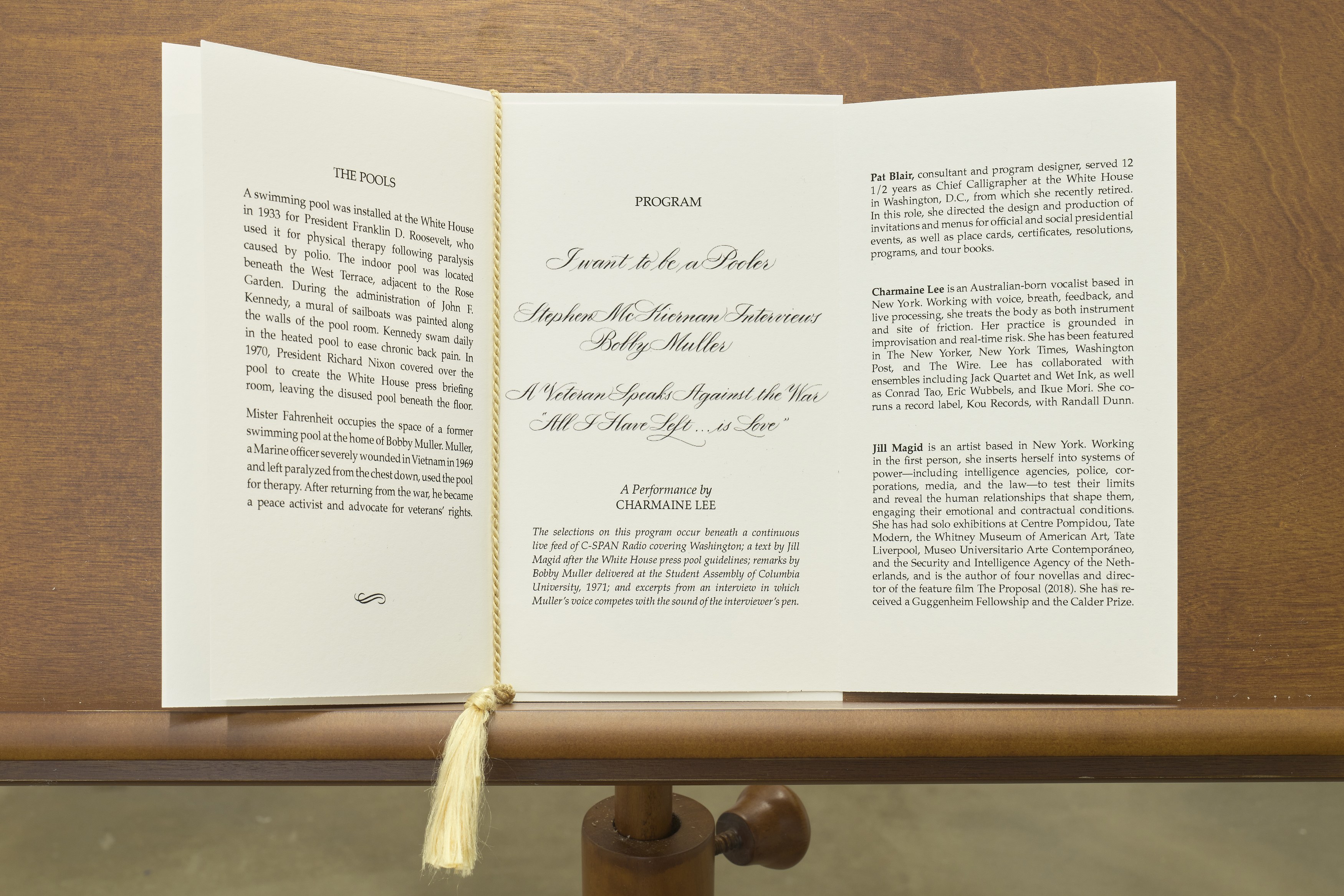
For its eighth season, Mister Fahrenheit is very pleased to present Pooler Room, a solo exhibition by Jill Magid. Bringing together installation, text, painting, and performance, Magid uses Mister Fahrenheit as her stage to trace power structures, intimately probing relations between individuals and the federal institutions designed to protect them. Pooler Room unfolds across a space that once housed a subterranean swimming pool belonging to former resident and Vietnam War Marine veteran, Robert (“Bobby”) Muller (b. 1946). After sustaining a spinal injury during the War that left him paralyzed from the chest down, Muller became an outspoken peace activist and advocate of veterans’ rights. The artist overlays another site where water, recovery, and state power intersect: the White House. In 1933, an indoor therapy pool was built in the West Wing for President Franklin D. Roosevelt, who took up swimming following his diagnosis with polio. Later, this pool was forced underground when the James S. Brady Press Briefing Room was constructed above it. Magid’s exhibition at Mister Fahrenheit is structured across two levels. Upstairs, a carpet is modeled after the platform in the White House press briefing room. The exhibition’s title refers to the press pool, a rotating group of journalists tasked with witnessing and relaying the actions and statements of the president on behalf of the broader press corps. A stenographer’s note from a pool report is presented on the wall, while a continuous C-SPAN broadcast fills the space. Downstairs, the former swimming pool is held in outline. A Program for Pooler Room rests on a stand, its text written in the format of an official White House program and rendered by one of its former calligraphers. Throughout the exhibition, this work will be performed at intervals by vocalist Charmaine Lee, whose voice is altered by the presence of water in her mouth. Layered with audio from an interview with Bobby Muller, these performances focus on moments when the sound of the interviewer’s pen competes with Muller’s voice. At the other end of the space, just above the tile line, is a painted fragment of the mural that once surrounded the White House swimming pool. The image remains partial, withholding a complete view. Born in Bridgeport, CT in 1973, Magid currently lives and works in New York. Solo exhibitions of the artist’s work have been presented at institutions worldwide including Tate Modern, London; Centre Pompidou, Paris; Whitney Museum of American Art, New York; Modern Art Museum of Fort Worth, Texas; The Renaissance Society, Chicago; Berkeley Museum of Art, California; Museo Universitario Arte Contemporáneo (MUAC), Mexico City; and Dia, Bridgehampton, New York. Current and recent group shows include Body Fragment, The Power Station, Dallas (through June 13, 2026); For What It’s Worth: Value Systems in Art since 1960, The Warehouse, Dallas (2024); NFT: Poétiques de l'immatériel, du certificat à la blockchain, Centre Pompidou, Paris (2023); Extended Present – Transient Realities, Ludwig Museum of Contemporary Art, Budapest (2022); and Worlds of Networks, Centre Pompidou, Paris (2022). Magid’s work can be found in the collections of the Solomon R. Guggenheim Museum, New York; Whitney Museum of American Art, New York; Centre Pompidou, Paris; Fundación Jumex Arte Contemporáneo, Mexico City; and Walker Art Center, Minneapolis, among others. The artist was the recipient of the 2017 Calder Prize, a 2020 Creative Time Artist Commission, and a 2021 Guggenheim Fellowship. A forthcoming exhibition of Magid’s work, titled Notice of a Citizen, will open at Olney Gleason, New York on June 11, 2026. Established in the West Village in 2019, Mister Fahrenheit is an independent project space for contemporary artists and curators. The program is devoted to realizing cross-disciplinary projects and collaborations outside of traditional gallery and institutional contexts.
 PastN. Dash
N. Dash
Apr 22 – Jun 19
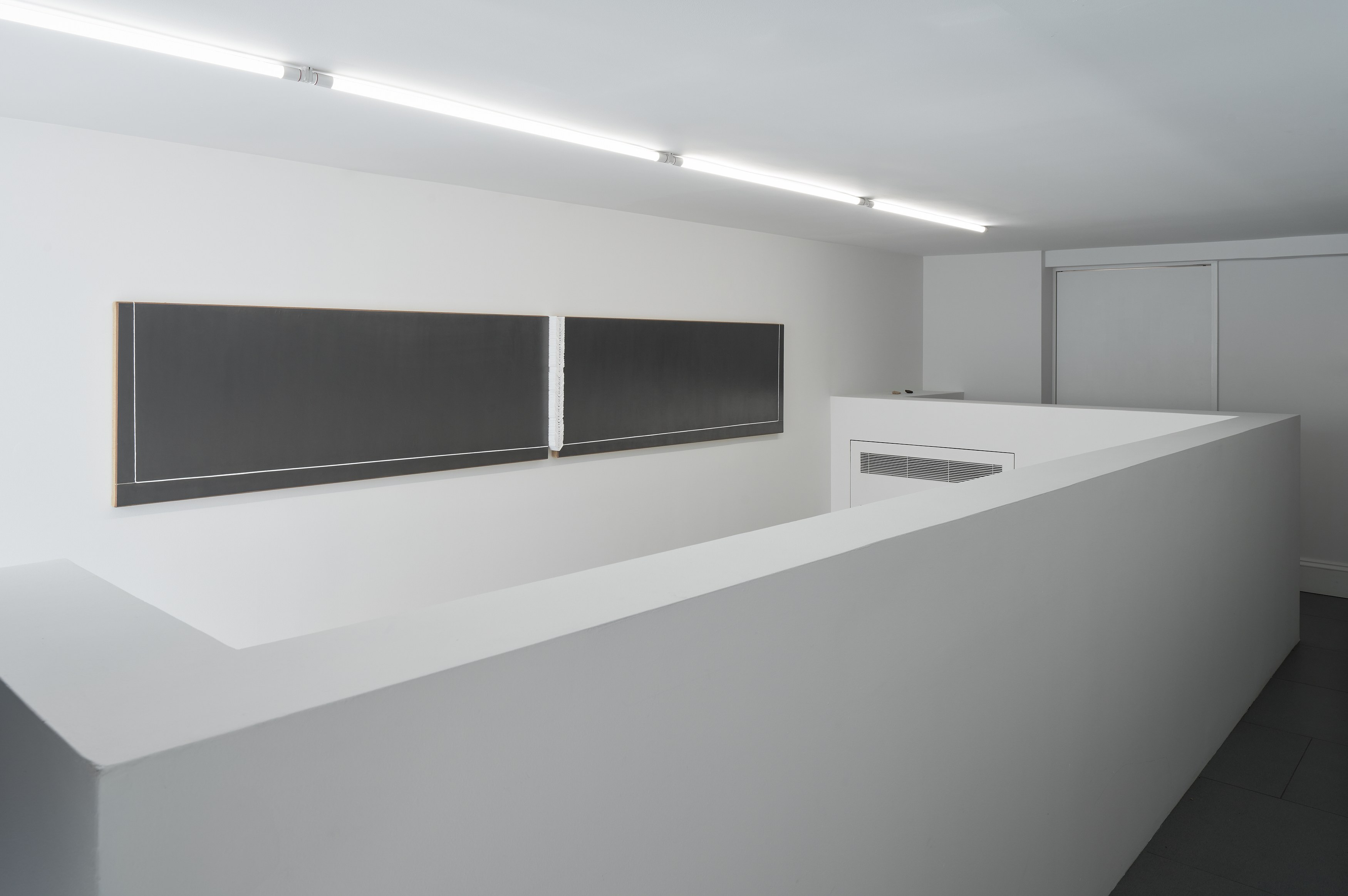
"James Hillman’s book The Dream and the Underworld depicts two worlds running in parallel: our day-world, where we spend our waking lives, and the underworld, where we dream, where our myths are born, and where our day-logic is useless. At night, we become aware of the underworld, but this shadow world always exists, all day long, just as the day-world continues to exist while we dream. Separating these worlds is soil." —Ross Simonini, Geophagy at Red Earth Hole, 2021 Mister Fahrenheit is very pleased to present a solo exhibition by N. Dash. Grounding the space with new paintings, this site-responsive installation probes the capacities of touch along with visible and invisible forms of energy – bodily, architectural, and environmental – through material, beginning with earth itself. Born in Miami in 1980, N. Dash currently lives and works in New York. The artist has presented solo exhibitions at institutions including SITE Santa Fe, New Mexico (2023–24); Stedelijk Museum voor Actuele Kunst (SMAK), Ghent (2022); Museum of Contemporary Art Santa Barbara, California (2019–20); The Aldrich Contemporary Art Museum, Ridgefield, Connecticut (2019); Fondazione Giuliani, Rome (2017); Hammer Museum, Los Angeles (2014); and White Flag Projects, St. Louis (2013). N. Dash’s work has also been included in group exhibitions at San Francisco Museum of Modern Art, California (2021, 2018, 2013); Dallas Museum of Art, Texas (2018); Jewish Museum, New York (2015); Centre for Contemporary Culture Strozzina, Palazzo Strozzi, Florence (2015), and Berkeley Art Museum and Pacific Film Archive, University of California (2016, 2014). The artist’s work can be found in the public collections of the Solomon R. Guggenheim Museum, New York; Museum of Modern Art, New York; Whitney Museum of American Art, New York; Sammlung Goetz, Munich; Stedelijk Museum voor Actuele Kunst (SMAK), Ghent; Albright-Knox Art Gallery, Buffalo, New York; Nelson-Atkins Museum, Kansas City, Missouri; Rose Art Museum, Brandeis University, Waltham, Massachusetts; San Francisco Museum of Modern Art; Dallas Museum of Art; Hammer Museum, Los Angeles, among others worldwide.
Past
Komedy CellarJacob Kassay
Oct 1 – Dec 5
Mister Fahrenheit is very pleased to present Komedy Cellar, a site-specific project by Jacob Kassay. Reframing the gallery space through systems of new sculpture and painting, this exhibition marks Mister Fahrenheit's sixth season. For nearly two decades, New York-based artist Jacob Kassay has used objects to probe experiences of surroundings. Finely tuned to the sites they occupy, the artist's works draw attention to the implicit, routine-based practices and beliefs that shape the ways in which we navigate, rationalize, and normalize our movement through familiar spaces. By harnessing peripheral, often overlooked attributes of their settings, such as interior architectures and ambient qualities of light, air, and noise, Kassay's installations subtly activate a type of physical memory that works to breach the rote habits and ingrained perceptions we construct around objects, our environments, and representations of the world at large. In his project at Mister Fahrenheit, Kassay amplifies this haptic sense through direct engagements with site and language, specifically that of live, stand-up comedy. Titled in reference to the eponymous underground comedy club located blocks away from the gallery, Komedy Cellar punctuates the space's architecture with a series of shaped handrail sculptures affixed to walls, lining elevations, and bisecting pathways. Echoing the artist's use of braille in earlier iterations of this work, these new railings transcribe a single performance into hardware that is scaled to the room: embossed in cells of raised pins along the surface of each metal support are sections of a joke. Configured in linear progressions much like the structure of a joke itself, these film-like guides physically encode and compress the "live" element of comedy - its suspenseful pauses, outbursts, and audience chatter - into an aluminum infrastructure of precisely gauged lengths, contours, and temperatures. Without image or sound, rhetorical devices like setup, misdirection, and punchline find material analogues in sharp bends, dead-ends, and a condensation-covered segment of frozen railing. As viewers navigate around, under, and between these supports by touch, they are looped through a system akin to the many ambient, machinic processes which continually abstract and circulate us. A joke is extruded into scaffolding; laughs and language are rendered into linear feet. While the railings stretch a joke's delivery to the dimensions of the site, two groupings of silver paintings tucked into sections within the upper and lower gallery areas use the room's architecture to a similarly uncanny and comic effect. Stacked together along their profiles, the canvases appear to be rows of dormant paintings in storage. From the front, however, the gag is revealed: they lack a solid face and are instead partial frames painted and stretched, more set prop and surrogate support than fully fleshed painting and surface. On their edges, slight variations of textures, colors, and burns mark each, vestiges of the hand-priming and chemical plating process that Kassay has implemented since 2005. The stacks of canvases do not mirror their surroundings as images but reduce reflection to its bare minimum, as their edges catch blurred slivers of light, shadow, and color. Scaled to the iconic double doors of the Comedy Cellar, a set of canvases downstairs mimes the entrance to the club, but like the railings, their hollow interiors suggest that the memories contained by objects may only be echoes and warped resonances of whatever life permeated them. These reverberations linger in the smallest work in the show, which contains only part of a face. Hung at eye-level along the gallery's arched feature wall is a head-sized painting of a human mouth, open wide like a comedy caricature, and filled with brass teeth. It appears to laugh - if only we knew the joke. Born in 1984 in Lewiston, NY, Jacob Kassay currently lives and works in New York. Recent solo exhibitions include Khiropractik, Art : Concept, Paris (2024); Chelsea, 303 Gallery, New York (2024); IT, Ivory Tars, Glasgow (2023); Never Before Seen Footage of Woodstock, Galerie Greta Meert, Brussels (2023); Nobody's Home, 1413 5th Ave, New York (2022); and Footage, Hallwalls Contemporary Arts Center, Buffalo, NY (2019). Kassay has participated in numerous group exhibitions at international venues including MoMA PS1, New York; The Wattis Institute, San Francisco; FRAC Poitou-Charentes, Angoulême, France; and Collezione Maramotti, Reggio Emilia, Italy. The artist's work was included in the 8th Gwangju Biennale (2010) and can presently be found in the public collections of the Albright-Knox Art Gallery, Buffalo, NY; Museum of Contemporary Art, Chicago, IL; Museum of Fine Arts, Boston, MA; Collezione Maramotti, Reggio Emilia, Italy; and FRAC Poitou-Charentes, Angoulême, France, among others worldwide.
Past
Choir As It's KeptGedi Sibony
Apr 26 – Jun 23
Mister Fahrenheit is very pleased to present Choir As It’s Kept, a solo exhibition by Gedi Sibony. Transforming the gallery through a cast of fastidiously staged objects and subtle interventions, Sibony presents new sculpture and painting as devices for deepening space, and experiences of it. For more than two decades, Gedi Sibony has made work that probes the interplay between object, viewer, and space. Well known for his approach to found materials, which involves rescuing and reworking items of refuse frequently associated with construction and production, the artist positions his objects within carefully considered contexts as encounters, guideposts for reframing experiences of place. In this way, Sibony’s works operate as receptive objects; when activated by the viewer’s movement, they collaborate with one another and their surroundings. In Choir As It’s Kept, Sibony confronts viewers with glimpses of these encounters through theatrical partitions. Scaffolding the installation is Its Power to be Infinitely, a salvaged grand stage curtain suspended to fill the gallery space from floor to ceiling. When viewed from the mezzanine, this work adheres to its onstage function of concealing, obscuring views from above along with light to narrow space as it guides visitors along a darkened pathway. At the rear of the gallery, a wooden cupboard levitates above the mezzanine’s parapet, drawing attention to peripheral glances of pockets of emptiness in the gallery below. In the downstairs area, Sibony continues this revealing act by lifting the curtain, both physically and allegorically. A discreet draping maneuver splits the panels of Its Power to be Infinitely, dramatically hollowing the gallery into a cavernous, chamber-like void. Ceremonial in its entrance, this enveloping form empties the space of light and sound. Stationed in the corridor of the curtains, a towering gesture of various wood scraps stands precariously, engineered to just barely maintain stability. As viewers encounter the work at eye-level, layers of space suddenly seem to converge: the emptiness of the figure’s pictorial frame gives way to the sculptural supports behind, which collapses into the deepening tunnel between the curtain panels. A small snake-like form slithers at the foot of the wooden figure, stealthy positioned as if to suggest a prelapsarian archetype. These notions of inseparability between objects, viewer, and space reverberate in Rung Orbits, a found still-life painting scavenged from a thrift store that the artist has modified. Translating his sculptural approach to a moderate, two-dimensional scale, he reconfigures the composition by emptying it, and carefully re-staging forms with paint. Here, Sibony leaves viewers with an intimate parting reflection on objects in space – namely, the way in which the world reveals itself, and the role of the artist in doing so. Born in New York in 1973, Gedi Sibony lives and works in Brooklyn. Recent solo exhibitions include Greene Naftali, New York (2020, 2018), Gladstone Gallery, Brussels (2017); The Douglas Hyde Gallery, Trinity College, Dublin (2014); Contemporary Art Museum, St. Louis (2009); and In the Still Epiphany, a curatorial project at The Pulitzer Foundation for the Arts, St. Louis (2012). Significant group exhibitions include the Museum of Contemporary Art Chicago (2020); Walker Art Center, Minneapolis (2018); The Museum of Modern Art, New York (2018); MoMA PS1, Long Island City, NY (2015); Museum of Contemporary Art, Los Angeles (2015); and the 56th Venice Biennale (2015). Sibony’s work belongs to the collections of The Museum of Modern Art, New York; Solomon R. Guggenheim Museum, New York; Whitney Museum of American Art, New York; Museum of Contemporary Art, Chicago; The Museum of Contemporary Art, Los Angeles; San Francisco Museum of Modern Art; Carnegie Museum of Art, Pittsburgh; Walker Art Center, Minneapolis; Dallas Museum of Art, Texas, among others worldwide. Established in the West Village of New York in 2019, Mister Fahrenheit is an independent project space for contemporary artists and curators. The program is devoted to realizing cross-disciplinary projects and collaborations outside of traditional gallery and institutional contexts.