Jeffrey Deitch
SoHo, Downtown, NY
18 Wooster St
Sign in to save this gallery, log a visit, or add a show to a shared list.
Exhibitions
- Night Shift
Ryan McGinley
Jun 13 – Aug 9
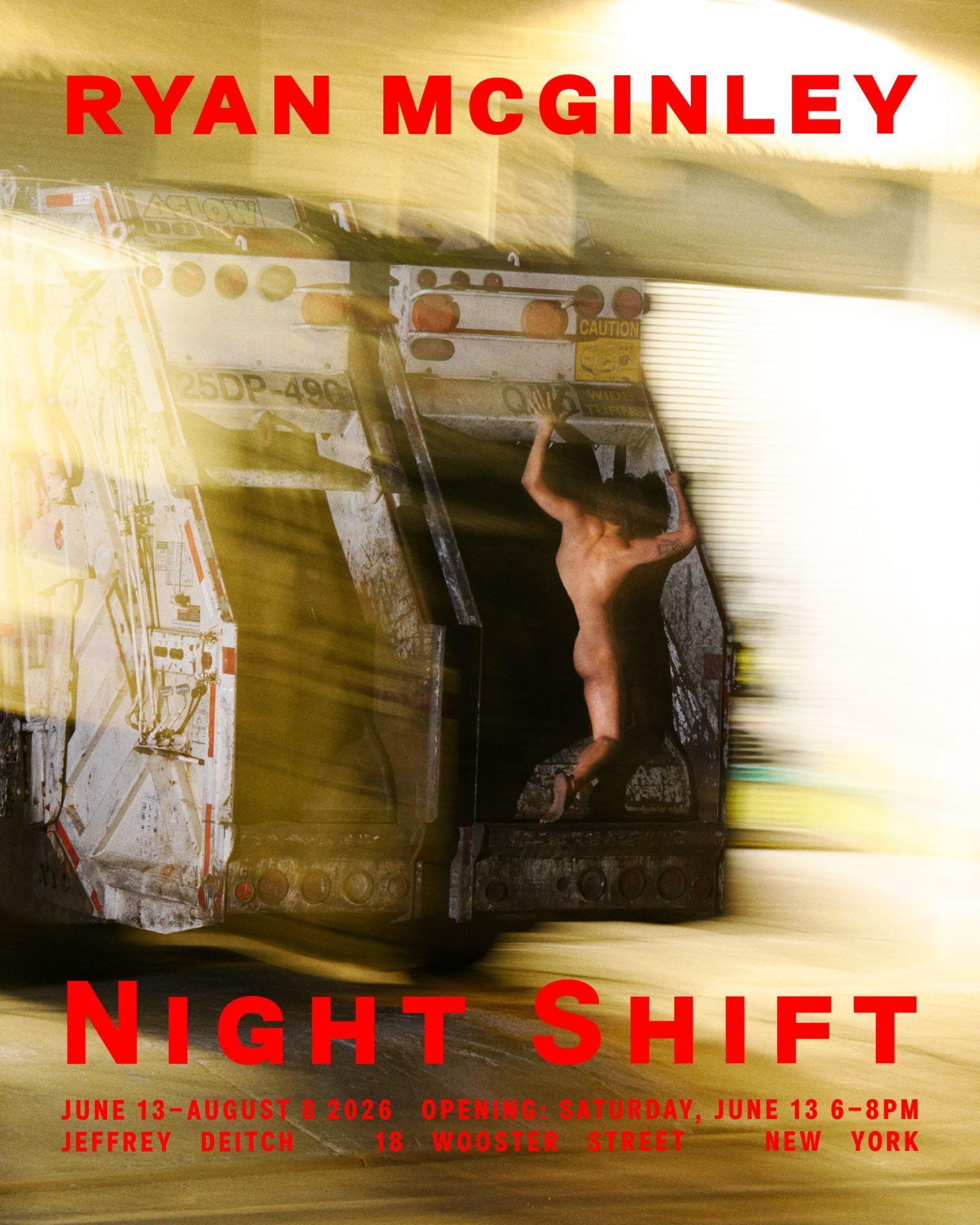
Ryan McGinley turns his lens back towards the city that never sleeps to present his newest body of work, Night Shift. Expanding on his career-defining visual language, the project recodes the aesthetics of his early practice–the raw, energetic spontaneity of nude bodies traversing the American landscape–to arrive at the endless possibilities of a nocturnal New York in a brave new world. McGinley’s career spans more than two decades of artistic output. This latest series reflects on the intuitive point-and-shoot practice of McGinley’s youth: from his seminal photographs of the graffiti collective IRAK, to the fantastical mise-en-scène of his extensive cross-country road trips, and his continued activism in documenting the queer revolution. Night Shift weaves those unique historical threads into the fabric of now, moving from the daydreaming pastures to the realities of a concrete paradise. Shot between 9pm and 5am through Spring into Winter 2025, the series captures all five boroughs - east to west, up to down. Queens, Brooklyn, Manhattan, the Bronx, and Staten Island. It is nine to five, the other way around. Employing a slow shutter, long lens, and radio flash, McGinley creates luminous, hallucinatory scenes in which bodies and city become one. Neon, halogen, and brake lights paint airy compositions that evoke a state of pulsation, where city and subject dance through, around, and within. “This is my poem to New York City,” says McGinley. “A place where the rare quietness of the city can reveal itself as a playground for a body in motion.” From cherry blossoms emerging through cracks in the sidewalk at the dawn of Spring, to fire hydrants drenching the hot asphalt surrounding Yankee Stadium in the heat of summer, the work captures fleeting moments that traverse over time and seasons. McGinley focuses on locations that hold personal resonance: weathered waterfront piers, smoke spilling from manholes, the typography of an old autobody shop, graveyards that open onto skylines, train tracks that directly lead to the empire, and the textures of oxidation and decay that define the city’s patina. Night Shift oscillates between post-apocalyptic and satirical song, as the iconically idiosyncratic landmarks emerge as their own subjects throughout the series, including the K Bridge, Fort Greene Park, Lincoln Center, the Angel of the Waters at Bethesda Fountain, and an abstracted Cyclone on Coney Island. Bicycles, bodegas, sanitation trucks, and staircases become props to the interplay of grit and magic that is McGinley’s New York. Ryan McGinley (b. 1977) is a photographer based in New York City. His early photos displayed the unseen intersection of skateboard and graffiti culture with a strong queer focus. At the age of twenty-five, he became the youngest artist to have a solo show at the Whitney Museum of American Art. McGinley has spent more than a decade road tripping throughout the United States to create work that incorporates the human body within the American landscape. You can always find Ryan on the streets of NYC doing queer activism, fighting for LGBTQ rights. McGinley frequently has solo gallery and museum exhibitions around the world. A GQ profile declared McGinley, "the most important photographer in America."
 PastLet the Music Play
Walter Robinson
May 2 – Jun 7
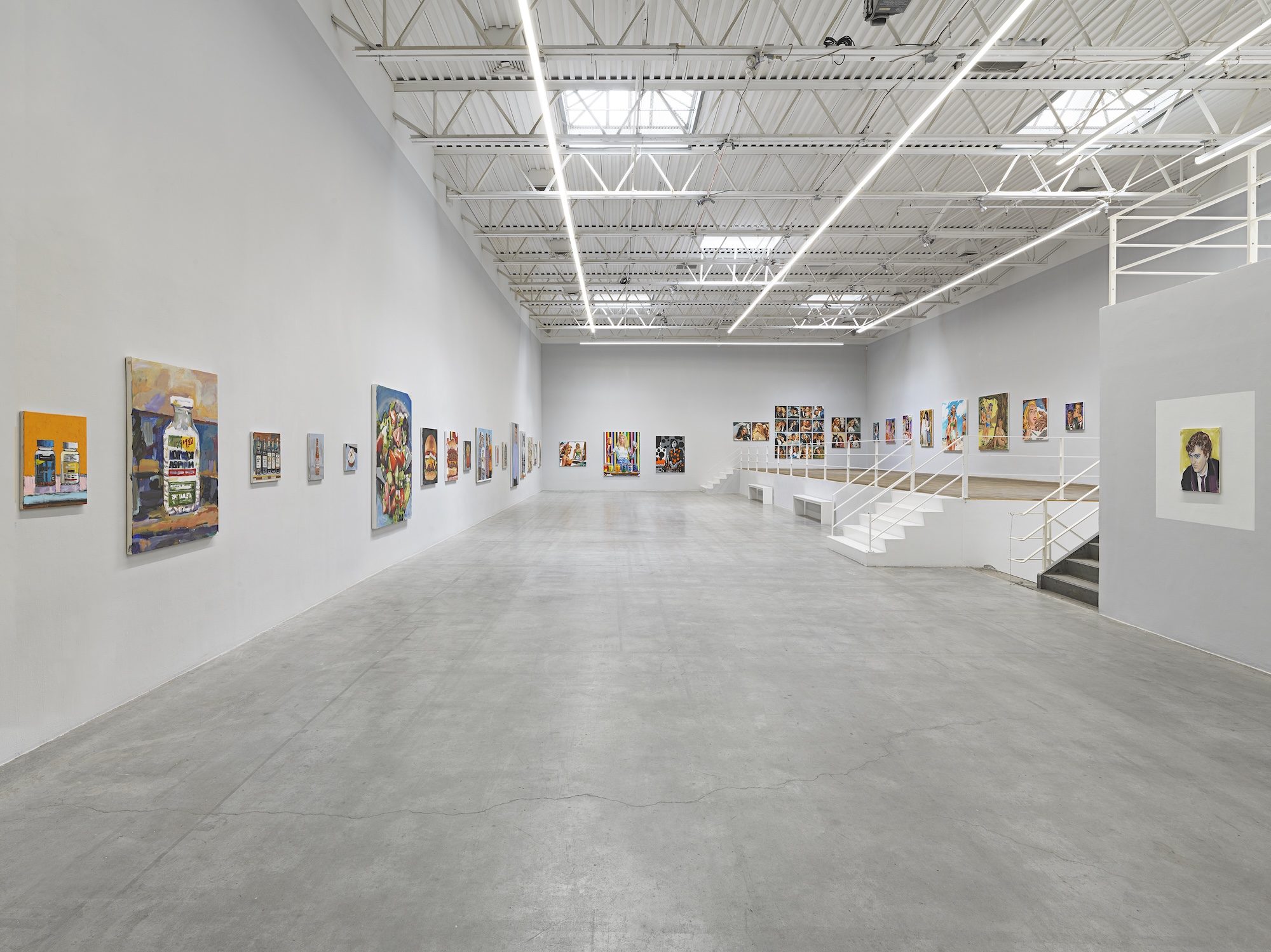
We may be known for what we do in life, or even for what we do not do, but to measure those things we do, even when we know better not to, is how we truly understand ourselves. That understanding, almost an empathy in Walter Robinson’s (1950-2025) art, is a rare wisdom. Call them guilty pleasures, simple joys or cheap thrills, their superfluous folly is not so much a lapse of judgement but a suspension of it. Perhaps all the indulgences and excesses that constitute our pleasure-economy are bad for us, dulling our wits, slackening our resolve and polluting our body, but to willfully enter this field of numbing distraction, and to stay there vigilantly alert as if before a grander sublimity, is a kind of deviant medicine. Wickedly smart yet struck with a trickster’s lunacy, Robinson channels so much of what is besetting the human condition into a contemplative sensory reverie, harnessing all that clutters our mind into a radically subversive instrument to probe our desires. In a consumer society where identity is store bought and branded, Robinson’s parsing of products as pleasures has proffered a more psychologically charged kind of late capital commodity art. He translates our collective ambivalence towards corporate banality and short-term seductions into an aesthetic ambiguity in which the celebratory tone of Pop Art and the critique of Pictures Generation oddly coexist as emotionally and intellectually whole contradictions. Like a beguiled and befuddled shopper lost in the market aisles of a surplus surfeit store of superficial indulgences, Walter knows just what grabs our attention and the myriad ways in which a look becomes an insidious form of entertainment. Competing against those same forces- what we might call the manufacture of desire- many artists have resorted to the spectacular to stand out in this attention deficit economy. Robinson rather has chosen to inhabit the society of the spectacle itself as a citizen outsider, to contemplate the attention deficit as a meditation object itself, to focus on the distraction as a material fact. Look, he tells us, what is normal is what will make you feel special and what is special is that which makes us feel normal, which is, after all, the comfort we seek most from our disposable possessions. In this consumer society, he reminds us, we are what we eat, and healthy or sustainable are just different options on a menu of exhausting excess. There will be more, because there is never enough. There’s no telling why Robinson decided to become a great painter, why he worked so hard at it or if he even foreknew he had the talent for such a remarkable touch, perhaps it was an abiding love of the medium and those who plied it or maybe he just recognized that certain painterly flourishes offer an allure, like an intimate caress or a whispered nothing, that can beguile and enchant in seemingly effortless fashion. He’s a conceptual painter who understood that his ideas could be far more subversive if they could be conveyed in a less cerebral fashion. What, we must wonder, could be more problematic than sugar-coating our problems? His visual confections, all the more dangerous for their deliciousness, are all come-on and tease, titillations launched as distractions and lodged as precognitive mind-mines of careful what you wish for prescience. Too good to be true, they are ultimately as troubling as they are satisfying, deceptions that are completely honest. Robinson’s art was conceived in the critical language that emerged in the wake of Modernism, as part of the wider critique of pictures, of media, of reproduction and of commodities that distinguished the most important artists of his generation. His art retained many of these concerns throughout his career but whereas so many leaned into the dry and reductive reasoning of theory, Robinson plunged into a slippery wet expansivity of libidinous sensuality. Feigning a casual effortlessness, the too-easiness of his art is what makes it so very challenging. Right up to the end Robinson conceptually centered his work in problematic processes that for all their seriousness were deliberately hard to take seriously. From lurid genre-infested dime store paperback cover illustrations and the supersized kitsch of his kitten paintings to his mock-sublime spin art, commercial product still lives, juicy lingering hamburgers or insipid normcore fashions, nothing seems now quite as arch as Robinson’s late experiments in Artificial Intelligence painting- those that he used as visual cues for his own paintings and a number that he actually outsourced to cheap overseas production, both featured in this exhibition. Going so far as to rob his art of its defining characteristic- his remarkably facile painting style- he reverts to a pure idea art, in which narrative tropes serve as representational prompts. All along the way Robinson has made art that confounds and challenges the bounds of good taste, often in ways that seemed like career suicide before eventually finding their audience and advocates in younger generations. Predicting what his last AI paintings will ultimately mean in years to come is to speculate on a future we cannot even imagine now, but how the fears and fantasies they invoke along the fault lines of authorship and creativity are provocations very much of this moment. —Carlo McCormick
 PastLandscapes
Doron Langberg
Mar 6 – Apr 26
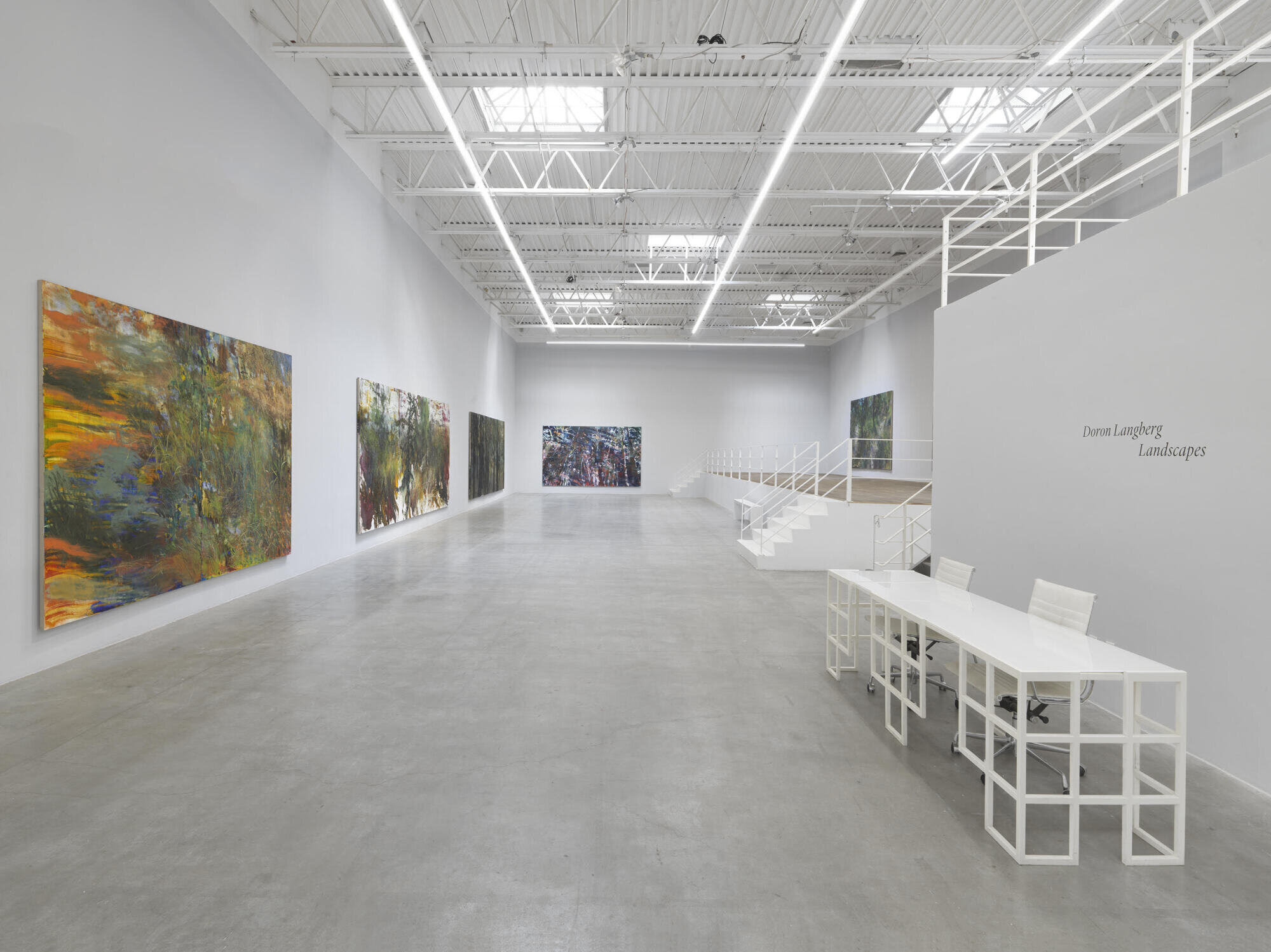
This body of work made over the last two years depicts the places that shaped me: Yokneam, where I grew up in Israel; Drohobych, the town in Ukraine where my dad escaped from after surviving the Holocaust; and Fire Island, a microcosm of my life in New York. During this time, the unrelenting violence in Gaza disintegrated ideas I had about my home and history. What does home mean when it perpetrates atrocities? How can we inflict such pain onto others when we experienced so much pain ourselves? Struggling to give form to these questions with my language of portraiture I found guidance in Van Gogh and Munch, who saw space in landscape to express their darkest experiences. I painted these spaces through the animating lens of how they were used, from dancing to acts of brutality, to understand how foundational parts of myself have changed. As Israel descended into a path of killing and destruction, I felt a growing rupture from my home. To approach this in painting I depicted a patch of shrubs outside my parents’ house with an agitated palette and surface. Though overwhelming, my feelings were not enough, I needed distance from my own subjectivity and the emotional ties that clouded my judgment. Thinking literally, while visiting my family during the war, I made a series of small paintings overlooking the sprawl of Emek Yizrael, focusing on the furthest part of the landscape. The resulting paintings revealed an unsettling peacefulness. Yokneam felt like that as well—too beautiful with its fields of wildflowers, too silent about all that is happening just a few hours’ drive away. Back at studio working on the HaEmek painting, I thought of artist Moshe Gershuni, whose symbols and gestures laid bare contradictions within Jewish Israeli identity and the distortions of the occupation. I borrowed his language of stains as a form of consciousness coursing through the landscape, to make visible the violence that enables my presence on this land. Not knowing what my Jewishness meant anymore, in late 2024 I went to paint in Bronica Forest outside of Drohobych, where thousands of Jews were murdered during the Holocaust, including some of my family and their community. I’m not sure what I expected to find there, but standing in the forest, making three paintings a day in complete silence, it became apparent that unlike the cacophony of voices in Israel or New York, no one was talking back to me. Bearing witness to the incalculable loss and cruelty that took place there through these small paintings, I thought of Gaza. The large works I made when I returned to New York—one describing a shadowy expanse of tree trunks, and the other, illuminated treetops at night seen from the perspective of falling materialized both the life and death of my family in the forest they surely loved. Making these works allowed me to mourn them, grounding my grief as a personal experience rather than a means to justify endless cycles of bloodshed. Untangled from ideology, my history became a source of moral clarity. In New York, everyday life felt changed, as everyone I knew carried the pain of the present moment. To paint this shift, I returned to the Meat Rack, a wooded cruising ground in Fire Island where I found freedom and abandon, describing it with layered materiality, weighed down by an overload of detail. In this new reality coming together took on a desperation—a break from thinking of the war and a way to process it. Seeing the war through the eyes of my close friends was painful but allowed for a worldview outside of the ideological vortex in Israel, with its intractable logic. It was like a gasp of air. Thinking of the connection between community and the possibility for change, I made a large painting of the Meat Rack rave, where in the summer after the war began, I felt a heaviness lift for the first time. Depicting figures melding into a field of color and each other was a way to paint the dissolution of my own confines through the subjectivity of the people around me. Making these paintings gave me the structure to contend with what is at the core of all of this—that no matter the circumstances, Palestinians deserve justice and liberation. By choosing to look away from unspeakable horrors under the auspice of protecting Jewish life, we destroy ourselves and countless others. Painting is my way to keep looking. —Doron Langberg, New York City, 2026
Past
Law and OrderSam McKinniss
Sep 6 – Nov 23
Sam McKinniss could be called a great painter of modern life, if we were to assume that life is still modern. It might be more precise to describe McKinniss as a great painter of contemporary reality. His work examines the mediated image, representing the “reality” people participate in through social media rather than through direct experience. For Law and Order, McKinniss has gathered an array of source images of law breakers and law enforcers from both fictional films and news photographs. Paintings of A list and D list celebrities are complemented by “location shots” and an image of an escaped Highland bull from his local Kent, Connecticut news blog. A small painting of Alcatraz looms large as a potent American symbol of so-called corrections. The artist has conceived of his exhibition almost as a storyboard. Rather than a conventional press release, we are reproducing McKinniss’s exhibition proposal, written like a film treatment. It provides a vivid presentation of the artist’s concept. "There will be no peace. Fight back, then, with such courage as you have And every unchivalrous dodge you know of, Clear in your conscience on this: Their cause, if they had one, is nothing to them now; They hate for hate’s sake." —W.H. Auden, exc. There Will Be No Peace, 1956. Law and Order is another exhibition for the immediate moment. It arrives fresh on the heels of my last one in January, The Perfect Tense, at David Kordansky Gallery in Los Angeles, accompanied as it was by uncontrollable natural disaster. I had intended the pictures, made alone in my studio before the fires started, to explore private grief turned around toward the public domain. In and out of LA, the subsequent months have proved crueler, more violent, and increasingly depressing. American politics drill down on the people with exceptional torque. We’re really in it now and despite my reminiscence there is no turning back. This is another show about how ubiquitous strong images seem to compensate for losses suffered in this era of persistent decline. I tweak them just so in the paint. Here in the middle of something terrifying and dumb, galling and unworkable, I look to the prevalent imagery in search of themes and depictions, for ways to discover exactly what the situation feels like. These are painted renditions of criminals, politicians, folk heroes, escaped livestock and one zoo animal, from a distance or in close-up. Pictured also are two infamous prisons. One is currently active yet largely kept out of view in rural Louisiana. The other is defunct yet popular as a tourist attraction in San Francisco Bay. The current American President wants to reactivate the tourism prison because he understands that representation is essentially abstract, nowhere near as spectacular as threats made good on the ground. This, as well as his TV resumé, and certainly without compliment of much grace or finesse, make him a kind of performance art star par excellence: hell-bent on reality and insane for the literal, and at scale. Thus we are subject to new forms of tyranny from the vantage of a wholly untenable worldview. The work of Law and Order is to locate, trace, and otherwise describe the parameters of that topdown worldview, to achieve a pictorial scenario spread across gallery walls wherein life may genuinely express itself in spite of the circumstances. Locations Midtown Manhattan Alcatraz Island La Salle Detention Facility, Jena, LA Characters Jeremy Meeks (Stockton, CA, 2014) Marco Rubio (in high school) Luigi Mangione (apprehended in PA, 2024. See also: Caravaggio, The Taking of Christ c. 1602) Callista Gingrich (at rally for her husband, Newt, hosted by Republican Jewish Coalition, Delray Beach, FL, 2012) Mary Boone (Parker Posey. Basquiat, 1996) Night Cow Celine Dion (performing Hymne à l’amour, Eiffel Tower, Paris Olympics, 2024) Bruce Wayne and Selina Kyle (Christian Bale and Anne Hathaway. The Dark Knight Rises, 2012) Chuck Bass (Ed Westwick. Gossip Girl, 2007-12) Escaped cavalry horses Quaker and Vida (London, 2024) Escaped highland bull Waldo (Kent, CT, 2025) Escaped eurasian owl Flaco (NYC, 2023) Juggalos (march on Washington, D.C. 2017) Abstractions Excess black and white oil paint on linen One large, one small Henri Fantin-Latour One copy, one real Caveat All of the above subject to change or omission before 9/3/25 Sam McKinniss (b. 1985, Northfield, Minnesota) lives and works in Kent, CT and New York, NY. His work has been included in recent group exhibitions such as Get in the Game: Sports, Art, Culture, SFMoMA, San Francisco, CA (2024–2025); Day for Night: New American Realism, Palazzo Barberini, organized by the Aïshti Foundation, Rome, Italy (2024); Friends & Lovers, The Flag Art Foundation, New York, NY (2023–2024); and Pictus Porrectus: Reconsidering the Full Length Portrait, Art&Newport, Newport, RI (2022). His work is in the permanent collections of institutions including the Institute of Contemporary Art, Miami, FL; New Britain Museum of American Art, CT; Wadsworth Atheneum Museum of Art, Hartford, CT; and Williams College Museum of Art, Williamstown, MA. His first monograph was published by Rizzoli in 2025.
Past
CarnivalMay 3 – Jun 29
Derrick Adams, John Ahearn, Diana Yesenia Alvarado, Henry Alvarez, Mario Ayala, Elias Baeck, Bambi the Mermaid, Ana Benaroya, Matthias Buchinger, Camille2000, Nadia Lee Cohen, Joe Coleman, George Condo, Danny Cortes, Karon Davis, Raúl de Nieves, Guillermo del Toro, Jane Dickson, Tom Duncan, John Dunivant, Celeste Dupuy-Spencer, Johnny Eck, Mike Elizalde, Chris ‘Daze’ Ellis, Isaac Psalm Escoto, Scott Ewalt, Walton Ford, Mark Frierson, Mr. Gorgeous, Red Grooms, Anne Imhof, Jamian JulianoVillani, Laura Kaplan, KAWS, Austin Lee, Randal Levenson, Patrick McDonnell, Johnny Meah, Elberto ‘Sluto’ Muller, Narcissister, Theophilus Nii Anum Sowah, Mu Pan, Kembra Pfahler, Liz Renay, Ari Roussimoff, M. Santaguida, Peter Saul, Kenny Scharf, Jim Shaw, Alake Shilling, Garo Sparo, Al Stencell, Mickalene Thomas, Rigoberto Torres, Fannie Tunison, Chuck Varga, Whitney Ward, Marnie Weber, Weegee, Jo Weldon, Robert Williams, Karl Wirsum, August Wolfinger, Snap Wyatt Artists have long been inspired by the themes of the carnival and the circus. They often identify with the craft, the courage, and the sometimes marginal existence of circus and carnival performers. The carnival is a unique social space where attitudes and behaviors that might be unacceptable in “polite society” are allowed to thrive. Artists occupy a similar marginal space, separate from social conventions. Drawing on this colorful, subversive, and often provocative world, Jeffrey Deitch has invited artist Joe Coleman to curate Carnival. The artists featured in the show engage with themes of spectacle, rebellion, and free expression in unexpected and thought-provoking ways. As Coleman describes: I believe that the carnival is a kind of profane, holy place where the private desires, fantasies, and fears of a society are given uninhibited free expression. This expression produced unique works of art to embody this mysterious part of ourselves. I have long been fascinated by these works, and in this show, I explore the many forms that this expression takes—from the amazing banners produced for side shows and crime shows, the spectacular costumes of the burlesque house, the Mardi Gras, and the art parade. The influence extends to puppet show figures, whose roots trace back to ancient theater, the wax figures that evolved from medieval votive saints to the criminal and celebrity effigies of the sideshow museum, and even the miniature and flea circuses. While the exhibition includes numerous contemporary artists whose work draws from the carnivalesque, Coleman has also invited his “family of friends” from burlesque and sideshow communities to contribute. This blending of artistic voices creates a dynamic and immersive celebration of these rebellious and theatrical subcultures. Joe Coleman (b. 1955, Norwalk, CT) is an internationally recognized painter, writer, and performer who has been exhibiting in major institutions internationally for four decades, including solo exhibitions at Palais de Tokyo, Paris; Kunst-Werke Institute for Contemporary Art, Berlin; Barbican Centre, London; and Wadsworth Atheneum Museum, Hartford. Coleman was featured in the Jeffrey Deitch and Gagosian collaborative exhibition Unrealism in Miami and more recently Luncheon on the Grass at Jeffrey Deitch, Los Angeles in 2022. He is represented by Andrew Edlin Gallery, New York. Coleman’s performance work from the 1980s was some of the most radical of its time, and is documented in films and books about the period. He is the subject of several monographs including A Doorway to Joe, the largest tome to date of the artist’s work and life, published by Fantagraphic Books last year. An avid and passionate collector, Coleman’s “Odditorium” is a private museum where sideshow objects, wax figures, crime artifacts, and works of religious devotion live together to form a dark mirror that reflects an alternative side of the American psyche. The collection has been published in numerous books, prints, and records. Joe Coleman is the subject of an award-winning feature length documentary, Rest in Pieces: A Portrait of Joe Coleman (1997). He has appeared in acting roles in films such as Asia Argento’s Scarlet Diva (2000) and as himself in the “Lower East Side” episode of Anthony Bourdain: Parts Unknown (2018). A new documentary film on Coleman and his wife Whitney Ward titled How Dark My Love will have a film festival premiere in 2025. Coleman lives with his wife, muse, and long-time partner Whitney Ward in New York.
Past
Flying HighTyler Ballon
Mar 8 – Apr 20
Jeffrey Deitch is pleased to present Flying High, an exhibition of ambitious new paintings by Tyler Ballon. Instead of a traditional press release, we are sharing the artist’s own statement, a heartfelt exploration of his work, his community, and the inspirations that shaped this exhibition: "My work focuses on the lives and experiences of the people in my community. I believe in capturing moments that can inspire and validate their existence, extending their stories beyond geographic and temporal boundaries. I want young people to see themselves as worthy of being immortalized in art—a recognition that transcends time. In this body of work, I explore the intersection of sports, identity, and history. While creating these paintings, I realized there is an interesting dichotomy between sports being a tool for success and having Black bodies being used to advance America’s ambition. My paintings challenge stereotypes that confine people of color to achieving success solely through physical prowess or musical talent. These works celebrate the resilience of young African Americans who carve out better lives using the resources available to them. The work also embodies the spirit of patriotism. Football, a quintessentially American sport, parallels military ideologies, offering young men an avenue to channel their aggression, build camaraderie and find fulfillment. I intentionally chose the football team I portrayed, Abraham Lincoln High School in Jersey City, New Jersey, as a metaphorical regiment—a tribute to the Black Civil War veterans who fought for freedom and citizenship. The “Lincoln” emblazoned on their uniforms honors their legacy their legacy and symbolizes the progress African Americans have made since the Civil War. Football has also become a tool for these young men to further their educational ambitions. Marching bands, historically used to command troops conveying orders and signals, play a central role in this narrative. As warfare evolved over time, marching bands began to take on a different function, becoming responsible for boosting morale, inspiring discipline and unity with uplifting melodies. Marching bands started adopting uniform designs that mirrored those of soldiers. I choose to portray the marching band of Malcom X Shabazz High School for their renowned excellence in performance, their New Jersey roots, and their namesake, Malcom X, a pivotal leader during the Civil Rights Movement whose ideology helped shape African American culture and history. Although nearly century later, his ideology channeled the mindset of the Civil War troops, fighting and defending themselves by any means necessary. The exhibition title, Flying High, reflects the aspiration to rise above the adversities of the inner city. These football fields, located within urban communities, become the place for young athletes to strive for a better future. Sports, with its principles of discipline and teamwork, often mirrors the challenges of life. My paintings celebrate these young individuals who push through obstacles to achieve greatness. Through these new paintings, I aim to excavate African American history while paying homage to our predecessors. Black Civil War troops fought for the citizenship and freedom we now fight to uphold. The children in these paintings are a testament to progress and a source of hope for the future. The painting reproduced above, Bear Arms/Second Amendment (2024-25), was inspired by Edouard Manet’s The Execution of Emperor Maximilian (1867). My painting depicts three young Black men protecting three young Black women—cheerleaders presented with dignity rather than objectification. Seeing a gun pointed at a person of color is something that’s familiar to American history. But having an African American man holding a rifle is distinctively different. The work challenges perceptions of Black men bearing arms, reclaiming their image as patriots and protectors, and pays homage to the Civil War troops." Tyler Ballon (b. 1996, Jersey City, NJ) creates monumental works inspired by the lives of people in his community. His artistic journey was shaped early on by his grandmother, a community activist and school lunch lady who embodied service and compassion. Tyler’s grandmother recognized his talent and instilled in him a respect for others, regardless of their circumstances. Though initially torn between sports and art, Tyler chose the latter, dedicating himself to painting with the encouragement of his grandmother and his family. His parents, both pastors, reinforced his faith and sense of purpose. Tyler refined his skills through an advanced art program in his high school—the JC Arts program—and later at the Maryland Institute College of Art, where he earned his BFA in 2018. After graduation, Tyler returned to his community, making its people the focal point of his work. Through large-scale paintings, he honors their lives and experiences, ensuring they are seen and celebrated. His art embodies his faith, principles, and the legacy of his grandmother, offering encouragement and validation to those around him. Flying High is more than an exhibition—it is a tribute to the resilience, history, and aspirations of a community. Through these works, Tyler Ballon redefines the narrative of African American life, past and present, and offers a vision of hope and pride for the future.
Past
This Was HereAlfonso Gonzalez Jr.
Nov 16 – Jan 26
Alfonso Gonzalez Jr. drove through every Los Angeles neighborhood during his boyhood, assisting his father, a professional sign painter. As a graffiti writer starting at age twelve, and later as a sign painter himself, he deepened his immersion into the Los Angeles cityscape. Gonzalez’s paintings of the streets and signage of contemporary Los Angeles express his profound feeling for the neighborhoods of the city and its people. His compositions generally do not include figures, but always evoke a human presence. The carcasses of cars in many of his paintings embody the lives of the people who abandoned them. Gonzalez documents the changing cityscape of Los Angeles and how people influence its transformation. His paintings of signage for hair and nail salons, accident lawyers and insurance brokers animate the exhibition with faces, hairstyles, and extravagant nail designs. Gonzalez thinks of his exhibition as a giant still life: an arrangement of the various elements of the real Los Angeles. While cities become increasingly homogenous, Gonzalez embraces the imagery unique to the working-class neighborhoods of Los Angeles. The paintings are composed from a combination of the artist’s photographs and his impressions and memories. They are realistic but also dreamlike. They exist in a liminal state between reality and imagination. Unlike most of the contemporary artists who are part of the art discourse, Alfonso Gonzalez Jr. did not attend art school. He learned his artistic skills the old-fashioned way, through hands-on apprenticeship and practical experience. Starting with his father, who now occasionally contributes lettering to his paintings, Gonzalez eventually found himself working alongside some of the most esteemed sign painters across the country. By enduring long hours and challenging weather conditions, Gonzalez not only mastered the technical skills that became the cornerstone of his artistic practice but also developed a rigorous discipline and meticulous work ethic. While traveling across the country as a sign painter, he also educated himself in art history, visiting museums and galleries. The artist has written the following statement to describe this body of work: "In This Was Here, I explore the relationship between communities and public spaces—how people visually influence and transform the landscape and surface of a city, shaping its appearance today. I approach this work not as an outsider, but as a resident and active participant in the craft and subculture. My history informs my approach to investigating the mark-making and layers created by the community that shape a city’s appearance. The aim is to capture and document a moment in time, marked by unprecedented and drastic change. This exhibition examines urban environments using a mix of photo documentation and imaginative, collaged compositions. It offers a reflection on these spaces that is both humorously observant and thoughtfully critical. Particularly in Los Angeles, the omnipresence of vehicles and sprawling networks of highways significantly impact how people navigate the city. Billboards and advertisements dominate the landscape, becoming ingrained in the visual vernacular of daily life. Recently, advertisements for accident lawyers, car insurance brokers, and real estate agents have replaced the once-dominant ads for entertainment and luxury. I humorously critique the marketing strategies used by advertisers, particularly their reliance on stereotypes and sexualized imagery to target specific demographics. This body of work offers a critical commentary on life in 2024, addressing the intersection of commerce, culture, and identity within contemporary cities." Born in East Los Angeles and raised in La Puente in the San Gabriel Valley, Gonzalez remains very engaged with his community, organizing backyard and pop-up exhibitions with his artists friends and most recently helping to curate the program for the John Doe Gallery in downtown Los Angeles. Gonzalez’s work is alsp being featured in Ordinary People: Photo Realism and the Work of Art Since 1968 at the Museum of Contemporary Art, Los Angeles, opening on November 23, 2024. This Was Here is the artist’s first solo exhibition in New York.
Past
Developing DesireAmanda Ba
Sep 7 – Oct 27
Amanda Ba, born in Ohio from first generation Chinese American parents, has long been influenced by diasporic memories and her family heritage. In her latest works, Ba observes China from a different perspective, seeking to capture the country’s cultural consciousness and interrogate its formation. Developing Desire features new paintings, a three-channel video and her first foray into installation. While working on the exhibition, Ba traveled to Hefei in Anhui Province, the city where she spent the first five years of her life and still maintains family connections. The raw footage she filmed while observing the city, the paradoxes of its booming real estate developments and its residents’ daily lives, comprises More Future Triptych (2024). This three-channel video, made in collaboration with Ba’s partner Justine Cheng, combines real and staged everyday scenes of public life to explore China’s history, obsessions and desires as they manifest on the surface of the country’s reality. “China’s fantasy of the world. The World’s fantasy of China,” says the voiceover, “What does it mean to desire the world? Can what is given be refused?” Echoing the perennial and ever growing construction sites captured in the video, a billboard composed of sixteen paintings rises in the main gallery space. Mimicking a post-internet heart-shaped collage filter, this mosaic of portraits seem to speak of the personal dreams and professional hopes of the young generation. The resulting effect mixes elements of socialist realism, pop art and advertising. The back of the billboard features wheatpasted drawings that appropriate the Dazibao handwritten posters of the Chinese Cultural Revolution. For these calligraphic drawings, Ba worked collaboratively with other contributors in a manner that is similar to graffiti writing, embracing the democratic nature of public text. On the gallery’s walls, Ba’s new paintings feature goddess-like, oversized nude figures, their sensuous, otherworldly flesh often appearing against or inhabiting Chinese metropolitan landscapes: the Huangpu river in central Shanghai, the city’s iconic highway interchanges, the ruins of redeveloped office and apartment complexes. These works seem to expose psychosexual fantasies, drawing unexpected connections between ideas of desire, libido, capital, nationalism, and democracy. Rubble is another recurring motif in Ba’s new paintings, appearing as the signifier for the impulses that propel the repeated acts of construction, destruction and reconstruction to which the exhibition bears witness. Amanda Ba was born in 1998 in Columbus, Ohio, and currently lives and works in New York City. She studied Visual Arts and Art History at Columbia University in New York and Slade School of Fine Art in London. Her work was included in Wonder Women, curated by Kathy Huang at Jeffrey Deitch in New York and Los Angeles, and 100 Years, an exhibition organized by Jeffrey Deitch and Gagosian in Miami’s Design District, both in 2022. Developing Desire is Ba’s first solo show in New York.
Past
Recent SculptureFrank Stella
Mar 8 – May 25
Double wide flatbed trucks navigated the bridges into Manhattan to transport five monumental works by Frank Stella to Jeffrey Deitch’s SoHo gallery. They are among the most ambitious and most radical works being made by any artist today. They extend Stella’s forms even further into three dimensions. The works are not painted sculptures or relief paintings. They completely fuse painting and sculpture in a way that has never been achieved before. All but one of these works are being exhibited for the first time. Frank Stella said that one of the objectives of his recent artistic approach has been to “build a painting rather than painting a painting.” The new work is a realization of this ambition. Stella combines traditional artists’ techniques with high technology to create his new work. His monumental sculptures begin with computer models that are transformed into a series of small sculptural maquettes through 3-D printing. The artist refines these models in the studio and then sends them to fabricators in the Netherlands and Belgium where they are engineered and constructed using technology derived from shipbuilding. The sections are then shipped to Stella’s studio in the Hudson Valley where they are refined and painted with automotive paint. The exhibition features works from two series, Scarlatti Sonata Kirkpatrick from 2014, and Atlantic Salmon Rivers from 2021-23. The Scarlatti Sonata Kirkpatrick sculptures are created with high density foam covered in fiberglass. The Grand Cascapedia, inspired by the Canadian river known for salmon fishing, is made from aluminum. As in all of Stella’s work, the forms embody their materials. The materials inspire the forms. Stella’s work of the 1980s were characterized by its extension of two-dimensional painting into his version of baroque space. These new works extend beyond baroque space into outer space. The forms seem to float in anti-gravity. They ascend, transcending their weight. They do not have front or a back, existing in the round. Frank Stella has expanded the art discourse for more that six decades. His new work continues to advance art into a place where it has never been before.
Past
Wild Style 40Nov 11 – Jan 14
Charlie Ahearn, John Ahearn, Janette Beckman, Fred Brathwaite (Fab 5 Freddy), Cathleen Campbell, Henry Chalfant, Joe Conzo, Martha Cooper, Jane Dickson, Brian Donnelly (KAWS), Chris Ellis (Daze), Sandra Fabara (Lady Pink), Aaron Goodstone (Sharp), Eric Haze, John Matos (Crash), Leonard McGurr (Futura), Osgemeos, Phase 2, Lee Quinones, Rammellzee, Revolt, Don White (Dondi), Andrew Witten (Zephyr), Martin Wong In the forty years since Wild Style was released, this small budget independent movie has stood as a testament to a scene, a subculture and a city that seems almost unimaginable today. Amidst a flurry of change, the nascence of a renaissance, a happenstance of abandonment and neglect colliding with the exuberantly wayward energies of invention and hope, Wild Style captured something all too illusive, fleeting and ephemeral and set it down as an indelible record, like lightning in a bottle or a dream journal, truth and witness to a crazy fantasy so fantastic we might otherwise imagine it an urban myth. What started as a game of make-believe ended up changing reality for a generation of participants caught up in its imaginary, as well as for subsequent generations who have chased its impossible liberties ever since. Wild Style 40 is a celebration in the form of an exhibition, a family and friends reunion of the visual artists who defined an era and inspired a movement. Charlie Ahearn, who wrote and directed Wild Style, once told me he was trying to make it like an art movie for teenagers, a song and dance family musical. For all the hardboiled noire gangster pimp and pusher parables that have come to define urban celluloid, this paean to joy would be the infectious charm that makes this film so transformative and optimistic. As the first and foundational movie of hip-hop, Wild Style’s ebullient enthusiasm characterized the spirit of ingenuity and community that manifested itself in DIY strategies and guerilla creativities bubbling up from the social and economic margins of bias and redlining. This commonalty of experience between Uptown and Downtown, where the rituals of communication via the dance of b-boys, the rhymes of MCs or the lettering of train writers could go all-city before it conquered the world, is the genesis and genius of Ahearn’s movie. It allows the exotic with the wink of an insider’s gaze and the embrace of an unruly humanism. Wild Style, though released in 1983 was largely filmed in 1981. This exhibition tries to convey the radical energy and rapid evolution of this culture over that brief time while both preserving the fertile ground from which these sensibilities emerged and acknowledging the legacy of these artists through time. Charlie Ahearn was a member of Colab (or Collaborative Projects) a collective of urban artists that engaged and addressed the inequities and hypocrisies of the city around them, most famously with the Times Square Show of 1980 in a derelict Times Square massage parlor. Their ideas, infusing Downtown like a zeitgeist, are part of the filmmaker’s vision and tradition coming out of the lineage of experimental, underground and No Wave film in New York City, as well as essential to the free-thinking adventurous mindset that made Downtown so receptive and welcoming to these new hybrid expressions emerging Uptown. While Wild Style 40 is in many ways a celebration of the graffiti art form that emerged out of this time and starred in the movie, it is centered within a broader circle of participation, including key figures from Colab, who were also forging new kinds of urban art, artists who were major supporters and benefactors of graffiti, the photographers who not only captured this movement but embodied it, and a few who have somehow carried these traditions with an authenticity and ingenuity that goes beyond what hip hop sounds like or graffiti looks like today. There are a lot of famous artists in this room, so there are many ways of trying to explain how and why they were put together. All of that is very important, but for me what really matters is that they are all friends, brought together again to mark a momentous occasion. —Carlo McCormick
Past
Tropical ApexBony Ramirez
Sep 9 – Oct 22
Since moving to the United States at thirteen, Bony Ramirez has never returned to the Dominican Republic. He owns no photographs of his childhood there but has vivid impressions of its colors and textures. Today, living in Harlem and working in Jersey City, Ramirez celebrates Caribbean culture through paintings and sculptures of these reconstructed memories. Ramirez’s work is populated by a taxonomy of symbols and motifs that seeks to broaden the understanding of Caribbean history, culture and traditions. Seashells, coconuts, machetes, horns, wood, chains and hardware materials are signifiers used to grasp the Caribbean’s cultural complexities, colonial history and the toughness that lies beneath its paradisiac surface. Ramirez resorts to magical realism to keep his childhood memories alive, a strategy that he connects to the experience of Caribbean immigrants growing up in the United States. In Tropical Apex, Ramirez combines his childhood memories and imagination in a series of portraits. At times referencing familiar places, like the family-run bodega and the kitchen of his rural childhood home, the paintings portray fictional characters belonging to a larger narrative. These figures are Black and brown subjects whose bodies present exaggerated features: endearing doll-like eyes and anatomical caprices that evoke themes and motifs of the Caribbean natural landscape. Despite their unusuality, these portraits recall Mannerist portraiture. They exude royal power and beauty. Ramirez also cites Pablo Picasso, Francis Bacon and Surrealist artists as his inspiration. “These figures are not human per se, but they are not non-human,” says the artist. Ramirez realized his paintings with a signature mixed-media technique. He develops the figures separately on paper in colored pencils, oil pastels and acrylic wash. The cut-out is then applied to wood panels worked with acrylic and embellished with other three-dimensional elements. He often utilizes European wallpapers to address the colonial history of the Caribbean. A proudly self-taught artist, Ramirez points to his background in construction as a source of his ingenuity. His attention to tactility expands beyond the paintings. The exhibition includes sculptures and installation elements realized in a style that recalls the colored hardwood architecture of the Caribbean. On the mezzanine, the artist recreates a rooster fighting ring like the one his father had constructed in their backyard in the Dominican Republic. The artist never appreciated this cruel hobby, a popular sport in his birth country, but is interested in exploring its cultural ramifications and roots in the definition of Caribbean masculinity. Lastly, a series of constructed sculptures populate the central area of the gallery. Realized with taxidermy animals and several other materials encountered in his paintings, these works are self-portraits that recount personal stories. “They help me understand aspects of my life,” says Ramirez. Bony Ramirez was born in Tenares, Salcedo, Dominican Republic, in 1996. He has exhibited at Bradley Ertaskiran, Montréal; François Ghebaly, Los Angeles; Bank/Mabsociety, Shanghai; and Jeffrey Deitch, Los Angeles, among others. Ramirez was recognized in the Forbes 30 Under 30 Arts & Style category in 2023 and the Artsy Vanguard in 2021. His work is in the public collections of the Museum of Fine Arts, Boston; Pérez Art Museum, Miami; Institute of Contemporary Art, Miami; X Museum, Beijing; and Frye Art Museum, Seattle. Tropical Apex is his first solo exhibition with Jeffrey Deitch and his most ambitious to date.
Past
The World Is YoursBisa Butler
May 6 – Jul 1
"It’s mine, it’s mine, it’s mine Whose world is this? The world is yours, the world is yours" —Nas, 1994 Bisa Butler’s exhibition, The World Is Yours, is at once a benediction and a mantra inspired by the lyrics of a song by the rapper Nas. In Butler’s words: "I am saying to all people who may have been mistreated through acts of prejudice and racism that this world also belongs to them. In fact, this world belongs to all of us, and it always has. The statement “The world is yours” encourages people to stay the course and never stop trying to create the life they envision." African Americans have overcome tremendous odds to build their communities and customs despite pervasive obstacles, and I want the new generation to keep up that fight. In the 1800s, Sojourner Truth said: “I will not allow my life’s light to be determined by the darkness around me.” If she, a woman born into bondage and then escaped with a small child, could shine a light on the evils of slavery and inspire people to action, then we have no choice but to do the same. Through her dynamic, celebratory portraits of Black Americans, Butler captures vividly the life and history of a people who are part of the American mosaic. Realized in a medium that both evokes the intimate sense of home and captures the collective dimension of a shared tradition, Butler’s quilts can be situated in the lineage of celebrated textile artists like Faith Ringgold, Romare Bearden, Harriet Powers and the quilters of Gee’s Bend, who elevated the ubiquitous artifact and centuries-old craft to an art form able to shine a light on the experience of African Americans. Through her subject matter and technique, Butler’s work expands the parameters of art history. In her quilts, Butler introduces elements of painting and photography. Although her finished works are made entirely of textiles, she approaches the medium from a painterly perspective. Butler uses layered fabrics and appliqués to create textured surfaces, saturated colors and vibrant patterns that she found missing from most traditional painting techniques. In her new works, Butler combines Nigerian hand-dyed batiks and African wax-resist cotton with holographic vinyl-fabric, silk, wool, velvet and lace. The stories told by Butler’s quilts, their fibers, colors and motifs interweave with the histories of industrial production, international trade and social change. Butler’s new body of work represents some of her first collaborative quilted portraits. Her subjects are sourced from iconic contemporary photographers like Gordon Parks, Janette Beckman and Jamel Shabazz. “They captured the spirit of their subjects on film,” says Butler, “and I strive to reinterpret and add to their vision with textiles. The quilts become a conversation between the photographer, the subject, myself and the audience.” Bisa Butler (b. 1973) lives in South Orange and works in Jersey City, New Jersey. She earned her BFA in painting at Howard University, Washington, D.C. and holds a MA in Teaching Art from Montclair State University, New Jersey. Her work has been exhibited widely, both domestically and internationally. In 2020, Portraits at the Art Institute of Chicago and the Katonah Museum of Art was the artist’s first institutional solo exhibition. Her quilts have been prominently featured in Black American Portrait at LACMA, Los Angeles (2022) and Fabric of a Nation: American Quilt Stories at the Museum of Fine Arts, Boston (2021), and their exhibition catalogs. Her work can be found in the permanent collection of several North American institutions, including the Art Institute of Chicago; The Smithsonian American Museum of Art; and The Pérez Art Museum, Miami. Butler is the recipient of the 2022 Gordon Parks Foundation Fellowship. The World Is Yours is Bisa Butler’s first solo exhibition at Jeffrey Deitch.
Past
Humming on LifeKennedy Yanko
Mar 4 – Apr 23
By employing paint skin and metal in ways that both transmute a bodily essence and reposition the weight of gravity, Kennedy Yanko wields materiality and abstraction with the possibility of intervening in the viewers’ perceptions. In Humming on Life, Yanko‘s first exhibition at Jeffrey Deitch, the artist continues this exploration. Although the tactile quality and lyrical processuality of Yanko’s works emphasize their sculptural quality, the artist considers herself foremost a painter. In her new body of work, Yanko takes an approach to sculpture that reconnects it, and her, with painting. In recent years, the weathered paint and bruised patinas found on salvaged metal relics informed her palette for the paint skins. Now, the artist is introducing colors to the metal she finds. By painting the metal directly, underpainting, fire-cutting forms and compositions, and then crushing those new shapes, Yanko is expanding the definition of painting through her process. She remarks: Working this way has been labor-intensive and has exposed me to sounds, like water thrashing inside a metal tank while cleaning it. Feeling that thrashing—hearing a power that felt like infinity incarnate—encouraged me to probe water as a medium and examine my intuitive method more closely, which seemingly only comes from physical exchange: input and output, expansion and contraction. In pulling water apart and becoming more curious about its behavior and participation, I’ve enjoyed revisiting the ways in which it’s a web of activation, a source, and information. It’s a cue and a salve and carries with it tinges of what it’s gone through. What water did for me in that moment was to point back to the livingness of my medium — of the metal and paint skin I rely on — and wash away the binary between life and matter. Erasing this divide expands the possibility of experience; it gives materiality an abstract power that we yield to. It’s that vitality, found in color, form, attention and consciousness, that I hope this work can be a language for. Kennedy Yanko (b. 1988, St. Louis, MO) lives and works in Brooklyn, New York. Yanko’s work has been exhibited internationally and shown by institutions including the Brooklyn Museum and the Rubell Museum, where she was the 2021 Artist in Residence. Recent institutional showings and installations of Yanko’s work include By Means Other Than the Known Senses, Art Basel Unlimited, Basel (2022), Set It Off, curated by Mickalene Thomas and Racquel Chevremont, The Parrish Museum, Water Mill (2022), Brooklyn Abstraction: Four Artists, Four Walls, Brooklyn Museum, Brooklyn (2022). In February 2023, Yanko will have work on view at the Kentucky Museum of Art and Craft in Louisville, Kentucky.
Past
Orgy for Ten People in One BodyIsabelle Albuquerque
Nov 12 – Jan 29
Isabelle Albuquerque is a sculptor who explores emergent systems of intrapersonal communion, collective identity, transhumanism, plurality, love, loss, memory and the emanation of desire. Orgy For Ten People In One Body brings together for the first time Albuquerque's complete series of ten headless figurative sculptures created between 2019 and 2022. In this work, the artist uses her own body and transmutes it across multiple forms and material languages. With a background in performance, Albuquerque is interested in materials like cast bronze and melting wax that encode a precise moment in time, making something once fleeting more eternal. Orgy For Ten People In One Body is realized with classical and boundary pushing techniques that incorporate both human and robotic hands. Acephalic in a way that Georges Bataille would have appreciated, the sculptures give body to a post-capitalist mythological world to come, in which a patriarchal language of form has been derailed and subverted by female eros. Charged with personal experience, collective history and futuristic projection, Orgy For Ten People In One Body performs and subverts art historical narratives and archetypes. Classic interspecies love stories like Leda and the Swan and Romulus and Remus meet new embodiments of hybrid creatures, mythic mothers, witches, pussies and saints. The work invites a poetic acceptance of multi-beingness, non-linear time, metamorphosis and a merge between self and other. Here, the body becomes a force of solidarity and pleasure—an activated collective site of resistance, power and ecstasy. Isabelle Albuquerque lives and works in Los Angeles. She is the daughter of Lita Albuquerque, the granddaughter of Ferida “Fred” Albuquerque and the great-granddaughter of Smarda the Jewel—a matriarchal lineage of artists from North Africa. She is a founding member of the Los Angeles performance group Hecuba, which she started with her long-time partner Jon Ray. Albuquerque and Ray are also founders of Osk, a studio that develops artificial intelligence to create and look at art and individual experience through hybrid human and nonhuman perspectives. Orgy For Ten People In One Body will be Albuquerque’s first solo exhibition at Jeffrey Deitch. She is currently working on a monograph about the series that includes an in-depth visual essay and conversations with the artists Arthur Jafa and Miranda July. The book is co-published by Jeffrey Deitch, Nicodim and Pacific, and will be distributed by D.A.P. in 2023.
Past
Truck StopMario Ayala
Sep 10 – Oct 30
Please join us for a conversation between Mario Ayala and Leo Fitzpatrick, moderated by Jeffrey Deitch to celebrate the closing of Ayala's solo exhibition Truck Stop. The conversation will take place on October 29th at 3pm. — Mario Ayala brings Southern California’s Inland Empire to New York for his September-October exhibition at Jeffrey Deitch. The truck stop chapel, tire shop and roadside billboard that he has installed in the gallery create the context for his new work. Ayala’s meticulously crafted paintings extend the American Pop tradition into the present, drawing on a unique combination of art historical and vernacular influences shaped through his own life experience. Ayala aspires to make “working class paintings.” He wants the truck drivers and automobile mechanics with whom he grew up, as well as art connoisseurs, to appreciate his work. The paintings are easily accessible on one level, but are also highly sophisticated and art historically informed, building on artistic innovations of American modernists like Charles Demuth and Stuart Davis and on the conceptual approach to painting of Jasper Johns and Ed Ruscha. Ayala describes his work as fusing Cool School and Mission School. His artistic vision draws on both the 1960s generation of Los Angeles artists influenced by billboards, hot rod culture, and industrial materials, and the hand painted signs and graffiti that influenced the San Francisco artists he encountered while a student at the San Francisco Art Institute. One of his SFAI professors, Carlos Villa, remains a foundational influence. The Luggage Store, co-directed by Darryl Smith and Laurie Lazer, and Andrew McClintock’s Ever Gold [Projects] became an essential part of his San Francisco experience. The artistic fusion that Ayala has developed goes well beyond the Cool School and the Mission School. Especially significant is Ayala’s extension of the Pop Art tradition into the vernacular imagery of the Mexican American and other Latin communities of Los Angeles, the Inland Empire, and the Bay Area. While living in San Francisco, he was especially inspired by the open artistic platform of the zines published by Audrey Revel, owner of the Doré photo studio in the Mission District. These zines gave voice to incarcerated artists and to young people of color and gave him hope and direction as an aspiring artist. The now legendary Teen Angels and Corazon magazines which celebrated the visual culture of his community from the 1980s to the mid 2000s, continue to influence his work. He keeps a prized collection of vintage issues in his studio. Ayala’s paintings are created through a fascinating fusion of old master, digital, and industrial techniques. After art school, Ayala studied automobile painting at LA Trade Tech and continues to study industrial painting processes. His combination of industrial applications with a practiced artist’s hand gives his work a unique sensibility. He compares the layering of glazes in old master and automobile painting, explaining how both use this technique to achieve realistic effects and an illusion of wetness. Ayala sees a parallel in the East Los Angeles subculture of lowriders and the hot rod culture that inspired the Cool School artists. He draws on both to create his distinctive combination of fine art and popular art imagery. Many of the paintings feature words, adding his contribution to the history of Los Angeles artists incorporating text into their paintings. The structure of the paintings also builds on Minimalism. He channels Donald Judd in his stack of precisely painted stereo consoles from automobile dashboards, which also reference Ashley Bickerton’s incorporation of commercial logos. The paintings appear to portray the backs of actual trucks, buses, an ambulance, oil cans and billboards, but upon deeper examination, one begins to realize that the images are shaped by the artist’s imagination. He delights in the combination of illusion, invention, and reality. He expands the terrain of Pop Art into a discourse with the subcultures that generate mainstream American culture. The work is exuberant, but there is also an undercurrent of darkness. The work captures the strange, surreal quality of much of the contemporary American experience. Mario Ayala is the son of a Mexican American mother and a Cuban immigrant father. He grew up in Inglewood in Los Angeles County, and later moved to the trucking hub of Fontana in the Inland Empire. He often accompanied his father on his long haul trucking route. His work includes many references to buildings and signage in Fontana and neighboring towns. Ayala now works in Los Angeles in a studio building surrounded by a community of artist friends. His studio practice involves many hours of solitary work but his engagement with this supportive community is an essential part of his approach to making art. With its fusion of fine art and industrial techniques, its mix of art historical and pop culture imagery, and its incorporation of his Southern California cultural heritage, Ayala’s work opens a totally contemporary artistic direction. He is creating the new American painting.
Past
Vibrant Matters: 2022 Yale School of Art Painting & Printmaking MFA GraduatesJul 9 – Aug 14
Rachael Catharine Anderson, Salvador Andrade Arévalo, Quinci Baker, Brianna Bass, Bhasha Chakrabarti, Zoila Andrea Coc-Chang, Kendrick Corp, Grant Czuj, Opal Ecker DeRuvo, Katherine Yaochen Du, Brett Ginsburg, Samantha Joy Groff, Anne Mailey, Kristoffer McAfee, Patricia Orpilla, Alex Puz, athena quispe, Matt Smoak, Brennen Steines, Ashley Teamer, Justin James Voiss Curated by Melanie Kress The twenty-one artists in Vibrant Matters are weavers. They are bricoleurs, collectors, storytellers, our new generation of historians, and painters of the impossible-to-describe thing that is the human psyche. This exhibition is a revisited iteration of the Yale MFA Painting & Printmaking 2022 Thesis Exhibition installed at Green Gallery in New Haven from January–March 2022, featuring new and recent work realized over the past two years. My co-teacher, Rachelle Dang, began our thesis year together by asking the artists to reflect on shared resonances seen in one another’s work. Together, we named embodied knowledge, interdependence, mending and healing, nonlinear time, layered and unreliable histories, tangled ecologies, and above all, the reverberating power of the material world. Many artists in this exhibition accumulate, layer, and dissect their surroundings to reveal truths about human behaviors and our place in an ecosystem much larger than ourselves. Others trace single objects across space and time as a way to read and write new personal and collective histories. Together, these artists express a collective, contingent, and tender self, searching for the body on the edges of perception; feel the haunting awe of the soil, the earth, and water, of being with animals, plants, and other creatures; and embody our many inadequate histories in order to tell new truths. Finally, they create with joy—a true love of painting and printmaking, of research, and of storytelling. They delight in collected materials, recorded sounds, in a new image found; in sharing poems, music, and mending between friends; in writing shared stories and finding escapes from the confines of an exhibition setting. —Melanie Kress Melanie Kress is Associate Curator for High Line Art and Critic at Yale University School of Art.
Past
Wonder WomenMay 7 – Jun 26
Joeun Kim Aatchim, Amanda Ba, Bhasha Chakrabarti, Susan Chen, Milano Chow, Dominique Fung, Chitra Ganesh, Bambou Gili, Shyama Golden, Sasha Gordon, Sally J. Han, Jeanne Jalandoni, Melissa Joseph, Tidawhitney Lek, Zoé Blue M., Tammy Nguyen, Catalina Ouyang, Maia Cruz Palileo, Anna Park, GaHee Park, Jiab Prachakul, Sahana Ramakrishnan, Anjuli Rathod, Hiba Schahbaz, Mai Ta, Nadia Waheed, Chelsea Ryoko Wong, Lily Wong, Zadie Xa, Livien Yin "I look at them and wonder if They are a part of me I look in their eyes and wonder if They share my dreams" —Excerpt from “Wonder Woman” by Genny Lim Genny Lim’s poem “Wonder Woman,” first published in 1981, follows the reflections of a narrator who observes the everyday lives of Asian women—across generations, countries, and socioeconomic backgrounds—wondering if their experiences reflect her own. The poem centers Asian women as its protagonists and ponders what commonalities exist between these women. Inspired by Lim’s poem, Wonder Women, curated by Kathy Huang, presents thirty Asian American and diasporic women and non-binary artists responding to themes of wonder, self, and identity through figuration. While some artists explore wonder as it relates to mythology and legend, others depict the heroines in their lives, offering works that highlight family, community, and history. Several of the works in Wonder Women address colonial and patriarchal structures in the West. “The increasing violence against Asians Americans, particularly against Asian women and the elderly, emphasizes the need to tell our own stories. Figuration allows the artists to present themselves, their communities, and their histories on their own terms,” says Huang. The resulting works offer a cross-section of experience that celebrates difference and points of connection at the same time. Several of the artists in Wonder Women are friends and collaborators across cities such as New York, Los Angeles, Austin, London, and Montréal. Curator Kathy Huang is Managing Director, Art Advisory & Special Projects at Jeffrey Deitch.
Past
Consumer ReportsPat Phillips
Nov 13 – Jan 16
Pat Phillips explores the social dynamics of America in his new series of paintings, Consumer Reports. The artist describes the series as follows: "Consumer Reports is a series that examines our relationships to goods. In a free-market economy, with an ever-increasing wealth gap, these paintings explore the perception of value and function for upward mobility. Though irrational expectations that disproportionately affect low/middle-class consumers, clothing and everyday items become superficial tools used in an attempt to gain both cultural and socioeconomic ground." Pat Phillips's paintings combine personal and historical imagery into surreal juxtapositions, drawing on his experience living in America to mediate complex questions of race, class, labor and a militarized culture. He found his way to art through painting and photographing box cars. His paintings fuse this graffiti background with a sophisticated study of figuration. He embraces this entry point, creating paintings and drawings that address the social and political threads running through American culture. The work has an immediacy, capturing the dynamism of the urban street. Images of sneakers, bootleg luxury handbags, cops and looters spin through his works. Cartoon characters interact with young men's bodies. Raw graffiti tags often animate the backgrounds. Phillips's paintings reflect the perspective of a young Black artist encountering the cultural contradictions of American capitalist society. The works are informed by his own direct experience as well as the movies, music, and TV commercials that have shaped his vision. The vernacular is combined with astute art historical references. A crime scene unfolds in Baroque space. The artistís notes on Untitled (melanindrammer), one of the most intriguing paintings in the show, describes his hybrid approach: "A Mickey Mouse-esk character wearing Jordan 12s (shoes) is seemingly reaching for a pallet of bricks stacked like a house. Based on news and eyewitness accounts, pallets of bricks have been planted by law enforcement to help incite violence and looting during BLM protests. Riot geared figures, marching boots and red laced dress shoes are seen marching through the background. Red laces, in neo-nazi sub-culture, are earned and worn on Dr. Martens boots after an individual draws blood (assaults someone). The moon (taken from a character from the 90s cartoon Ren & Stimpy) overlooks in delight...anticipating what will happen next. The character wears blue latex gloves (unlike Mickey's traditional white gloves). This represents the uncertainty that many Americans felt...not only while performing their daily task (fear of getting sick) but those who took to the streets in protest during the deadly pandemic. Untitled (melanindrammer) is a reference to the 1933 minstrel Mickey Mouse film Mickey's Mellerdrammer." Pat Phillips was born in Lakenheath, England, in 1987 but grew up primarily in rural Louisiana. He currently lives and works in Philadelphia. Phillips's work was featured in the 2019 Whitney Biennial. His paintings are in the collections of the Whitney Museum, the Albright-Knox, the New Orleans Museum of Art, among other public collections. His work was included in Punch, curated by Nina Chanel Abney at Jeffrey Deitch in 2019.
Past
Clay PopSep 10 – Oct 31
Diana Yesenia Alvarado, Alex Anderson, Trisha Baga, Alex Becerra, Genesis Belanger, Seth Bogart, Chen Nien Ying, Woody De Othello, Sharif Farrag, Ryan Flores, Dominique Fung, Melvino Garretti, Raven Halfmoon, Kahlil Robert Irving, Elizabeth Jaeger, Devin B. Johnson, Heidi Lau, Grant Levy-Lucero, Candice Lin, Jasmine Little, Lindsey Mendick, Keegan Monaghan, Masato Mori, Ruby Neri, Brian Rochefort, Jennifer Rochlin, Brie Ruais, Sterling Ruby, Sally Saul, Alake Shilling, Adam Silverman, Jessica Stoller, Katie Stout, Magdalena Suarez Frimkess, Wade Tullier, Amia Yokoyama, Bari Ziperstein Clay Pop documents the reinvention of ceramic sculpture by a new generation of artists. A medium that has often been characterized as more craft than art is now an exciting platform for formal and conceptual innovation. A medium that traditionally diverged from engagement with popular culture is now adding a new dimension to Pop Art. Paralleling current concerns in painting, many of the artists featured in Clay Pop are also exploring issues of gender, race and identity, using clay in new ways to engage with social issues. Artists are using the medium to create a personal narrative. Clay is being pushed beyond the confines of craft and design. “Artists are taking a traditional medium and turning it on its head,” says the exhibition curator Alia Williams. An earlier generation of ceramic artists is referenced, but the range of influences encompasses vernacular commercial imagery and artistic sources from African American assemblage to Walt Disney. Much of the new work is exuberant and figurative, expanding on how the medium of clay has been traditionally used. Glazes are especially colorful. Funk art from 1970s Northern California is a source, as is Claes Oldenburg’s store. Some of the artists also draw on artistic influences from the Middle East, Africa and Asia. Many of the 37 artists in the exhibition know each other, forming a community around this new direction in ceramic sculpture. The community is especially dynamic in Los Angeles, where several of the artists share kilns and studios. Clay Pop is the first large exhibition to document this new artistic direction. Curator Alia Williams is the Managing Director of Jeffrey Deitch, New York. Exhibition design is by Charlap Hyman and Herrero.
Past
OysterknifeMiles Greenberg
Jul 22 – Aug 6
Jeffrey Deitch presents a continuous 24-hour screening of Miles Greenberg’s performance Oysterknife (2020). Visitors will be able to experience the artwork inside the space during opening hours and through the glass facade when the gallery is closed. Oysterknife was originally presented as a live performance in July 2020, live-streamed from inside a black box in Montreal, Canada. In this durational work, Greenberg walked on a conveyor belt for 24 consecutive hours without interruption. It was the artist’s most austere and demanding exploration of ritual. Epic in its endurance, introspection and athleticism, the performance is a meditation on the physical and mental limitations of the body, creating space for unmediated automatic movement. In a story about his work in The New York Times published on March 5, 2021, the artist explains his vision behind the work as follows: "Oysterknife is my love letter to the performance art of the 1970s, and more specifically to the great Black pioneers of endurance such as Senga Nengudi, Pope.L and David Hammons. Endurance work, at a certain point, necessarily involves a degree of spectacle around bodily deterioration. I feel my body being consumed every day. I’m within my comfort zone so long as I have agency over the poetics of that consumption. But here, I wanted to let go of that, just to see what would happen. This is real physical pain—it always is—but this time, that pain isn’t wrapped up in metaphor." Oysterknife was first presented by the Marina Abramović Institute and is co-produced by the Phi Centre in Montreal.
Past
(a)Float, (a)Fall, (a)Dance, (a)DeathKenturah Davis
May 8 – Jun 27
"Dance writing" is the literal translation of the Greek word choreography. This is how Kenturah Davis explains her unique approach to her new drawings. Her work fuses language, figuration and performance. She describes her latest series as follows This project began with a very open-ended question about how the apparatus of language might function as a kind of choreography for how we exist and move through the world. I initially began with identifying pragmatic ways that language structures our movements. In the way that architecture can guide how one moves through space, or the placement of a handle on a cup suggests how to pick it up, language that constructs the fabric of a given society similarly tries to choreograph our activities. Embedded in this is my interest in thinking about how we, as actors in a society, negotiate that choreography (conforming, resisting and improvising) to pursue freedom. This new work is an effort to consider how language produces conditions of contingency, blurring the personal and the political. Large-scale drawings show figures shifting and drifting against a backdrop of texts embedded in the paper. They suggest that the structures that shape our experience in the world extend from the ways we use language. The implications of this language are activated through our bodies. Davis's new series of drawings includes the debates that took place during the passage of the Thirteenth Amendment of the US Constitution. The transcripts of the Senate debates are impressed into the multiple panels that make up each image. Davis writes that "the amendment itself, in just a few lines, purports a concept of freedom by virtue of abolishing slavery on the condition that one is not a criminal. The debate exemplifies a framework that, on the one hand facilitates freedom, and simultaneously facilitates confinement. This range of outcomes is suggested in the drifting, shifting, and blurring of the figures in the drawings as they intersect the text." While immersed in making the first group of drawings in the series, Davis realized that she needed a counterpoint to consider other philosophical frameworks that might conceive freedom differently. She turned to non-western traditions, highlighting those that developed in Sub-Saharan Africa that counter western binary systems. Her drawings deliver a kaleidoscope of texts that embrace liminal space and the contingent nature of meaning, reconfiguring how we conceive of freedom. In this new body of work, I am trying to reconcile presence and possibility. The structures that shape our experience in the world extend from the ways we use language. By acknowledging that language is not immutable but rather generates conditions of contingency, then its current failure to produce abiding freedom does not need to be a permanent condition. It can compose other conditions for us to move through. Kenturah Davis lives and works between Los Angeles and Accra, Ghana. The artist earned her BA from Occidental College, Los Angeles, and MFA from Yale University School of Art in 2018. Her work was included in Punch, curated by Nina Chanel Abney at Jeffrey Deitch, Los Angeles, in 2019. The Savannah College of Art and Design presented Everything That Cannot Be Known, a solo exhibition of her work, in 2020. Public projects include a major commission by the Los Angeles Metro Rail to create large-scale, site-specific work that will be permanently installed on the new Crenshaw/LAX rail line, opening in 2021, and Four Women, a commissioned mural by Alliance Francaise to commemorate International Women's Day, in Accra, Ghana. (a)Float, (a)Fall, (a)Dance, (a)Death is Kenturah Davis's first solo exhibition in New York. The exhibition is presented in collaboration with Matthew Brown, Los Angeles.
Past
No Good Deed Goes UnpunishedKaron Davis
Mar 6 – Apr 25
Bobby Seale, bound and gagged in a Chicago courtroom, is one of the most searing images in American history. There were no photographs of this shocking episode during the trial of the Chicago 8 in October 1969, only artists' sketches. This has made the image even more resonant as we conflate the sketches and subsequent actors' portrayals in our visual memory. The image of Bobby Seale, physically restrained but defiant, refusing to submit to the judge, has haunted the artist Karon Davis for many years. It became especially provocative during the past year's incidents of police violence. A powerful sculptural tableau of a bound and gagged Bobby Seale in front of Judge Julius Hoffman and the Chicago jury will confront visitors to Karon Davis's exhibition. Displayed in front of the courtroom are fifty sculpted bags of groceries, juxtaposing the Black Panthers' free food program for the Black community in Oakland, California, with the repression of the judicial system. Davis's theme for the exhibition is "No Good Deed Goes Unpunished," a reference to the government's violent prosecution of the Black Panthers and its distortion of the public's understanding of the Panthers' contributions to their community. She describes the bags of groceries as a "garden of golden fruit." Their mummification represents the preservation of Black lives and culture. Davis sees the artist as a keeper of contemporary history, reminding people of past events that still resonate in the present. Karon Davis also has a personal connection to the story of the trial of the Chicago 8. One of her father's first acting gigs was voicing the role of Bobby Seale for a reading of the trial transcript. The recording was released as a vinyl record, which her father would talk about, but which she had never listened to. She eventually found the LP in an antique shop in Leimert Park, Los Angeles that sold old records in the back. The recording will be heard in the gallery. Davis talks about how being wrongly accused by the police and the courts is an epidemic that African Americans live with. The experience of growing up Black in America has unfortunately found her more than once in positions where she has feared for her safety. She recalls one such frightening incident about a decade ago when she and her late husband, artist Noah Davis, were driving from his gallery opening to their celebratory dinner. Los Angeles police pulled over their car and dragged them out of their seats. Noah was pushed face down onto the sidewalk and handcuffed. Karon, in her party dress and high heels, was also handcuffed and thrown against a wall. She urged Noah to stay calm. After being restrained and held on the sidewalk for an hour and a half, they were finally released they had "fit the description" of people who were being sought for a robbery. The events of the past year kept Karon thinking about what could have turned this all-too-common scenario into tragedy. She had begun a sculpture of Bobby Seale bound to a chair about two years ago but had put it aside to pursue other sculptural projects. The image stayed in her mind, and with the violence against black bodies that convulsed much of America during the past year, she decided that it was the right time to engage with his story. Davis tells this story in her unique sculptural language. She has developed a technique that deconstructs the tradition of plaster casting. She fuses life casts of friends and family with casts of her own body parts to create haunting, ghost-like figures. Sections of the bodies are deliberately missing so that the completion of the figure is left to the viewers' imagination. The brokenness of the works is reflective of the situation in which the figures are broken inside. Davis strives to create an "in-between state," which captures the soul. Davis is fascinated with ancient Egypt and connects her technique with mummification. She uses strips of plaster to wrap the body, piecing her subjects back together. She also thinks of her sculptural tableaux as mummifying the stories of Black history that she is driven to tell. The artist's background in theater informs her approach to sculpture. Davis comes from a show biz family and grew up in rehearsal halls. She spent years studying dance and watching performances. Her original intention was to go to film school and make movies. She wanted to tell stories. Her sculptural courtroom is like a frozen scene from a play a play that the viewer can enter and experience. She "casts" her subjects as a theater director would, in addition to her "casting" them in plaster. She found a model with a remarkable resemblance to Bobby Seale. The sculptures of the twelve jurors appear to be portraits of the actual participants but are cast from people in her inner circle: her sister, her Los Angeles gallerist, friends of her studio manager as well as parts of her own face. Davis predominately makes sculptures of Black figures. She explains that if she has not seen a specific image of Black history in art history, she tries to create it herself. In No Good Deed Goes Unpunished, the viewers are witness to one of the most unjust trials in American history. The work celebrates the defiance of Bobby Seale in the face of injustice. No Good Deed Goes Unpunished is Karon Davis's first solo exhibition in New York. Her work was included in People at Jeffrey Deitch in 2018 and was shown at David Zwirner in 2020. Wilding Cran Gallery, Los Angeles, presented solo exhibitions of her work in 2016 and 2018. Her work is in the collection of the Hammer Museum, Los Angeles, the Museum of Fine Arts, Houston, and the Brooklyn Museum. Davis is Co-Founder of the Underground Museum, Los Angeles. Davis was born in Reno, Nevada, in 1977 and grew up in New York and New Jersey. She is a graduate of Spelman College and the film school of the University of Southern California. Davis lives and works in Los Angeles.
Past
What if Women Ruled the World?Judy Chicago
Nov 20 – Dec 20
Finding her strong voice to stand out in a male-dominated world, Judy Chicago opened the way for generations of women artists. Enriched by the distinctive spirit of collaboration that brings it to life, her work stems from the belief that art is a vehicle for enlightenment and social transformation. This winter, Jeffrey Deitch presents for the first time in the United States What if Women Ruled The World?, Judy Chicago’s astonishing installation comprised of eleven monumental appliqué, handmade brocade and velvet banners. What if Women Ruled the World? was created as part of The Female Divine, a historic collaboration between Chicago and Dior’s creative director Maria Grazia Chiuri for the Spring/Summer 2020 haute couture collection. Chicago’s towering installation formed the centerpiece of Dior’s runway presentation at the gardens of The Musée Rodin in Paris in January 2020. Judy Chicago’s tapestries confront the viewer with provocative questions that challenge gender stereotypes and the most fundamental expressions of our culture and universal experience. Amplified by the opulence of colors and the softness of textures, these essential and thought-provoking questions wave the foundations for new paradigms. Would Men and Women Be Equal? Would God Be Female? Would the Earth Be Protected? While the banners are reminiscent of medieval heraldic tapestries, they are in fact fiercely anti-patriarchal and uphold a new order based on equality and empowerment. In Western culture, textile arts have conventionally been—accurately or not—associated with a female sphere. Chicago’s tapestries elevate the militant power of these crafts. Her works inherently celebrate the human connections made from shared stories, knowledge and opinions developed during the labor-intensive process of production. Each of the embroideries was meticulously realized by female students at the Chanakya School of Craft, in Mumbai—a nonprofit organization that teaches women artisanal techniques that in India are traditionally practiced only by men. What if Women Ruled the World? at Jeffrey Deitch is organized in conjunction with the presentation of Judy Chicago’s three interpretations of the iconic “Lady Dior” bag as part of the fifth edition of Dior Lady Art. This project extends Chicago’s goal of infusing fashion with greater meaning. Judy Chicago (b. 1939, Chicago) is an artist, author, feminist, and educator whose career spans over five decades. Since 1996, she has lived in Belen, New Mexico, where her nonprofit arts organization, Through The Flower, is headquartered and where an art space and resource center has being established. Recent exhibitions include Judy Chicago: A Reckoning, ICA Miami, Miami, FL (2018-2019); Roots of The Dinner Party: History in the Making, Brooklyn Museum, Brooklyn, NY (2018); and Inside the Dinner Party Studio, National Museum of Women in the Arts, Washington, D.C. (2017-2018). In the fall of 2019, Judy Chicago: Los Angeles was presented at Jeffrey Deitch’s Los Angeles Gallery. A retrospective survey of Judy Chicago’s work will be held at the De Young Museum in San Francisco in August 2021.
Past
Good PicturesSep 19 – Nov 8
Marina Adams, Michael Ambron, Kevin Beasley, Genesis Belanger, Judy Chicago, Oliver Clegg, Holly Coulis, Somaya Critchlow, Julie Curtiss, Awol Erizku, Louis Fratino, Dominique Fung, Lenz Geerk, Kati Gegenheimer, Mark Thomas Gibson, Sayre Gomez, Adam Green, Meena Hasan, David Humphrey, Marcus Jahmal, Haley Josephs, JPW3, Hein Koh, Emily Ludwig Shaffer, Dustin Metz, Marilyn Minter, Mario Moore, Katrina Mortorff, Jayson Musson, Dona Nelson, Odili Donald Odita, Erik Parker, Lamar Peterson, Rachel Rossin, Rafaël Rozendaal, Koichi Sato, Jacolby Satterwhite, Sally Saul, Peter Schuyff, Li Shurui, John Szlasa, James Ulmer, John Wesley, Xu Zhen Curated by Austin Lee What is painting? That is the question that runs across a rectangle of canvas exhibited in the new installation of the permanent collection of The Museum of Modern Art in New York: WHAT IS PAINTING DO YOU SENSE HOW ALL THE PARTS OF A GOOD PICTURE ARE INVOLVED WITH EACH OTHER, NOT JUST PLACED SIDE BY SIDE? ART IS A CREATION FOR THE EYE AND CAN ONLY BE HINTED AT WITH WORDS. John Baldessari’s painting, What is Painting (1966-68), sparked the attention of Austin Lee when he saw the work at the Museum of Modern Art last fall. “It’s been stuck in my head ever since,” Lee recounts. “I think of painting as evidence of a state of mind. Documentation of thoughts. That can take form in an infinite amount of variations.” Good Pictures, curated by Austin Lee, expands Baldessari’s investigation into what it takes to make a good painting, or more generally, a good picture. In Good Pictures, Lee has brought together artists with whom he has a personal history, some of which he considers part of his artist community. As Lee reveals, “They are artists who have influenced what my idea of painting is. Some through years of discussion, some from only seeing the work online.” The works in Good Pictures embrace the holistic idea suggested by Baldessari’s painting that “all the parts of a good picture are involved with each other, not just placed side by side.” The exhibition showcases a mix of styles and techniques with some technological experimentation. Baldessari’s ironic painting is an invitation to celebrate seemingly simple “fundamentals of art.” The show is not meant to answer the question, but provide a prompt for artists in a group show to do what they always do. Austin Lee was born in Las Vegas and currently lives and works in New York. During the past two years, he has presented exhibitions all over the world from Kaikai Kiki in Tokyo to Mosaic Art Foundation in Istanbul to his ambitious solo exhibition at Jeffrey Deitch in New York in 2019.
Past
Entertainment Erases HistoryPeter Nagy
Mar 6 – Aug 16
From the early stages of his career Peter Nagy has successfully negotiated the roles of both artist and gallerist, first in New York and then in New Delhi, India. In the 1980s, his legendary East Village gallery Nature Morte championed a new kind of art: where neo- conceptualism fused with a rediscovered Pop sensibility. Nagy’s activity as a gallerist mirrors his artistic explorations around the ways in which the context of art ultimately determines its value and meaning. Jeffrey Deitch, in collaboration with Magenta Plains, presents Entertainment Erases History, a historical exhibition of works by Peter Nagy. Entertainment Erases History focuses on the iconic decade in Nagy’s career in New York between 1982 and 1992. The works on view—entirely in black-and-white—critique traditional methods of representation by adopting a minimalist spirit of seriality and repetition. Entertainment Erases History includes Nagy’s anti-commodity Xerox works of the early 1980s and progresses into the Cancer Painting series and later architectural paintings, museum floor plans and tongue-in-cheek timelines of contemporary art history. Deeply self-conscious with a flair for wit and irony, Nagy’s works reflect the spirit of New York in the 1980s. Connecting with the propaganda tactics of artists such as Barbara Kruger and Louise Lawler and artists in the Nature Morte community such as Gretchen Bender, Ross Bleckner, and Steven Parrino, Nagy’s works reflect the trends of the decade. From the beginnings of a digitized information culture to the infatuation with logos and branding, his practice tackles the obsession with photo-mechanical reproduction, the degradation of information, the development of a hyper-inflated art star system, and the rise of institutional critique. Upon entering the gallery, the visitor is greeted by Nagy’s prophetic statement piece Entertainment Erases History (1983), which gives the title to the exhibition. This alternative timeline of 20th-Century art presents a visual representation of the progression of history in which keystone paintings, sculptures, and architecture are replaced by the era’s technological innovations (albeit dated from today’s vantage point). Using the paste-up method, Nagy created collages made from advertisements, logos, and found images which were then Xeroxed and offered in unlimited editions. Visitors to Nature Morte in the East Village fondly recall the bin of works on paper which they could browse through, including Nagy’s Xeroxes. The Xerox process transforms the images of logos and advertisements into physical objects, ready for sale at a modest price. In Entertainment Erases History, the Xeroxes are presented in their traditional paper format as well as enlarged into monumental wall vinyls. In 1986, Nagy’s Cancer Paintings debuted at International With Monument, the fabled East Village gallery that launched the careers of Peter Halley and Jeff Koons, among others. For these works, Nagy applied the pathology of cancer to the production of signs, creating “cells” by sandwiching logos and other graphic elements until defamiliarized and abstracted. Among the most widespread and feared diseases, cancer became a catalyst for the artist to expand on a powerful social and psychological metaphor of our time, its inner contradictions, and dysfunctionality. As the 1990s approached, Nagy began a new series of works in which images of Baroque and Rococo architecture are transformed into psychedelic wallpaper-like patterns. A “cancerous” version of classical architecture, Baroque imagery offers the artist a vehicle to unveil the decadent behaviors of our culture, from consumerism to corporate power. In the coming years, Nagy’s paintings would progressively incorporate a wide variety of references and become even more open-ended, leaving us with the impending question: how will our society adapt to the fast-moving digitalized culture and its globalized stage? Peter Nagy (b. 1959, Bridgeport, CT) studied Communication Design, Art History and Theory at Parsons School of Design, N.Y., from 1977 to 1981. His work has been included in solo and group exhibitions at Centre Pompidou, Paris, FR; Museum of Contemporary Art, Los Angeles, CA; The New Museum of Contemporary Art, New York, NY; The Aldrich Museum of Contemporary Art, Ridgefield, CT; Metropolitan Museum of Art, New York, NY; and The Whitney Museum of American Art, New York, NY. He also participated in installations by Group Material at Documenta 8, Kassel, DE and Americana in the 1985 Whitney Biennial. Recently Nagy’s works from the 1980s were included in shows at The Met Breuer, New York, NY; the Hirshhorn Museum, Washington, DC; Magenta Plains, New York, NY; Tate Modern, London, England; Centre National d’Art Contemporain, Geneva, and the Museum of Contemporary Art, Chicago. Nagy has received awards from the Pollock Krasner Foundation, the Jean Stein Foundation, as well as an award for Curatorial Excellence from the India Habitat Centre, New Delhi. Nagy lives and works in New Delhi, IN.
Past
Tokyo Pop UndergroundSep 14 – Nov 3
Makoto Azuma, Haroshi, Akiyoshi Mishima, Masato Mori, Tetsuya Nakamura, Yoshiro Nishi aka Yoshirotten, Toshio Saeki, Hajime Sorayama, Keiichi Tanaami, Makoto Taniguchi, Hiroki Tsukuda, Kazuki Umezawa, Harumi Yamaguchi, Yuichi Yokoyama Until the Meiji Restoration in 1868, the Japanese language did not have a word for fine art. The word bijutsu was constructed, combining Chinese characters bi, for beauty, and jutsu, for craft. This hybrid term reveals the unique trajectory of Japanese contemporary art, different from the foundations of contemporary art in the West. Tokyo Pop Underground, curated by Tokyo gallerist Shinji Nanzuka, explores the complex history of Japanese contemporary art from the 1960s to the present through the works of thirteen artists who emerged from pop and underground culture. Shinji Nanzuka explains that “originally in Japan, most of what is referred to as art are practical items, developed together and in integration with popular culture.” He cites examples from calligraphy to folding screens, paintings on sliding paper doors, lacquerware, netsuke and the Ukiyo-e prints that served as posters and commercial portraits. He also mentions art historian Naoyuki Kinoshita’s study of intricately realistic handicrafts such as iki-ningyou, life-like dolls that were made for exhibitory performances. Nanzuka’s mission in this exhibition is to present contemporary artistic commentaries on this Japanese artistic heritage. Deviating from the mainstream current of “art for art’s sake” when he opened his Tokyo gallery in 2005, Nanzuka decided to focus on artists whose works at the time were not considered to be art. Artists like Keiichi Tanaami, Harumi Yamaguchi and Hajime Sorayama, whose works are now celebrated in the international art world, were looked down upon as producers of commercial and popular art. Nanzuka saw them as prime exponents of the idiosyncratic nature of Japan’s culture and history. Another reason that Tanaami, Yamaguchi, Sorayama and Toshio Saeki did not receive recognition until recently is the radical intensity of their practice. The expressions of sex and violence in their work are statements of anti-authority and anti-uniformity. The aggressive portraits of women painted by Harumi Yamaguchi show her engagement with the women’s liberation movement of the 1970s. Sorayama’s sexualized robots predict a dystopian future. There are strong links between the underground Japanese culture from which many of these artists emerged and the American graffiti and skateboard subcultures that were embraced by Japanese youth. Haroshi, one of the younger artists in the show, constructs his works entirely from wood sliced from skateboards. The artists in Tokyo Pop Underground reflect the strains in contemporary Japanese culture as it rebuilt itself after the ruins of war and confronts numerous natural disasters. Their work reflects what Nanzuka describes as “the crazy cross-cultural exchange” between the West, the East and the Far East, shaping a new international artistic language.
Past
Feels GoodAustin Lee
Mar 9 – May 19
Austin Lee's exuberant paintings extend Pop Art into the present. As Andy Warhol used photo silkscreens to connect painting with the image-making technologies of the 1960s, Lee fuses digital techniques with traditional painting and sculptural processes to create totally contemporary works of art. Lee "humanizes" the digital sketches into lush paintings and vibrant sculptures. His work becomes a bridge between the digital and the physical. Earlier generations of artists began their careers sketching on paper. Lee began by using Photoshop and other digital tools to sketch on his computer. His work combines the latest image making technologies with traditional artistic processes. He uses the airbrush and the paintbrush to create luminous paintings that evoke both the light of a computer screen and the bold coloration of color field painting. In addition to digital drawing techniques, Lee uses 3-D modeling software to manipulate perspective in both his paintings and sculptures, creating forms that are not found in nature. He is one of the rare artists who has invented his own artistic vocabulary. Both his paintings and his sculptures are instantly identifiable as works by Austin Lee. With his original fusion of techniques, Lee creates iconic images that embody a contemporary vision. In addition to his paintings of the invented images that emerge from his drawings, Lee will also be showing a group of new portraits that he paints from life. He has been painting visitors to his studio with airbrush during the past several years, resulting in an accumulation of faces. He describes them as being more about capturing a feeling than a likeness. "I work on them until they feel like someone is there." Austin Lee received his MFA from Yale in 2013. During the past two years, he has presented solo exhibitions at Peres Projects in Berlin, Bank Gallery in Shanghai, and Kaikai Kiki in Tokyo. His work was included in Punch, curated by Nina Chanel Abney at Jeffrey Deitch in the fall of 2018.
Past
PunchSep 15 – Oct 28
Nina Chanel Abney, Derrick Adams, Trevor Andrew aka GucciGhost, Alexandra Bell, Katherine Bernhardt, Jonathan Lyndon Chase, Caitlin Cherry, Theresa Chromati, Cheyenne Julien, Jon Key, Austin Lee, Lilkool, Ruby Neri, Charlie Roberts, Gabriella Sanchez, Koichi Sato, David Shrobe, Reginald Sylvester II, Allison Zuckerman Curated by Nina Chanel Abney Nina Chanel Abney has brought together a group of artists in her circle who examine culture and society through the figurative lens. Punch focuses on artists of Abney’s generation whose work raises compelling questions about the blurred lines of art today: Where do we draw the line between culture and subculture, figuration and abstraction, and the physical and the digital? Many of these artists grew up in the digital age, seeing firsthand how multiple streams of information from different media can penetrate consciousness. These image streams create a common language for artists to examine and digest how developments in society and culture have altered our perception of contemporary life. The visual energy in these works is palpable—the rhythm and bold forms create a dynamic dialogue between art and popular culture. The works in the exhibition reference art historical precedents such as Abstract Expressionism and Pop Art as well as street art. The integration of design, graffiti, cartoons, satire, presented with visual punch, expands the language of representation. Using painting, sculpture, and photography as acts of defiance, these artists explore how they can create a hybrid practice without adhering to historical labels while portraying a society immersed in new media and pop culture. Punch presents diverse approaches to contemporary figuration that defy traditional expectations. Nina Chanel Abney was born in Chicago and currently lives and works in New York. Abney’s work is included in collections around the world, including the Brooklyn Museum, The Rubell Family Collection, Bronx Museum, and the Burger Collection in Hong Kong. Combining representation and abstraction, Abney’s paintings capture the frenetic pace of contemporary culture. Broaching subjects as diverse as race, celebrity, religion, politics, sex, and art history, her work eschews linear storytelling in lieu of disjointed narratives. Abney’s distinctively bold style harnesses the flux and simultaneity that has come to define life in the 21st century.
Past
PeopleMay 5 – Jul 1
John Ahearn, Pawel Althamer, Korakrit Arunanondchai, Vanessa Beecroft, Nick Cave, Karon Davis, John DeAndrea, Aleksandra Domanović, Rachel Feinstein, Peter Fischli / David Weiss, Forcefield, Katharina Fritsch, Isa Genzken, Stefan Hablutzel, Duane Hanson, Martin Honert, Elizabeth Jaeger, Koffi Koffi Kouakou / Coulibaly Siaka Paul / Emile Guebehi / Nicolas Damas, Tony Matelli, Barry McGee, Matthew Monahan, Narcissister, Ugo Rondinone, Kenny Scharf, Kiki Smith, Rigoberto Torres, Anna Uddenberg, Andra Ursuta, Andro Wekua People, an exhibition of figurative sculpture, will be presented at Jeffrey Deitch’s gallery. A presentation of Totem by Narcissister can be viewed on May 12th and May 19th from 1pm to 6pm. The works by the twenty-nine artists included in the show reflect the diversity of the people who the sculptures represent. The artists’ directions range from photorealism to allegory. The subjects range from ordinary individuals to objects of fantasy. The diversity of styles and imagery reflects the world that we live in. All of the works reflect a new approach to figurative sculpture that is inspired by the innovations of Dada, Surrealism and Assemblage. None of the works are carved or modeled in a traditional way. Some are made from body casts, while others are constructed from mannequins and found objects. Only a few use conventional sculptural materials like bronze. People is inspired by Mike Kelley’s influential exhibition The Uncanny, originally presented in 1993, and by the work that generated some of the concepts articulated in Paul McCarthy and Mike Kelley’s “Heidi House” from 1992. “Heidi House,” formally titled Heidi, Midlife Crisis Trauma Center & Negative Media-Engram Abreaction Release Zone will be presented in a new configuration designed by Paul McCarthy in Jeffrey Deitch’s 76 Grand Street gallery building, around the corner. People also extends the discourse of the Like Life exhibition of figurative sculpture currently on view at the Met Breuer.
Past
Inner and Outer SpaceKenny Scharf
Oct 21 – Dec 23
The faces are melting in Kenny Scharf’s new paintings. “Things are disintegrating,” he says, “I am reacting to our increasingly out-of-control situation.” Scharf’s work continues to be infused by his inexhaustible optimism and his sense of fun but there has always been an engagement with profound issues beneath the façade. Ecology, the environment, and capitalist excess have long been central themes. More recently, his paintings have shown his alarm over the effects of petroleum and the mountains of nondegradable plastic that are produced from it. Scharf’s work has always combined and contrasted the pop culture he absorbed growing up in Los Angeles with the important innovations in modern and contemporary art. His earlier work fused Dali and Disney. More recently, he has been in dialogue with Pollock and Abstract Expressionism. In the new work, he merges his distinct style with color field and stain painting. “I like to connect with every movement in 20th-century art,” Scharf explains. “I make new hybrids, taking it all in and putting it in a blender.” A distinctive style is something that Scharf admires in other artists and from the beginning has tried to achieve in his own work. He believes in art as an expression of individual identity. From his first mature work as a student at the School of Visual Arts, a painting by Kenny Scharf was instantly recognizable. Still adhering to his signature style, he continuously invents new forms. Scharf is very enthusiastic about his new “sloppy style” that characterizes the major paintings in the exhibition. Rows of faces disintegrate into colorful drips reminiscent of both New York School painting and the serial imagery of minimal art. In these new works, Scharf is striving to create clear and simple forms that resonate with meaning. He feels liberated and excited, adding that “it is so much fun.” The expression of emotion in art is essential to Scharf. Art that is cold leaves him cold. He explains that cartoon faces can express emotion with abstract power. Like his artistic colleagues from his early years in New York, Jean-Michel Basquiat and Keith Haring, Scharf studied cartoons as a way to intensify figurative expression. It is his early downtown history that brings Scharf back to New York this October. The Museum of Modern Art is opening an exhibition on the seminal performance space Club 57 in which Scharf played a central role. Watching him paint, one can see how his experience as a backup dancer for Klaus Nomi and his other performative roles have shaped his approach to his work. One side of his painting practice is detailed and meticulous to the extreme. The other side is tremendously physical and requires him to use his body like a dancer. Visitors to Scharf’s Los Angeles studio are greeted by a hundred or more discarded plastic toys in his yard and on his roof. During the early part of his career, Scharf found his art materials in the garbage. To this day, he still stops his car when he finds plastic toys and TV sets thrown away on the street. These discarded plastic objects have inspired the two other bodies of work featured in the show: his Assemblage Vivant Tableaux Plastiques, and his TV Bax. The assemblage works, which are inspired by the Nouveau Realistes, are constructed from his stock of recycled plastic toys. The TV Bax are painted on the plastic backs of discarded television sets. Like the toys, the TV backs have a disconcerting anthropomorphic quality. Scharf wonders if their anonymous designers created these plastic covers, which are different for every model, to resemble a face. Scharf finds these thrown-away toys and TV backs to be poignant objects, resonant with emotion. “Each of these objects carries a story,” Scharf explains. He thinks about how people might have struggled and sacrificed to buy these toys and TVs, and about the intense relationship that children and families have with them. Scharf resurrects the lives of these inanimate objects in his work. He also notes that garbage keeps changing with technology. The backs of TV sets used to have large protruding “noses.” Now they are flatter and more similar to a canvas. Since his childhood, Scharf has been fascinated by outer space. Space travel and the portrayal of infinite space have long been central themes. In his life and in his work, he tries to eliminate boundaries and borders. As he pursues his dialogue with the great painters of the New York School, he is increasingly preoccupied with the inner space of painting. His exploration of inner space creates a dynamic tension with his passion for outer space. With his characteristic exuberance and his moral voice, Scharf reformulates his unique combination of Pollock and Pop to create a vibrant new body of work.
Past
Dream Baby DreamAlan Vega
Sep 3 – Oct 1
A year after the passing of Alan Vega, who I first knew as Alan Suicide, we will present Dream Baby Dream, a memorial exhibition to commemorate Alan’s life and work. The exhibition has two components: video projections of historic performances by Suicide, and a selection of Alan’s sculpture and works on paper from the 1960s to his last works in 2016. The following tribute is adapted from a text I wrote for Kaleidoscope Magazine after Alan’s death: One of my formative artistic experiences was an encounter with the work of Alan Suicide at the O.K. Harris gallery in 1975. The impact began with the black press-type sign with the artist’s name on the entrance wall. Instead of the meticulously aligned letters that had become standard in every SoHo gallery, the name Alan Suicide was half scratched out in an early manifestation of punk attitude. It was a simple gesture, but shocking in its disruption of the expected protocol. Stepping into the gallery, I was confronted by an assemblage of discarded TV picture tubes, Christmas lights, broken radios, and various electronic debris dragged in from the street. Dangling wires were plugged in, activating the lights and popping tubes. The structures were as anti-form as possible, but surprisingly dense. They fused Punk, Pop and Pollock. Another one of my formative experiences was seeing Alan and Marty Rev’s band Suicide perform at Max’s Kansas City in the spring of 1976. Half of the audience seemed to embrace Alan’s confrontational performance; the other half was infuriated. Alan described his approach in a 2002 Village Voice interview with Simon Reynolds: “Back then, people went to shows to forget their everyday life for a few hours. With Suicide, they came off the street and I gave them the street right back.” Alan’s unhinged performance was riveting, but what really astonished me was what happened when Alan and his band mate Marty walked off the stage. Marty’s noise box was still sounding. The music kept playing without anyone playing it. Those early Suicide concerts changed the concept of musical performance, influencing the development of electro pop and electronic dance music. Alan Vega, a.k.a. Alan Suicide, died at the age of 78 on July 16th, 2016. Friends who I spoke with about his death were incredulous to learn that he was 78. He always maintained the stance and the style of someone who was in his twenties. He was one of the inventors of the Punk aesthetic in art and music, and in 1970, may have been the first to describe his sound as punk. His first Suicide show, at the Project of Living Artists on 729 Broadway was advertised as “Punk Music by Suicide.” Punk describes only one part of Suicide’s artistic and musical direction, however. With his black beret and his hipster lingo, and his immersion into assemblage, Alan also created his own extension of Beat culture. His music also drew deeply on rockabilly and on the Doo-Wop that he would have heard on the Brooklyn street corners when he was a teenager in the 1950s. In his way he was also a Pop artist. I enthusiastically followed all the new bands emerging at CBGB and Max’s during the mid 1970s, but for me Suicide was the most radical and the closest in its alignment with concurrent developments in visual art. My friend the photographer Marcia Resnick arranged for us to meet Alan for drinks at Max’s a few weeks after his astonishing performance. Two Suicide fans from New Jersey also showed up, delighting Alan with their home made white-on-black Suicide T-shirts. I remember asking Alan about his favorite artists. Making sure that his young fans could not hear him, he whispered to me, “I like Jackson Pollock.” At the time, I thought of Pollock as a monument from my art history courses, not as a direct influence on a punk rocker. Alan’s admission about one of his primary aesthetic sources was a breakthrough insight for me, deepening my understanding of how radical art remains radical. It also helped me to understand the way innovations in one artistic medium such as painting, can extend into other media such as music. Alan helped me to see the work of Pollock as alive, rather than ossified art history, continuing to inspire a new approach to artistic form. Alan’s art, music and insights still resonated with me twenty-five years later, around 2001, when I began hearing some of my young artist friends talk about their interest in Suicide. A whole contingent of artists connected to my projects had gone to see a Suicide New Year’s Eve performance. I decided to try to re-connect with Alan and find out if he might consider an exhibition of his radical sculpture from the 1970s. Alan was not easy to contact. Finally, I was able to speak with his manager, Liz Lamere, who I eventually found out was also his wife. We arranged to meet in Alan’s Financial District loft apartment, which he enjoyed for its remoteness from the commercialization of the former artist neighborhoods. “ I have been waiting twenty-five years for you to follow up,” he admonished me as he greeted me at the door. He had remembered my enthusiasm for his work from our conversation at Max’s in 1976. Alan agreed to retrieve and re-construct some of his light and electronic parts sculptures from the 1970s and we presented an exhibition entitled Collision Drive, named after his second solo album, in January 2002. Alan and Marty also put on a brilliant Suicide performance during the exhibition, drawing long time fans from the ‘70s and ‘80s as well as enthusiasts from the new generation. It was great to see Alan’s work embraced by young artists. Several years after Collision Drive, Alan was Dan Colen’s and Dash Snow’s first choice to perform inside their notorious sculptural environment, The Nest. Alan went all out, performing knee deep in the paper from shredded phone books, backed by A.R.E. Weapons. Alan was both of his time and way ahead of his time. Alan and Marty’s seminal debut album, Suicide, from 1977 was too radical to achieve commercial success when it was released, but is now listed by Rolling Stone as one of the 500 most influential albums of all time. Alan’s sculpture is not yet in the collections of the major contemporary art museums, but one of my missions is to see his sculptural work also achieve the public recognition that it deserves. Alan was a pioneer in the blurring of boundaries between media. His aesthetic approach encompassed sculpture, music, poetry and art performance. His work created an original, uniquely American, fusion of Abstract Expressionism, Pop, Assemblage, Minimalism and anti-form. All of his work was literally charged with electricity. Modernism was pushed into a combustible clash with pop culture. Alan was an anti-pop star and an anti-artist. He was both a proponent and a progenitor of the radical strain in American art. - Jeffrey Deitch Courtesy of Invisible Exports
Past
LaundromatAi Weiwei
Nov 5 – Dec 24
Many artists engage with current political issues in their work, but it is the rare artist whose message transcends the art discourse and influences a wide international audi- ence. Ai Weiwei has built on the moral authority of his work to focus attention on some of the world’s most urgent problems. Through his work, he has become one of the most important advocates of human rights. Laundromat is an extraordinary exhibition project that addresses the current refugee crisis. The exhibition focuses on the refugee camp at Idomeni on the border of Greece and FYROM, the former Yugoslav Republic of Macedonia. Ai Weiwei explains the back- ground and the concept of the exhibition in the following Q & A: How did the refugee project begin? The refugee project began while I was living under soft detention in Beijing. Following my arrest and secret detention in 2011, my passport was confiscated and I was prohib- ited from traveling outside of China. Although I could not leave the country, I was able to stay engaged globally through the Internet. I have participated in hundreds of exhibi- tions in absentia. For the 56th Venice Biennale, the Ruya Foundation asked me to make a selection of drawings for a publication entitled Traces of Survival. The drawings were made by refu- gees living in the Shariya refugee camp in Iraq. This gave me an opportunity to get further involved and I asked to make a visit to the camp. I designed a survey and, be- cause I could not leave China, had two assistants travel to the camp. The survey asked of the refugees several basic and essential questions: Who are they? What kind of life did they have before? How did they become refugees? What did they think of their future? In total, my assistants conducted over a hundred interviews at the Shariya camp. In July 2015, I received my passport back from the Chinese authorities and traveled to Berlin. There, I visited some refugees who had recently arrived from Syria. I decided to become more involved. I was unfamiliar with the situation and the scope of the issue was wide enough for me to study. During Christmas, I visited the Moria refugee camp in Les- bos, with my son and partner. I saw how the refugees arrived on the Greek shore, many of them women and children. The conditions at the camp were shocking. I thought back on my own experience as a refugee. When I was born, my father, Ai Qing, was denounced as a ‘rightist’ and was criticized as an enemy of the party and the people. We were sent to a labour camp in a remote region far away from our home. We carried almost nothing with us to the camp, only trying to survive. It was an extremely difficult time being seen as a foreigner in your own nation, an enemy of your own people, an enemy of those my father loved most. I know what it is like to be viewed as a pariah, as sub-human, as a threat and danger to society. How did you first get involved in Idomeni? The refugees leave their homes because of the war. They are trying to escape immediate danger. They have lost their relatives. I met a young boy, only 18 or 19 years old, and he was shaking. I put my arm around him. He told me that, underneath his blanket, he had lost his right arm. I also began to shake. He’s so young and you can only imagine what he has been through, what his future will be like. That fear, even after having arrived in Europe, can still be seen in their eyes. I can imagine that fear has not dissipated, but their new reality has given them even more to worry about. I cannot give them food or tea, or money, but rather I can let their voices be heard and recognized. I can give them a platform to be acknowledged, to testify that they are hu- man beings. During the saddest moments in our history, mankind has had to prove their worth as humans to their own kind. Unfortunately, this has proven to be the most diffi- cult task. As an artist, this is something I would like to take on. I decided to follow the refugees’ path. I went to the Idomeni refugee camp. It had become a bottleneck when the flow of refugees entering Europe was completely shut off. Be- fore, the refugees would travel through Idomeni on the so-called Balkan Route to reach Europe. Once the Macedonian government closed the border, the camp swelled to over 15,000 refugees. They stayed in the field next to the railroad tracks, living in temporary tents provided by the NGOs. They stayed there with no government assistance. The NGOs provide support for the flow of refugees, but many things are beyond their power. They cannot handle things such as registering the refugees and they have no authority to enact order. They cannot establish basic sewage or clean water systems. During my visit, it rained constant- ly. The Idomeni fields turned to mud. The refugees, many of them women and children, lived through these extremely difficult conditions, waiting to be handed a cold sandwich and news of what would come next. With great frustration, we couldn’t do much. I start- ed to take many photographs, to try to record the moment. The harsh reality can act as evidence and make us reflect on these conditions. This is a condition many people refuse to see, or try to distort or ignore. Many willfully believe this isn’t actually taking place. When you see so many children out of school, 263 million children worldwide, you can easily predict what our future holds. By this point, we had already decided to make a documentary. We had several teams covering different people’s stories: a young pianist from Syria, a lady who brought her cat with her on the long journey, a family of thirty from Afghanistan, an economics student who hoped to finish his PhD in Europe but who is, today, still stuck in a Greek refugee camp. We have filmed in Greece, Turkey, Lebanon, Jordan, Israel, Gaza, and Kenya. We will film in Afghanistan, Iraq, Pakistan, Bangladesh, and Mexico. I have per- sonally visited over twenty camps in different locations and interviewed over a hundred people including politicians, NGOs, volunteers, smugglers, gravediggers and countless refugees. How did the concept of Laundromat come together? When we started filming in Idomeni, the first thing we noticed was people trying to change their clothes. These are the clothes they wore from Syria, wet and soiled from the difficult journey across the ocean, over mountains and through woods. They had no chance to wash their clothes until they were forced to stop in Idomeni. They would hand wash the clothes and throw it on the border fence to dry. There was nowhere else to hangdry their laundry. We photographed the clothes, but we did not, and could not, imagine they could later be included in an exhibition. The clothes were some of the few posses- sions they could take when they decided to leave their homes. There is not much else they could take. Off the coast of Lesbos, I found an abandoned boat drifting in the sea. Inside, I found a copy of the Bible and a baby’s bottle. You would also find small objects wash up on the shore. These objects were the most precious things a person could have, the last things they brought with them as they sought a new life. Once the refugees were forced to evacuate to different camps from Idomeni, many of those possessions were left behind. Trucks came in and loaded these items up to take towards the landfill. I decided to see if we could buy or collect them so they would not be destroyed. Previously, my studio collected many life jackets from the local officials in Lesbos and made an installation with them at the Berlin Konzerthaus. My team negotiated with local officials who agreed to let us have the collected material. They were aware of our pres- ence and were supportive. With a truckload of those materials, including thousands of blankets, clothes and shoes, all impossibly dirty, we transported them to my studio in Berlin. There, we carefully washed the clothes and shoes, piece by piece. Each article of clothing was washed, dried, ironed, and then recorded. Our work was the same as that of a laundromat. The work that will be shown at Jeffrey Deitch, let’s talk about some of the parts. You will be showing the clothes on the clothing racks in the main space. Is that the evidence of the work, evidence of what happened in Idomeni? My work is a total work. What I do everyday, shooting documentary footage, doing research, archiving materials, that is all part of the same effort. It could be called an individual work, but it’s really part of a total effort. One of the aspects included in the exhibition is the Allen Ginsberg poem… Allen is an old friend of mine. He has always had a strong compassion for those in need of help. With the help of the Allen Ginsberg Project and Larry Warsh, we received Allen’s early poems and readings. I think this is the best location for New York City to experience its own poet, the son of an immigrant, reading September on Jessore Road. His voice reflected the Bangladesh refugee crisis, which he saw when he visited the West Bengal refugee camps in the 70s. It’s a very touching poem evoked by a gentle, human voice. The story it tells is the same one unfolding today, the same story from a thousand years ago and, unfortunately, one that might continue into the future.
Past
A RetrospectiveWalter Robinson
Sep 17 – Oct 23
During the summer of 1974, only a few weeks after I began working as the all purpose assistant at the John Weber Gallery in SoHo, Walter Robinson and Edit deAk walked in with a pile of Art-Rite magazines and deposited them on the office counter. The art world was a small community in those days and the most effective distribution system for a vanguard art magazine was just to leave stacks of them on the reception desks or in the offices of the six major galleries. There was no need to send them out in the mail to subscribers or to sell them on newsstands. Almost every relevant reader would be likely to come around and pick up a copy. Every few years there is a new art magazine that is able to position itself at the center of the dialogue around new art. In the mid 1970s, the magazine was Art-Rite, printed on the cheapest possible newsprint and edited by Walter and Edit and their friends in their Wooster Street communal loft. Art-Rite had no veneer of intellectual snobbery. Artists, writers and hangers on were welcome to drop in to the Art-Rite loft almost any time of day or night. You could always enter an interesting conversation, some of which were transformed into texts for the magazine. The conversation with Walter Robinson that began when he and Edit dropped off the stack of Art-Rites continues to this day, more than forty years later. My first art critical essay, on the work of my first real artist friend, Christopher D’Arcangelo, was written for Art-Rite but unfortunately it never ran in the magazine because Carl Andre, who Chris and I looked up to as our art guru, insisted that it was problematic. (Luckily I kept a copy and it was finally published to some acclaim several years ago.) Walter and I kept the dialogue going through the Times Square Show in 1980, during his early exhibitions at Metro Pictures, and most recently during my Unrealism exhibition in Miami where for many of the visitors, Walter was the major re-discovery. Walter has been at the center of the art discourse through Art-Rite, his pioneering art work, and his many years of astute commentary in Art in America, Art Net and on his legendary underground TV show with Paul H-O, Gallery Beat. When I found out that Barry Blinderman had not been able to find a New York venue for his Walter Robinson retrospective exhibition, I volunteered that this would be the ideal project to inaugurate my return to my Wooster Street gallery. I am very pleased to host this lively exhibition that documents Walter’s exceptional artistic achievements. Walter painted Nurse Paintings before Richard Prince and Spin Paintings before Damien Hirst. He has long been at the center of the art community but his modest manner and his disdain for aggressive careerism have left his work less recognized than it should be. I am looking forward to presenting this sensitively curated overview of Walter’s work to the New York art community. -Jeffrey Deitch