
Mitte, Berlin
Christine Tien Wang & Ken Lum
What Am I Doing Here?
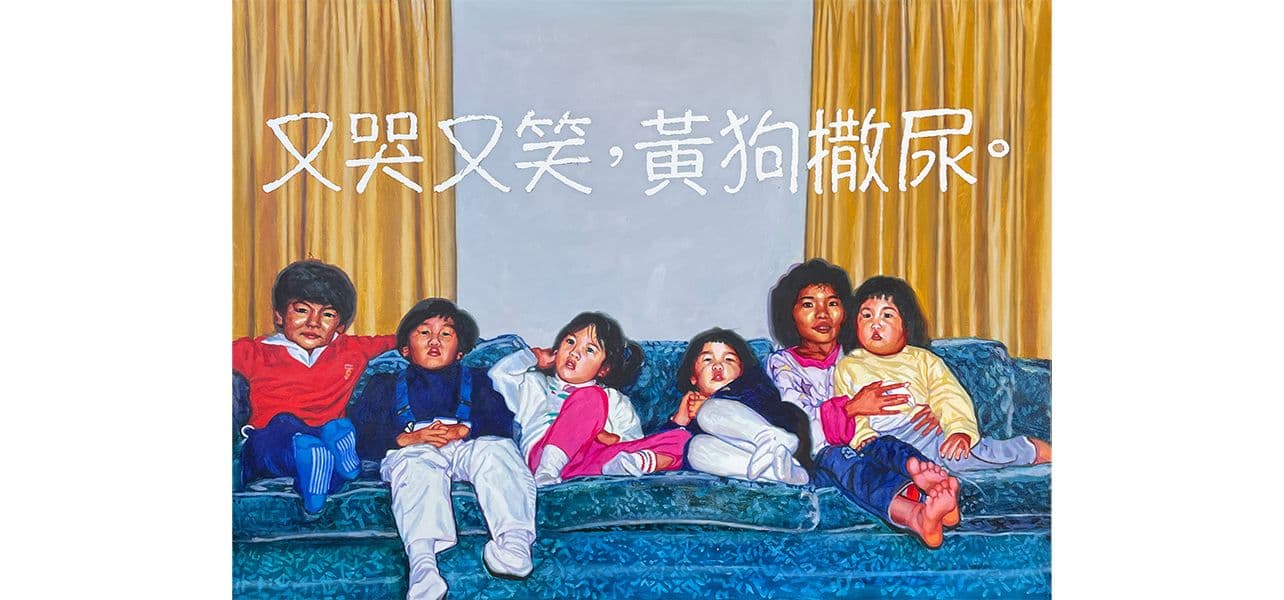
Nagel DraxlerAt a superficial glance, from a purely formal point of view, the works of Ken Lum and Christine Tien Wang have in common the combination of text and image, which are mutually interrelated. Lum contrasts his large-format, staged portraits with short, repetitive phrases that reflect statements about the emotional inner life of the people depicted. Mostly these relate to inner crises or childish emotional outbursts, prompting the viewer to contextualize the text with the image, in order to appropriately assess the situation. Through the use of language, the image acquires its implicit meaning, and repetition reinforces the impression of the hopelessness of the depicted situation. This reciprocal condition between text and image, and the resulting expansion of context form the basis for memes, which are omnipresent in Wang's work. Here, image and writing engage in a mostly humorous, ironic, cynical, or sarcastic interaction to comment on current issues. Without explicitly intending to be didactic, the works of both artists thus refer to social problems and phenomena, leaving it to the viewer to deal with them. In relation to Wang's recent paintings, another common thread can be discerned in the works of both artists, rooted in their individual biographies yet simultaneously representing a collective experience. Both are descendants of immigrants and share the challenge of adapting to a foreign identity while internalizing North American norms. They belong to “[…] one of the groups of 'foreigners’ whose Canadianism [Americanism, author’s note] was supposed to consist of subjection to Anglo-Commonwealth norms, of assimilation, of loss of memory, language use and literacy, and of gratitude, compulsive conformism and patriotism.”[1] In Chinese, Wang writes “American” across a painting that shows her parents, who immigrated in the 1970s, together with her as a baby. This depiction reflects a life shaped by specific conditions associated with immigration and the constant striving for belonging, which is an experience that both artists share across a generation: "Cahors, France. Following the opening of an exhibition, I was invited to dinner in this southern French city famous for its ancient bridge and robust red wines. At the restaurant I met for the first time of the other, mostly European artists in the exhibition. As introduction were being made, one artist, all smile and looking surprised, exclaimed to me: “Why I did not know you were asian. Your work looks like it could have been made by a non-oriental.”"[2] While Wang delves into the personal, Lum examines identity formation in the context of acculturation in his “Portrait-Logo-Series” and “Portrait-Repeated Text Series”, using staged portraits of individuals or groups representing certain classes or types. Works such as “Sacred Blade” serve as an anthropological commentary in a humorous way: the stereotypical suburban hard rock band that, despite their ambitions, cannot make it out of the wood-paneled rehearsal room. In their precision of the typical, Lum's portraits depict marginalized groups whose social circumstances stand in the way of their striving for autonomy. Wang's paintings tell the story of this dilemma across generations. “Berlin Wall” shows her grandfather, who fled from the communist regime in China to Taiwan, where he was accused of espionage by the Kuomintang government and sentenced to twelve years in prison. Upon his release, he invested his entire fortune to ensure his daughter could study in the USA, while he himself retired in Canada, spending his time traveling. The photo was taken during a visit to Berlin in 1988. On another painted family photo one can read “Laughing one moment, crying the next, the yellow dog is peeing”. This proverb was often used by Wang's uncle to describe the inconsistency of children's emotions: the tears of children are as insignificant as a dog's urine. Apart from the personal meaning of the image, the children represent a social group whose “tears” are also often considered insignificant. —Denise Kokko 1 - Jeff Wall: Four Essays on Ken Lum, in: Ken Lum, exhibition catalogue, published by Witte de With, Rotterdam / Winnipeg Art Gallery / Vancouver Art Gallery, 1990. 2 - Ken Lum: Seven moments in life of a chinese canadian artist, in: Ken Lum: Everything is Relevant. Writings on Art and Life 1991-2018, Concordia University Press, Montreal, 2019, p. 20.