
Collateral, Venice
Stanley Whitney
The Italian Paintings
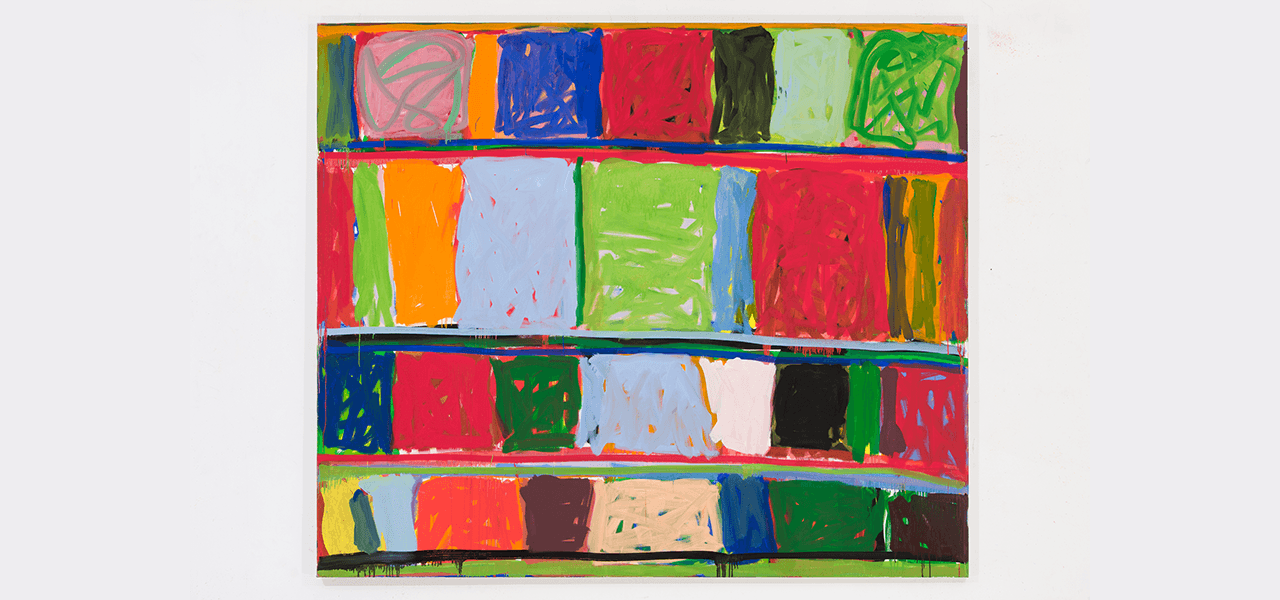
Palazzo Tiepolo PassiThe Buffalo AKG Art Museum and curators Cathleen Chaffee (Buffalo AKG Art Museum, New York) and Vincenzo de Bellis (Walker Art Center, Minneapolis) are delighted to reveal further details about Stanley Whitney’s presentation for the Collateral Event at the Biennale Arte 2022. The exhibition will feature large and small-scale paintings and works on paper, alongside Whitney’s sketchbooks, many exhibited for the first time, offering a glimpse into the artist’s process and experimentations. A look at Whitney’s practice over the last three decades seen through the lens of Italy, Stanley Whitney: The Italian Paintings is not only the first time the New York-based painter will present works that have been exclusively created in Italy, but it is also the first opportunity to experience these works together in their cultural birthplace. The title refers to a body of work that encompasses pivotal transitional paintings from the time Whitney spent in Rome in the early 1990s, through to the work created during subsequent summers in his studio in Parma. The presentation considers, for the first time, the important influence of Italian art and architecture on Whitney’s oeuvre. The exhibition begins with a gallery dedicated to three monumental, horizontal-format diptychs from 1993-94. These works recall Whitney’s first sojurn in Rome, marking the beginning of a lifetime of inspiration from Italian culture. While Whitney had been exploring the formal possibilities of color within ever-shifting grids of multi-hued blocks and all-over gestural fields since the mid-1970s, this visit to Rome marked a paradigm shift in his work, and Italian art and architecture soon became palpable in his abstractions. Whitney and his partner moved to Italy in 1992 as an escape from the New York art world – a difficult scene for an abstract artist of color to find a place in – and he was immediately drawn to the colors and forms surrounding him: the construction of the Pantheon and the Colosseum, Vatican City, the stacked urns in the Etruscan Museum, Renaissance history, as well as the play of the light on the buildings and the colors of the windows. In the diptychs on view, the circular forms of Whitney’s earlier paintings began to expand and draw towards each other, crowding out what might have previously been more open space in his compositions. Whitney has kept a studio outside Parma since the 1990s and the pace of that region became a key, albeit underrecognized part of his creative practice. In an adjacent gallery, visitors will see the next phase of Whitney’s journey, where these circular forms, grounded by horizontal bars, begin to coalesce into squares and rectangles while the space between them narrows further. The tightness of these stacked compositions announced a truly new direction and he began creating the densely gridded paintings he continues to make today, works characterized by architectural geometries, spontaneous brushwork, and endlessly variable juxtapositions of color. In the Palazzo’s grandest space will be installed a series of more than a dozen of these square canvases from throughout the 2000s, allowing viewers to perceive the incredible diversity within the limitations Whitney begins imposing on his compositions during this period, a practice he continues to this day. Another gallery will be largely dedicated to more than thirty diminutive canvases Whitney has been making for decades and which contain all of the power, experimentation, and incredible coloration found in his larger paintings, but on a scale that draws the visitor very close, inviting intimate contemplation. Finally, throughout the exhibition, works on paper will give visitors a glimpse into Whitney’s remarkable practice more broadly. Twenty of the artist’s Italian sketchbooks will shine a light on the development of the artist’s ideas, his reading, travels, and the titles for his paintings, while ink drawings from the 1990s and a series of luminous gouaches from recent years hint at the way this artist’s remarkable practice is grounded in experimentation across media. The exhibition is presented across the Noble Floor of the sixteenth- century Palazzo Tiepolo Passi, located along the central stretch of the Grand Canal. Organized around a central hall – alongside an ornate balcony that looks over the Grand Canal and an additional terrace draped in a pergola of wisteria – the exhibition winds through the side rooms, each with its own unique character and décor. Whitney’s paintings are presented in dialogue with the Palazzo’s aesthetic history and remaining Venetian frescoes, painted by Andrea Meldola. The Collateral Event is accompanied by a new publication featuring essays discussing the works on view and Whitney’s relationship with Italy as well as installation views. Stanley Whitney: The Italian Paintings precedes a major survey exhibition at the Buffalo AKG in Buffalo, NY, USA in 2024 organized by Cathleen Chaffee, Chief Curator. Stanley Whitney: The Italian Paintings at Palazzo Tiepolo Passi is supported by Lisson Gallery. Stanley Whitney was born in Philadelphia in 1946 and lives and works in New York City and Parma, Italy. He holds a BFA from Kansas City Art Institute as well as an MFA from Yale University and is currently Professor emeritus of painting and drawing at Tyler School of Art, Temple University. Select solo exhibitions include Focus – Stanley Whitney at the Modern Art Museum, Fort Worth, TX, USA (2017) and Dance the Orange at the Studio Museum in Harlem, New York, NY, USA (2015). Whitney has also been included in many prominent group shows, such as Inherent Structure, Wexner Center for the Arts, Columbus, OH, USA (2018); documenta 14 in Athens, Greece and Kassel, Germany (2017); Nero su Bianco at the American Academy in Rome, Italy (2015); Outside the Lines: Black in the Abstract, Contemporary Art Museum of Houston, TX, USA (2014); Reinventing Abstraction: New York Painting in the 1980s, Cheim & Read, New York, NY, USA (2013); and Utopia Station at the 50th International Art Exhibition of La Biennale di Venezia (2003). He has won prizes including the Robert De Niro Sr. Prize in Painting (2011), the American Academy of Arts and Letters Art Award (2010) and awarded a Guggenheim Fellowship (1996). Whitney’s work is included in public collections around the world, including the Albright-Knox Art Gallery; Metropolitan Museum of Art, New York; Whitney Museum of American Art, New York; The Long Museum, Shanghai; Art Gallery of New South Wales, Sydney; and National Gallery of Canada, Ottawa. Founded in 1862, the Buffalo AKG Art Museum (formerly, the Albright- Knox Art Gallery) is the sixth oldest public art institution in the United States. For more than 150 years, the Buffalo AKG has collected, conserved, and exhibited the art of its time, often working directly with living artists. This tradition has given rise to one of the world’s most extraordinary collections of modern and contemporary art. The museum’s collections span some of the greatest moments in art through the centuries, beginning with its first acquisition, Marina Piccola, Capri, 1859, by Albert Bierstadt— both the first painting and the first work gifted by an artist to enter the museum’s collection—and is especially rich in postwar American and European art. In 2019, the museum broke ground on the largest campus expansion and development project in its history, which will include the creation of a new work of signature architecture designed by OMA/Shohei Shigematsu. Upon completion of construction, the Buffalo AKG Art Museum will open in 2023. Dr. Cathleen Chaffee (American, b. 1977) joined the Albright-Knox in January 2014 and has been Chief Curator since September 2017. At the Albright-Knox, Chaffee is currently preparing touring retrospective exhibitions dedicated to Stanley Whitney (2024) and to Marisol (Venezuelan and American, born France, 1930–2016) (2023/4). She has curated exhibitions and authored accompanying publications for projects including Introducing Tony Conrad: A Retrospective (2018), Joe Bradley (2017), Shade: Clyfford Still / Mark Bradford (2016), Eija-Liisa Ahtila: Ecologies of Drama (2015), and Overtime: The Art of Work (2015), among others. She co-curated Anthony McCall: Dark Rooms, Solid Light (2019), Looking at Tomorrow: Light and Language from The Panza Collection, 1967– 1990 (2016), Screen Play: Life in an Animated World (2015), and Erin Shirreff (2016). Chaffee’s books and essays have addressed the work of Bas Jan Ader, Richard Artschwager, Carol Bove, Mark Bradford, Marcel Broodthaers, Tony Conrad, Hanne Darboven, Gabriel Kuri, Eric N. Mack, and Joëlle Tuerlinckx, among many others. Her writing has been published in magazines such as Artforum, Frieze, Contemporary, Mousse, and Manifesta Journal. Chaffee has lectured widely on contemporary art and artists as well as topics including language and duration in minimal and conceptual art, the representation of labor in post-war art, artist-curated exhibitions, and the home and “home-like” in art after Duchamp. Chaffee was Horace W. Goldsmith Assistant Curator of Modern and Contemporary Art at the Yale University Art Gallery from 2010 to 2014 and previously held curatorial positions at the Museum of Modern Art, New York, and the Cleveland Museum of Art. Chaffee received her PhD from the Institute of Fine Arts at New York University and was awarded a 2008 Fulbright Fellowship to Belgium to complete research for her dissertation, Décors: Marcel Broodthaers’s Late Exhibition Practice 1974–75. She received her master’s degree from the Courtauld Institute of Art, University of London. In 2018 Chaffee was the VIA Art Fund’s Curatorial Fellow. Vincenzo de Bellis (b. Italy, 1977) is Curator and Associate Director of Programs, Visual Arts at the Walker Art Center, Minneapolis since 2016. During his tenure at Walker he has organized exhibitions such as The Paradox of Stillness: Art, Object, and Performance (2021); Mario Garcia Torres: Illusion Brought Me Here (2018); Nairy Baghramian: Deformation Professionelle (2017); Jimmie Durham: At the Center of the World (2017); I am you, You are too (2017). His exhibition American Art 1961-2001: the Walker Art Center Collections from Andy Warhol to Kara Walker was on view at Palazzo Strozzi, Florence till August 29, 2021. De Bellis’s next project is the first US Museum retrospective of Jannis Kounellis (October 2022) touring to Jumex, Mexico City in 2023. From 2012 to 2016 De Bellis served as Artistic Director of the International Fair of Modern and Contemporary Art in Milan, which he relaunched to a new international platform. From 2009 to 2016 de Bellis was founding director and curator of Peep- Hole Art Center in Milan. There he curated over 25 exhibitions and 28 publications. Among the projects he curated for PeepHole: the first retrospectives of Paolo Icaro and Paolo Gioli, as well as the first solo exhibitions in Italy of artists such as Uri Aran, Trisha Baga, Mario Garcia Torres, Renata Lucas, Gabriel Sierra among others. In 2015, de Bellis organized Ennesima: An Exhibition of Seven Exhibitions on Italian Art at Triennale di Milano. He also curated a solo exhibition by Betty Woodman at Museo Marino Marini, Florence, and ICA, London (in 2016). Previously, de Bellis held curatorial roles at Museion, Bolzano, and GAMeC, Bergamo. De Bellis holds a Master of Arts in Curatorial Studies from Center for Curatorial Studies, Bard College. Prior to move to the United States De Bellis was part of the Steering Committee for Contemporary Art at Ministero dei Beni e delle Attività Culturali. He is currently a member of the Advisory Board of Mimmo Rotella Institute, Milan, and as well as Board of Directors of MACTE, Termoli. De Bellis is also part of the Steering Committee of the Contemporary Curators Conference, USA.
Visit
San Polo 2774