

Giardini, Venice
Małgorzata Mirga-Tas
Re-enchanting the World
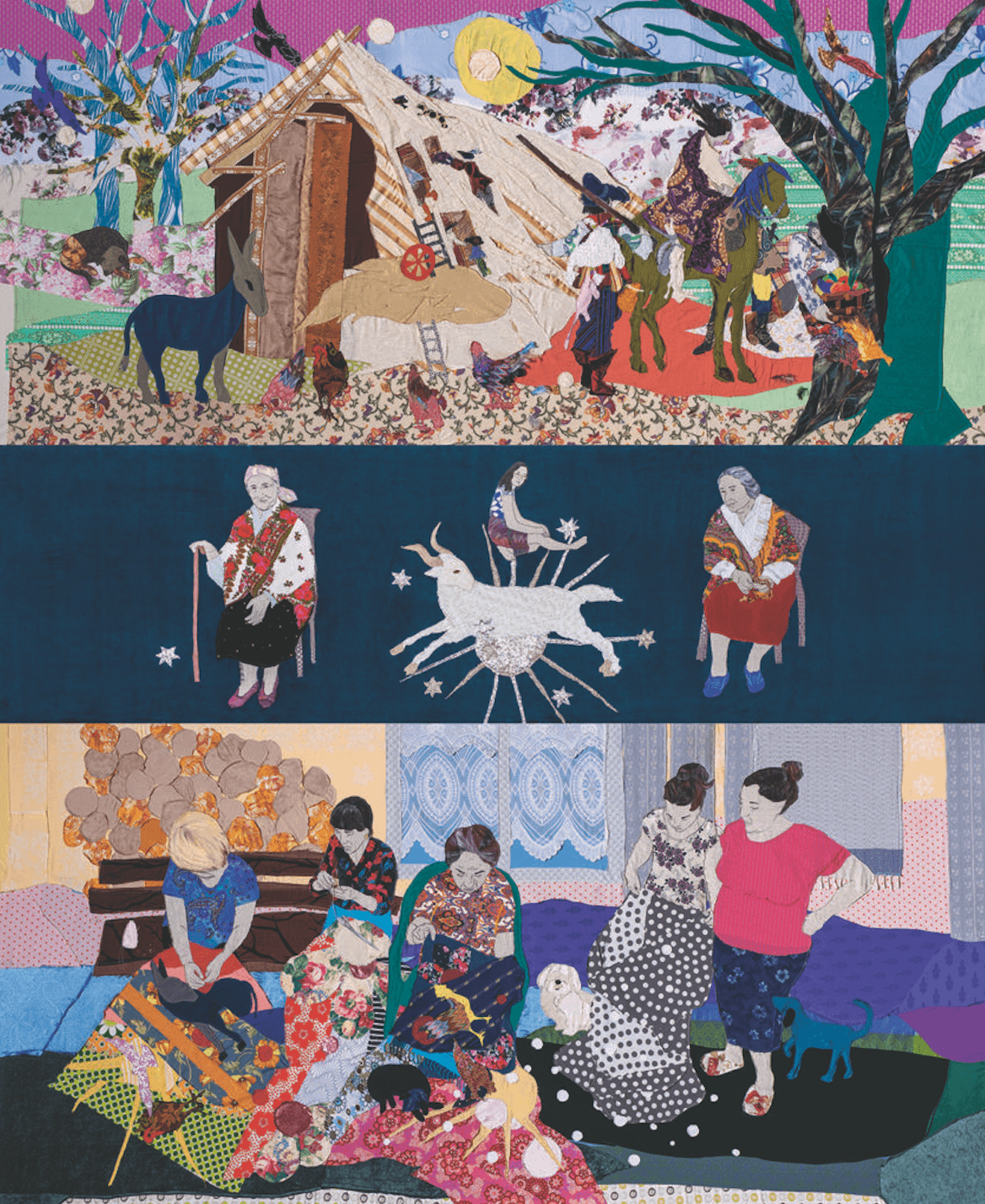
Polish PavilionThe Re-enchanting the World project by the Polish-Roma artist for the Polish Pavilion at the 59th International Art Exhibition is an attempt to expand the Polish and European iconosphere and art history with representations of Roma culture. Adhering to the title of this year’s edition of the Biennale Arte (The Milk of Dreams), the artist will create a magical world, constantly subjected to re-enchantment, proposing a kind of temporary and adventurous asylum to give viewers hope and respite. The exhibition is curated by Wojciech Szymański and Joanna Warsza. The artist draws from images of key importance for European art history and visual culture, ‘appropriating’ them and inscribing in them a Polish-Roma identity and vernacular historical experience. The project for the Polish Pavilion is based on the ideas of transnationality, cyclicity, and changing oft-appropriated meanings, proposing a new narrative to describe the unending cultural migration of images and mutual influences between Roma, Polish and European cultures. The title is inspired by Silvia Federici’s book, Re-enchanting the World: Feminism and the Politics of the Commons (2018), which proposes re-enchanting as a way of recovering the idea of community and rebuilding relationships with others, including non-human actors: animals, plants, water or mountains. As such, re-enchanting – a non-violent process in which women play an important role – reverses the unfortunate fate of the world, shaking off its evil spell and charm. Małgorzata Mirga-Tas will design and make a series of twelve large-format textiles to cover the walls of the Polish Pavilion in Venice. The layout, form and motifs of the fabrics draw from the famous ‘calendar’ fresco cycle of the Renaissance Palazzo Schifanoia in Ferrara. Małgorzata Mirga-Tas is a Polish-Roma artist and activist. In her works, sculptures, paintings, spatial objects and large-format textiles, she addresses anti-Romani stereotypes and engages in building an affirmative iconography of Roma communities. She graduated from the Faculty of Sculpture at the Academy of Fine Arts in Krakow (2004). She participated in several dozen individual and group exhibitions, including the 11th Berlin Biennale (2020), the Art Encounters Biennial in Timişoara (2019, 2021), 3rd Autostrada Biennale in Prizren (2021), while her works were displayed at the Moravian Gallery in Brno (2017), the Center of Polish Sculpture in Orońsko (2020), Museum of Modern Art in Warsaw (2020), or Rautenstrauch-Joest-Museum in Cologne (2021), among others. She lives and works in Czarna Góra, Poland. Wojciech Szymański, art historian and art critic, independent curator. Assistant professor at the Institute of Art History, University of Warsaw, author of several dozen articles, editor and author of monographs and exhibition catalogues, principal investigator and researcher in a number of Polish and international scientific projects; since 2019 he has been editor-in-chief of “Ikonotheka” journal. Curator of numerous art shows, with special interest in contemporary Roma art and its presence in the global art world. He curated the following shows featuring the works of Małgorzata Mirga-Tas: Kali Berga (Krakow 2016, Berlin 2017); The Right to Look (Krakow 2018), 29. Exercises in Ceroplastics (Orońsko 2020), Out of Egypt (Białystok 2021). He is a member of the International Association of Art Critics (AICA). He lives in Krakow. Joanna Warsza is an independent curator, editor, and Program Director of CuratorLab at Konstfack University of Arts in Stockholm. Recently she co-curated, together with Övül Ö. Durmusoglu, Die Balkone in Berlin, the 3rd Autostrada Biennale in Kosovo, and the 12th Survival Kit in Riga. She was also the Artistic Director of Public Art Munich 2018, curator of the Georgian Pavilion at the Biennale Arte 2013, head of the public program of Manifesta 10 and associate curator of the 7th Berlin Biennale at the invitation of Artur Żmijewski. Her recent publications include Red Love. A Reader on Alexandra Kollontai (with Maria Lind and Michele Masucci, 2020), and And Warren Niesłuchowski Was There: Guest, Host, Ghost (with Sina Najafi; published by Cabinet Books and Museum of Modern Art Warsaw, 2020). Originally from Warsaw, she lives in Berlin. The Adam Mickiewicz Institute is a national cultural institution. Its mission is to build lasting interest in Polish culture globally. The Institute works with foreign partners and initiates international cultural exchange in accordance with Poland’s foreign policy. The Institute has implemented cultural projects on six continents, in 70 countries, including the United Kingdom, France, Russia, Israel, Germany, Turkey, the USA, Canada, Australia, Morocco, Ukraine, Lithuania, Latvia, China, Japan, and Korea. The Institute has implemented 38 strategic programmes, and held events attended by an audience of 60 million. The Culture.pl website provides fresh information on the most exciting Polish cultural events around the globe. It is also the biggest and most comprehensive source of knowledge about Polish culture. The Adam Mickiewicz Institute is governed by the Ministry of Culture and National Heritage. The European Roma Institute for Arts and Culture e.V. (ERIAC) has a unique and single mandate as the transnational, European-level organization for the recognition of Roma arts and culture. ERIAC is a joint initiative of the Council of Europe, the Open Society Foundations, and the Roma Leaders’ initiative – the Alliance for the European Roma Institute for Arts and Culture, which represents a historical and ground-breaking development, initiated by Roma intellectuals and public figures, as a result of over four decades of Roma cultural activism and artistic movement. From its beginnings, the ERIAC office in Berlin has served as the headquarters to support the large network of Roma individuals and organizations working in the fields of arts and culture, and also has given space to a contemporary art gallery and an educational program which is open to the public and welcomes individual visitors and visitor groups. ERIAC exists to increase the self-esteem of Roma and to decrease negative prejudice of the majority population towards the Roma by means of arts, culture, history, and media. Commissioner: Janusz Janowski (from 2022), Hanna Wróblewska (till 2021) / Zachęta — National Gallery of Art Curators: Wojciech Szymański and Joanna Warsza