
Giardini, Venice
Șerban Savu
What Work Is
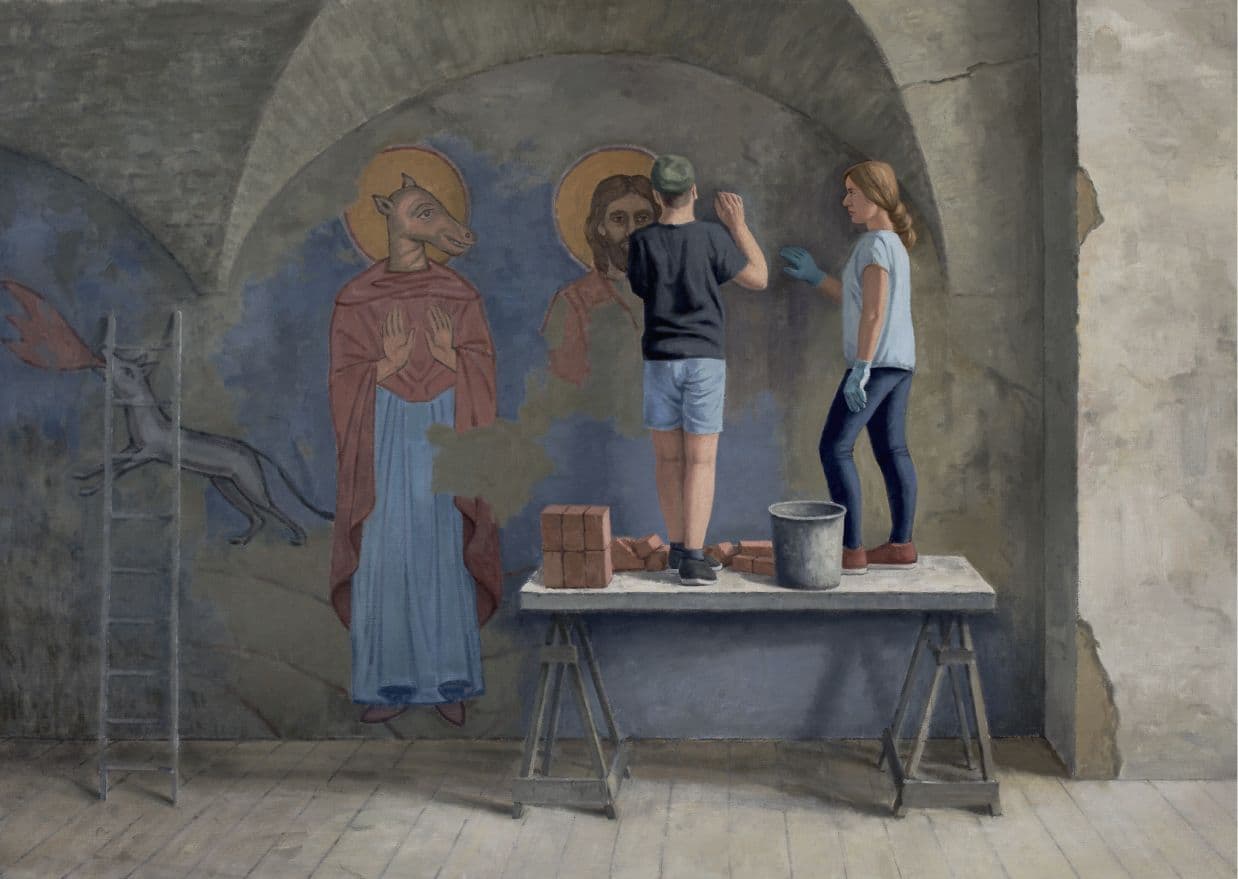
Romanian PavilionȘerban Savu’s project for the Romanian participation in the 60th International Art Exhibition – La Biennale di Venezia intervenes in the representational history of the laboring body, composing a complex iconography of work and leisure, primarily informed by a study of historical realism and its ideologies, as well as of the propaganda art of the Eastern Bloc. Rather than contest or dismantle those discourses, Savu rearranges the tropes of revolutionary élan and cohesion, of workers united in both political aspirations and the choreographic rhythms of building the future, to capture the unadorned reality of a historical limbo, moments of suspension and inertia as microcosms of ampler societal shifts or crises. Addressing the general theme of Biennale Arte 2024, “Foreigners Everywhere”, the sense of disorientation in a political or economic limbo, which is the signature of many paintings by Șerban Savu, is an oblique reflection on the displacement and homesickness associated with migratory work, on the disconnection between labour and belonging. The narrative arc of gainful employment elsewhere and the blissful return to one’s roots can often result in estrangement and double alienation: becoming foreign to themselves, the characters depicted in Savu’s What Work Is are caught in a temporal no-man’s-land between two worlds pivoting away from one another. Arranged in a vast polyptych-like installation, about 40 paintings – a cross-section of Savu’s work over the last fifteen years – are populated by disoriented protagonists and lethargic extras, all seemingly caught in a lull between work and rest, in a collective reverie where doing something or giving everything up appear as equally likely outcomes. Realism is here reversed into a modality of portraying disassembled utopias, eroded frameworks for communal action and fragile social bonds. Across from the polyptych, a large bench incorporates the plinths of four architectural scale models displaying mosaics which diverge from the metaphors and tonalities that the medium conveys in religious environments, or in the cosmogonies of labor that Socialist mosaic-making excels in. Bathos, ambiguity, rest or perplexity replace the apotheoses that mosaics depict in those contexts: remains instead of inaugurations, anachronisms instead of futures, anxious fragments instead of allegorical projections. The visual and conceptual space delineated by the paintings and the models is permeated by questions about work and its negative definitions: what works is not, what it does not look like, and what it does not mean, all these as (inverse) premises for a political definition of individuality whose value is not predicated on economic productivity. Invited to respond to Șerban Savu’s project, the Brussels-based graphic design studio Atelier Brenda (Sophie Keij and Nana Esi) offers a site-specific intervention on the façade and in the lobby of the Romanian Pavilion. The graphic message on the façade of the pavilion amplifies the muted interrogation contained in the title of the project at a monumental scale. In the lobby of the pavilion, the coin proposed by Atelier Brenda materializes the ambiguities which permeate the paintings and mosaics, setting their questions within the abstraction of monetary exchange, or the symbolic authority of minting coins as equivalents for bodies and their effort, but also within the coin as a material vanishing point for the different perspective lines which traverse the other works. Complementing the presentation in the Romanian Pavilion in Giardini della Biennale, Savu’s project for the New Gallery of the Romanian Institute of Culture and Humanistic Research in Venice operates between the public sphere of monumental art and the artist’s studio as a space of production and reflection. The gallery will host the production of a large-scale mosaic work, reflecting the spirit of the small Venetian manufacturing workshops. The mosaic True Nature, based on Savu’s 2019 painting with the same name, is here to be magnified at a monumental scale. Upon completion, timed to coincide with the end of the Biennale, the mosaic will be offered for installation on a building façade in Chisinau, thus completing the arc of its conception, as Savu developed the idea of True Nature as an ironic antithesis to The Plowman of the Universe, a Soviet-era Socialist mosaic on the façade of the “Yuri Gagarin” Youth Center in the Moldovan capital. In addition to the mosaic workshop, the New Gallery will also host a public program of talks, on topics ranging from the histories of mosaic to theories of work in contemporary anthropology, economy and philosophy, on ecology and the post-work society, coordinated by Ovidiu Ţichindeleanu, a prominent Chișinău-based cultural critic. The exhibition will be completed by the publication at the end of the Biennale Arte 2024 of a book edited by Mihnea Mircan that will bring together a series of critical texts relevant to the themes raised by the works presented in Venice and which will richly illustrate it. Commissioner: Ioana Ciocan Curator: Ciprian Mureșan Invited Artists: Atelier Brenda (Nana Esi and Sophie Keij) Project Manager: Cristian Alexandru Damian
Visit
Giardini