

Germain, Paris
Robert Wilson
The Days Before
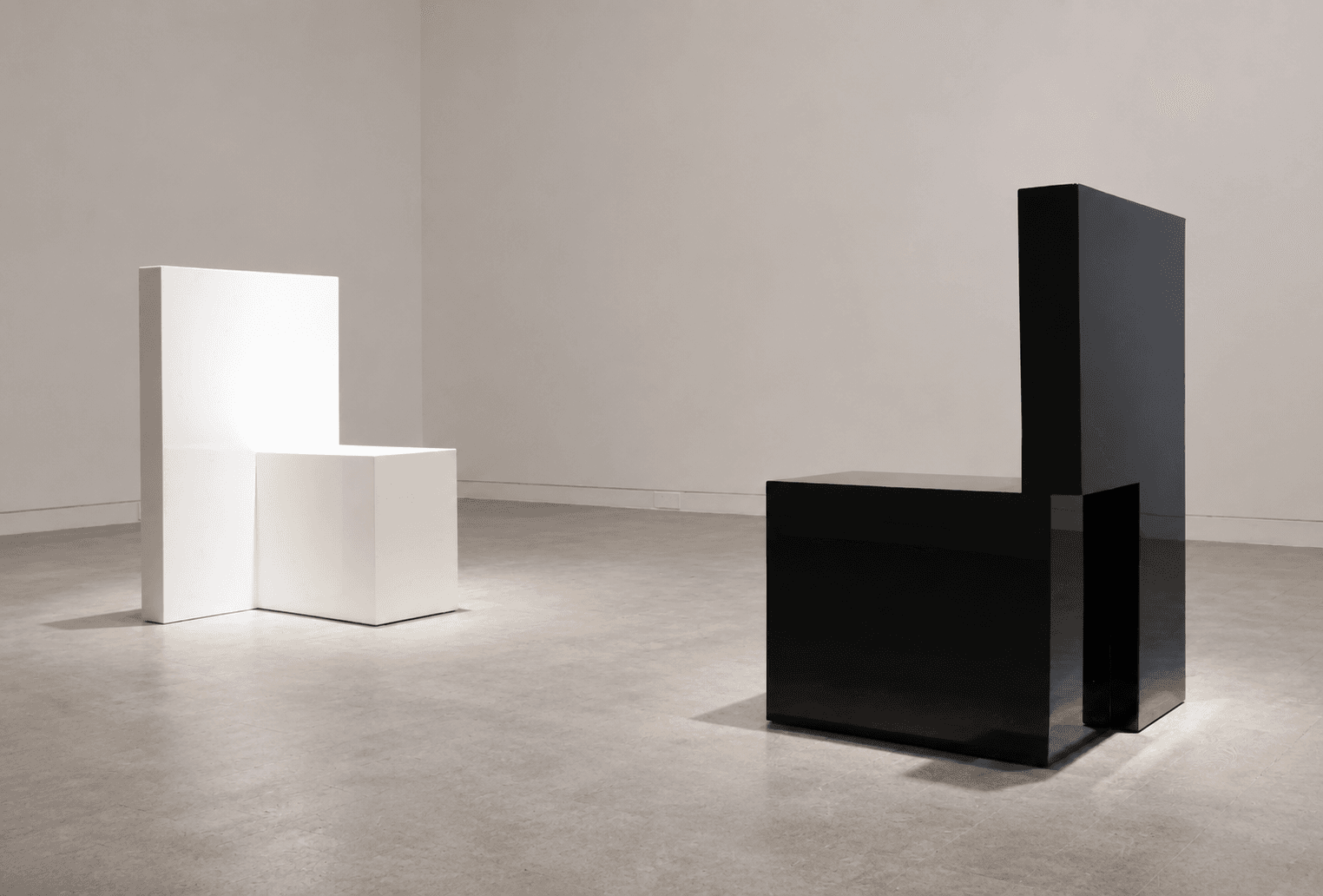
Ketabi BourdetKetabi Bourdet Gallery is pleased to present The Days Before, its second exhibition dedicated to the work of Robert Wilson. It is the first exhibition in France devoted to the American artist since his passing in July 2025, at the age of 83. Conceived in collaboration with the artist’s Estate, the exhibition brings into dialogue two lacquered-wood versions of the Father’s Chair, designed for the set of the play The Days Before: Death, Destruction & Detroit III, alongside a series of 25 charcoal drawings depicting the same chair. Originally conceived in natural oak in 1999, the Father’s Chair was reimagined by Robert Wilson in 2022 as a striking series in black, white, and red lacquered wood. Each colorway was produced in an exclusive edition of just six pieces. Furniture — and chairs in particular — occupies a central place in his work as well as in his personal life. In his theatre and opera productions, chairs acquire a symbolic presence comparable to that of the actors. Even when removed from their original scenographic context, these pieces retain their sculptural power and assert themselves as autonomous works. In the series of charcoal drawings, Robert Wilson explores the motif of the chair through endlessly renewed variations, moving beyond the subject itself to transform it into a true field of formal experimentation. The Days Before: Death, Destruction & Detroit III is one of two sequels developed from the experimental opera Death, Destruction and Detroit, written and directed by Wilson in 1979. The work originated from a photograph that fascinated the artist, which he kept for many years on his desk in New York without knowing precisely what it depicted. He later learned that it showed Rudolf Hess at Spandau Prison in Berlin, together with two other Nazi war criminals, raking leaves in a mechanical and constrained gesture. This image inspired the prologue of DD&D with the legendary German actor Otto Sander. Among the emblematic scenes of the work are one in which Philippe Chemin and Heike Pfitzner sit on deck chairs designed by Wilson on a rooftop overlooking New York in flames, and another in which Otto Sander, portraying Hess disguised as Siegfried, confronts two dinosaurs. Born in Waco, Texas, in 1941, and a major figure of the Downtown New York scene of the 1970s and 1980s, Robert Wilson was a visual artist, theatre director, and playwright, internationally recognized for having profoundly renewed theatre and opera, notably with Deafman Glance (1970) and Einstein on the Beach (1976), created with Philip Glass. Alongside his work for the stage, Robert Wilson developed an autonomous artistic practice from the 1960s onward, in which drawing and design held a central place. Working primarily with charcoal, ink, or paint, he conceived his images as visual scores: spaces of tension, silence, and repetition, where form is constructed through duration and attention. His works on paper, often produced in rigorous series, explore recurring motifs — architectures, figures, objects — which he revisits with an almost meditative precision. Design, and furniture in particular, follows this same logic. Chairs, tables, and consoles are never conceived as simple functional objects, but as presences in their own right, situated at the boundary between sculpture and architecture. Initially developed for the stage, these elements acquire formal autonomy outside the theatrical context: reduced to essential lines, shaped by light and color, they extend into space the fundamental principles of his work — frontality, slowness, repetition — and form part of a coherent visual language in which each object becomes an actor. He was also the founder of the Watermill Center on Long Island, which houses part of his art and design collections and has served, since 1992, as a laboratory dedicated to contemporary creation. His works are now held in the collections of major international institutions, including MoMA in New York and the Centre Pompidou in Paris.