Chinatown, New York
Group Exhibition
Good Bunny
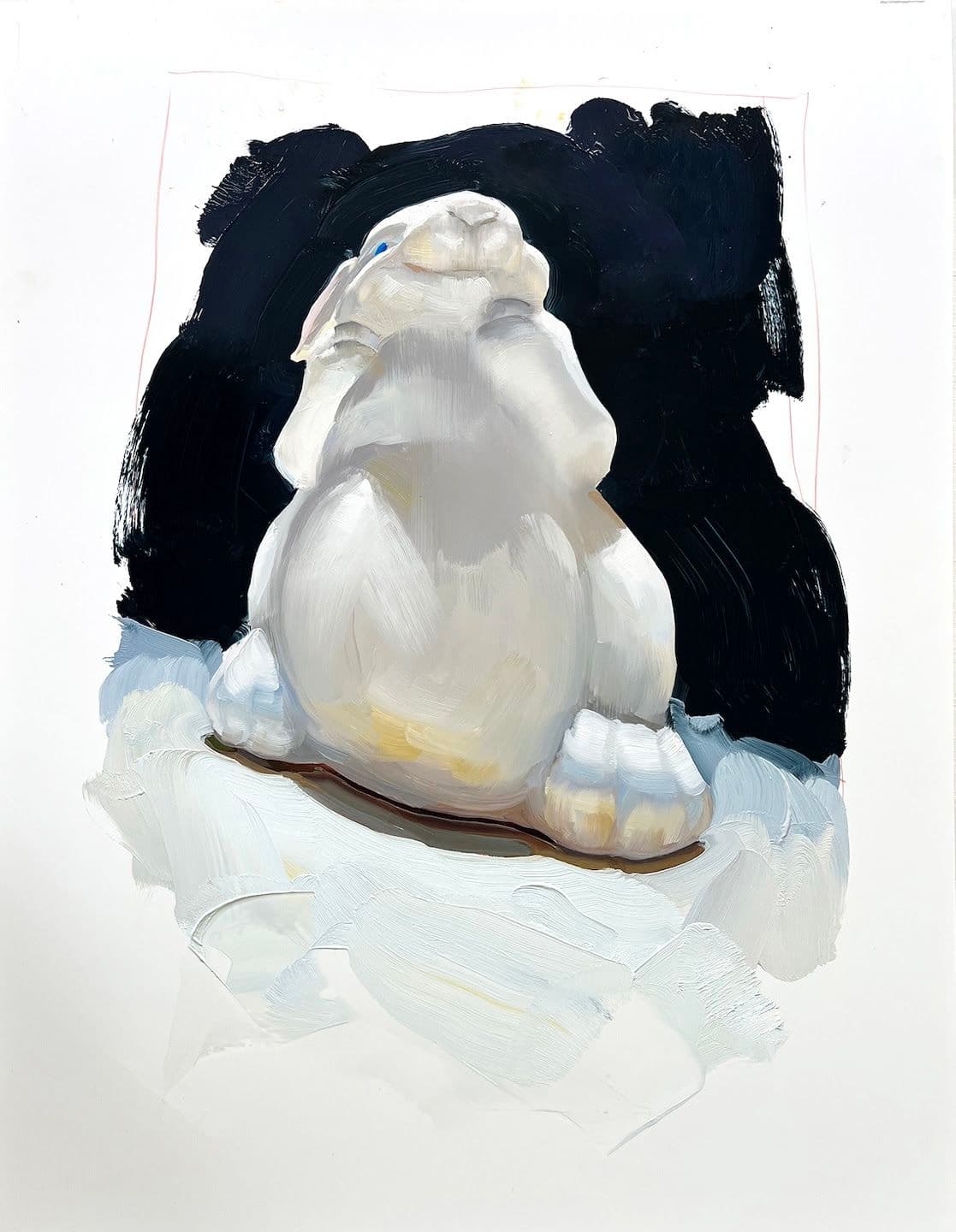
Frosch & CoNeal Barab, Sarah Dineen, Emily Eveleth, Seth M. Forman, Barbara Friedman, Jerelyn Hanrahan, Debra Jenks, Norma Markley, Edie Nadelhaft, Helen Oji, Fleur Palau, Fedele Spadafora, Jeanne Verdoux Frosch & Co is pleased to present Good Bunny, a group exhibition featuring a dozen artists. Good Bunny began with an idea from artist and co-curator Edie Nadelhaft, whose trippy ghost rabbit tondos grew out of a snarky response to the hilarious and politically charged pearl-clutching over the Super Bowl halftime show. What started as a playful provocation soon morphed into a rambling riff on the surprisingly complex representation of “good” bunnies in art. From Beatrix Potter's sweet anthropomorphic tales and Albrecht Dürer's iconic Young Hare to the allegorical society of Watership Down and Lewis Carroll’s psychedelic muse, it is clear that rabbits have loomed large in the human imagination for centuries. Rabbits in Good Bunny are rarely just rabbits. They tumble through abstract space, emerge unexpectedly from poured paint, drift across cloudy skies, or become participants in rituals whose meaning remains elusive. Throughout the exhibition, humor and unease coexist as the familiar figure of the bunny slips between innocence and absurdity, folklore and fantasy. Barbara Friedman’s odd creatures arise from chance encounters with paint, where unexpected forms emerge from oil spills and spreads of pigment before being coaxed into imagery. Meanwhile, Sarah Dineen’s painting Certain Dark Things #11 brings together abstract forms and fragments of recognizable imagery. Bunny-like ears, a frog-like shape, and a city skyline converge above an ocean or a sky. Similarly balancing abstraction and representation, Helen Oji’s Tumble draws inspiration from the vertical format of Japanese painted scrolls, allowing her bunny to emerge in fragments—its hind legs above and ears below—as it tumbles through space. Fleur Palau’s paintings expand the rabbit’s possibilities into a world of magical realism and escapism, where recurring characters Roberto and Amber embark on imagined adventures through landscapes shaped by the artist’s years in Italy, yet transformed entirely through invention. Edie Nadelhaft’s rabbits inhabit a space between fantasy and uncertainty. Inspired by the absurdity of the cultural backlash over a moment of joyful entertainment, the artist wondered whether even paintings of cute bunnies like Purple Rabbit’s Majesty, which features a lavender-tinged portrait of a friend’s pet rabbit could become subjects of moral scrutiny. The rabbit continues to shift identities in the works on paper, serving as a vehicle for memory, folklore, and contradiction. Inspired by Bruce Fergusson's writing on the oxymoron as a space where opposing ideas coexist, Emily Eveleth's Fair Warning introduces the "pugilist bunny" as a figure that occupies this state of productive ambiguity; at once gentle and combative, playful and confrontational. Jeanne Verdoux's etching Escaping Bunny carries the lingering imprint of captivity, asking whether the memory of confinement can ever fully disappear. Blending humor and intimidation with references to Czech surrealism, Fedele Spadafora brings savory little monsters to life in his sweet and spooky Police Bunnies, painted on vintage menu cards from Prague. Norma Markley's layered collage Bunny Too draws from Vincent Gallo's road drama The Brown Bunny, combining photography, stitched fabric, grids, and traces of the artist's own hand. The sewn bunny emerged intuitively, introducing a note of surreal humor along a highway to somewhere, anywhere, nowhere. The sculptural works return the rabbit to the realm of personal history while expanding its symbolism. In Dancing Rabbit, Jerelyn Hanrahan revisits the childhood bunny drawings taught to her by her aunt, transforming an early lesson into a wooden sculpture. Her group of small rabbits (Different and the Same), display a range of colors on one side, while revealing their shared wooden surface on the other—a reflection on individuality and our underlying shared humanity. Neal Barab has been living and working in what is known as the “Sculpture Paradise” Pietrasanta, Italy, for more than half of his life. Using a variety of colored marble, his small carved Bunny Inna Boat (Personaggi series), reflects his approach to creating figures with distinct personalities, companions intended to gather stories across generations. With a penchant for inventing personas to inhabit, Debra Jenks’ pink marshmallow bunny in a Ziploc bag melds fictive and autobiographical content. She approaches the rabbit through her alter ego, the fictional outsider artist Edwina Rochér (a play on Ed Ruscha and Ferrero Rocher), transforming the humble marshmallow Peep into both stand-in for the artist and social symbol. Taken together, these works reveal the rabbit as trickster, companion, witness, storyteller, spirit, and surrogate for ourselves. Throughout Good Bunny, seemingly contradictory qualities—innocence and menace, humor and melancholy, tenderness and absurdity—occupy the same space. Far from a simple symbol of innocence, the “good bunny” emerges as an endlessly mutable figure; at once comic, uncanny, and impossible to fully define.