Dates
Jun 24 – Aug 2, 2026
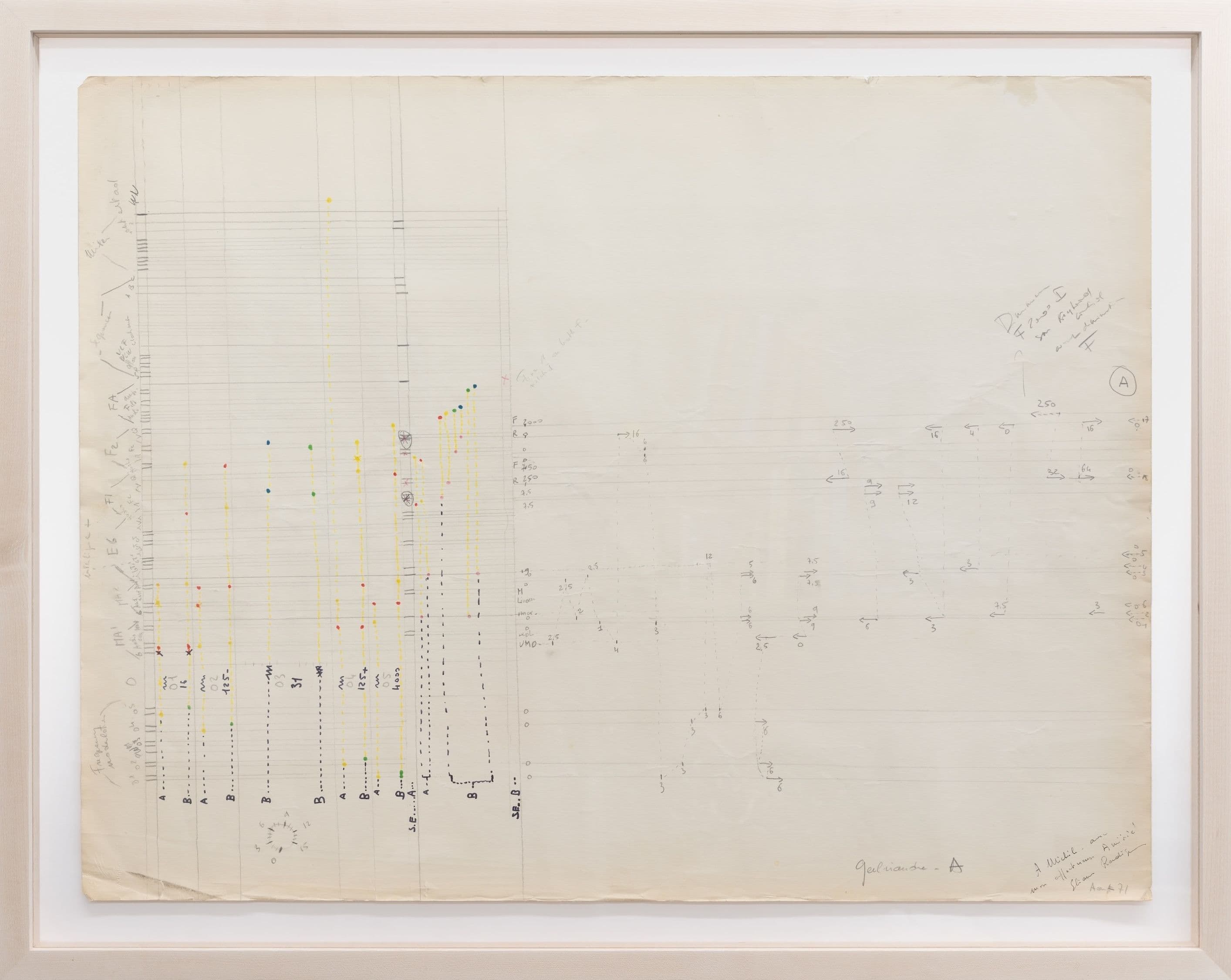
Sylvano Bussotti, Vijay Masharani, Benjamin Patterson, Lisa Alvarado, Alison Nguyen, Alexa West, Noah Barker, Raffaela Naldi Rossano, Éliane Radigue, Hanne Darboven, Iris Touliatou, Steffani Jemison In 1969, avant-garde composer Sylvano Bussotti completed a filmic portrait of his creative milieu in Rome, Rara, which captured the likes of Cathy Berberian and Daria Nicolodi in fragmentary vignettes. While silent, Bussotti nevertheless scored Rara with various forms of exogeneous sound, accompanying the film with music from his own catalog or even playing the piano live during screenings. With each showing of Rara, then, there was a mediatic break between film and sound in which the concept of the score moved away from sonic narration to become part of a disjointed, almost cubist scenography. is reconfiguration is also reflected in the graphic scores Bussotti made for Rara and other projects throughout his practice, where clefs, staffs, and bars play host not to musical notation but calligraphic abstraction and figurative drawings. Bussotti’s idiosyncratic scores shi ed music away from its prevailing, instrumental functions, re-deploying them as destabilizing performances and grounds for intermedia exchange. The artists in this exhibition also approach the score with an expansive perspective. Certain work evinces a similar formalism to that of Rara, like Fluxus artist Benjamin Patterson who translated the concept of the score into instructions for performative actions (several examples of which are included here from the artist’s Black & White File ), Éliane Radigue, a composer like Bussotti whose score for the 1972 work Geelriandre emphasizes the austere graphic language begotten by her composition, and Conceptualist Hanne Darboven, who harnessed the score as one among many readymade systems used to mark time and creatively collate information. Bussotti himself also appears in the exhibition through a sculptural collage that juts out from the wall, its flank featuring torn pieces of musical notation set alongside images of homoerotic antique sculpture, text, and diagrams, matrixing the score into a mediatic assemblage in the same spirit as Rara. Younger artists have continued to push the score’s conceptual and visual capacities in new directions. Iris Touliatou, Noah Barker, and Alison Nguyen, for instance, configure it as a tool for analyzing social systems. For Touliatou’s series Untitled (adults), the artist made an agreement with a paper company that the firm send her their nearly used up rolls of thermal paper (o en used for receipts), each sheet revealing marks of the many hands who had graced their fragile surfaces, a map of labor coordinated by the artist’s bureaucratic choreography. e rhythmic pattern of Barker’s stainless steel dots in 9G relates to punch cards from the Manhattan Project, while their fluorescent palette recalls the psychedelic day-tripping of Tom Wolfe’s Merry Pranksters. is conflation of American militarism and hippiedom may seem strange but, drawing on the scholarly work of Fred Turner and others, Barker’s work models the historical entanglement of these otherwise antagonistic forces, one that took place under the banner of a widespread techno- utopianism spanning nuclear power and LSD alike. Like a score from without, the rhythmic repetition—a continual “clocking-in”—that animates Barker’s sequence becomes a way of emphasizing hippiedom’s internalization of military techne, what Turner describes as the move “from counterculture to cyberculture.” Elsewhere, Alison Nguyen’s gilded compositions unearth Vietnamese folk songs censored by the national government, each work suggesting how the practice of effacing and eventually exhuming musical notation is nested within local political paradigms that become one part of the score’s material lifecycle. For others, the score—like Bussotti’s live musical response to his film—is environmentally oriented, another way of understanding the coordinated relationship between media. Lisa Alvarado’s hanging paintings, for instance, are deeply intertwined with the artist’s role as a harmonium player in the band Natural Information Society. ese paintings, while hung in the gallery, are ultimately peripatetic stage sets for the band’s performances, o en used as backdrops for shows that produce a vibrational relation between wave and image, sound’s ephemeral rise and fall and painterly abstraction. Raffaela Naldi Rossano offers a series of works in the exhibition all related to the social shape of sound’s emanation. e sculpture on view is taken from her ongoing project, Tentacular Bed, where modular pieces of furniture—all of which are instruments—make aural the spatial relations between bodies. e drawing on view is also deeply relational, the result of a ritualistic practice in which Rossano submerges paper supports in sea water, their opaque lettering collectively producing a secret code between herself and the water. Alexa West uses the score as part of her choreographic practice. Adapted from Bob Fosse and Carol Haney’s duet during “From is Moment On” in Kiss Me Kate, the artist’s four-channel installation in this show takes the dance’s archetypical rendering of male and female relationships as a gendered schema to tinker with and unspool. Working with two dancers, one male, one female, West choreographs each into both Fosse and Haney’s roles, dressed alternatively as a witch or baseball player. e result is a programmatic video score in which four distinct gender-and-costume arrangements are performed, demonstrating the way “male” and “female” operate as readymade devices and dancerly languages within the format of the Hollywood musical. Still others push the parameters for the score’s legibility in terms of visual language. Vijay Masharani’s drawings feature a wash of lyrical, energetic mark making. In these works, we find, rather than abstraction as such, a horizontal arrangement of contingent forms whose chimeric permutations imply shifts in state, pirouettes, transfers, and directional flow. Masharani surfaces a non-objective language for "scoring" beyond the more literal compositions in the show, one shared in Steffani Jemison’s totemic work and its vertical swath of calligraphic, letter-like forms. If Masharani fleshes out the musical poetics of Futurist propulsion, Jemison’s work draws on the artist’s interest in encryption and codes within the Black radical tradition as a means of skirting physical and epistemological violence. In her work, to score is not necessarily a means of transmitting information but strategically lingering on the underside of intelligibility. These valences of the score demonstrate its profligate use in contemporary practice, as protocol, transcription technique, and abstract language, continually troubling the boundary lines between music and visual media and animating that space, like in Bussotti’s Rara, as a site of potent generation. —Blake Oetting Blake Oetting is a Postdoctoral Fellow between the Departments of History of Art and Rhetoric at the University of California, Berkeley and Curatorial Fellow at the Berkeley Art Museum and Pacific Film Archive. He is a graduate of the Whitney Independent Study Program. Recent articles by Oetting appear in Oxford Art Journal, Art Journal, Criticism, and Nka: Journal of Contemporary African Art. His art criticism has appeared in Artforum, Texte Zur Kunst, Flash Art, e Brooklyn Rail, November, BOMB, caa.reviews, e Public Review, baargeld and exhibition catalogs for Renée Green, Hernan Bas, and Jean Cocteau (which he co-edited with Kenneth Silver). Oetting has curated exhibitions at the Peggy Guggenheim Collection, Helena Anrather Gallery, and 80WSE, and served as a visiting critic at the Parsons School of Design. He has also worked for a number of institutions, including the Whitney Museum of American Art, the Museum of Modern Art, the Barnes Foundation, e Metropolitan Museum of Art, and the journal, Res: Anthropology and Aesthetics. Oetting’s work has been awarded fellowships from the Smithsonian American Art Museum, the Harry Ransom Center at the University of Texas, Austin, the Helen Frankenthaler Foundation, the Robert Rauschenberg Foundation, and the Museum Research Consortium at the Museum of Modern Art.