
Upper East Side, New York
John Kacere
From Barbara to Valerie
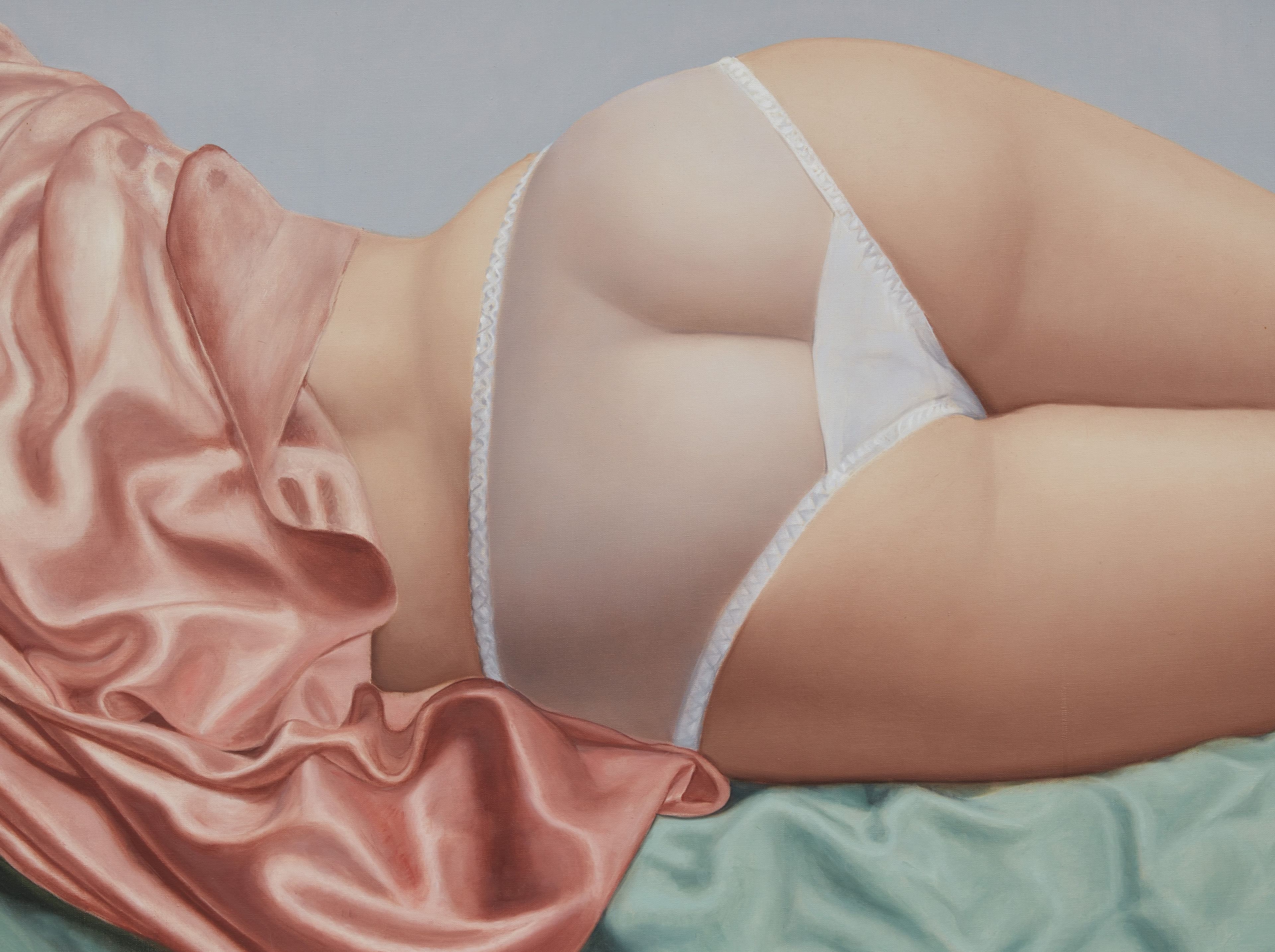
Salon 94 DesignSalon 94 is pleased to present a focused exhibition of works by American photorealist painter John Kacere (1920–1999), featuring paintings, drawings, and photographs from his most celebrated period of the 1970s to 1990s. Kacere adopted a photorealist style in the early 1960s, charting a new career trajectory as one of the original practitioners of photorealism, though he famously rejected the term and was, in turn, rejected by some of his contemporaries for his chosen subject matter. His renowned paintings show the midsections of women—enlarged and cropped, dressed in lingerie—a merging of traditional categories of portraiture, landscape, and still life. The series includes approximately 130 paintings, as well as drawings and photographic studies. Sensual and provocative, these beautifully-rendered compositions adeptly juxtapose undulating silken fabrics against the matte surface of skin. Not a true portrait, nor landscape, nor still life, Kacere's work embodies elements of all three. Realism, of course—then and now—was perplexing, yet enduring: it spoke to the work of the camera and eschewed abstraction for the coolness of a scene of life framed by the painter—and for the viewer. A technical master who painted with thin layers of paint, Kacere transformed intimate subject matter into powerful statements about representation and desire. Kacere presented fragments of the body as complete compositional statements. Each painting is titled after its sitter (Marisa, Kathy, Edie, Roxanne, and so on), communicating a familiarity with each model. Scarlett Johansson in the opening scene from Lost in Translation (2003), Directed by Sophia Coppola, single-channel video clip, 2 minutes Kacere's work gained international recognition in 1972, when photorealist artists were included in Documenta 5 in Kassel, a watershed moment for the style. Kacere's work endures despite the ongoing feminist criticism of his obvious male gaze. To stand in front of Kacere's paintings is to confront their contradictory pull: their beauty, their kitsch, and their nakedness. His iconic style is embedded in contemporary culture: Sofia Coppola's opening scene in Lost in Translation is a certain homage, as is Christopher Kane's use of Kacere's work in his design, and, most recently, the Loewe advertising campaign released this month. Fernando Botero famously kept a Kacere in his bedroom; Sylvester Stallone hung one above his desk. Start to look and you see traces of Kacere's paintings everywhere. What does it mean for Salon 94 to show these works here and now? The contemporary relevance of Kacere's work lies, still, in its complex negotiation of the male gaze, desire, and representation. But in exhibiting these paintings at Salon 94, where our artists transform the mainstream gaze into a discourse of female sexual agency and confidence—three recent examples include Marilyn Minter's "Bathers" and "Odalisques," Huguette Caland's "Bribes de corps," and Deborah Kass's "Art History Paintings"—we ask these questions in public alongside an informed audience willing and able to look against the grain. In an era of ongoing debates about representation, agency, and the continued commodification of the female body, Kacere's paintings offer a lens through which to examine these persistent cultural tensions. His hyperreal technique and cropped compositions create an aesthetic distance that allows viewers to consider both the seductive power of his imagery and the questions it raises about objectification and desire. John Kacere (1920–1999) was an American painter and a prominent figure of the Photorealist movement, best known for his monumental, cropped depictions of the female form. Through his meticulous attention to detail and heightened sense of scale, Kacere transformed intimate subjects into commanding compositions that blur the line between realism and idealization. His paintings probe the aesthetics of desire and the formal language of representation. Kacere was closely associated with Ivan Karp’s O.K. Harris Gallery in New York, a pivotal platform for the movement. His work has been featured in major exhibitions, including Remembering John Kacere at Louis K. Meisel Gallery (2020) and Butt Can You Feel It? at Gratin Gallery, New York (2024). His paintings are held in the collections of the Stedelijk Museum, the Metropolitan Museum of Art, the Portland Art Museum, and the Wadsworth Atheneum, among others.