

West, London
Eduardo Terrazas
Encounters
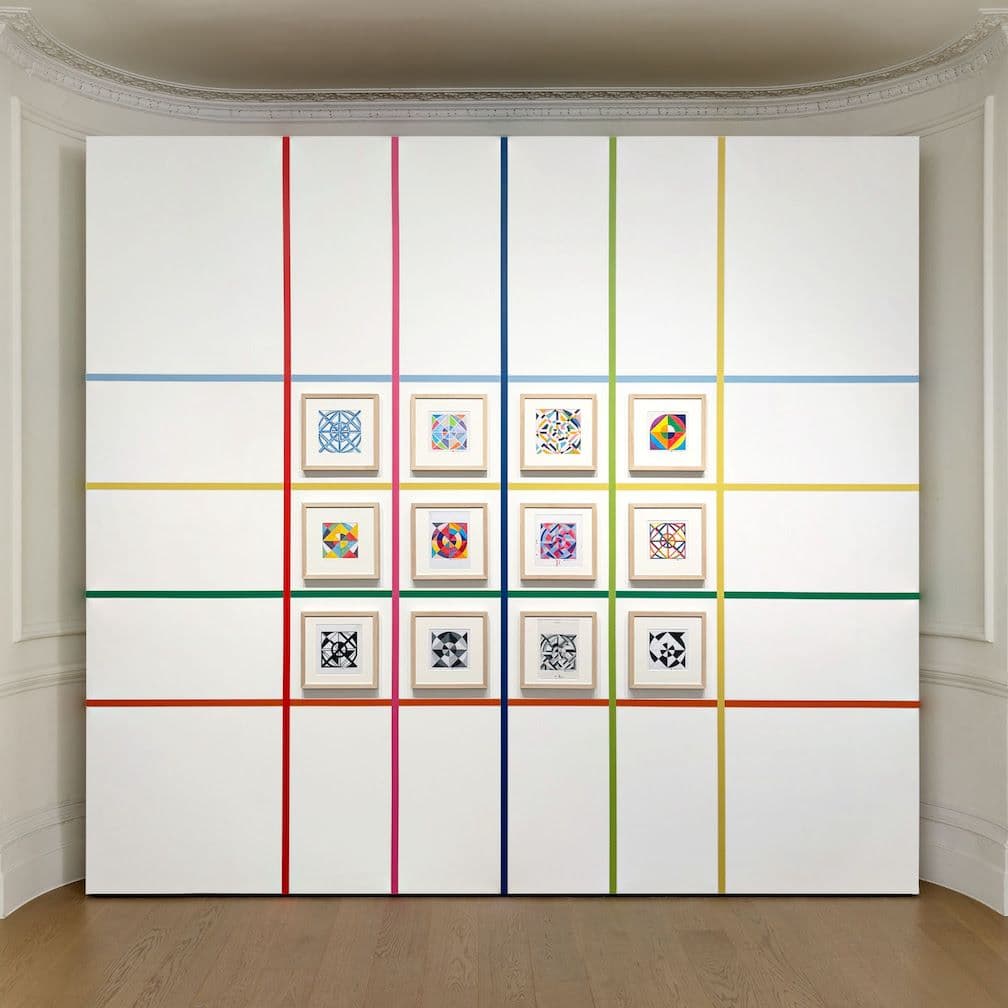
Timothy TaylorTimothy Taylor is pleased to present Encounters, an exhibition of new works by Eduardo Terrazas. The gallery’s fourth presentation dedicated to the artist features ten large-scale geometric abstractions completed this year, including three works from an eponymous new series in which the artist returns to oil on canvas for the first time in more than five decades. The exhibition also includes twelve mixed-media works on paper. Together, these dynamic pieces expand Terrazas’s enduring exploration of colour, luminosity, structure, and possibility. Since the 1960s, Terrazas, who is currently featured in the main exhibition of the 60th Venice Biennale Stranieri Ovunque – Foreigners Everywhere (through November 24), has made significant contributions to the fields of architecture, design, art, and urban planning. In 1973, he developed the ongoing series Possibilities of a Structure, which fuses the Modernist language of geometric abstraction with traditional techniques, such as yarn painting practised by the indigenous Huichol people of Sierra Madre Occidental in Mexico. The works in Cosmos—the first of five subseries—iterate a geometric structure Terrazas conceived based on perceptions of the cosmos. The structure features the X and Y axes from the Cartesian coordinate system intersected by two diagonal lines, which represent infinity, all surrounded by a circle that embodies the Greek celestial dome. Four diagonals form a rhombus, representing the four forces that maintain harmony in the universe: gravity, electromagnetism, strong nuclear force, and weak nuclear force. At the centre of the structure is planet Earth, symbolised by a circle. The exhibition includes four kaleidoscopic works from Cosmos, in which the artist presses wool yarn into Melipona beeswax that has been layered on wooden boards, creating meticulous designs. The works have a potent tactility; light catches the yarn as it stretches in different directions, lending a sculptural and almost animistic quality to the surface. With their play of colour, line, and depth, these works encourage a meditative, spiritual state and contemplation of the cosmos’s exquisite dimensions. Twelve smaller works on paper from the same series dating from 2015 to 2022 offer a greater view into the remarkable diversity of effects the artist has drawn out from his exploration of these fundamental geometries. Building on the logic of Cosmos, Terrazas developed the series Cosmic Variations, which features the same retooled craft traditions but explores tensions inherent to other polygons. Three new works from the series are featured here, including a dodecagon comprised of vibrant fragments of colour whose angles set the viewer’s eye in constant motion. Two octagons offer vastly different perceptual experiences. One, in oceanic shades of blue, houses extended triangles that seem almost to fold and collapse in space like origami. The other, in grayscale, reconceives the same geometric possibilities of the octagon but results in the faceted appearance of a cut diamond. With the new series Encounters, Terrazas returns to his roots, presenting his first oil on canvas paintings made since his Zero series of 1969. In three works, the artist materialises distinct compositions based on simple grids that evoke networks and neighbourhoods. Each suggests, in its own way, notions of flux, progress, interdependence, and continuity. Across the works in these resonant series, Terrazas reflects how we are all interconnected in space and society. With his exploration of form, he makes vivid the idea that setting aesthetic contours leads not to limitation, but to a range of possibilities. Trained as an architect, Eduardo Terrazas (b. 1936, Guadalajara, Mexico) first gained international acclaim for his urban environments and the logo, co-designed with Lance Wyman, for the 1968 Olympic Games in Mexico City. The motif, based on a Huichol textile, was heralded for foregrounding Mexican traditional folk design infusing it with a modern and abstract graphic sensibility. In the 1970s, he began a series of investigations into geometric forms that would serve as a throughline within his artistic career. Terrazas has held positions as a lecturer in Architectural Design at Columbia University, New York, from 1964 to 1965; the University of California, Berkeley, from 1969 to 1970; and Cidoc, Cuernavaca, in 1971. He mounted his first solo exhibition in 1972 at the Palacio de Bellas Artes, Mexico City, and the following year his work was the subject of exhibitions at the Museo Nacional de Bellas Artes, Santiago, Chile, and at the Museo Nacional de Arte, La Paz, Bolivia. In 2013, he was invited to contribute his Tablas series, which employs a Huichol yarn-painting technique, to the Sharjah Biennial, and a large-scale survey of his work was presented in Segunda Naturaleza, Museo de Arte Carrillo Gil, Mexico City in 2015. Last year, the Museo del Palacio de Bellas Artes in Mexico City honoured the artist with a retrospective exhibition that spanned his practice from painting and architecture to urban-scale projects. His work is currently featured in Foreigners Everywhere, the main exhibition of the 60th Venice Biennale, curated by Adriano Pedrosa.