
East, London
Galerie Tschudi
Condo London 2026
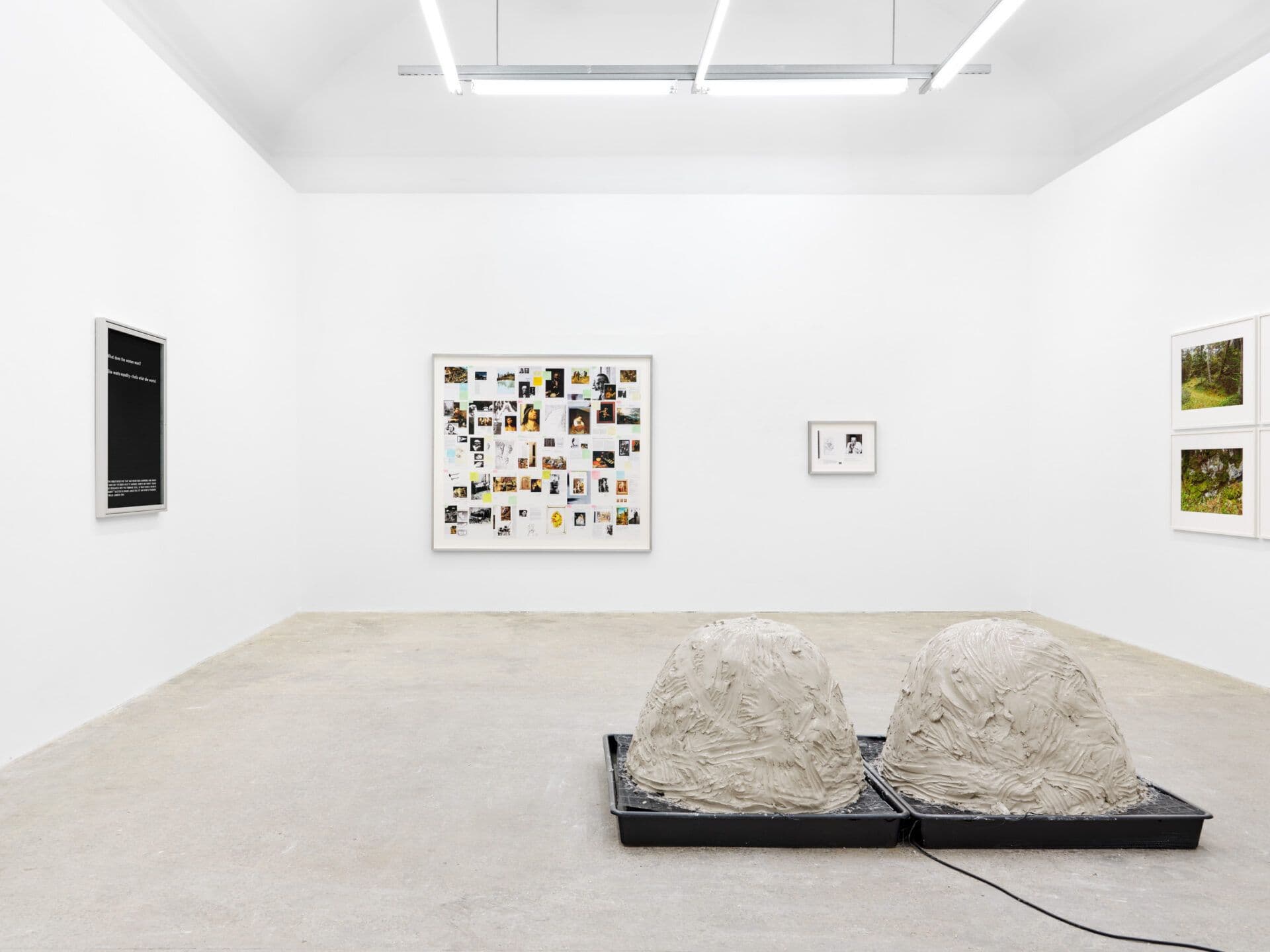
Hollybush GardensHollybush Gardens hosting Galerie Tschudi, Zuoz/Zurich presenting Bethan Huws and Andrea Büttner's Birds. Hollybush Gardens is pleased to host Galerie Tschudi for Condo London 2026, with an exhibition that brings together works by Bethan Huws and Andrea Büttner. The title refers to the birds that recur throughout works by both artists – and also the use of ‘bird’ as a slang term for women in English. A new ‘word vitrine’ by Huws responds to Sigmund Freud’s question ‘What does the woman want?’, while Büttner’s Fountains (2011) is a sculpture in the form of an enlarged pair of breasts. The show explores the research-based nature of the artists’ practices, their shared and long-standing interest in Marcel Duchamp, the history and legacy of Conceptual art and the readymade, appropriation, and linguistics. For Huws, birds in flight are analogous to human thought. Her film Zone (2013) features footage of around twenty species of water birds, including cranes, egrets, herons, cormorants, coots and kingfishers, sourced from wildlife documentaries, which is collaged together to reimagine an encounter at a lake in the rural Limousin region of France. The footage is accompanied by a voiceover of Guillaume Apollinaire’s poem of the same name, which he read to Duchamp, Francis Picabia and Gabrièle Buffet on a significant journey in 1912 to the Jura mountains in France. Echoes of the poem recur throughout Duchamp’s work, and it features a passage in which real and imaginary birds from all regions of the world – the hummingbird, eagle, African Ibis, Roc-bird, and Chinese peehees – fly into the poem. This shared play on words, presents itself throughout the exhibition. Huws’ ongoing series of ‘word vitrines’ (1999–) features white plastic letters inserted into lined black backgrounds inside glass-fronted aluminium cases; industrial readymades most commonly found in offices and restaurants to display rudimentary information such as opening hours or menu items. The sentences in Huws’ vitrines each communicate a particular thought or proposition: Untitled (We don’t need artists we need thinkers) (2019) is a critique of artists working in the wave of Conceptual art in the 1990s, while Untitled (What does the woman want? She wants equality – that’s what she wants!) (2025) is a response to Freud’s question in the context of gender equality. Huws’ interest in signage as readymade is also evidenced in the neon work Carotte de tabac (2018/22), a reproduction of the red double inverted cone sign that designates tobacconists in France. A simplified figure of a carotte de tabac featured on the front cover of the catalogue Surrealist Intrusion in the Enchanters Domain, produced to accompany an exhibition organised by Duchamp and Andre Breton in 1961. Of the many tobacco related items in Duchamp’s work and the numerous photographs of him holding a cigar or pipe with smoke billowing around, Huws writes: ‘all this suggests to me that Duchamp knows perfectly well the etymological meaning of the word ‘esprit’ – indeed his ‘first words’ note in the Green Box, I would interpret as referring to etymology. The word esprit originally comes from the Latin spiritus ‘soufflé’ (breath), from ‘vent’ (wind), and abstractly ‘esprit’ (spirit/mind), of spirare ‘souffler, respirer’ (to blow, to breathe), from ‘vive’ (to live, to breathe).’ Moss and its biological and linguistic associations hold a longstanding fascination for Büttner. She writes: ‘Moss is like a moist Land Art version of the dust on the surface of Duchamp’s Large Glass (1915–23), shown in Man Ray’s photograph Dust Breeding (1920). It gathers where surfaces are left alone. Moss is something small that can be found nearly everywhere. Moss is also a slang word for money in German.’[1] From 2011–14, Büttner spent time researching the internationally renowned moss collection at the National Museum Cardiff, Wales, and worked closely with Ray Tangney, a moss curator, biologist and specialist in biodiversity. She discovered that mosses are cryptogamous plants, meaning they have a hidden sexuality; they are small and reproduce via spores, rather than seeds. Büttner came to understand a connection between hidden sexuality, smallness and shame – mosses are associated with themes of littleness, humiliation and judgement. The series of twelve photographs, taken by Tangney on his field trips and displayed in a grid formation, includes close-ups of different moss types, images of moss growing alongside neighbouring plants, and wider views of moss growing on rocks in various habitats. The green grid is another reference to Duchamp; according to Huws green is the colour that recurs most frequently in his work, most notably in the Green Box, the notes that accompany the Large Glass. Büttner’s monochrome Phone Etching (2015) – also reminiscent of the accumulation of dust on the Large Glass – is part of a series of abstract depictions of everyday gestures evidencing traces of the artist’s fingers on the surface of the screen after scrolling on her iPhone. These smudgy marks become incidental paintings when transposed and enlarged; they recall twentieth-century gestural abstraction and bring attention to the residual marks left by the human body on the digital device. Fountains (2011) comprises two roughly shaped hand-made mounds of unfired clay. They discreetly spout water from a hole at the top of each mound, which drips slowly down their sides. Referencing both Duchamp’s Fountain (1917) and Sherrie Levine’s cast-bronze replica Fountain (Buddha) (1996), Büttner’s active fountain and its form, suggestive of an enlarged pair of breasts, could be seen as a feminine and abject response to Duchamp’s porcelain urinal. As Lars Bang Larsen suggests: ‘Büttner’s style of appropriation is anything but blank or smooth. It is dirty and sticky.’[2] The notion of the palimpsest is present in Huws’ Panel works, such as Painting Panel (2020), comprising forty A4 pages arranged in a 5 x 8 grid, which show the relationships between Duchamp's work and the history of painting. As Ulrich Loock writes, she presents ‘collections of notes that…take up Duchamp’s notion of the readymade, in that the exhibited A4 sheets are not originals, but rather printed copies of Huws’ notes, including a number of coloured Post-its.’[3] In the diptych Meine Agnes (2020), Huws brings together a drawing by Albrecht Dürer of his young wife Agnes alongside a photograph of Duchamp taken in 1963 by Marvin Lazarus, both with rolled-up sleeves, seated in almost identical poses of contemplation. Huws notes that there are numerous references to Northern Renaissance painters in Duchamp’s work, and the concept of the bride is a recurring theme. Büttner’s Kunstgeschichte des Bückens (Art History of Bending) (2021) is a dual analogue slideshow comprising 80 pairs of 35 mm slides which play on a loop. The side-by-side format references the ‘compare and contrast’ style of traditional Art History lectures. Büttner’s found images – including Ancient Egyptian wall paintings, Roman mosaics, medieval illuminated manuscripts, and nineteenth century Realist and Impressionist paintings by French artists such as Courbet, Millet and Pissarro – together examine the iconography of the bending figure at work throughout art history, carrying out menial labour in rural landscapes and domestic spaces. The figures bend, stoop, kneel, and bow to their work, often with a curiosity and attention towards the physical world; their portrayals speak to poverty and class, but also to a sense of care and devotion. Also included in the exhibition is an ongoing series of embroideries based on drawings (2015–) which reflect Huws’ ongoing interest in art made by individuals without formal training. Featured here are the first two lace textiles to use polychrome threads and the introduction of a new technique, a free style bobbin lace that imitates the marks of the original felt tip drawing. SDF (2020) is based on a drawing acquired by the artist from a homeless person sleeping rough in the Paris Metro of two figures in a domestic space (the acronym stands for Sans Domicile Fixe – without fixed address) and Untitled (Spring) (2020), made after a drawing of a bunch of flowers by a young girl. Huws was drawn to the presence of the seven colours of the visible light spectrum represented in the flower heads, and the economic use of the bottom edge of the sheet of paper. She writes that ‘the point of the exercise with the lace textile works is to attempt to capture the spirit of each individual drawing.’ Andrea Büttner (b. 1972, Stuttgart, Germany), lives and works Berlin, Germany. Significant solo exhibitions include Andrea Büttner Works, Bechtler Stiftung, Uster (2025); What Is So Terrible About Craft?, Hollybush Gardens, London (2024); No Fear, No Shame, No Confusion, Kunstsammlung Nordrhein- Westfalen (K21), Düsseldorf; The Heart of Relations, Kunstmuseum Basel (2023); Shepherds and Kings, Kunstmuseum Liechtenstein at the Johanniterkirche, Feldkirch, Austria (2022); Andrea Büttner, Hollybush Gardens, London (2021); What is so terrible about craft?, Kunstverein München, Germany (2019); The Heart of Relations, Hollybush Gardens, London (2019); Shepherds and Kings, Bergen Kunsthall, Norway (2018); Hammer Projects: Andrea Büttner, Hammer Museum, Los Angeles, USA (2017); Beggars and iPhones, Kunsthalle Wien, Austria (2015); Andrea Büttner, Walker Art Center, Minneapolis, USA (2015), BP Spotlight: Andrea Büttner, Tate Britain, London, UK (2014); and Andrea Büttner, Museum Ludwig, Cologne, Germany (2014). Büttner is the winner of the Cologne Cathedral International Art Competition, and is creating a new site-responsive work to be unveiled in 2026. Her work is held the collections of art institutions internationally, including Tate, London; Museum of Modern Art, New York; Walker Art Center, Minneapolis; Hammer Museum, Los Angeles; The Art Institute of Chicago, National Museum Cardiff, Wales; MMK Museum für Moderne Kunst, Frankfurt; Museum Ludwig, Cologne; Lenbachhaus, Munich; Kunstmuseum Bonn; Staatsgalerie Stuttgart; Hamburger Kunsthalle, Hamburg; Julia Stoschek Collection, Düsseldorf; Reina Sofia, Madrid; Kunsthaus Zürich; Walter Phillips Gallery, The Banff Centre, Canada; Collezione Maramotti, Reggio Emilia, Italy; Louisiana Museum of Modern Art, Denmark; Kunstmuseum Basel, Switzerland; Kunstsammlung Nordrhein-Westfalen (K21), Düsseldorf, Germany; Stedelijk Museum, Amsterdam. In 2014, Büttner’s artist book Hidden Marriages, which brings together photographs of moss alongside drawings by Gwen John, was published by Koenig books on the occasion of her solo exhibition at the National Museum Cardiff, Wales. Bethan Huws was born in Bangor, Wales in 1961 and currently lives and works in Berlin and Paris. She studied at the Royal College of Art in London from 1986–88. Her works have been shown in numerous group and solo exhibitions, including Kunsthalle Bern; ICA, London; Haus Esters, Krefeld; Städtische Galerie im Lenbachhaus, München; Kunsthalle Düsseldorf; Tate Britain, London; Bonnefantenmuseum, Maastricht; Kunstmuseum St. Gallen, Switzerland; Kestnergesellschaft, Hannover; Centre International d’Art et du Paysage, Vassiviere; Whitechapel Art Gallery, London; FRAC Limousin, Limoges; Ludwig Museum, Cologne; Kunsthalle Karlsruhe; Kunstmuseum Bern; Kolumba, Cologne; Kunstmuseum Winterthur, Hamburger Kunsthalle, Museum für Moderne Kunst (MMK) in Frankfurt am Main, The National Museum of Modern Art in Kyoto and Centre Pompidou in Paris. Huws represented Wales at the 50th Venice Biennale in 2003 and is the recipient of the 2006 B.A.C.A. Europe Laureate prize at the Bonnefantenmuseum in Maastricht. Her work is represented in public collections of institutions including Tate Britain, London; National Museums and Galleries, Cardiff, Wales; Museu de Arte Contemporânea de Serralves, Porto; Centre Georges Pompidou, Paris; Frac Bretagne, Rennes; Kunstmuseum St.Gallen; Kunstmuseum Bern; Kunsthaus Zug; Kunstmuseum Winterthur; Kunstmuseum Chur; Bonnenfantenmuseum, Maastricht; Museum Ludwig, Cologne; Kolumba Kunstmuseum des Erzbistums, Cologne; Kunstmuseen, Krefeld; The David Roberts Art Collection; The Henry Moore Institute, Leeds; Kunstmuseum Liechtenstein, Vaduz; Art Gallery New South Wales, Sydney; Daimler Art Collection; Stuttgart and Museum für Moderne Kunst (MMK), Frankfurt. Huws’ artist book Research Notes, which compiles her years of research into Marcel Duchamp comprising notes, critical commentary and photographs was published by Koenig Books in 2014. 1 - Andrea Büttner, Hidden Marriages (London: Koenig Books, 2014) 3. 2 - Lars Bang Larsen on Andrea Büttner, walkerart.org/magazine/remarks-lars-bang-larsen-on-andrea-buttner-1-1-a-simple-premise-or- an-idiotic-riff 3 - Ulrich Loock, galerie-tschudi.ch/exhibitions/bethan-huws-exhibition Condo London 2026 is a collaborative exhibition involving 50 galleries across 23 London spaces.