
Marais, Paris
Théo Mercier
Mirror Error
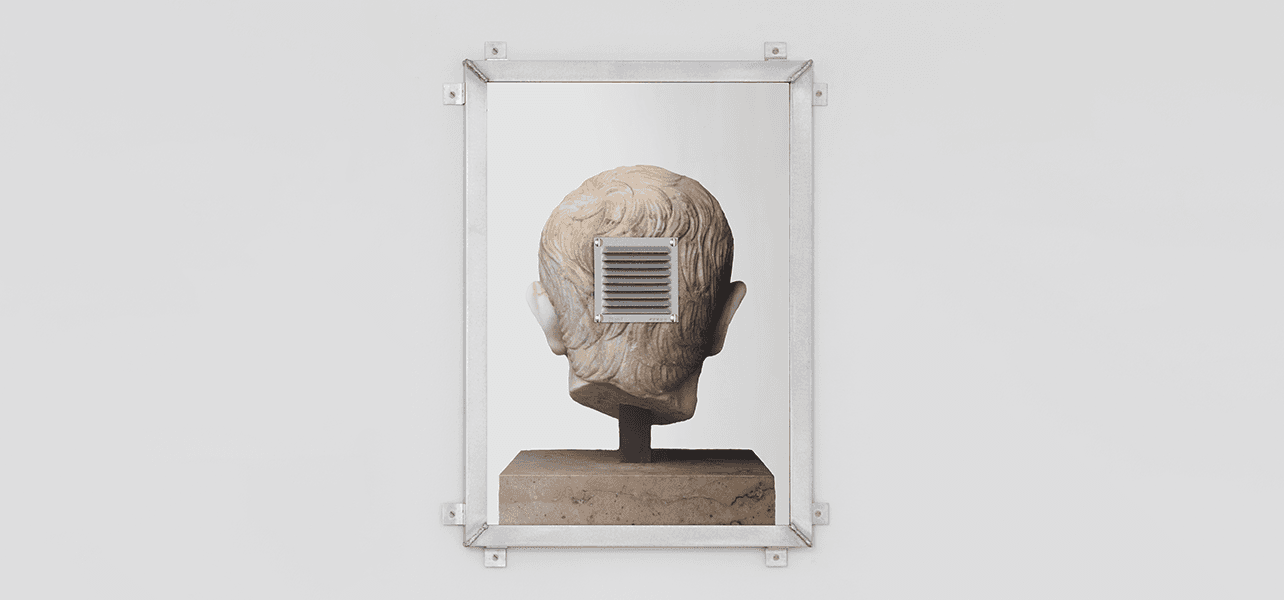
Mor CharpentierFor his second solo show at Mor Charpentier, Théo Mercier questions the role of the archetypal object and the place of the artist halfway between museum curator, laborator and cybernaut. Through a series of new mural works, deeply rooted in artistic references, he challenges traditional representations of portraits and landscapes, and creates visual narratives prompting the viewer’s reflection on time, identity and adaptation. Some twenty acid-etched mirrors are displayed on the gallery's two levels, from which photographs of famous antique statues emerge. The chemical treatment of the surface and the arrangement of the composition are such that the sculptural fragments are superimposed on the viewer's image, blurring the boundaries between past and present, static and dynamic, art and life, and engaging a reflection on the fluidity of identity and the continuum of history. The tradition of mirrors in art extends beyond their practical function as reflective surfaces, delving into realms of symbolism. Artists have often utilized mirrors as tools to explore the human condition, offering viewers a glimpse into their own psyche through self-portraits or capturing the essence of their subjects. But rather than invoking the classical paintings by Van Eyck or Velazquez, in which the mirror is used to achieve realism and create an optical illusion, the Facetime series seems closer to the Pop Art movement, with is fascination for mass media imagery and the combination of disparate elements to produce visually striking and thought- provoking compositions. For Mercier, the fragmentation of these marble bodies is also reminiscent of the looting campaigns that led to the creation of most antique collections: they are pieces torn from their homeland, mythologized, and kept in these fictional places called museums. By choosing a particular cropping on the surface of each mirror —which does not allow a complete view of its surroundings but a simple selection— he accentuates this idea of an incomplete picture and hacks the subjective and artificial construction of history. In some works, the artist goes even further, combining photographs with 3D elements to create chimeras, mutant creatures that have evolved to survive the passage of time: here, a lock of hair is transformed into a fossil; there, an aeration grid is implanted in the back of a skull, as if to provide it with air. These questions of transplant, mutation, or obsolescence run through all Théo Mercier's work, which is itself in constant transformation. Here, the artist takes on the role of the scientist in his laboratory —dissecting and assembling, creating rebus— and through these amalgamations of past, present and future, he invites visitors to reflect on their own capacity to adapt to an ever-changing world. The exhibition is completed by three collections of stones and hand-painted poems arranged on glass and brushed aluminum shelves, which recall the ultra-contemporary frames of the mirrors and once again evoke this collision of temporalities. Stone is the starting point for this project: the sculptor's raw material, it embodies all our fantasies of weight and eternity and refers to the artist's more intimate collecting practice. Almost every day, whether he's in Paris, Marseille, Los Angeles, Mexico City or even Tasmania, Mercier takes a moment to walk around, picking up stones — natural or modified by the hand of man. With their multitude of sizes, shapes and colors, they stimulate and accompany his thoughts and visions, becoming objects charged with music. And it’s no coincidence that the shelves of Tell Me a Scorie remind us of music scores, which initiate a certain choreography of the eye and bring rhythm within the exhibition space. Like the mirrors, the collections of stones are also part of a long artistic tradition of curiosity cabinets or Chinese scholar's rocks — these "natural ready-mades" as Malraux called them. In embracing the repertory work of collecting and classifying, Mercier embodies the figure of the curatorial artist who not only creates but also extracts, orders and arranges. However, and this is his singularity, he does so without ever establishing a hierarchy: in his works, a vestige of the Roman forum can stand next to a polished pebble or the cobblestone of a Parisian construction site. There's a kind of horizontality in values, between the natural and the artificial, the ancient and the contemporary, the vulgar and the precious. Here, the stones are gathered for their purely plastic quality and because they evoke a form of post-industrial geology; together, they shape mineral landscapes that conjure up the great ruins of the past and the more humble ones of everyday objects. Through the interplay of images, materials and cultural references, Mercier deploys a large, fractionated fresco that creates a particular dynamic of the gaze and questions our perception of the world around us. The exhibition thus becomes a space for critical self-awareness and societal reflection, encouraging the viewer to engage actively with the present and ponder the implications of our collective actions on the future.