
Institutions, Venice
Shirin Neshat
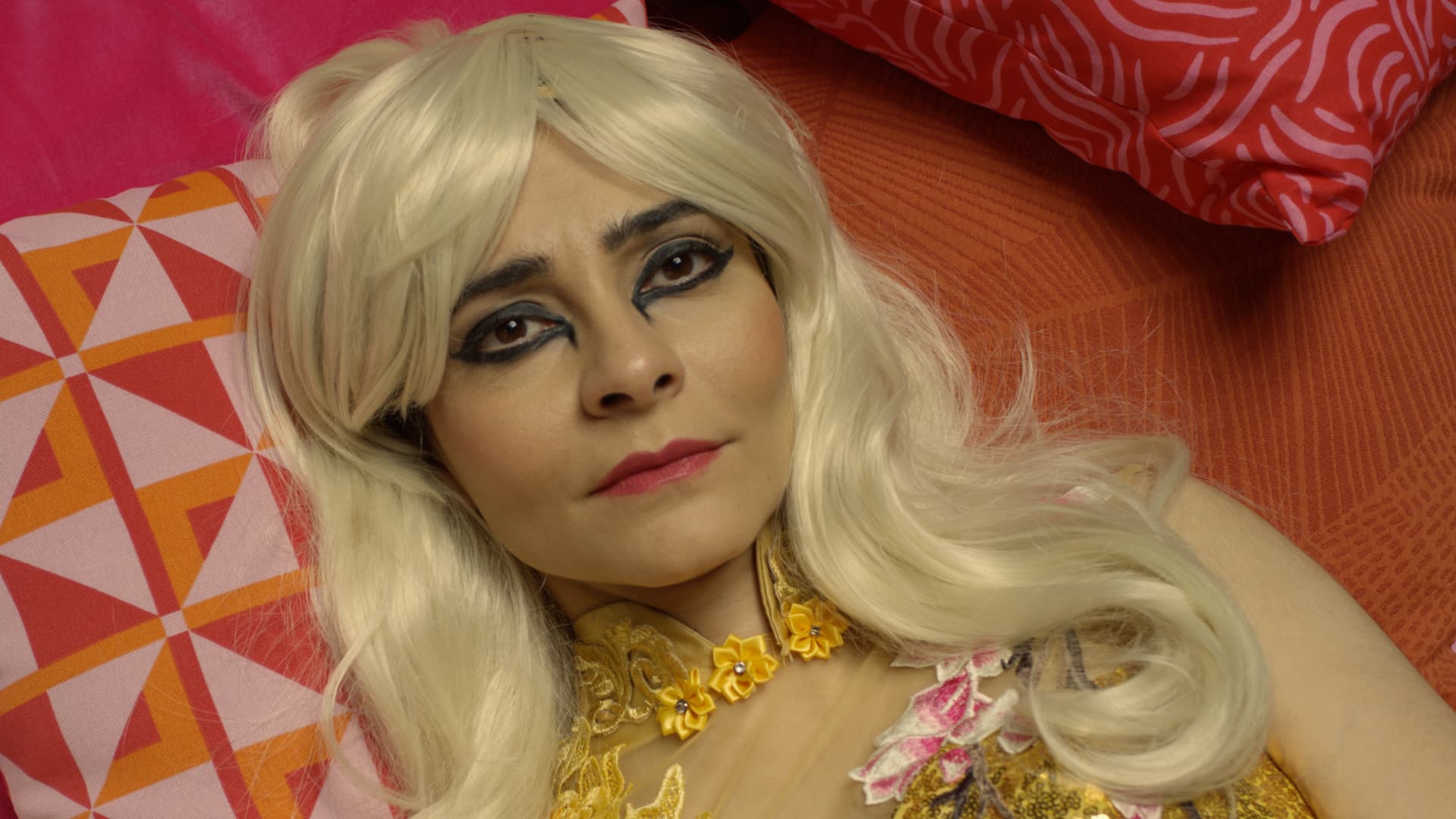
Do U Dare!
Palazzo MarinOpens Friday, May 8 Visual artist and filmmaker Shirin Neshat premieres a new film trilogy this May, concurrent with the edition of the Venice Biennale, curated by Ilaria Bernardi and Bartolomeo Pietromarchi, organized by Associazione Genesi, and Banca Ifis, and presented by Gladstone Gallery and Lia Rumma Gallery. Inspired by Neshat's fascination with the tragic story of Nasim Aghdam, an Iranian-born media personality whose life and artistic practice resonated with Neshat, Do U Dare! explores one artist's gaze upon another and the connections that emerge between them. Shot in three different socioeconomic landscapes in New York, the three films investigate the paradox between women's inner and outer worlds, reality and illusion, and American society and the Iranian female perspective. This trilogy was inspired by the story of Nasim Aghdam, an Iranian woman who due to her Bahá'í faith, fled to the U.S. when she was a child to escape persecution by the Iranian government. Living in suburban California, isolated and struggling to connect with American society while also losing her connection to her Iranian heritage, Aghdam built her own imaginative world online where she performed, sang, and danced in stylized videos that spoke to her longing, rage, and a need to be seen. She embodied and subverted the universal image of women as objects of desire and control through her provocative and unsettling videos that confronted and mocked her viewers' expectations. Her videos went viral, gathering millions of views until YouTube suddenly shut down her channel. Devastated by authoritarian censorship akin to that which her family experienced in Iran, Aghdam entered YouTube's headquarters armed, injured several people, and ultimately took her own life. Examining Aghdam's artistic and life journey, Neshat found that Aghdam's isolation and artistic yearning mirrored her own story of exile, ambition, and displacement, as she too had left Iran for Southern California. Both women carried emotional wounds—nostalgia for their homeland, loneliness, and the psychic fracture of being caught between two worlds—and turned to creative practice as an act of resistance and a way to cope with their circumstances and to forge a new identity. Neshat's empathetic exploration of a once peace-advocating Aghdam's turn to violence inspired the emotional and artistic core of Do U Dare! Each of the three videos in the Do U Dare! trilogy unfolds within a distinct socioeconomic landscape of the greater New York area, forming a fragmented portrait of Nasim Aghdam's inner world: Immigrant Displacement Set in a low-income immigrant neighborhood of Brooklyn, this video follows Nasim as she moves through a community marked by poverty, exclusion, and quiet despair. Observing lives caught in bureaucratic indifference and cultural alienation, she bears witness to the cruelty beneath the American promise of opportunity. Her quiet defiance grows into mounting fury, culminating in an unexpected and radical act of protest, revenge, and a desperate need to be heard. Stardom and the Fantasy of Visibility Filmed in the corporate core of Wall Street, the second video places Nasim amid a dense, buzzing financial district where men and women move mechanically through their routines, emotionally vacant and disconnected. As night falls, the same soulless crowd becomes mysteriously drawn toward a disembodied musical voice. Following the pull of the sound, Nasim discovers herself at its center—transformed into a performer who commands the crowd, moving them to tears. This chapter explores Nasim's obsession with fame, recognition, and public validation. Stardom and artistic ingenuity emerge as seductive forces—a compulsive longing to be seen, admired, and acknowledged, driven by the belief that visibility itself might confer power, relevance, and meaning. Nasim in Her Studio The final video unfolds within Nasim's suburban home, where she secretly produces her own videos inspired by her encounters with the world and the media. She repeatedly impersonates different characters—singing, dancing, and speaking—absurdly ridiculing political hypocrisy, systemic injustice, and racism. These performances become obsessive reenactments drawn from the fantasies, narratives, and personas that consume her, delivered in English and, at times, in Farsi. Central to this chapter is her rejection of the sexual objectification of women, particularly the culture surrounding breast-enlargement surgery. Through confrontational imagery and controlled choreography, the work exposes the paradox of the female body—celebrated for its beauty while simultaneously commodified, surveilled, and consumed, even as women are blamed for their own exposure. Similar to Neshat's previous work, in Do U Dare! the three films build from black and white social realism into a realm of magic and surrealism, illustrating Aghdam's fragile mental state, her emotional instability through exile and displacement, her ultimate inability to distinguish between imagination and reality, and her obsession with impersonating others—experiences that resonate with many immigrants in their attempt at assimilation and belonging in America. Through this intricate interplay between truth and fiction, past and present, Do U Dare! acts as both mirror and dialogue, a meditation on exile, loneliness, artistic obsession, and the fragile boundary between creation and self-destruction. The film questions not only the lengths to which an artist will go to be seen, belong, and reclaim her voice, but also the human cost of displacement and the redemptive power of art. Shirin Neshat is an Iranian-born artist and filmmaker living in New York. Neshat works with the mediums of photography, video, film, and Opera, which she imbues with highly poetic and politically charged images and narratives that question issues of power, religion, race, gender, and the relationship between the past and present, individual and collective through the lens of her personal experiences as an Iranian woman living in exile. Neshat has held numerous solo exhibitions at museums internationally including the Pinakothek der Moderne, Munich, Germany; Modern Art Museum of Fort Worth; The Broad, Los Angeles; Museo Correr, Venice, Italy; Hirshhorn Museum, Washington D.C.; the Detroit Institute of Arts; Stedelijk Museum, Amsterdam, Netherlands; the Serpentine Gallery, London, England; Hamburger Bahnhof, Berlin, Germany; and the Musée d'art contemporain de Montréal, Canada. Neshat was awarded the Golden Lion Award, the First International Prize at the 46th Biennale di Venezia, the Hiroshima Freedom Prize, the Dorothy and Lillian Gish Prize, and the Praemium Imperiale Prize. Neshat directed her first feature-length film, Women Without Men, which received the Silver Lion Award for "Best Director" at the 66th Venice International Film Festival. Neshat directed her first opera Verdi's Aida at the Salzburg Festival and, which was restaged at the Paris Opera House. She is currently directing Gluck's Orfeo ed Euridice, at the Teatro Regio in Parma, which will premiere on January 23rd, 2026.