
NoHo, New York
John Chamberlain
Land Before Time: Three Dinosaurs and a Gondola
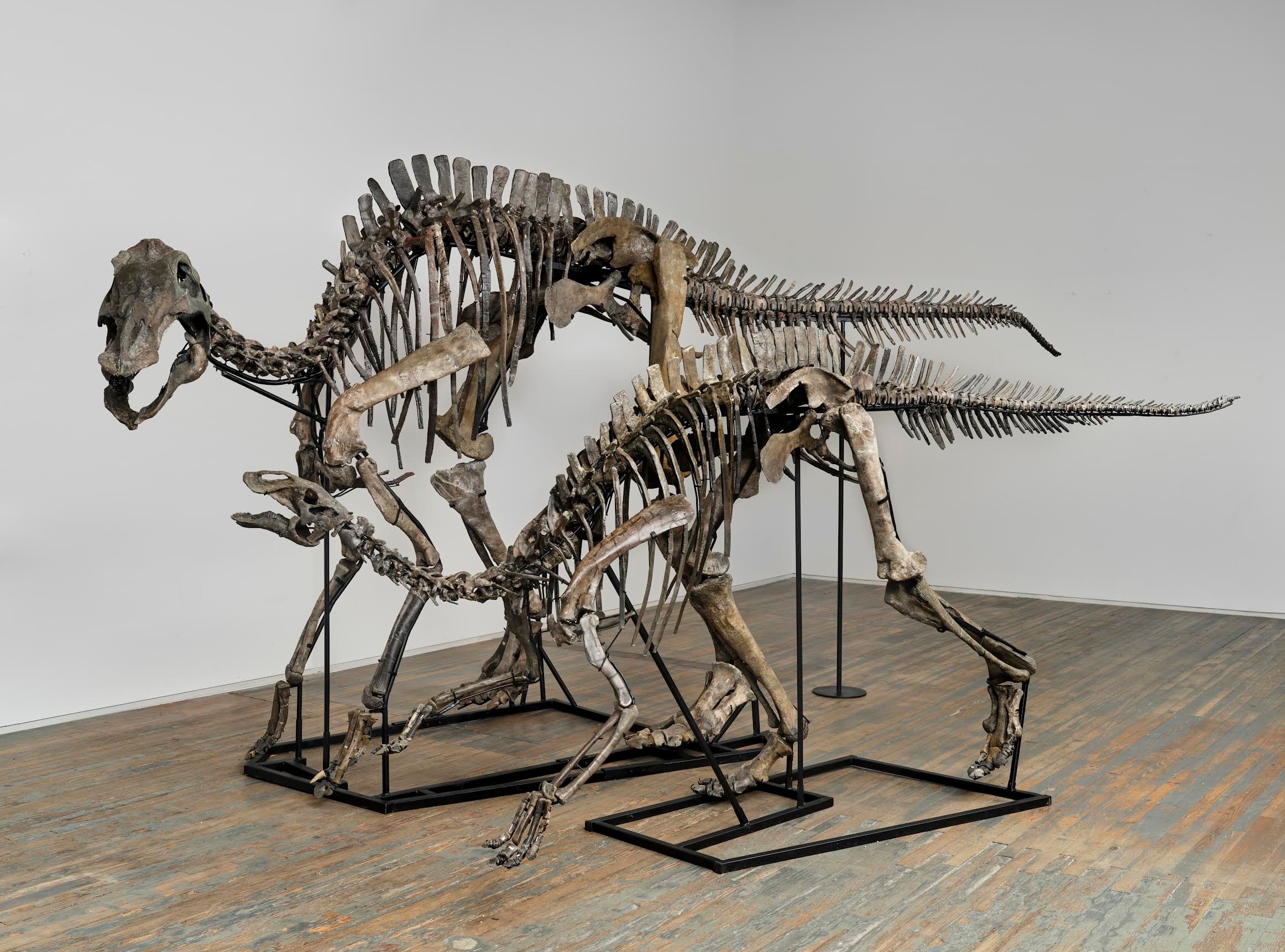
AmanitaAmanita is pleased to present, Land Before Time: Three Dinosaurs and a Gondola, an exhibition pairing three complete Maiasaura fossil specimens with Gondola Marianne Moore by John Chamberlain. This marks the first time a family group of Maiasaura dinosaurs has been exhibited together. The fossil specimens are presented in collaboration with Granada, a cross disciplinary, vertically integrated endeavor that encompasses the full spectrum of activity surrounding natural history - from excavation and sourcing to scientific research, preparation, education, and exhibition. Working alongside Granada, Dr. Frédéric Lacombat and his team of paleontologists led the excavation, mounting, research, and scientific direction of these specimens The exhibition brings into direct dialogue two distinct categories of objects: paleontological specimens and postwar American sculpture. Installed in close proximity, the works are approached not as illustrations of separate disciplines, but as materially and formally comparable entities - objects shaped by processes of compression, accumulation, and transformation over time. The Maiasaura was an herbivorous hadrosaur species whose name translates to “good mother lizard,” referencing evidence of nesting and parental care. The fossils are presented as complete sculptural forms. Their skeletal structures articulate a balance of mass and lightness: elongated spines, rib cages that expand and contract in rhythmic intervals, and limbs that register both weight-bearing function and latent movement. Preserved through fossilization, these bodies have undergone a profound material shift, in which organic matter has been replaced by mineral deposits. The result is not only a record of prehistoric life, but a transformation of bone into stone, forms that are at once anatomical and architectural. In parallel, Chamberlain’s Gondola Marianne Moore, constructed from salvaged automobile steel, registers a different but related order of transformation. Emerging in the early 1980s, these works occupy a critical moment in Chamberlain’s practice, where his signature language of crushed metal achieves a heightened sense of compositional clarity and volumetric tension. Twisted fenders and compressed panels interlock to produce structures that evoke torsos, limbs, and skeletal frameworks. The works suggest a latent figuration: zoomorphic and bodily in their articulation, yet never fully resolved into representation. The full series comprises fourteen sculptures (including the large-scale related work 'Dooms Day Flotilla'). Five of the Gondolas are in the collection of the DIA foundation in New York, NY and three are in the Chinati foundation in Marfa, Texas. This oscillation between abstraction and figuration is central to Chamberlain’s significance. His use of industrial detritus - discarded car parts shaped by impact, force, and prior use - transforms the residue of American postwar industry into objects of sculptural complexity. Chamberlain’s Gondolas, in particular, carry a sense of compression and suspension, as if forms have been arrested mid-collapse. Their surfaces retain traces of paint, weathering, and stress, functioning as records of both mechanical and temporal pressure. Rather than positioning fossils as scientific artifacts and Chamberlain’s works as purely artistic objects, the exhibition proposes a reversal: fossils are understood as sculpture, and sculpture as specimen. Both bodies of work function as records, snapshots of distinct temporal conditions. In Chamberlain’s case, the compressed remnants of late-industrial America; in the fossils, the preserved remains of life from approximately 75 million years ago. The exhibition is grounded in a shared set of formal and conceptual concerns: mass, movement, ruin, time, and material transformation. Across both bodies of work, forms are shaped by forces beyond the artist or organism: pressure, collision, sedimentation, and decay. The Maiasaura skeletons articulate a structural logic of growth and support, while Chamberlain’s sculptures register rupture and recomposition. Yet both arrive at a similar visual language: interlocking systems of line and volume that suggest bodies - whether living, mechanical, or fossilized - caught in states of transition. Visually, the installation is deliberately direct and dramatic, allowing the scale and presence of the works to assert themselves. At the same time, the pairing is structured through a rigorous formal logic, emphasizing compositional parallels in density, silhouette, and internal structure. The result is not a juxtaposition for novelty, but a sustained inquiry into how objects carry time and how materials, organic or industrial, are reshaped into enduring forms. Land Before Time: Three Dinosaurs and a Gondola frames both bodies of work as products of force and duration, where form emerges through compression, displacement, and time rather than singular authorship or intent. In doing so, the exhibition complicates conventional distinctions between artifact and artwork, proposing a shared condition in which objects, whether derived from prehistoric life or postwar industrial material, are continuously redefined by the processes that shape and preserve them. By aligning these works through their formal, material, and temporal qualities, the presentation offers a concentrated lens through which to consider how objects persist, accumulate meaning, and are recontextualized across disciplines. Founded in Florence in 2021, Amanita is a contemporary art gallery dedicated to representing emerging international artists working across painting, sculpture, installation, and interdisciplinary practices. The gallery fosters ambitious, research-driven exhibitions that foreground new voices within a global context. Amanita operates two locations in New York, including its East Village space at 313 Bowery, home of CBGB and recently expanded with the opening of a new gallery in Rome, strengthening its dialogue between the American and European art scenes. Beyond its primary spaces, Amanita has organized exhibitions and projects in Florence, St. Moritz, Los Angeles, and Miami, and has participated in international art fairs in Maastricht, Istanbul, and Turin, supporting the institutional and market development of its artists. Through this transnational presence, the gallery is committed to building long-term careers and contributing to contemporary artistic discourse across contexts. Granada was founded in 2015 in Tucson, Arizona, a place long regarded as the global center of the gem, mineral, and fossil world - a context that continues to shape its perspective and access today. Established by Alison and Rüdiger Pohl, and grounded in a multi-generational legacy of collecting and scientific engagement, Granada was conceived not simply as a gallery, but as a platform to connect natural history with cultural and artistic expression. From its origins in Tucson, Granada has expanded into a broader international framework, with a strong presence in Europe and ongoing collaborations across scientific, artistic, and institutional fields. This evolution reflects a deliberate shift from a place of exhibition to a system of knowledge, exchange, and cultural expression.