
Chelsea, New York
Huguette Caland
My Home
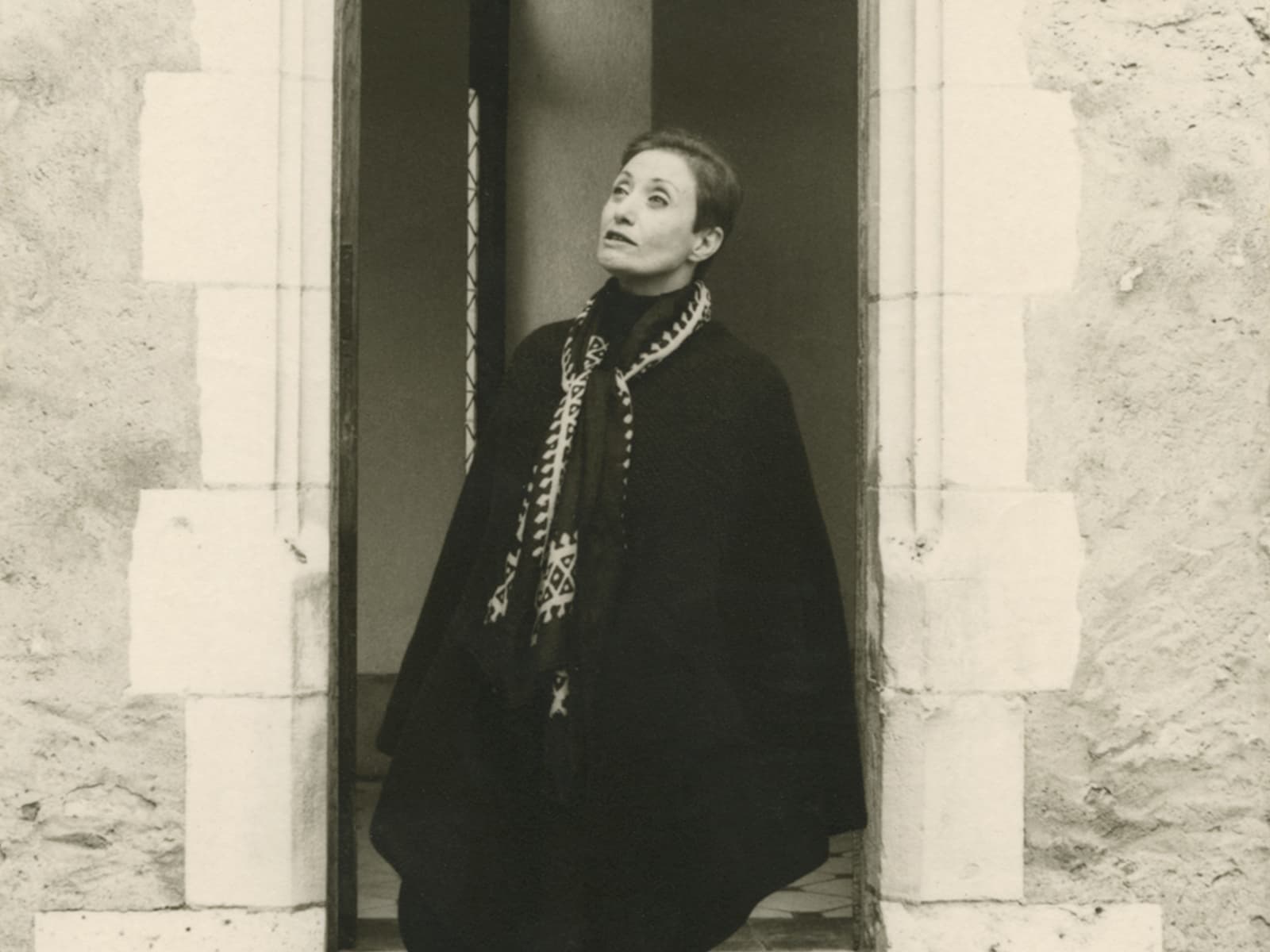
Lisson"Imagination was probably my only homeland" Lisson Gallery is honored to stage the first solo exhibition of Huguette Caland’s work in New York for five years. Organized by independent curator and writer Tarini Malik, this presentation charts Caland’s groundbreaking career across five decades and three continents. Working in Beirut, Paris and Los Angeles, the artist displayed a conscious and liberated attitude toward the notion of home, finding new artistic impetus at every turn and constantly furthering her work, across different countries and cultures. Through drawing, painting, sculpture and writing, Caland developed her unique voice in every location she inhabited and every language she encountered, finding spiritual solace in depictions of places, mental spaces and her own sensual form, a “practice that attempted to undo the rootlessness of both her diaspora and her own body,” as Malik puts it. Born in Beirut in 1931, Caland finally submitted to her passion for making art in the 1960s where she produced remarkable, abstracted, color-field paintings (such as the untitled works shown here from 1968), out of her home in the suburb of Kaslik. These early works demonstrate a sensitivity to form, color and surface that would come to structure her later engagement with the body. If these paintings hold form at a distance, her subsequent move to Paris in 1970, at the age of 39, marks a decisive shift toward a more intimate and embodied language. In Paris, removed from the social and familial frameworks that had previously shaped her life, Caland reoriented her practice toward the body – not as an object to be represented, but as a lived site. The erotically charged Bribes de corps (body fragments) series emerges from this moment of personal and artistic liberation. Here, the artist’s own body is encountered through seams, apertures and shifting contours: partial, proximate views that evoke touch and sensuality. Four works from 1973 present these curvaceous, uncanny landscapes through unfamiliar perspectives, where the body is rendered as a continuous terrain rather than a bounded form. It was in her new studio on Rue du Grand Prieuré in the eleventh arrondissement where that she found license and confidence to express herself fully and immerse herself in the Parisian art world. Working collaboratively with Egyptian, Lebanese and French poets for her series of drawn Corps (1978), her paintings and drawings range from the figurative to the elusive and inscrutable, often in the same work. References to her body, her surroundings and her relationships surface and recede, producing images at once intimate and withheld. This oscillation between presence and withdrawal finds a poignant articulation in her faceless self-portrait from the early 1980s, in which the artist wears her signature abaya or caftan (she designed a collection of them titled Nour for Pierre Cardin), collapsing distinctions between art, fashion and lived identity. She moved to Venice Beach in Los Angeles in 1987, remarking that her name sounded like ‘California-land’. Despite again struggling with her outsider status, she nevertheless entered an incredibly fertile period for her practice. She produced major bodies of work including Silent Memories and Silent Letters, which both contain secret missives and nostalgic feelings either hidden by layers of lines, punctuated by dots or woven into matrices of color. If the earlier works locate the body as a site of encounter, here it becomes dispersed - translated into systems of marks or gestures that both conceal and communicate. Lines, dots and chromatic fields act as repositories for encoded feeling - nostalgia, distance, memory – while also evoking cartographic forms that trace geographies traversed. A pair of irregularly shaped Silent Letters suggests both the outline of the United States and the borders of Lebanon, extending her earlier bodily landscapes into spatial and territorial registers. Two Cityscapes (both 1999) recall vertiginous views of busy intersections and cascading buildings that zoom out from haptic marks toward architectural signs. These vertical panels of urban sprawl also reflect the more domestic view of My Home (1992), a horizontal triptych painted in LA that lends the show its title, evoking the red roof tiles of Lebanon, a central doorway and a figure on the right-hand side. In this work, space is rendered as both lived and distanced, at once a site of shelter and a surface onto which memory and desire are projected. One of her final major bodies of work, the Rossinantes (humorously named after Don Quixote’s trusty steed) extend Caland’s sustained exploration of the body as a site of both mapping and agency. Registering age, movement and lived experience, these works in both sculpture and painting assert a form of self-determination through transformation. In this sense, the Rossinantes bring into alignment the central concerns of her practice: the body as both intimate and cartographic, and home as something continually produced through its shifting forms. As Malik notes, “home was a rendering and a reflection of the self.” A pioneering figure of abstract modernism, Lebanese artist Huguette Caland’s multidisciplinary practice challenged aesthetic and social norms of her time through abstract representations of the female body. Her drawings, paintings, textiles and sculptures render the figure in subtle lines and bursts of color that are simultaneously intimate, erotic and bold. In 1970, Caland moved to Paris from Beirut to pursue her artistic practice, a period that saw an exuberant focus on the body. It was there that she deepened the expressive and explicit power of line and color in her work, creating the Bribes de corps series. Foregrounding the body and its erotic expressions, the paintings from this series shift between figuration and abstraction and established Caland as a key figure in the broader discourse of Abstract Expressionism and Color Field painting. Having moved to California in 1987, she forged influential relationships with leading artists such as Larry Bell and Ed Moses. There, her practice shifted from abstraction to figuration with emphasis placed on the poetics of line, seen in the series Limousin and Granite and Homage to Pubic Hair. Caland’s later works are more intricately constructed ‘landscapes’ that often resemble the surface of textiles; while the compositions appear differently, these works are evocative of her early drawing from the 60s and 70s. In all her work, a perpetual ambivalence appears between the assertion and the erasing of the body, challenging conventions around beauty and desire, Caland’s practice is simultaneously minimalistic and daringly referential. Huguette Caland was born in 1931 in Beirut. After studying at the American University of Beirut (1964–70), Caland moved to Paris in 1970 and then Los Angeles in 1987, before returning to Beirut in 2013. Her work has been the subject of a number of solo and group shows, including ICA Miami, US (2024); The Drawing Center, New York, US (2021); Orlando Museum of Art, US (2021); Tate St. Ives, Cornwall, UK (2019); Institute of Arab and Islamic Art (IAIA), New York, US (2018); 57th Venice Biennale, Venice, Italy (2017); Hammer Museum, Los Angeles, US (2016); Prospect.3, New Orleans Biennial, New Orleans, US (2014); Centre Pompidou, Paris, France (2014); Beirut Exhibition Center, Lebanon (2013); Carnegie Art Museum, Oxnard, US (2012); National Museum of Women in the Arts, Washington DC, US (2010). Caland passed away in Beirut in 2019, aged 88. Lisson’s solo exhibition follows Caland’s touring retrospective curated by Hannah Feldman, A Life in a Few Lines, which toured from the Museo Nacional Centro de Arte Reina Sofía in Madrid to the Deichtorhallen in Hamburg, with the exhibition's final venue being the Hammer Museum in Los Angeles this autumn.