
Downtown, Los Angeles
Honor Titus
Goodness Gracious
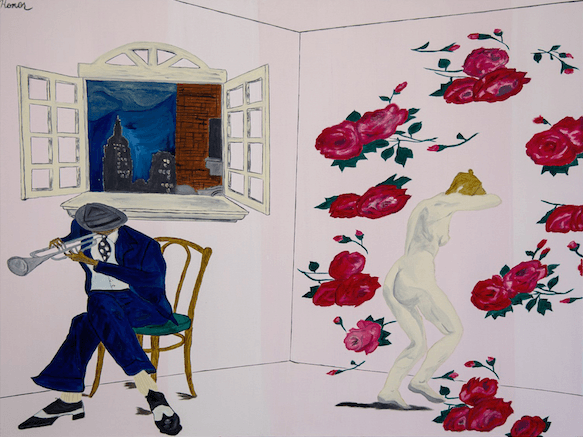
Henry Taylor'sPortrait of Honor Titus as a Nabi Painter They say truth is in the name. There is for certain a lot of “honoring” in Honor Titus’ art: modesty, a relation to different sources that can be perceived in his painting, his mystical temper, which comes through quite clearly in his poems, as he addresses “the definite pessimism/ that is atheism”. His moral stance is one of openness to the world, ready to take on experiences and belong to something greater than he is. Therefore, he welcomes and honors all its elements. We can tie his artistic practice to the life of someone born in 1989, with the Internet and the condition of those who now can do everything and learn about anything. Whether the content of their knowledge is accurate or not, doesn’t matter. Anyone can be a poet, a painter, a musician – all three arts of which Honor is a practitioner. And yet, he does not wear them as a badge of honor – as a title. He practices them, his experience is one of the act, and not of the name. He makes poetry, painting, music, and does not fixate himself in being one or the other. We are what we do: and the more we use the different parts of our brain, of our hand, of the neurons that are in our stomach, the more we can be. His paintings, in their own right, manifest this exponential field of possibility: they draw from a wide range of inspirations, from American art – the metaphysics of Hopper -, the visual language of jazz (let us think of music as a soundtrack for the contemplation of his art), comics (here, we also think of the way Chicago Imagists shifted the relation between high art and comic culture), French 19th century art. He is a keen admirer of the Nabis, notably Edouard Vuillard, whom he has cited as a reference in a title for one of his paintings, named, ominously, Vuillard and Me (2019). The Nabis are a fascinating reference point, as they addressed the language of decoration – a significant part of their work was used as décor - as well as stood at the forefront of the mysticism of the time. The name “Nabi” means “prophet” in both Hebrew and Arabic. Honor is a proper descendant of this lineage: his work enacts and plays with traditions of decoration, both recent and older. We can find in his paintings references to advertisement, as well as to the very method of Vuillard: creating forms of color, that speak to each other, so that the image is a mere starting point, for painting to compose, decompose and recompose itself. Patterns start and end in painting, they end up becoming a material for painting to exist as such. Part of the Nabi methodology was to change the traditional relation between foreground, background, center: in their art, every element of the painting becomes an element of a layering, which has not real back and no real front. Honor’s work, even though we can see components that seem further up and some further down, does not rely on the laws of perspective, as, in so doing, is inherently metaphysical: everything coexists, and no part is more important than another. It is this coexistence and this layering that build up the material of his art. The Nabis were early pop artists, to a certain extent: they saw every form of image, then spreading, as food for paint- ing, for this laboratory of images that come, go, and remain. They were early abstract artists, who understood before abstraction became a language of its own, that then would limit itself. They felt that abstraction was a process during which an image is extracted from an image, and then returns into composition. All these traits find their succession in Honor Titus’ work. As a poet, he adds words to them: lyrics for images, without images. One thinks of Gauguin’s practice as well: both as a writer who defined and defied the French language, and as a maker of images, who used color as a vibrating space – something equally true of Honor’s work, where blue, yellow, explode outside of the painterly. But Gauguin’s view was conditioned by his materialism: Honor’s view exists in the 21st century, and it is profoundly spiritual. The painter is a Nabi again. - Donatien Grau Honor Titus is a self taught painter (b. Brooklyn, 1989). While touring extensively in a punk outfit and holding poetry readings in NYC, he made the acquaintance of Raymond Pettibon, whom he assisted. After relocating to Los Angeles in 2016, Honor Titus has taken to the medium for his own expression. Honor Titus creates “fragmented street scenes” employing a myriad of influence, whether it be jazz music, memory, literature, architecture, or advertisement. The isolation and romance of the cities he’s inhabited and frequented (New York City, London, Paris, and now Los Angeles) are constant motifs. On view by appointment through February 15th