Hollywood, Los Angeles
Lizzie Fitch & Ryan Trecartin
Ply Would
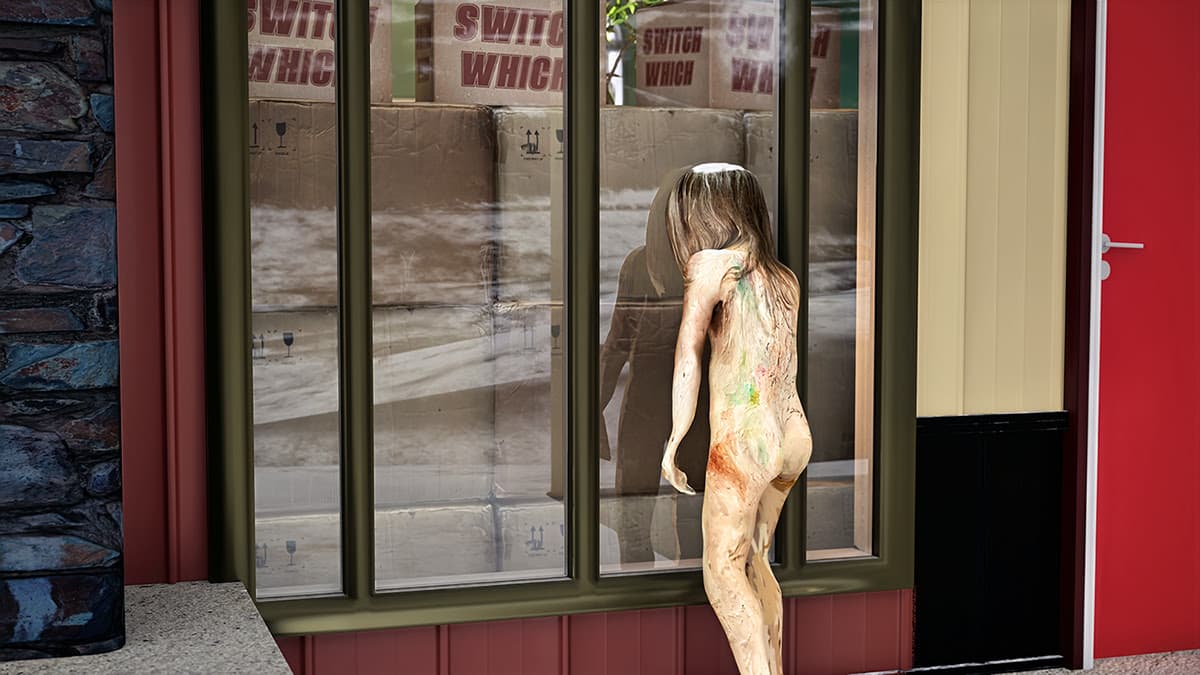
Morán MoránMoran Moran is pleased to present Ply Would, an exhibition by Lizzie Fitch (b. 1981) and Ryan Trecartin (b. 1981), featuring a new sculptural theater housing two interconnected movies. Known for their immersive installations, the artists present several standalone sculptures alongside video work within a room-size hybrid structure as part of their multiphase project Whether Line. Whether Line was initiated in 2016, when the artists relocated to rural Ohio and constructed permanent sets and land work. Comprising a hobby barn, a watchtower, a lazy river trench, and other structures, the site operates as a generative framework—part landscape, part stage, part conceptual engine. Aspects of this real-life setting are transposed into the current body of work as an amusement park or “culture” preserve. Originally commissioned by Fondazione Prada as a large-scale multimedia installation in Milan, the movie that shares the name of the larger project, Whether Line (2019/2026), uses the fiction of idealized rurality as a starting point, exploring contested concepts of territory and property and the inherent mutability of boundaries, whether existential, psychosocial, or physical. In the movie, narrative functions spatially rather than sequentially. Plot points operate as locations on a map that can be entered, revisited, and regulated, while characters are defined less by interior psychology than by position and mobility. The work imagines a speculative social order in which people are featured within a managed environment, their identities preserved according to rules written by an “access class.” What appears as leisure or protection gradually reveals itself as a system of surveillance and constraint—a horror structure embedded within the language of tourism and care. Trecartin has continued to revisit and mine this foundational video work, a strategy he has employed once before in Junior War (2013). In this exhibition, Whether Line (2019/2026), the movie, finds its final form. Structurally, the work embraces iteration, contradiction, and simultaneity, further underscoring the artist’s interest in the fundamental instability and fluidity of meaning. The movie Title Waive (2026) is an evolution of Trecartin’s familiar linguistic and editing devices, with dense layers of virtual rendering, animation, captioning, digital manipulation, and musical compositions recorded live as part of the artists’ expansive performance Audience Plant (2024). Characters recur from Whether Line (2019/2026) but function differently inside the new, partly animated environment. Through continual layering and return, characters and scenes persist across altered states. Lines of dialogue are repeated and tweaked, echoing in loops and fragments, often with a lumbering quality. Faces and settings transform and contort, slipping between the real and the augmented, the subtly imperceptible and the fully uncanny. “We buy and sell origin stories, any condition, any situation,” says one character. “You will never leave the moodboard,” utters another. “Try it again, try it again. More. Build.” Within the exhibition space, the movies are installed inside a sculptural theater that echoes the barn-like structures seen on screen, such as wooden decking, weatherboard cladding, wallpaper, carpet, banisters, sofas, and chairs. Elements of the installation play with the boundaries of interior and exterior space and between observation and participation. The two screens on which the movies are projected are placed on opposite sides of the same partition wall, providing a sense of multiple vantage points on a continuously evolving work. A series of sculptural works occupy the space alongside the videos. Composed of human figures scaled smaller than life, these sculptures act as both a visual and psychological connection between the audience and the two movies. Conceived as software proxies that represent the park’s modeling logic and code, they give human form to the site’s underlying systems—the park’s “back end”—and extend the artists’ long-standing use of character as a structural device: a way of organizing action and language rather than simply expressing interiority. Titles such as Lip Sink (2025), Page (2025), Drift Watch (2025), and Open Fire (2025) position these works as operational units within a larger structure. In a reversal of the artists’ typical process, these figurative works were produced first with the intention that they would be digitized and animated, ultimately serving as framing devices that inform the movie’s narrative and shape how its plots unfold. These sculptural figures appear, in their animated state, in the intro and outro for Title Waive (2026) and were created by longtime collaborator Rhett LaRue using a gaming environment he developed to mirror the artists’ real-life site in Ohio.