Dates
May 28 – Jul 19, 2026
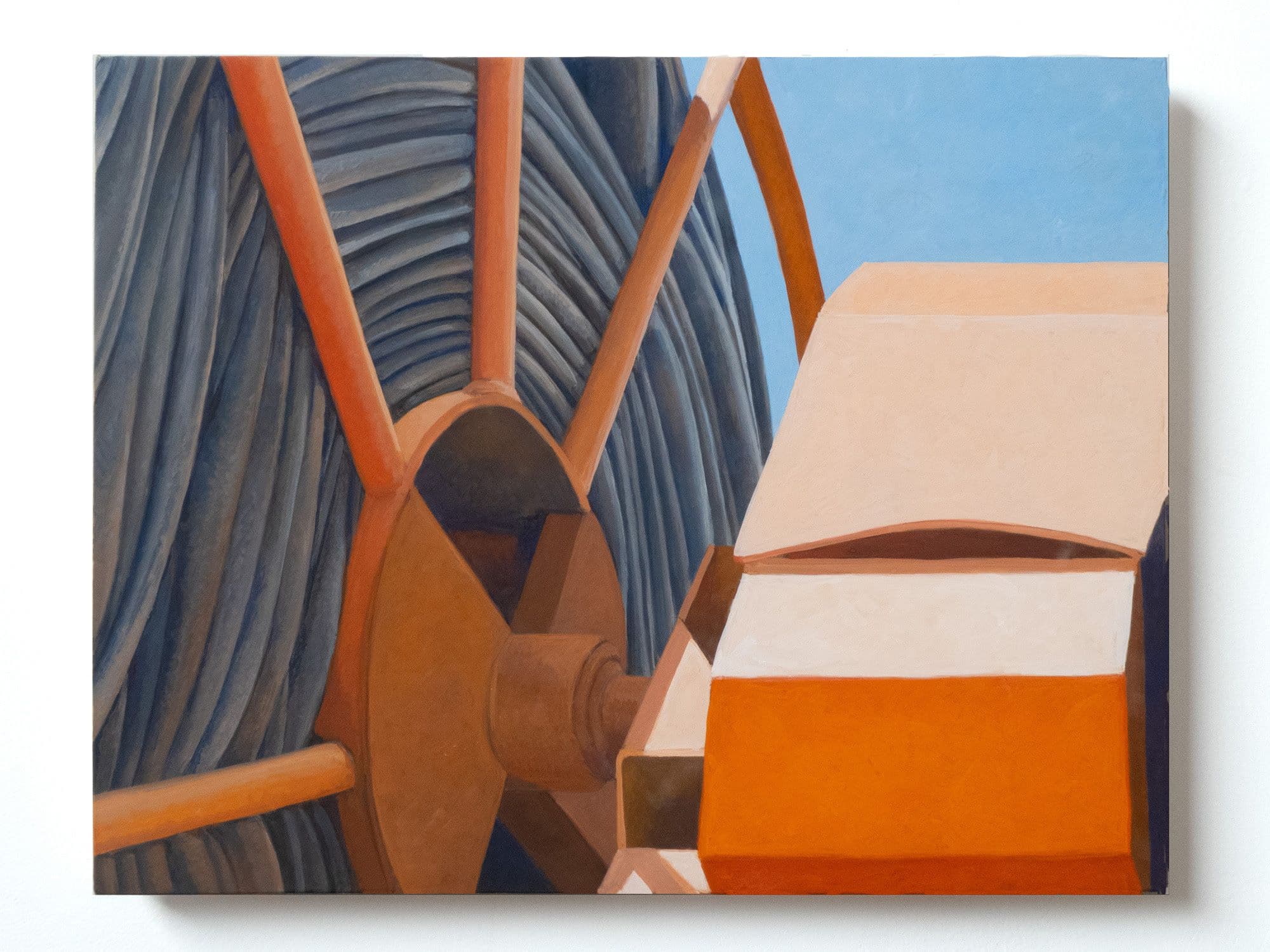
"I believe….that the artist’s fundamental loyalty must be to form, and his energy employed in the activity of making." —William Gass, Finding a Form Why do I choose farm machines to paint? There is a subtext in these paintings: what is the meaning of agriculture in our current culture?; how do we accept the use of dirty, gas-guzzling machinery to produce food?; how are landscapes changed by these practices, by the sometimes upsetting reality of farming? Although these issues were foremost when my subjects were working landscapes, now I am a still life painter of sorts, one who is primarily focused on questions of form. I think of the industrial designers, who were simply making machines that did their jobs efficiently, but as Louis Sullivan wrote, about architecture, “form ever follows function.” Yet function does not preclude beauty. Shape, line, volume, structure: formalist terms of art also make sense in the design world of machinery. Form is ever varying and surprising in these machines, and what I find in them is wildly more imaginative than any composition I could invent. Each spring and early summer I go to local dairy farms with my camera, gathering images for paintings. I often forget, months after taking these photographs, what the machines I’ve depicted actually do. For me what is important are their formal elements, their invitation to abstraction. The translation from photograph to paint changes the image and its meaning. A photograph is of a disinterested moment, and sees detail: a strictly perceptual, straightforward gathering of scratches, dents, rust, making the image “real to life.” In my painting, I am interested in a tactile reality, a reality which emphasizes a solid sense of form, a physical presence; the brief capture of a digital photograph becomes a hand-made object, worked on over time. The strange clarity of unknown things can lead to a sense of the unreal, which I welcome; I also welcome unintended metaphors. I choose to depict the subjects in sunlight, as it brings complexity to color and form; it “elucidates”: (makes clear, illuminates, with an etymology “to shine”). The medium of egg tempera adds to this clarity; its crispness, translucency, and quick drying enable me to layer color, making it rich and vibrant. I began working with egg tempera on gessoed panels almost 30 years ago, inspired by my love of Quattrocento panel paintings. I wanted to steal some of the beauty I found in the predella panels of Fra Angelico, The Master of the Osservanza, and others. Egg tempera suited my precise sensibility. Then, a stunning exhibition of The Hours of Catherine of Cleves at the Morgan Library in 2010 piqued my interest in working on parchment. Oh, I fell in love with the material: the calfskin parchment is smooth and sensuous, and the paint works beautifully on it. Although my painting process demands patience and close attention––building form, layering color over and over, redrawing and changing details––it is deeply satisfying, and at times feels magical; and how wonderful to be painting images of modern machinery using ancient techniques. The small size of my paintings also asks for close attention from a viewer when hanging on a wall, as the things of this world ask us for attention. —Altoon Sultan Altoon Sultan (b. 1948, Brooklyn, New York) lives and works in Groton, Vermont. Having had her first solo exhibition at Marlborough Gallery, New York, in 1977, she went on to have many solo shows in NYC, at Marlborough and at Tibor de Nagy and throughout the United States over more than 40 years, with her most recent solo show at Galleria Zero, Milan, Italy (2025). Sultan’s work has been included in numerous group shows including many at museums such as the National Museum of Women in the Arts, the Philbrook Museum of Art, the Hood Museum, the Fleming Museum, the San Francisco Museum of Art, and the Boston Museum of Fine Arts. Awards include two National Endowment for the Arts grants, an Academy Award in Art from the American Academy, and a medal for painting from the National Academy of Design, where she was elected a member in 1995. Sultan’s works are included in public collections of the Library of Congress, Washington, DC; Metropolitan Museum of Art, New York, NY; Museum of Fine Arts, Boston, MA; National Academy of Design, New York, NY; National Gallery of Australia, Canberra; National Museum of Women in the Arts, Washington, D.C.; Ogunquit Museum of American Art, Ogunquit, ME; Portland Museum of Art, Portland, ME; Princeton University Library, Princeton, NJ; Tate Gallery, London, UK; Walker Art Center, Minneapolis, MN; Yale University Art Gallery, New Haven, CT, among others.