Dates
Nov 15 – Jan 11, 2026
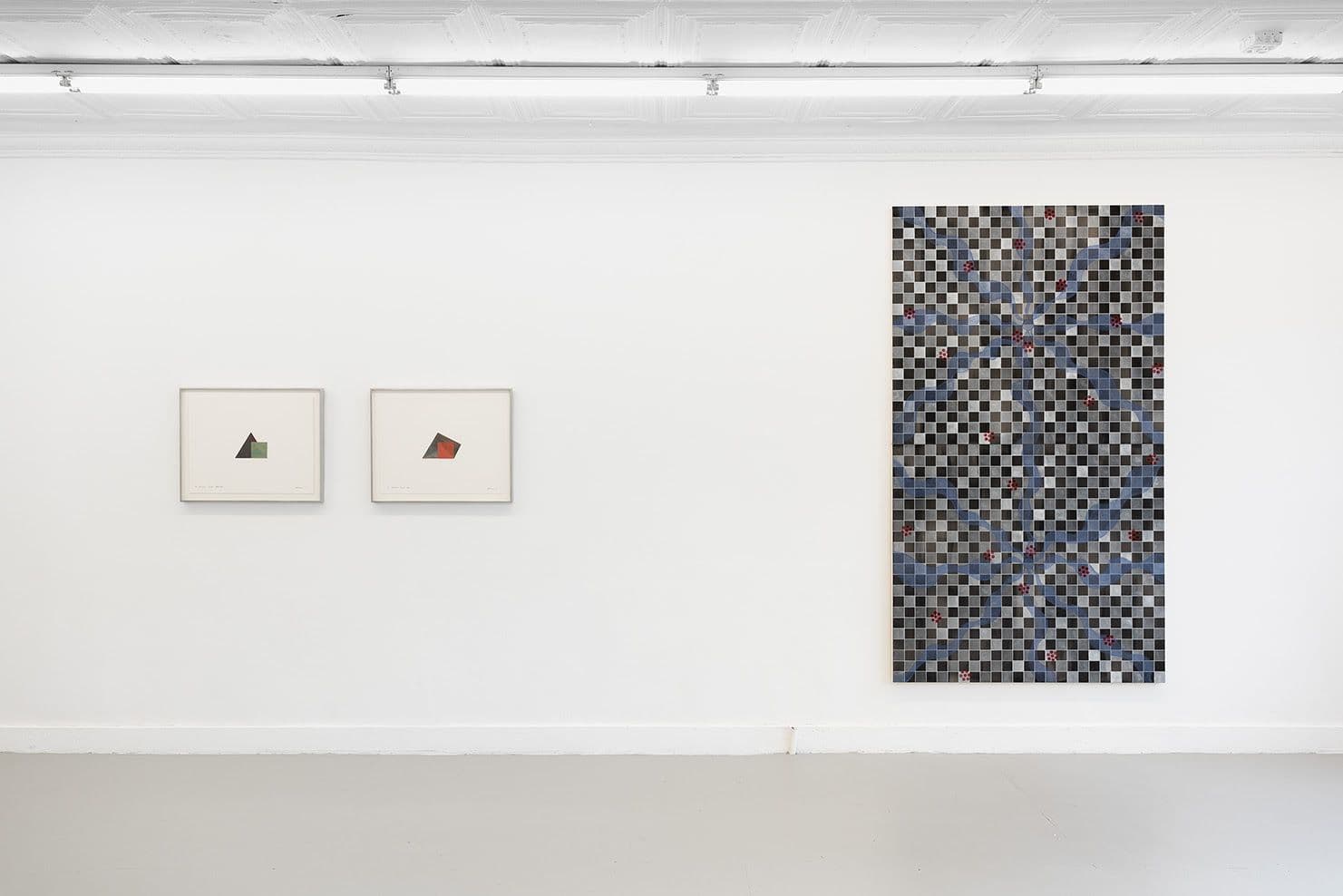
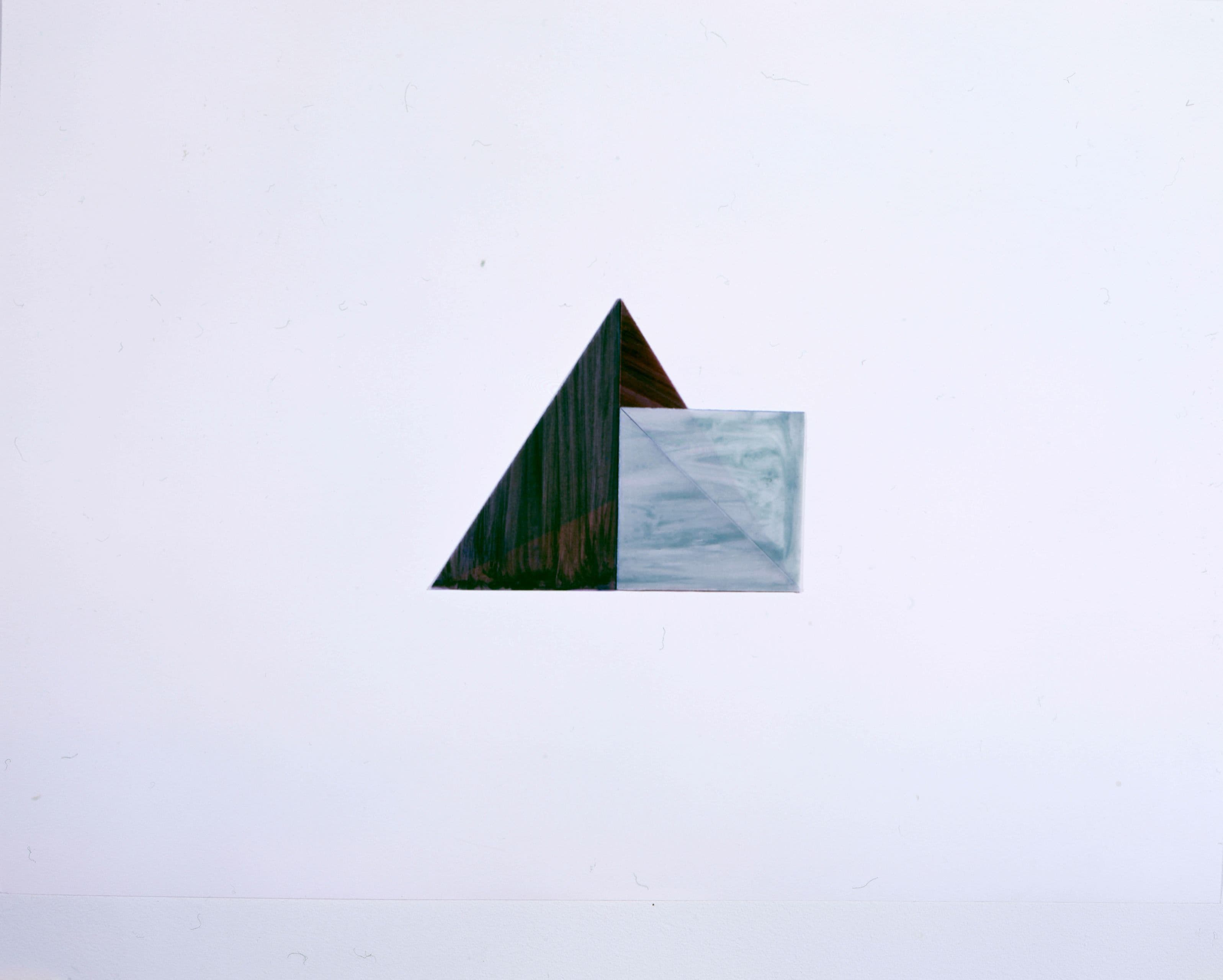
Ulrik is pleased to present a two-person exhibition of the works of Hanna Hur (b. 1985) and Dorothea Rockburne (b. 1929). The exhibition is the first presentation of either artists’ work with the gallery. The exhibition brings together the work of two artists working with the formal vocabulary of geometric abstraction. Each in her own way, the artists use the figure of the angel to articulate a relationship to the history of painting and a relationship to the image. Dorothea Rockburne’s visual language is informed by her training, beginning in 1950, at the Black Mountain College in North Carolina, and then in New York, in the mix of 1960s minimalism. The works on view by Rockburne here comprise a selection of works from the series Small Musician Angels and Angel Study. These were executed over the course of five years, from 1979–84, at the same time as Rockburne undertook the creation of her landmark Egyptian Paintings series of painted, sculpted canvas works. Hanna Hur’s works in the present exhibition were all completed in the current year. Rockburne’s Study For Two Angels, One Hundred Years (1984) is a study for a larger work of painted, folded vellum, affixed directly to the wall. In the study, three modest geometric figures—also vellum painted with watercolor, each figure pleated over itself, its shape configured in keeping with the mathematical principles of the golden section—attend a collage of art-historical angels. The collage features a detail from The Life of Saint Francis, a suite of 28 frescoes painted between 1297 and 1300 in the Basilica di San Francesco in Assisi historically (though not uncontroversially) attributed to Giotto. In the image in Rockburne’s study, we see Saint Francis facing the white glow of a seraphim. In pairing the geometric figures with Giotto’s angels, Rockburne suggests the passage of red, blue, and history between them. Angels also figure in Hur’s practice, evidenced in this instance by Angel xi, Angel xii, and Angel xiii (all 2025). Each features the same image—a pattern of horizontal lines, bisected by a vertical axis—repeated over a series of checkered grids. Though Hur deals in abstraction, she describes the image as representing, nonabstractly, an angel. In conceptualizing the image this way, Hur positions her practice somewhat idiosyncratically in relation to a history of painting in which the angel has been so thoroughly overfigured. Across Rockburne and Hur, we see the angel rendered as transparency, as iteration, as form, and as math—each its own provocation against a historical visual order. Within the strict parameters of Rockburne’s and Hur’s works’ articulated logic are some rogue visual elements, small and exciting moments of looseness and light. Rockburne says that she has always been interested in beauty. In her 1982 work Angel Study: Dark Halo, deep red and blue watercolors resolve into a kind of painterly gradient. In Hur’s Eye i and Eye ii, stripes of thinned blue record the free motion of Hur’s hand. Hur draws upon a precise formal idiom to investigate the relationship between formalism and ritual. This investigation is visible across her practice, where grids, compositions, and color relationships recombine and evolve towards new images and new resolutions. Hur’s Sequence II (2018–25) is made up of accumulated fragments of failed drawings, and as such foregrounds these evolutions, splicing noncontinuous periods of time into a complete image, and taking stock of experiments made along the way. Where Rockburne’s compositions fold time in on itself, Hur’s Sequence II accumulates moments in historical time, building memory and process into the material. —Tess Edmonson Hanna Hur (b. 1985, Toronto, Canada) lives and works in New York. Recent solo exhibitions include Sweetwater, Berlin (2025), Doosan Art Center, Seoul (2024); Dracula’s Revenge, New York (2024), Kristina Kite, Los Angeles (2023, 2021); Feuilleton, Los Angeles (2020); and Bel Ami, Los Angeles (2019). Institutional group exhibitions include Made in L.A., Hammer Museum, Los Angeles (2025), Head For The Hills!, Hammer Museum, Los Angeles (2024); Itinéraires Fantômes, Capc Musée d’art contemporain de Bordeaux (2024); Shadow Tracer, Aspen Art Museum (2022); Drawing Down the Moon, Hammer Museum, Los Angeles (2022); and The Inconstant World, Institute of Contemporary Art, Los Angeles (2021). Hur’s work is held in the permanent collections of The Museum of Modern Art, New York; The Hammer Museum, Los Angeles; and The Museum of Contemporary Art, Los Angeles. Dorothea Rockburne (b. 1929, Montréal, Canada) lives and works in New York. She has been the subject of three significant survey exhibitions in the last decade, including Dorothea Rockburne, Dia:Beacon, Beacon, NY (2018-2022); Dorothea Rockburne: Drawing Which Makes Itself, Museum of Modern Art, New York, NY (2013-2014); and In My Mind’s Eye, Parrish Art Museum, Southampton, NY (2011). Additional solo museum exhibitions include A Gift of Knowing: The Art of Dorothea Rockburne, Bowdoin College Museum of Art, Brunswick, ME (2015); Dorothea Rockburne, Rose Art Museum, Brandeis University, Waltham, MA (1989); and Dorothea Rockburne: Locus, Museum of Modern Art, New York, NY (1981), among others. Significant group exhibitions include From Géricault to Rockburne: Selections from the Michael and Juliet Rubenstein Gift, Met Breuer, New York, NY; Out of Place: A Feminist Look at the Collection, Brooklyn Museum, Brooklyn, NY (both 2020); America is Hard to See, Whitney Museum of American Art, New York, NY (2015); Materializing ‘Six Years’: Lucy R. Lippard and the Emergence of Conceptual Art, Brooklyn Museum, NY (2012); On Line: Drawing Through the 20th Century, Museum of Modern Art, New York, NY (2010-11); The Women of Black Mountain College, Black Mountain College Museum + Arts Center, Asheville, NC (2008-9); High Times, Hard Times, Weatherspoon Art Museum, University of North Carolina, Greensboro, NC (2006); A Minimal Future? Art as Object 1958-1968, The Geffen Contemporary, Los Angeles, CA (2003); Primarily Structural, MoMA PS1, Long Island City, NY (1999); Abstraction, Geometry, Painting, Albright-Knox Art Gallery, Buffalo, NY (1989); Language, Drama, Source and Vision, New Museum, New York, NY (1983); 39th Venice Biennale, Venice, Italy (1980); Whitney Biennial, Whitney Museum of American Art, New York, NY (1979, 1977, 1973); Eight Contemporary Artists, Museum of Modern Art, New York, NY (1974); and Documenta 5 and 6 (1972 and1977), Kassel, Germany, among others. Rockburne’s work is represented in prominent private and public collections, including the Museum of Modern Art, New York, NY; Metropolitan Museum of Art, New York, NY; Solomon R. Guggenheim Museum, New York, NY; Whitney Museum of American Art, New York, NY; Art Institute of Chicago, Chicago, IL; National Gallery of Art, Washington D.C.; Museum of Fine Arts, Boston, MA; Philadelphia Museum of Art, Philadelphia, PA; Yale University Art Gallery, New Haven, CT; Museum of Fine Arts, Houston, TX; Los Angeles Museum of Contemporary Art, Los Angeles, CA; Museum of Contemporary Art, Los Angeles, CA; Art Gallery of Ontario, Toronto, Canada; and the Auckland City Art Museum, Auckland, New Zealand, among many others.