

Chelsea, New York
Group Exhibition
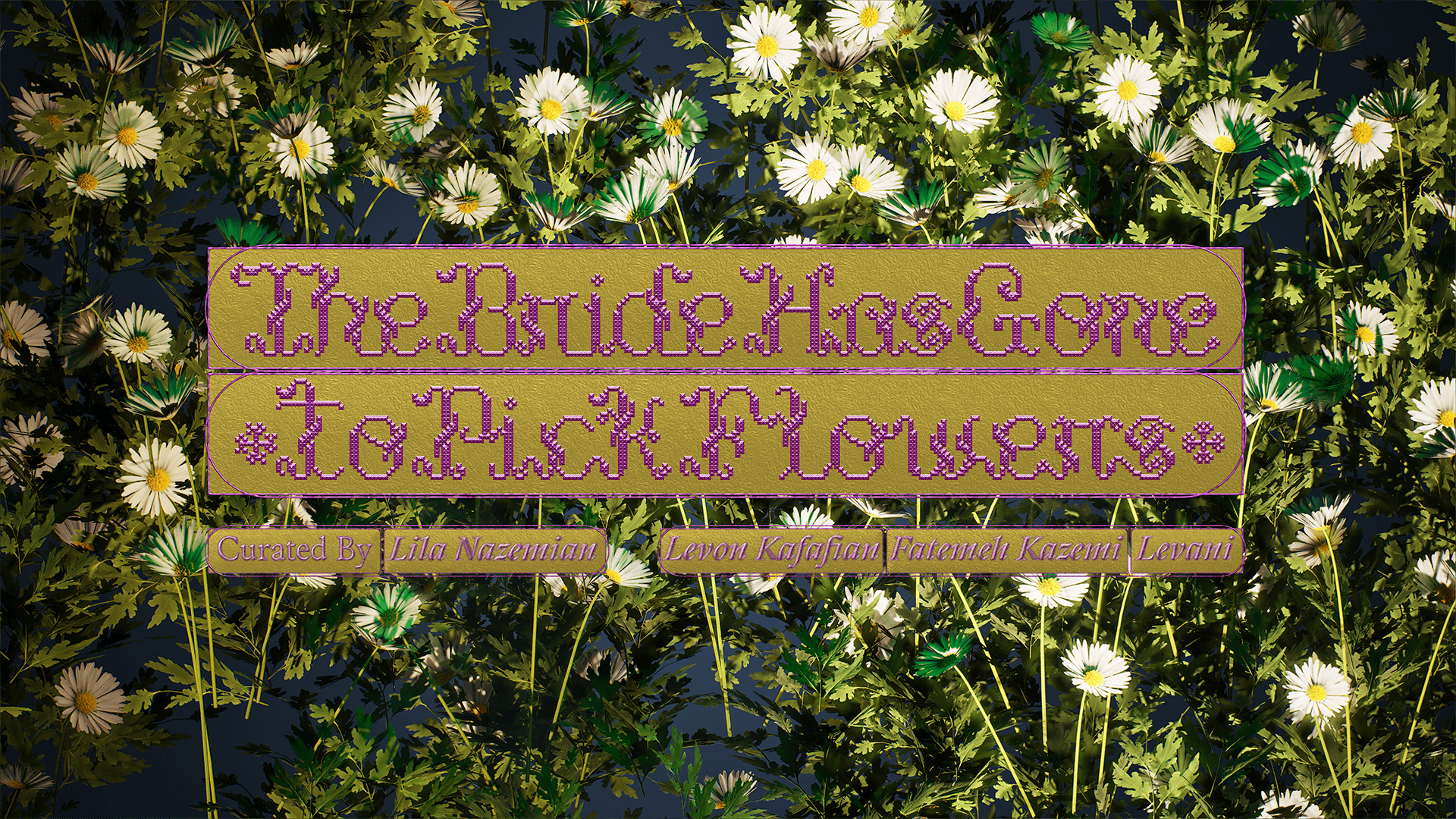
The Bride Has Gone to Pick Flowers
Cue Art FoundationLevon Kafafian Fatemeh Kazemi Levani The Bride Has Gone to Pick Flowers presents works by three artists who utilize installation, sculpture, assemblage, textile, sound, and performance to delve into the significance of marriage rituals from the Caucasus region. Together, they create new worlds that reimagine these traditions through a speculative and queer lens. The title of the exhibition makes reference to a Persian phrase common in Iranian wedding ceremonies: "ل ر روس هنیچب", spoken as part of a playful consent ritual at the altar. When the bride demurs at the first or second offer of marr guests chime in with various lighthearted reasons for why she cannot respond, before the inevitable "yes" arrives. Within the exhibition, the eponymous bride becomes a metaphor for the fluid and evolving nature of identity, a character shaped by the dynamic exchange of ideas and the porosity of cultural boundaries. Each artist employs alter egos as a vehicle for exploring and reinterpreting inherited practices. By embodying ancient deities and iconic literary figures, Kafafian, Kazemi, and Levani question societal norms, reposition archetypal constructs, and expand upon established customs, creating spaces that are inclusive and affirming of queer identities. Levon Kafafian’s installation Mirror of Fate is inspired by the Armenian midsummer holiday hampartsum—a celebration of love and new beginnings. It is centered around the serpentine spirit Anarad, a central figure in their ongoing world-building project, Azadistan. Making reference to the practice of vijagakhagh (fortune telling), Kafafian creates an altar enveloped within suspended panels of hand-dyed silk dedicated to divination and the search for love. Among the objects handmade by the artist within the altar are a book, a leather artifact and rug, and Pools of Liquid Time crafted from satin, beadwork, and cured resin that evoke the flow of time, Anarad’s domain of influence and magic. The work is accompanied by a soundscape by electronic musician and sound artist Lara Sarkissian informed by the resonant echoes of Armenian churches and the mountainous landscapes of the Caucasus. Fatemeh Kazemi’s Yalan Dünya draws inspiration from a ritual led by married women of rubbing sugar cubes above the heads of newlyweds. In Saqi, a partition screen is covered in wallpaper that reproduces drawings of a female figure and archival photos of lovers embracing. These works explore the parallels between celebration and mourning, joy and grief. Kazemi channels her alter ego, the saqi (cupbearer), a seminal character in Persian literature who serves as a conduit for collective memory. In Dünya Mest Olmuş, wall moulding doubles as a concrete poem written from the perspective of the saqi about the process of fermenting grapes to be distilled into libations. The saqi embodies both earthly and spiritual realms and is represented as both male and female, manifesting a fluidity aligned with Kazemi's explorations of queerness and cultural identity. Levani delves into ancient Georgian beliefs and Sumerian mythology in the installation the altar, which marries the elemental forces of fire, water, earth, and air. Projected footage of the sun—a primary source of light, life, energy, and knowledge—is flanked by v. the hierophant i. + ii., two horned, androgynous totems that embody the duality of light and dark, masculine and feminine. Positioned amidst them is a water-filled stone basin hand carved by sculptor Papuna Dabrundashvili. Sounds of protesters in Tbilisi, recorded by artist Marika Kochiashvili, create perceptible vibrations. Across from the installation is ii. the priestexx [bride], which has dual presence as a warrior, and includes hand-hammered copper adornments by designer Godera. These works echo struggles for justice throughout time and highlight the relationship between present-day and ancestral cultural practices. The Bride Has Gone to Pick Flowers transforms the gallery into a sanctuary imbued with the tranquility of sacred gathering sites. Viewers—who enter with their own personal histories, heritages, identities, and beliefs—are invited to take a moment of reprieve to contemplate their place within the world, and to consider how ancient traditions and contemporary realities intertwine to shape our individual and collective understandings of love, identity, and community. Levon Kafafian is a weaver who works the narrative threads of costume, artifact, ritual, and installation into stories about possible worlds and potential futures. Treating woven cloth as portals into these other worlds, Kafafian generates texts infused with future ancestral practice, hybridity, and magic. Their current work channels the world of Azadistan out of the Armenian diasporic imaginary toward the forthcoming graphic novel Portal Fire. Based in Detroit, Kafafian holds a BFA in Fiber from the College for Creative Studies and a BA in Anthropology from Wayne State University (2014). They co-led a seven-week public educational weaving program in partnership with Trapholt Museum for Moderne Kunst, Denmark (2022), and they regularly lecture and teach workshops across the U.S. Kafafian has exhibited at the Museum of Contemporary Art Detroit, the Stamps Gallery at the University of Michigan, and the Arab American National Museum. They are the recipient of numerous grants, including the Alex and Marie Manoogian Museum Grant (2021), Creative Armenia Spark Grant (2021), the Red Bull Arts Microgrant (2020), the Rauschenberg Foundation Seed Grant (2016) and the Knight Art Challenge Award (2016). They have participated in residencies at the International Studio and Curatorial Program (2023) and the Arab American National Museum (2019). Fatemeh Kazemi ظ ط) همطاف (she/they, b. 1992, Tehran)—also known as Afimoh—is an interdisciplinary ar researcher whose practice spans material fabrication, fiction writing, archiving, filming, curating, organizing, and hosting. Her work engages with themes of communal grief or م) (/gham/), underground economies, kitsch Iranian visual culture ritual, and subculture. Developed through conversation and community-oriented collaborations, her approach is deeply rooted in collective experiences. Kazemi earned a BFA in Painting from the University of Tehran (2014) and an MFA in Studio Art from Syracuse University (2024). Her work moves fluidly across worlds, blending installation, lens-based media, and the poetic flow of creative writing. She has exhibited at Parallel Circuit Space (Tehran), SUB Community (Çanakkale), Ruschman Gallery (Chicago), Navel LA (Los Angeles), Smack Mellon (New York), and Bayt Al Mamzar (Dubai). Her experimental films have been screened at the London Short Film Festival, CulturalHub (New York), LUX Book Fair (London), Dresden Film Festival, Everson Museum of Art (Syracuse), and Foundry By Emaar (Dubai), among other venues. Levani (Levan Mindiashvili, b. Tbilisi, Georgia) is a transdisciplinary artist who works at the interstices of art, science, ecology, and spirituality. Ze hold an MFA from IUNA Buenos Aires National University and BFA from Tbilisi State Academy of Arts. Levani has had solo exhibitions at Cuchifritos Gallery + Project Space; Artists Alliance Inc.; Marisa Newman Projects; the National Museum of Georgia; NARS Foundation, and the Silk Museum, Tbilisi, among others. Zir work has been included in group exhibitions at The Bronx Museum of the Arts; Socrates Sculpture Park; Kunsthalle Tbilisi; the National Museum of China; Elizabeth Foundation for Arts; BRIC Biennial; the Tartu Art Museum, and more. Levani is a recipient of residencies, awards, and grants that include: the LES Studio Program at Artists Alliance Inc.; the Annual Fellowship at Socrates Sculpture Park; the Peter S Reed Foundation Grant; the NYFA Immigrant Artist Mentoring Program; the Creative Time X Summit Grant; the AIM Fellowship at the Bronx Museum of the Arts; the NARS Foundation Studio Residency; and an award from the National Endowments for the Arts. Levani’s work has been featured in Frieze, Art in America, The Brooklyn Rail, Bomb, ArtAsia Pacific, Art Papers, Hyperallergic, The Art Newspaper, and more.