Dates
Jan 10 – Feb 8, 2026
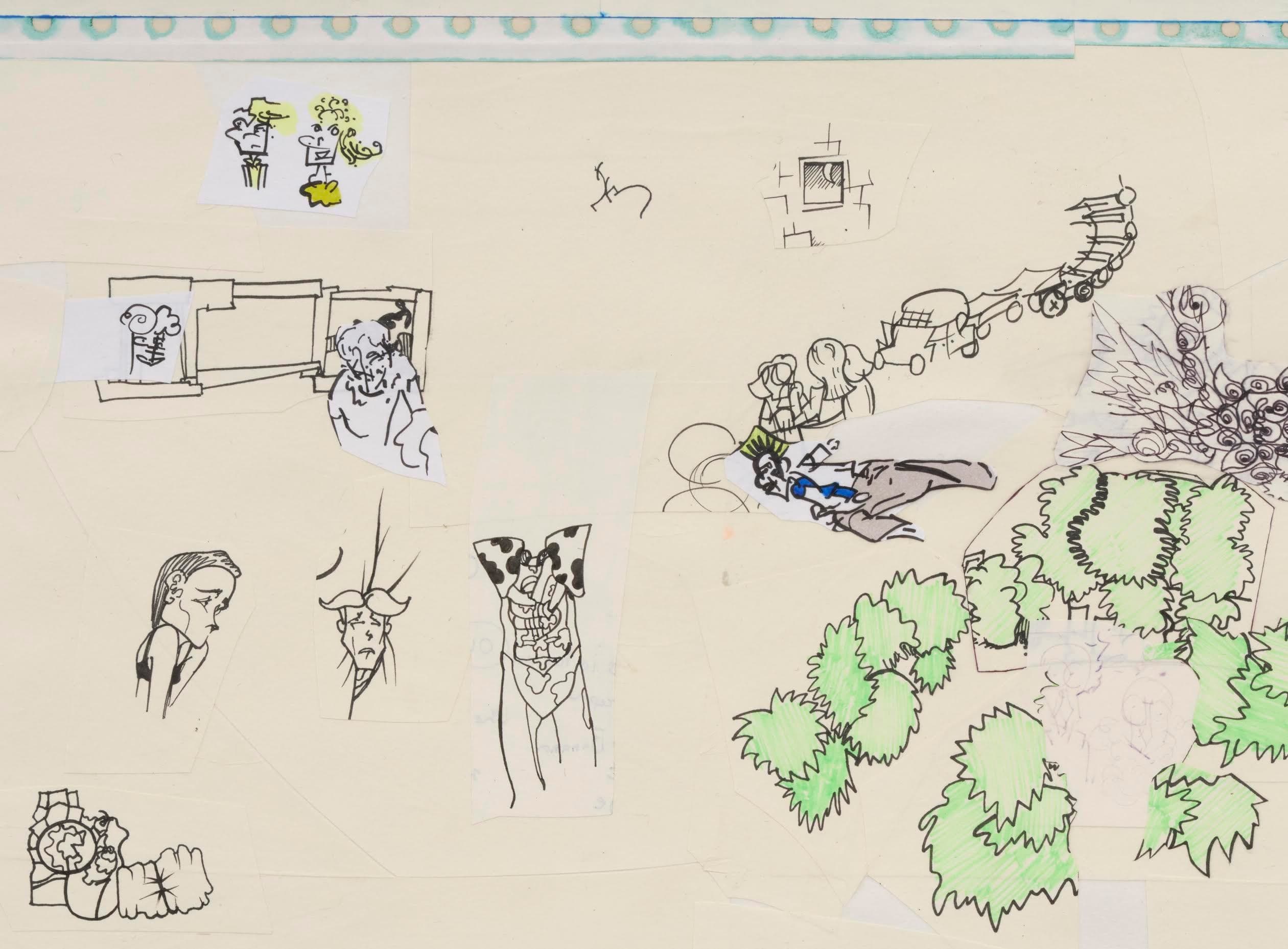
Paul Becker Amalia Schulthess Julia Yerger Château Shatto is pleased to present Ternary, an ensemble of three distinct presentations staged in the gallery concurrently: a focused survey of work by Paul Becker (b. 1967); a suite of sculpture spanning the 1960s and 1970s by Amalia Schulthess (b. 1919, d. 2021); and a grouping of new paintings and collages by Julia Yerger (b. 1993). For two decades, Paul Becker (b. 1967) has realized paintings and drawings that ally themselves with discursion and automatism. His work treats the act of looking—slow, equivocal, and susceptible to drift—as a subject in its own right. Rather than advancing allegory or illustration, Becker uses representational imagery as a strategy to stall, redirect, and modulate attention. Formally, Becker’s work attends to how a figure can inhabit pictorial space without tripping into meaning or narrative. Through an expressive and lambent approach to rendering, Becker finds new and capricious ways of aligning figuration with strategies drawn from ornament, design and decorative structure, allowing an image to hum within myriad referential and aesthetic registers at once. Paul Becker (b. 1967) lives and works in London. He received a Master of Fine Arts from Slade School of Fine Art, London. Select solo exhibitions include: Museum of Contemporary Art, Antwerp; Marc Jancou Gallery, Saanen, Switzerland; Mackintosh Lane, London; Drop City, Newcastle; Le Salon, Brussels; Vane Gallery, Newcastle; Transition Gallery, London; and Chapter Gallery, Cardiff. Becker’s artwork and writing has been presented at venues across the United Kingdom and Europe, including: Swedenborg House, London; Monash University Museum of Art, Melbourne; Towner International Biennial, Towner Eastbourne, Eastbourne; MAUVE, Vienna; M_HKA, Antwerp; Whitechapel Gallery, London; Institute of Contemporary Arts, London; Hollybush Gardens, London; and Studio Voltaire, London. In 2020, Becker was the Abbey Fellow in Painting at the British School in Rome, and was awarded a grant from the Pollock-Krasner Foundation, in addition to a Henry Moore Institute Research Fellowship. The sculptural corpus of Amalia Schulthess (b. 1918, d. 2021) speaks to an economy of transformation that is latent not only in the medium of sculpture, but the world of objects writ large. Working in a manner that Thomas Albright noted as presenting a “clarity and logic that approaches the perfection of mathematics,” Schulthess moved swiftly between marble, cast metals and carved wood to realize a technically ambitious and heterogenous oeuvre across seven working decades. Drawing freely from natural morphology, Schulthess often abstracted the organic architectures of eggs, shells, and subtly erogenous forms, fusing them with motifs that evoke technological or mechanical systems. The result is a sculptural language in which anatomical fantasy and industrial logic cohabit within a single resonant being. Her works often linger in states of metamorphosis, suggesting bodies or structures caught between emergence and dissolution, presence and absence, hand and machine. Taken together, these technically ambitious works constitute not only an exploration of sculptural media, but also a sustained meditation on creation itself. Amalia Schulthess (b. 1918, d. 2021) was born and raised in Switzerland, and studied at State College Torgen, Appenzell Auserrhoden and the Kunstgewerbeschule, Zurich. In 1974, Schulthess was the subject of a survey at Santa Barbara Museum of Art. Other exhibitions in her lifetime included La Jolla Art Centre, La Jolla; Long Beach Museum of Art, Long Beach; Esther Robles Gallery, Los Angeles; Rose Rabow Gallery, San Francisco; David Cole Gallery, Sausalito, and Space Gallery, Los Angeles. Her work is in various public and private collections both in Europe and America including the Santa Barbara Museum of Art, La Jolla Art Centre, and the Long Beach Museum of Art. A felt texture of perception hums across Julia Yerger’s (b. 1993) work. Her compositions conjure an atmosphere of assembly, as broken passages of oil solicit questions around matter, reference and construction. Hers is a decisively still image that stubbornly manages a flickering sense of animation, through myriad images and pictorial units presented in planarity rather than sequence. Yerger’s newest collages provide a philosophical skeleton to her more gamey works in oil: their formats are diminutive, and their renderings even more atomic. These three works comprise re-assemblies of earlier ink sketches––all lifted from an extant studio sketchbook, executed over recent years. Each drawn element remains distinct and independent atop its new substrate, yet a sense of interaction is generated by their surprising arrangement. This relational sensibility is enforced by the presence of a pasted paper frame, staging each scene as a sort of virtual habitat where images seem to communicate and rehearse how they might belong together. These collages expose the material and conceptual armature beneath Yerger’s paintings, a fragile circulatory system of utterances, inflections, and refuse. Julia Yerger (b. 1993) lives and works in Los Angeles. She received a Bachelor of Arts from Maryland Institute College of Art, Baltimore. Selected solo and two-person exhibitions include Château Shatto, Los Angeles; Kings Leap, New York; Clearing, Brussels; PAID, Seattle; New Low, Los Angeles; and Johannes Vogt, New York. Selected group exhibitions include Matthew Brown, Los Angeles; Société, Berlin; Sebastian Gladstone, Los Angeles; Bel Ami, Los Angeles; The Wolford House, Los Angeles; Paul Soto, Los Angeles; Harkawik, New York; Apt 13, Providence and February Gallery, Austin. Yerger’s work has been featured in Art Now LA, Cultured, Contemporary Art Review Los Angeles, and Los Angeles Review of Books.