

East, London
Rosemary Mayer
Make Me a Place in Time and Seasons: Works by Rosemary Mayer, 1971–1983
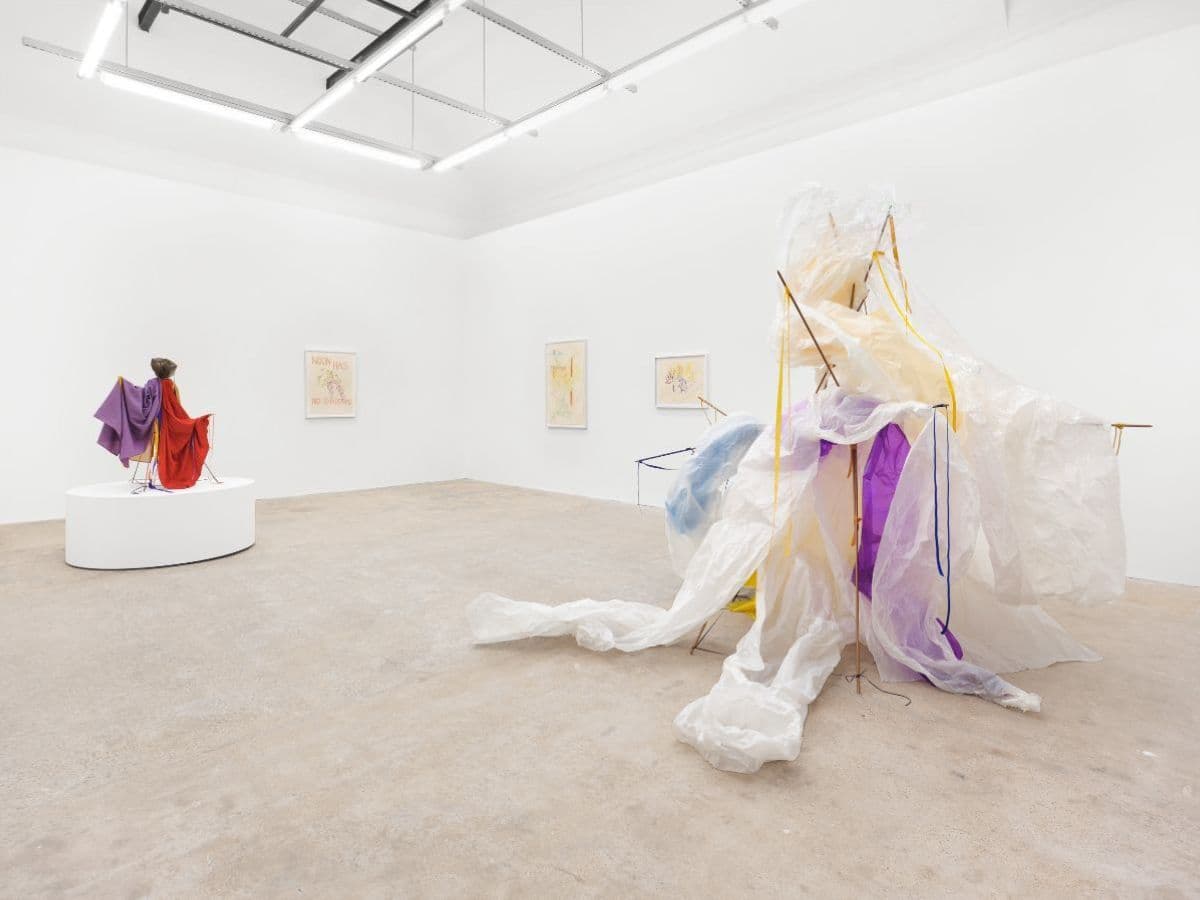
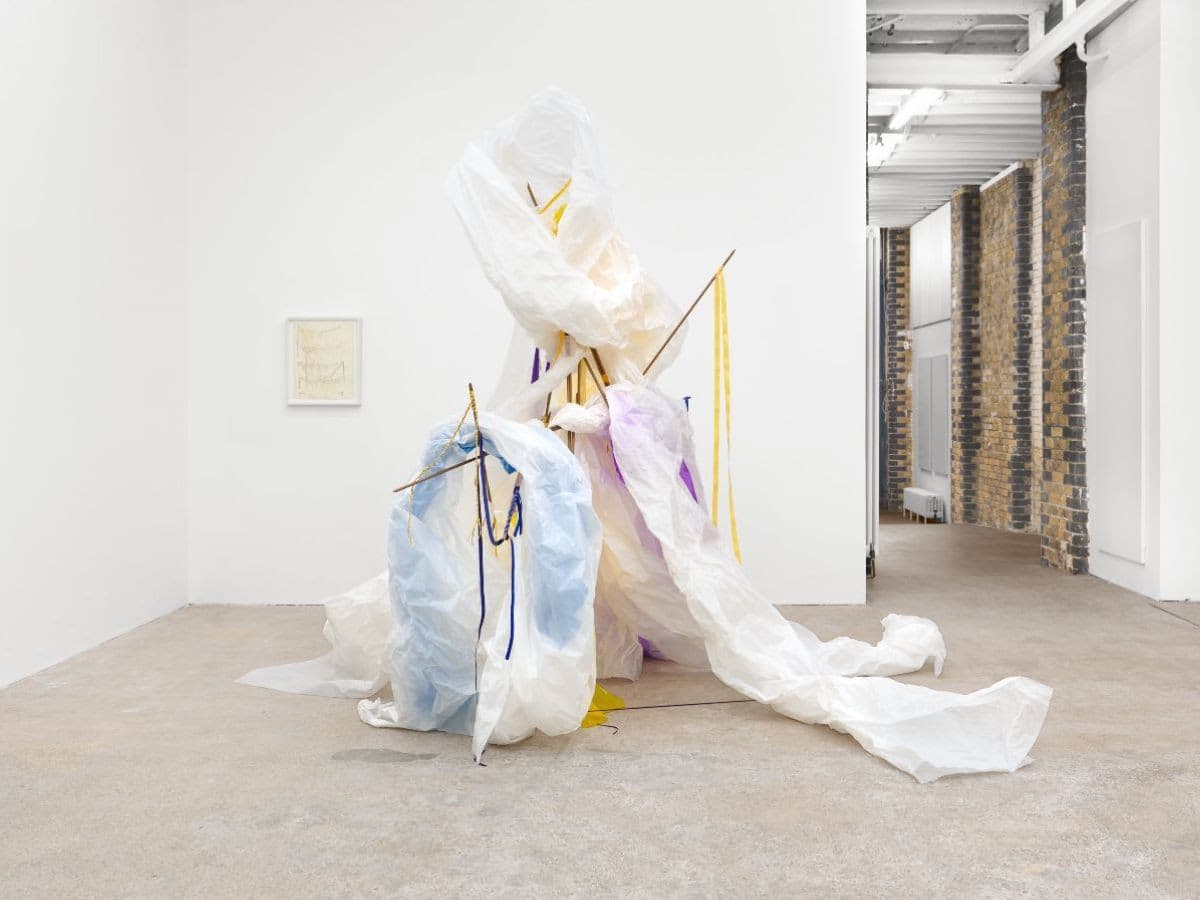
Hollybush GardensHollybush Gardens presents Make Me a Place in Time and Seasons, a solo exhibition by Rosemary Mayer (1943–2014), which brings together works on paper related to fabric sculptures, ephemeral installations and unrealised projects from the 1970s and early 1980s. The show also includes two related sculptures from Mayer’s ‘temporary monument’ series: Scarecrow (model) for a field (1978–79), the only extant sculpture from this period, made with fabric, wood, and ribbons, and Irises (1980–81/2025), a 'Ghost' sculpture conceived for this exhibition by the Estate of Rosemary Mayer. A selection of early drawings, which Mayer began in 1971, relate to her wall-based sculptures, created by layering multiple fabrics of varying translucencies, and evince her interest in draping, knotting and tethering. Some of the drawings are ‘permanent records’ of sculptures that no longer exist, a number of which Mayer had dedicated to individual women lost or forgotten throughout history, such as Hypatia (1972), a four-metre high, four-tiered curtain of cream-coloured satin, cheesecloth, rope and wire named after the fourth century NeoPlatonian mathematician and astronomer. Other drawings, such as Untitled (8.25.71), 1971, featuring draped sashes of coloured fabric with the the annotation ‘resting on two nails’, Untitled (8.27.71), 1971 and Untitled (coils), 1972 are ideas for ‘impossible knotted sewed and twisted pieces’. The drawings reveal Mayer’s desire to collapse the distinction between ornamentation and sculpture, two and three dimensions; in a statement of 1972, she writes: ‘between painting and sculpture – taking from both… interrelations – part to part, shape to shape, color to color, texture to texture, method to method, structure to structure.’ As Mayer’s sculptural practice developed, she became deeply interested in redefining traditional ideas of monumentality, which she had begun to explore in the fabric sculptures dedicated to historical women. She developed a series of ephemeral and experimental ‘temporary monuments’ from 1977 to 1982 – public installations which took the form of balloons, scarecrows, ghosts, and tents, and sought to commemorate figures from the past, connect people to local histories and celebrate the present. Scarecrow (model for a field) (1978–79), comprising wooden rods draped with red, brown, and purple fabrics, is a proposal for an unrealised temporary monument, which Mayer envisioned for a field in a rural setting. For Mayer, the scarecrow was a vehicle for seasonal ritual and celebration.In an essay, she captured their particular seasonal and ephemeral nature, writing that they ‘announce the growing season, flapping in the wind in mimicry of human forms. In fall, after harvest, they fell apart in the fields…’ Mayer’s Ghost works, which she began to make in 1980, developed from the form of the Scarecrow sculpture. They aimed to capture ‘the impermanence of a person, or a life’, and also relate to time and seasonality. Irises (1980–81/2025), a new Ghost sculpture made for the exhibition, composed of wooden rods draped with crumpled translucent papers, cellophane and ribbons, is inspired by Roses (1981), originally created for an exhibition at the Arnot Museum of Art in upstate New York to mark the arrival of summer. Irises celebrates the spring season – the flowers will be in bloom throughout the exhibition. Irises also alludes to flowers as a recurring motif across Mayer’s practice, and relates to her interest in flowers as an utmost expression of transience and the passage of time. The iris appears in several of her temporary monument works, most prominently as part of her major balloon work Spell (1977), for which she wrote the names of spring flowers on large weather balloons along with the word ‘return.’ ‘Iris Return,’ ‘Crocus Return,’ and ‘Hyacinth Return,’ were balloons as plants, rising up from the ground like shoots, and lasting for a short period of time, as a new form of seasonal celebration. On one of the posters for Spell, she writes: ‘To give me a hold, make me a place in time and seasons, mark them this way and think of the other, older ways people marked years and seasons, of circling ghosts around days with religious ceremonies, birthdays, new clothes for different seasons.’ Tents were another of Mayer’s temporary monument forms, and she was drawn to their dual nature, as structures for shelter and survival, but also as sites for celebration, relaxation and connection to nature, such as garden pavilions or tents for camping in forests or the mountains. Her tents, the final works in the temporary monument series, also emerged from her interest in draping textiles and other materials onto armatures, as explored in the early fabric sculptures and works on paper. Mayer created a number of drawings and proposals for different types of tents, such as City Roof Tent on Wheels (1980), a circular structure with swathes of fabric draped around its circumference, and wheels underneath to enable it to move in the wind. The vividly coloured drawing Moon Tents for Autumn Moon (1982) is like a poster or announcement for an event ‘for watching the moon crossing the sky’, and includes the provocations, ‘Can you stay up late?’ and ‘Have you got the time?’ alluding to Mayer’s interest in collectivity and participation. A number of the drawings, such as Marie’s Banners (1982) show other elements intended to stand near the tents, including banners and flags made out of fabric attached to rods and poles, and studies for ephemeral floral sculptures including Joan’s Floral (1982), akin to garlands or plaques, which she intended to be attached to the walls near the tents. Only one tent was realised as an installation, called Moon Tent and created on the occasion of the full moon in October of 1982 at the home of art historian Robert Hobbs in Lansing, New York. The work was installed for one night and consisted of wrapping an existing wooden pavilion atop Hobbs’ roof with glassine, which interacted with the light of the setting sun and the rising moon. Guests gathered within the structure to converse, play music and observe the moon. In the spirit of Moon Tent, Hollybush Gardens collaborated with the Estate of Rosemary Mayer and artist Reto Pulfer to develop Moon Tent for the Flower Moon, a one night installation and event at Peveril Gardens on the FormaHQ rooftop, on the full moon on 11 May. Re-interpreting Moon Tent and referencing Mayer’s drawings of drapery, tents and banners, Pulfer created a series of braids, garlands and fabrics which intercepted the apertures and architecture of the building and rooftop garden. In dialogue with these interventions, Marie Warsh of The Estate of Rosemary Mayer brought together handmade floral sculptures, realised with direct reference to Mayer’s drawings, made from the glassine, cellophane and coloured papers that frequented her practice. Together, the installation offered an intergenerational call and response with Mayer’s original Moon Tent across time, place and practices. Moon Tent for the Flower Moon built upon earlier events to collectively realise new iterations of Mayer’s ephemeral installations, including a Moon Tent celebration on the Swiss Institute rooftop, New York on 20 October 2021, during Mayer’s first retrospective, and Connections, a balloon installation on 11 November 2023 at Wallis Annenberg Center for the Performing Art in Beverly Hills, California. Rosemary Mayer (1943-2014) was a prolific artist involved in the New York art scene from the late 1960s. Most well-known for her large-scale sculptures made with fabric, she also created works on paper, artist books, and outdoor installations, exploring themes of temporality, history, and biography. During the 1970s she had exhibitions at various alternative spaces in New York City, including one of the earliest shows at A.I.R Gallery, the first cooperative gallery for women, of which she was a founding member. She was also a critic and writer, contributing to various journals of artists’ writings and creating an issue of the magazine Art-Rite. Her interest in art history, and particularly the artists of the Mannerist period, resulted in her translation of the diary of Jacopo da Pontormo, which was published alongside a catalogue of her work by Out of London Press in 1982. Beginning in the 1990s, she became focused on teaching art, eventually becoming a professor at LaGuardia Community College in Queens. Since Mayer’s death in 2014, her estate has helped to organise exhibitions and publications of her work, beginning with a show at Southfirst Gallery, Brooklyn in 2016 and the publication of excerpts from her 1971 journal. In 2020, her work was introduced to European audiences through Nick Mauss’s exhibition, Bizarre Silks, Private Imaginings and Narrative Facts, etc., at Kunsthalle Basel and her first solo exhibition, Rods Bent Into Bows, at ChertLüdde, Berlin. In 2021, a solo show at Gordon Robichaux in New York entitled Pleasures and Possible Celebrations, focused on her installations with balloons and related work. Her work was also included in Greater New York 2021 at MoMA PS1, in Just Above Midtown: Changing Spaces, at MoMA and in SIREN (some poetics) at the Amant Foundation in Brooklyn in 2022. The first institutional survey of Mayer’s work, Ways of Attaching, opened at the Swiss Institute, New York in autumn 2021.The exhibition was organised in partnership with Ludwig Forum, Aachen; Lenbachhaus, Munich; and Spike Island, Bristol, where the exhibition traveled in 2022. An accompanying catalogue was published in 2022. Mayer’s work is in the collection of the Museum of Modern Art, Lenbachhaus, Munich, and numerous private collections. The Estate of Rosemary Mayer is represented by Gordon Robichaux, New York and ChertLüdde, Berlin