

Matignon, Paris
Lily Stockman
Minotaur
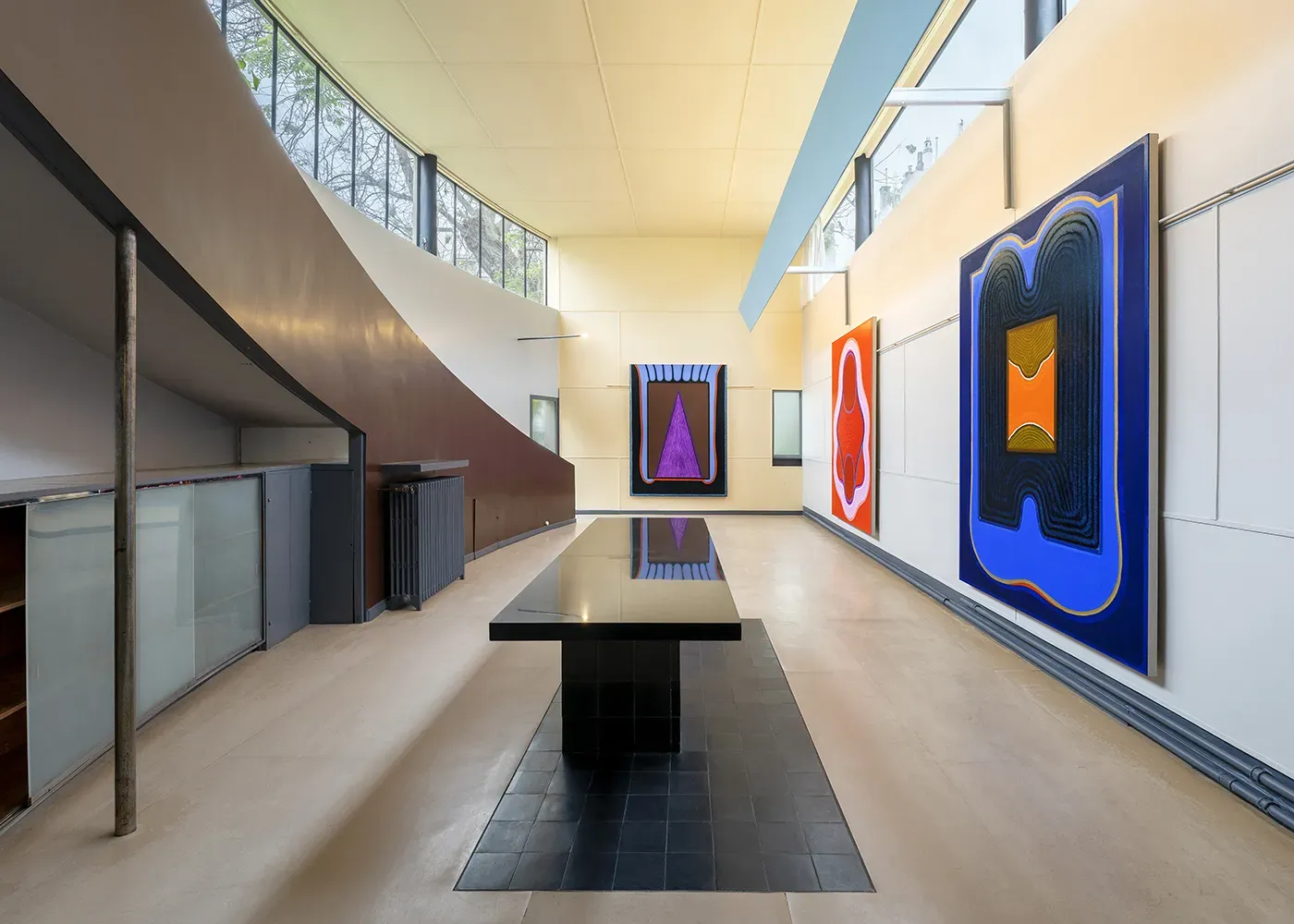
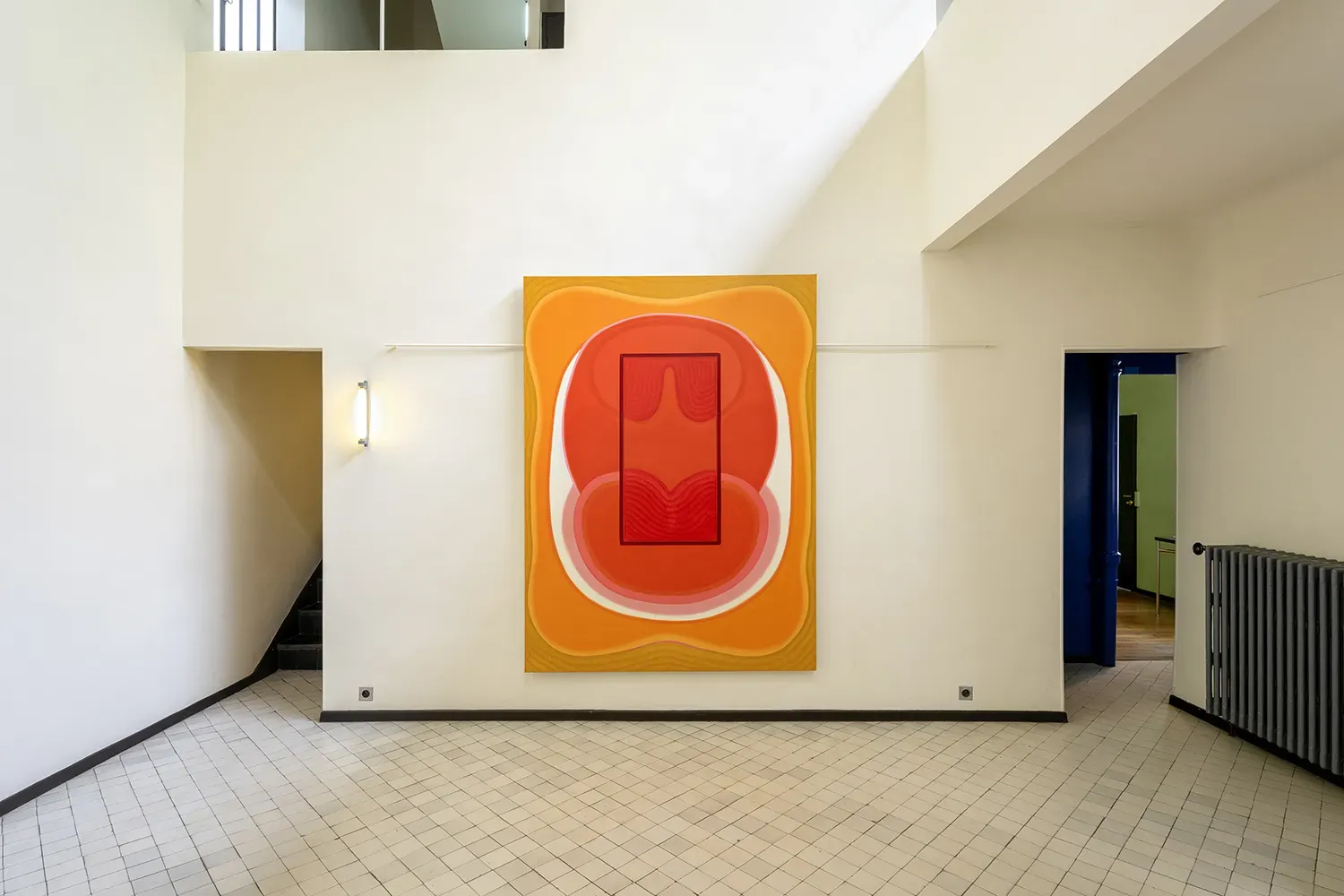
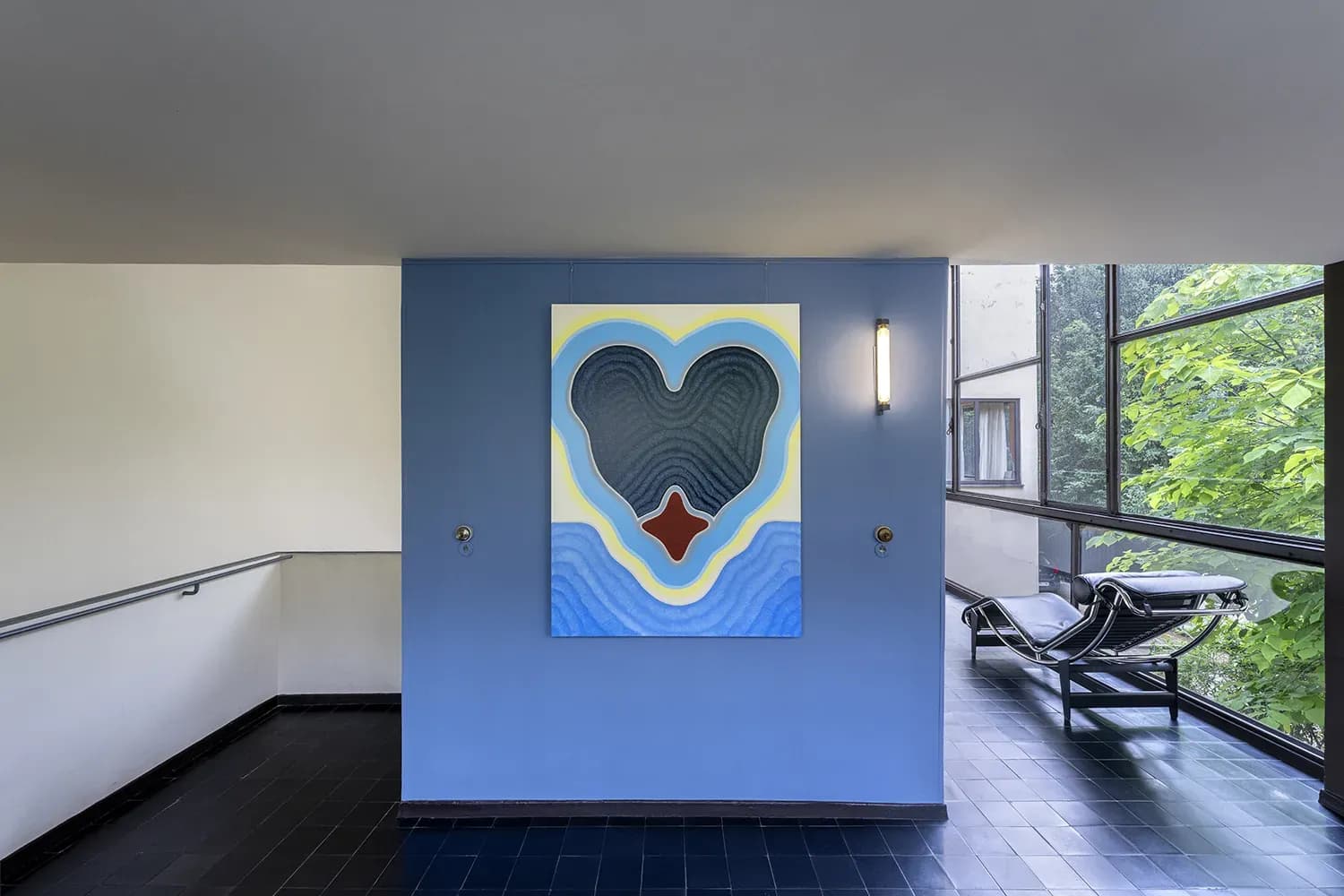
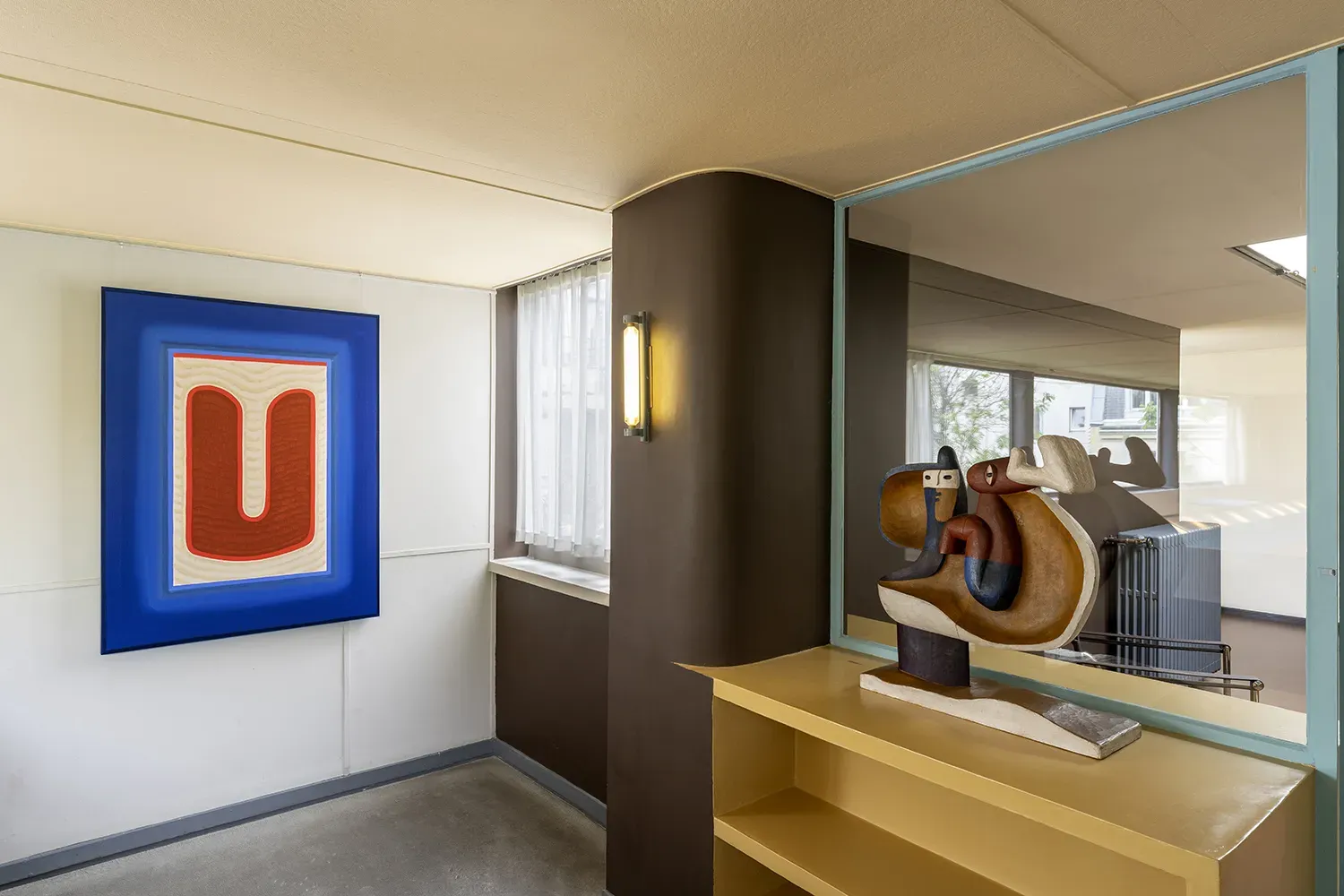
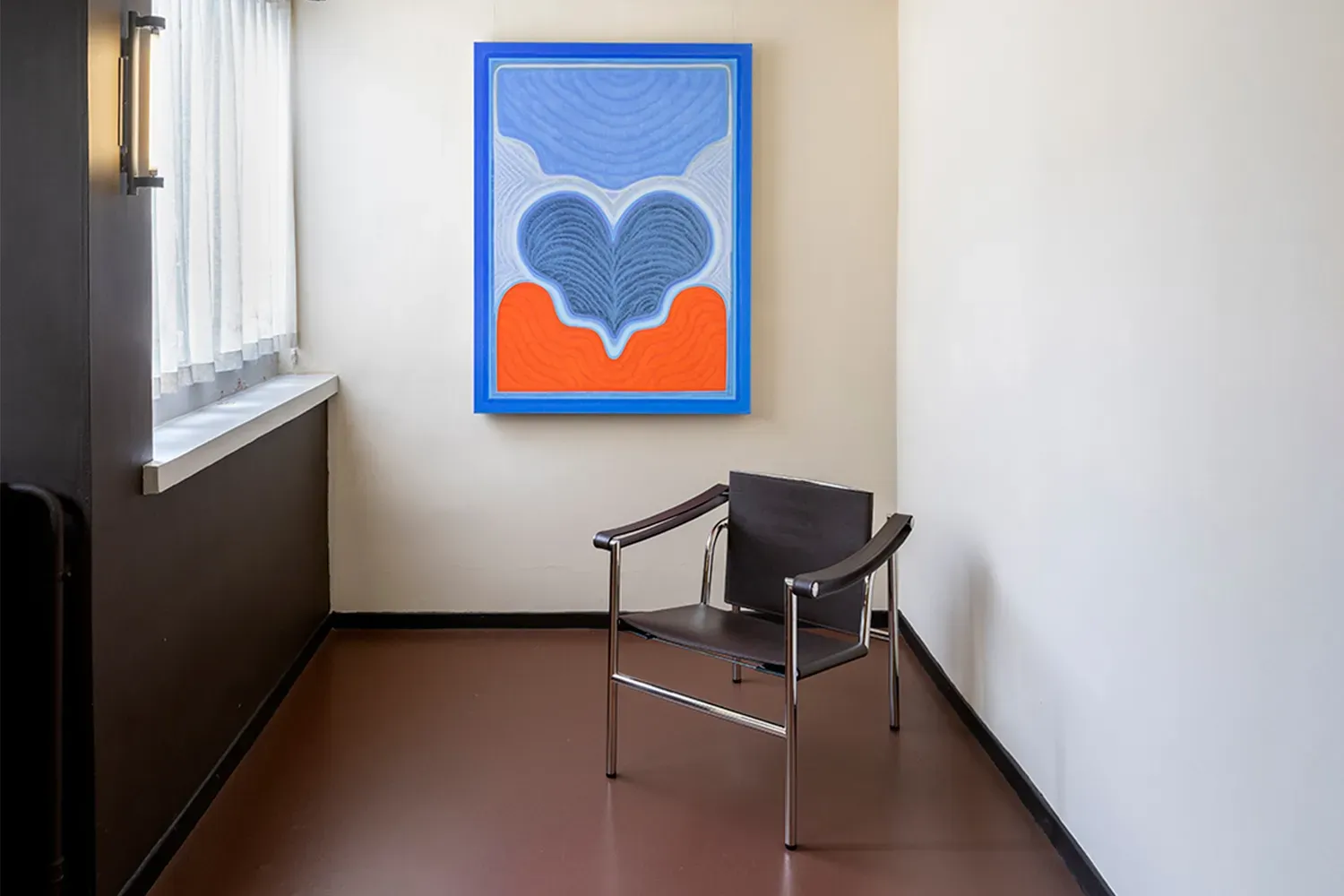
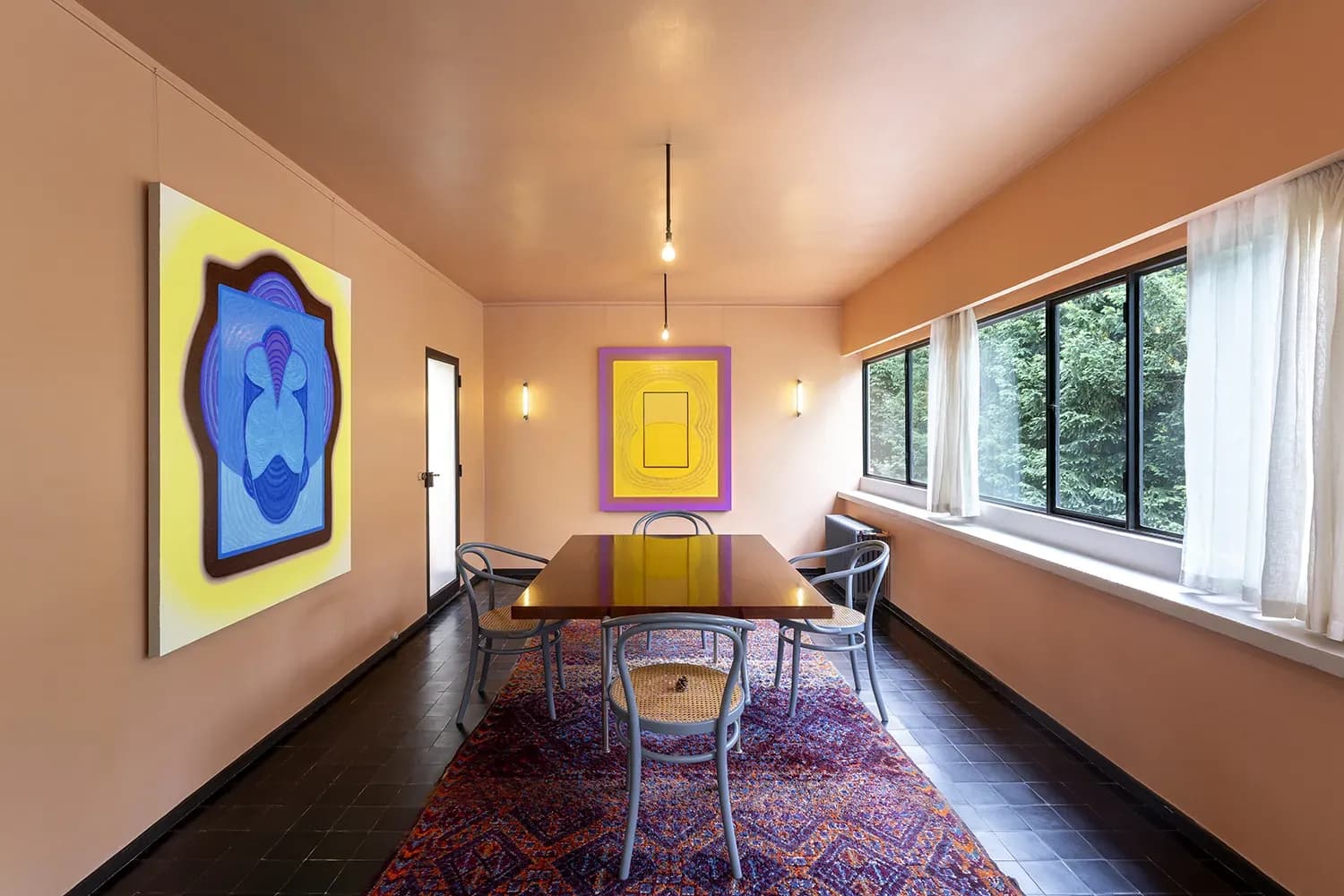
Maison La RocheWe are reminded that this building was designed as a domestic space to be lived in, cooked in, loved in. Le Corbusier famously wrote “a house is a machine for living in,” but Stockman seems to posit something philosophically closer to fellow modern architect Eileen Gray: a house is something more intimate and personal, “the shell of a man, his extension, his release, his spiritual emanation.” Stockman shape-shifts between the hard-lined geometric painter and fluttering, painterly mark-maker; bull in a china shop and holy cow; masculin féminin. The paintings, like Maison La Roche, complicate and delight the more time you spend with them. Singular to Maison La Roche, more than any other Le Corbusier project, is its polychromatism— cerulean blue, apricot, reflective black, brilliant orange. The colours of the walls are drawn from Le Corbusier’s paintings and collages, forming a link between the mediums Le Corbusier practiced his entire life. These colours in turn inspire Stockman’s palette for Minotaur. The paintings are keyed to their spaces creating a call and response between them, encouraging a sensitive consideration of how the paintings relate to their environment and consequently a contemplative awareness of how we ourselves interact with the space through the sensory experience of the fabric of the building: warmth from sunshine beating through the glass, the different textures of the floors beneath your feet that change from concrete to linoleum, uneven gritted tiles to rolling wood as you explore the villa. Metronome mimics the effect of a sundial as the light entering the atrium traverses the floor throughout the day, while the gentle vibrating gradations of Stockman’s scumbling brushstrokes echoes the dappled light that makes its way through the leaves of the plane trees that guard the house’s borders. The many textures present in June Morning encourage us to viscerally sense how these paint surfaces might feel. In some cases, Stockman also incorporates colours and textures she experienced in interactions with other Le Corbusier schemes. The purple of Metronome is inspired by the embroidered textiles she remembered seeing while living in Jaipur, India. It was during this period that the painter visited the modern metropolis of Chandigarh Capitol Complex, designed by Le Corbusier between 1950 and 1965 as Punjab’s new capital post-partition. The complex lends its name to two of Stockman’s paintings in Minotaur— the large-scale Chandigarh and Sukhna Lake. It was here at Chandigarh, amazed by the sudden rotation of Le Corbusier’s massive Open Hand Monument as the wind picked up, that Stockman became aware of the power that one surprising small detail has to transform or unify a grander scheme. Though the paintings of Minotaur follow their unicursal path along the walls of Maison La Roche, Minotaur celebrates the ceaseless creative urge to draw from multiple sources and through a variety of guises. Shared between Le Corbusier and Lily Stockman is a framework that is rich, seemingly simple but disguising a multitude of details to make objects that are not solely paintings nor buildings. They construct creations that incorporate all aspects of creative culture, vessels through which languages, structures, schemes and histories can be deciphered, if only you take the moment to look. —Anna Monks Designed and built between 1923 and 1925 by Le Corbusier and Pierre Jeanneret, the Maison La Roche was widely admired. It will contribute, like all purist villas, to establishing Le Corbusier as the master of modernity in architecture. The use of new construction materials allowed Le Corbusier to implement, for the first time, what he would call in 1927 «the five points of a new architecture»: the free facade, the free floorplan, long windows, the roof-garden and stilts. According to the wishes of its owner Raoul La Roche, a banker and collector of modern art, the house is divided into two parts: the gallery which presented his collection of paintings and his private apartments. The Maison La Roche, as well as the Maison Jeanneret, have been the subjects of several restoration campaigns since the 1970’s. They were classified as Historic Monuments in 1996 and, since 2016, have been listed with 16 other works by Le Corbusier on the UNESCO World Heritage List. Lily Stockman was born in Providence, RI, in 1982. She lives and works in Los Angeles and Yucca Valley, CA. Drawing from nature and its grammar of symmetry, camouflage, and repetition, Stockman plumbs her familiar landscapes (Los Angeles, the Mojave Desert, a remote island in Maine) for her distinctive palette of glowing, tertiary colours– crackling orange, red earth, Holbein brown, and Fra Angelico blue. In a review of Stockman’s most recent exhibition, The New Yorker art critic Johanna Fateman describes the artist’s biomorphic compositions as “both diagrammatic and vaporous, a combination that calls to mind the spiritualist abstractions of the American modernist Agnes Pelton. Although they’re more lyrical, Stockman’s nested shapes also have the meticulous magic of Josef Albers’s squares.” Stockman’s paintings emerge from a wide range of references, from the prosaic — seed catalogues, topographic maps, birdsong, skating on a frozen pond –– to the archaic — Shaker gift drawings, mediaeval hocketing, portable Renaissance altarpieces, poetry metre. After concentrating on painting at Harvard, where she also studied art history under Yve-Alain Bois, Stockman continued her studies in two important apprenticeships which shaped her lifelong pursuit of abstraction: Buddhist thangka painting at the Union of Mongolian Artists in Ulaanbaatar, and later, traditional Mughal miniature painting in Jaipur. From there she went on to pursue her MFA at New York University. Stockman’s work is in the permanent collections of the Farnsworth Art Museum in Maine, Hirshhorn Museum and Sculpture Garden in Washington, D.C., Institute of Contemporary Art Miami, LA MOCA, Palm Springs Art Museum, Phoenix Art Museum, and Orange County Museum of Art, where she was recently included in the California Biennial 2022: Pacific Gold.