
SoHo, New York
Fernando Palma Rodríguez
ĀMantēCayōTl: And When It Disappears, It Is Said, the Moon Has Died
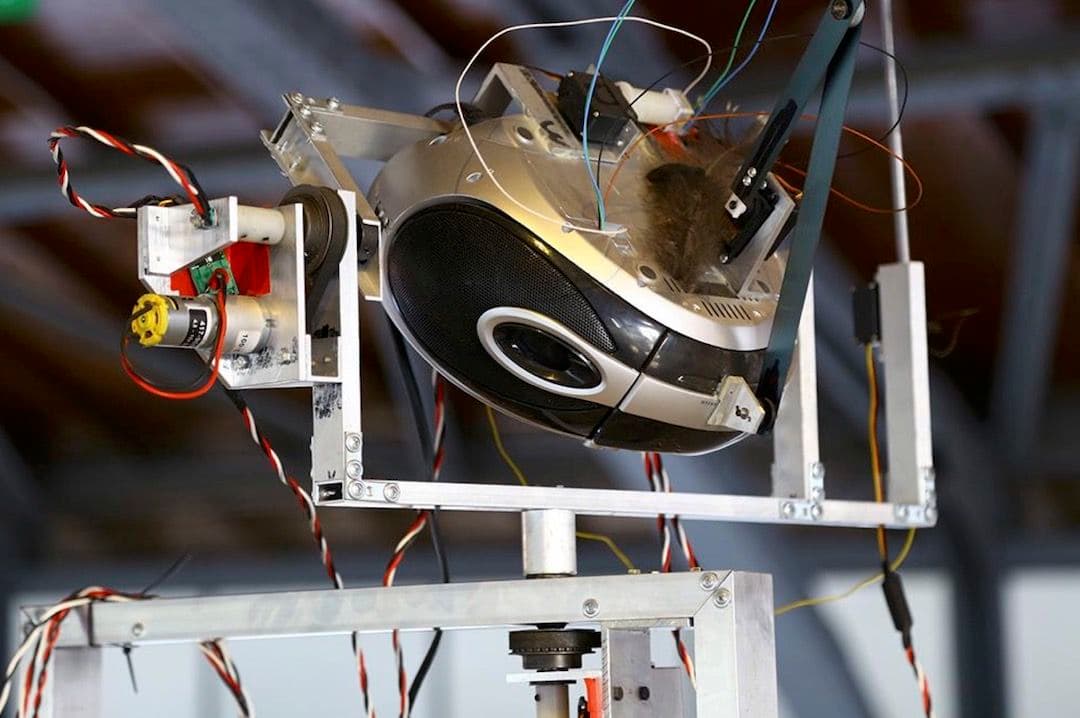
Canal ProjectsCanal Projects is pleased to present a new large-scale installation by the Nahua artist Fernando Palma Rodríguez (b. 1957, Mexico). A pioneer of Indigenous robotics, the artist's new project Āmantēcayōtl presents an installation that emulates a corn field on the slopes of the Teuhtli Volcano in Milpa Alta, Mexico. At Canal Projects, the exhibition features three robotic entities that embody different deities of the mesoamerican pantheon. A large-scale Cincoatl snake is suspended above the cornfield and be accompanied by two additional robotic agents: The Huehuecoyotl (Old Coyote) and Tezactipocla (Jaguar lord). Throughout time, farmers have encouraged the Cincoatl snake to roam their crops—the name Cincoatl is consequently often translated as “snake-friend of maize corn.” Huehuecoyotl (Old Coyote) is the god of music, dance, mischief, and song. As a trickster, the coyote has the capacity to navigate different worlds, roaming the earth and the underground. On the other hand, Tezcatlipoca (Jaguar lord), which literally translates to “smoking mirror,” is known as the god of the Great Bear constellation and the night sky. Tezcatlipoca is a prolific shapeshifter, who would commonly appear in the form of a large jaguar, also referred to as “Heart of the Mountain." Together, the mechanized entities make evident the sacred relationship that exists between Nuahua cosmologies and their entwinement in the cultivation of corn, bean, and squash, which are grown together in what is traditionally known as the Milpa. At the center of the exhibition, the Cincoatl snake glides through a corn field or Milpa while the Huehuecoyotl (Old Coyote) and Tezactipoclas (Jaguar lord) interact with viewers, embodying practices and traditions involved in relating to, caring for, and being in community with the land. The artist’s invocation of the sacred pantheon, more than a personification of these deities, is a practice of becoming, which allows the artist to redefine the very notion of the robot as a conduit for the recuperation of the Nahuatl language, earth technologies, and the positioning of Aztec cosmologies. Palma Rodríguez combines his training as an artist and mechanical engineer to create robotic sculptures that are activated by drawing upon internet-sourced climate data from the Milpa Alta region. His works respond to issues facing Indigenous communities in Mexico today while also underscoring that the struggles for the protection of life and the defense of territory are inseparable from the recuperation of traditional ways of life. Palma Rodríguez’s approach to robotic art delineates an entirely different definition of technology as one that is determined by people’s capacity to cultivate life. Recognizing the role that Nuhua cosmovision plays in the definition of Indigenous technologies, the exhibition provides an entry point into the earth-based practices that help sustain and nourish life in community. According to the artist, Indigenous technologies are built on lessons learned from the soil and from harvesting crops, such as reciprocity, care, and interdependence. “In working the land,” says Palma Rodríguez, “life merges into creation, nature into culture, and ultimately, art into technology.” The artist’s machines, therefore, speak to the agency and intentionality of sacred figures that aid in the cultivation of life and construction of livable worlds. Unlike western technology, Indigenous technologies center the recuperation of ancestral knowledge, practices, and worldviews. Indigenous notions of technology uphold the more-than-human world, which lies in stark contrast to western ideas of technology defined by instrumentality, accumulation, and control. This means taking into account Indigenous social principles like animism, relationality, and reciprocity, which presuppose a technique of vision that not only positions people within nature but also opens the possibility for establishing intersubjective relationships with the environment, ancestors, and even temporality. In the context of the thirty year anniversary of the North American Free Trade Agreements (NAFTA), which came into effect on January 1, 1994, Canal Projects invited the artist to produce his largest site specific installation to date. This year also marks a symbolic moment in Palma Rodríguez’s artistic career, for it was in 1994 that he showed his first robotic sculpture titled Greeting Zapata Moles, which responded to the industrialization of his hometown, a process that that would lead to the systematic dispossession of resources and land from his community. Connecting Mexico and the United States through the invocation of sacred machines whose movements are an embodiment of natural phenomena, the exhibition aims to enact a future of technological justice and care in the face of decades of environmental violence towards Indigenous communities by NAFTA. Fernando Palma Rodríguez (Mexican, b. 1957) lives in the agricultural region of Milpa Alta outside Mexico City, where he runs Calpulli Tecalco, a non-profit organization dedicated to the preservation of Nahua language and culture. Central to Palma Rodríguez’s practice is an emphasis on Indigenous ancestral knowledge, both as an integral part of contemporary life and a way of shaping the future. Fernando Palma Rodríguez lives and works in San Pedro Atocpan, Mexico. He was the subject of a retrospective at Museo de Arte Contemporáneo de Oaxaca (2017). His work has been included in group exhibitions at FRAC des Pays de la Loire, Carquefou, France (2016); Parallel Oaxaca, Mexico (2016); Nottingham Contemporary, England (2015); the Biennial of the Americas, Denver, Colorado (2015); Museo Universitario del Chopo, Mexico City, Mexico (2014); and SITE Santa Fe, New Mexico (2014). Also, there was an exhibition of his work at MoMA in NYC called In Ixtli in Yollotl, We the People (2018).