
Marais, Paris
Group Exhibition
Studio Conversations
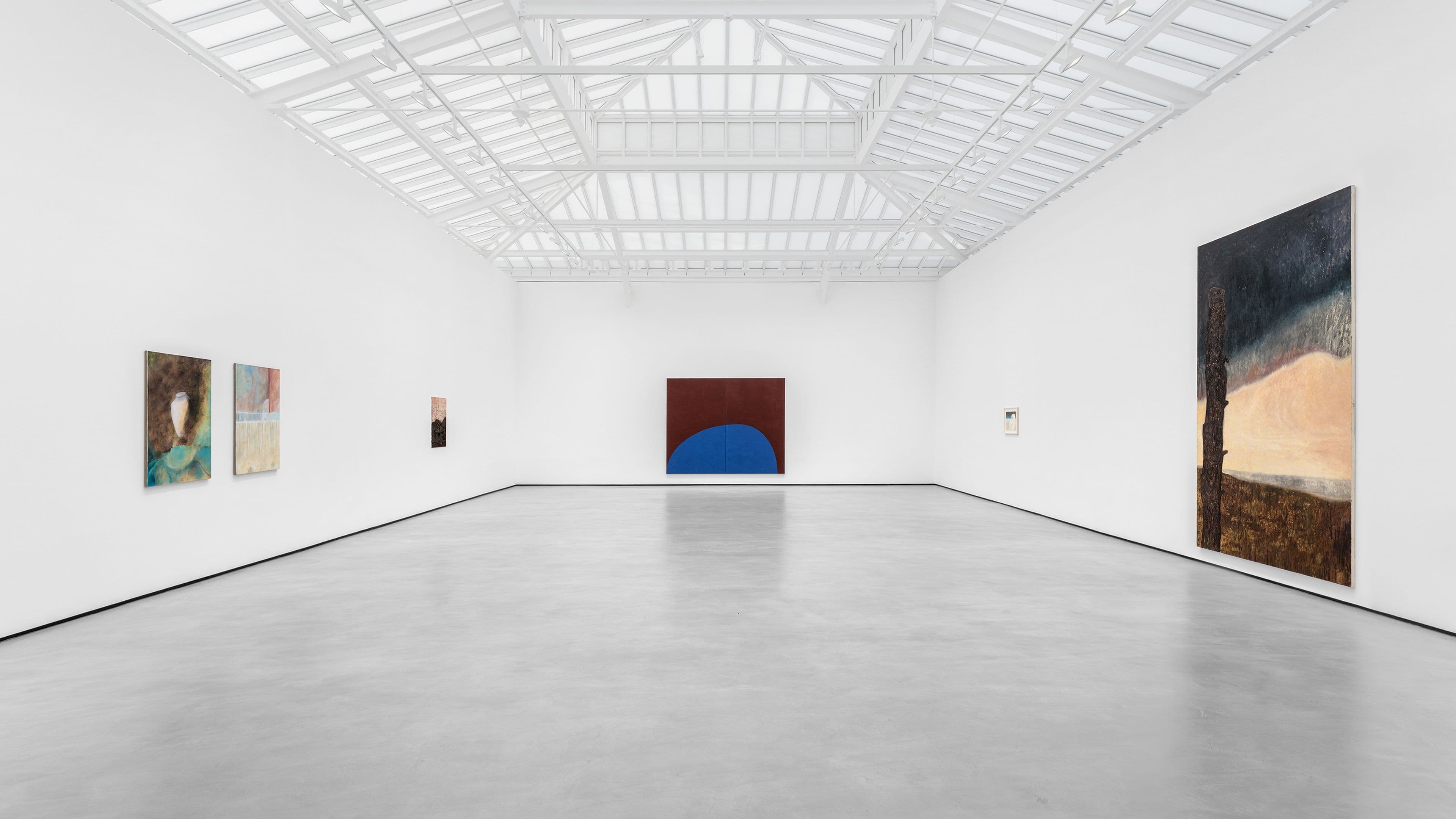
David ZwirnerJean Claracq, Marcel Dzama, Suzan Frecon, Mamma Andersson, Nino Kapanadze, Christine Safa David Zwirner is pleased to present Studio Conversations, an exhibition curated by Anaël Pigeat, structured as a series of dialogues between artists who are representative of the current Parisian art scene and those who have inspired them from the beginning of their career: Jean Claracq with Marcel Dzama, Nino Kapanadze with Mamma Andersson, and Christine Safa with Suzan Frecon. Admiration, appropriation, inspiration … What does it mean for one artist to look at another's work? How does an artist view another's work? What dialogues and playful interactions can emerge between them? The encounters that took place between these painters, from conversation to collaboration, gave rise to exchanges and reflections, friction to resonance. Christine Safa spoke with Suzan Frecon, whose work has had a strong influence on her since her early years at the École des Beaux-Arts in Paris. Frecon's work has led Safa toward abstraction despite the recent omnipresence of figurative painting. Together, they discussed the presence of the colors in pre-Renaissance and Minoan architecture, the weight of pigments and the effects they produce on the canvas, geometry, questions of scale and the shape of icons—but also shapes that ultimately take on their own reality once they have been painted: unresolved painting states that take us back to an elemental sense of form. Nino Kapanadze met Mamma Andersson in Paris, when she was working on a series of engravings in a studio near Place de la République (Atelier René Tazé). Originally from Georgia, Kapanadze had long admired Andersson's work without knowing that the Swedish artist had taken an interest in the little-known Georgian painter Niko Pirosmani, or that she had written a text about his use of black backgrounds. Both have long been passionate about the experience of frescoes, particularly those by Giotto in the Scrovegni Chapel in Padua; the contrasts of light and bursts of color on the canvases of El Greco; and the humble paintings in Romanesque churches. Following their initial conversation, in preparation Studio Conversations, each of them painted works inspired by natural landscapes and simple forms, creating an astonishing echo effect both formal and spiritual. Jean Claracq, who has been in residence in New York since the beginning of 2025, visited Marcel Dzama in his Brooklyn studio. The two artists talked about music, Polaroid photography, surfing, and the light produced by the full moon. As the conversation progressed, Claracq and Dzama created works on paper collaboratively, blending their worlds in a kind of game. To experiment with new forms, Claracq moved away from the main lines of his explorations, medieval references and pictorial variations on the light of computer and telephone screens. Dzama, whose work extends from drawing and painting to sculpture and stage design, also presents a series of works on paper in which costumed characters explore our gestures and emotions, penetrating into our subconscious. Characterized by a unique combination of textured brushstrokes, loose washes, stark graphic lines, and evocative colors, the work of Mamma Andersson (b. 1962) embodies a new genre of painting that recalls late nineteenth-century Romanticism while also embracing a contemporary interest in layered, psychological compositions that draw inspiration from a wide range of source materials. A painter of miniatures and icons, Jean Claracq (b. 1991) creates a dialogue between traditional painting and the digital world. His models come from social networks such as Instagram and Grindr. They interact in his paintings with numerous references to the history of classical art, particularly the schools of northern Europe. Using traditional techniques—oil paint on wood and attention to detail—the artist plays with different ways of reading and accurately depicts our relationship with screens and loneliness in the urban environment. Since rising to prominence in the late 1990s, Marcel Dzama (b. 1974) has developed an immediately recognizable visual language that investigates human action and motivation, as well as the blurred relationship between the real and the subconscious. Drawing equally from folk vernacular as from art-historical and contemporary influences, Dzama’s work visualizes a universe of childhood fantasies and otherworldly fairy tales. Made over long stretches of time, Suzan Frecon’s (b. 1941) abstract oil paintings and works on paper invite the viewer’s sustained attention. In her work, composition serves as a foundational structure, holding color, material, and light. Frecon mixes pigments and oils to differing effects, and the visual experience of her work is heightened by her almost tactile use of color and contrasting matte and shiny surfaces. Figure can become ground and ground can become figure in, as the artist defines it, a back-and-forth of full and empty space. In her paintings, Nino Kapanadze (b. 1990) seeks the presence of silence, of sensations of fear or peace, representations that are not descriptions. Avoiding the idea that an image has a fixed end or a fixed viewing point, with neither category nor predefined identity, she explores the sensation of movement, varying tempo and transparency within the realm of the canvas. Christine Safa (b. 1994) paints landscapes from memory. She also paints figures, portraits, and sometimes doubles. These are emotionally charged moments and places that memory has preserved. Faces and mountains mixed. Silhouettes and horizons. In the light of a moment frozen in memory. Figures in the landscape, reduced to the essentials but alive. A warm palette that confesses its Mediterranean origins. What it means to be there, simple but complete, is what these sober, powerful paintings say with obvious empathy.