
East, London
Evelina Hägglund & Minh Lan Tran
Somewhere I Have Never Travelled, Gladly Beyond
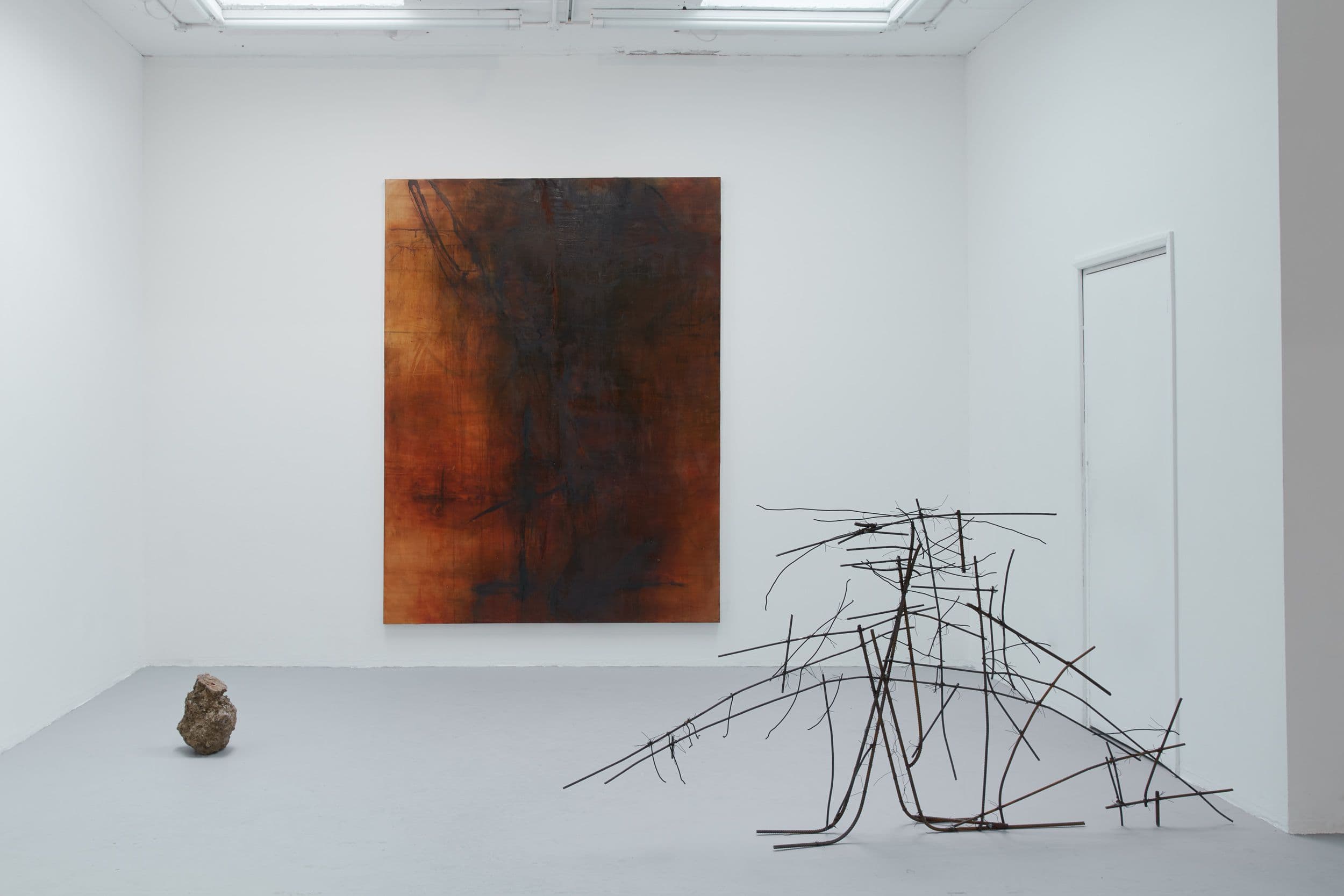
Nicoletti ContemporarySomewhere I Have Never Travelled, Gladly Beyond, a duo show of paintings, drawings and sculptures by Swedish artist Evelina Hägglund (1992, lives and works between London and Stockholm) and French-Vietnamese painter Minh Lan Tran (1997, lives and works in London). Titled after a poem by E.E Cummings, in which the American poet evokes a journey towards the silent eyes of a lover – a territory beyond experience, where words are no longer sufficient to convey the intensity of his feelings – the conversation between the two artists reflects upon the nature and limits of language, unfolding within a space where materiality and sensation become the primary means of communication. Throughout the exhibition, Hägglund and Tran use different tactics that question traditional regimes of representation and signification. Prioritising physicality and instinct over linguistic categories and interpretation, the artists revel in the idiosyncrasies of the materials they employ to explore the affective properties of bodies and the vitality of inanimate matter. In Hägglund’s work, these ideas translate into series of large-scale drawings covered with a profusion of flowing lines and abrupt strokes in graphite. The marks and shapes appearing on the raw canvas correspond to the outlines of sculptures made of metal rods and wires, some of which are assembled in ways that suggest the form of scorched trees, while some others seem to conjure up the silhouette of ominous figures. Any of these associations, however, reveals more the tendency of the human mind to create intelligible relationships between things than the artist’s intention, who rather sees these works as the result of an intuitive confrontation between her body and the materials she manipulates. ‘Ideas are not separate from the body’, Hägglund argues, ’and I believe that by including my very hands, by incorporating me as a maker in the work, I am in a much more honest position to express an idea’. ’Ceasing trying to get signification “right” sets me free’, she continues, ‘I can bend and twist, invert, fill, learn and unlearn the world as I imagine it’. Materiality and corporeality are also central to Tran’s practice, who describes her working process as a choreography ‘where movement alternatively sculpts, scatters and distrib-utes intensities across the canvas’. Tran usually begins work by writing on the raw surface of the canvas, coordinating her movement with the rhythms of poems. The artist then covers these inscriptions with a mixture of pigments and organic materials such as eggs, glue, salt, dust and metal powders, building up her compositions through thin layers of paint that are subsequently rubbed off, scratched and incised. The fluid play of textures and tactile reliefs emerging from this process operate as indexes of Tran’s bodily gestures, which are enhanced by the running strokes and cursive lines spreading across the canvas. ‘I evolve in the space of the canvas with a similar tension than the one hap-pening on stage or in a fighting ring’, the artist explains, ‘I see the act of painting as a catalyst of violence and the canvas as it receptacle’. Sometimes giving the impression of looking at eroded soils or stitched wounds, Tran’s paintings reconnect with artistic traditions which, from Soutine to Fautrier and Dubuffet, eschewed narration and focused their attention on the base materiality of paint to capture primal forms of sensations. Likewise, Tran treats her materials as autonomous, living things, provoking alchemical reactions between the elements of her compositions to emulate the metamorphic processes occurring in nature. Hägglund is similarly concerned with material processes and reactions, producing works that often look more organically shaped than aesthetically formed. If the slender allure and sheer precariousness of her sculptures may contrast with Tran’s lavishly textured surfaces, both artists share a common interest in the sensuous and emotional properties of raw matter, through which they explore the potential of art to express dimensions of existence for which we have no words. As such, the dialogue between their work invites us to contemplate the language of physicality and the vibrancy of inert matter – a territory where our inherent desire for comprehension usually prevents us to see these things which, paraphrasing Cummings, are too near to be touched, but where reside an infinite reservoir of meanings that are yet to be unravelled. Evelina Hägglund lives and works in London and Stockholm. Her work gets to grips with how she understands and responds to language. By making sculptures and drawings made of metal, concrete, canvas, clay and graphite, she explores physicality as a way of communicating. After completing her bachelor degree at AVA - Academy of Visual Arts in Ljubljana in 2018, she entered the Master of Fine Art program at Goldsmiths, University of London, where she graduated in 2021. Her work has been shown in solo and group exhibitions internationally, including at Union Pacific (2021), Saatchi Gallery, UK (2021); Inter Pblc, Copenhagen, DK (2021); Jakobsbergs konsthall, Stockholm, SWE (2020); Kiribati National Museum, Tarawa, Kiribati (2019); Kino Siska gallery, Ljubljana, Slovenia (2019); Temporary Gallery, Cologne, DE (2016); and the Biennial of Graphic Arts, The Museum of Modern Art, Ljubljana, SI (2016). Hägglund was a resident at Transborders in Austria/Slovenia (2019), Land404 in Sweden (2018) and is the co-founder and editor of ~lish, a journal in the Foreigner’s English. She received grants and awards from Goldsmiths, University of London (Warden’s Award, 2021); Gunvor och Joseph Anérs foundation (2020); Fredrika Bremer förbundets foundation (2020); Sixten Gemzéus foundation (2019); The Royal Swedish Academy of Fine Arts (2019); Anders Sandrews foundation (2019); and Foundation AAA (2018 and 2017). In 2021, Hägglund received a public commission from Plaza Protocol, curated by Tjaša Pogačar, Ljubljana, Slovenia. Minh Lan Tran lives and works in London. She studied at the Ecole du Louvre, Paris (2014–17) and the University of Oxford (2017–19). She holds an MA in Byzantine studies from the Courtaud Institute of Art, London (2020) and is currently pursuing an MA in Painting at The Royal College of Art, London. Her recent projects include House of Annetta, curated by Edmond Brooks Beckman, London (2021); a residency and solo exhibition curated by Camille Van Klaveren at Association WAMM / Fondation Prince Pierre, Monaco (2021); Pending, curated by Ludovica Bulciolu at San Mei Gallery, London (2020); and Lucrèce Residency, Yordas Cave, UK (2020).