

West, London
Roman Opalka
Passages
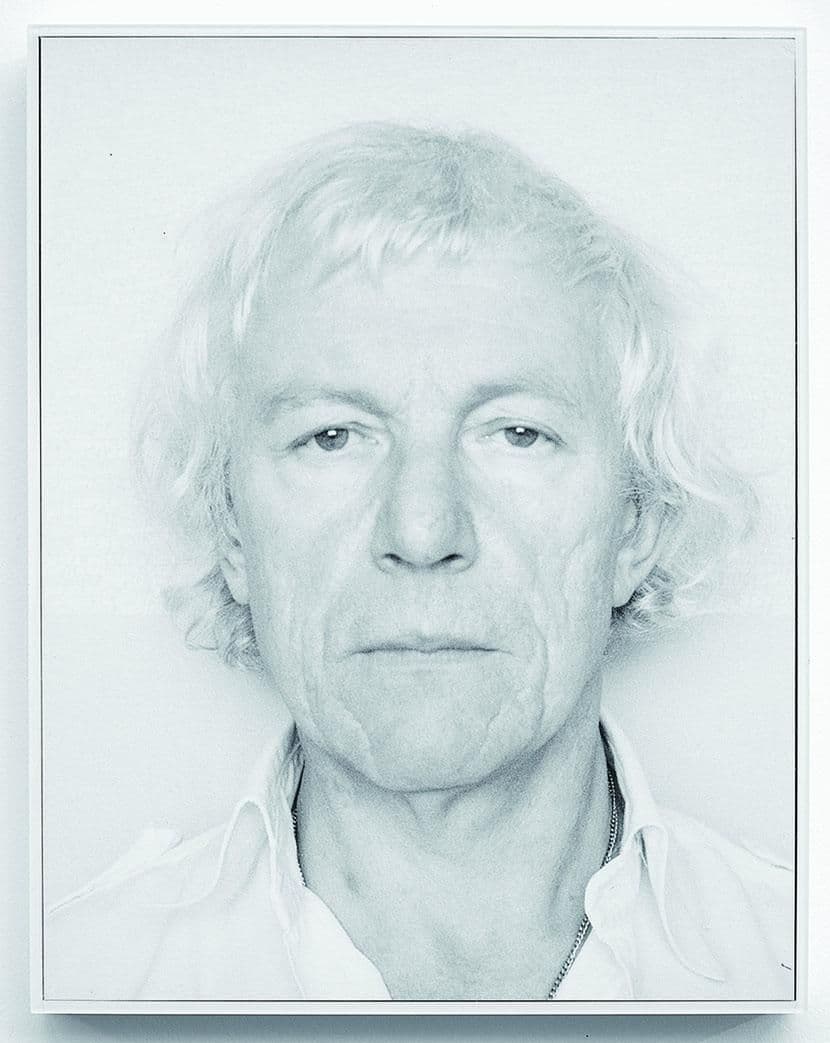
Dominique LévyIn 1965, French-born Polish artist Roman Opalka began a project that would occupy the entirety of his career and trace the course of his life, titled Opalka 1965/1 – ∞. The paintings—or Détails—of 1965/1 – ∞ each constitute a part of the whole, and comprise rows of tiny, rhythmically progressing numbers painted in sequence from one canvas to the next. Understanding this project as inextricably related to his own mortality, Opalka famously said, ‘It is important that the last Détail should not be finished by me, but by my life.’ By the time of his death, the artist had painted more than five million numerals on 233 canvases. Dominique Lévy is pleased to present Roman Opalka: Passages in its London gallery. The exhibition will feature three important paintings from the 1965/1 – ∞ series, called Passages, each of which marks the culmination of one million consecutive numbers. Five Passages exist, the first (marking one million) and final (marking five million) of which are currently on view in the opening exhibition of the Met Breuer, New York, titled Unfinished: Thoughts Left Visible. In Roman Opalka: Passages, Dominique Lévy Gallery will unite the second, third, and fourth Passages. After the first Passage, Opalka began gradually increasing the percentage of white he added to the background of each painting. Because of this, the canvases grow progressively paler and the numerals begin to merge with their ground. Marching steadily toward effacement, each million passage denotes an important milestone in Opalka’s project while simultaneously making clear the semiotic emptiness of even these seemingly significant numerals, which ultimately represent only the passing of time. In punctuating three seminal moments in 1965/1 – ∞, Passages provides an overview of the artist’s career, revealing his oeuvre to be a metaphor for human existence. ‘Time as we live it and as we create it embodies our progressive disappearance’, Opalka wrote in a 1987 essay, ‘We are at the same time alive and in the face of death—that is the mystery of all living beings.’ The three Passage paintings will be accompanied by a selection of the artist’s self portrait photographs, created in parallel to the Détails as part of the 1965/1 – ∞ cycle. In keeping with his rigorous documentary method, Opalka would photograph himself from the neck upwards and with a neutral expression on his face after each painting session. Like the canvases, the photographs grow paler and paler as the artist ages and his hair whitens. In addition to documenting his work in the photographic medium, Opalka also made audio recordings of his voice as he painted, which will also be included in the exhibition. In these, he intones numbers as he is painting them in his native Polish. Passages will also present a group of Opalka’s Etude sur le mouvement (Movement Studies) works on paper from 1959-60. These drawings are direct predecessors to the 1965/1 – ∞ works and demonstrate Opalka’s early examination into capturing movement and time. Roman Opalka was born on August 27, 1931, to Polish émigrés in Hocquincourt, northern France. He and his family returned to Poland in 1935, only to be deported to Germany after the Nazi invasion. After being liberated by the United States Army in 1945, they moved back to Poland, where the artist studied lithography at a graphics school before enrolling in the School of Art and Design in Lodz. Opalka later earned a degree from the Academy of Fine Arts in Warsaw and began experimenting with abstract and monochrome paintings, which he called Chronomes. In 1965 he began his 1965/1 – ∞ project, to which he would devote the majority of his life’s work. Opalka began exhibiting in Poland in the mid-1960s, and by the early 1970s was represented in solo and group exhibitions throughout Europe and in Asia and Latin America. His first trip to the United States came in 1972, and his first American exhibition opened in 1974 at the John Weber Gallery. In the forty years since then, Opalka’s work has been showcased in scores of gallery and museum shows worldwide. His retrospective exhibitions and writings in several languages, as well as his participation in events such as Documenta 6 (1977), the XIX Biennial of Sao Paolo (1987), and the Venice Biennale (1995, 2003), have brought him global recognition. In 1977, Opalka moved to France, settling at Teillé, near Le Mans. He obtained French citizenship in 1985, and in 2009 he was awarded Commandeur dans l’Ordre des Arts et des Lettres. He died in Chieti, Italy, in August 2011. Dominique Lévy has represented the Estate of Roman Opalka since 2012. His previous solo exhibition with the gallery took place in New York in September – October 2014. Work by the artist is held in major museum collections, including the Musée national d’art moderne, Centre Georges Pompidou, Paris; Los Angeles County Museum of Art, Los Angeles; La Jolla Museum of Contemporary Art, San Diego; Kunsthalle Hamburg, Hamburg; The Museum of Modern Art, New York; Nationalgalerie, Berlin; and the Solomon R. Guggenheim Museum, New York.