
Marais, Paris
Daniel Correa Mejía
Lucrecia
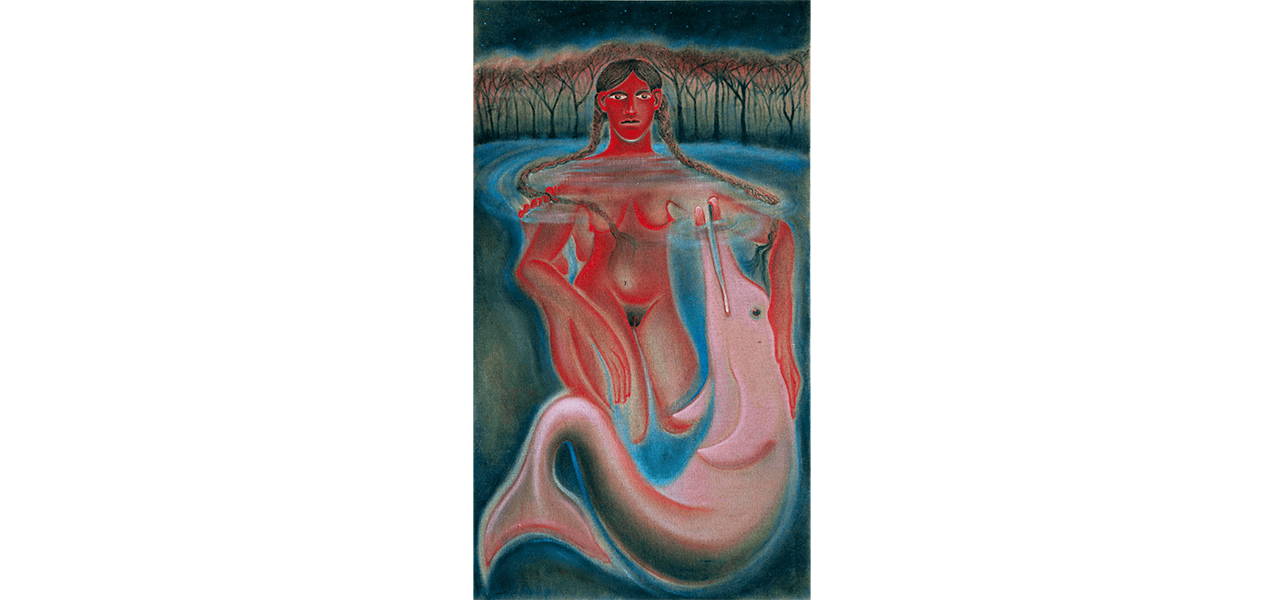
Mor CharpentierAs if we could all at once look at Narcissus' water reflection, Daniel Correa Mejía's images appear before us like swirling mirages on restless and fluid surfaces. Are they Visions? Memories? Figments of imagination? They strike as being airy and liquidy, dreamlike and playful. The spontaneity and imaginativeness with which kids approach the act of drawing and painting show that, for most, these practices were once a form of play. A ground to discover parts of ourselves through the visual expression of things that delighted and amused us. The paediatrician and psychoanalyst D.W. Winnicott wrote, "It is in playing, and perhaps only in playing, that the child is free to be creative." However, as people grow older, only a few continue to make pictures throughout their life. For those who extend the practice into adulthood, picture-making tends to cease being an exercise of pure play and imagination. That is not the case for Correa Mejía. It is precisely on the ground of intuitive and impromptu playfulness that he finds the well of his ever-flowing images. Letting himself be carried away by a river of ideas that appear as he allows them to flow is fundamental to his act of image-making. Through his playlike act of painting, Daniel makes use of imagination and life events, to conceive and convey a fictional world for his own delight. An imagined land of bright and vibrant hues of blues and reds, filled with its own characters, stories, and symbols. A realm where the artist attempts to make sense of himself, his personal experiences, and everything he finds mysterious about the world. Dreamlike scenarios filled with recurrent natural elements like the moon, trees, and water, entangle with the stories told through alluring and idealised bodies in the shape of humans and animals. This figmental world serves the painter as a safe playground where eroticism and sexuality can openly be the means of experiencing and experimenting with his ideas on love. A scent of ingenuous hedonism envelops almost every scene, traversing nearly the entire body of work. Every picture stands like a reflection of the artist's psyche. A mirror where imagination turns his grapple with the mystery of life and human existence, into romantic and vivid manifestations of his utmost feelings of desire, wonder and despair. The male figure is central to the work. Youthful-looking, vigorous, and gracefully shaped bodies bring to mind distinct depictions of men in ancient Greece, like the beautiful and gracious eromenos, or like Adonis, the mortal god. Soft and rounded lines bring to life their stylised nakedness usually revealed among bodies of water, trees, or dogs. The latter are important and recurring figures as well. Canines come across sometimes as allies, protectors or companions. While at other instances, they appear to be the incarnation of more animalistic and instinctive ways of their human counterparts. In this exhibition, one can also encounter a few depictions of women, which appear strong and dominant on large canvases. Their expressive representations evoke the presence of motherhood itself: archetypal personifications of fertility and care. These women, young or old, mothers or grandmothers, suggest the telling of stories about the cycle of life and death, family ties, and other ways of loving. In Daniel's pictorial world, water is the element that connects everything and holds it together. For him, the healing and calming qualities of water remain a great mystery that infuses all aspects of his work. What is it about water that brings us peace? Daniel wonders. Is it because we are, almost entirely, made of water? Or is it that water reminds us of our mother’s womb? Of our origin? Water, love, desire, wonder. Among the mists of this spiralling world of paint, there is Lucrecia, submerged in water from her neck down and bounded almost entirely by a friendly-looking dolphin. With full, youthful breasts, rounded hips, and slightly swollen belly, all suggestive of an early pregnancy. She gazes directly at the viewer with confident and sombre-looking eyes. Who is she? Like a central metaphor for everything incomprehensible about life, Lucrecia seems to encapsulate most of Daniel's concerns. We find her immersed in water, the element she embodies with her nurturing voice of protection and guidance. Lucrecia being all at once what makes Correa Mejía feel safe and calm: water, mother, and the act of painting. She lives in the pictures while being the very act of making them. She is both a reflection of Daniel in the water of his imagination, as much as a caring muse that watches over him. A voice born from need and play with the power to bring Daniel comfort and direction, just as playing in painting does.