
Marais, Paris
Andrew Schoultz
There Is a World Outside of Your Window
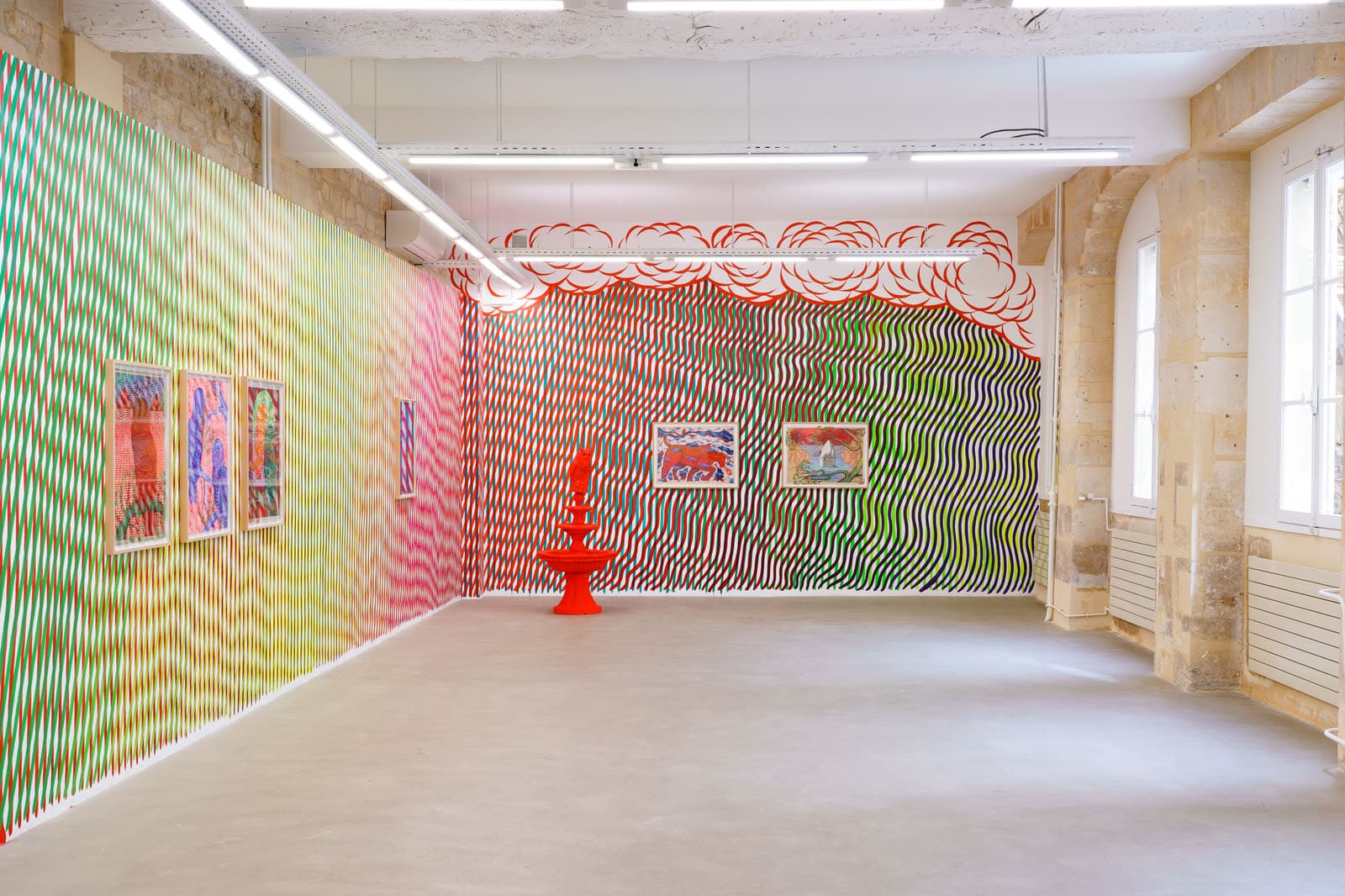
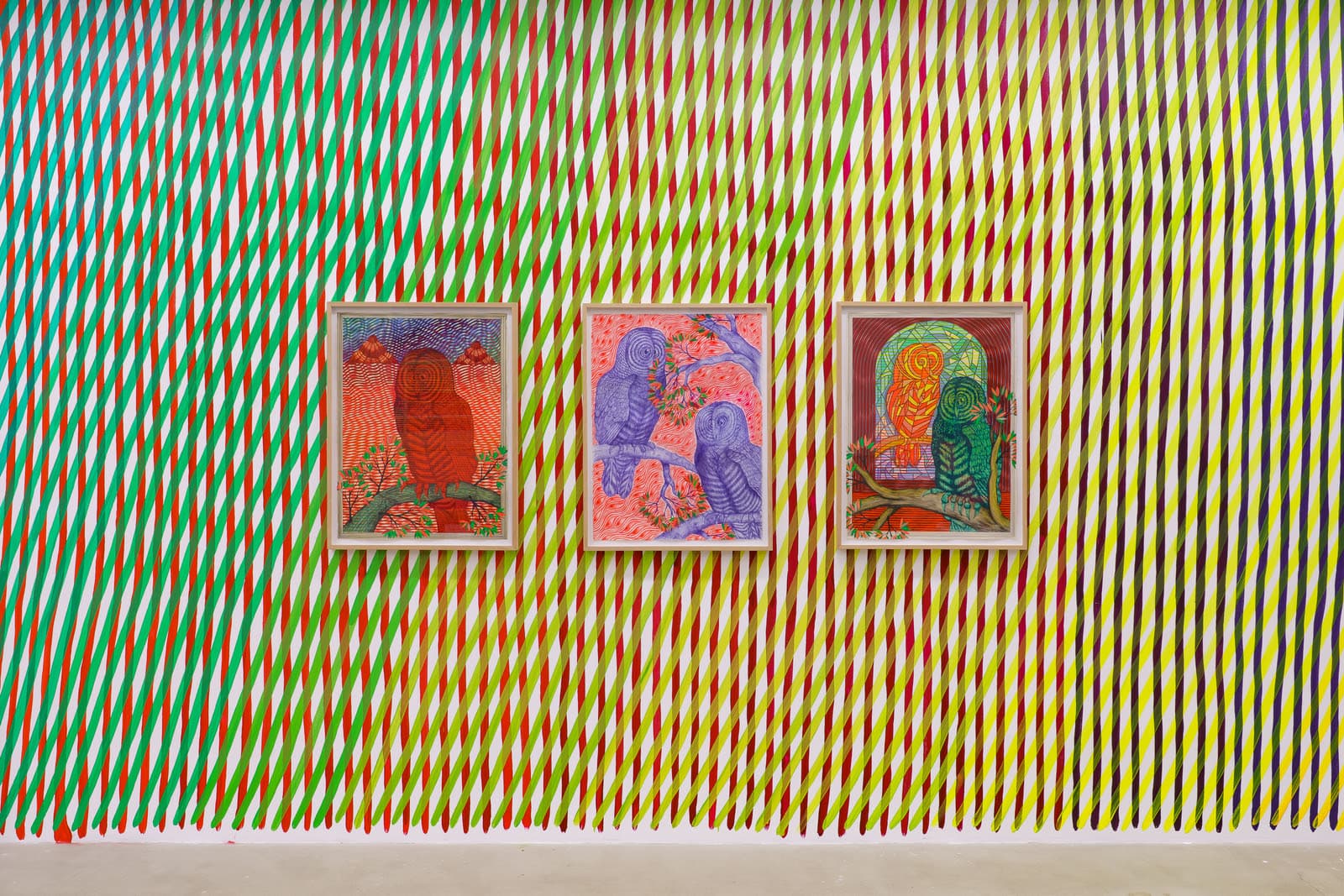
Galerie DrosteSpeaking of windows, the poet Charles Baudelaire once said: “In this dark or luminous hole, life lives, life dreams, life suffers.” [1] This 19th-century prose resonates deeply with the title of this exhibition, chosen by the American artist Andrew Schoultz: There is a world outside of your window. As early as the 19th century, the issue of photography haunted the debate over the loss of humanist values; today, our artistic relationship to the world is being redefined by artificial intelligence, sometimes perceived as a boon, sometimes considered a threat. With this exhibition, Schoultz takes a stand and tells, without mincing words, that he invites us to see the world beyond a form of falsely comforting virtuality. For several months now, strange posters with a desperately minimalist design have been appearing in the Paris metro, advertising a round, connected device that promises never to let us down. Is the machine finally starting to take humans for fools? How sad it is never to encounter a “no”—those missed appointments, those refusals that become substance, those coincidences that trigger others and enrich our existence. There are undoubtedly people who dream of a path paved entirely with “yes”, free of constraints, a one-way, nonstop journey to a realm shaped by their desires. Without battles, without struggles, without negotiations, access there would be obvious and taken for granted. In Greek, this has long been called hubris, and in most cases, hubris—that sister of excessive excess—always ends badly. Let us ask the opinion of all those tormented in ancient legends, those who wanted everything at once and who, even today, have their livers eaten by eagles or must roll a stone to the summit, only to watch it fall back down, inevitably, in every ascent. And if we wish to extend the metaphor of references to ancient Greece, one detail deserves our attention: the owl, often present in Schoultz’s works as a figure of wisdom—Athenian and patient—seems to watch over the entirety of his thought. There is, in fact, something as ancient as it is apocalyptic in the artist’s manner of painting and drawing, which formulates signals—like waves, like a linear and repetitive gesture—in the style of Orthodox and sacred icons. His statement beautifully blend a genuine and popular desire to be understood with profound and sometimes cryptic references that speak through symbols. He must capture the eye through bold color, gesture and message. The work Last Hand of Man (It’s Not Too Late), as frightening as it is hypnotic, only appeals to our human conscience. More alarmed than judgmental, the painter’s vision confronts us with certain contradictions and invites us to question our relationship with the animal that we are—one that, unlike the imitative machine, feels, suffers, and dies. It is possible to understand these terms without sadness, but with the obvious joy of feeling alive. In this warning, in this advice that resembles a cry of hope, in the style of Jacques Brel’s song “Il nous faut regarder,” the artist actually offers a subtle ode to free, unconditional contemplation. —Laure Saffroy-Lepesqueur Born 1975, he lives and works in Los Angeles, California. He received his BFA in Illustration from the Academy of Arts University in San Francisco, CA. His works are represented in important collections such as the Los Angeles County Museum (LACMA), the Berkeley Art Museum or the San Francisco Museum of Modern Art, CA. 1 - « Les Fenêtres », Petits Poèmes en prose, Michel Lévy Frères, 1869