
Collateral, Venice
Andrius Arutiunian
Gharīb
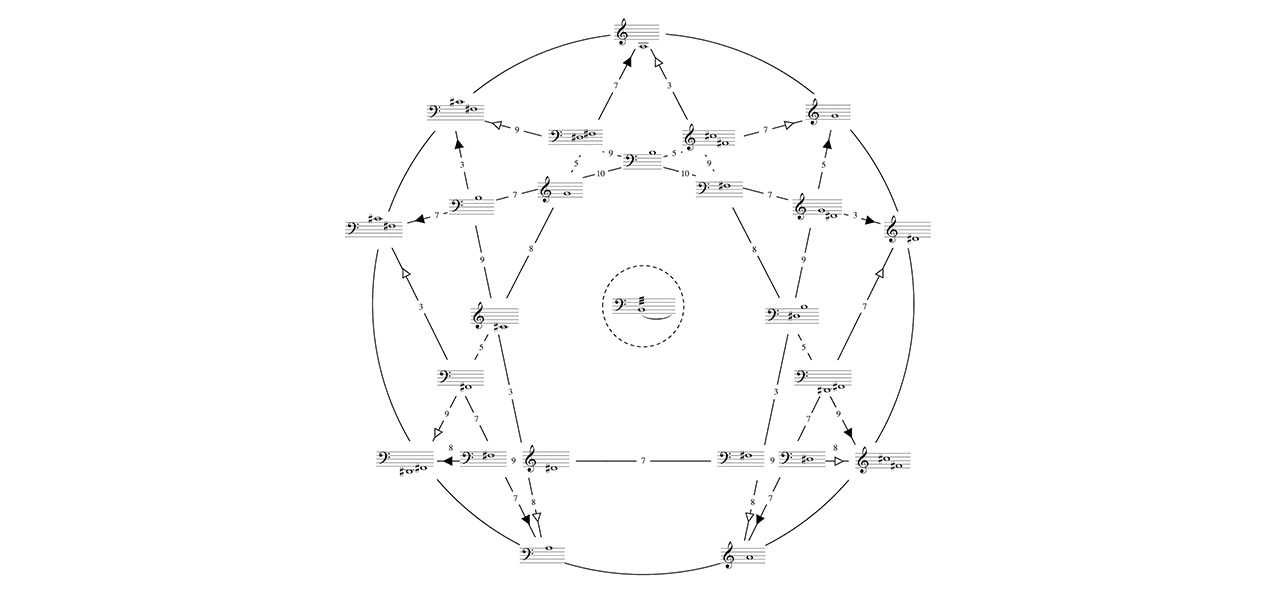
Armenian Pavilion“At last we arrive to gharīb—that notion of dissonance, resistance, and retreat. Gharīb translates as a ‘stranger who enters into our midst.’ As a word of almost-cryptogenic origins it moves at ease across Arabic, Armenian, Farsi, and Turkish languages, proposing a way of simultaneous being within and without—beyond a language, a place, an origin and a common myth—a contradiction at its heart, its crucial principle of definition. Gharīb has long been associated with the clandestine activities of music-making, illegal social clubs, early psychotropic substance trade and the underground. Gharīb as a mode of disillusionment and liminality, as a way of retracing the political margins. To embed and disappear, to exist and evaporate at the same time, an attempt to belong, a way of sensing the world. The cosmology of the Gharīb Pavilion plays through the modes of sonic dissent, vernacular knowledges, and messy systems of elusiveness. Songs of illicit origin, alternate tuning systems, oil extraction and Cher with her autotune tricks, Gurdjieff’s harmonious law of seven and divine systems of digestion. A certain musical score emerges, dotted by the hushed voices of the unheard, the disappeared, and the radical.” —Andrius Arutiunian The Exhibition Drawing from Andrius Arutiunian’s research, the Pavilion explores forms of organisation and world ordering, both musical and political, which remain outside the Western imaginaries. Here, the gharīb is imagined as a dissonance to the prevailing understandings of time, rhythm, and attunement. The exhibition is composed of a series of new objects and installations. The Pavilion uses sound and music as its main elements, with a large-scale piece called You Do Not Remember Yourself at its centre—an instrument playing with natural resonances and diaphony. The Pavilion begins with the Midnight Practice, a gathering in a tiny Venetian courtyard from midnight to the early morning. During these liminal hours, a symbolic dish is consumed, a Gharīb oghi is served, and a series of hypnotic musical exercises is played. Subdued, unhurried, and hushed, the Midnight Practice unfolds as a collective attempt of listening and being together. The Midnight Practice reconnects with the Armenian-Greek mystic and composer Gurdjieff and his memorable gatherings. One of the first thinkers (and quite possibly charlatans) to introduce a syncretic reading of Eastern philosophy to the West, Gurdjieff stayed a rather enigmatic and conflicting figure among his contemporaries, with his constant fluctuation between mystical appearances, bizarre coincidences, and bouts of simultaneous drunkenness and somberness. The Location The Armenian Pavilion moves into a new space on the Biennale map in Castello. A working-class Venetian apartment, neither a palazzo nor a white cube, the space retains the memories of its former occupants, offering a temporary shelter to the manifestations of gharīb. The Publications The Book of Gharīb containing essays by Andrius Arutiunian, Jason Bahbak Mohaghegh and Anna Della Subin is published together with a vinyl by the Hallow Ground label, with a limited artist edition for the Venice Biennale. The Gharīb pocket book—a portable companion to the Pavilion—collects disparate excerpts from stories, essays, recipes, spells, tones and voices in multiple languages. The Artist Andrius Arutiunian (born in 1991) is an Armenian-Lithuanian artist and composer based in the Netherlands. Working through hybrid forms of sound, Arutiunian often combines hypnotic aural structures, synthetic sound sources, and sonic vernaculars. Recent shows and performances include CTM festival, Berlin; Rewire, The Hague; FACT, Liverpool; Lucia Festival, Florence; Stedelijk Museum, Amsterdam; documenta 14, Parliament of Bodies, Kassel. Special thanks to Sona Dalalyan, Mariam Gigoyan, Adelina von Fürstenberg, Miguel Magalhães, Shogher Margossian, Marianna Maruyama, Gabrielė Mišeikytė, Anush Ohanyan, Razmik Panossian, Eliane Radigue, Filipa Ramos, Eloise Sweetman, as well as to AGBU Milan, Fondazione Berengo, and the Honorary Consulate of Armenia in Venice. Commissioner: Arayik Khzmalyan, Deputy Minister of Education, Science, Culture and Sport Curators: Anne Davidian, Elena Sorokina