Dates
Jun 24 – Aug 1, 2026
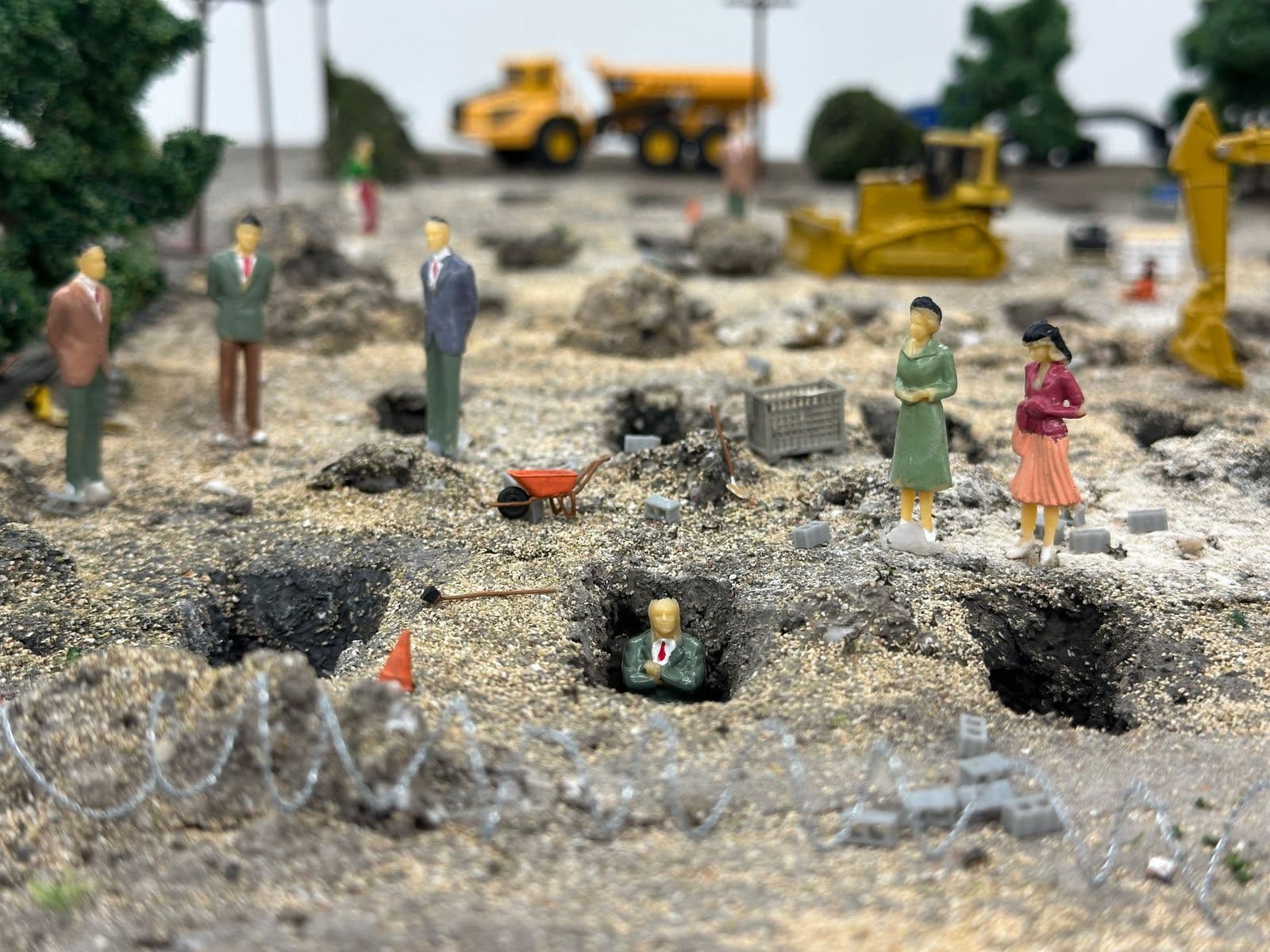
Dimin is excited to present Gods (Too/2/To) Decompose, an exhibition of sculpture and spectacle from artist duo Jen Catron and Paul Outlaw. As performers and sculptors, Catron and Outlaw create works at the scale of civic monument. Working with shared cultural emblems and public rituals, they construct sweeping environments in which spectacle and excess reveal the strain of collective myth. Riffing on the line "Gods, too, decompose" from Nietzche's The Gay Science, gods (too/2/to) decompose consists of three sculptures that together form a fragmentary arc through contemporary American belief systems. Developed in parallel with the pair's ongoing work around America's 250th birthday, the sculptures examine spectacle, nationalism, technological power, displacement, and the instability of collective narratives. The works operate through familiar cultural forms that become bodily, vulnerable, and increasingly difficult to resolve. An oversized anthropomorphic hot dog serves as the exhibition's central figure. Comic, mournful, menacing, and tender, the sculpture bears a swollen belly suggestive of pregnancy, or transformation. The hot dog functions as an American icon, carrying associations with leisure, mass consumption, and public celebration. Here, however, the symbol becomes uncertain. Its apparent vulnerability introduces questions of responsibility, reproduction, and decline, positioning the figure between monument and body, optimism, and dread. The work is conceived as a quieter counterpart to their 65-foot public art project Hot Dog in the City curated by Times Square Arts in 2024, transforming a symbol of collective spectacle into an intimate and psychologically charged presence. A large sponge-like figure with human arms and legs appears suspended between death and ascension. The sculpture draws from the history of Bikini Atoll, where the displacement of the Marshallese people and subsequent nuclear testing transformed both landscape and culture. The sponge references both the porous body and the fictional world of SpongeBob SquarePants, whose setting is canonically located beneath Bikini Atoll. This collision of childhood entertainment, nuclear and environmental violence, and historical erasure is central to the work. The figure absorbs multiple readings simultaneously: exhausted body, relic, memorial, cartoon character, contaminated landscape, and religious icon. Positioned within the exhibition, it serves as a meditation on the ways catastrophe is absorbed, aestheticized, and gradually incorporated into cultural memory. The third work takes the form of a suspended miniature landscape composed primarily of sand, excavation sites, and architectural interventions. Initially recalling a sandbox or site of childhood play, the work gradually reveals itself as a field of extraction, surveillance, simulation, and burial. The piece draws connections between gaming culture, artificial intelligence, and contemporary warfare. References to AI-assisted targeting, drone warfare, and digital simulation remain embedded within the work's structure rather than explicitly depicted. The sculpture occupies a space between playground, archaeological site, military terrain model, and memorial, allowing viewers to move between personal memory and geopolitical reality. Together, the three works examine how contemporary societies process violence, belief, and power through symbols that often appear benign, entertaining, or familiar. The exhibition is less concerned with specific events than with the systems that make such events intelligible: nationalism, mythology, technological mediation, spectacle, and collective forgetting. The works explore a moment in which inherited narratives appear increasingly unstable, yet continue to shape political and emotional life. Jen Catron & Paul Outlaw are a collaborative duo whose large-scale sculptures and performances examine spectacle, excess, and the construction of myth. Working across public and institutional contexts, they transform vernacular symbols into civic-scale monuments that engage broad audiences, using humor and scale to draw viewers into critical encounters with systems of consumption, celebration, and collective belief. Their work foregrounds how power is performed and sustained in shared space. They force close looking and wide participation, destabilizing hierarchies between the epic and the everyday while revealing how cultural meaning is constructed, circulated, and contested. Catron & Outlaw have presented projects with institutions including the Brooklyn Museum, Times Square Arts, the Museum of Contemporary Art Detroit (MOCAD), and Creative Time. Their work has received national and international press coverage and is held in collections including the Brooklyn Museum and The Bunker Arstpace in West Palm Beach. They live and work in Brooklyn, New York.