
Downtown, Los Angeles
James Herman
Island
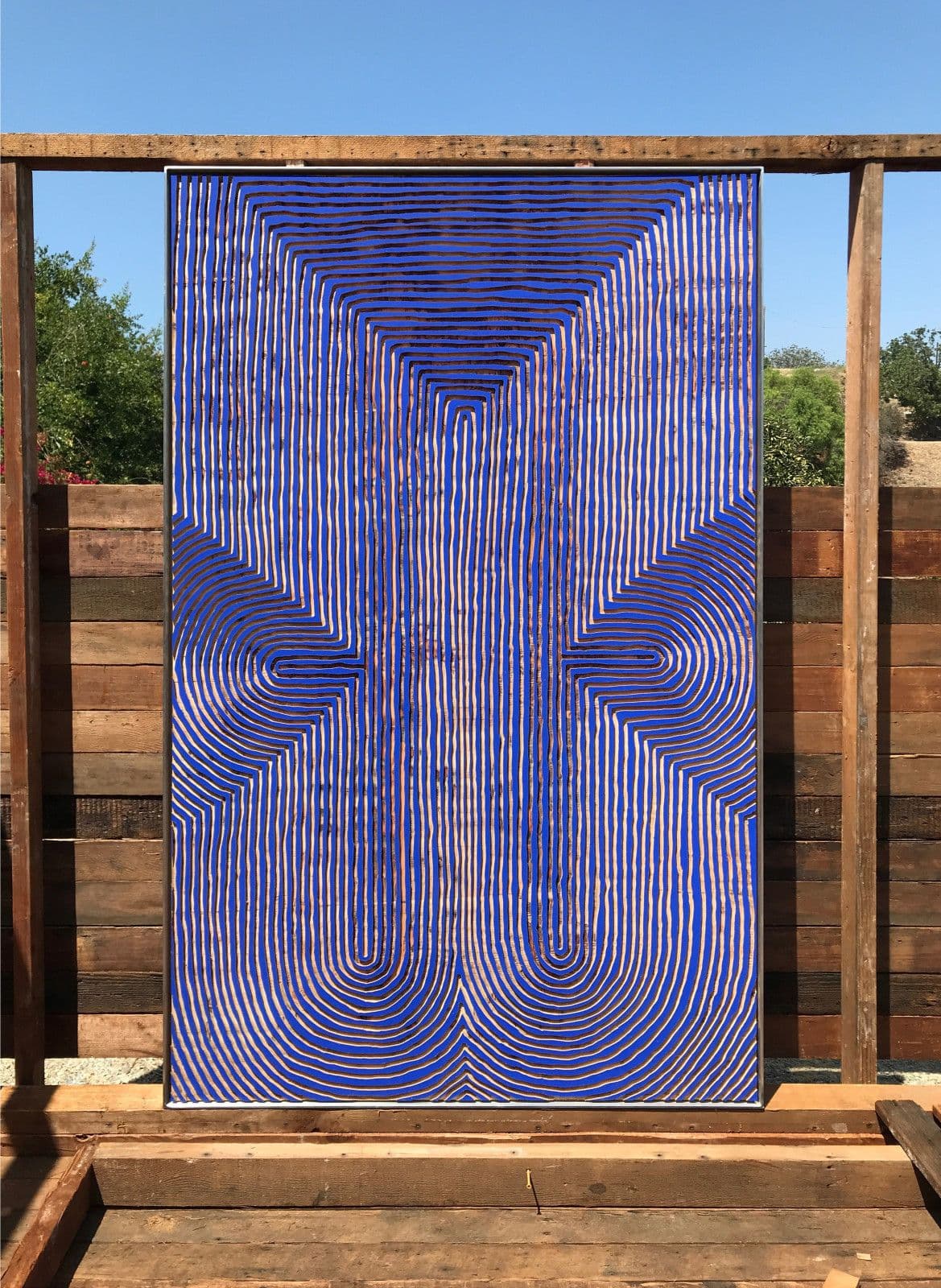
IbidIbid Gallery is pleased to present Island, the gallery’s second solo exhibition with the Los Angeles based artist James Herman. Using sculpture, painting, and printmaking alongside his homesteading practice, Herman’s work straddles alternative off-the-grid building methods with the legacy of Post-war American painting in his psychedelic, referential-laden forms and their social function. Herman’s painted plywood panels and architectural dwellings act as reflectors and spatial activators for his ultimate conceptual practice: a radical domesticity based in sustainability, self-reliance, subsistence, and repetitive labor. Expanding on his prior “termite drawings”, Herman’s most recent series of carved and painted plywood panels incorporate more complex graphic forms in their optical radiance. Herman’s initially determinate process of drawing a glyph on painted plywood and carving its outline takes on unpredictable forms as the carvings emanate from their core glyph and reveal the unpredictable contours of the plywood’s layers. The varying hues and unexpected noise from the wood’s strata contrasts with the surface’s monochromatic surface to create pulsing, vibrant sensations with an undeniable energetic quality. The meditative energy work enacted by Herman in carving the panels transfers into the physical objects themselves, emitting or reflecting a stored energy onto the viewer. Painted in a color gradient corresponding to internal sensory phenomena, the meditative and disorienting effects of the panels allow the viewer to enter into a state of heightened sensory awareness and self-realization. Reminiscent of Frank Stella’s Black Paintings, the panels waver between sculptural relief and painting as they shrug off subjective composition-making and emphasize their own tautological self-formation. Herman replaces Stella’s koan ‘What you see is what you see’ with mantras of autonomy and abundance: ‘Nature is on my side’ – ‘Everything we will ever need is right here’ – ‘A thing done in haste will go to waste.’ Beyond the dialectical functions of modern and contemporary art historical references, the panels also relate to certain Non-Western artwork which often combine aesthetic forms with the literal applications, such as Rajasthani Tantric paintings, Austronesian nautical charts, and Japanese rock gardens. Alongside Herman’s panels is a new architecturally-scaled sculpture from his studio and home. The structure does in its form what the panels begin in concept and material: to introduce a space of interiority and domesticity into the gallery. To insert an otherwise private space into the public viewing sphere is to champion the intimate act of homesteading and tending to one’s domestic space. Engaging with subsistence farming, mindful consumption, and alternative building methods, Herman’s self-described shed mysticism is a sentiment encompassing his life-studio philosophy in which there is no hierarchy between art making and gardening, building, and upkeep. The history of back-to-the-land movements reach as far as the Fall of the Roman Empire with more recent episodes in 1960’s America, especially in the Pacific Northwest . Growing up in Oregon, Herman continues a history of off-the-grid living on his hillside in Montecito Heights in East Los Angeles. Herman engages with both the technics of organic architecture and the aesthetic histories of countercultural lifestyles. Made of reclaimed lumber, the rising-setting sun on his shed-structure’s roof signals the cyclical ethos of self-reliance as a practice of care as much as creation. Herman’s approach to making and upkeep as a mode of being, rather than vehicle to a singular final product, is a direct affront to certain contemporary art practices. Inherent in this approach is an opensource approach to the information and knowledge produced through his practice. This is visible in his use of printmaking, specifically silkscreen, as it relates to the opensource nature of information in recent American countercultural histories. Hand-bound books on construction techniques, political posters, pamphlets on experimental drug usage, and self-published journals chronicling utopic commune life were, and still are, inexpensive ways to share information across those seeking a new form of living. Similarly, Herman’s large color panels, with their raised and recessed surfaces, suggest oversized woodcut blocks, ready to imprint their information and energy on paper and viewer alike. James Herman was born in Denver, Colorado in 1985. Herman attended the Yale Norfolk Summer School of Art and received his BFA from the University of Oregon. He has been included in exhibitions at Scranch, Joshua Tree, CA; Holiday, Los Angeles, CA; Night Gallery, Los Angeles, CA; Roberts and Tilton, Los Angeles, CA; Matéria, Rome; Cabrillo National Monument, Point Loma, CA; the Henry Ford Museum, Detroit, MI; and the Rio Gallery, Salt Lake City, UT. His book Driftwood Forts of the Oregon Coast was published by Nestucca Spit Press in 2014. Herman lives and works in Los Angeles.