
Marais, Paris
Robin Rhode
The Broken Wall
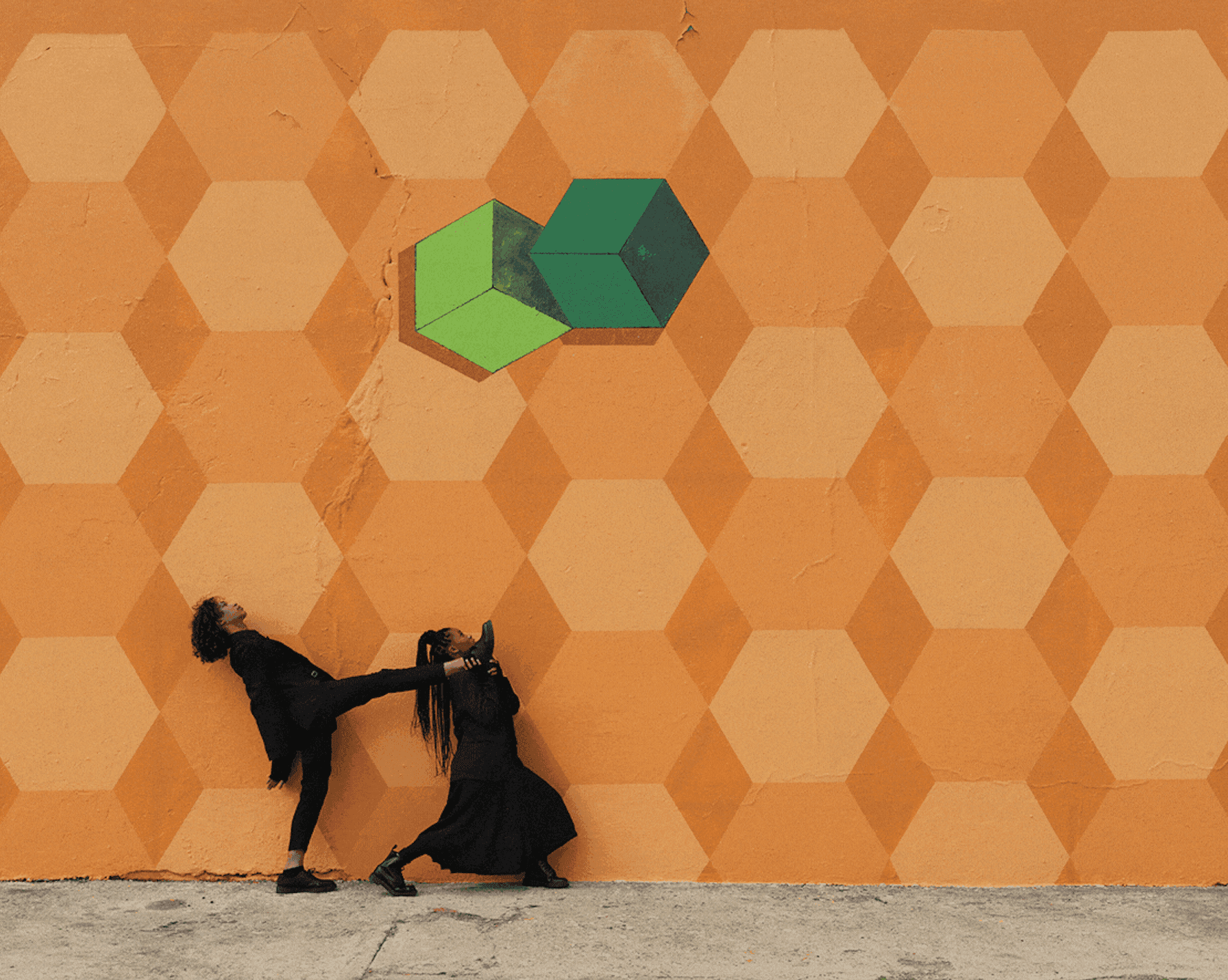
Kamel Mennour[Scroll down for French version / Veuillez trouver ci-dessous la version française] Violaine Boutet de Monvel: The Broken Wall, your second solo show at Kamel Mennour, follows up on your exhibition a plan of the soul, for which you were awarded the 2018 Zurich Art Prize at the Museum Haus Konstruktiv. What are you presenting at the gallery? Robin Rhode: I present three recent photographic ensembles from Haus Konstruktiv, along with older ones. They were all produced outside, against the same broken wall in the Johannesburg suburb of Westbury, in South Africa, where I grew up. I’ve also included a wall painting to echo the geometric tiling that appears in Nigerian Sands (2018). Manifesting this motif into the exhibition space allows the audience to have a stronger physical relationship to my work. It activates the surface of the gallery’s walls in a very subtle way, like a soft whisper blurring the notion of fictional space. VBdM: What is the process behind these photographic ensembles, in which performers playfully interact with figurative or abstract wall drawings in the making? RR: I’ve been working on this particular wall in Johannesburg for seven years. My team includes about fifteen persons now, mostly young people from the community. I always sketch and develop the concept behind each work beforehand. The notion of physical interaction between the performers and the wall drawings is crucial. From one photograph to the next, there is a transient, almost spiritual shift, when the drawing becomes alive, breaths, gets a heartbeat and develops a soul through the performers’ engagement with it. VBdM: The sequences of interactions that these works unfold, respectively, often read as if you were catapulting dancing bodies into drawing fields. What is your relationship to choreography and narration? RR: I’ve never formally studied choreography, but I have an immense appreciation for dance and performing arts. I come from a very gestural society, where the movement of the body speaks louder than words and conveys more than language. It breaks down communication barriers between cultures, especially those as complex as South Africa’s. Narration comes organically through drawing. Each mark carries a storyline, and each photograph is a steppingstone towards a broader narrative that extends beyond the picture frames. VBdM: Drawing and photography poetically encompass your performances here, which are both staged and documented. What importance do these two mediums have in your overall practice? RR: I consider here photography only in terms of capturing a wall drawing and the performance that animates it. Drawing is really at the core of my aesthetics. It is the central narrative towards which everything else gravitates. I currently feel the urge to make art with all the visual lexicons at my disposal and I flirt with many mediums to do so, but my ultimate wish is to draw, become an abstract painter and find inner peace in the process. VBdM: This show was titled after an essay by Sean O’Toole, in which he draws parallels between your work and Johannesburg. The city was shaped throughout the Apartheid era. Having relocated to Berlin, do you believe your practice still relates to the wall as a possible symbol of ethnic or political segregation? RR: My work has considerably evolved since I moved to Berlin, seventeen years ago. As a South African artist, I feel almost compelled to produce works that engage with identity politics or the issue of decolonization, which dominate the art scene in my home country. However, due to my geographical distance, I was led to embrace new forms of inspiration. Among them, colour theory, architecture and mathematics have been a breath of fresh air to me, away from the overly political, but I still use humour to poke fun at aspects of power. Born in 1976 in Cape Town (South Africa), Robin Rhode lives and works in Berlin (Germany). His work was part of major solo and group exhibitions at a number of important museums around the world such as the Museum Haus Konstruktiv, Zurich; the Haus der Kunst, Munich; the Los Angeles County Museum of Art (LACMA); the Museum of Modern Art (MoMA), New York; the National Gallery of Victoria, Melbourne; the Hamburger Bahnhof - Museum für Gegenwart, Berlin; the Centre Pompidou, Paris; the Wexner Center for the Arts, Columbus; the Hayward Gallery, London. Furthermore he has participated at the 51st Venice Biennale, the Biennale of Sydney and the New Orleans Biennial. His work is part of various public collections: the Centre Pompidou, Paris; the Julia Stoschek Collection, Düsseldorf; LVMH Moët Hennessy – Louis Vuitton, Paris; the National Gallery of Victoria, Melbourne; the Solomon R. Guggenheim Museum, New York; the Museum of Modern Art (MoMA), New York; the Walker Art Center, Minneapolis. Robin Rhode was the eleventh winner of the internationally renowned Zurich Art Prize in 2018. ***** Violaine Boutet de Monvel : The Broken Wall, votre deuxième exposition personnelle à la galerie kamel mennour, fait suite à votre exposition a plan of the soul, pour laquelle vous aviez reçu le Zurich Art Prize en 2018 au Museum Haus Konstruktiv. Que présentez-vous à la galerie ? Robin Rhode : Je présente trois ensembles photographiques récents issus de l’exposition à la Haus Konstruktiv, et d’autres, plus anciens. Ils ont tous été produits en extérieur, contre ce même mur laissé à l’abandon à Westbury dans la banlieue de Johannesburg en Afrique du Sud, où j'ai grandi. Je montre également une peinture murale qui fait écho à la trame géométrique qui apparaît dans Nigerian Sands (2018). La présence de ce motif dans l'espace d'exposition permet au public d'avoir une relation physique plus forte avec mon travail. Il active la surface des murs de la galerie d'une manière très subtile, comme un doux murmure qui brouille la notion d'espace fictif. VBdM: Quel est le processus derrière ces ensembles photographiques, dans lesquels les performeurs interagissent de façon ludique avec des dessins muraux figuratifs ou abstraits en cours de réalisation ? RR: Je travaille sur ce fameux mur à Johannesburg depuis sept ans. Mon équipe compte aujourd'hui une quinzaine de personnes, pour la plupart des jeunes de la communauté. J'esquisse et je développe toujours le concept derrière chaque œuvre en amont. La notion d'interaction physique entre les performeurs et les dessins muraux est essentielle. D'une photographie à l'autre, il y a un glissement transitoire, presque spirituel, au cours duquel le dessin prend vie, respire, développe un pouls et une âme à travers l'engagement des performeurs. VBdM: Les séquences d'interactions, qui se déroulent respectivement dans ces œuvres, se lisent souvent comme si vous catapultiez des corps dansants dans le champ des dessins. Quelle est votre relation avec la chorégraphie et la narration ? RR: Je n'ai jamais formellement étudié la chorégraphie, mais j’ai une grande admiration pour la danse et les arts performatifs. Je viens d'une société très gestuelle, où le mouvement du corps parle plus que les mots et transmet bien plus que le langage. Il brise les barrières de communication entre les cultures, en particulier lorsqu’elles sont aussi complexes que celles de l'Afrique du Sud. La narration se construit organiquement à travers le dessin. Chaque trait porte un élément de scénario et chaque photographie est un tremplin vers une narration plus large qui s'étend au-delà du cadre de l'image. VBdM: Le dessin et la photographie englobent ici de façon poétique vos performances, qui sont à la fois mises en scène et documentées. Quelle est l'importance de ces deux médiums dans votre pratique globale ? RR: Je ne considère ici la photographie qu'en termes de captation du dessin mural et de la performance qui l'anime. Le dessin est vraiment au cœur de mon esthétique. C'est le récit central autour duquel tout le reste gravite. J'éprouve actuellement le besoin de créer avec tous les lexiques visuels à ma disposition et je flirte avec de nombreux médiums dans cette optique, mais mon vœu ultime est de dessiner, de devenir un peintre abstrait et de trouver la paix intérieure dans ce processus. VBdM: Le titre de cette exposition est tiré d’un essai de Sean O'Toole, dans lequel il établit des parallèles entre votre travail et la ville de Johannesburg, façonnée pendant l'Apartheid. Ayant déménagé à Berlin, croyez- vous que votre pratique se rapporte toujours au mur comme symbole possible de ségrégation ethnique ou politique ? RR: Mon travail a considérablement évolué depuis mon arrivée à Berlin, il y a dix-sept ans. En tant qu'artiste sud-africain, je me sens presque obligé de produire des œuvres qui traitent de politique identitaire ou de décolonisation, des thèmes qui dominent la scène artistique dans mon pays. Cependant, en raison de la distance géographique, j'ai été amené à embrasser de nouvelles formes d'inspiration. Parmi elles, la théorie des couleurs, l'architecture et les mathématiques ont été pour moi une bouffée d'air frais, loin du trop politique, mais j'utilise toujours l'humour pour me jouer des aspects du pouvoir. Né en 1976 à Cape Town (Afrique du Sud), Robin Rhode vit et travaille à Berlin (Allemagne). Son travail a été présenté au sein de nombreuses expositions personnelles et collectives dans de prestigieuses institutions à travers le monde : le Musée Haus Konstruktiv, Zurich ; le Haus der Kunst, Munich ; le Los Angeles County Museum of Art (LACMA) ; le Museum of Modern Art (MoMA), New York ; la National Gallery of Victoria, Melbourne ; le Hamburger Bahnhof - Museum für Gegenwart, Berlin ; le Centre Pompidou, Paris ; le Wexner Center for the Arts, Columbus ; la Hayward Gallery, Londres. Il a participé à la 51ème Biennale de Venise, la Biennale de Sydney et la Biennale de La Nouvelle-Orléans. Ses œuvres font partie de maintes collections publiques : le Centre Pompidou, Paris ; la Julia Stoschek Collection, Düsseldorf ; LVMH Moët Hennessy – Louis Vuitton, Paris ; la National Gallery of Victoria, Melbourne ; le musée Solomon R. Guggenheim, New York ; le Museum of Modern Art (MoMA), New York ; le Walker Art Center, Minneapolis. Robin Rhode a été le onzième lauréat du très reconnu Zurich Art Prize en 2018.