
West, London
Group Exhibition
A Moment for Eternity
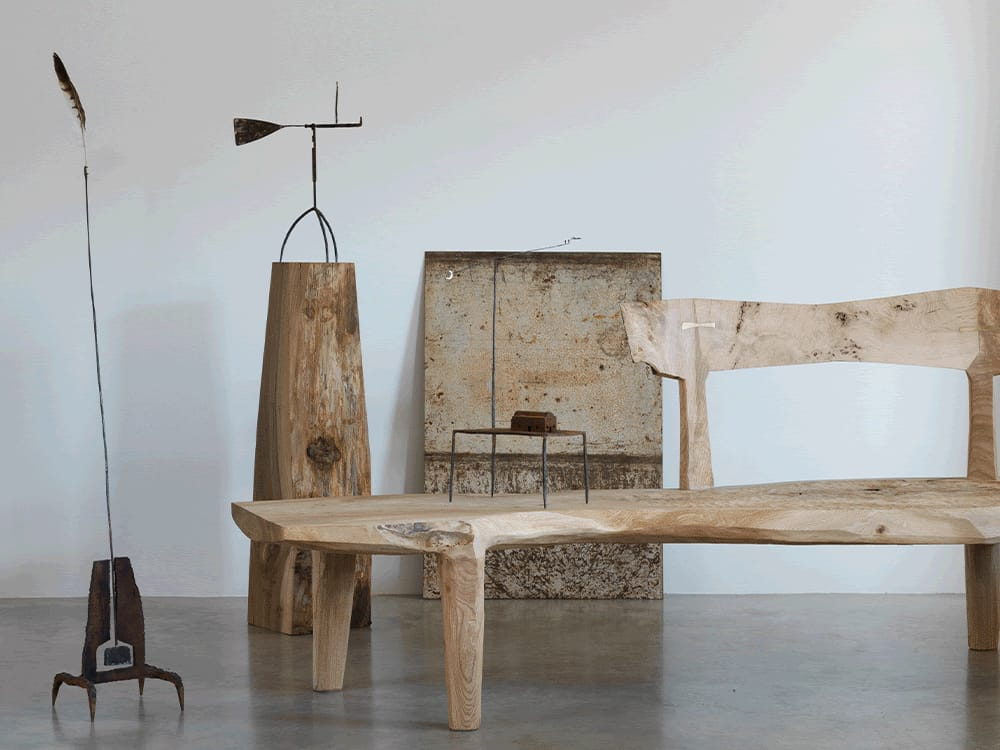
Hauser & WirthCraig Bamford (SASA Works) Akiko Hirai Richard McVetis Rosa Nguyen Jonty Sale In a presentation by Make at Hauser & Wirth London and curated by Jacqueline Moore, a collective of established artist-makers showcase works that embody a narrative of time and space, nature and human connection. Their expressive responses to material and making explore the ritualistic, a theme that also resonates with the work of the artist Takesada Matsutani. Through repetition and gesture, the artist makers transform the physical properties of their materials into new forms. With each action—stitch by stitch, the click of the camera shutter, a chisel’s mark or drop of liquid clay—mind, body and matter converge. Each artist maker possesses a distinctive visual language: Akiko Hirai’s ceramic moon jars are characterized by metamorphosis, revealing the expressive, animistic spirit of clay and raising questions of mortality and permanence with their powdered ashen finish. Richard McVetis materializes time in stitch, mapping his reflections on the interconnectedness of life and the cosmos. With wood as his medium, furniture maker Craig Bamford (SASA Works) balances rawness and refinement, imperfection and precision through material exploration, crafting stories of elemental energy and human connection. Rosa Nguyen draws on botanical matter to produce porcelain vessels, as well as ceramic and glass works presented as a wall tableaux, addressing ideas of memory, expiration and temporality. Exploring the apparent flux and stasis of nature, Jonty Sale magnifies the natural world in enigmatic photographic images which play with perception and scale. There is a profound and universal beauty in the fusion between the physical act of making and human intention, with the work of each artist inseparable from their inner lives and minds. Surveying the works in the exhibition, viewers’ senses become alert, held simultaneously in the embrace of the suspended moment and life’s flow—the convergence of permanence and impermanence—in ‘a moment for eternity.’ Signage for this exhibition is produced using OM Signage Film©, an artist-developed, non-petrochemical alternative to PVC created by Other Matter®. Developed in response to the environmental impact of conventional exhibition graphics, the material integrates into standard fabrication processes while reducing reliance on petrochemical plastics. Make is dedicated to contemporary making and the crafted object, committed to showcasing a range of the world’s best emerging and established artist-makers. Led by Manuela Wirth, the international program includes exhibitions, residencies and meaningful collaborations with external curators, institutions and craft organizations. Make is a natural extension of the wider Hauser & Wirth gallery ethos—embracing craft heritage, provenance, sustainability, and the value of emotional engagement with the handmade. Since launching in 2018, Make has presented work by over 80 artist-makers and provided valuable insights into the diverse processes and rich narratives of their practices. Craig Bamford is a maker deeply informed by place, material and landscape. Bamford grew up in a rural part of Kenya near the Rift Valley and, being able to see the stars so clearly as one can in Africa, he formed an early connection with the idea of the cosmos, mystery, balance and the rich co-existence of man and nature. The idea of interconnectedness and respect for the natural world is integrated with the notion that the process of making comes from a place of the inner consciousness. Bamford’s practice explores the energies that materials hold and the idea of animism, that each form and object has a life force. His works reflect cycles in time, the seasons and the celestial, taking foraged and found materials and transforming them into objects and furniture pieces which embody his connection with the sacred and the spiritual. Exhibitions include ‘Five Seasons’ (2022) Make Hauser & Wirth, Somerset, UK; ‘Hot Water for Tea’ (2024), Make Hauser & Wirth, Somerset, UK; and ‘Alchemy and Form’ (2025 – 2026), Blue Mountain School, London, UK. Akiko Hirai is a Japanese ceramicist living and working in the UK. Born in Shizuoka, Japan, Hirai came to London to study at Central St Martins in the 2000s. Hirai’s ceramic forms are often derived from traditional Japanese and Korean vessels such as moon jars and tea wares. She embeds her body clay with unexpected materials to encourage the texturally rich surfaces typical of her practice. She is intrigued by the interaction of materials and the transformative power of the kiln; this metamorphosis allows the work’s surface to evolve, a process she compares to the ageing and changing of all life forms over time. For Hirai, her works reflect the ritual process of making and a bodily connection with her material. She does not seek perfection but rather beauty in imperfection, attracted to the unrefined quality of objects. Her work is held in public collections worldwide, including the Victoria and Albert Museum, London, UK and The Fitzwilliam Museum, Cambridge, UK. Her work was recognized by the influential Loewe Foundation Craft Prize in 2019. London-based artist-maker Rosa Nguyen works with ceramic and glass to create objects, vessels and installations in the form of poetic compositional tableaux. Taking inspiration from the natural world and our holistic relationship with it, her work is characterized by organic and abstracted vessel forms and the incorporation of living and dried botanical materials. These are assembled and manipulated through casting and preserving in both fired and clay gesso. She dips plant matter in liquid porcelain and processes them in sacrificial kiln firings, which fuse and transform the combusted vegetal materials into strange, otherworldly forms in rich glassy colored glazes. With a long-standing interest in animist and oriental philosophies, Nguyen’s work evokes a contemplative aesthetic and a deep-rooted spiritual connection with nature. Her work often alludes to the transience between life and death, celebrating the interconnectivity between all life forms. Exhibiting widely in the UK and overseas, her work is represented in public collections in Europe, China and Japan, including The Garden Museum collection in London, UK, the Crafts Council Collection in London, UK and The Shigaraki Museum, Japan. Richard McVetis’ practice is deeply rooted in the repetitive nature of making and process, and intrinsic to this is hand embroidery. Often monochromatic and labor intensive, his meticulously crafted installations and embroideries span across the congruity of macro and micro. His exploration of time, memory and cosmology, capture the rhythms and patterns of existence and explore the subtle differences that emerge through ritualistic and habitual making. These inscribed patterns mark the hand’s rhythms, recording human presence, time and decay, each stitch or line acting as a marker for lived time, an embodiment of thought and patience. Through stitch, McVetis weaves together his own enquiry into the way this dimension is felt, experienced and constructed. He has been shortlisted for several distinguished prizes, including the Jerwood Drawing Prize, UK, 2011 and 2017, and the Loewe Foundation Craft Prize, 2018. His work ‘Happening’ was awarded Bronze at the Cheongju Craft Biennale, South Korea, 2025. Exhibitions include, ‘Renew’ (2019), Kettle’s Yard, Cambridge, UK; ‘Threads: Breathing stories into materials’ (2023), Arnolfini, Bristol, UK. For Wiltshire-based photographer Jonty Sale, the photographic experience is not necessarily instant, final or definitive. Rather, he sees it as a corollary of his experience of the landscape: ever-happening and in a state of constant change. Eschewing the pastoral tradition, the photographs are not meant to reassure, but rather to agitate and stimulate. The images lack the specifics of location and as non-recognizable places they are free to exist in the imagination. His time-based work exhibits annual seasonal cycles of interest and ideas arrived at, tried out, adopted and discarded; indeed, these developments are coterminous with the duration of time spent in his locale, suggesting that it is he who changes, as much as the landscape does. His interest and excitement lie foremost in the apparent perplexity of growth and form, in the haphazardness of thickets and hedgerows, of hawthorn, blackthorn, bramble and briar. Jonty has exhibited regularly in the UK and North America, where his works are also held in private collections.