
West, London
Jean Dubuffet
Fragments: Coucou Bazar
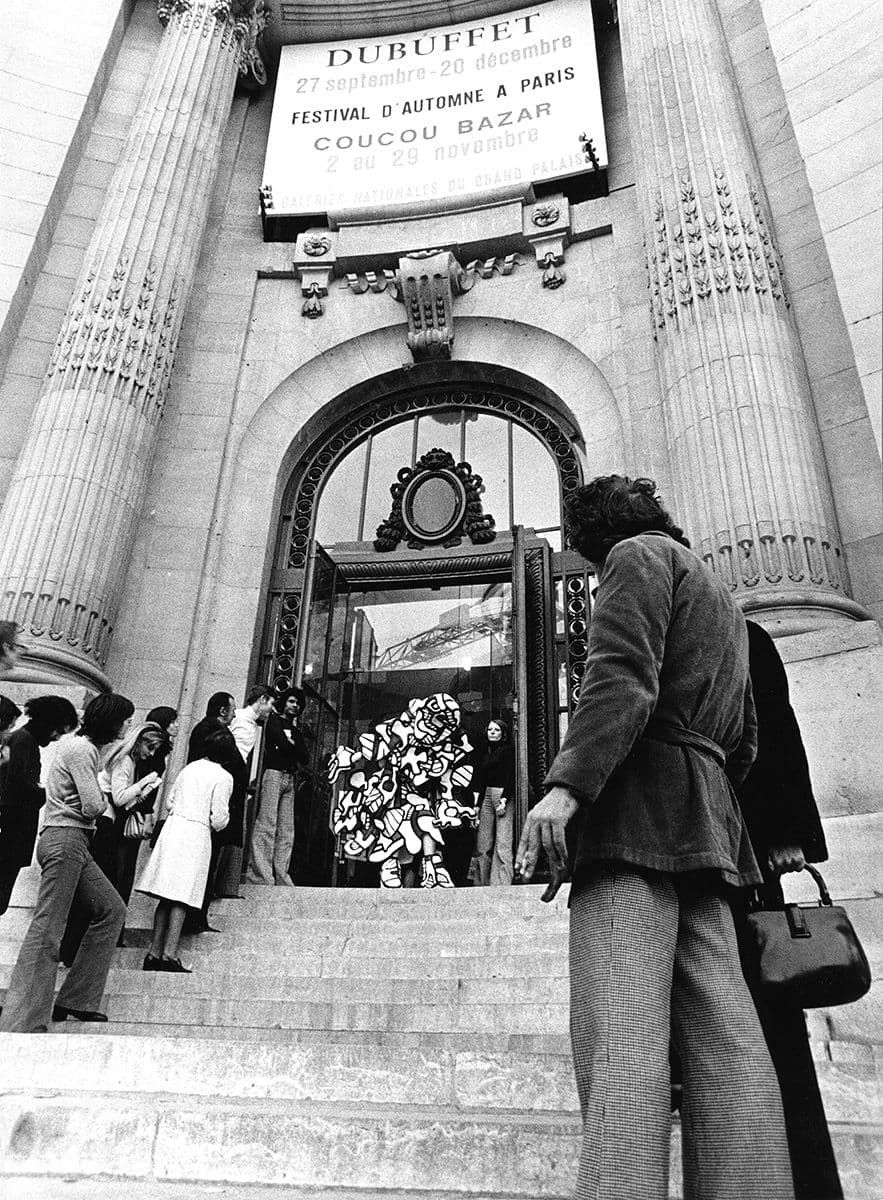
Pace GalleryPerformances at 10am, 2pm, and 6pm Pace Gallery is delighted to stage a rare capsule performance of two characters from Jean Dubuffet’s Coucou Bazar on loan from the Fondation Dubuffet, outside the entrance of 6 Burlington Gardens. Fragments: Coucou Bazar is the realization of Dubuffet’s long-term ambition of creating a living painting. The work calls attention to absurdity, blurring the boundaries between art and life. Just as his paintings sought to merge figure and ground, this performance – which incorporated painting, sculpture, architectural environments, music, choreography, and motorised props – created a spectacle that eschewed all conventions of theatre and performance. Through Coucou Bazar Dubuffet imagined a world entirely separate from his own. This non-narrative piece requires no prior knowledge of Dubuffet’s work. Coucou Bazar brings the work directly to the street and out of the gallery space. It’s an opportunity for pedestrians to happen upon a street performance as though spontaneous. This performance reignites Pace Live in London, a programme of dynamic, multidisciplinary public events, which will continue to be a major focus for the gallery. In May 1973, on the occasion of Jean Dubuffet’s retrospective at the Solomon R. Guggenheim Museum, the artist revealed a seminal work, his animated painting and performance Coucou Bazar. Coucou Bazar (or Bal de L’Hourloupe) Dubuffet mused, was outside category its status ambiguous “one wonders if it is for theater lovers or for painting lovers!” In truth Coucou Bazar engaged both forms. The work’s roots, clearly and decidedly that of painting, born from the artists decades long desire to both “exaggerate the marks of intervention,” while “eliminating all human presence” while also engaging theater, music and dance. As Dubuffet suggests in his extended and poetic production notes, since it is difficult to move in these costumes “these conditions could give rise to a new kind of dance: an extremely slow-motion dance based on quasi-immobility; each actor limiting their movements to the sparest gestures: here a hand, there a knee, here a shoulder.” For Fragments: Coucou Bazar two of the original costumes, on loan from the Fondation Dubuffet, will be reactivated and presented to a new public. A public, and as Dubuffet has it the “person in the street,” who through casual and directed encounter will once again be befriended through slow dance and living painting. Coucou Bazar consists of a number of elements, chief amongst them, the Practicables, a series of flats comprised of cellular material panels and layered resin modeled on drawings of characters, animals and decorative elements. A number of which were mounted on wheels or animated by machinery during the performance. Dubuffet designed twenty costumes, defined as characters, and composed of various interchangeable elements from masks and hats, to dresses, coats and gloves. The first two presentations (New York and Paris) were accompanied by the music of İlhan Mimaroğlu, a Turkish musician and electronic composer who over time collaborated with other notables such as composer Edgard Varèse, jazz pioneer Charles Mingus and Italian film director Federico Fellini. Later performances were accompanied by Dubuffet’s own musical experiments. In its time Coucou Bazar was without peer, sui generis, Dubuffet’s slow animation and activation of painting and sculpture signaled the future for visual arts engagement with performance. As many artists now look to animate sculpture through sound or through audience engagement or as virtual worlds are created and disseminated digitally, Dubuffet through his combining of forms and mediums created a fully realized world. Jean Dubuffet (b. 1901, Le Havre, France; d. 1985, Paris) believed that art must be part of ordinary life and sought artistic authenticity outside of established conventions and an annihilation of hierarchical values. Dubuffet looked to the margins of the everyday—the art of prisoners, psychics, the uneducated, and the institutionalized—to liberate his own creativity, coining the term “art brut.” His interest in the tactile possibilities of abstract art, its texture and materiality, evolved early on with the use of media such as sand, glass, and tar—an employment of matter that characterized his work as well as the Art Informel movement of the 1940s and 1950s. In keeping with his exploration of the quotidian, his use of line and color was redefined in his mature work of the 1960s, dominated by his renowned Hourloupe series, the longest cycle of artwork in the artist’s oeuvre, which spanned twelve years from 1962 to 1974. Dubuffet maintained an active career in his later years, prolifically creating paintings, works on paper, and monumental sculpture.