

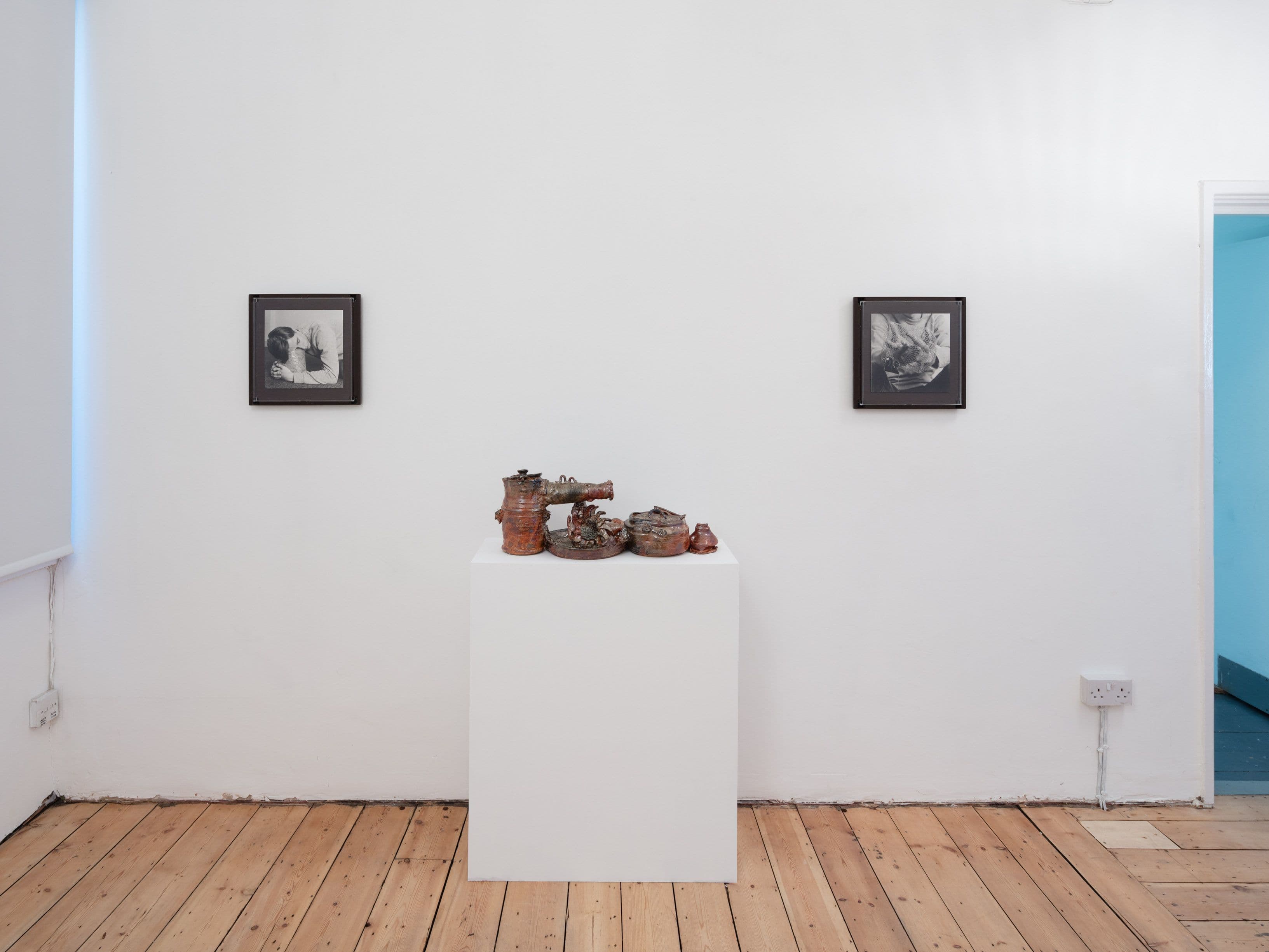
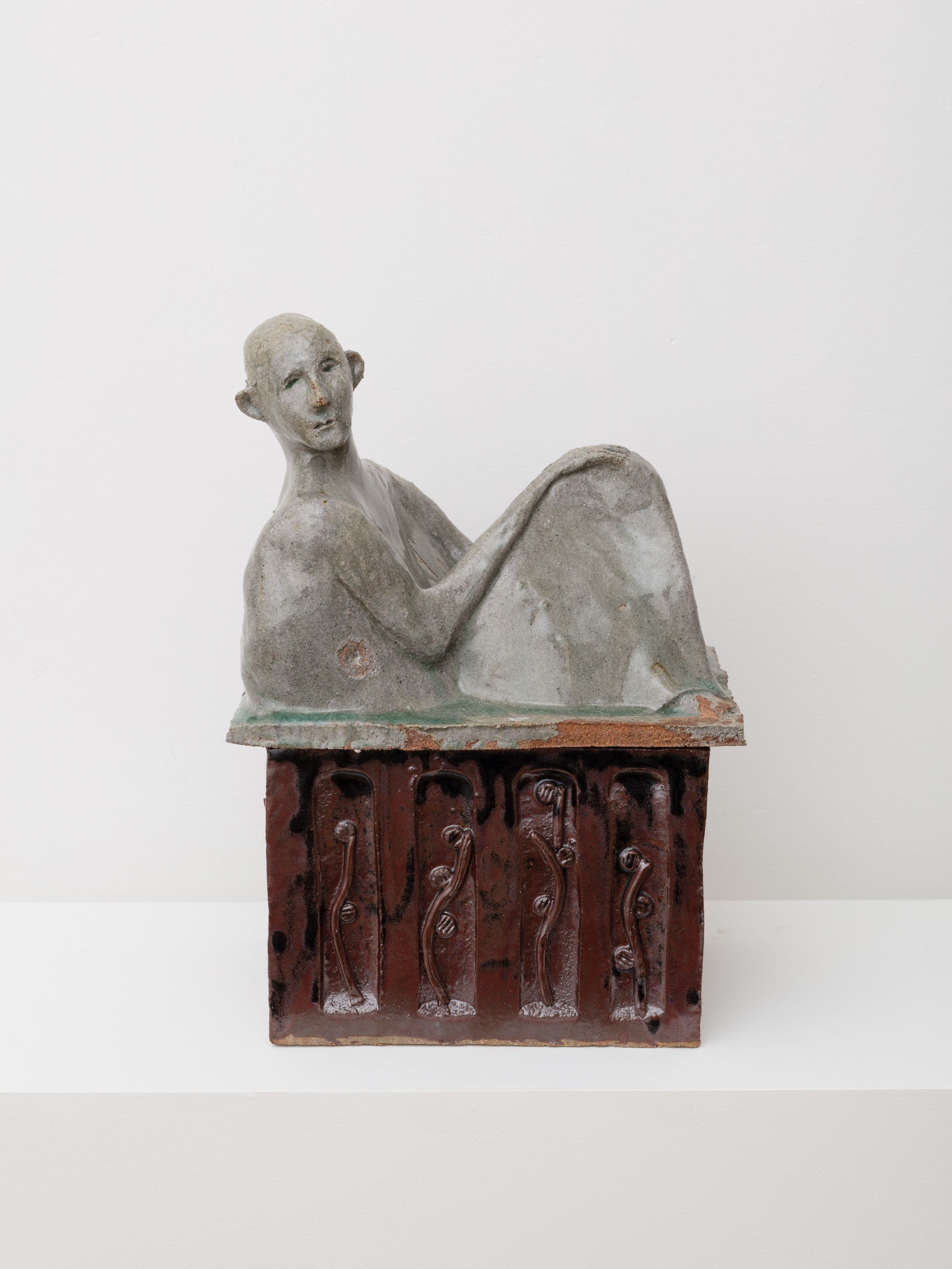
West, London
Mark Aerial Waller / Ian Law & Aaron Angell
Two Exhibitions
RodeoMark Aerial Waller: Leave Nothing Behind But Your Footprints and Take Nothing But Your Time Collaborators in Pandæmonium by Jonathan P. Watts ‘Everything which here arouses horror and indignation is of recent origin, belongs to the industrial epoch.’ – Friedrich Engels, The Conditions of the Working Class in England, 1845 It was in the 1950s, in the wake of Allied bombings and Blitzkreigs, that pop stars and consumer commodities finally demoted the gods (cf. Reyner Banham’s ‘Household Godjets’ and Richard Hamilton’s Adonis in Y Fronts (1963)). Extending the Hollywood dream frontier, youthful visages first were possessed of the infinities in the fifties as spectacular media became a calculating dream syndicate. Embalmed in broadcast sounds and images, stars lived forever as mere mortals died once and for all. [1] Twice Mark E. Smith died. Once in January, earlier this year, of lung and kidney cancer, and before that, according to a BBC News Tweet in March 2017, on his sixtieth birthday. ‘I was ill around that time,’ he told an interviewer after death one, ‘but was starting to feel better and somebody comes in and says, “by the way, you’re dead”’. [2] Neither star nor mortal, somehow resisting both, Smith, former frontman of the band The Fall, was more like a terrorising poltergeist of the kind that haunts Richard Bovet’s guidebook to the occult, Pandæmonium (1684), or perhaps an industrious disruptor of time and space in the Surrealist Humphrey Jennings’s fragmentary anthology of writing on the coming of the machine age, titled, too, Pandaemonium (1985). The building of pandæmonium in book one of John Milton’s Paradise Lost, written in 1660 but not published for a further seven years, is equated with the burgeoning industrial revolution. It begins with fallen angels toiling to mine, smelt, forge and mould the metals in the soils of hell. A foul wind tampers the landscape: There stood a Hill not far whose griesly top Belch’d fire and rowling smoak; the rest entire Shon with a glossie scurff, undoubted sign That in his womb was hid metallic Ore, The work of Sulphur. Thither wing’d with speed A numerous Brigad hasten’d. [3] ‘Pandæmonium,’ Milton wrote in the introductory notes to an early edition of book one, ‘is the Palace of All the Devils’. Alchemical knowledge, proto-scientific magic, is equated with the quest to build a new Jerusalem – ‘it will never be finished’, Milton concedes. Historically, pandæmonium has been courted by the European artistic avant-garde as a productive derangement and potential rearrangement of the senses (colonising, imperialistic, it is a model of civilisations formed in conflict). Wyndham Lewis, Mark E. Smith’s artist-hero, co-founder of the Vorticists, served on the western front in world war one. Before he went over in 1917, he’d been editor of Blast, the ‘Review of the Great English Vortex’, which took the name Ezra Pound had used to characterise an artistic milieu that identified as neither Post-Impressionists nor Futurists. For Lewis, Vorticism captured the still place ‘at the heart of the whirlpool… where all energy is concentrated’. [4] Discussing his dazzling figurative drawings of 1910–12, the art historian Charles Harrison writes that the tendency… is towards the energizing of the whole picture space by a rhythm established in delineating the figures, so that the total design becomes as it were an embodiment of human action or interaction, ‘rationalized’ according to the metaphor of mechanization. [5] Mark E. Smith as pandæmonium: preternatural, supernatural, techno-human. Bored of the ‘natural’ body. Fucked on booze, caned on speed. Man-machine. Extremist. Psychotropic-man-machine. Senses deranged and rearranged. Action and interaction irrationalized according to the metaphor of mechanization. Repetition, repetition, repetition. Beyond human. [6] For a decade, between 1998 and 2008, Mark E. Smith became collaborator-raconteur in a trilogy of Mark Aerial Waller’s films: Glow Boys (1998) (accompanied by the ‘paratextual’ film Interview with a Nuclear Contract Worker (1999), featuring the poet Douglas Park, Midwatch (1999) and Resistance Domination Secret: Agamemnon (2008). Beginning with Glow Boys, paranoiac fiction of the working practices of actual nuclear engineers who exceed their recommend daily dose of radioactivity for pay, Waller’s casting of Smith as the canteen caterer is on point. An intoxicated (and toxic) vortex of speeding energy, Smith may as well have already been radioactive man in his white lab coat like a velveteen lounge tux. He croons, announcing his presence as a singular Aeschylean chorus: ‘I am the caterer! I am the caterer!’ It’s the caterer who feeds the workers contaminated food and tolerates Mister Fantastic’s messianic latitudes (played by Grahame Fox, Ralf Kenning in Game of Thrones), a Marvel comics meets Isambard Kingdom Brunel kind of character, who, seemingly plugged into the electrical grid, is high on energy: ‘I’m a fucking creator! Father of power!’ When he dies, shot as game by the local pub landlord, the grid shuts down and the film ends. Even the cinematic apparatus relied on his labour. Glow Boys is retro-futurist Coronation Street, a Surrealist high jinks. But it’s also serious ‘state of the nation’ work, a recognition that, since world war two, nuclear power has been our – the world’s – post-war pandæmonium. [7] Waller shows us the nuclear energy ‘sweatshop sublime’: Mister Fantastic is one of Milton’s fallen angels, who toils to mine, smelt, forge and mould trace plutonium, as are the military veterans Waller interviewed while researching the film, Ron and John, assigned to ‘Operation Mosaic’ in 1956 on Monte Bello Islands and ‘Grapple’ in 1957 on Christmas Island, Australia. ‘People,’ Ron told Waller, were saying about seeing lights through the back of their heads and all manner of other things, and loud bangs. But I’d heard loud bangs. If there hadn’t been a bang I would have been bloody… [pause] It’s part of my whack. John recounts wading into a nuclear test pond encircled by black scum: It was strange because there was nothing that would cause it. There was no vegetation as such. All that was there were some lizards and some spiders, and some deformed cats that had escaped from the previous explosion. At the end of the day his legs were ‘absolutely bright red’. Waking up the following morning, my legs had started swelling, feet and everything, they had swelled so badly that I couldn’t even wear sandals. I had to have the sandals on with string wrapped round them… and I’d reported sick to the sick bay… and during one of his sober periods the doctor looked at me, and started washing the legs with Potassium Permanganate, Calamine Lotion, Gentian Violet… so many bloody different colours they used to call me Rainbow Legs or Technicolor Feet… and everybody could hear me because the sandals were loose on the deck they would go: flip flop, flip flop, so I was wearing a pair of flippers. After a while the swelling started to go down a bit and it creased like a peach does… or an apple; little depressions and it started bleeding, and they’ve now been bleeding for forty years, sixteen days. [8] The domestication of nuclear power plants belies the horror and indignation of the nuclear epoch and is further veiled in black comedy by its experimental operatives (an ameliorative for exploitation?). Mutated cats the norm. John transforming into frog. John becoming The Wizard of Oz. Back in the glow boys’ canteen a sign announces that ‘Science Never Sleeps’; in this perpetual dusk the speeding caterer raps a paean to Mister Fantastic: ‘He braved the unknown terrors of outer space and was changed by cosmic rays to something more than human.’ Waller calls Interview With A Nuclear Contract Worker (1999) ‘paratextual’, or a parasite to a host, which is to say mutualistic, one sustaining the other, fusing. Off set, away from the narrative frame, the interview’s intimacy, carried by the low-fidelity image, impresses the viewer, pre-Big Brother, as insight expressed through reflexivity. Yet this very contract worker can be seen resting in the twilight canteen of Glow Boys, shifty and paranoid. Perhaps it’s not only the body that’s changed by cosmic rays but fact and fiction’s very frontiers too? Mutating seamlessly between hired actor and actual contract worker, experiences fictional and actual, Parks’ fabulated monologue to camera draws a parallel with actual glow boys pretending to be who they’re not in order to work longer hours. Cosmic rays obliterate identity. We pass to make do in the world. ‘We,’ Parks says, glancing coquettishly into the lens, are almost some kind of driving power in ourselves… If you think of it as with the atom in purely scientific… terms something that makes things happen in the modern world but perhaps… we go somewhere more celestial or perhaps divinely appointed. It couldn’t happen without us. Likewise, these films couldn’t have happened without Mark E. Smith. Waller once described his video practice in mediumistic terms as: a conduit flowing from the viewers in the gallery, plunging down a hole to the crypt/archive, and out to the production process and its economics, politics and historical context, before finally spilling out onto the set, the street and the material reality that once was. [9] Mark E. Smith and Waller’s films as conduits: compressed occultish channels for wayward historical voices and embodiments. In Smith’s lyrics we feel that all of the British working class’s times and places flow through him as vividly populated panoramas. A demented time-traveling caterer from the fleet of Nelson, he’s actually possessed in Midwatch, lurching on deck, rum ration sunk, ranting at the other actor who’s a mutineer from the kind of nuclear bomb tests that Ron, John and friends witnessed in the 1950s. It’s pandaemonium. Waller shot Midwatch (the term the British Navy give to watch duty between midnight and 4am) on infrared video after midnight in pitch black on a summer solstice in one continuous take. No one, including Waller behind camera, could see anyone else. Before The Blair Witch Project (1999) and the normalisation of fright aesthetics by Living TV reruns of Most Haunted, it is a descent into night, into the subconscious and into the repressed – psychologically and historically. [10] In the final film of the Mark E. Smith trilogy, Resistance Domination Secret: Agamemnon, his disembodied voice is a poltergeistic envoy floating over baroque imagery. In the true sense of the word, Mark Aerial Waller’s films are parasitic on Mark E. Smith. They’re co-dependents and Waller’s work, in turn, contaminates Smith’s. On The Fall’s album The Unutterable (2000) Smith set the lyrics of Midwatch 1953 to a synth bleep: The light of the dawn Midwatch Who could foresee? Midwatch Who could foresee what happened in 1953? Midwatch Who could possibly see what happened in 1953? In Mark E. Smith’s (ghost written) autobiography he tells of how his grandfather was a foreman at a factory. On Fridays he’d stand at the gates of the prison and, as the men were being released, he’d pick them out and offer them a start. As John Fleming writes in the Dublin Review of Books this was the model for the band: ‘a musician’s prospects were a function of how well they fitted in with his plan; their career in The Fall was subject to Smith’s destructive creativity and often-malicious whim.’ [11] Smith, Waller one day realised, had been trying him out. He wanted to star in his own feature-length film. The collaboration ended when Smith realised Waller wasn’t with the plan. Waller’s trilogy, then, were prequels, speedy premonitions of the unrealised project – never finished. Shown together for the first time at Rodeo they’re a blueprint for a Palace of All the Devils. Jonathan P. Watts is a contemporary art critic living in Norwich, where he also co-directs the artist-led space Lower.Green. 1 - Richard Dyer, ‘Stars as a Social Phenomenon’ in Stars, BFI Publishing, 1979. 2 - ‘Mark E. Smith – the final interview: “I can clear a pub when I want to”’, The Guardian, Thursday 25 January 2018. 3 - John Milton, ‘The Building of Pandæmonium’ in Humphrey Jennings, Pandaemonium 1660–1886: The Coming of the Machine as Seen by Contemporary Observers, Picador, 1985/1987, p.3. 4 - As reported by Violet Hunt in I have this to say: the story of my Flurried Years, London, 1925, in Charles Harrison, English Art and Modernism 1900–1939, Allen Lane and Indiana University Press, 1981, p.102. 5 - Ibid. p.79. 6 - Amphetamine, Julie Burchill and Tony Parsons write in The Boy Looked at Johnny: The Obituary of Rock and Roll (Pluto Press, 1978), ‘is the only drug that makes you sit up and ask questions rather than lie down and lap up answers – is the only drug not to act as an all-American palliative. Dope, downers, LSD, cocaine and heroin – they all demand “Thou shalt have no other God before me”, whereas speed does nothing more than act as a hyper-active vitamin pill.’ They argue that it is a useful drug, with 72 million tablets taken by British troops in the second world war, and used by doctors since 1932 to treat epilepsy, alcoholism, schizophrenia, problem children, neurotic housewives, over-worked men, heart block, migraine – the list goes on. Moreover, it is a threatening drug because it ‘increases IQ by an average of eight points… And because, unlike dope and acid which were never anything more than youth (so long as the youth had been to college, that is) drugs, speed has always been an essentially proletarian drug.’ ‘It is,’ they continue, ‘the only drug that can make a prole realise that to make it you don’t need more intelligence, just the confidence to look down on them. Speed is the only thing that can take the place of elocution lessons’. 7 - Smith accepted Waller’s invitation to feature in Glow Boys because it reminded him of Lindsay Anderson’s black comedy, Britannia Hospital (1982). 8 - ‘Backwards Translation’ in Metronome, ed. Clementine Deliss, 1999. 9 - ‘Life in Film / Mark Aerial Waller’, frieze, 5 May 2011. 10 - David Keenan, England’s Hidden Reverse, Strange Attractor Press, 2003/2012, p.vii. 11 - ‘Dead Beat Descendants’, Dublin Review of Books, Issue 101, June 2018. --- Ian Law & Aaron Angell: Early Monodies Sharing Roots: Plumb Poltergeist by Aaron Angell and Ian Law Written on the occasion of the exhibition at Art Exchange, University of Essex, March 2018 by Matthew Bowman Some exhibitions can feel perfectly spaced and capable of conjoining sparseness with plenitude. In entering this exhibition, the viewer observes a number of works belonging to discrete groups. We have obvious groups determined by particular mediums and themes: a group of photographs; a group of ceramic work; a group of assisted readymades or found objects. Once the exhibition has become a bit more familiar to us, it becomes evident that the groups function not as self-contained units, but are ultimately interwoven in a complex manner. The photographs, for instance, are linked with the large painting close to them. But moreover, they are linked with the inflatable furniture, the ceramics, and the other painting. Despite whatever the variety of approaches on display might suggest, the exhibition brings together just two artists: Aaron Angell and Ian Law. It would be misleading to state that this amounts to a group show, as that would imply we have disparate bodies of work brought together under a particular theme (though saying that would not be quite incorrect either). At the level of curatorial description, it might be called a collaborative exhibition—although, doing so would come with certain provisos having to be made. Some of works are clearly made by Law, and others are made by Angell, so it makes sense to claim that the works are individual but the exhibiting of those works are collaborative. However, other works are also made by the two of them working together. Perhaps one way of clarifying the issue is that collaborative quality of this exhibition partly derives from an admixture of working together and working alongside one another. It is a dialogical process in which each speaker maintains their own position but discovers a shared ground between them. In the long run, I want to argue that the shared ground as betokening connection between distinct entities is essential to grasping the exhibition as a whole. But in order to render such a thought as perspicuous as possible, I shall consider aspects of both Angell and Law individually before seeking to highlight key aspects of Plumb Poltergeist. Indeed, part of my argument here is that, despite obvious differences between their practices, something resembling “determinate negation” as a system of interrelations—or elective affinities—plays a role in their thinking. Because of this, the collaboration between them succeeds and structures the exhibition’s content. The issue of determinate negation manifests itself in Angell’s engagement with ceramics. In interviews, a certain degree of ambivalence becomes apparent when discussing the ceramic basis of his works and the Troy Town Pottery. For instance, whilst conversing with Sam Thorne, Angell makes the remark that he is trying “to look at ceramics as almost not ceramics” and that he wishes those seeing the work in a gallery do not immediately exclaim “Oh, it’s ceramics” but rather “it’s sculpture.” Also during the same interview, he mentions Anthea Hamilton producing work at the Pottery and, in relation to an exhibition in New York in which some of the work was shown, he comments it “was really nice, she didn’t even list it as ceramics in this exhibition in New York. It was just stuff that was there; almost a designer’s approach to the material.” How, then, might one explain this ambivalence and evaluate its significance? To ask such a question should not be a preliminary to locating a point at which contradictions are resolved; on the contrary, there is arguably something productive about allowing the terms to remain in a state of disjunction. But how can we make sense of this state of disjunction and justify its presence? One way into this question would be through something that could be named “anti-ceramics”—or, at least, that is the name I would like to propose here. I borrow the idea in significant part from an interesting essay by Nancy Foote titled “The Anti-Photographers” that was published in Artforum in 1976. Discussing the photographic work of artists such as Ed Ruscha, Eleanor Antin, Bernd and Hilla Becher, Jan Dibbets amongst others, she coined the term “anti-photography” in order to capture their staunch resistance against standard conventions of rightness in photography (for example, correct depth of field, sharp focus, composition, proper relation to subject, etc.) rather than any hatred for the medium as such. As she writes: “Despite its dependence on photography, conceptual art exhibits little photographic self-consciousness, setting itself apart from so-called serious photography by a snapshot-like amateurism and nonchalance that would raise the hackles of any earnest professional.” It is plausible, arguably, to perceive a similar interest in amateurization and deskilling within the loose congregation of works that may fall under the anti-ceramics banner. Of late there seems to have been a virtual resurgence in ceramics within the artworld and one of its apparent characteristics is a certain refusal of, or deconstructive attitudes towards, the various standards attached to the dominant craft tradition. Whilst I would not desire to contend that there is anything like a movement, there does nonetheless appear to be almost a tendency. For instance, one could point to artists like Emma Hart (who exhibited quite naïve ceramic work at the Folkestone Triennial and here in Art Exchange) and Claire Twomey. Or one could think further back and proffer something like Fischili and Weiss’ brilliant and hilarious Suddenly This Overview, with its playfully amateur handling of materials and selection of off-kilter subject matter, as an important precursor. In any case, the last decade or so has witnessed a renewed interest in clay that virtually separates ceramics as medium from ceramics as material. As medium, ceramics is both elevated and burdened by its history, especially by that history of craft traditions and studio work that emerges after, and often against, the Industrial Revolution. The focus upon its materiality offers a resistance against the craft tradition that animates its medium status, but notably it requires the existence of that tradition in order to make its resistance pertinent. As both Walter Benjamin and Martin Heidegger contended, there is a deep etymological history chaining “tradition” to “betrayal,” so that the handing down of tradition is also its ongoing betrayal. Law’s practice evinces a similar respect for and dependency upon interrelationality, though the logic of determinate negation is less overt or even important here. Put differently, it is less a case of “not this, but that” than of “that and that and that.” We could apprehend this veritable spider’s web of connections by taking Law’s On Simone Weil Avenue . . . as an example (the ellipsis are part of the series’ title; I shall remark upon them later). The work consists of a series of photographs mounted onto a replica of a Barbie Dream House floor that has been shifted from a horizontal to vertical orientation. Simone Weil (1909-1943) was a French philosopher and theological thinker who, uprooted by the invasion of France by Nazi forces, was exiled for a short time to Ashford in England, where she died. In the months leading to her death, Weil worked on a report examining how French society can renew itself both politically and spiritually through rediscovery and reassertion of its “roots” once the Nazi regime had been driven back. This report was published posthumously in 1949 as the book The Need for Roots. Subsequently, a non-residential road called Simone Weil Avenue was made in her honour and is the home for a retail park and hotel. Initially, Law was intrigued by the potential disjunction between Weil’s social philosophy and the consumerist hive that has appeared under her name. Using the hotel as his base, Law worked with a local actor and photographer to produce the photographs for On Simone Weil Avenue . . . . We see the actor working or perhaps playing with items—a cereal box, candles, netting, eggs—bought from the retail park. Whether this is a form of work or play, there appears to be an overcoming of the alienation between worker and commodity fostered by capitalism. The resultant photographs are affixed upon industrially reproduced copies of Barbie Dream Houses and displayed on the wall. Another set of oppositions therefore come to the fore: what one might assume is the ultimate antithesis of Barbie and Weil (though one might comment that Weil and Barbie share the same dream in some odd sense) as well as the classical horizontal/vertical binary. Once again, these oppositional terms function as a means for thinking interrelation, for thinking the determinate connections between apparently discrete categories. The large painting on the wall depicts, in a loose fashion, a toothbrush and toothpaste tube bought at the retail part and used as one of the props by the actor (and drawn on the egg). It reproduces on large scale the actor’s original egg decoration; the brown paint used matches the brown packaging that the Barbie Dream House was mailed from the USA in. Besides Weil’s book, the reference to roots may also bring to mind the writings of Gilles Deleuze and Felix Guattari and their theorization of the “rhizome”—especially inasmuch as their thinking in this area has a considerable influence in art over the last two decades. Such a thought, intended by them as a means for capturing a certain lateral interrelationality amid concepts, is not inappropriate in this context of Plumb Poltergeist but needs to be revised or reconfigured before it possesses any interpretative force. Here we might we start from the tree—the tree, with its roots, as a metaphor; the picture of tree that was in many respects the light-bulb moment, or seed, that initiated the exhibition; and finally the various trees, both depicted and semi-visible, within the works of the exhibition itself. In order to be clear, it is helpful to begin with the second tree but proceeding onto the first and third in this listing. Looking for a preliminary starting point for the exhibition, Angell wandered around campus and stepped into the Something Fierce exhibition in the Hexagon that celebrations the 50th anniversary of the University of Essex. Within that exhibition, on the upper floor, was a recreation of a student bedroom with the kind of paraphernalia such places might have had in the 1960s. His eye was caught by a poster reproducing Richard Doyle’s The Enchanted Tree, a somewhat kitschy painting depicting fairies playing around the gnarled base of a tree. In telling Law about the poster, it turned out that Law had been reading Weil’s The Need for Roots and considering a project relate to her death in Ashford. And so a way into the exhibition was found. This happy coincidence, however, is arguably made all the more concrete by the tree serving as a felicitous metaphor (the first item on my list above). While many plants are indeed rooted, it is worthwhile tracking the possible metaphorical value of the tree here rather than settling simply for the rhizome. For example, we can work up from the network of roots below the soil and follow up the trunk, eventually reaching another network of branches that touch the sky around them. “Branching out” is a nice turn of phrase to have in mind, suggesting the divergent paths that stem from a seemingly single source. The networks formed by such an action moreover are not static, but are simultaneously integrated with and responsive to their ever-changing environs (the branches engage the air and the roots the soil) and in a on-going process of transformation (the tree grows, reconfiguring its form as it does). Perhaps finally, we can mentally picture the acorns that grow and fall from the tree, impregnated with the potential of generating new networks, new trees. Responsiveness, interrelationality, transformation, process, fecundity—all these qualities are to be found in the tree and can characterize the works in this exhibition insofar as they are “rooted” in the campus but branch outwards without leaving the idea of the campus behind. Indeed, the exhibition situates the campus in specific geographic relation to Ashford, the Isle of Wight, and San Gimignano; it constantly displaces itself from one location to another, refusing to find a home to abide permanently in. So we have the depiction of the tree as seed of the exhibition and the metaphor of the tree. What, then, about the presence of the trees in the exhibition? Probably the most obvious example would be Hinterglasmalerei in which Doyle’s original picture is loosely recreated. The funerary urns are another example, though the way function as so it more implicit. Their glaze is partly made from the ashes of a Victoria Plum Tree that originally lived in the garden of Law’s grandparents. In fact, there is a striking inversion here that should be marked: funerary urns are intended to contain the ashes of somebody that has died; the urns, or Cineraia, built by Angell and Law do not preserve anyone’s ashes, however. Embracing the homology between corporeal ashes and ash glazes, it is as if the absence of ashes in the urn’s interior has necessitated the manifestation of “ashes” on or as its exterior. This switching between interior and exterior (which it is tempting to say has intriguing resonances with core themes in Hegel’s Lectures on Aesthetics, especially his discussion of sculpture as defined by an exteriority or form utterly continuous with its interiority or content) mirrors the Hinterglasmalerei’s switching of recto and verso and suggests the independency of these oppositions (interior/exterior, recto/verso). Finally—but given the way that the exhibition is essentially restless, can we actually say or mean “finally”?—would it be senseless to track the linguistic homology further and highlight the correspondence between the various ashes just mentioned and the references to Ashford, the town where Weil died. Maybe there is no “finally” insofar as the recognition that linguistic homologies also has a part to play leads one to the further recognition that the exhibition title Plumb Poltergeist puns on the Victoria Plum Tree. These connections are essentially contingent, which further testifies to the equivocation that underwrites the exhibition’s status as collaborative, or joint, or parallel. Law’s On Simone Weil Avenue . . . photographs were recently shown at Rodeo and acted in dialogue with the overlooked American artist Robert Overby. It is easy, and natural, to imagine those photographs being presented by themselves, say, within their own exhibition, having no more linkages than those already existent between each other as a series, or to Weil’s life, or just simply to Law’s practice as a whole. By the same token, the three stools shown by Angell can be exhibited in an entirely different context or just returned to being domestic items once again. There is a certain constitutive instability to the relationships between the works combined with the possibility of those relationships being sundered as soon as Plumb Poltergeist closes. Nonetheless, if they are nullified by subsequent circumstances, it is conceivable they remain knowable afterwards, lingering as traces of displaced, semi-forgotten and therefore semi-recalled meanings. Like the poltergeist wantonly throwing objects around, Plumb Poltergeist is a deeply restless exhibition in which new configurations are generated between elements. Such new configurations are far from static; indeed, mobility and self-displacement continue to be features of the generated configuration, meaning that the elements will further circulate without cessation and hence produce yet more possible configurations in their fundamental contingency. We can end, in that case, by emphasizing the ellipsis that makes up part of the title of Law’s On Simone Weil Avenue . . . . The presence of those three dots indicate an opening of possibilities correlated with the ambiguity of the “On” in the title. Law’s usage of the ellipsis here less marks an excision of specific words than serves as an invitation for the viewer to continue making additional connections. That invitation bespeaks the exhibition’s innermost character, namely the interplay of roots in which unexpected conjunctions are discovered by Angell, Law, and us, the audience.