
East Village, New York
Group Exhibition
The View from Inside
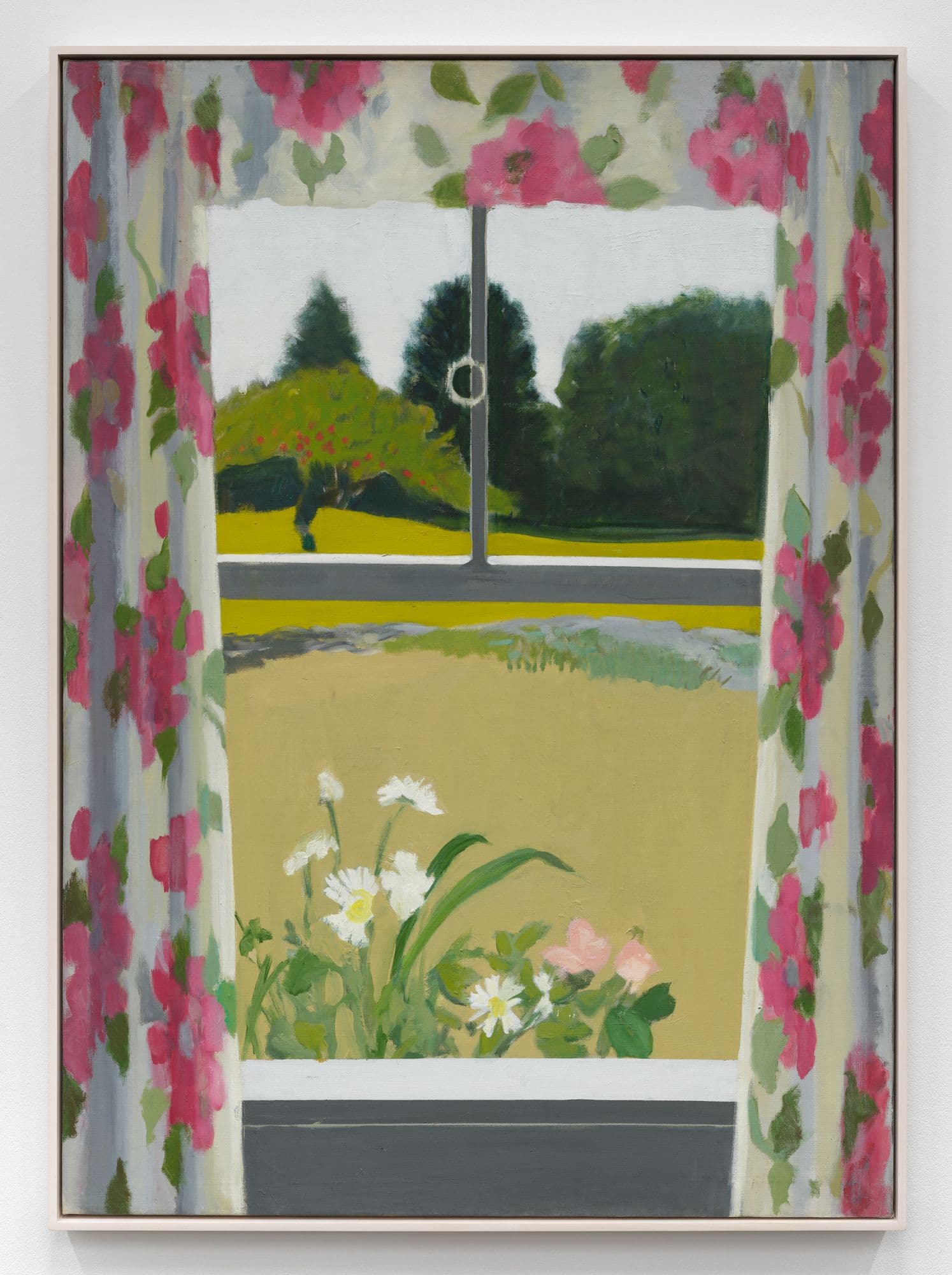
KarmaHenni Alftan, Lois Dodd, Jane Freilicher, Josephine Halvorson, Yvonne Jacquette, Catherine Murphy, Sylvia Plimack Mangold Writing in Arts magazine in 1974 on the topic of “Women Realists,” art historian Linda Nochlin probed the relationship between the surfaces of their canvases and the images on them, asking: “Are we looking through or at the picture plane? And from where?” This cohort, who reinvented representational painting in an era dominated by male Minimalists, Conceptualists, and Pop artists, included Yvonne Jacquette, Sylvia Plimack Mangold, Lois Dodd, Jane Freilicher, and Catherine Murphy. The View from Inside presents works by these artists in dialogue with paintings by Henni Alftan and Josephine Halvorson, both of whom are working in their lineage. The exhibition considers paintings that take as their subject unpeopled views into, inside of, and out from interior spaces. Architectural thresholds—windows, doors, and so on—at turns offer and thwart passage. The works in the exhibition explore, among other formal issues, relative degrees of trompe l’oeil and stylized flatness, the role of the crop in setting the bounds of a composition, and embodied and disembodied perspectives, offering a plethora of views from inside. Yvonne Jacquette’s interiors of the 1960s capture unexpected angles on the domestic. The tension between their cool, detached tone and the intimacy of their perspective puts the spectator in the artist’s shoes while refusing to impose a particular affect. Open Door, Tin Ceiling (1969) presents a vertiginous view of the moulding separating the wall from the ceiling, which is bisected by an open door that seems to jut out of the canvas. Across the tin’s grid of diamonds and squares a symphony of yellows, greys, and blues unfolds. At once beautiful and banal, Jacquette’s paintings use the techniques of realism to portray the minimalism present in the everyday. In Sylvia Plimack Mangold’s series portraying her apartment’s parquet floor, which she began in 1966 and continued for a decade, she pays nearly photorealistic attention to every whorl and gnarl in the wood slats. For the artist, however, these painstaking renderings are “not about fooling the eye, but about questioning the nature of painting and, thereby, levels of reality.” In First Study (1973), a mirror reflects the parquet at an oblique angle but omits Plimack Mangold, who has painted herself out of the composition. Lois Dodd and Jane Freilicher’s interiors, while less austere and more gestural than those of Plimack Mangold and Jacquette, also use the constraints of the private space of the home as structuring devices. Writing about Freilicher’s “interior landscapes” in paintings like Window on the West Village (1999) and Soap Opera I (1986), Nathan Kernan notes how “the outside is explicitly brought in, and the inside is taken out.” The table in the foreground of Still Life—Rooftops (1970) extends to the edge of the window frame, creating one continuous plane with the roofing outside, a symbolic passageway between containment and freedom. Painting from her home instead of in a separate studio, Dodd similarly merges the boundary between inside and outside through tight framing and clever reflection, as in Mirror + Window (1988). In The Broken Door, Blaisey’s Place (1999), boundaries between interior and exterior are caught in the middle of their mutual dissolution. Pieces of wood weave over and under each other around a central void, a portal to what lies just beyond. Dodd’s broken door is echoed by Josephine Halvorson’s Breaking Door (2014), a six-foot-tall canvas that approaches life-size. With her trompe l’oeils of a latched window framing a monochromatic night sky, Halvorson, like Jacquette, suggests that the visible world already contains the seeds of abstraction. Catherine Murphy offers a vision realer than reality; in Nochlin’s words, “no photograph would care so much, could be as ostentatiously lavish in its documentation” as Wallpapered Corner (2000), in which carefully observed seams in the decorative, hunting-themed wall covering reveal the cracks in representation. Cellar Light (1985), presents a glimpse of the first floor of a house from an oblique corner angle that feels at once impossibly broad and intuitively true. Henni Alftan’s paintings, on the other hand, stylize quotidian moments into broad, flat panes of color: a glass of milk casting a shadow and an empty picture frame become chances to translate transparency and geometry. Alftan’s Neighbours (2025) doubles down on the question of framing so central to The View From Inside, showing the sightline from one home into another uncannily similar, equally unoccupied residence. Honing in on the elements of interior architecture that confine by design, the artists here present expanded views that illuminate not only boundaries but also the possibility of transcending them.