

Charlottenburg, Berlin
Markus Lüpertz
Veränderungen in der Malerei der Siebziger Jahre
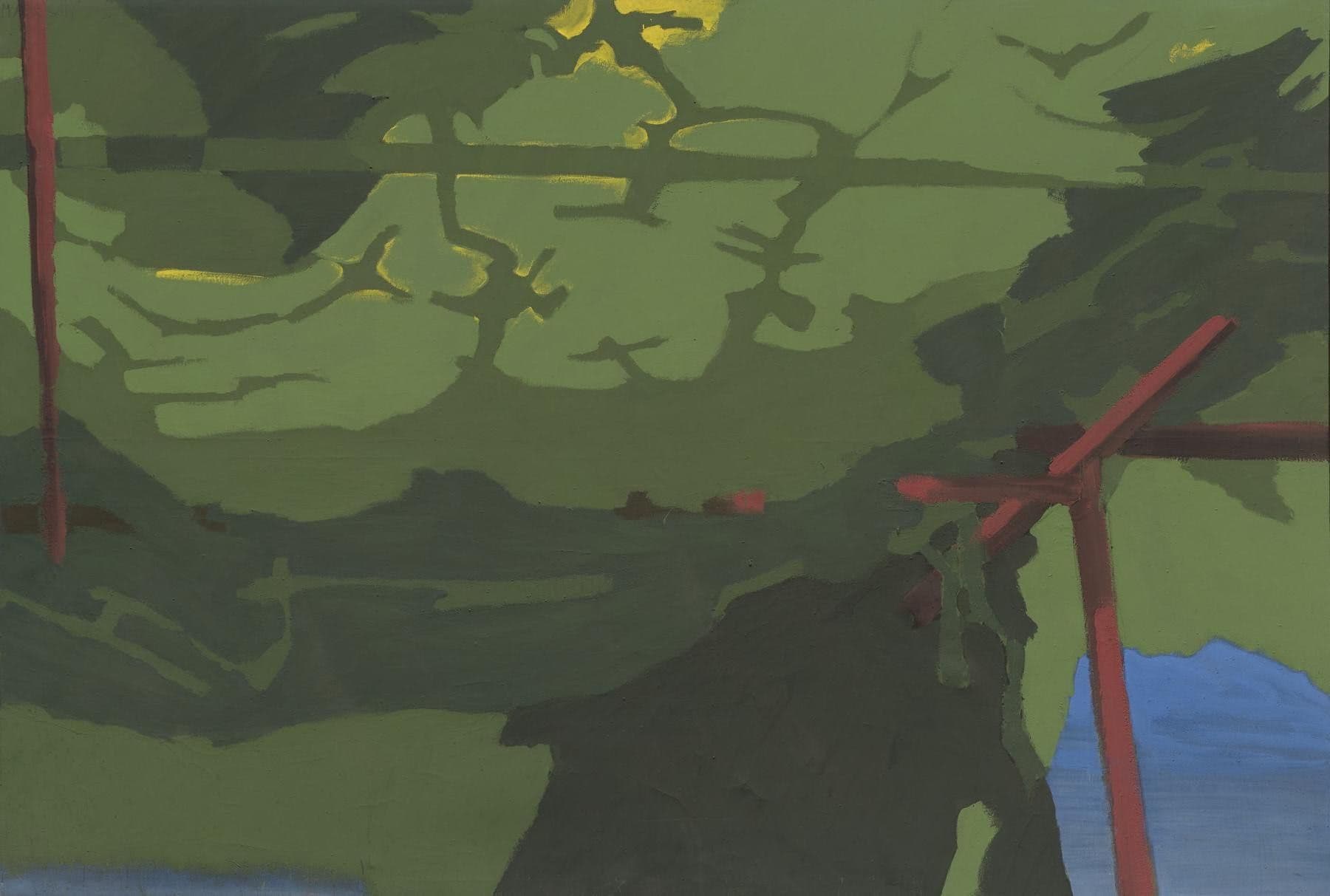
Michael WernerAlbrecht Dürer’s trailblazing watercolors once celebrated nature as a harmonious organism. Markus Lüpertz’ early works engaged with the German tradition of landscape painting and its political instrumentalization. The harsher landscapes of the late 1960s and early 1970s deconstruct the idyllic notion of nature promulgated by Dürer and turn it on its head. Works such as Lüpertz’ monumental series Late Summer I–IV or Pergola – dithyrambic – Leafy canopy II (all 1970) tell a different story: These landscapes are seething. Where Dürer in his Pond in the Woods (1495) captures a flowing, breathing nature, in Lüpertz’ canvases nature freezes to become a threatening topography, shot through with drawings like lightning flashes – ciphers of a latent upheaval. What seems so transparent in Dürer’s work congeals under Lüpertz’ brush to form rigid tableaus: a formal outburst attacking the collective silence of fledgling West Germany, while also exposing landscape images as ideologically infused terrain. A key to this is to be found in Florence. After his presentation in the Kunsthalle Baden-Baden show 14 × 14 in 1969, curated by Klaus Gallwitz and after winning the Villa Romana Prize in 1970, Lüpertz spent a year in the Tuscan city. There, the architecture of the Mussolini regime was ubiquitous, and unlike the hesitant culture of remembrance in West Germany Italian filmmakers like Rossellini or Pasolini were busy dissecting the links to the Nazi occupying forces; they thus broke a taboo, something at the time seemingly still unthinkable in Germany. It was a catalytic experience for Lüpertz: Visible in his images now is that selfsame green coloring both Wehrmacht helmets and landscapes. Dürer’s wood- green turns into the color of camouflage and nature becomes the deceptive shroud enveloping the repressed. Lüpertz’ artistic achievement lies in how he manages to transform the subject matter: The leafy canopy of the pergola morphs from protective space into an ossified solid. His works in pencil and crayon condense organic shapes into archaic symbols, and in doing so deconstruct German iconography. Here, Dürer’s tradition no longer serves some mystification but becomes a critical mirror held up to expose the national trauma. In contrast to Joseph Beuys’ shamanist performance I Like America and America Likes Me (1974), in which a misunderstood unity is purportedly brought about by ritual reconciliation, Lüpertz opts for stringent painterly archaeology: He dissects. His canvases and works on paper from 1970 to 1973 are palimpsests of history, creating multiple layers of paint, material, and memory. They are comparable to Dürer’s studies of nature but for Lüpertz the landscape is no idyll, but an archive of upheaval. The dithyrambic landscapes of the 1970s are among the key works of German self- interrogation. Each green harbors a wound, each line a flash of lightning that breaks it all open. With Lüpertz’ jarring lightning flashes and Beuys’ ritual gestures, in the 1970s, a radical survey commences of the unknown pictorial space, of terrain twixt myth, trauma, and new form.