
Hamptons, New York
Claude Lawrence
Free Jazz
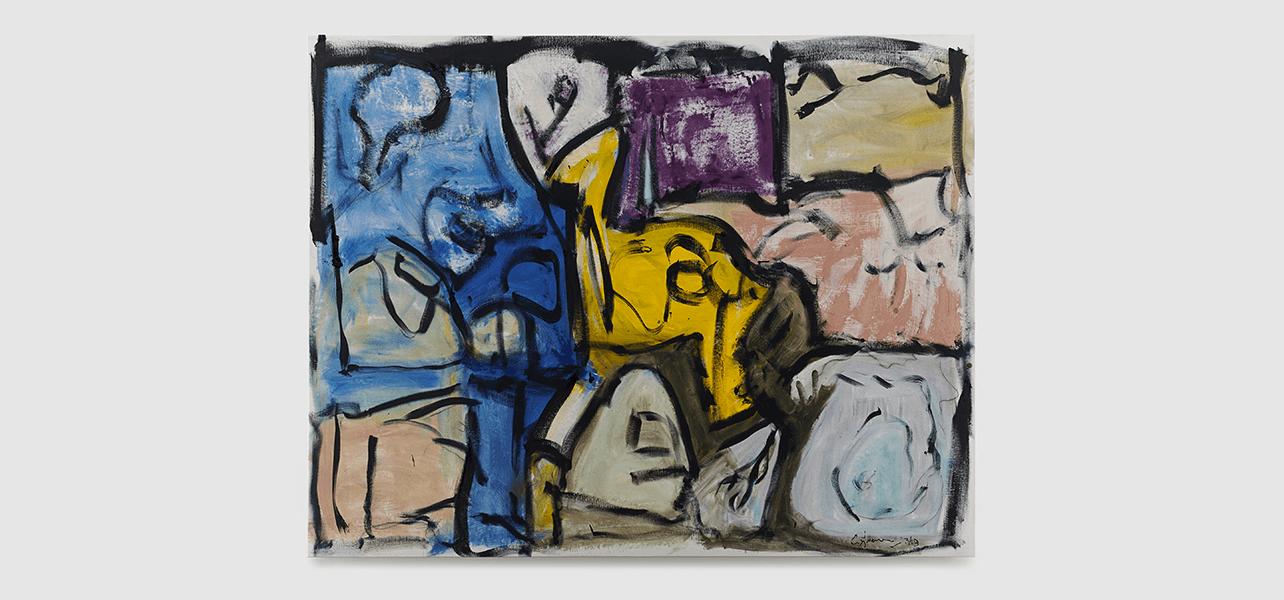
David LewisDavid Lewis is pleased to present Claude Lawrence, Free Jazz, a presentation of paintings made in the gallery space, which Lawrence used as his studio in the winter of 2022-23. It is Lawrence’s first exhibition with the gallery. Using the East Hampton gallery as his studio this past winter, Lawrence created two complete bodies of work: “Reflections on Porgy and Bess” and “Free Jazz.” both meditate on the space of music and abstraction as a space of freedom. In “Reflections,” each painting responds specifically to a song in Gershwin’s opera, itself a musical mediation on African American history. The “Free Jazz” works are even more abstract, in spirit and tone. The title of the group nods to the achievement of avant-garde saxophonist Ornette Coleman, and serves as an emblem of the nexus of improvisation, jazz, abstraction and freedom that Claude Lawrence has pursued for decades. These works play wristy melodic lines and gestures, verging sometimes on handwriting or even hieroglyph, and ranging from searing bebop intensity to cool delicate wisps of line and suggested form. Blocks of color, like chords—sometimes dissonant, sometimes harmonious—organize the pictorial space. Occasional faces—or hints of faces, as if seen in clouds—appear and disappear within this color-music, this polyphony of improvised line and tone. Claude Lawrence was born in Chicago in 1944. In the 1960s, he was a professional jazz saxophonist who painted on the side. He was friends with many painters at the time, including Jack Whitten, and what they talked about was Jazz. They also talked about the legacy of Abstract Expressionism, and in particular the achievements of Norman Lewis. Lawrence recalls the pressure then for African American artists to paint figurative, “political” work, and the freedom, represented by Norman Lewis and abstraction in painting, to instead claim the space of abstraction, and improvisation. For Lawrence this space of aesthetic freedom was also a political one. Politics intervened. In 1968, the day after the assassination of Martin Luther King, Lawrence left the country for France. In the years following this avant-garde expatriation, painting became his professional focus. At the same time, his experimentation with figurative elements gave way to an increased tendency towards pure improvisation, what Lawrence calls “impulse,” and “attack.” This is Lawrence’s personal interpretation of the classical equation between musical abstraction and abstract paintings, an equation foundational to modernist art. “Improvisation in jazz and abstract art are the same. I don’t know where it comes from but it is about the attack. It’s about an impulse. That is what defines you as an artist.” The “Free Jazz” paintings mark Lawrence’s gallery debut, and reflect upon the long arc of his creative path, the project of building a space of African American freedom and potential upon the legacy of Norman Lewis, abstract expressionism, and jazz.