
West, London
Daniel Buren
Pages in Situ
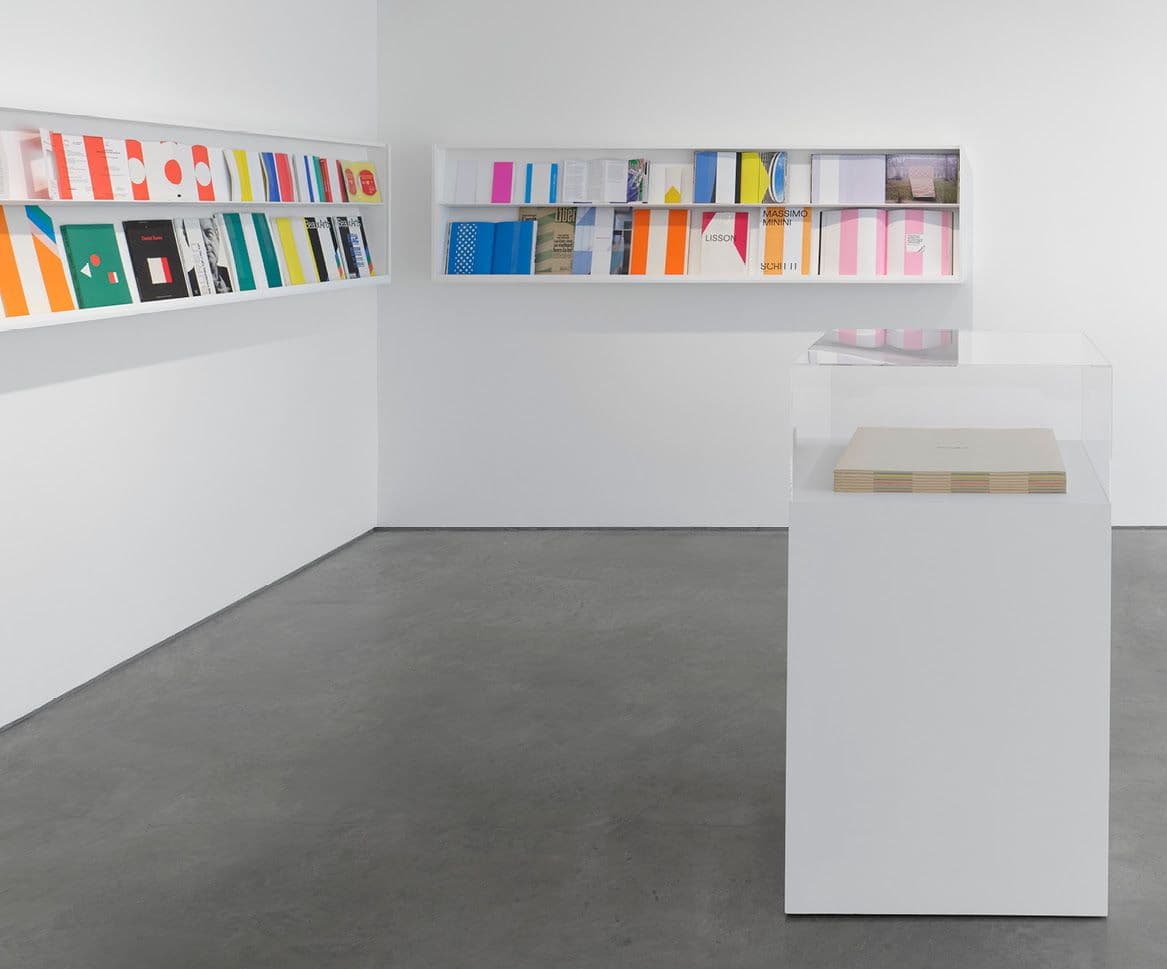
Lisson"I am interested in books when their purpose or meaning fits with my interest, or when they teach me something or rectify some wrong concept I had, or look beautiful, or make no sense, or are extremely well done, no matter which is the classification or profession of the author." —Daniel Buren, Art-Rite, Vol. 14 (1977) This exhibition, curated by graphic designer Fraser Muggeridge, charts Daniel Buren's expanded use of the 8.7cm stripe over almost six decades, from the street to the gallery walls and from the canvas to the printed page. Exploring the legacy of the artist's famous motif – through art works, archival objects and his prodigious publishing and printed matter output – the display attempts an entire history of the stripe as subversive interruption within books, magazines and publications. It begins with Buren's anonymous contribution to the Prospect 68 catalogue at the Kunsthalle Düsseldorf – a double-page spread of green stripes – and ends with a new version of an off-site exhibition of vertically pasted stripes first staged on a billboard in central London in 1972. Bringing together more than 100 printed items, Pages in situ spans interventions in books, magazines and newspapers, often presented "without name or explanation", alongside invitations, posters and group and solo exhibition catalogues, as well as dedicated artist books. Variations in colour, sequencing, cut-outs and format all play a role in shaping each item. Across these diverse formats, Buren's consistent "visual tool" operates as a powerful graphic element, threading through each publication while continually shifting in form and intent. It also features numerous examples of printed material that adhere to the 8.7cm principle, without explicitly displaying stripes, using perhaps the same width for columns of printed text or for the dimensions of reproduced images. The exhibition also explores Buren's notion of how he creates all of his works ‘in situ' and includes examples from the series of six printed posters produced with the Antwerp gallery Wide White Space. These functioned simultaneously as announcement, invite, poster and art work (related to his Affichages Sauvages), being flyposted around and as part of five Buren exhibitions between 1969 and 1974. The artist is also recreating his 1972 billboard work on Shaftesbury Avenue, composed of 8.7 cm-wide white and purple striped paper, reimagining the work for 2026 in cyan for a new site located in nearby Camden at 70 Eversholt Street NW1 1DA. Buren's expansion of painting into the real world also influenced the exploded and cut paintings shown in the upper gallery (some of which were also made into books afterwards). These fragmentary interventions are both striped installations in three parts, dating from 1968 and 1980, applied directly to the wall, extending to touch the extremities of the space they are being shown in. This exhibition reveals the conceptual and material breadth of Buren's engagement with the stripe motif and with all things print, foregrounding both the medium and his specific visual vehicle as a critical and adaptable framework for artistic production. Daniel Buren has punctuated the past 50 years of art with unforgettable interventions, controversial critical texts, thought- provoking public art projects and engaging collaborations with artists from different generations. Throughout his career Buren has created artworks that complicate the relationship between art and the structures that frame it. In the early 1960s, he developed a radical form of Conceptual Art, a “degree zero of painting” as he called it, which played simultaneously on an economy of means and the relationship between the support and the medium. In 1965 he began using his 8.7cm-wide vertical stripes as the starting point for research into what painting is, how it is presented, and more broadly, the physical and social environment in which an artist works. All of Buren’s interventions are created in situ, borrowing and colouring the spaces in which they are presented. They are critical tools addressing questions of how we look and perceive, and the way space can be used, appropriated, and revealed in its social and physical nature. In his work life finds its way into art, while autonomous art is able to reconnect with life. Daniel Buren was born in Boulogne-Billancourt (Paris), France in 1938. He lives and works in situ. His work has been the subject of major exhibitions at Museu de Arte Moderna, Rio de Janeiro, Brazil (2026); Museo Pistoia, Pistoia, Italy (2025); Daegu Art Museum, Daegu, South Korea (2023); Fondation Louis Vuitton, Paris, France (2022); Espoo Museum of Modern Art, Espoo, Finland (2022); Galleria d’Arte Moderna e Contemporanea di Bergamo (GAMeC), Bergamo, Italy (2020); Institut d’Art Contemporain (IAC), Villeurbanne, France (2020); Museo de Arte Italiano, Lima, Peru (2019); Carriageworks, Redfern, Australia (2018); Walker Art Centre, Minneapolis, OH, USA (2018); Kunstsammlungen Chemnitz, Chemnitz, Germany (2018); Kunsthalle Dusseldorf, Dusseldorf, Germany (2017); Centre Pompidou Málaga, Málaga, Spain (2017); Bozar Palais des Beaux-Arts, Brussels, Belgium (2016); Museo - Espacio, Aguascalientes, Mexico (2016); Baltic Centre for Contemporary Art, Gateshead, UK (2014); Musée d’Art Moderne et Contemporain, Strasbourg, France (2014); Centre Pompidou-Metz, France (2013); the Solomon R Guggenheim Museum, New York, NY, USA (2005) and the Centre Pompidou, Paris, France (2002). Buren has exhibited in the Venice Biennale, Italy more than ten times and was awarded the Golden Lion for his French Pavilion in 1986. That same year, he produced his first and most controversial public commission, The Two Plateaux, for the main courtyard of the Palais-Royal in Paris, France. In 2007, he received the Praemium Imperiale for Painting from Japan. Most recently, he was selected for the site specific Monumenta 2012 commission at the Grand Palais in Paris, France. Buren’s 1994 installation The Arches, permanent work in situ, is on view at the Southampton City Art Gallery, and in May 2017, he launched another permanent installation in the UK – Diamonds and Circles, works in situ – at Tottenham Court Road station in London, commissioned by Art on the Underground. Fraser Muggeridge is a graphic designer whose practice focuses on working with artists and cultural institutions on a range of printed matter. His work is rooted in typography and informed by an interest in design theory, contemporary practices, and the historical conditions of graphic design, particularly in relation to art and artists’ publications. He is Professor of Design at Leeds Beckett University and a visiting professor at the Iceland University of the Arts in Reykjavík.