
Institutions, Venice
Group Exhibition
Printing the Unprinted
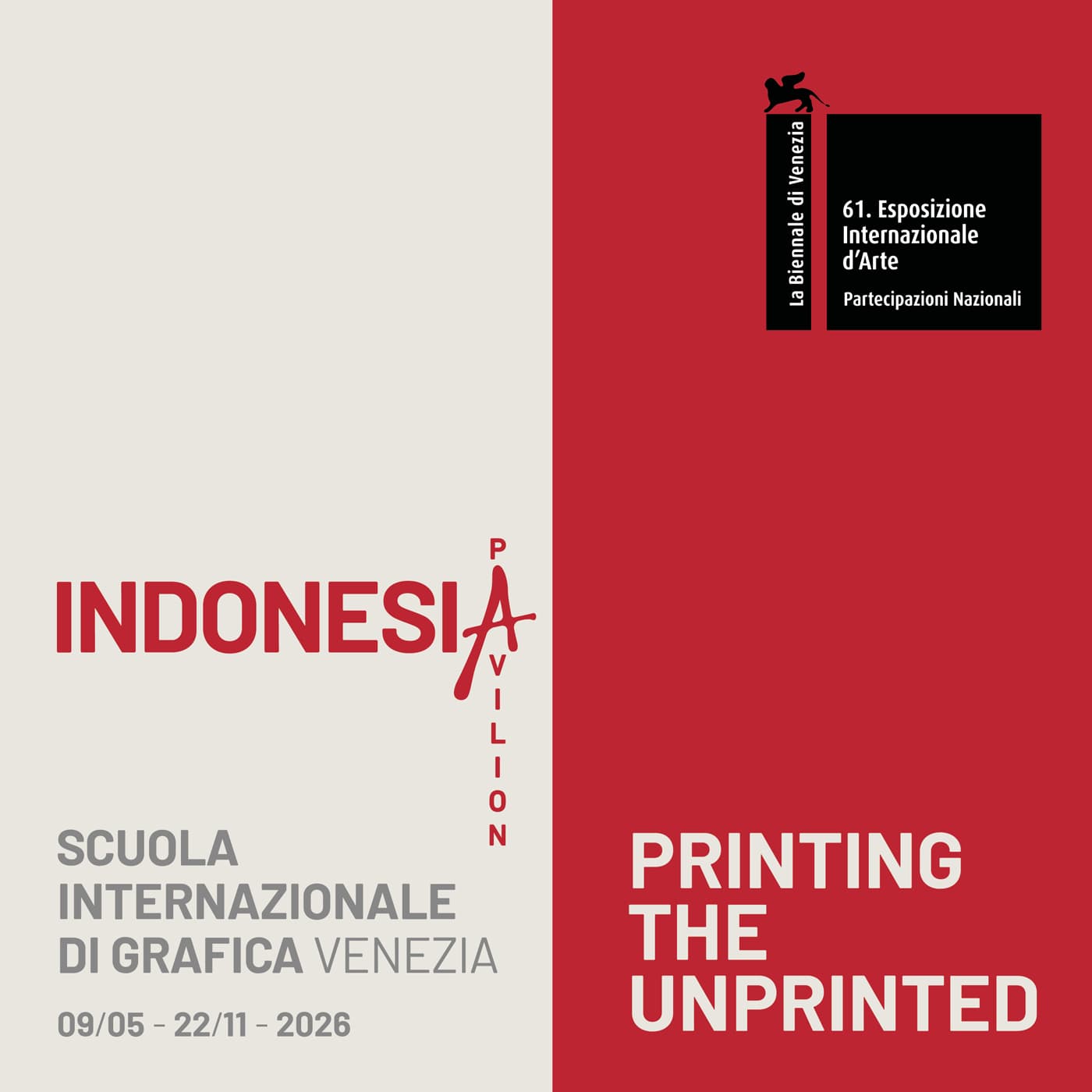
Indonesian PavilionOpens Saturday, May 9 Agus Suwage, Syahrizal Pahlevi, R .E. Hartanto, Nurdian Ichsan, Theresia Agustina Sitompul (Terre), Mariam Sofrina, Rusyan Yasin The Indonesia Pavilion at the 61st International Art Exhibition – La Biennale di Venezia presents Printing the Unprinted, a collaborative project between the Indonesian Ministry of Culture and the Scuola Internazionale di Grafica, Venice. The Pavilion offers exhibitions, artists-in-residence, art talks, workshops, and a symposium, bringing together seven Indonesian artists from various generations to highlight the central role of printmaking. Printing the Unprinted disclaims the logic of traditional global histories written as sequences of arrivals, where someone arrives and is discovered, named, or claimed, implying absence. For centuries, secrets slumbered within etchings, drawings, sketches, and vivid texts waiting to be discovered. Later re-examinations have prompted scholars to argue that envoys from Harajaon Pusuk Buhit contributed to the development of early modern global knowledge, particularly in Asian-European studies. The "Great Voyage" challenges the assumption that only European powers undertook and documented global exploration in the 15th century, suggesting Southeast Asian societies also engaged in navigation, legal organization, and transregional observation. Renewed interest in the text has inspired historians, artists, and independent researchers. The narrative of a 14-year voyage from Lake Toba to various international destinations highlights advanced maritime technology, astronomy, trade, governance, and artistry in 15th-century Southeast Asia. Instead of producing works in Indonesia and transporting them to Venice, the artists create their works during a two-month residency in Venice at the Scuola Internazionale di Grafica. This situates artistic production within a relational and process-driven context, emphasizing co-presence, dialogue, and collaboration. The Pavilion fosters intergenerational exchange by pairing established artists with emerging practitioners, nurturing talent through initiatives like Negeri Elok and the National Talent Management (MTN). The collaboration acknowledges historical and cultural trauma, prompting thoughtful engagement with challenging past events and traditions. Participants employ contemplative practices like reflection and group discussion, emphasizing care and collective witnessing. The project prioritizes ethical healing, fostering empathy, mitigating trauma, and building resilience through object-making. Using painting, drawing, printmaking, and mixed media, Agus Suwage's practice questions identity under regimes of power and representation, using his own face as both object and subject. His self-portraits are not narcissistic but sites where personal vulnerability meets political critique, destabilizing the authority of images. Shaped by resistance to authoritarianism, his work places Indonesian experience within global debates on subjectivity, surveillance, and power. He lives in Yogyakarta, Central Java. Mariam Sofrina Paints photorealistic landscapes and cityscapes, using light and detail to evoke nostalgia, uncertainty, and unstable logics, challenging the accuracy of photography and reality. She lives in Bandung, West Java. Nurdian Ichsan uses clay as a contemporary medium to question identity, spirituality, and collective memory. Transforming ceramics into a critical language, his work carries historical trauma and spiritual resonance, reactivating material tradition to address present conditions. He lives in Bandung, West Java. R. E. Hartanto utilizes realist portraiture to investigate human psychology, biological impulse, and social structures. His practice explores existential inquiries, examining how the past dictates the pursuit of meaning within a modern ecosystem. Theresia Agustina Sitompul uses printmaking to question gender roles, colonial inheritance, and the invisibility of women's labor. Through everyday objects, print becomes method and metaphor—an act of care and resistance. She lives in Yogyakarta, Central Java. Syahrizal Pahlevi Works in woodcut and direct printing, drawing on everyday objects and vernacular culture to expose power and ideology in visual forms. His practice positions popular culture as a field of contestation, continuing Indonesia's tradition of socially engaged printmaking. He lives in Yogyakarta, Central Java. Rusyan Yasin uses drawing and travel sketching to document space, memory, and displacement. His process-driven work draws from mobility and lived experience. He lives in Bogor, West Java. Commissioner: Endah T.D. Retnoastuti, Director General for Cultural Diplomacy, Promotion and Cooperation Ministry of Culture Curator: Aminudin TH Siregar
Visit
Cannaregio 1798, Scuola Internazionale di Grafica