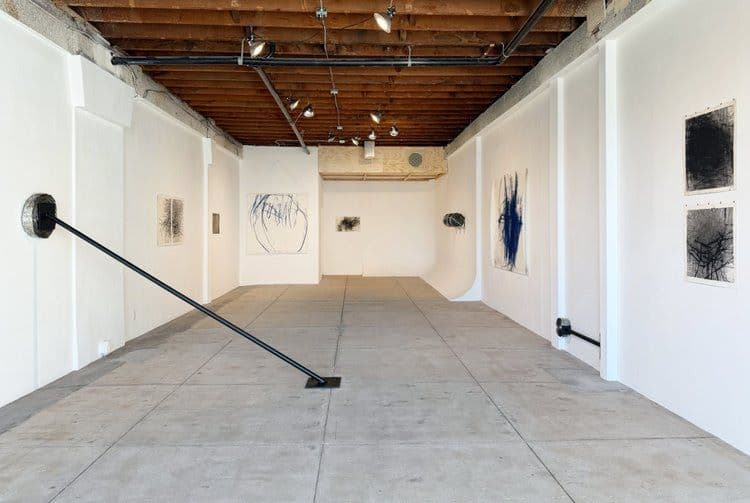
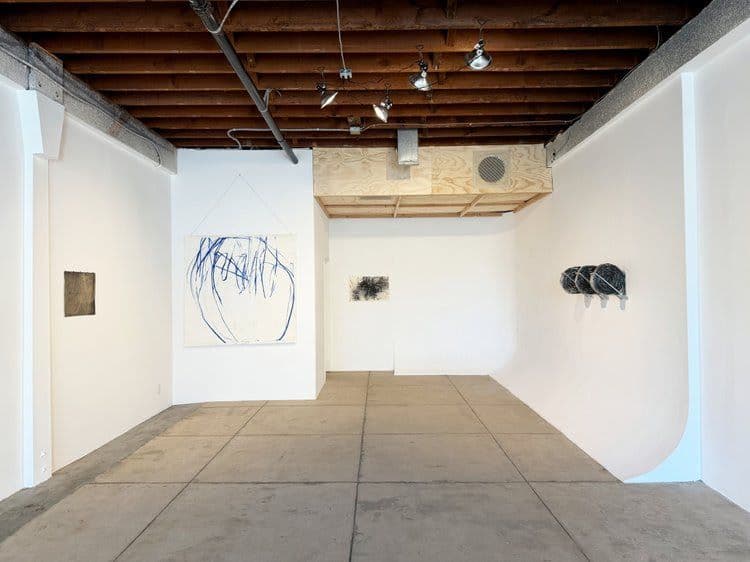
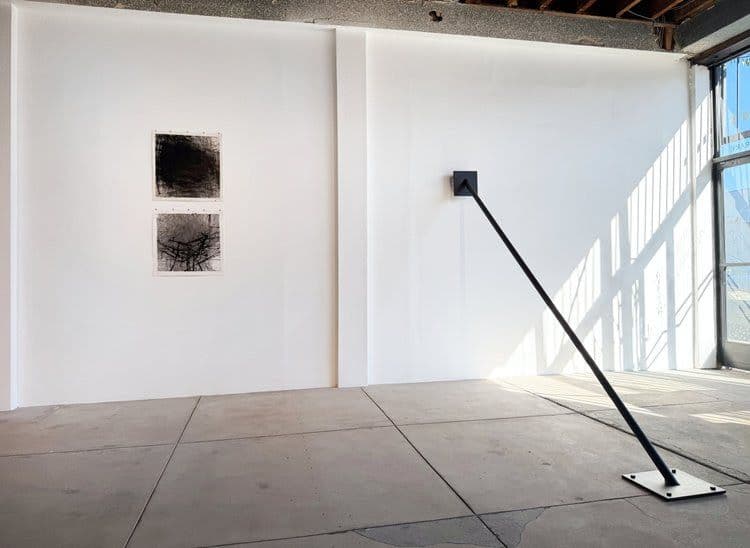
Hollywood, Los Angeles
Lindsey Harald-Wong & Solomon Rousseau
Carom Carom
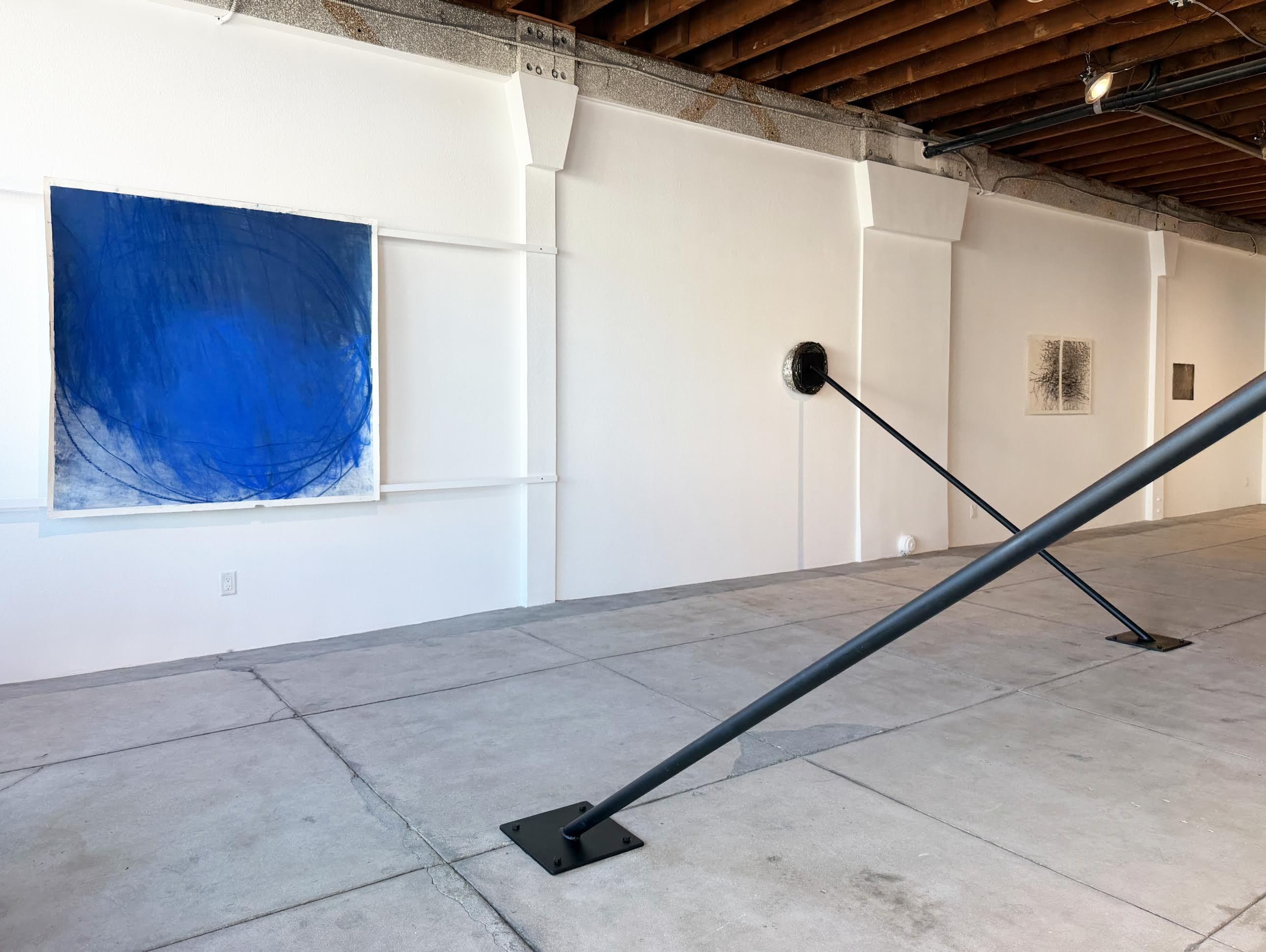
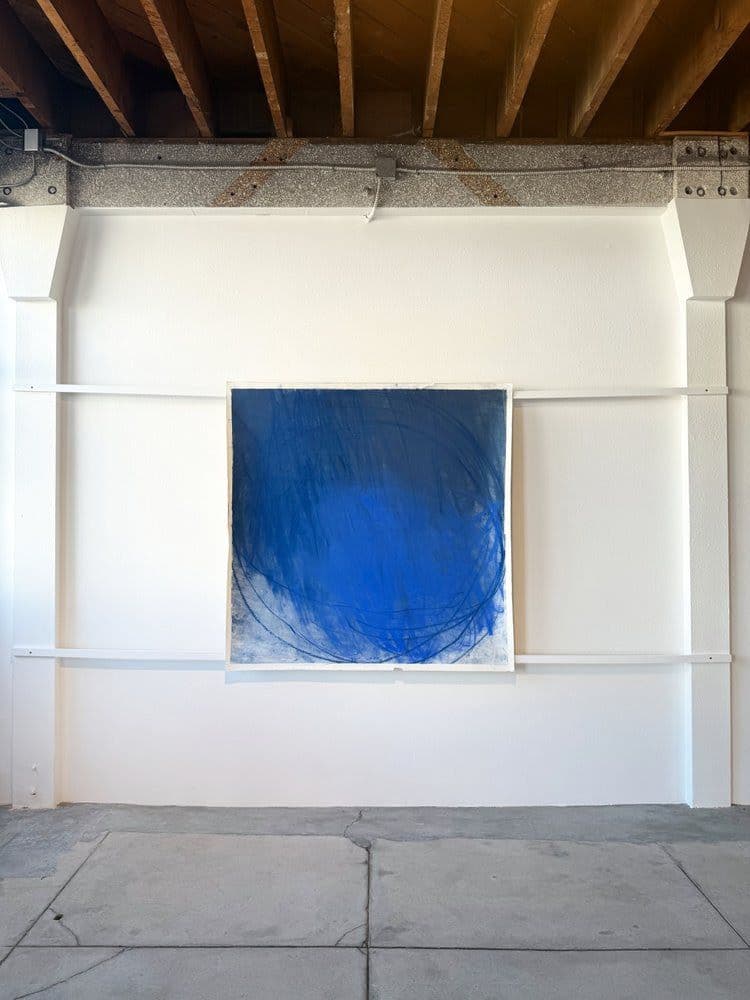
Reisig and Taylor ContemporaryHigh Noon, low Once again they all gather to see the pleasure reflected in their faces. They line the avenue at High Noon, low so nobody has the shady excuse of their lamination. The sunlight is falling straight down, pinning things to themselves. No stretching or pointing, only spindled compressions avoiding any edges. So they’re all holding their breath, with shrill gasps breaking their grip once they make a complete revolution. All ventral, they keep turning in place without changing position. Or they’re changing positions without turning a different direction. (They’re disoriented but moving in a straight circle.) They line the street in order but nobody is ever facing the same way. It’s hard to tell if they’re all wearing the same clothes or if it’s too bright to tell. Their paths form parallel lines on either side of the street but each side says a spiral: North, Northeast, East, Southeast, South, Southwest, West, Northwest, Up, Down , North, Northeast, East, Southeast, South, Southwest, West, Northwest, Up, Down, and all that’s silage to feed the sill with spilling over: Mud, Salt Crystals, Rocks, Water. 10 directions, none of them hardly helter. All reversing the noon. And none in their silos, just rounded-up barely like they wind-up out West. Prodded like a Western. Like Sun, spur right-side down ruminants carom carom drunk on any number of grasses while scratching themselves out to pasture with a howl gaped like the lunar symmetry reflected in their faces, the pleasure reflected in turning away, defected by how their phases are remarked (in front of everyone): Mud, Salt Crystals, Rocks, Water. Hoof ungulating approximations of day, accumulations of night with tumbleweeds counting rags caught with chloroform—the backdraft that feeds the lapping hum of woof on bone not making where the waters start panting with the dorsal sound of something gathering below the surface above the parasol or pinwheel Like sun, stream , a punctured glare with upside-down iridescence— a plain in flames , dripping sideways , South, Southwest, West, Northwest, Up, Down, North, Northeast, East, Southeast, …. ad hoc (“For this”) For now, for this, form does not appear as image, organization, or autonomous unit. This (on the page, in the room) appears as a surplus lack—a hole with the pile that drives its absencing still in place, but is also exactly a hole. Squandered. A lag in the difference of a place from itself: an (un)alignment, a measure, a pressure or pleasure held in place. A ricochet or rebound (or anything that happens at least twice). A surface where force has passed and left itself behind, fed by the backdraft of a movement. A void or a boundary that holds, redirects, or exhausts movement. Not forms, but reæls where pressure, accumulation, interval, and limit remain active and incomplete. Nothing resolves. Nothing lands outside itself without existing, exiting. Without sliding or slipping or spilling. Ensiling. Heaping. Without becoming effervescent. Without disappearing. Nothing asks to be read. (“I’m writing.”) No lifeform asks to live. No (school of) things. No abstraction of anything. Nothing organizes relations as participation, exchange, or social performance. (“I’m reading.”) Bodies that find their way in are just not out: not contributors but variables—more holes, less air. Disturbances in light, shifts in balance, durations encountered as proximities. Silos with all the signage fallen off, all the silage sent away. (But I can see stains of where it was so I replace my reading with what’s written by the fainting edges.) Everything curves along the perspendicace[1] where I observe the lack at my end or I’m eavesdropping on these edges so I can fill them with letters, for later on. The scrape of their yawn is enough geometry for an origin. Non-linear but enough lining to get us there. For now, for this, circularly, this orientation recurs at its edges: lengthwise but coiled: for standing, sitting, inverted; for east and west; for zenith and nadir; for spurned meridians that claim to fix position while drifting under the pressure of any encounter. These are not metaphors. Too much inertia. Not fires replaced by smoke signals painted orange. They are surgical operations. Repairs against the starved limits of an infinity, of somewhere plucked from the center of any field of vision. Horizons that repair against falling—there are too many signs of flight! So all the vertigo is pinned to thin air. That’s why they’re formal operations: space is divided, bodies are aligned—like I reproduce distance between days as proxy for the sun, fabrications of a moon. Figures of speech that are only letters. Or, an elapsing that gives way to lost time, but more of it. Measures that allow one thing to stand in for another, to substitute something for itself.[2] But wait: This is not a return of the real[3] as purity, autonomy, or transcendence. It is a refusal of form as dogma. A negation of any distance that absolves itself from being as far away as it is nearby. An injection of external systems. (Even footnotes and citations are ways of going further in, or nearer out.) For this, the exhibition turns on a return to the reæl: of form, of material, of labor, of the work of art. More precisely, it turns on the ad hoc forces, frictions, symptoms, holes, and structures that take-place through the reæl of an artwork (and the gallery): of any lifeform that (re)turns to another or any structure that remains open. But this is not an autonomous or secret real even though it tends to stay hidden—like a planetary orbit or a bouncing ball it is an automatic reæl that renders right-in-front-of-you its mysteriously (but obviously) knotted relations with physics, desire, fantasy, economy, logic, body, poetry; symbols and images. Constellations and common grounds. Caroming caroming between flickerings and forevers, the exhibition simultaneously slows-down and speeds- up everyday, readymade encounters with (art) objects and surfaces to the point where the shared delirium that keeps everything ‘in place’—so we forget enough of ‘what’s happening’ in order to function (regularly)—is set into motion and we can see all the forms of distance elided by a civilization’s insistence on good luck and bad timing. On restoring things to what they already are, rather than viewing forms as what always withhold completion. This makes us sick until we rip-off the covers (…and we didn’t even know we were already lying in bed, half-asleep.) Now we can really see what’s between the sheets. No insides or outsides, no dorsals or ventrals, no facts or essences. No lies: only the constructed forces of a falling-into-place while being built-up. But remember: although this stream-of-consciousness resists any ‘stepping outside,’ the exhibition does not attempt to follow something like the assertion that interpretation replaces experience or substitutes for an artwork.[4] The exhibition is ‘going’ nowhere. (Remember: there are no insides or outsides, for now.) Instead, the exhibition is more concerned with how the physicality (as well as the psyche) of any encounter with an artwork (interpretative or otherwise), doubles, iterates, perforates, re-populates (colonizes), dis/figures that instance ‘for good.’ This exhibition is the formation of a problem preliminary to any possible encounter (with a work of art), not a an assertion ‘about it.’ This problem (of negation) is a question of what happens when ‘I’ eclipse an artwork as soon as I approach it, and the artwork eclipses ‘me’ as soon as I turn away. That lapse (or alignment) is a revelation—an unconcealment ( aletheia )—even though something remains concealed, momentarily. Something is blocked, but this block is exactly what shows the hovering, elliptical relations of one to the other: that, for a moment, the relation or movement is what appears in the place object. (Because something causes something else to happen, as long as we are looking.) So how do we live inside that instance without running for the exit or pointing to the entrance? (Or just standing there like an idiot, that’s bound to happen anyway….) How do the works function, operate, speak, write, read, exist, and encode without referring to somewhere outside themselves—without depending on a ‘meta-language’ or a ‘language from above (or below) to carry their actions, timing, and space? Or, how does an artwork incorporate the meta and the extrinsic into itself and make these collateral realities real by making them work intrinsically: ‘for this’ (ad hoc), here and now—without reference? (There is a hole in the work of art.) With turns, in tongues, the exhibition is asking: when does an artwork speak its own language through others without becoming interpreted away or fully absorbed by a subject, system, or ideology? (Without mistaking the stars for their constellations, or a tire for a wheel.) How does a work of art keep the interval of its chance encounter in motion and under pressure—constantly changing phase and position—without completely falling away, disappearing from view or rejecting legibility? (And what is the scale of this encounter? Planetary? Particle? Person? All at once? [Yes.]) How can readymade materials show themselves as unreadymade, or alreadymade (again)? Where are a the shifts between making, not-making, and not-not making? How is timing timed? How much can something tear without being ripped apart? I’ll say: this is for this. Ad hoc. This is not a discourse, this is for turning away from the semblant,[5] the gild of a lily. [“there is no sexual relation” -> “there is no formal relation” -> “there is no aesthetic relation” -> “there is (no) relation relation”] …. Ticking time bomb (603) Once again we’ve skipped town and landed in alien territory. A new land called “Melrose Hill” where Koreatown suddenly disappears into thin air and we find ourselves surrounded by galleries gathered like grapes on the vine, ready to be wine or raisins—or ready to be eaten-up right away, maybe even swallowed whole. Like a hollow sun, Zwirner’s bleached-bone exterior reflects a vast, empty gleam from across the street. Or maybe it’s more like that fake lunar surface they say NASA used to stage the moon landing. (And some say, on certain nights where the moon is particularly bright, we don’t even need to use our own lights: we can just soak-up all the rays staring into our gallery from across the street.) Either way, it feels good to be surrounded, to find ourselves populated as much as we are populating. There’s more silage out here, deeper reserves. And more action. Next to us (on the same side of the street): Ochi, Wilding Cran, Morán Morán. Nearby or across the street (‘walking distance’): James Fuentes, David Zwirner, Charlotte Call, Château Shatto, The Brick. It’s pretty packed out here. (Which is good.) Packed enough that I’m probably forgetting to mention other galleries around there. And, like us, galleries keep moving here. But why? Well, it’s simple really: rarely in Los Angeles do I see people actually walking around like it’s a real city with real sidewalks, real places to go, real things to do—even if its found in a place with a fake name like Melrose Hill. It’s a fake name, but a real place. With all the foibles and quirks of Los Angeles packed within walking distance. Somehow, that’s an extraordinary treasure here—so we’ll treasure it. And, evidently, people go where people already are, so there’s a kind of gravity to this place that’s unavoidable when otherwise confronted with the scattered space of Los Angeles. Anyway, enough beating about the bush: We’re on Western, way-out West (well, North—and central—actually). It’s the Wild Wild West out here and like that phrase everything on this damn road repeats. Everything says “Furniture” more than once like I can’t keep track of what I’m seeing without saying it twice. Maybe I can’t (or maybe I’m just being incorrigible because of our proximity to Morán Morán). Maybe I’m searching for too much meaning in these signs. But maybe not: just look at all the asinine little market-machines telling us to call them “coco” (très jolie) while they move back-and-forth from that autonomous eatery, strutting their unimpressive stuff against the tides of door-dashers and uber-eatsers that fill-up the fire zones to ensure that we are as likely to die as they are. Meanwhile, there’s a guy built like clock riding a bike that yelps at the same spot as he passes-by everyday. But we like him, at least he’s on point. Like a ticking time bomb. Lindsey Harald-Wong (born in Denver, Colorado) is an artist based in Malaysia. She is a former faculty member at Pratt Institute and Parsons School of Design, where she taught drawing. Harald-Wong earned an M.F.A. in Painting and Drawing from Brooklyn College and also studied at the New York Studio School of Painting and Drawing. Her early work is initially rooted in perception, drawing directly from light and space while operating at the threshold between vision and abstraction. These works frequently engaged still-life motifs—such as flowers—using observation as a means of probing the limits of visibility and form. Beginning in the early 2000s, Harald-Wong’s practice shifted toward a more direct engagement with the surface itself. Works such as Small Cosmos (2005) and the queen bee (2005), respectively included in exhibitions with Reisig and Taylor Contemporary (Los Angeles) in 2024 and 2026, mark a transitional moment in which perceptual inquiry gives way to a generative, process-driven approach. Here, mark-making becomes autonomous while remaining grounded in the sheer materiality of the work, unfolding at its own pace and according to its own intrinsic logic. Living in Malaysia, Harald-Wong operates largely ‘outside’ the dominant economic and social circuits of Western contemporary art. Within this relative isolation, she has cultivated a practice shaped by deep time and mysterious forms of her environment. Evolving patiently, but immediately, through sustained attention and repetition, her work develops a cryptic yet immediate visual language composed of frenetic marks and webbed movements, slowly transformed through years of disciplined, meditative making on her own terms. Solomon Rousseau is a Jamaican-American artist based in Los Angeles. Working across painting, sculpture, installation, and photography, his practice takes-place through repetition, reduction, and physical processes yielding interstitial and iterative entities. At once primitively elemental and rigorously formal, his works fall from latent material and conceptual residues of Minimalism, Post-Minimalism, Mono-ha, Arte Povera, Post-Conceptualism, and Land Art. But his practice also overruns these historical categories/contexts as his works inhabit deep, terrestrial or planetary time along humming tensions between control and impermanence, precision and decay. And, to some extent, his works overrun the context of Art itself by returning to the primordial place between being and becoming (something else): the event horizon of objects, subjects, and things. His work unfolds as a sustained meditation: a laborious rhythm of destruction and creation that seeks balance between chaos and order, instinct and structure. Rousseau’s process is both alchemical and materialist, joining chance, ambiguity, and indistinction to measured construction through the use of utilitarian industrial materials—raw and refined, organic and synthetic. Materials are not employed to depict (displace or represent) but to disclose and unconceal: elliptically eclipsed surfaces, densities, and resistances become records of touch, gravity, and time. Though the artist’s hand remains legible, it is deliberately restrained, echoing natural accidents and overlooked phenomena. This often-invisible labor, understood as an existential condition, blurs the boundary between (not-)making and (not-)being. The resulting works exist in suspension between presence and absence, matter and thought. They are not representations but encounters, sustaining a pause within the interval between seeing and feeling, where silence, space, and process emerge as the true medium and primordial material. Rousseau’s consciously attuned practice has developed along an unconventional path, shaped by autodidactic research and residencies in Sweden, Indonesia, Mexico, Japan, and France rather than formal institutional training. Following his first solo exhibition in 2020 at the Bendix Building in Los Angeles, he was stranded abroad during the pandemic and spent two years living in solitude in the Colombian Andes—an experience that further deepened the introspective and material rigor of his work. Since returning to Los Angeles, he has exhibited at Giovanni’s Room (Los Angeles, 2024), Redacted Art Fair (Los Angeles, 2025), and Silke Lindner (New York, 2025). The 2026 exhibition at Reisig and Taylor Contemporary (Los Angeles) is his first dual exhibition. Ahead and already: Rousseau continues to develop new sculptural series and site-responsive installations, marking the next phase of an evolving practice grounded in material attention, temporal awareness, and the resonance of form as living experience. 1 - In Le surnaturel et les dieux d’après les maladies mentales (1946), George Dumas catalogues patients’ coinages; “perspendicace” is noted as a schizophrenic portmanteau blending perpendiculaire and perspicace to name “very perspicacious spirits” standing perpendicularly above the subject’s head. See also: Marcel Duchamp, The Green Box, trans. George Heard Hamilton (New York: Wittenborn, Schultz, 1934). 2 - carom carom names a relation that does not resolve after a single encounter. (It’s not a title but a name that performs the relations acted-out by the exhibition.) The repetition does not intensify or explain the term; it subjects it to itself. A carom is a deflection produced by contact and constraint. And this doubled rebound either suggests a proximity to a hole or void, to falling (like the pool-ball into the pocket)—or it suggests a recurring ricochet between limits or boundaries. All the gravity of inertia set into motion. The exhibition works-through this recursive structure as both method and orientation. 3 - Unlike (shallow) Hal Foster’s identification with ‘the return of the real’ with off-site traumas and events that resist representation, I am insisting on a return to the reæl of the work itself, of a body itself, here and now. Foster’s use of this phrasing—“the return of the real”—rests on a misreading of Jacque Lacan’s concept of the same name. While “the return of the real” is excluded from symbolization and barred from representation. For Foster, its not that representation is actually barred, it’s that the representation occurs off-scene: his post-war analysis refers to literal historical events that are visible and represented (so whether or not they are traumatic or personally inaccessible to someone should not shift the status of the real of the work.) The real is more structurally deep than an event or a collection of traumas. He has mistaken the place of the real with the primitive scene (the Freudian moment of hearing Mama and Papa’s primal sounds through the bedroom door). Hal Foster, The Return of the Real: The Avant-Garde at the End of the Century (Cambridge, MA: MIT Press, 1996). 4 - Susan Sontag, “Against Interpretation,” in Against Interpretation and Other Essays (New York: Farrar, Straus & Giroux, 1966), 3–14. 5 - Jacques Lacan, Le Séminaire, livre XVIII: D’un discours qui ne serait pas du semblant (Paris: Seuil, 2007), seminar of 1971. [This is where Lacan first states his famous phrase “there is no sexual relation” at the start of his formulation of his ‘theory of sexuation.’]