

Belleville, Paris
Nicolas Boulard
Monde Actuel
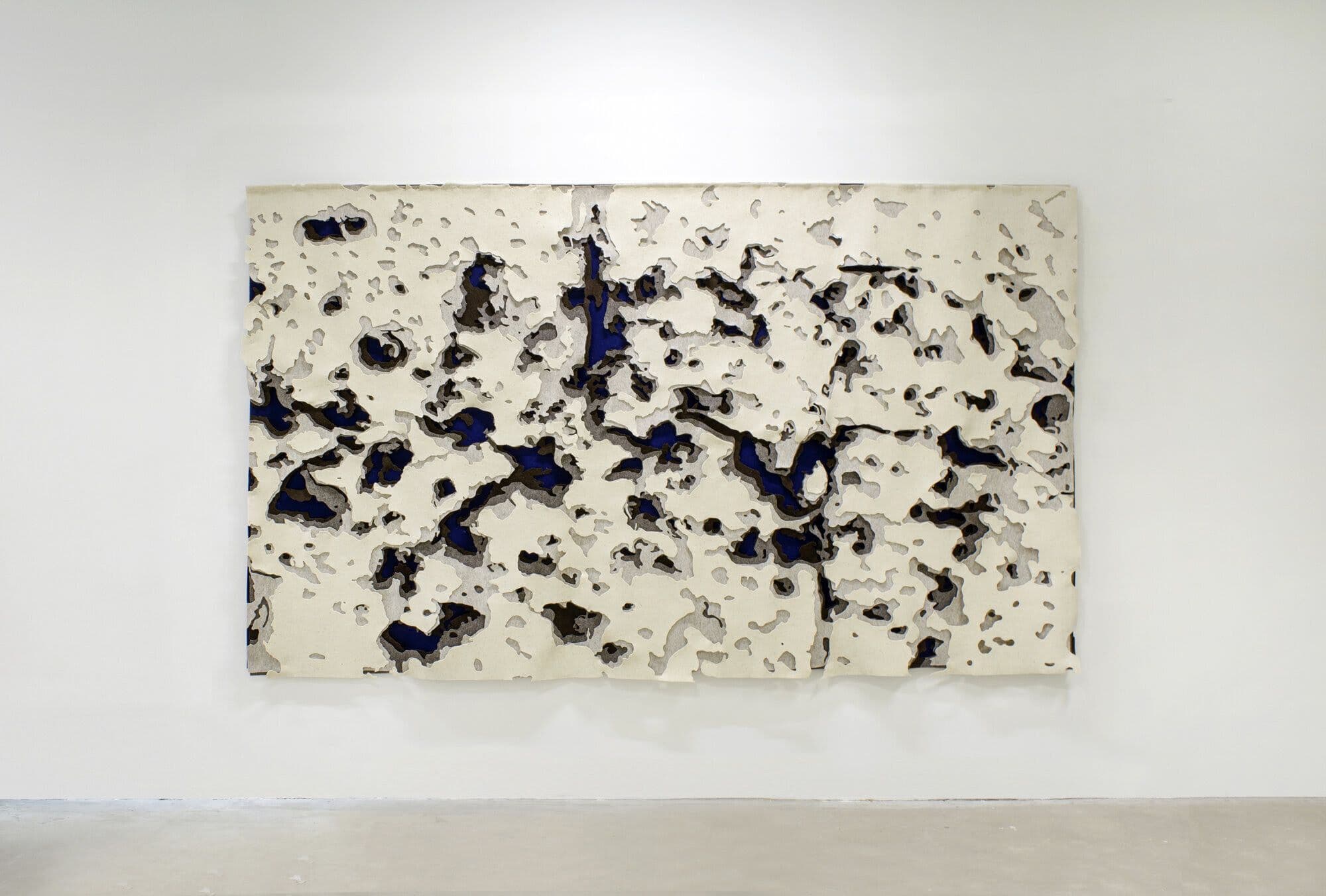
,48 m²[Scroll down for French version / Veuillez trouver ci-dessous la version française] The Monde Actuel (Actual World) is a paradox. The world, as a physical space, is actual. It is time passing. The sentence is ambiguous. Which world are we talking about? Actual in what context? What are the parameters of the world’s actuality? The world that is being made, that is happening. The world, being made, is no longer actual. Its actuality disappeared the moment it was evoked. We’d have to freeze the world, or rather a fragment of it, a portion, freeze in its actuality, to keep a trace, an instant, a moment. But which world? And what moment? The actual world is that which takes place in the here and now. Without interface, without vector. What’s happening. The actual world is made up of space and time, two inseparable entities according to Albert Einstein who, to support his theory of relativity, took as his model a whole loaf of bread cut into slices: the loaf is space, the slice is time. The slice is a fragment of the present, a portion of time. And this instant is itself composed of a superposition of times. The slicing is infinite. Actual world is an ongoing process, a space that contains others. An organic mechanism that never stops. Materials that come alive, expand, dilate and contract, and elements that mix and cohabit to produce new forms. Organisms work their way through matter, parasitizing it to modify its structure, to create a new context, a new situation, a new process that leads to yet another. Here, we observe these movements, these recognizable forms, these identifiable fragments, in the unstable structures that make up the actual world. Ambiguity is recurrent in the artworks exhibited. It’s a play on the obvious, and on the forms used. We find here particular assemblages between art-historical references and organic materials produced by fermentation. The Monde Actuel exhibition brings together recent and never shown works. Here, forms are fleeting and changing. In the gallery space, a bust model displays a leather jacket with the exhibition title: Monde Actuel, the perfect anagram for Claude Monet. Born in 1976 in Reims, Nicolas Boulard studied at the École supérieure des Arts Décoratifs in Strasbourg, where he graduated in arts in 2002. He then joined the Collège Invisible, networked post-graduate studies at the École des Beaux- Arts in Marseille. His artistic work has been shown in several solo exhibitions in France (Frac Champagne-Ardenne, Frac Alsace, Frac Aquitaine, the art center la Halle des bouchers) and abroad (Moma in San Francisco, Machine Project in Los Angeles, S-air in Japan). He lives in Clamart near Paris. During the past twenty years, Nicolas Boulard has been building an artistic work at the crossroads of knowledges and practices that usually have no relation to each other. For him, art comes from blending, like most wines. The field of gastronomy and viticulture are thus the starting point for an investigation of the modalities of creation. Nicolas Boulard questions art in terms of his indepth knowledge of wine-making processes. And reciprocally, he shakes up the rules of viticulture by handing him the mirror of art. All of his work heterogeneously mixes artistic vocabulary and grammar with borrowings from other fields. It is an interdisciplinary and « undisciplined » work. In the work of Nicolas Boulard, citations are frequent, in particular from the minimal art of the 70s. The works entitled Specific Cheeses studies the subject of forms starting from relationships highlighted with impertinence between cheese and minimal art. Putting artistic and gastronomic production on the same level, he questions the nature and origin of the form and the scale of the values attached to it. In a landscape of artistic creation where artists have challenged traditional categories, Nicolas Boulard positions himself with an apparent lightness even more on the fringes of recognized practices, from a formal and conceptual point of view. He questions art as language. But beyond that, it questions our relationship to societal issues such as territory and sustainability. His work is unseemly but necessary heterogeneity, an encouragement to disobedience, against blind conformism. Nicolas Boulard creates sculptures and installations by bringing references from minimalist art and conceptual art together with organic materials mostly coming from food production. His artworks wittily disrupt the aseptic aesthetics of the American minimalism, inspired by the structured shapes of cheese, wine or bread. The appropriation of materials from the fermentation is characteristic of his work and produces a unique and uncommon work: the fermentation is the transition from one state to another, in which the effect of microorganisms such as yeasts irreversibly alters the original nature of a material. This transformation process is as much a source of inspiration as a working method. Through wood and felt cutting, prints on large format paper, plaster or bronze casts, his artworks re ect an ongoing process. Based on elements collected in his daily environment and in history of art, his works take on an indeterminate appearance, as if caught up in an intermediate state. The geometric aesthetics disrupted by the use of living matter reminds us that art is a practice about transition. With the use of natural materials such as felt or wood, his works convey powerful concepts and give us a special experience. His art practice puts the viewer in an ambiguous situation with the work: whether facing the decorative extravagance of a tapestry made from the image of penicillium diffusing into a slice of Roquefort blue cheese (Penicillium #1 and #2) or the strange arrangement of the holes in the crumb of oversized bread slices and carefully cut in poplar wood boards (Pain #1 and #2). Such assemblies are akin to the Grotesques which, at different times of history of art, have intrigued by highlighting a taste of hybridization, metamorphosis, and caricature. ***** Le Monde Actuel est un paradoxe. Le monde, en tant qu’espace physique, est actuel. Il est du temps qui passe. La phrase est ambiguë. De quel monde parle-t’on ? Actuel de quel contexte ? Quels sont les paramètres d’actualité du monde ? Le monde qui se fait, qui se passe. Le monde, se faisant, n’est donc plus actuel. Son actualité a disparu dès l’instant où elle a été évoquée. Il faudrait alors figer le monde, ou plutôt un fragment de monde, une portion, le figer dans son actualité, pour en garder une trace, un instant, un moment. Et de quel monde ? Et de quel instant ? Le monde actuel est ce qui a lieu dans l’ici et le maintenant. Sans interface, sans vecteur. Ce qui se passe. Le monde actuel est composé d’espace et de temps, deux entités indissociables selon Albert Einstein qui, pour appuyer sa théorie de la relativité, prenait comme modèle un pain entier que l’on découpe en tranches : le pain, c’est l’espace, la découpe, c’est le temps. La tranche est un fragment d’actuel, une portion de temps. Et cet instant est lui-même composé d’une super- position de temps. Le découpage est infini. Le monde actuel est un processus en cours, un espace qui en contient d’autres. Une mécanique organique qui ne s’arrête pas. Des matières qui s’animent, se gonflent, se dilatent, se contractent, et des éléments qui se mêlent et cohabitent pour produire de nouvelles formes. Les organismes se fraient un chemin dans la matière, ils la parasitent pour en modifier la structure, pour créer un nouveau contexte, une nouvelle situation, un nouveau processus qui en amène un autre, encore. On observe ici ces mouvements, ces formes reconnaissables, ces fragments identifiables, dans les structures instables qui composent le monde actuel. L’ambiguïté est récurrente dans les œuvres exposées. Il s’agit d’un jeu avec les évidences, celle des formes convoquées. On retrouve ici des assemblages particuliers entre des références de l’histoire de l’art et des matières organiques issues de fermentation. L’exposition Monde Actuel fait une synthèse d’œuvres récentes ou méconnues. Ici, les formes sont passagères et changeantes. Dans l’espace de la galerie, un mannequin présente un blouson en cuir clouté avec le titre de l’exposition : Monde Actuel, anagramme parfaite de Claude Monet. Nicolas Boulard, né en 1976 à Reims, a fait ses études à l’école supérieure des arts décoratifs de Strasbourg d’où il sort diplômé en art et en communication graphique en 2002. Il rejoint ensuite le Collège Invisible, post-diplôme en réseau de l’école des Beaux-Arts de Marseille. Son travail artistique a été présenté dans plusieurs expositions personnelles en France (Frac Champagne-Ardenne, Frac Alsace, Frac Aquitaine, centre d’art la Halle des bouchers, centre d’art contemporain de Châteauvert, Château de Montsoreau - Musée d’art contemporain) et à l’étranger (Moma de San Francisco, Machine Project à Los Angeles, S-air au Japon). Depuis près de 20 ans, cet artiste développe une pratique protéiforme et singulière. Doté d’une parfaite connaissance des règlementations du monde du vin, c’est en authentique spécialiste que l’artiste a transgressé les normes traditionnelles de production en plantant un vignoble dans une remorque (Clos Mobile 2009), en produisant un millésime fantôme du célèbre grand cru de la Romanée Conti (DRC 1946, 2007) ou en récoltant du raisin dans les supermarchés de Reims pour produire un Grand vin de Reims en 2006. Par ces gestes iconoclastes, l’intention est de produire de nouvelles formes. Depuis 2010, il travaille sur un projet intitulé Specific Cheeses, une étude sur la similitude des formes du Minimal Art et des fromages. Cette recherche artistique s’est développée sous la forme de performances avec la confrérie Specific Cheeses, de conférences (Cheese Theory et Cheese Analyse) et d’éditions avec les fanzines Specific Cheeses qui compilent dans 12 numéros une anthologie de la représentation du fromage dans les arts du Moyen-âge à nos jours. Que ce soit dans ces projets sur le vin, le fromage ou le pain, c’est en pleine conscience des enjeux environnementaux actuels que l’artiste a coopéré avec des personnalités engagées dans des pratiques naturelles et respectueuses des écosystèmes. Nicolas Boulard réalise des sculptures et des installations en assemblant des références du Minimal art et de l’art conceptuel avec des matériaux organiques issus, pour la plupart, de productions alimentaires. Ses œuvres perturbent l’esthétique aseptisée du minimalisme américain en s’inspirant des formes organiques du fromage, du vin ou du pain. Son travail se caractérise par l’appropriation de matières issues de fermentation pour produire une œuvre atypique et unique : la fermentation est le passage d’un état à un autre où l’action de micro-organismes comme des levures modifie irréversiblement la nature originelle d’une matière. Ce processus de transformation est autant une source d’inspiration qu’une méthode de travail. Par des découpes de bois ou de feutre, des impressions sur papier en grand format, des moulages en plâtre ou en bronze, ses œuvres rendent comptent d’un processus en cours. En s’inspirant d’éléments prélevés dans son environnement quotidien et dans l’histoire de l’art, ses œuvres prennent une apparence incertaine, comme prises dans un état intermédiaire. L’esthétique géométrique perturbée par des matières vivantes nous rappelle que l’art est une pratique de la transition. Par l’utilisation de matériaux naturels comme le feutre ou le bois, ses œuvres permettent d’isoler des concepts forts et nous font vivre une expérience particulière. Sa pratique artistique place le spectateur dans une situation ambiguë avec l’œuvre : que ce soit face à l’extravagence ornementale d’une tapisserie réalisée à partir de l’image du penicillium se diffusant dans une tranche de roquefort (la série des tapisseries Penicillium) ou à la disposition des cavités dans des tranches de pain démesurément agrandies et soigneusement découpées dans des planches de bois de peuplier (Pain #1 et #2). Ces assemblages s’apparentent aux grotesques qui, à différentes périodes de l’histoire de l’art, ont intrigué en mettant en avant un goût de l’hybridation, de la métamorphose et du caricatural.