
Tribeca, New York
Tomm El–Saieh & Diego Singh
Flaming Mirror
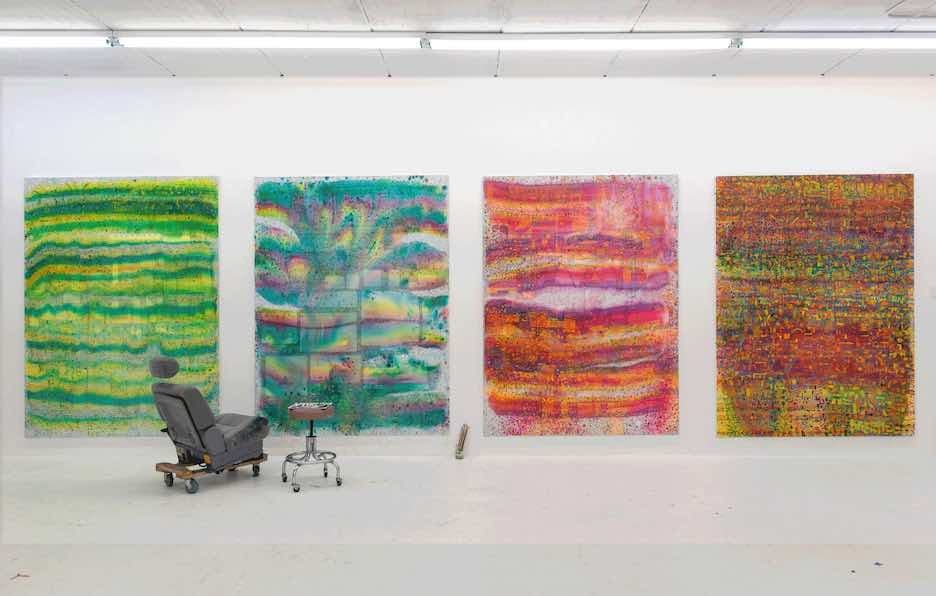
Luhring AugustineLuhring Augustine is delighted to present Flaming Mirror, an exhibition of new works by Tomm El-Saieh and Diego Singh,. A few years ago, seemingly out of nowhere, objects like café chairs and bike saddles suddenly burst into flames in the streets near a London high-rise. It was the “Walkie Talkie” building’s concave, mirrored façade reflecting the sun so intensely, even on cloudy days, that it created extremely powerful rays of heat. Acting like a burning mirror, the building’s surface concentrated light into the more palpable element of fire. The intangible optical started to forcefully affect the tactile environment. The title of Tomm El-Saieh’s and Diego Singh’s two-person exhibition, Flaming Mirror, evokes an image similar to this burning mirror effect. Five paintings by each artist, all developed over the last two years, face each other. The work’s rhythmic and chromatic surfaces appear to bounce off each other, like sounding boards or infinity mirrors exposed to their echoes and resonances, with the viewer located in the space between. While the works are not exact juxtapositions of each other, they certainly convey that the two artists have known each other for almost twenty years, working side by side, including together operating an artist-run gallery in Miami Beach, Central Fine. El-Saieh’s and Singh’s works both explore connections between chromatic and tactile qualities in abstraction, approached, however, from vastly different angles. Accordingly, “flaming mirror” is not just a metaphor for the spatial dynamic apparent in the exhibition, but also reflects the two artist’s physical and metaphorical handling of color within their respective works. Color does not just circumscribe the chromatic, “(it) is the name given to forces that allow us to confront the uneasy task of marking difference,” as artist Amy Sillman writes. Informed by the rich history of Haitian painting, yet bypassing its largely figurative tradition, El-Saieh combines washed-out, watercolor-like planes with dense and rhythmic patterns of dry-rubbed paint. This lattice of marks may appear to viewers like maps or grids, or act like Rorschach tests. The various layers of paint appear to operate at different speeds; the velocity of the poured, cloud-like paint of the background, contrasts with the laborious brushstrokes on the surface, inscriptions that appear meticulously chiseled. On the other hand, Singh’s handling of paint erases its own traces of application. Oil and acrylic paint — poured and brushed in various ways — create obscured layers to the point of becoming impenetrable. Figure and ground meld into one colorful surface, wrapped in meshes of yellow, green, and red. Testing the legacies of modernism and the boundaries of language, Singh’s paintings explore the ways that abstraction and vibrancy relate to representations of queerness. In Singh’s work color appears at times dense and sticky, at others lucid and luminous; lines, fine like hair, run through the paintings, and then –– in a flash –– the silhouette of a figure materializes out of the thicket of marks. Just like light in a burning mirror, color in El-Saieh’s and Singh’s paintings is both a visual and a tactual component. Arguing for color as a “shamelessly plastic element” art historian Lex Morgan Lancaster states: “Chromatic abstraction can […] engage forms of spectatorship beyond the normative, not cohering a figure but producing more haptic encounters.” In bundling, bouncing, and refracting light through various ways of handling color, El-Saieh and Singh open a space of articulation that reaches beyond language. Flaming Mirror communicates not only visually but viscerally through the entire range of senses––touch, smell, sound, and sight––, which might affect its surroundings in wholly unexpected ways, just short of bursting into flames. —Stephanie Seidel, Monica and Blake Grossman Curator, Institute of Contemporary Art, Miami: